NATIONAL WATER SUPPLY
AND SANITATION
PROGRAMME
WATER SUPPLY AND
SANITATION IN INDIA
• Drinking water supply and sanitation facilities are very
important and crucial for achieving the goal of “HEALTH
FOR ALL”.
• According to WHO, “poor sanitation and inadequate
sewage disposal the nation’s biggest public health
problems.”
• Approximately 80-90% of untreated sewage is discharged
directly into rivers and streams, the main source water supply
in cities. Human faeces remains one of the world’s most
dangerous pollutants, spreading microbes that causes typhoid,
cholera, diarrheal illness, amoebic dysentery and other virulent
disease.
HEALTH IMPACT
• The lack of adequate sanitation and safe water has
significant negative health impacts including diarrhea,
chronic diseases, respiratory problems, skin disorders,
allergies, headaches and eye infections.
RESPONSIBILTY FOR WATER
SUPPLY AND SANITATION
• Water supply and sanitation is a state responsibility under
the INDIAN CONSTITUTION.
• State may give the responsibility to the Panchayati Raj
Institutions (PRI) in rural areas.
• In urban areas, responsibility is given to the municipalities,
called Urban Local Bodies (ULB).
POLICY AND REGULATION
• The responsibility for water supply and sanitation at the
central and state level is shared by various ministries. At
the central level three ministries have responsibilities in the
sector.
1) The Ministry Of Drinking Water And Sanitation
2) The Ministry Of Housing And Urban Poverty Alleviation
3) The Ministry Of Urban Development.
NATIONAL WATER SUPPLY AND
SANITATION PROGRAMME
• 1954 - National Water Supply And Sanitation
Programme
• 1972 -ARWSP (Accelerated Rural Water supply
Programme)
• 1981 -International Drinking Water Supply And
Sanitation Programme
• 1991- renamed As Rajiv Gandhi National Drinking
Water Mission
• 2002 - Swajaldhara
• 2008 - National Urban And Sanitation Policy
• 2009 - National Rural Drinking Water Progamme.
• 2014 - Swachh Bharat Mission.
NATIONAL WATER SUPPLY AND
SANITATION PROGRAMME
• It was initiated in 1954.
• Objective :-
To providing safe water supply and adequate drainage
facilities for the entire urban and rural population of the
country.
• Targets :-
a) 100% urban and rural water supply.
b) 50% urban sanitation.
c) 25% rural sanitation.
ARWSP (ACCELERATED RURAL
WATER SUPPLY PROGRAMME)
• In 1972, a special programme known as “ARWSP” was
started as supplement to the national water supply and
sanitation programme.
• The central government supports the efforts of the states in
identifying problem villages through assistance under
ARWSP.
INTERNATIONAL DRINKING
WATER SUPPLY AND SANITATION
PROGRAMME
• It was launched in 1981 by the government of India.
• Targets were set on coverage – 100% coverage for water,
both urban and rural, 80% for urban sanitation and 25% for
rural sanitation.
• A ‘Problem village’ has been defined as one where no
source of safe water is available within a distance of 1.6
km / 15 m deep, or where source has excess salinity
iron, fluorides & other toxic elements, or where water is
exposed to the risk of cholera.
• The stipulated norm of water supply is 40 litres of safe
drinking water per capita per day.
• At least one hand pump/ spot source for every 250
persons.
• Adopt proper environmental practices including disposal
of garbage, refuse and waste water.
• To convert all existing dry latrines into low cost sanitary
latrines.
• The programme was subsequently renamed as the Rajiv
Gandhi National Drinking Water Mission in 1991.
• In 1999-2000, Sector Reform Project was started to
involve the community in planning, implementation and
management of drinking water schemes which was in
2002 scaled up as the Swajaldhara Programme.
SWAJALDHARA
• It was launched in 25th Dec. 2002. It has certain reform
principles which needed to be adhered by the states
governments.
• Aim:-
To provide safe drinking water in rural areas, with full
ownership of the community, building awareness among the
village community on the management of drinking water
projects, including better hygiene practices and encouraging
water conservation practices along with rainwater harvesting.
• Swajaldhara has two components :
i. Swajaldhara 1 (first dhara) : is for gram panchayat or
a group of panchayat (at block / tehsil level).
ii. Swajaldhara 2 (second dhara) : has district as the
project area.
ACTIVITIES
• Plan , implement , operate , maintain and manage all water
supply and sanitation programme.
• Conversation measures :
i. Rain water harvesting
ii. Ground water recharge system
• The programme was revised from 1st April 2009 and
named as National Rural Drinking Water Programme.
• It is now a component of Bharat Nirman which fouses
on the creation of rural infrastructure
Bharat Nirman
• Launched by Government of India in 2005.
• Programme to build rural infrastructure.
• Phased manner
• Phase I 2008 -2009
Priority - cover water quality problem and other
contaminants, e .g. , arsenic and fluoride affected
habitations.
• Phase II 2011 -2012
New initiatives in 12th Five Year
Plan
• Rural Water Supply and Sanitation Project for low
income states(raise coverage of piped water supply,
toilet coverage and strengthening of institutions and
systems in rural drinking water and rural sanitation
sectors).
• Enhancement of service levels for rural water supply
from the norm of 40 lpcd to 55 lpcd.
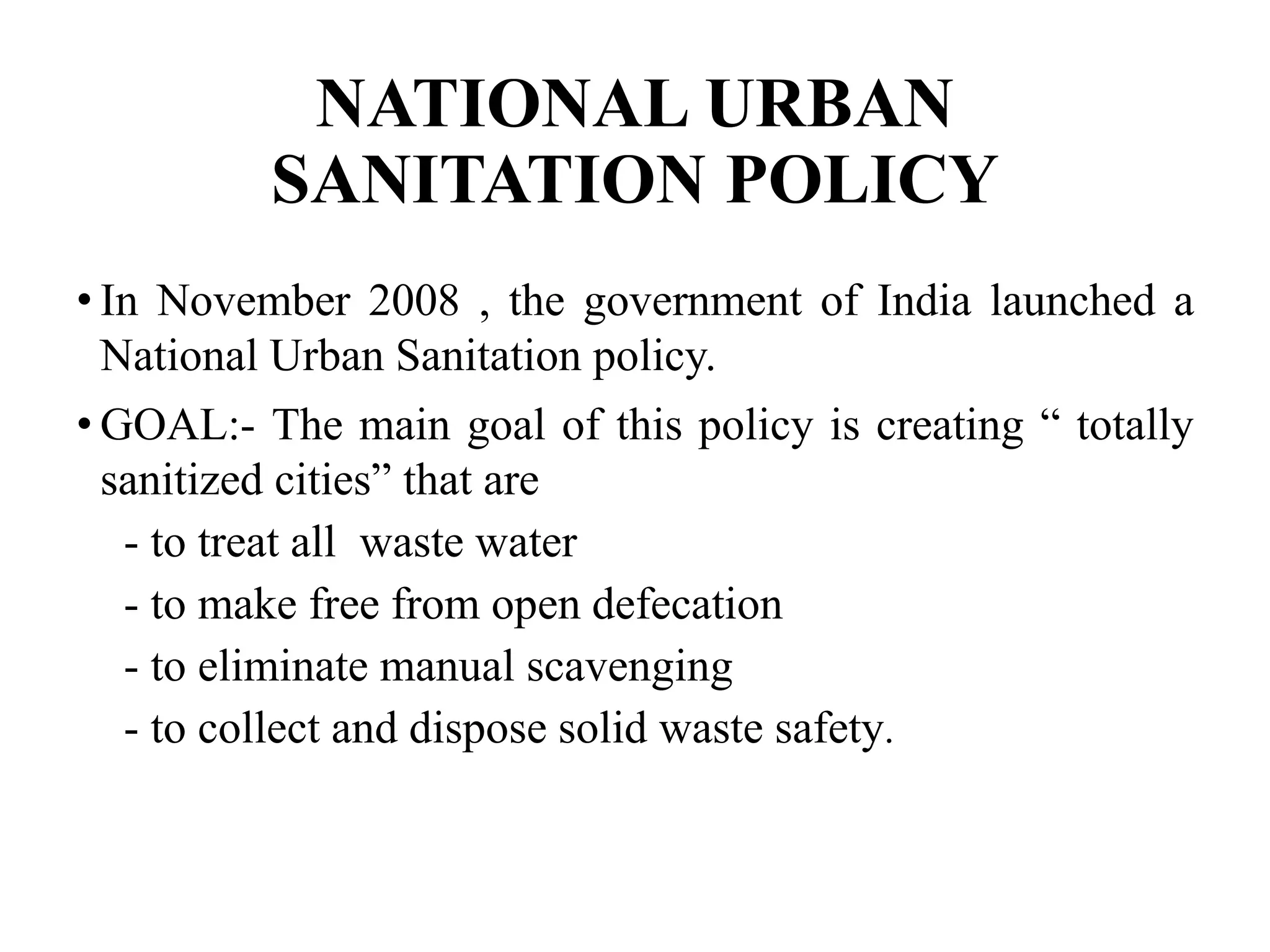
NATIONAL URBAN
SANITATION POLICY
• In November 2008 , the government of India launched a
National Urban Sanitation policy.
• GOAL:- The main goal of this policy is creating “ totally
sanitized cities” that are
- to treat all waste water
- to make free from open defecation
- to eliminate manual scavenging
- to collect and dispose solid waste safety.
Rural Sanitation Programme
• Nirmal Bharat Abhiyan (NBA)
• Launched in 2012
• Objectives
i. to achieve sustainable behavioural change with
provision of
ii. sanitary facilities in entire communities in a phased
manner,
iii. saturation mode with "Nirmal Grams" as outcomes.
Swachh Bharat Abhiyan
Logo
Swachh Bharat Abhiyan
• Launched by Prime Minister of India Shri Narendra
Modi on 2nd Oct, 2014, at Rajghat, New Delhi.
• He also announced 26 Sept – 2 Oct as swachhta week to
sensitize the people living in rural areas.
• This campaign aims to accomplish the vision of Clean
India by 2nd Oct 2019 on 150th birth anniversary of
Mahatma Gandhi.
Aim
• Eradicate open defecation by year 2019, by constructing
12 million toilets in rural India.
• Mission has two sub-mission
i. Swachh Bharat Mission Urban
ii. Swachh Bharat Mission Gramin.
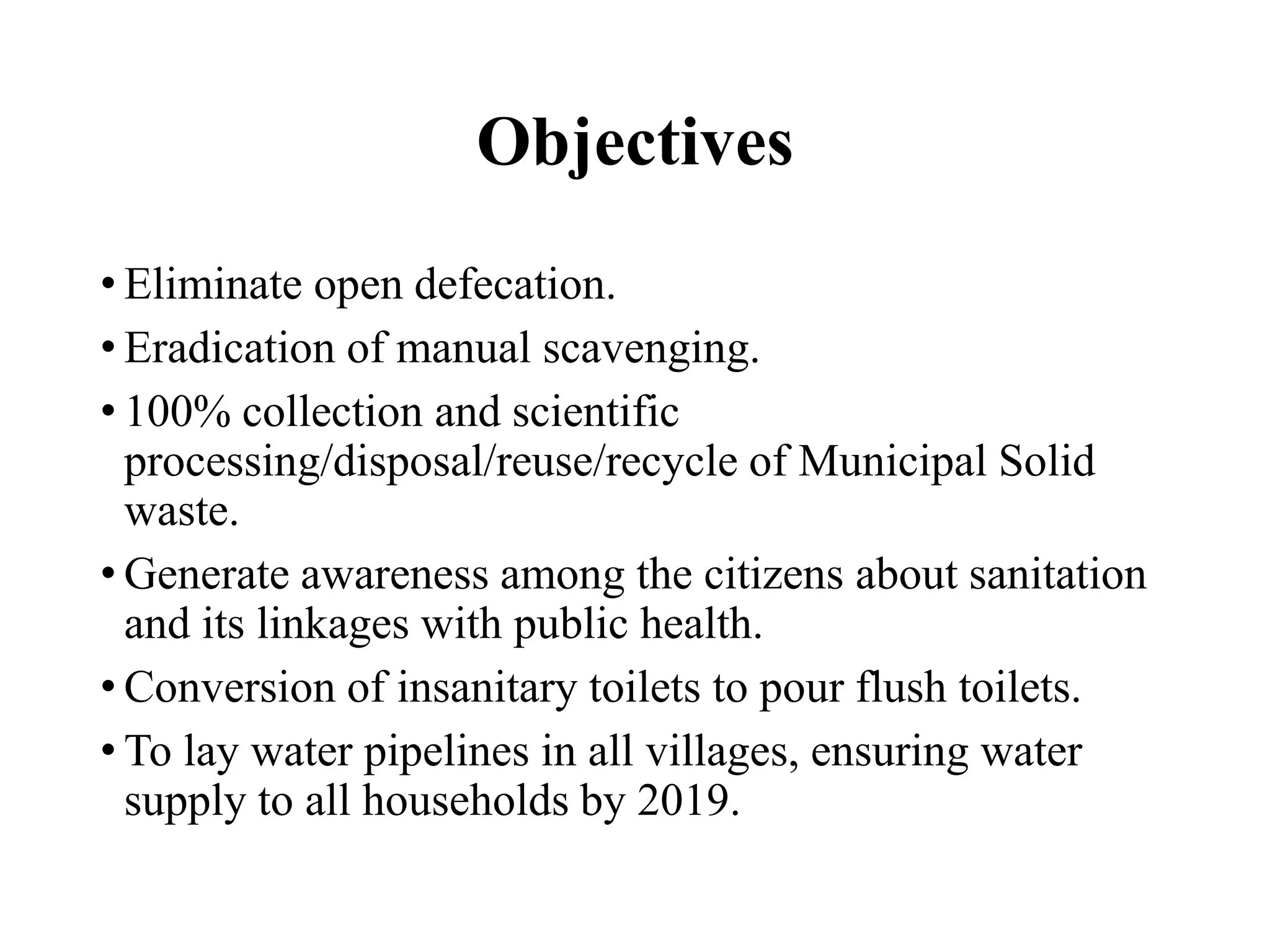
Objectives
• Eliminate open defecation.
• Eradication of manual scavenging.
• 100% collection and scientific
processing/disposal/reuse/recycle of Municipal Solid
waste.
• Generate awareness among the citizens about sanitation
and its linkages with public health.
• Conversion of insanitary toilets to pour flush toilets.
• To lay water pipelines in all villages, ensuring water
supply to all households by 2019.
Component
• Community and Public Toilets.
• Construction of Household Toilets.
• Solid Waste Management.
• Information, Education & Communication(IEC) and
Public Awareness.
• Capacity Building and Administration & Office
Expenses (A & OE).
Strategy
• Planning Phase
• Implementation Phase
• Sustainability Phase
Sub Mission
• Swachh Bharat Mission Urban (SBM-U)
• Swachh Bharat Mission Gramin (SBM-G)
Swachh Bharat Mission Gramin (SBM-G)
• The mission in rural India will mean improving the level
of cleanliness in rural areas through solid and liquid
waste management and making gram panchayats free of
open defecation, clean and sanitized.
• Aim:-
All rural families has access to toilets.
Key Objectives
• Bring about an improvement in the general quality of
life in the rural areas, by promoting cleaning, hygiene
and elimination open defecation.
• Accelerate sanitation coverage in rural areas to achieve
the vision of Swachh Bharat by 2nd Oct 2019.
• Motivate communities and panchayati raj institutions
to adopt sustainable sanitation practices and facilities
through awareness creation and health education.
• Encourage cost effective and appropriate technologies
for ecologically safe and sustainable sanitation.
• Develop wherever required, community managed
sanitation.
Key Components
• Start up activities including preparation of state plan.
• Construction of household toilets.
• Construction of community sanitary complexes.
• Capacity building of functionaries.
Activities
• Construction of toilets in government school sand
anganwadi centres (ministry of human resource
development and ministry of Women & child
development respectively).
• Rural school sanitation focusing on separate toilets for
girls and boys in a major intervention (programme of
Department of School Education.)
Incentives
• Incentives for construction of toilet will be available for
BPL and above BPL restricted to SC/ ST, small and
marginal farmers, landless labourers, physically
handicapped and women headed families.
Swachh Bharat Mission Urban
(SBM-U)
• Implimented by Ministry of Urban Development.
• Objectives :-
• Eliminate open defecation.
• Eradication of manual scavenging.
• Modern and scientific municipal solid waste
management.
• To effect behavioural change regarding healthy
sanitation practices.
• Generate awareness about sanitation and its linkage
with public health.
• Capacity augmentation for ULB.
• To create enabling environment for private sector
participation in Capex and Opex.
Component
• House toilets, including conversion of insanitary
latrines into pour-flush latrines.
• Community toilet
• Public toilets.
• Solid waste management.
• IEC and public awareness.
• Capacity building and administrative and office
expenses.
• Public Toilets - implied that these are to be provided for
the floating population/ general public in places such as
markets, train station, tourist places, near office
complexes, or other public areas where there are
considerable number of people passing by.
• Community Toilets - implied that a shared facility provided
by and for a group of residents or an entire settlement.
Community toilet blocks are used primarily in low-income
and/or informal settlements / slums, where space and/or land
are constraints in providing a household toilet. These are for
a more or less fixed user group.
Special group focused under the
mission
• All manual scavengers in the urban areas.
• All temporary accommodation for migrants and
homeless in urban areas have adequate provision for
toilet.
• Mandating the construction labours in urban areas have
access to temporary toilets at all sites in urban areas,
buildings, parks and roads where construction
maintenance work is taking place or where construction
temporarily housed.
• Priority shall be accorded pro actively to cover
households with vulnerable sections such as pensioners,
girl children, pregnant and lactating mothers.
Household toilet components of
SBM-Urban
• No households engage in the practice of open
defecation.
• No new insanitary toilets are constructed during the
mission period.
• Pit latrines are converted to sanitary latrines.
• The target group for construction of household units of
toilets, thus, is:
i. 80% of urban households engaging in open
defecation;
ii. All house holds with insanitary latrines; and
iii. All households with single-pit latrines.
Solid waste management
component of SBM-Urban
• Municipal solid waste management refers to a
systematic process that comprises of waste segregation
and storage at source, primary collection, secondary
storage, transportation, secondary segregation, resource
recovery, processing, treatment and final disposal of
solid waste.
Namami Gange
Logo
Namami Gange
• Launched in Jun 2014 by The Union Government with
budget outlay of Rs 20,000 crores.
• Ojective:-
Effective abatement of pollution, conservation and
rejuvenation of National River Ganga.
Activities
• Three levels
i. Entry-level activities (for immediate visible
impact).
ii. Medium term activities (to be implemented within
5 years of time frame).
iii. Long-term activities (to be implemented within 10
years).
Entry Level Activities
• Includes river surface cleaning to address the floating solid
wastes; rural sanitation to arrest the pollution (solid & liquid)
entering through rural sewage drains and construction of
toilets; renovation, modernization, & construction of
crematoria that prevents the disposal of un-burnt/partially
burnt bodies in the river; repair, modernization &
construction of ghats to improvise the human-river connect.
Medium Term Activities
• Medium-term activities will focus on arresting the
municipal and industrial pollution entering into the river.
• Municipal Pollution:-
To address the pollution through municipal sewage, 2500
MLD additional treatment capacity is to be created in next 5
years.
• Industrial Pollution:-
Grossly Polluting Industries located along Ganga have been
directed to reduce the effluent quality & volume or implement
zero-liquid discharge.
Long-term Activities
• Providing adequate flow to the river is envisioned
through determination of e-flow, increased water-use
efficiency, and improved efficiency of surface irrigation.
THANK YOU!

National water supply and sanitation programme.pptx

  • 1.
    NATIONAL WATER SUPPLY ANDSANITATION PROGRAMME
  • 2.
    WATER SUPPLY AND SANITATIONIN INDIA • Drinking water supply and sanitation facilities are very important and crucial for achieving the goal of “HEALTH FOR ALL”. • According to WHO, “poor sanitation and inadequate sewage disposal the nation’s biggest public health problems.”
  • 3.
    • Approximately 80-90%of untreated sewage is discharged directly into rivers and streams, the main source water supply in cities. Human faeces remains one of the world’s most dangerous pollutants, spreading microbes that causes typhoid, cholera, diarrheal illness, amoebic dysentery and other virulent disease.
  • 4.
    HEALTH IMPACT • Thelack of adequate sanitation and safe water has significant negative health impacts including diarrhea, chronic diseases, respiratory problems, skin disorders, allergies, headaches and eye infections.
  • 5.
    RESPONSIBILTY FOR WATER SUPPLYAND SANITATION • Water supply and sanitation is a state responsibility under the INDIAN CONSTITUTION. • State may give the responsibility to the Panchayati Raj Institutions (PRI) in rural areas. • In urban areas, responsibility is given to the municipalities, called Urban Local Bodies (ULB).
  • 6.
    POLICY AND REGULATION •The responsibility for water supply and sanitation at the central and state level is shared by various ministries. At the central level three ministries have responsibilities in the sector. 1) The Ministry Of Drinking Water And Sanitation 2) The Ministry Of Housing And Urban Poverty Alleviation 3) The Ministry Of Urban Development.
  • 7.
    NATIONAL WATER SUPPLYAND SANITATION PROGRAMME • 1954 - National Water Supply And Sanitation Programme • 1972 -ARWSP (Accelerated Rural Water supply Programme) • 1981 -International Drinking Water Supply And Sanitation Programme
  • 8.
    • 1991- renamedAs Rajiv Gandhi National Drinking Water Mission • 2002 - Swajaldhara • 2008 - National Urban And Sanitation Policy • 2009 - National Rural Drinking Water Progamme. • 2014 - Swachh Bharat Mission.
  • 9.
    NATIONAL WATER SUPPLYAND SANITATION PROGRAMME • It was initiated in 1954. • Objective :- To providing safe water supply and adequate drainage facilities for the entire urban and rural population of the country.
  • 10.
    • Targets :- a)100% urban and rural water supply. b) 50% urban sanitation. c) 25% rural sanitation.
  • 11.
    ARWSP (ACCELERATED RURAL WATERSUPPLY PROGRAMME) • In 1972, a special programme known as “ARWSP” was started as supplement to the national water supply and sanitation programme. • The central government supports the efforts of the states in identifying problem villages through assistance under ARWSP.
  • 12.
    INTERNATIONAL DRINKING WATER SUPPLYAND SANITATION PROGRAMME • It was launched in 1981 by the government of India. • Targets were set on coverage – 100% coverage for water, both urban and rural, 80% for urban sanitation and 25% for rural sanitation.
  • 13.
    • A ‘Problemvillage’ has been defined as one where no source of safe water is available within a distance of 1.6 km / 15 m deep, or where source has excess salinity iron, fluorides & other toxic elements, or where water is exposed to the risk of cholera. • The stipulated norm of water supply is 40 litres of safe drinking water per capita per day.
  • 14.
    • At leastone hand pump/ spot source for every 250 persons. • Adopt proper environmental practices including disposal of garbage, refuse and waste water. • To convert all existing dry latrines into low cost sanitary latrines.
  • 15.
    • The programmewas subsequently renamed as the Rajiv Gandhi National Drinking Water Mission in 1991. • In 1999-2000, Sector Reform Project was started to involve the community in planning, implementation and management of drinking water schemes which was in 2002 scaled up as the Swajaldhara Programme.
  • 16.
    SWAJALDHARA • It waslaunched in 25th Dec. 2002. It has certain reform principles which needed to be adhered by the states governments. • Aim:- To provide safe drinking water in rural areas, with full ownership of the community, building awareness among the village community on the management of drinking water projects, including better hygiene practices and encouraging water conservation practices along with rainwater harvesting.
  • 17.
    • Swajaldhara hastwo components : i. Swajaldhara 1 (first dhara) : is for gram panchayat or a group of panchayat (at block / tehsil level). ii. Swajaldhara 2 (second dhara) : has district as the project area.
  • 18.
    ACTIVITIES • Plan ,implement , operate , maintain and manage all water supply and sanitation programme. • Conversation measures : i. Rain water harvesting ii. Ground water recharge system
  • 19.
    • The programmewas revised from 1st April 2009 and named as National Rural Drinking Water Programme. • It is now a component of Bharat Nirman which fouses on the creation of rural infrastructure
  • 20.
    Bharat Nirman • Launchedby Government of India in 2005. • Programme to build rural infrastructure. • Phased manner • Phase I 2008 -2009 Priority - cover water quality problem and other contaminants, e .g. , arsenic and fluoride affected habitations. • Phase II 2011 -2012
  • 21.
    New initiatives in12th Five Year Plan • Rural Water Supply and Sanitation Project for low income states(raise coverage of piped water supply, toilet coverage and strengthening of institutions and systems in rural drinking water and rural sanitation sectors). • Enhancement of service levels for rural water supply from the norm of 40 lpcd to 55 lpcd.
  • 22.
    NATIONAL URBAN SANITATION POLICY •In November 2008 , the government of India launched a National Urban Sanitation policy. • GOAL:- The main goal of this policy is creating “ totally sanitized cities” that are - to treat all waste water - to make free from open defecation - to eliminate manual scavenging - to collect and dispose solid waste safety.
  • 23.
    Rural Sanitation Programme •Nirmal Bharat Abhiyan (NBA) • Launched in 2012 • Objectives i. to achieve sustainable behavioural change with provision of ii. sanitary facilities in entire communities in a phased manner, iii. saturation mode with "Nirmal Grams" as outcomes.
  • 24.
  • 25.
    Swachh Bharat Abhiyan •Launched by Prime Minister of India Shri Narendra Modi on 2nd Oct, 2014, at Rajghat, New Delhi. • He also announced 26 Sept – 2 Oct as swachhta week to sensitize the people living in rural areas. • This campaign aims to accomplish the vision of Clean India by 2nd Oct 2019 on 150th birth anniversary of Mahatma Gandhi.
  • 26.
    Aim • Eradicate opendefecation by year 2019, by constructing 12 million toilets in rural India. • Mission has two sub-mission i. Swachh Bharat Mission Urban ii. Swachh Bharat Mission Gramin.
  • 28.
    Objectives • Eliminate opendefecation. • Eradication of manual scavenging. • 100% collection and scientific processing/disposal/reuse/recycle of Municipal Solid waste. • Generate awareness among the citizens about sanitation and its linkages with public health. • Conversion of insanitary toilets to pour flush toilets. • To lay water pipelines in all villages, ensuring water supply to all households by 2019.
  • 29.
    Component • Community andPublic Toilets. • Construction of Household Toilets. • Solid Waste Management. • Information, Education & Communication(IEC) and Public Awareness. • Capacity Building and Administration & Office Expenses (A & OE).
  • 30.
    Strategy • Planning Phase •Implementation Phase • Sustainability Phase
  • 31.
    Sub Mission • SwachhBharat Mission Urban (SBM-U) • Swachh Bharat Mission Gramin (SBM-G)
  • 32.
    Swachh Bharat MissionGramin (SBM-G) • The mission in rural India will mean improving the level of cleanliness in rural areas through solid and liquid waste management and making gram panchayats free of open defecation, clean and sanitized. • Aim:- All rural families has access to toilets.
  • 33.
    Key Objectives • Bringabout an improvement in the general quality of life in the rural areas, by promoting cleaning, hygiene and elimination open defecation. • Accelerate sanitation coverage in rural areas to achieve the vision of Swachh Bharat by 2nd Oct 2019.
  • 34.
    • Motivate communitiesand panchayati raj institutions to adopt sustainable sanitation practices and facilities through awareness creation and health education. • Encourage cost effective and appropriate technologies for ecologically safe and sustainable sanitation. • Develop wherever required, community managed sanitation.
  • 35.
    Key Components • Startup activities including preparation of state plan. • Construction of household toilets. • Construction of community sanitary complexes. • Capacity building of functionaries.
  • 36.
    Activities • Construction oftoilets in government school sand anganwadi centres (ministry of human resource development and ministry of Women & child development respectively). • Rural school sanitation focusing on separate toilets for girls and boys in a major intervention (programme of Department of School Education.)
  • 37.
    Incentives • Incentives forconstruction of toilet will be available for BPL and above BPL restricted to SC/ ST, small and marginal farmers, landless labourers, physically handicapped and women headed families.
  • 38.
    Swachh Bharat MissionUrban (SBM-U) • Implimented by Ministry of Urban Development. • Objectives :- • Eliminate open defecation. • Eradication of manual scavenging. • Modern and scientific municipal solid waste management.
  • 39.
    • To effectbehavioural change regarding healthy sanitation practices. • Generate awareness about sanitation and its linkage with public health. • Capacity augmentation for ULB. • To create enabling environment for private sector participation in Capex and Opex.
  • 40.
    Component • House toilets,including conversion of insanitary latrines into pour-flush latrines. • Community toilet • Public toilets. • Solid waste management. • IEC and public awareness. • Capacity building and administrative and office expenses.
  • 41.
    • Public Toilets- implied that these are to be provided for the floating population/ general public in places such as markets, train station, tourist places, near office complexes, or other public areas where there are considerable number of people passing by.
  • 42.
    • Community Toilets- implied that a shared facility provided by and for a group of residents or an entire settlement. Community toilet blocks are used primarily in low-income and/or informal settlements / slums, where space and/or land are constraints in providing a household toilet. These are for a more or less fixed user group.
  • 43.
    Special group focusedunder the mission • All manual scavengers in the urban areas. • All temporary accommodation for migrants and homeless in urban areas have adequate provision for toilet.
  • 44.
    • Mandating theconstruction labours in urban areas have access to temporary toilets at all sites in urban areas, buildings, parks and roads where construction maintenance work is taking place or where construction temporarily housed. • Priority shall be accorded pro actively to cover households with vulnerable sections such as pensioners, girl children, pregnant and lactating mothers.
  • 45.
    Household toilet componentsof SBM-Urban • No households engage in the practice of open defecation. • No new insanitary toilets are constructed during the mission period. • Pit latrines are converted to sanitary latrines.
  • 46.
    • The targetgroup for construction of household units of toilets, thus, is: i. 80% of urban households engaging in open defecation; ii. All house holds with insanitary latrines; and iii. All households with single-pit latrines.
  • 47.
    Solid waste management componentof SBM-Urban • Municipal solid waste management refers to a systematic process that comprises of waste segregation and storage at source, primary collection, secondary storage, transportation, secondary segregation, resource recovery, processing, treatment and final disposal of solid waste.
  • 48.
  • 49.
    Namami Gange • Launchedin Jun 2014 by The Union Government with budget outlay of Rs 20,000 crores. • Ojective:- Effective abatement of pollution, conservation and rejuvenation of National River Ganga.
  • 50.
    Activities • Three levels i.Entry-level activities (for immediate visible impact). ii. Medium term activities (to be implemented within 5 years of time frame). iii. Long-term activities (to be implemented within 10 years).
  • 51.
    Entry Level Activities •Includes river surface cleaning to address the floating solid wastes; rural sanitation to arrest the pollution (solid & liquid) entering through rural sewage drains and construction of toilets; renovation, modernization, & construction of crematoria that prevents the disposal of un-burnt/partially burnt bodies in the river; repair, modernization & construction of ghats to improvise the human-river connect.
  • 52.
    Medium Term Activities •Medium-term activities will focus on arresting the municipal and industrial pollution entering into the river. • Municipal Pollution:- To address the pollution through municipal sewage, 2500 MLD additional treatment capacity is to be created in next 5 years. • Industrial Pollution:- Grossly Polluting Industries located along Ganga have been directed to reduce the effluent quality & volume or implement zero-liquid discharge.
  • 53.
    Long-term Activities • Providingadequate flow to the river is envisioned through determination of e-flow, increased water-use efficiency, and improved efficiency of surface irrigation.
  • 54.