NANOTECHNOLOGY USED
IN AGRICULTURE
Uva Wellassa university of Sri lanka
1
Introduction
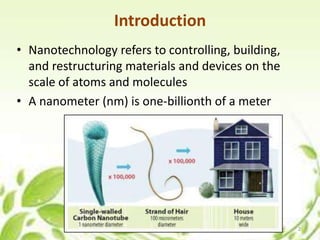
• Nanotechnology refers to controlling, building,
and restructuring materials and devices on the
scale of atoms and molecules
• A nanometer (nm) is one-billionth of a meter
2
Nanotechnology for Crop
Biotechnology
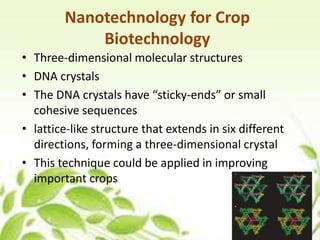
• Three-dimensional molecular structures
• DNA crystals
• The DNA crystals have “sticky-ends” or small
cohesive sequences
• lattice-like structure that extends in six different
directions, forming a three-dimensional crystal
• This technique could be applied in improving
important crops
3
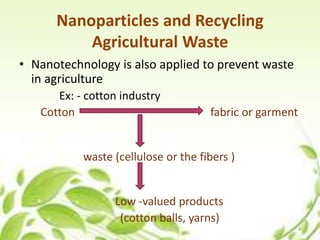
Nanoparticles and Recycling
Agricultural Waste
• Nanotechnology is also applied to prevent waste
in agriculture
Ex: - cotton industry
Cotton fabric or garment
waste (cellulose or the fibers )
Low -valued products
(cotton balls, yarns)
4
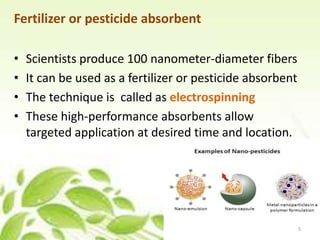
Fertilizer or pesticide absorbent
• Scientists produce 100 nanometer-diameter fibers
• It can be used as a fertilizer or pesticide absorbent
• The technique is called as electrospinning
• These high-performance absorbents allow
targeted application at desired time and location.
5
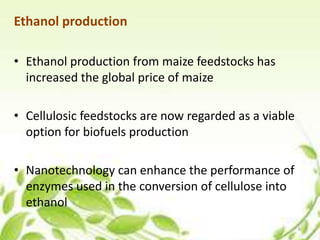
Ethanol production
• Ethanol production from maize feedstocks has
increased the global price of maize
• Cellulosic feedstocks are now regarded as a viable
option for biofuels production
• Nanotechnology can enhance the performance of
enzymes used in the conversion of cellulose into
ethanol
6
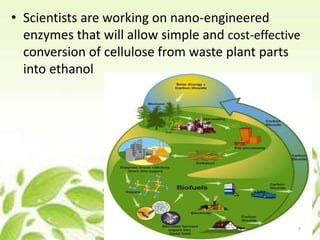
• Scientists are working on nano-engineered
enzymes that will allow simple and cost-effective
conversion of cellulose from waste plant parts
into ethanol
7
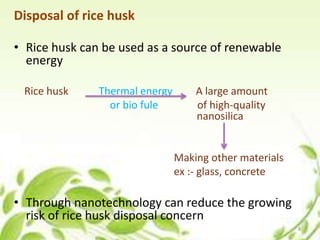
Disposal of rice husk
• Rice husk can be used as a source of renewable
energy
Rice husk Thermal energy A large amount
or bio fule of high-quality
nanosilica
Making other materials
ex :- glass, concrete
• Through nanotechnology can reduce the growing
risk of rice husk disposal concern
8
Nanotech Delivery Systems for Pests,
Nutrients, and Plant Hormones
• Nanosensors and nano-based smart delivery
systems could help in the efficient use of
agricultural natural resources like water, nutrients
and chemicals through precision farming.
• Through the use of nanomaterials and GPS with
satellite imaging of fields, remotely detect crop
pests or evidence of stress such as drought.
9
• Once pest or drought is detected, there would be
automatic adjustment of pesticide applications or
irrigation levels.
• Nanosensors dispersed in the field can also
detect the presence of plant viruses and the level
of soil nutrients.
• Nanoencapsulated slow release fertilizers have
also become a trend to save fertilizer
consumption and to minimize environmental
pollution
10
• Nanobarcodes and nanoprocessing could be used
to monitor the quality of agricultural produce
• Through nanotechnology, scientists are able to
study plant’s regulation of hormones
ex:- auxin – induce root growth and
seedling establishment
• Has developed a nanosensor that reacts with
auxin
• It can measure auxin concentration at a particular
point using electric signal
• It helps to understand how plant roots adapt to
their environment, especially to marginal soils
11
Recent Developments
• The scientists have planned to develop a plastic
storage bag lined with nanoparticles
• A milk container was designed with a
nanopatterned, antimicrobial coating that helps
the diary farmers
• The scientists have planned to develop
nanopatterned paper sensors to detect bovine
pregnancy to determine if the cows will run dry
without milk due to udder infection or pregnancy
12
Impacts of nanotechnology in
agriculture
• Have many potential applications in a variety of
fields
• Carbon nanotubes can be used to recognize and
fight viruses and other pathogens
• However, results of studies in animals have raised
concerns about the potential toxicity of
nanoparticles
13
Conclusion
• Nanotechnology is capable of being used in
agricultural products that protect plants and
monitor plant growth and detect diseases
• Scientists are still seeking new applications of
nanotechnology in agriculture and the food
industry
• The agricultural sector and the food industry will
indeed see tremendous changes for the better in
the coming years
14
15
Thank
you

Usage of Nanotechnology in Agriculture

  • 1.
    NANOTECHNOLOGY USED IN AGRICULTURE UvaWellassa university of Sri lanka 1
  • 2.
    Introduction • Nanotechnology refersto controlling, building, and restructuring materials and devices on the scale of atoms and molecules • A nanometer (nm) is one-billionth of a meter 2
  • 3.
    Nanotechnology for Crop Biotechnology •Three-dimensional molecular structures • DNA crystals • The DNA crystals have “sticky-ends” or small cohesive sequences • lattice-like structure that extends in six different directions, forming a three-dimensional crystal • This technique could be applied in improving important crops 3
  • 4.
    Nanoparticles and Recycling AgriculturalWaste • Nanotechnology is also applied to prevent waste in agriculture Ex: - cotton industry Cotton fabric or garment waste (cellulose or the fibers ) Low -valued products (cotton balls, yarns) 4
  • 5.
    Fertilizer or pesticideabsorbent • Scientists produce 100 nanometer-diameter fibers • It can be used as a fertilizer or pesticide absorbent • The technique is called as electrospinning • These high-performance absorbents allow targeted application at desired time and location. 5
  • 6.
    Ethanol production • Ethanolproduction from maize feedstocks has increased the global price of maize • Cellulosic feedstocks are now regarded as a viable option for biofuels production • Nanotechnology can enhance the performance of enzymes used in the conversion of cellulose into ethanol 6
  • 7.
    • Scientists areworking on nano-engineered enzymes that will allow simple and cost-effective conversion of cellulose from waste plant parts into ethanol 7
  • 8.
    Disposal of ricehusk • Rice husk can be used as a source of renewable energy Rice husk Thermal energy A large amount or bio fule of high-quality nanosilica Making other materials ex :- glass, concrete • Through nanotechnology can reduce the growing risk of rice husk disposal concern 8
  • 9.
    Nanotech Delivery Systemsfor Pests, Nutrients, and Plant Hormones • Nanosensors and nano-based smart delivery systems could help in the efficient use of agricultural natural resources like water, nutrients and chemicals through precision farming. • Through the use of nanomaterials and GPS with satellite imaging of fields, remotely detect crop pests or evidence of stress such as drought. 9
  • 10.
    • Once pestor drought is detected, there would be automatic adjustment of pesticide applications or irrigation levels. • Nanosensors dispersed in the field can also detect the presence of plant viruses and the level of soil nutrients. • Nanoencapsulated slow release fertilizers have also become a trend to save fertilizer consumption and to minimize environmental pollution 10
  • 11.
    • Nanobarcodes andnanoprocessing could be used to monitor the quality of agricultural produce • Through nanotechnology, scientists are able to study plant’s regulation of hormones ex:- auxin – induce root growth and seedling establishment • Has developed a nanosensor that reacts with auxin • It can measure auxin concentration at a particular point using electric signal • It helps to understand how plant roots adapt to their environment, especially to marginal soils 11
  • 12.
    Recent Developments • Thescientists have planned to develop a plastic storage bag lined with nanoparticles • A milk container was designed with a nanopatterned, antimicrobial coating that helps the diary farmers • The scientists have planned to develop nanopatterned paper sensors to detect bovine pregnancy to determine if the cows will run dry without milk due to udder infection or pregnancy 12
  • 13.
    Impacts of nanotechnologyin agriculture • Have many potential applications in a variety of fields • Carbon nanotubes can be used to recognize and fight viruses and other pathogens • However, results of studies in animals have raised concerns about the potential toxicity of nanoparticles 13
  • 14.
    Conclusion • Nanotechnology iscapable of being used in agricultural products that protect plants and monitor plant growth and detect diseases • Scientists are still seeking new applications of nanotechnology in agriculture and the food industry • The agricultural sector and the food industry will indeed see tremendous changes for the better in the coming years 14
  • 15.