Prepared by
Hasib Sikdar
B.Sc. in Textile Engineering
BUFT
*
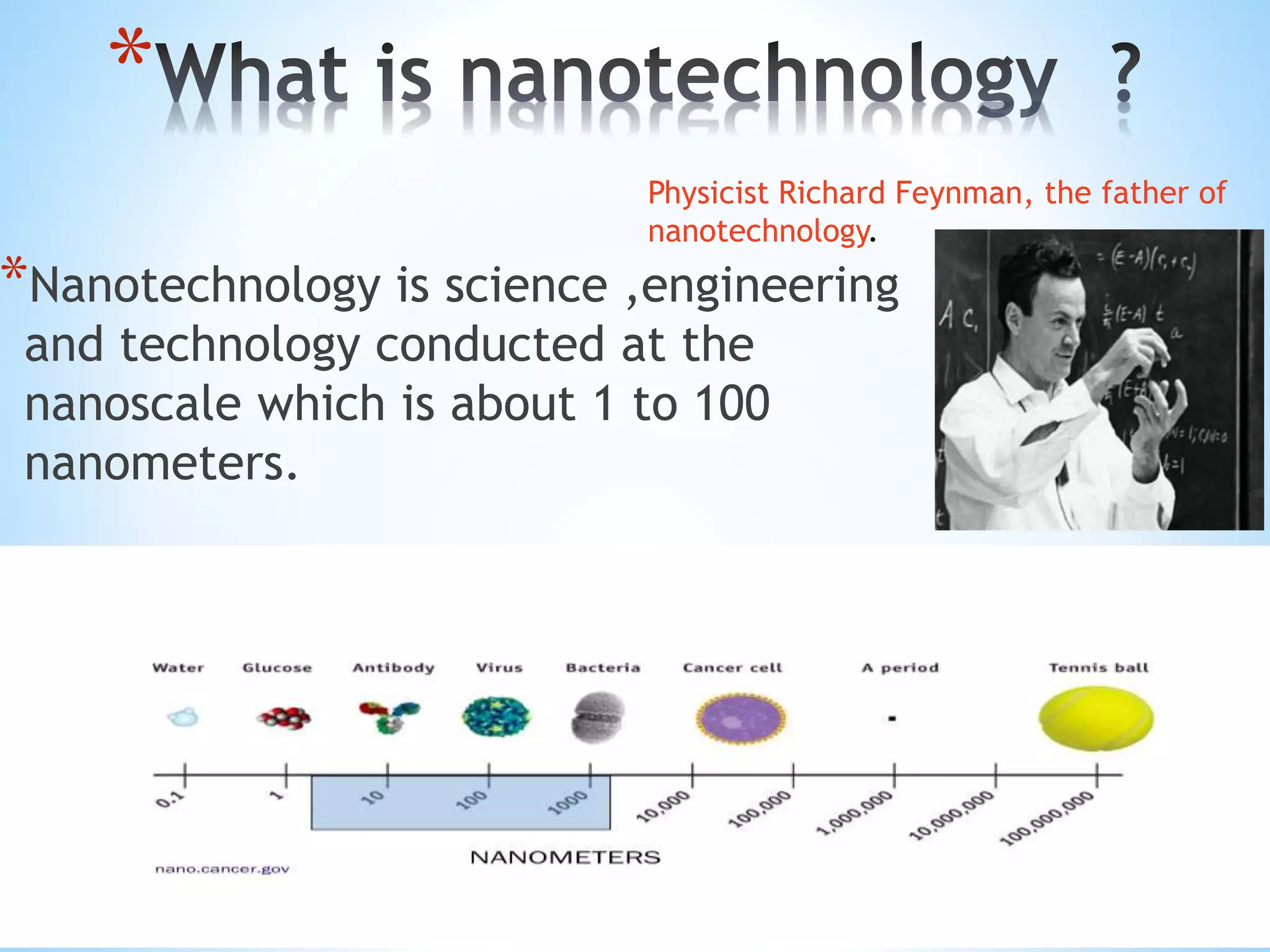
*Nanotechnology is science ,engineering
and technology conducted at the
nanoscale which is about 1 to 100
nanometers.
Physicist Richard Feynman, the father of
nanotechnology.
*
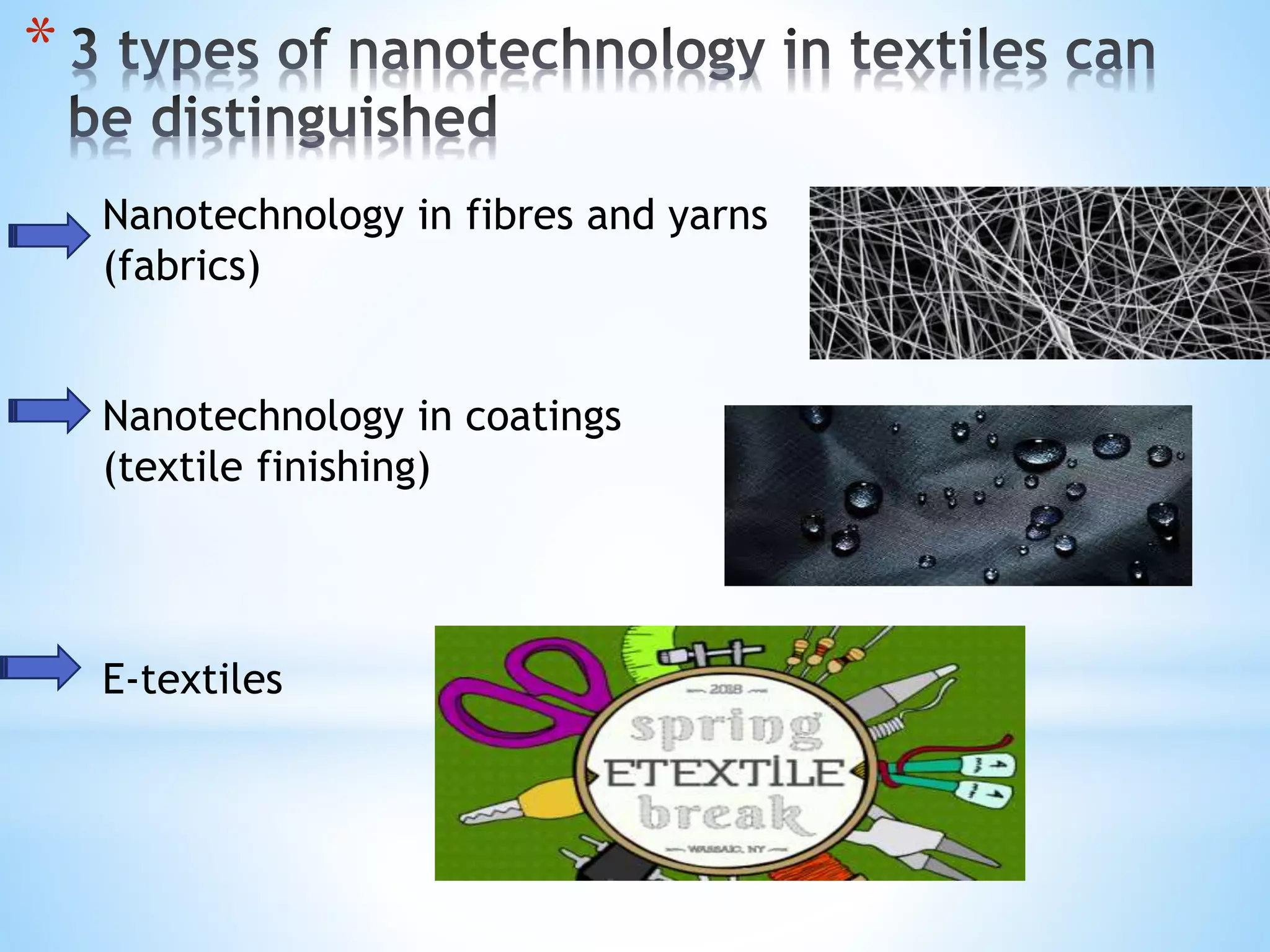
Nanotechnology in fibres and yarns
(fabrics)
Nanotechnology in coatings
(textile finishing)
E-textiles
Nanofibers are defined as fibers with diameter less
than 10 nanometer.
The smallest nano fibers madetoday are
between 1.5 and 1.75 nanometers
involves engineering on a small scale to creat smaller,cheaper,lighter,faster
device that can do more things with less raw materials
*Nanoparticles
Various types of nanoparticles used in textile
industries
They are:
1. Nano whiskers
2. Nano net
3. Nano wrap
*
*Nano whiskers can make the fabric stain ,water resistant, superior
durability, soft, natural & wrinkle resistance
*Nano whiskers can keep the fabric breathable to unlike resins
finishes!
*Nano Net
*Three dimensional nanostructure which covers
the molecule completely
*Alters the property of synthetic fibers like
polysters to give a fell off cotton & linen
*Wicks body moisture fast
*Dries quickly & gives the cooling effect
*Nano Wrap
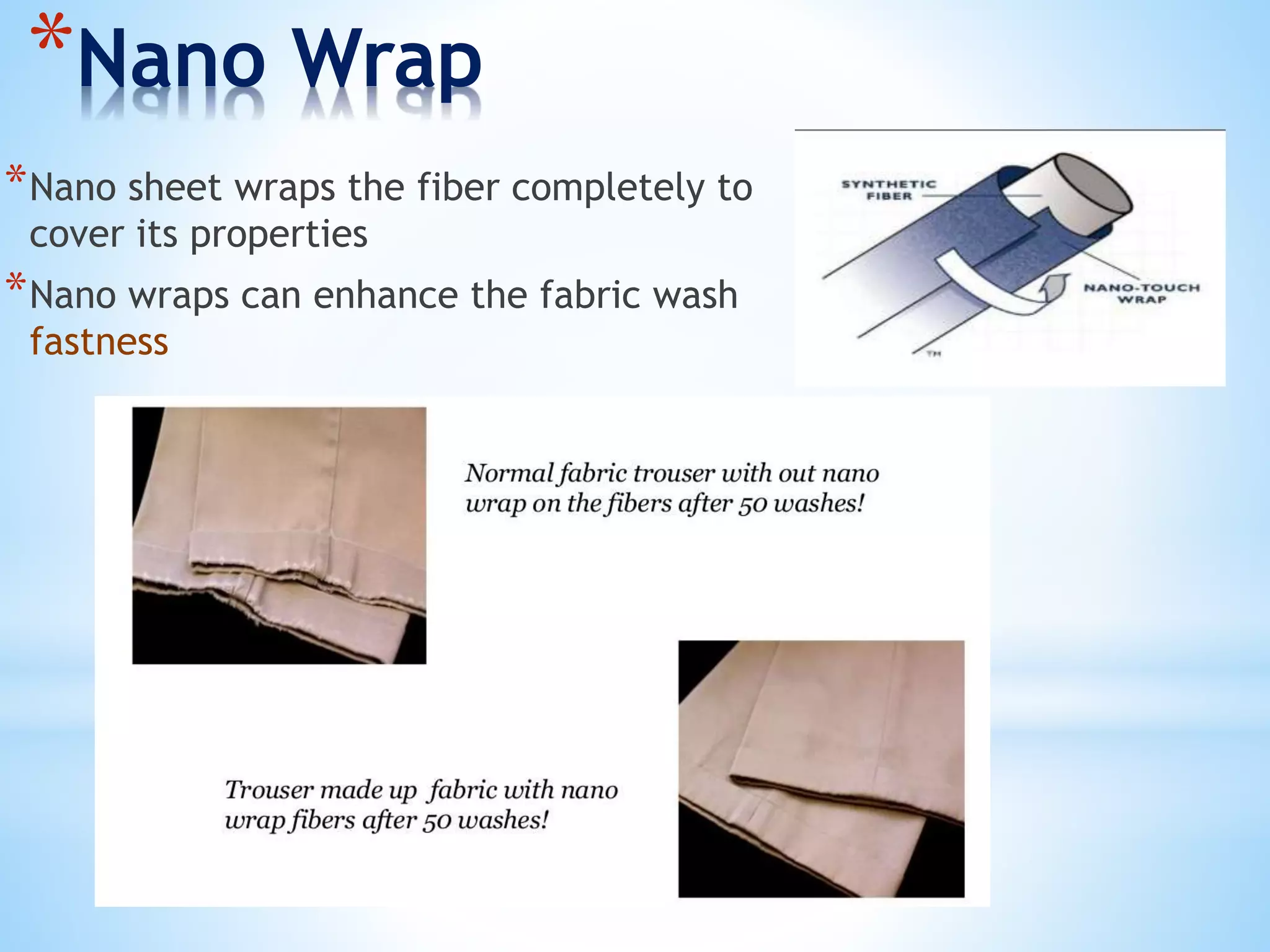
*Nano sheet wraps the fiber completely to
cover its properties
*Nano wraps can enhance the fabric wash
fastness
*Self cleaning clothes
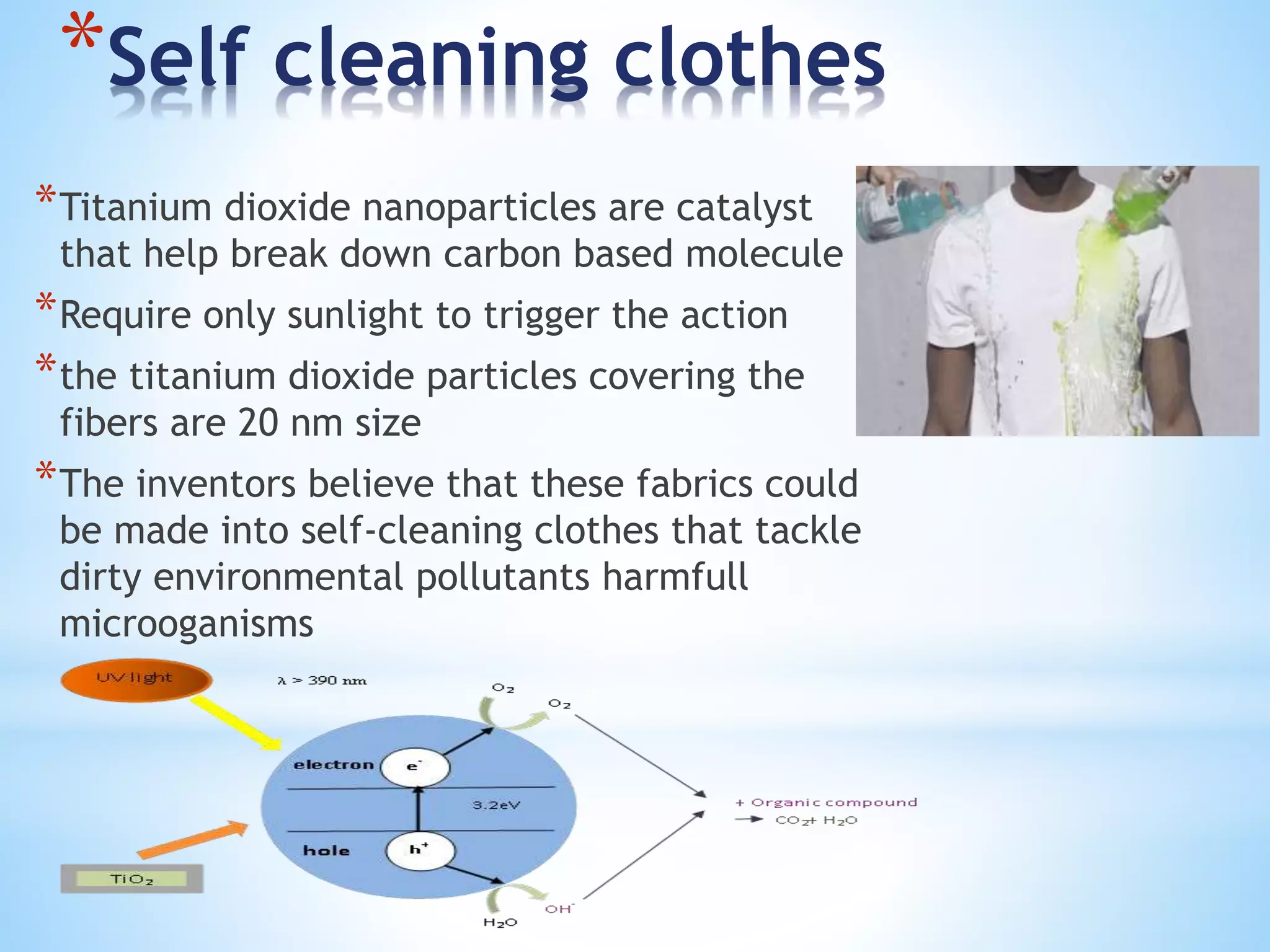
*Titanium dioxide nanoparticles are catalyst
that help break down carbon based molecule
*Require only sunlight to trigger the action
*the titanium dioxide particles covering the
fibers are 20 nm size
*The inventors believe that these fabrics could
be made into self-cleaning clothes that tackle
dirty environmental pollutants harmfull
microoganisms
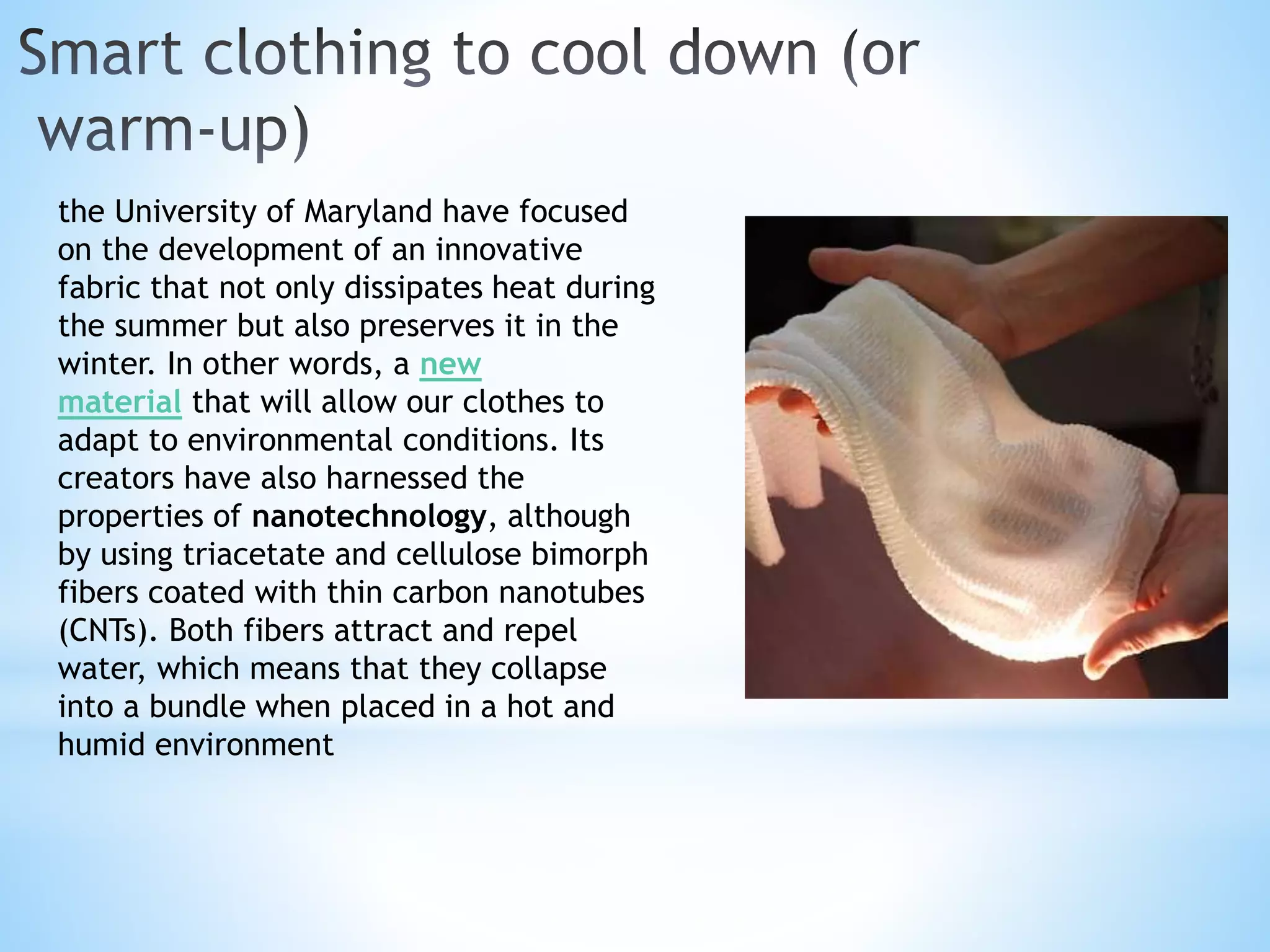
the University of Maryland have focused
on the development of an innovative
fabric that not only dissipates heat during
the summer but also preserves it in the
winter. In other words, a new
material that will allow our clothes to
adapt to environmental conditions. Its
creators have also harnessed the
properties of nanotechnology, although
by using triacetate and cellulose bimorph
fibers coated with thin carbon nanotubes
(CNTs). Both fibers attract and repel
water, which means that they collapse
into a bundle when placed in a hot and
humid environment
*
*Military uniforms that change color to match
the environment
*Light weight bulletproof vests
Invisible cloth
Scientists are manipulating light so
soldiers to disappear
Scientists are also working on electrochromic
Comouflage fabric which change colors instantly
To blend in with the surrounding
*
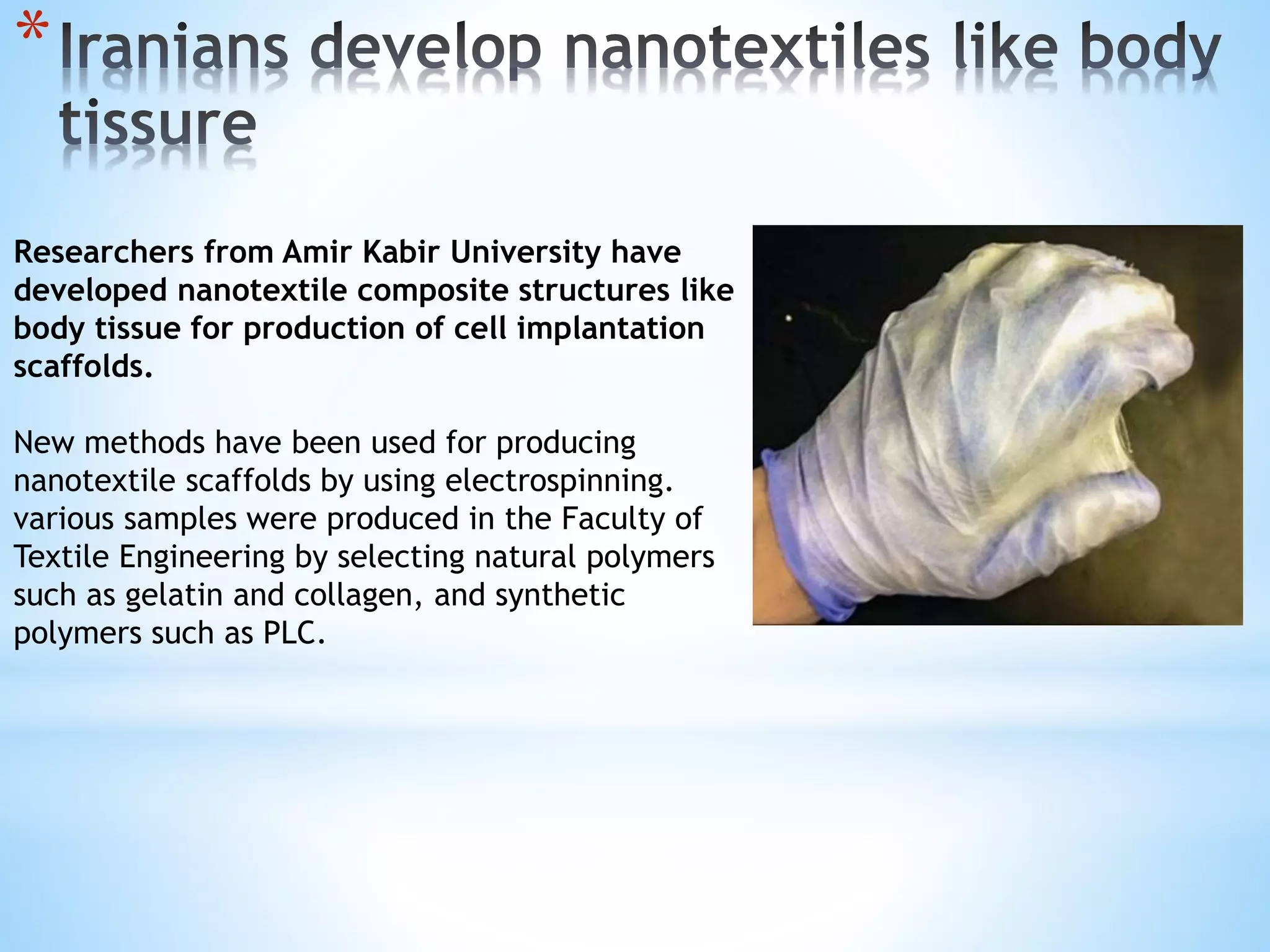
Researchers from Amir Kabir University have
developed nanotextile composite structures like
body tissue for production of cell implantation
scaffolds.
New methods have been used for producing
nanotextile scaffolds by using electrospinning.
various samples were produced in the Faculty of
Textile Engineering by selecting natural polymers
such as gelatin and collagen, and synthetic
polymers such as PLC.

Nanotechnology in textiles

  • 1.
    Prepared by Hasib Sikdar B.Sc.in Textile Engineering BUFT
  • 2.
    * *Nanotechnology is science,engineering and technology conducted at the nanoscale which is about 1 to 100 nanometers. Physicist Richard Feynman, the father of nanotechnology.
  • 3.
    * Nanotechnology in fibresand yarns (fabrics) Nanotechnology in coatings (textile finishing) E-textiles
  • 4.
    Nanofibers are definedas fibers with diameter less than 10 nanometer. The smallest nano fibers madetoday are between 1.5 and 1.75 nanometers involves engineering on a small scale to creat smaller,cheaper,lighter,faster device that can do more things with less raw materials
  • 5.
    *Nanoparticles Various types ofnanoparticles used in textile industries They are: 1. Nano whiskers 2. Nano net 3. Nano wrap
  • 6.
    * *Nano whiskers canmake the fabric stain ,water resistant, superior durability, soft, natural & wrinkle resistance *Nano whiskers can keep the fabric breathable to unlike resins finishes!
  • 7.
    *Nano Net *Three dimensionalnanostructure which covers the molecule completely *Alters the property of synthetic fibers like polysters to give a fell off cotton & linen *Wicks body moisture fast *Dries quickly & gives the cooling effect
  • 8.
    *Nano Wrap *Nano sheetwraps the fiber completely to cover its properties *Nano wraps can enhance the fabric wash fastness
  • 10.
    *Self cleaning clothes *Titaniumdioxide nanoparticles are catalyst that help break down carbon based molecule *Require only sunlight to trigger the action *the titanium dioxide particles covering the fibers are 20 nm size *The inventors believe that these fabrics could be made into self-cleaning clothes that tackle dirty environmental pollutants harmfull microoganisms
  • 11.
    the University ofMaryland have focused on the development of an innovative fabric that not only dissipates heat during the summer but also preserves it in the winter. In other words, a new material that will allow our clothes to adapt to environmental conditions. Its creators have also harnessed the properties of nanotechnology, although by using triacetate and cellulose bimorph fibers coated with thin carbon nanotubes (CNTs). Both fibers attract and repel water, which means that they collapse into a bundle when placed in a hot and humid environment
  • 12.
    * *Military uniforms thatchange color to match the environment *Light weight bulletproof vests Invisible cloth Scientists are manipulating light so soldiers to disappear Scientists are also working on electrochromic Comouflage fabric which change colors instantly To blend in with the surrounding
  • 13.
    * Researchers from AmirKabir University have developed nanotextile composite structures like body tissue for production of cell implantation scaffolds. New methods have been used for producing nanotextile scaffolds by using electrospinning. various samples were produced in the Faculty of Textile Engineering by selecting natural polymers such as gelatin and collagen, and synthetic polymers such as PLC.