NANOSCIENCE andTECHNOLOGY
Arathi .S* Ayesha Azmath** G Shivani ***
B.Sc 2ND year St.Anns Degree College
1
Howdo we define “Nanoscience” and “
Nanotechnology ”
 Nanotechnology is study
of controlling of matter
on an atomic and
molecular scale. It deals
with structures sized
between 1 to 100 nm.
 The first ever concept
was presented in 1959 by
the famous professor of
physics Dr. Richard
P.Feynman
 Nanotechnology is then
the design, the
manipulation, the
building, the production
and application, by
controlling the shape
and size by nanometer
scale.
 The agronomic
application of
nanotechnology in
plants is called
phytonanotechnology
2
3
VARIOUS
APPLICATIONS
4
Applications in agriculture
Nanotechnology has the potential to
revolutionize the agriculture
phytonanotechnology with new tools for
i. The controlled release of
agrochemicals (e.g., fertilizers,
pesticides, and herbicides)
ii. Target-specific delivery of
biomolecules (e.g., nucleotides,
proteins, and activators)
iii. Delivery of vaccines into plants using
nanocapsules.
iv. The use of nanosensors for the
detection of the plant pathogens,
monitoring the soil conditions and
plant growth, etc
5
Controlledreleaseof agrochemicals
 The Indian Council of Agricultural Research (ICAR) has
opened up an exclusive platform to target
Nanotechnology Applications in Agriculture
 Major themes such as
 Diagnostic kits for early detection of pests and
diseases,
 Nano-pheromones for effective pest control
 Nano agri-inputs for enhanced use efficiencies,
precision water management
 Stabilization of organic matter in soil
 Nano food systems and
 Bio safety besides establishing the policy frame work
6
Nanofertilizersand theirroles:
Fertilizers to accumulate in the soil or aquatic system –
 Eutrophication
 imbalanced fertilization,
 multi-nutrient deficiencies
 and decline of soil organic matter
Use of nanoscale nutrients to suppress crop disease
Micronutrients are critical in the defense against crop disease.
Mn, Cu, and Zn enhance disease resistance by activating the host
defense enzymes phenylalanine ammonia lyase and polyphenol
oxidases.
Maize treated with TiO2 nanoparticles showed significant growth
compared to its bulk treatment.
7
Nano-pesticide
 Nano Pesticides in the initial stage of crop growth
 Decrease pest population below the economic threshold
level
 Effective control for a longer period
 Permabality
 Biodegradability
Nanopesticide delivery techniques are
 nanoemulsions,
 Nanoencapsulates
 Nanocontainers, and nanocages
Nanoherbicide
Molecule encapsulated with nanoparticle
 specific receptor in the roots of target
weeds,
 inhibit glycolysis of food reserve in
the root system
8
Detectionofpollutants,pathogen
 Nano-sensors with bioreceptor give accurate soil moisture
updates at the root zone and soil temperature .
 Inhibition effects of silver nanoparticles - powdery mildews on
Cucumber and Pumpkin. (Kabir et al., 2011)
 Mycogenic silver nanoparticles against Aspergillus niger inciting
collar rot disease in groundnut. (Bhaskar et al., 2014)
Bioremediation
Nanotechnology has played a significant role in microbial
remediation
 nanoparticle-water slurry can be mixed in
contaminated soil
 These particles will reduce the toxicity
 slowly degradable or resistant pesticides
9
10
11
Recyclingof agricultural wastes
• Nanotechnology can be applied By using a
technique called electrospinning.
– in reduction of wastes during agriculture
– manufacturing such as cotton, beverage and rice
– milling industries.
12
13
Cotton
Fabric cotton
cellulose or
fibers
Electrospining
nanofiber
Other
byproducts
Elecrospining
These Nano fiber can used as
Pesticides ,herbicides
Biofuelproduction
 Beverage industries, mainly engaged in ethanol
production using maize feedstock
continuously.
 enhancing the performance of enzymes
 involved in conversion of cellulose to ethanol
14
Industries Rice and husk
Husk for
biofuel
Nanoscilions
useful
materials like
concrete, glass
Agri-foodindustry
Zinc spray of the nanoparticles was
found to be essential to
 increase the vegetarian protein, fat
and fibers in the Indian diets.
The development of gold
nanoparticles
measurable change in the Surface
PlasmonResponse (SPR)
absorption peak
 monitor different parameters in food
or environment such as
 temperature, humidity etc.
(Ditta, 2012)
15
Shelf-lifeenhancement of agricultural
products:
Nano-films
adding nano-clays or silver nano-particles
acta as a antibacterial agent , nanoparticle-
based transparent sunscreens, and carbon
nanotubes for stain-resistant textiles
Improve the
tensile properties,
stiffness, dimensional
stability
and thermal resistance
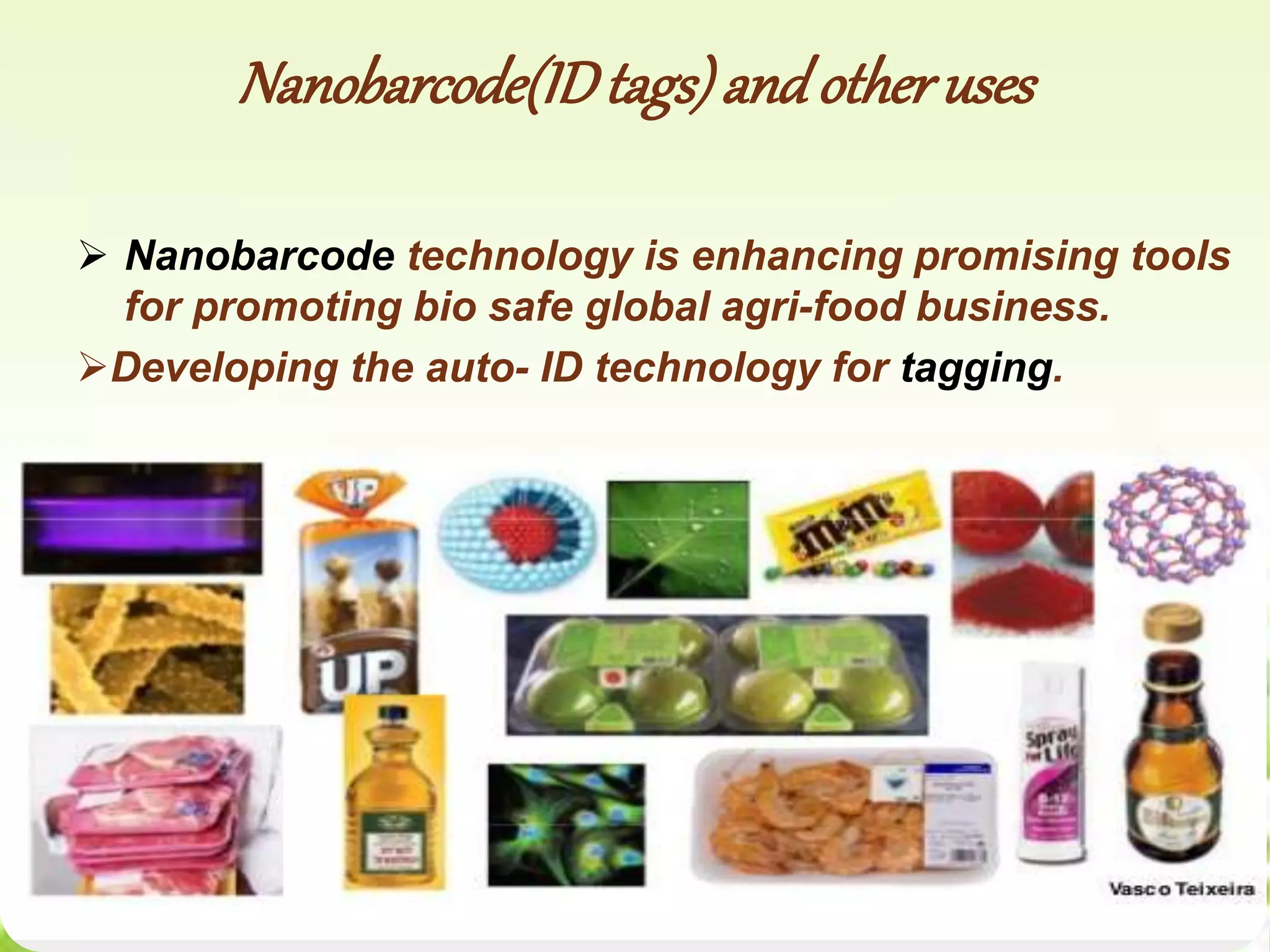
Nanobarcode(IDtags)and otheruses
 Nanobarcode technology is enhancing promising tools
for promoting bio safe global agri-food business.
Developing the auto- ID technology for tagging.
17
Impactsand Delimits
• Interaction of nanoparticles with the nontarget sites, which lead to
certain environmental and health issues (Claudiaetal., 2014).
• Higher production costs.
• Public is not aware of many application of nanotechnology.
• Nanotechnology is considered as one of the possible solutions to
problems in food and agriculture. Just like biotechnology, issues of
safety on health, biodiversity, and environment along with
appropriate regulation are raised on nanotechnology.
• To date, nonscientists are developing techniques for atom-by-atom
construction of objects that have potential applications not just in
agriculture but also in medicine, electronics, information technology,
and environmental monitoring and remediation, to name a few.
18
REFERENCES
• Claudia Parisi, Mauro Vigani and Emilio
Rodriguez-Cerezo (2014). In: Proceedings
• Ditta Allah (2012). How helpful is
nanotechnologyin agriculture? Adv. Nat. Sci.:
Nanosci.Nanotechnol. Available online
atDoi:10.1088/2043-6262/3/3/033002
• https://www.ncbi.nlm.nih.gov
• https://www.slideshare.net/DulminieNanayak
kara/nanotechnology-usage
19
20

Nanotechnology

  • 1.
    NANOSCIENCE andTECHNOLOGY Arathi .S*Ayesha Azmath** G Shivani *** B.Sc 2ND year St.Anns Degree College 1
  • 2.
    Howdo we define“Nanoscience” and “ Nanotechnology ”  Nanotechnology is study of controlling of matter on an atomic and molecular scale. It deals with structures sized between 1 to 100 nm.  The first ever concept was presented in 1959 by the famous professor of physics Dr. Richard P.Feynman  Nanotechnology is then the design, the manipulation, the building, the production and application, by controlling the shape and size by nanometer scale.  The agronomic application of nanotechnology in plants is called phytonanotechnology 2
  • 3.
  • 4.
  • 5.
    Applications in agriculture Nanotechnologyhas the potential to revolutionize the agriculture phytonanotechnology with new tools for i. The controlled release of agrochemicals (e.g., fertilizers, pesticides, and herbicides) ii. Target-specific delivery of biomolecules (e.g., nucleotides, proteins, and activators) iii. Delivery of vaccines into plants using nanocapsules. iv. The use of nanosensors for the detection of the plant pathogens, monitoring the soil conditions and plant growth, etc 5
  • 6.
    Controlledreleaseof agrochemicals  TheIndian Council of Agricultural Research (ICAR) has opened up an exclusive platform to target Nanotechnology Applications in Agriculture  Major themes such as  Diagnostic kits for early detection of pests and diseases,  Nano-pheromones for effective pest control  Nano agri-inputs for enhanced use efficiencies, precision water management  Stabilization of organic matter in soil  Nano food systems and  Bio safety besides establishing the policy frame work 6
  • 7.
    Nanofertilizersand theirroles: Fertilizers toaccumulate in the soil or aquatic system –  Eutrophication  imbalanced fertilization,  multi-nutrient deficiencies  and decline of soil organic matter Use of nanoscale nutrients to suppress crop disease Micronutrients are critical in the defense against crop disease. Mn, Cu, and Zn enhance disease resistance by activating the host defense enzymes phenylalanine ammonia lyase and polyphenol oxidases. Maize treated with TiO2 nanoparticles showed significant growth compared to its bulk treatment. 7
  • 8.
    Nano-pesticide  Nano Pesticidesin the initial stage of crop growth  Decrease pest population below the economic threshold level  Effective control for a longer period  Permabality  Biodegradability Nanopesticide delivery techniques are  nanoemulsions,  Nanoencapsulates  Nanocontainers, and nanocages Nanoherbicide Molecule encapsulated with nanoparticle  specific receptor in the roots of target weeds,  inhibit glycolysis of food reserve in the root system 8
  • 9.
    Detectionofpollutants,pathogen  Nano-sensors withbioreceptor give accurate soil moisture updates at the root zone and soil temperature .  Inhibition effects of silver nanoparticles - powdery mildews on Cucumber and Pumpkin. (Kabir et al., 2011)  Mycogenic silver nanoparticles against Aspergillus niger inciting collar rot disease in groundnut. (Bhaskar et al., 2014) Bioremediation Nanotechnology has played a significant role in microbial remediation  nanoparticle-water slurry can be mixed in contaminated soil  These particles will reduce the toxicity  slowly degradable or resistant pesticides 9
  • 10.
  • 11.
  • 12.
    Recyclingof agricultural wastes •Nanotechnology can be applied By using a technique called electrospinning. – in reduction of wastes during agriculture – manufacturing such as cotton, beverage and rice – milling industries. 12
  • 13.
  • 14.
    Biofuelproduction  Beverage industries,mainly engaged in ethanol production using maize feedstock continuously.  enhancing the performance of enzymes  involved in conversion of cellulose to ethanol 14 Industries Rice and husk Husk for biofuel Nanoscilions useful materials like concrete, glass
  • 15.
    Agri-foodindustry Zinc spray ofthe nanoparticles was found to be essential to  increase the vegetarian protein, fat and fibers in the Indian diets. The development of gold nanoparticles measurable change in the Surface PlasmonResponse (SPR) absorption peak  monitor different parameters in food or environment such as  temperature, humidity etc. (Ditta, 2012) 15
  • 16.
    Shelf-lifeenhancement of agricultural products: Nano-films addingnano-clays or silver nano-particles acta as a antibacterial agent , nanoparticle- based transparent sunscreens, and carbon nanotubes for stain-resistant textiles Improve the tensile properties, stiffness, dimensional stability and thermal resistance
  • 17.
    Nanobarcode(IDtags)and otheruses  Nanobarcodetechnology is enhancing promising tools for promoting bio safe global agri-food business. Developing the auto- ID technology for tagging. 17
  • 18.
    Impactsand Delimits • Interactionof nanoparticles with the nontarget sites, which lead to certain environmental and health issues (Claudiaetal., 2014). • Higher production costs. • Public is not aware of many application of nanotechnology. • Nanotechnology is considered as one of the possible solutions to problems in food and agriculture. Just like biotechnology, issues of safety on health, biodiversity, and environment along with appropriate regulation are raised on nanotechnology. • To date, nonscientists are developing techniques for atom-by-atom construction of objects that have potential applications not just in agriculture but also in medicine, electronics, information technology, and environmental monitoring and remediation, to name a few. 18
  • 19.
    REFERENCES • Claudia Parisi,Mauro Vigani and Emilio Rodriguez-Cerezo (2014). In: Proceedings • Ditta Allah (2012). How helpful is nanotechnologyin agriculture? Adv. Nat. Sci.: Nanosci.Nanotechnol. Available online atDoi:10.1088/2043-6262/3/3/033002 • https://www.ncbi.nlm.nih.gov • https://www.slideshare.net/DulminieNanayak kara/nanotechnology-usage 19
  • 20.