
Introduction 
Matter and Energy are manifestations of the universe they 
exist in a variety of forms and interact with each other in 
many ways. 
Nano means 10-9. ( Nanometer is one thousand Millionth 
of a Meter) 
To understand how small one nm is let us see few 
comparisons 
1. A Red blood cell is approximately 7000nm wide. 
2. Water Molecule is almost 0.3nm across. 
3. Human hair which is about 80,000nm wide.
Nano Material 
1.Nano Materials could be defined as the materials with at least 
one of its dimensions in the range of a Nano meter. 
2.Thus the material need not be so small that it cannot be seen, it 
can be a large surface or a long wire whose thickness is in the 
scale of Nanometers. 
3. Materials that are Nano scale in one dimension are layers, such 
as a Thin films or Surface coatings. 
4. Materials that are Nano Scale in two dimensions include Nano 
wires and Nano tubes. 
5. Materials that are Nano scale in three dimensions are particles 
for example precipitates, colloids and quantum dots (Small 
particles of Semiconductor Materials)
Nano Science 
Nano Science can be defined as the study of 
phenomena and manipulation of materials at 
Atomic, Molecular and Macromolecular 
scales where properties differ significantly 
from those at a larger scale. 
Nano Science is the study and understanding 
of properties of Nano Particles.
Nano Technology 
Nanotechnology can be defined as the design, 
characterization, production and application of 
structures devices and systems by controlling 
shape and size at a Nano meter Scale.
Why properties of Nano Materials are different ? 
The properties of Nano Materials are very much different 
from those at a larger scale. 
Two principal factors cause the properties of Nano 
Materials to differ significantly from other materials. 
1.Increased relative surface area. 
2.Quantum confinement effect. 
These factors can charge or enhance properties such as 
reactivity , strength and electrical characteristics.
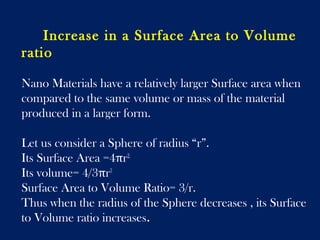
Increase in a Surface Area to Volume 
ratio 
Nano Materials have a relatively larger Surface area when 
compared to the same volume or mass of the material 
produced in a larger form. 
Let us consider a Sphere of radius “r”. 
Its Surface Area =4πr2. 
Its volume= 4/3πr3 
Surface Area to Volume Ratio= 3/r. 
Thus when the radius of the Sphere decreases , its Surface 
to Volume ratio increases.
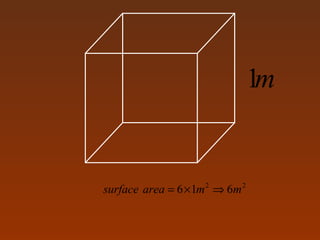
surface area = 6´1m2 Þ6m2 
m 1
 Let us consider one Cubic Volume shown in figure its the 
Surface Area is 6m2 . 
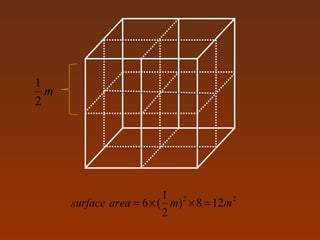
 When it is divided into eight pieces its Surface Area 
becomes 12m2, similarly When the same volume is divided 
into 27 pieces its Surface Area becomes 18m2. 
 Thus we find that when the given volume is divided into 
smaller pieces the Surface Area increases. 
 Hence as particle size decreases a greater proportion of 
atoms are found at the surface compared to those inside. 
 Nano particles have a much greater surface area per given 
volume compared with larger particles. It makes materials 
more Chemically reactive.
surface area = 6´ (1 m ´ = m 
)2 8 12 2 
2 
1 
m 
2
Quantum Confinement 
In Nano Crystals, the Electronic energy levels are not 
continuous as in the bulk but are discrete (finite 
density of states), because of the confinement of the 
electronic Wave function to the physical dimensions 
of the particles. This phenomenon is called 
Quantum confinement and therefore Nano Crystals 
are also referred to as quantum dots (QDs).
Properties of Nano Materials 
Nano Materials have properties that are different 
from those of bulk materials. 
Most Nano structure materials are Crystalline in 
nature and they posses unique properties.
Physical Properties of Nano Particles 
 Crystal structure of Nano particles is same as bulk 
structure with different lattice parameters. 
 The inter atomic spacing decreases with size and 
this is due to long range electrostatic forces and the 
short range core-core repulsion. 
 The Melting point of Nanoparticles decreases with 
size.
Chemical Properties 
 The Electronic structure of Nanoparticles is 
dependent on its size and the ability of Nano 
cluster to react, depends on cluster size. 
 The large Surface area to volume ratio the 
variations in geometry and the electronic structure 
of Nano particles have a strong effect on catalytic 
properties.
Electrical properties 
 The electronic structure of Nano materials is 
different from its bulk material. 
 The density of the energy states in the conduction 
band changes. 
 When the energy spacing between two energy 
levels is more than KBT , energy gap is created. 
 Nano clusters of different sizes will have different 
electronic structures and different energy level 
separations. 
 The Ionization potential at Nano sizes are higher 
than that for the bulk materials
Magnetic Properties 
 The Magnetic Moment of Nano particles is 
found to be very less when compared them with 
its bulk size. 
 Nanoparticles made of semiconducting 
materials Germanium , Silicon and Cadmium 
are not Semiconductors.
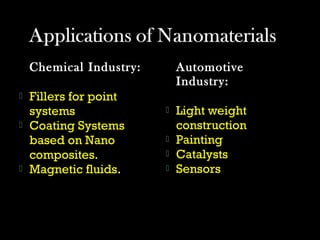
Chemical Industry: 
 Fillers for point 
systems 
 Coating Systems 
based on Nano 
composites. 
 Magnetic fluids. 
Automotive 
Industry: 
 Light weight 
construction 
 Painting 
 Catalysts 
 Sensors
Medicine 
 Drug delivery 
systems 
 Active agents 
 Medical rapid tests 
 Antimicrobial agents 
and coatings. 
 Agents in cancer 
therapy. 
Electronic Industry: 
 Data memory 
 Displays 
 Laser diodes 
 Glass fibers 
 Filters 
 Conductive, antistatic 
coatings.
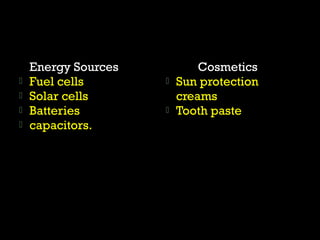
Energy Sources 
 Fuel cells 
 Solar cells 
 Batteries 
 capacitors. 
Cosmetics 
 Sun protection 
creams 
 Tooth paste
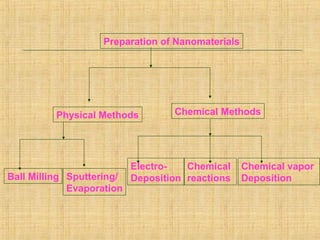
Preparation of Nanomaterials 
Physical Methods Chemical Methods 
Ball Milling Sputtering/ 
Evaporation 
Electro- 
Deposition 
Chemical 
reactions 
Chemical vapor 
Deposition

Nano science _technology

  • 2.
    Introduction Matter andEnergy are manifestations of the universe they exist in a variety of forms and interact with each other in many ways. Nano means 10-9. ( Nanometer is one thousand Millionth of a Meter) To understand how small one nm is let us see few comparisons 1. A Red blood cell is approximately 7000nm wide. 2. Water Molecule is almost 0.3nm across. 3. Human hair which is about 80,000nm wide.
  • 3.
    Nano Material 1.NanoMaterials could be defined as the materials with at least one of its dimensions in the range of a Nano meter. 2.Thus the material need not be so small that it cannot be seen, it can be a large surface or a long wire whose thickness is in the scale of Nanometers. 3. Materials that are Nano scale in one dimension are layers, such as a Thin films or Surface coatings. 4. Materials that are Nano Scale in two dimensions include Nano wires and Nano tubes. 5. Materials that are Nano scale in three dimensions are particles for example precipitates, colloids and quantum dots (Small particles of Semiconductor Materials)
  • 4.
    Nano Science NanoScience can be defined as the study of phenomena and manipulation of materials at Atomic, Molecular and Macromolecular scales where properties differ significantly from those at a larger scale. Nano Science is the study and understanding of properties of Nano Particles.
  • 5.
    Nano Technology Nanotechnologycan be defined as the design, characterization, production and application of structures devices and systems by controlling shape and size at a Nano meter Scale.
  • 6.
    Why properties ofNano Materials are different ? The properties of Nano Materials are very much different from those at a larger scale. Two principal factors cause the properties of Nano Materials to differ significantly from other materials. 1.Increased relative surface area. 2.Quantum confinement effect. These factors can charge or enhance properties such as reactivity , strength and electrical characteristics.
  • 7.
    Increase in aSurface Area to Volume ratio Nano Materials have a relatively larger Surface area when compared to the same volume or mass of the material produced in a larger form. Let us consider a Sphere of radius “r”. Its Surface Area =4πr2. Its volume= 4/3πr3 Surface Area to Volume Ratio= 3/r. Thus when the radius of the Sphere decreases , its Surface to Volume ratio increases.
  • 8.
    surface area =6´1m2 Þ6m2 m 1
  • 9.
     Let usconsider one Cubic Volume shown in figure its the Surface Area is 6m2 .  When it is divided into eight pieces its Surface Area becomes 12m2, similarly When the same volume is divided into 27 pieces its Surface Area becomes 18m2.  Thus we find that when the given volume is divided into smaller pieces the Surface Area increases.  Hence as particle size decreases a greater proportion of atoms are found at the surface compared to those inside.  Nano particles have a much greater surface area per given volume compared with larger particles. It makes materials more Chemically reactive.
  • 10.
    surface area =6´ (1 m ´ = m )2 8 12 2 2 1 m 2
  • 11.
    Quantum Confinement InNano Crystals, the Electronic energy levels are not continuous as in the bulk but are discrete (finite density of states), because of the confinement of the electronic Wave function to the physical dimensions of the particles. This phenomenon is called Quantum confinement and therefore Nano Crystals are also referred to as quantum dots (QDs).
  • 12.
    Properties of NanoMaterials Nano Materials have properties that are different from those of bulk materials. Most Nano structure materials are Crystalline in nature and they posses unique properties.
  • 13.
    Physical Properties ofNano Particles  Crystal structure of Nano particles is same as bulk structure with different lattice parameters.  The inter atomic spacing decreases with size and this is due to long range electrostatic forces and the short range core-core repulsion.  The Melting point of Nanoparticles decreases with size.
  • 14.
    Chemical Properties The Electronic structure of Nanoparticles is dependent on its size and the ability of Nano cluster to react, depends on cluster size.  The large Surface area to volume ratio the variations in geometry and the electronic structure of Nano particles have a strong effect on catalytic properties.
  • 15.
    Electrical properties The electronic structure of Nano materials is different from its bulk material.  The density of the energy states in the conduction band changes.  When the energy spacing between two energy levels is more than KBT , energy gap is created.  Nano clusters of different sizes will have different electronic structures and different energy level separations.  The Ionization potential at Nano sizes are higher than that for the bulk materials
  • 16.
    Magnetic Properties The Magnetic Moment of Nano particles is found to be very less when compared them with its bulk size.  Nanoparticles made of semiconducting materials Germanium , Silicon and Cadmium are not Semiconductors.
  • 17.
    Chemical Industry: Fillers for point systems  Coating Systems based on Nano composites.  Magnetic fluids. Automotive Industry:  Light weight construction  Painting  Catalysts  Sensors
  • 18.
    Medicine  Drugdelivery systems  Active agents  Medical rapid tests  Antimicrobial agents and coatings.  Agents in cancer therapy. Electronic Industry:  Data memory  Displays  Laser diodes  Glass fibers  Filters  Conductive, antistatic coatings.
  • 19.
    Energy Sources Fuel cells  Solar cells  Batteries  capacitors. Cosmetics  Sun protection creams  Tooth paste
  • 20.
    Preparation of Nanomaterials Physical Methods Chemical Methods Ball Milling Sputtering/ Evaporation Electro- Deposition Chemical reactions Chemical vapor Deposition