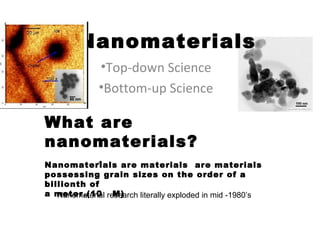
Nanomaterials
•Top-down Science
•Bottom-up Science
What are
nanomaterials?
Nanomaterials are materials are materials
possessing grain sizes on the order of a
billionth of
a meter.(10 M)
-9
Nanomaterial research literally exploded in mid -1980’s
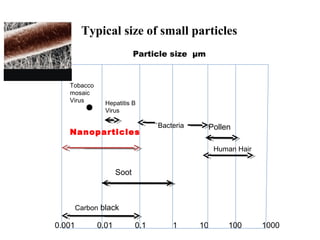
Typical size of small particles
0.001 0.01 0.1 1 10 100 1000
Tobacco
mosaic
Virus Hepatitis B
Virus
Bacteria Pollen
Human Hair
Soot
Carbon black
Nanoparticles
Particle size µm
• Conventional material have grain size
anywhere from 100 µm to 1mm and more
• Particles with size between 1-100 nm are
normally regarded as Nanomaterials
• The average size of an atom is in the order of
1-2 Angstroms in radius.
• 1 nanometer =10 Angstroms
• 1 nm there may be 3-5 atoms
• Although a broad definition, we categorise nanomaterials as those which have structured components with at least one dimension less
than 100nm. Materials that have one dimension in the nanoscale (and are extended in the other two dimensions) are layers, such as a
thin films or surface coatings. Some of the features on computer chips come in this category. Materials that are nanoscale in two
dimensions (and extended in one dimension) include nanowires and nanotubes. Materials that are nanoscale in three dimensions are
particles, for example precipitates, colloids and quantum dots (tiny particles of semiconductor materials). Nanocrystalline materials,
made up of nanometre-sized grains, also fall into this category. Some of these materials have been available for some time; others are
genuinely new. The aim of this chapter is to give an overview of the properties, and the significant foreseeable applications of some
key nanomaterials.
• Two principal factors cause the properties of nanomaterials to differ significantly from other materials: increased relative surface area,
and quantum effects. These factors can change or enhance properties such as reactivity, strength and electrical characteristics. As a
particle decreases in size, a greater proportion of atoms are found at the surface compared to those inside. For example, a particle of
size 30 nm has 5% of its atoms on its surface, at 10 nm 20% of its atoms, and at 3 nm 50% of its atoms. Thus nanoparticles have a
much greater surface area per unit mass compared with larger particles. As growth and catalytic chemical reactions occur at surfaces,
this means that a given mass of material in nanoparticulate form will be much more reactive than the same mass of material made up
of larger particles.
• To understand the effect of particle size on surface area, consider a U.S. silver dollar. The silver dollar contains 26.96 grams of coin
silver, has a diameter of about 40 mm, and has a total surface area of approximately 27.70 square centimeters. If the same amount of
coin silver were divided into tiny particles – say 1 nanometer in diameter – the total surface area of those particles would be 11,400
square meters. When the amount of coin silver contained in a silver dollar is rendered into 1 nm particles, the surface area of those
particles is 4.115 million times greater than the surface area of the silver dollar! (Source
• Watch an introduction to nanotechnology, starting with Richard Feynman's classic talk in December 1959 "There's Plenty of Room at
the Bottom - An Invitation to Enter a New Field of Physics
• Two principal factors cause the properties of
nanomaterials to differ significantly from Bulk
materials:
• Increased relative surface area
• Quantum effects.
These factors can change or enhance
properties such as reactivity, strength and
electrical characteristics.
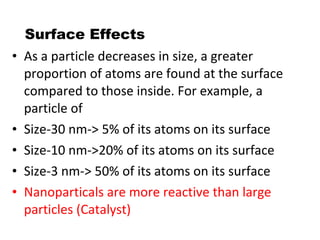
Surface Effects
• As a particle decreases in size, a greater
proportion of atoms are found at the surface
compared to those inside. For example, a
particle of
• Size-30 nm-> 5% of its atoms on its surface
• Size-10 nm->20% of its atoms on its surface
• Size-3 nm-> 50% of its atoms on its surface
• Nanoparticals are more reactive than large
particles (Catalyst)
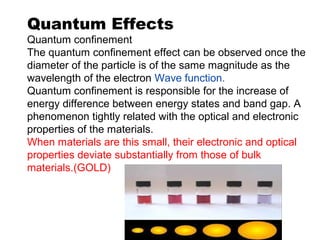
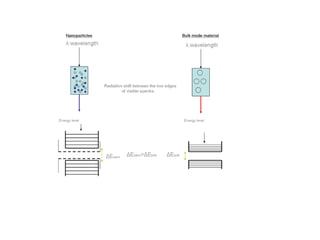
Quantum Effects
Quantum confinement
The quantum confinement effect can be observed once the
diameter of the particle is of the same magnitude as the
wavelength of the electron Wave function.
Quantum confinement is responsible for the increase of
energy difference between energy states and band gap. A
phenomenon tightly related with the optical and electronic
properties of the materials.
When materials are this small, their electronic and optical
properties deviate substantially from those of bulk
materials.(GOLD)
Classification of Nanomaterials
• Nanomaterials as those which have structured components
with atleast one dimension less than 100nm.
• One dimension in nanoscale (Other two dimensions are
extended)
Thin films
Surface Coatings
Computer chips
• Two dimensions in nanoscale (Other one dimension is
extended)
Nanowires
Nanotubes
• Three dimensions in nanoscale
Nanoparticles
Precipitates
Colloids
Quantum dots (tiny particles of semiconductor material)
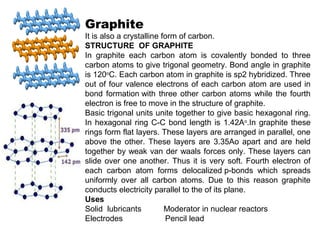
Graphite
It is also a crystalline form of carbon.
STRUCTURE OF GRAPHITE
In graphite each carbon atom is covalently bonded to three
carbon atoms to give trigonal geometry. Bond angle in graphite
is 120o
C. Each carbon atom in graphite is sp2 hybridized. Three
out of four valence electrons of each carbon atom are used in
bond formation with three other carbon atoms while the fourth
electron is free to move in the structure of graphite.
Basic trigonal units unite together to give basic hexagonal ring.
In hexagonal ring C-C bond length is 1.42Ao
.In graphite these
rings form flat layers. These layers are arranged in parallel, one
above the other. These layers are 3.35Ao apart and are held
together by weak van der waals forces only. These layers can
slide over one another. Thus it is very soft. Fourth electron of
each carbon atom forms delocalized p-bonds which spreads
uniformly over all carbon atoms. Due to this reason graphite
conducts electricity parallel to the of its plane.
Uses
Solid lubricants Moderator in nuclear reactors
Electrodes Pencil lead
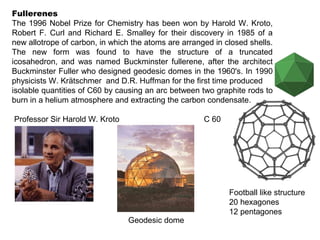
Fullerenes
The 1996 Nobel Prize for Chemistry has been won by Harold W. Kroto,
Robert F. Curl and Richard E. Smalley for their discovery in 1985 of a
new allotrope of carbon, in which the atoms are arranged in closed shells.
The new form was found to have the structure of a truncated
icosahedron, and was named Buckminster fullerene, after the architect
Buckminster Fuller who designed geodesic domes in the 1960's. In 1990
physicists W. Krätschmer and D.R. Huffman for the first time produced
isolable quantities of C60 by causing an arc between two graphite rods to
burn in a helium atmosphere and extracting the carbon condensate.
Professor Sir Harold W. Kroto C 60
Geodesic dome
Football like structure
20 hexagones
12 pentagones
Appliations-
The fullerenes have synthetic pharmaceutical and industrial applications.
Degenerative diseases and ordinary aging processes are caused by intracellular
Oxygen free radicals with unpaired electrons. C60 fullerenes can react with radicals
Thus halting the process of aging. It act as good MRI contrast agent. They can also
Be used in light emitting diodes in different electronic equipments and computing
divices
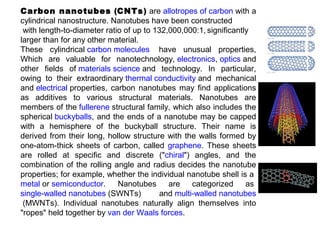
Carbon nanotubes (CNTs) are allotropes of carbon with a
cylindrical nanostructure. Nanotubes have been constructed
with length-to-diameter ratio of up to 132,000,000:1, significantly
larger than for any other material.
These cylindrical carbon molecules have unusual properties,
Which are valuable for nanotechnology, electronics, optics and
other fields of materials science and technology. In particular,
owing to their extraordinary thermal conductivity and mechanical
and electrical properties, carbon nanotubes may find applications
as additives to various structural materials. Nanotubes are
members of the fullerene structural family, which also includes the
spherical buckyballs, and the ends of a nanotube may be capped
with a hemisphere of the buckyball structure. Their name is
derived from their long, hollow structure with the walls formed by
one-atom-thick sheets of carbon, called graphene. These sheets
are rolled at specific and discrete ("chiral") angles, and the
combination of the rolling angle and radius decides the nanotube
properties; for example, whether the individual nanotube shell is a
metal or semiconductor. Nanotubes are categorized as
single-walled nanotubes (SWNTs) and multi-walled nanotubes
(MWNTs). Individual nanotubes naturally align themselves into
"ropes" held together by van der Waals forces.
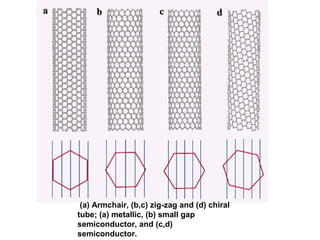
(a) Armchair, (b,c) zig-zag and (d) chiral
tube; (a) metallic, (b) small gap
semiconductor, and (c,d)
semiconductor.
Properties and Applications:-
The nanotubes are extremely strong and stiff and relatively ductile. For single
walled nanotubes tensile strengths range between 50 and 200 Gpa more than
carbon fibres. This is strongest known material. Elastic modulus values are of
the order of one tera pascal with fracture strains between 5% to 20%. They
have very low densities. Because of these properties carbon nano tube has
been termed as ultimate fibre. It has been regarded as 100 times stronger
Than steel at the same time six times lighter (weight wise). They find
Applications in filling material in composite material.
They can act as either conductors or semiconductors depending on
their chirality so they find their applications in molecular electronics and
Computers they are used as ultra sensitive electrochemical sensors. They are
used in batteries and fuel cells.
Field emission results from the tunnelling of electrons from a metal tip into
Vacuum under application of strong electric field. Small diameter and high aspect
ratio
(lower loading of CNTs is needed compare to other conductive additives to achieve
same electrical conductivity .CNTs are very favourable for field emission.)
Even for moderate voltages a strong electric field develops at free end of supported
CNTs because of their sharpness.
The large surface area and high absorbency of CNTs make them ideal
candidates for use in air gas and water filtration
Methods of preparation of CNT
Arc Method
Laser Method
Chemical vapour Deposition
Ball Milling
Carbon nanocones
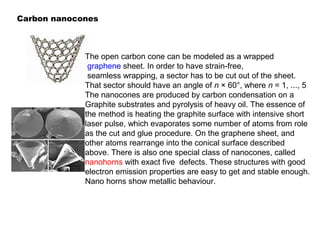
The open carbon cone can be modeled as a wrapped
graphene sheet. In order to have strain-free,
seamless wrapping, a sector has to be cut out of the sheet.
That sector should have an angle of n × 60°, where n = 1, ..., 5
The nanocones are produced by carbon condensation on a
Graphite substrates and pyrolysis of heavy oil. The essence of
the method is heating the graphite surface with intensive short
laser pulse, which evaporates some number of atoms from role
as the cut and glue procedure. On the graphene sheet, and
other atoms rearrange into the conical surface described
above. There is also one special class of nanocones, called
nanohorns with exact five defects. These structures with good
electron emission properties are easy to get and stable enough.
Nano horns show metallic behaviour.
Nanowires
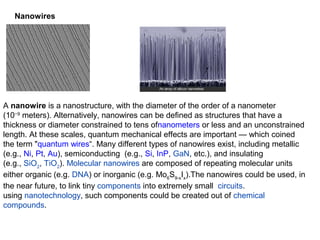
A nanowire is a nanostructure, with the diameter of the order of a nanometer
(10−9
meters). Alternatively, nanowires can be defined as structures that have a
thickness or diameter constrained to tens ofnanometers or less and an unconstrained
length. At these scales, quantum mechanical effects are important — which coined
the term "quantum wires“. Many different types of nanowires exist, including metallic
(e.g., Ni, Pt, Au), semiconducting (e.g., Si, InP, GaN, etc.), and insulating
(e.g., SiO2
, TiO2
). Molecular nanowires are composed of repeating molecular units
either organic (e.g. DNA) or inorganic (e.g. Mo6
S9-x
Ix
).The nanowires could be used, in
the near future, to link tiny components into extremely small circuits.
using nanotechnology, such components could be created out of chemical
compounds.
Typical nanowires exhibit aspect ratios (length-to-width ratio) of
1000 or more. As such they are often referred to as one-dimensional (1-D)
materials. Nanowires have many interesting properties that are not seen in
bulk or 3-D materials. This is because electrons in nanowires are quantum
confined laterally and thus occupy energy levels that are different from the
traditional continuum of energy levels or bands found in bulk materials.
Nano wires are synthesized in laboratory from elements.
There are many applications where nanowires may become important in
electronic, opto-electronic and nanoelectromechanical devices, as additives
in advanced composites, for metallic interconnects in nanoscale quantum
devices, as field-emitters and as leads for biomolecular nanosensors.
Haeckelites
If we try to bend graphene sheet it will straighten up. A new hypothetical
type of grapheen sheet which admits pentagons heptagons and hexagons.It
has been proposed, noting that the no. of heptagons and pentagons should be
same, In order to compensate for the negative curvature of the heptagons and positive
curvature of pentagon. These arrangements are now called haeckelites in honour of
Emst Haeckel a German zoolologist who produced a beautiful drawing of radiolaria,
(Organism) in which heptagonal hexagonal and pentagonal rings are observed.
Carbon haekalite structures are metallic. It is possible to roll up the haekelite sheets to
form nanotubes which will be conductors independent of diameter and chirality.
Laser Method
In 1996 CNT were first synthesized using a dual pulsed laser
and achieved yields of 70% wt. Samples were prepared by laser
vaporization of graphite's rods with a 50:50 catalyst mixtures of
cobalt and nickel at 12000C in flowing argon followed by heat
treatment in vacuum at 1000 oc to remove the C60 and other
fullerenes . The initial Laser vaporization pulse was followed by
second pulse to vaporizes the target more uniformly .The use
of two successive laser pulses minimizes the amount of carbon
deposited as sooth. Second pulse breaks up the larger particles
ablated by first one and feeds them into the growing nano tube
structure. The material produced by this method appears as a
mat of ropes 10-20nm in diameter and up to 10 micro meter or
more in length.
• Chemical vapor deposition method
This Method is useful in production of CNTs on large
scale . Both MWCNTs and SWCNTs are obtained by
this method . The Method involved decomposing a
hydrocarbon gas such as methane acetylene
ethylene at temperature of about 1100oc ,in
presence of metal nano particle catalyst mostly Ni Co
Fe supported on MgO or Al2O3 . Carbon atoms
produced by decomposition are condensed on
cooler surface containing metal catalyst . The size of
the metal nano particle determine the diameter of
the nano tube with open ends. It is continuous
process used as industrial scale.
CONCLUSION
one needs to remember the words of Richard Feynman: “... there is plenty of
room at the bottom”. This statement was made in 1959, and its meaning reflects
the (possible) significance of the molecular – scale devices. In his lecture at the
California Institute of Technology, Feynman proposed the new ideas to be
realized on the molecular size level – the information on the nanoscale,
miniaturized and quantum computers, and the extensively advertised concept of
nano - robots. And what do we see at the present time? On the one hand, there
is a popularized idea of nano – robots, which will appear to build any thing in no
time and without any cost; but there are no ideas (even in the theoretical aspect)
how these systems should look like. There are many enthusiasts of this
approach but they lack the practical techniques which are needed to convert
their dreams into the scientific and technical reality. On the other hand, there are
some types of the nanostructures (the quantum dots, semiconducting hetero
structures and the carbon nanostructures described above) which are
investigated enough, and some of them have commercial applications . The
most important thing we need to do now is to develop the present technologies in
accordance with the present state of the science and with the requirements of
the mankind. The highly advertised nanorobots would be just a little part of the
wonders of future engineering. Both the development and use of the novel
technologies are in our hands; our duty is to manage them in the worthy way.

cnt-nanomaterials-130227040648-phpapp02.pdf

  • 1.
    Nanomaterials •Top-down Science •Bottom-up Science Whatare nanomaterials? Nanomaterials are materials are materials possessing grain sizes on the order of a billionth of a meter.(10 M) -9 Nanomaterial research literally exploded in mid -1980’s
  • 2.
    Typical size ofsmall particles 0.001 0.01 0.1 1 10 100 1000 Tobacco mosaic Virus Hepatitis B Virus Bacteria Pollen Human Hair Soot Carbon black Nanoparticles Particle size µm
  • 3.
    • Conventional materialhave grain size anywhere from 100 µm to 1mm and more • Particles with size between 1-100 nm are normally regarded as Nanomaterials • The average size of an atom is in the order of 1-2 Angstroms in radius. • 1 nanometer =10 Angstroms • 1 nm there may be 3-5 atoms
  • 4.
    • Although abroad definition, we categorise nanomaterials as those which have structured components with at least one dimension less than 100nm. Materials that have one dimension in the nanoscale (and are extended in the other two dimensions) are layers, such as a thin films or surface coatings. Some of the features on computer chips come in this category. Materials that are nanoscale in two dimensions (and extended in one dimension) include nanowires and nanotubes. Materials that are nanoscale in three dimensions are particles, for example precipitates, colloids and quantum dots (tiny particles of semiconductor materials). Nanocrystalline materials, made up of nanometre-sized grains, also fall into this category. Some of these materials have been available for some time; others are genuinely new. The aim of this chapter is to give an overview of the properties, and the significant foreseeable applications of some key nanomaterials. • Two principal factors cause the properties of nanomaterials to differ significantly from other materials: increased relative surface area, and quantum effects. These factors can change or enhance properties such as reactivity, strength and electrical characteristics. As a particle decreases in size, a greater proportion of atoms are found at the surface compared to those inside. For example, a particle of size 30 nm has 5% of its atoms on its surface, at 10 nm 20% of its atoms, and at 3 nm 50% of its atoms. Thus nanoparticles have a much greater surface area per unit mass compared with larger particles. As growth and catalytic chemical reactions occur at surfaces, this means that a given mass of material in nanoparticulate form will be much more reactive than the same mass of material made up of larger particles. • To understand the effect of particle size on surface area, consider a U.S. silver dollar. The silver dollar contains 26.96 grams of coin silver, has a diameter of about 40 mm, and has a total surface area of approximately 27.70 square centimeters. If the same amount of coin silver were divided into tiny particles – say 1 nanometer in diameter – the total surface area of those particles would be 11,400 square meters. When the amount of coin silver contained in a silver dollar is rendered into 1 nm particles, the surface area of those particles is 4.115 million times greater than the surface area of the silver dollar! (Source • Watch an introduction to nanotechnology, starting with Richard Feynman's classic talk in December 1959 "There's Plenty of Room at the Bottom - An Invitation to Enter a New Field of Physics
  • 5.
    • Two principalfactors cause the properties of nanomaterials to differ significantly from Bulk materials: • Increased relative surface area • Quantum effects. These factors can change or enhance properties such as reactivity, strength and electrical characteristics.
  • 6.
    Surface Effects • Asa particle decreases in size, a greater proportion of atoms are found at the surface compared to those inside. For example, a particle of • Size-30 nm-> 5% of its atoms on its surface • Size-10 nm->20% of its atoms on its surface • Size-3 nm-> 50% of its atoms on its surface • Nanoparticals are more reactive than large particles (Catalyst)
  • 7.
    Quantum Effects Quantum confinement Thequantum confinement effect can be observed once the diameter of the particle is of the same magnitude as the wavelength of the electron Wave function. Quantum confinement is responsible for the increase of energy difference between energy states and band gap. A phenomenon tightly related with the optical and electronic properties of the materials. When materials are this small, their electronic and optical properties deviate substantially from those of bulk materials.(GOLD)
  • 9.
    Classification of Nanomaterials •Nanomaterials as those which have structured components with atleast one dimension less than 100nm. • One dimension in nanoscale (Other two dimensions are extended) Thin films Surface Coatings Computer chips • Two dimensions in nanoscale (Other one dimension is extended) Nanowires Nanotubes • Three dimensions in nanoscale Nanoparticles Precipitates Colloids Quantum dots (tiny particles of semiconductor material)
  • 10.
    Graphite It is alsoa crystalline form of carbon. STRUCTURE OF GRAPHITE In graphite each carbon atom is covalently bonded to three carbon atoms to give trigonal geometry. Bond angle in graphite is 120o C. Each carbon atom in graphite is sp2 hybridized. Three out of four valence electrons of each carbon atom are used in bond formation with three other carbon atoms while the fourth electron is free to move in the structure of graphite. Basic trigonal units unite together to give basic hexagonal ring. In hexagonal ring C-C bond length is 1.42Ao .In graphite these rings form flat layers. These layers are arranged in parallel, one above the other. These layers are 3.35Ao apart and are held together by weak van der waals forces only. These layers can slide over one another. Thus it is very soft. Fourth electron of each carbon atom forms delocalized p-bonds which spreads uniformly over all carbon atoms. Due to this reason graphite conducts electricity parallel to the of its plane. Uses Solid lubricants Moderator in nuclear reactors Electrodes Pencil lead
  • 11.
    Fullerenes The 1996 NobelPrize for Chemistry has been won by Harold W. Kroto, Robert F. Curl and Richard E. Smalley for their discovery in 1985 of a new allotrope of carbon, in which the atoms are arranged in closed shells. The new form was found to have the structure of a truncated icosahedron, and was named Buckminster fullerene, after the architect Buckminster Fuller who designed geodesic domes in the 1960's. In 1990 physicists W. Krätschmer and D.R. Huffman for the first time produced isolable quantities of C60 by causing an arc between two graphite rods to burn in a helium atmosphere and extracting the carbon condensate. Professor Sir Harold W. Kroto C 60 Geodesic dome Football like structure 20 hexagones 12 pentagones
  • 12.
    Appliations- The fullerenes havesynthetic pharmaceutical and industrial applications. Degenerative diseases and ordinary aging processes are caused by intracellular Oxygen free radicals with unpaired electrons. C60 fullerenes can react with radicals Thus halting the process of aging. It act as good MRI contrast agent. They can also Be used in light emitting diodes in different electronic equipments and computing divices
  • 13.
    Carbon nanotubes (CNTs)are allotropes of carbon with a cylindrical nanostructure. Nanotubes have been constructed with length-to-diameter ratio of up to 132,000,000:1, significantly larger than for any other material. These cylindrical carbon molecules have unusual properties, Which are valuable for nanotechnology, electronics, optics and other fields of materials science and technology. In particular, owing to their extraordinary thermal conductivity and mechanical and electrical properties, carbon nanotubes may find applications as additives to various structural materials. Nanotubes are members of the fullerene structural family, which also includes the spherical buckyballs, and the ends of a nanotube may be capped with a hemisphere of the buckyball structure. Their name is derived from their long, hollow structure with the walls formed by one-atom-thick sheets of carbon, called graphene. These sheets are rolled at specific and discrete ("chiral") angles, and the combination of the rolling angle and radius decides the nanotube properties; for example, whether the individual nanotube shell is a metal or semiconductor. Nanotubes are categorized as single-walled nanotubes (SWNTs) and multi-walled nanotubes (MWNTs). Individual nanotubes naturally align themselves into "ropes" held together by van der Waals forces.
  • 14.
    (a) Armchair, (b,c)zig-zag and (d) chiral tube; (a) metallic, (b) small gap semiconductor, and (c,d) semiconductor.
  • 15.
    Properties and Applications:- Thenanotubes are extremely strong and stiff and relatively ductile. For single walled nanotubes tensile strengths range between 50 and 200 Gpa more than carbon fibres. This is strongest known material. Elastic modulus values are of the order of one tera pascal with fracture strains between 5% to 20%. They have very low densities. Because of these properties carbon nano tube has been termed as ultimate fibre. It has been regarded as 100 times stronger Than steel at the same time six times lighter (weight wise). They find Applications in filling material in composite material. They can act as either conductors or semiconductors depending on their chirality so they find their applications in molecular electronics and Computers they are used as ultra sensitive electrochemical sensors. They are used in batteries and fuel cells. Field emission results from the tunnelling of electrons from a metal tip into Vacuum under application of strong electric field. Small diameter and high aspect ratio (lower loading of CNTs is needed compare to other conductive additives to achieve same electrical conductivity .CNTs are very favourable for field emission.) Even for moderate voltages a strong electric field develops at free end of supported CNTs because of their sharpness. The large surface area and high absorbency of CNTs make them ideal candidates for use in air gas and water filtration
  • 16.
    Methods of preparationof CNT Arc Method Laser Method Chemical vapour Deposition Ball Milling
  • 17.
    Carbon nanocones The opencarbon cone can be modeled as a wrapped graphene sheet. In order to have strain-free, seamless wrapping, a sector has to be cut out of the sheet. That sector should have an angle of n × 60°, where n = 1, ..., 5 The nanocones are produced by carbon condensation on a Graphite substrates and pyrolysis of heavy oil. The essence of the method is heating the graphite surface with intensive short laser pulse, which evaporates some number of atoms from role as the cut and glue procedure. On the graphene sheet, and other atoms rearrange into the conical surface described above. There is also one special class of nanocones, called nanohorns with exact five defects. These structures with good electron emission properties are easy to get and stable enough. Nano horns show metallic behaviour.
  • 18.
    Nanowires A nanowire isa nanostructure, with the diameter of the order of a nanometer (10−9 meters). Alternatively, nanowires can be defined as structures that have a thickness or diameter constrained to tens ofnanometers or less and an unconstrained length. At these scales, quantum mechanical effects are important — which coined the term "quantum wires“. Many different types of nanowires exist, including metallic (e.g., Ni, Pt, Au), semiconducting (e.g., Si, InP, GaN, etc.), and insulating (e.g., SiO2 , TiO2 ). Molecular nanowires are composed of repeating molecular units either organic (e.g. DNA) or inorganic (e.g. Mo6 S9-x Ix ).The nanowires could be used, in the near future, to link tiny components into extremely small circuits. using nanotechnology, such components could be created out of chemical compounds.
  • 19.
    Typical nanowires exhibitaspect ratios (length-to-width ratio) of 1000 or more. As such they are often referred to as one-dimensional (1-D) materials. Nanowires have many interesting properties that are not seen in bulk or 3-D materials. This is because electrons in nanowires are quantum confined laterally and thus occupy energy levels that are different from the traditional continuum of energy levels or bands found in bulk materials. Nano wires are synthesized in laboratory from elements. There are many applications where nanowires may become important in electronic, opto-electronic and nanoelectromechanical devices, as additives in advanced composites, for metallic interconnects in nanoscale quantum devices, as field-emitters and as leads for biomolecular nanosensors.
  • 20.
    Haeckelites If we tryto bend graphene sheet it will straighten up. A new hypothetical type of grapheen sheet which admits pentagons heptagons and hexagons.It has been proposed, noting that the no. of heptagons and pentagons should be same, In order to compensate for the negative curvature of the heptagons and positive curvature of pentagon. These arrangements are now called haeckelites in honour of Emst Haeckel a German zoolologist who produced a beautiful drawing of radiolaria, (Organism) in which heptagonal hexagonal and pentagonal rings are observed. Carbon haekalite structures are metallic. It is possible to roll up the haekelite sheets to form nanotubes which will be conductors independent of diameter and chirality.
  • 21.
    Laser Method In 1996CNT were first synthesized using a dual pulsed laser and achieved yields of 70% wt. Samples were prepared by laser vaporization of graphite's rods with a 50:50 catalyst mixtures of cobalt and nickel at 12000C in flowing argon followed by heat treatment in vacuum at 1000 oc to remove the C60 and other fullerenes . The initial Laser vaporization pulse was followed by second pulse to vaporizes the target more uniformly .The use of two successive laser pulses minimizes the amount of carbon deposited as sooth. Second pulse breaks up the larger particles ablated by first one and feeds them into the growing nano tube structure. The material produced by this method appears as a mat of ropes 10-20nm in diameter and up to 10 micro meter or more in length.
  • 22.
    • Chemical vapordeposition method This Method is useful in production of CNTs on large scale . Both MWCNTs and SWCNTs are obtained by this method . The Method involved decomposing a hydrocarbon gas such as methane acetylene ethylene at temperature of about 1100oc ,in presence of metal nano particle catalyst mostly Ni Co Fe supported on MgO or Al2O3 . Carbon atoms produced by decomposition are condensed on cooler surface containing metal catalyst . The size of the metal nano particle determine the diameter of the nano tube with open ends. It is continuous process used as industrial scale.
  • 23.
    CONCLUSION one needs toremember the words of Richard Feynman: “... there is plenty of room at the bottom”. This statement was made in 1959, and its meaning reflects the (possible) significance of the molecular – scale devices. In his lecture at the California Institute of Technology, Feynman proposed the new ideas to be realized on the molecular size level – the information on the nanoscale, miniaturized and quantum computers, and the extensively advertised concept of nano - robots. And what do we see at the present time? On the one hand, there is a popularized idea of nano – robots, which will appear to build any thing in no time and without any cost; but there are no ideas (even in the theoretical aspect) how these systems should look like. There are many enthusiasts of this approach but they lack the practical techniques which are needed to convert their dreams into the scientific and technical reality. On the other hand, there are some types of the nanostructures (the quantum dots, semiconducting hetero structures and the carbon nanostructures described above) which are investigated enough, and some of them have commercial applications . The most important thing we need to do now is to develop the present technologies in accordance with the present state of the science and with the requirements of the mankind. The highly advertised nanorobots would be just a little part of the wonders of future engineering. Both the development and use of the novel technologies are in our hands; our duty is to manage them in the worthy way.