Rietveld Refinements:
Determination of crystal structure and
crystal imperfections
Speaker: Salman-ul-hassan
Supervisor: Dr Nikolay. Zotov
Outline:
• Diffraction methods
• What comes before Rietveld method
• What is Rietveld Refinement?
• Why Rietveld Refinements widely used?
• Stages in Rietveld Refinements
• Le-bail Method
• Fit criteria
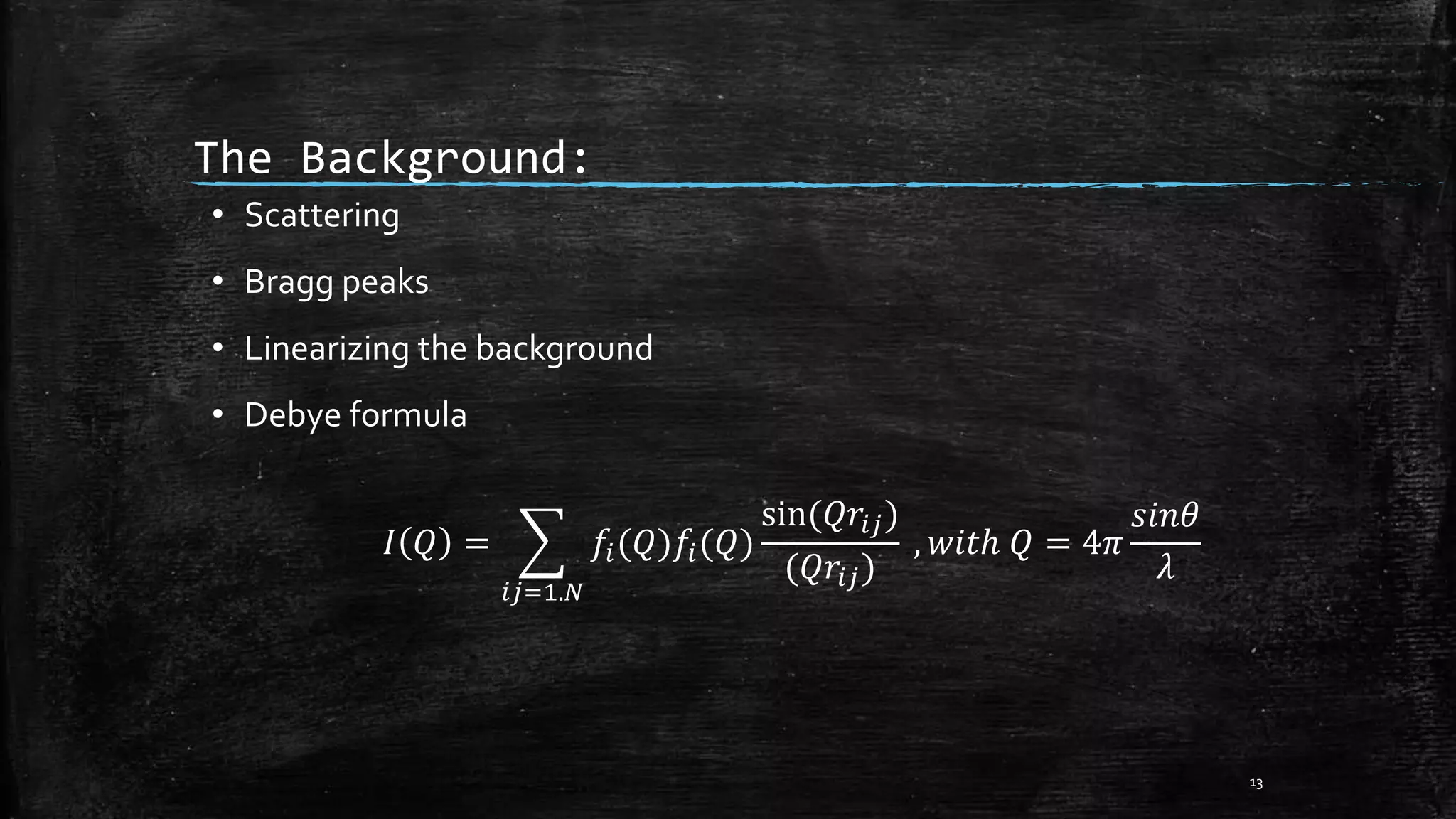
• Peak shape function
2
• The background
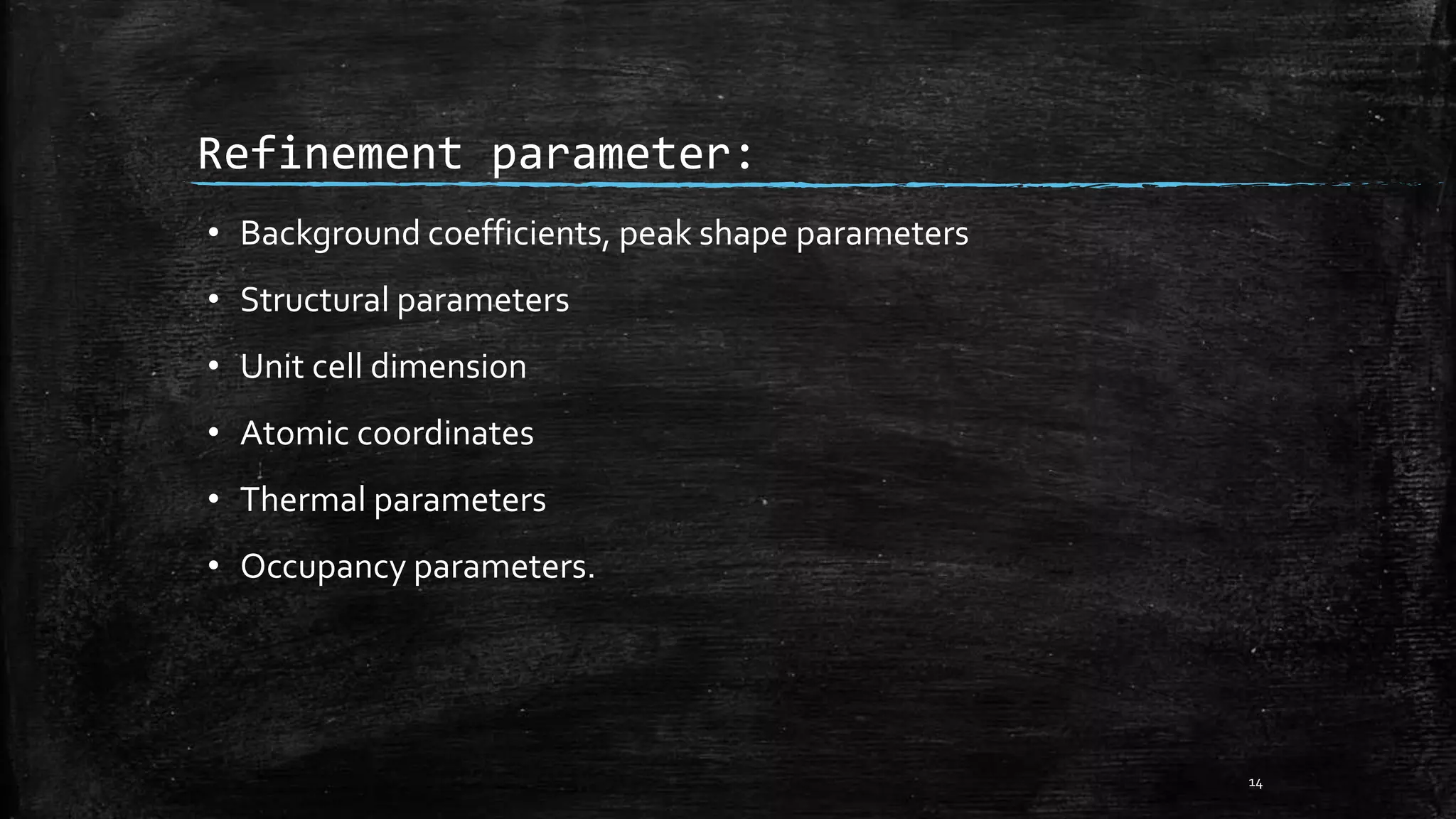
• Refinement parameter
• Some common problems
• Software's used in Rietveld
refinements
• Summary
Diffraction Methods:
• Identify crystal structure & quantify the content of crystalline
materials.
• Bragg’s Equation:
nλ=2dsinθ
• Sources:
X-ray
Neutrons
Electrons
1. B.DCULLITY, elements of x-ray diffraction, 2nd edition,Addison-wesley publishing, chapter 3 3
What comes before Rietveld method:
• Debye & Paul Scherer
Large and randomly oriented grains
Difficulty in measuring intensities
Increasing complexities
4
2. Fabio pulizzi, powder struggle, nature, (2014),
7.http://pd.chem.ucl.ac.uk/pdnn/mod1/ip.htm
Figure 1: Debye-Scherrer rings[7]
What is Rietveld Refinement?
5
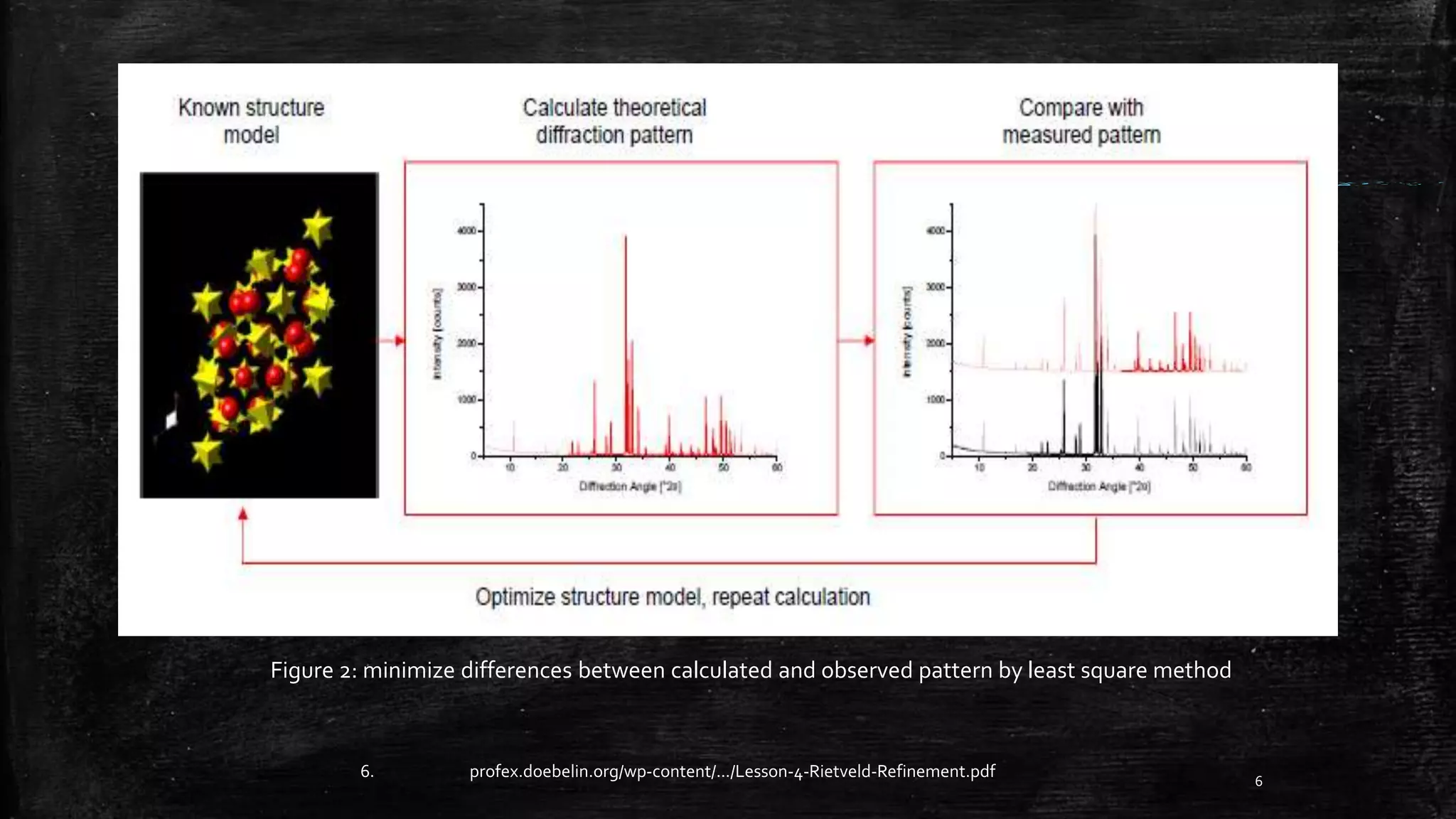
• Structure refinement technique
• use of least square method:
𝑀𝑖𝑛 = 𝑖=0
𝑛=1
[𝑊𝑖(𝑌𝑜𝑏𝑠 𝑖 − 𝑌𝑐𝑎𝑙𝑐 𝑖)2
]
𝑌𝑐𝑎𝑙𝑐 𝑖 can be expressed by following formation.
𝑌 𝑐𝑎𝑙𝑐 𝑖= 𝑝ℎ=1
𝑝ℎ𝑎𝑠𝑒𝑠
𝑆 𝑝ℎ ℎ𝑘𝑙(𝑝ℎ)(𝐾ℎ𝑘𝑙|𝐹ℎ𝑘𝑙
2|⏀ℎ𝑘𝑙(2θ𝑖−2θℎ𝑘𝑙)
3. Eric J. Mittemeijer ,U welzel, Modern Diffraction Methods,Chapter-2,WILEYVCH.
6
Figure 2: minimize differences between calculated and observed pattern by least square method
6. profex.doebelin.org/wp-content/.../Lesson-4-Rietveld-Refinement.pdf
Why Rietveld Refinements widely used?
7
• Computational nature
• Fast calculation
• Uses the entire spectrum (as wide as possible)
• Used in various fields
• Provide information about defects & quantitative phase analysis
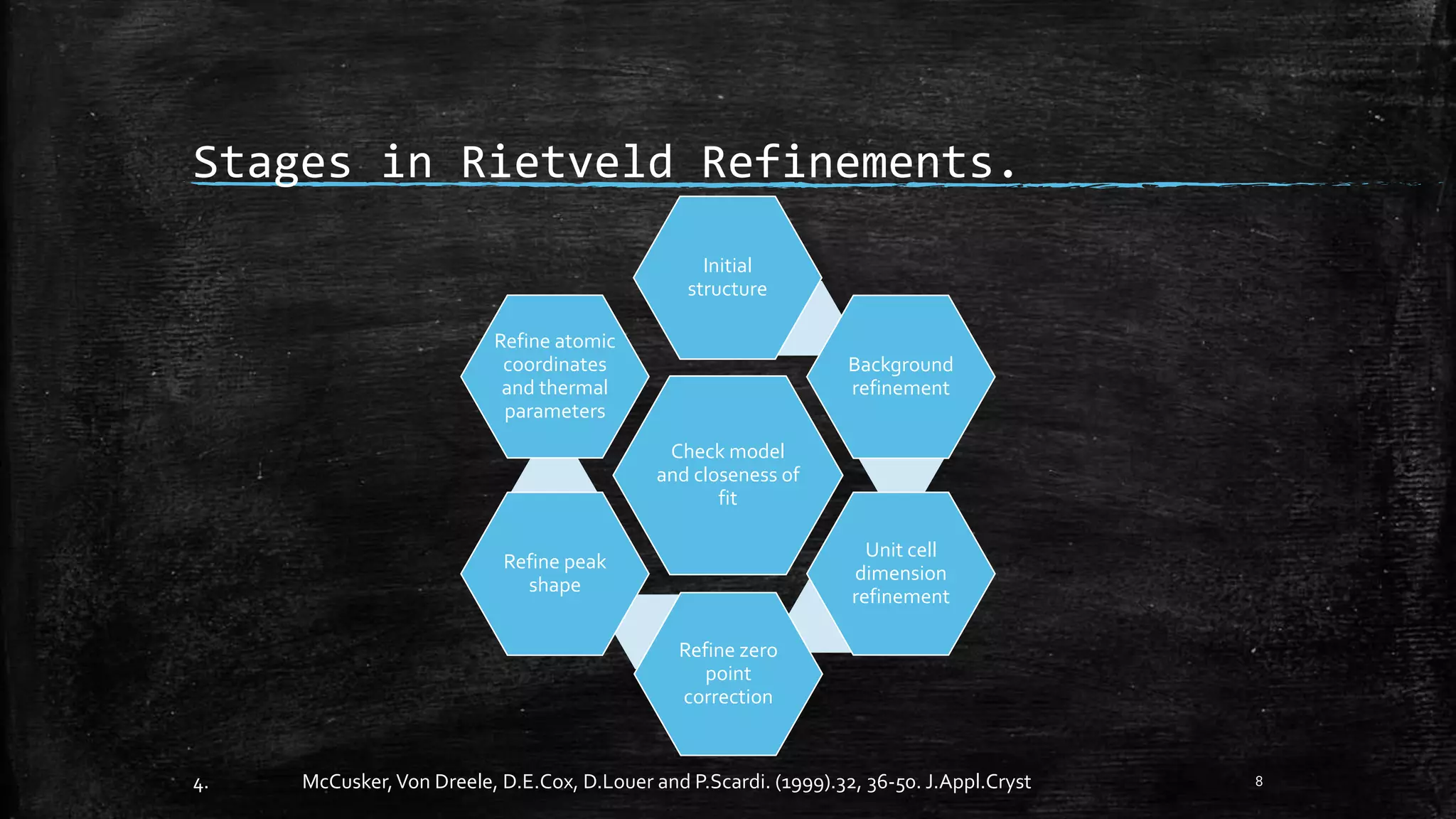
Stages in Rietveld Refinements.
84. McCusker,Von Dreele, D.E.Cox, D.Louer and P.Scardi. (1999).32, 36-50. J.Appl.Cryst
Check model
and closeness of
fit
Initial
structure
Background
refinement
Unit cell
dimension
refinement
Refine zero
point
correction
Refine peak
shape
Refine atomic
coordinates
and thermal
parameters
Le-bail Method:
• Use for Profile refinement
• Crystal structure determination
How to use?
Modify Rietveld code to set all 𝐹ℎ𝑘𝑙 𝑐𝑎𝑙𝑐 = 1
Extract 𝐹ℎ𝑘𝑙 𝑜𝑏𝑠 using Rietveld algorithm
Set 𝐹ℎ𝑘𝑙 𝑐𝑎𝑙𝑐 from extracted 𝐹ℎ𝑘𝑙 𝑜𝑏𝑠
Repeat 𝐹ℎ𝑘𝑙 𝑜𝑏𝑠 extraction now with 𝐹ℎ𝑘𝑙 𝑐𝑎𝑙𝑐
9
Figure 3: Peak fits of three selected reflections of LaB6.[3]
3. Eric J. Mittemeijer ,U welzel, Modern Diffraction Methods, Chapter-2,WILEYVCH.
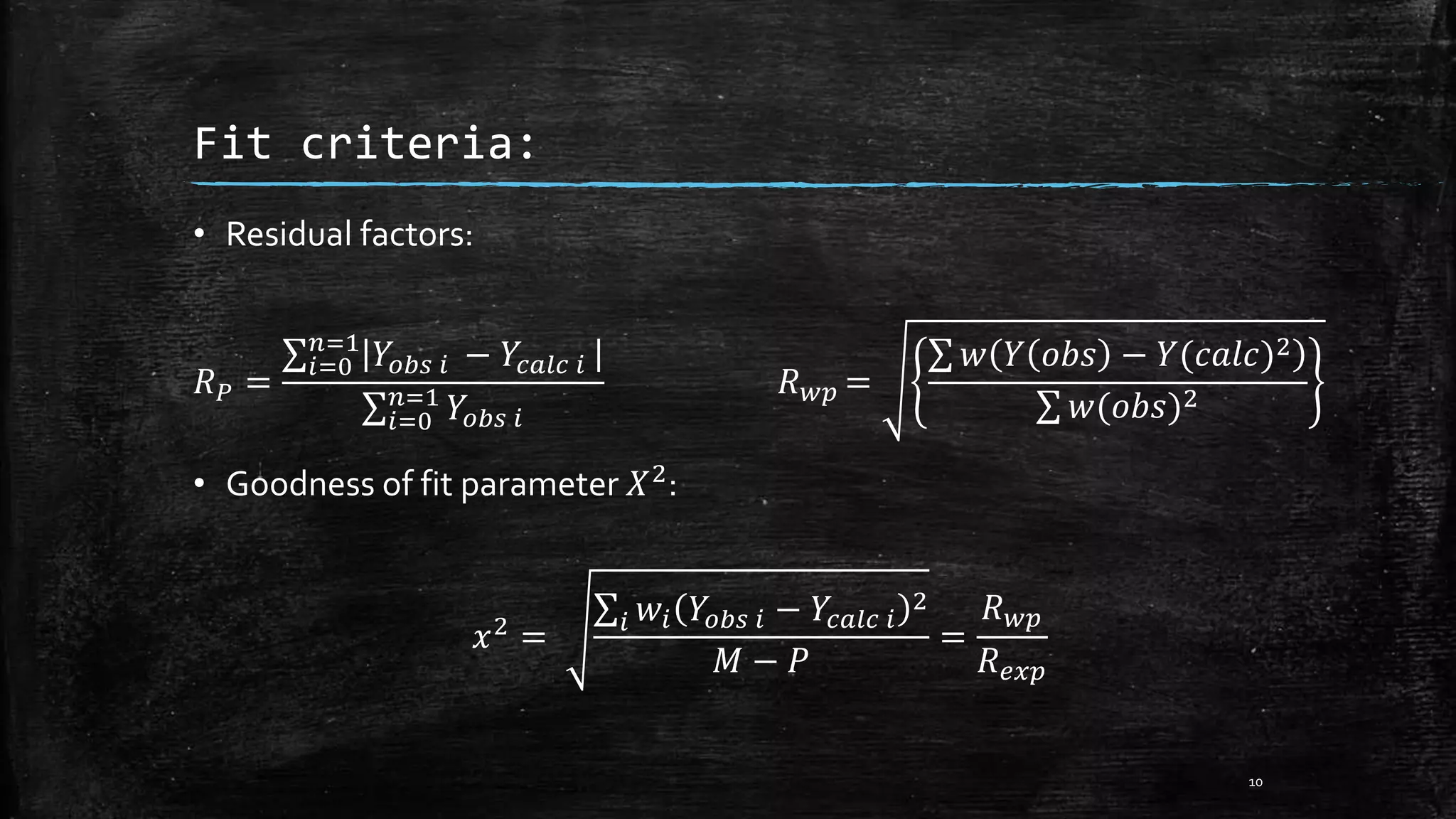
• Residual factors:
𝑅 𝑃 =
𝑖=0
𝑛=1
𝑌𝑜𝑏𝑠 𝑖 − 𝑌𝑐𝑎𝑙𝑐 𝑖
𝑖=0
𝑛=1
𝑌𝑜𝑏𝑠 𝑖
𝑅 𝑤𝑝 =
𝑤 𝑌 𝑜𝑏𝑠 − 𝑌(𝑐𝑎𝑙𝑐)2
𝑤(𝑜𝑏𝑠)2
• Goodness of fit parameter 𝑋2
:
𝑥2 = 𝑖 𝑤𝑖 𝑌𝑜𝑏𝑠 𝑖 − 𝑌𝑐𝑎𝑙𝑐 𝑖
2
𝑀 − 𝑃
=
𝑅 𝑤𝑝
𝑅 𝑒𝑥𝑝
10
Fit criteria:
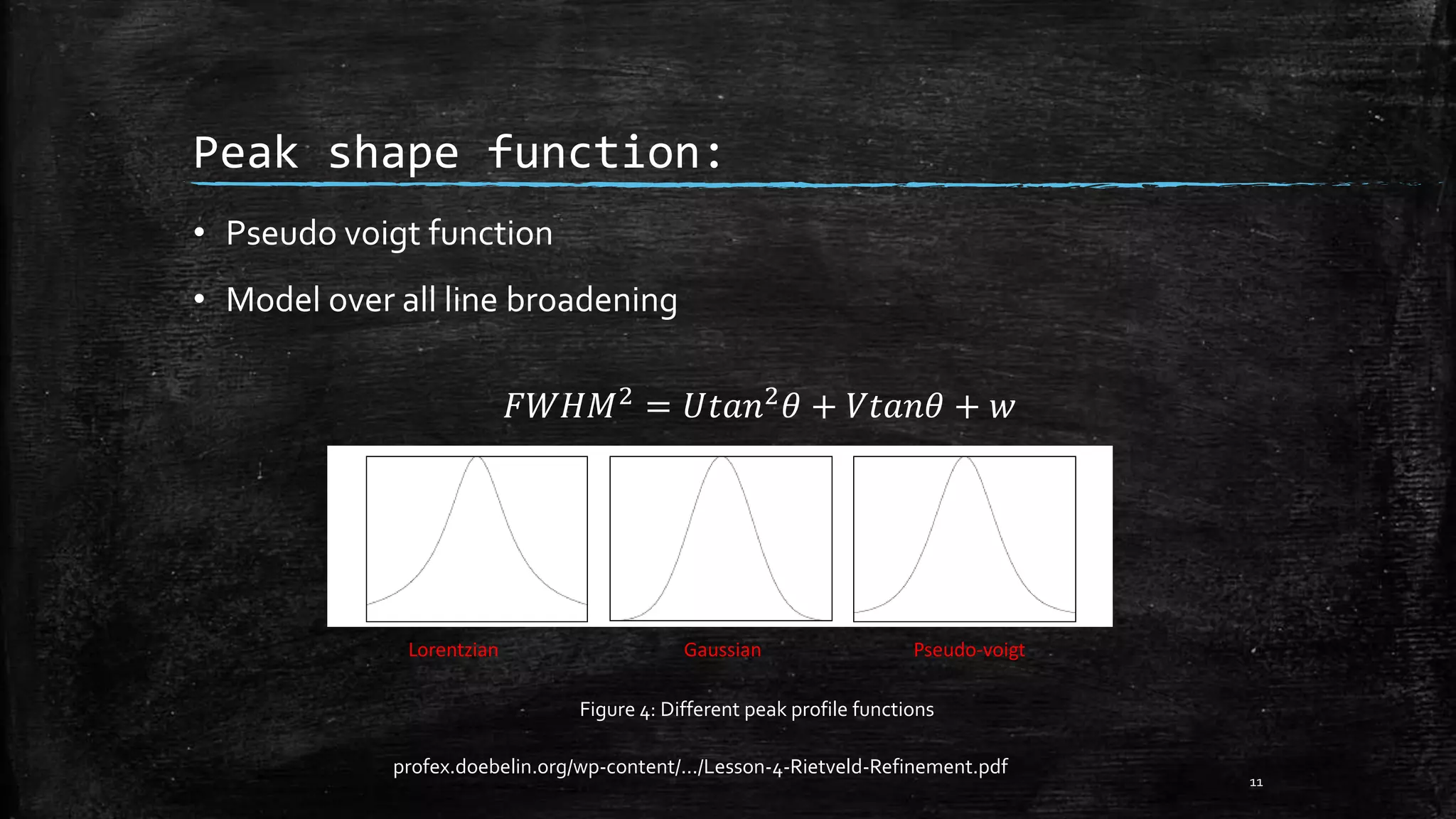
Peak shape function:
• Pseudo voigt function
• Model over all line broadening
𝐹𝑊𝐻𝑀2
= 𝑈𝑡𝑎𝑛2
𝜃 + 𝑉𝑡𝑎𝑛𝜃 + 𝑤
11
Lorentzian Gaussian Pseudo-voigt
Figure 4: Different peak profile functions
profex.doebelin.org/wp-content/.../Lesson-4-Rietveld-Refinement.pdf
12
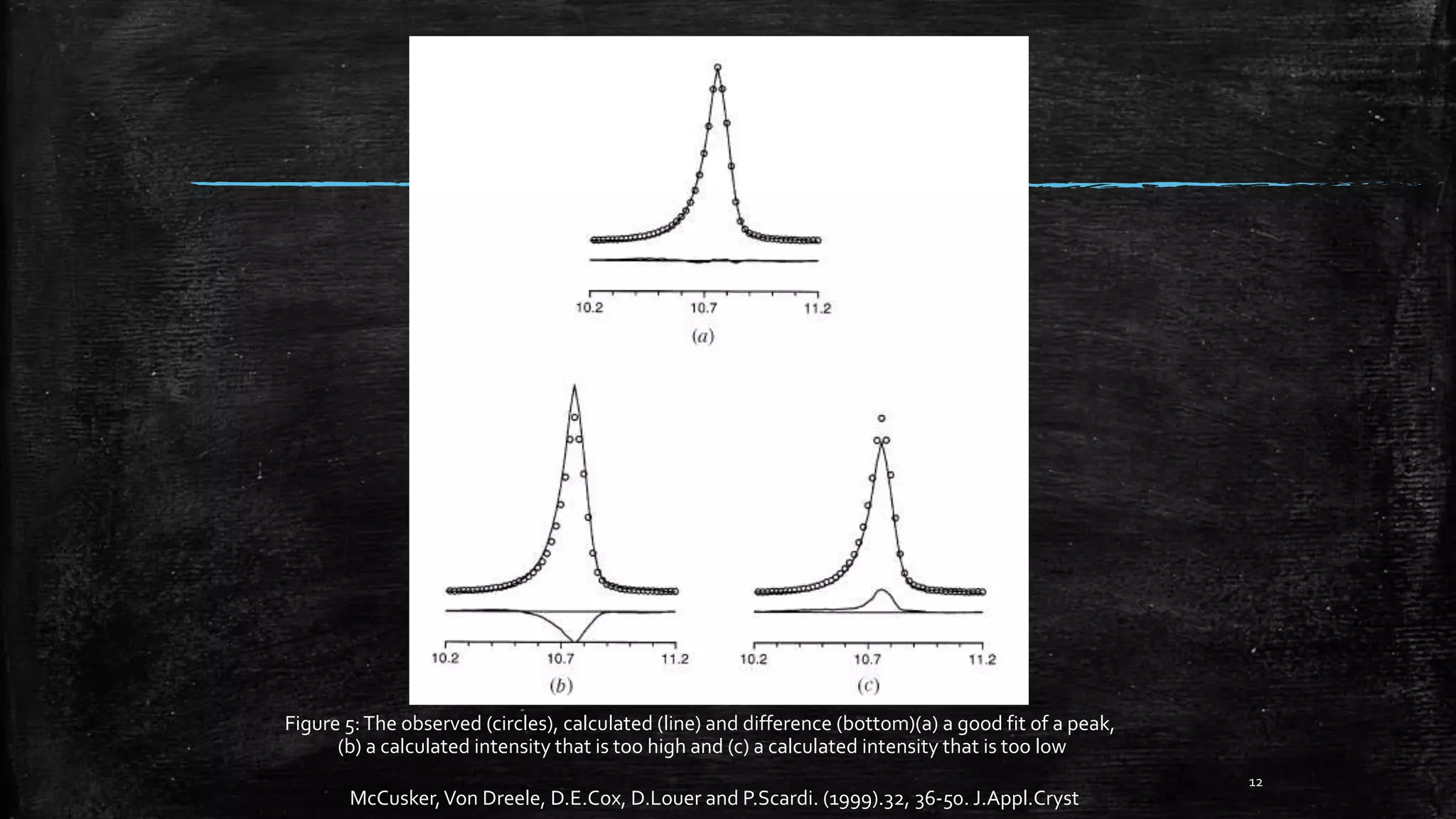
Figure 5:The observed (circles), calculated (line) and difference (bottom)(a) a good fit of a peak,
(b) a calculated intensity that is too high and (c) a calculated intensity that is too low
McCusker,Von Dreele, D.E.Cox, D.Louer and P.Scardi. (1999).32, 36-50. J.Appl.Cryst
The Background:
• Scattering
• Bragg peaks
• Linearizing the background
• Debye formula
𝐼 𝑄 =
𝑖𝑗=1.𝑁
𝑓𝑖(𝑄)𝑓𝑖(𝑄)
sin(𝑄𝑟𝑖𝑗)
(𝑄𝑟𝑖𝑗)
, 𝑤𝑖𝑡ℎ 𝑄 = 4𝜋
𝑠𝑖𝑛𝜃
𝜆
13
Refinement parameter:
• Background coefficients, peak shape parameters
• Structural parameters
• Unit cell dimension
• Atomic coordinates
• Thermal parameters
• Occupancy parameters.
14
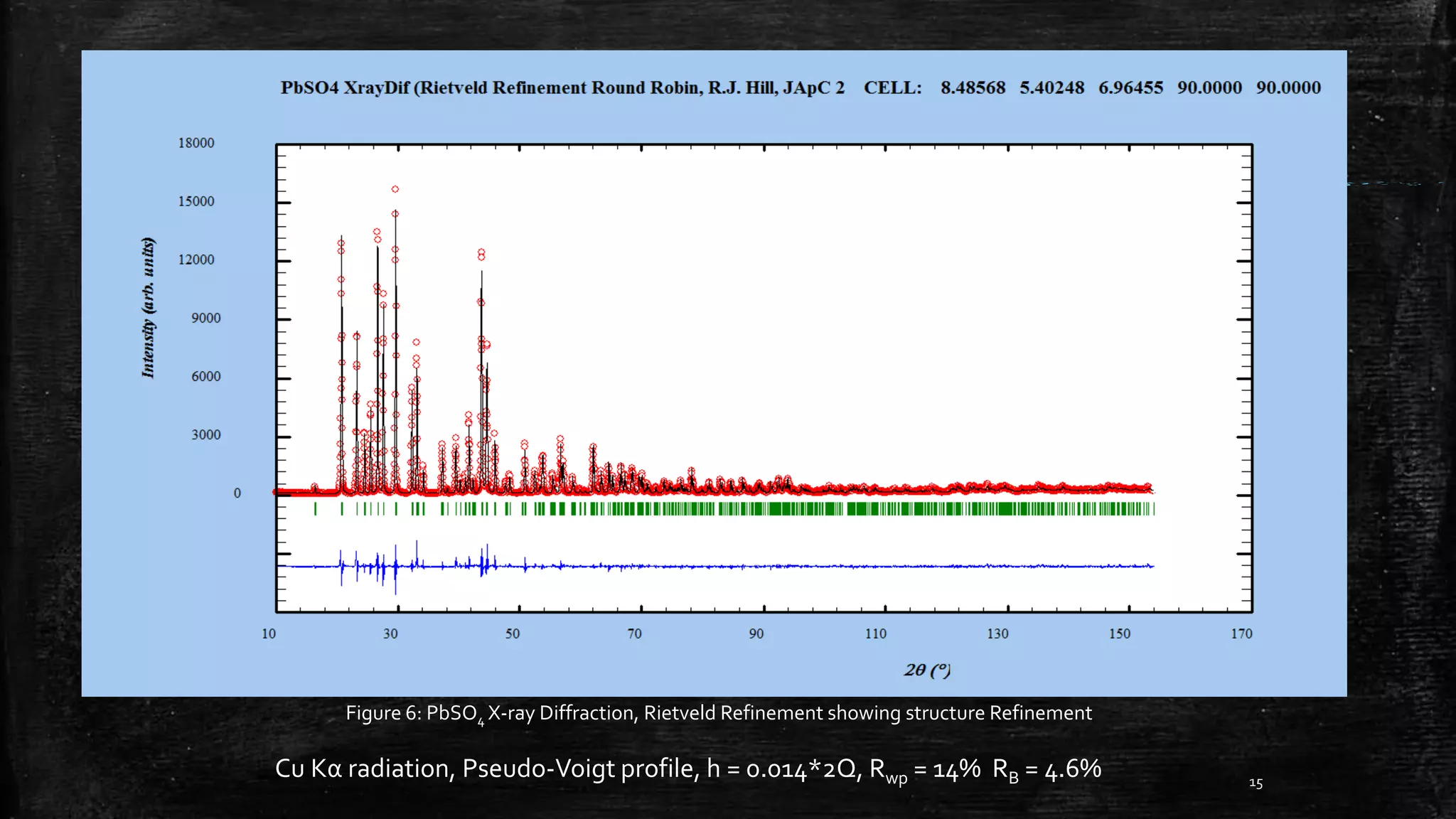
15
Figure 6: PbSO4 X-ray Diffraction, Rietveld Refinement showing structure Refinement
Cu Kα radiation, Pseudo-Voigt profile, h = 0.014*2Q, Rwp = 14% RB = 4.6%
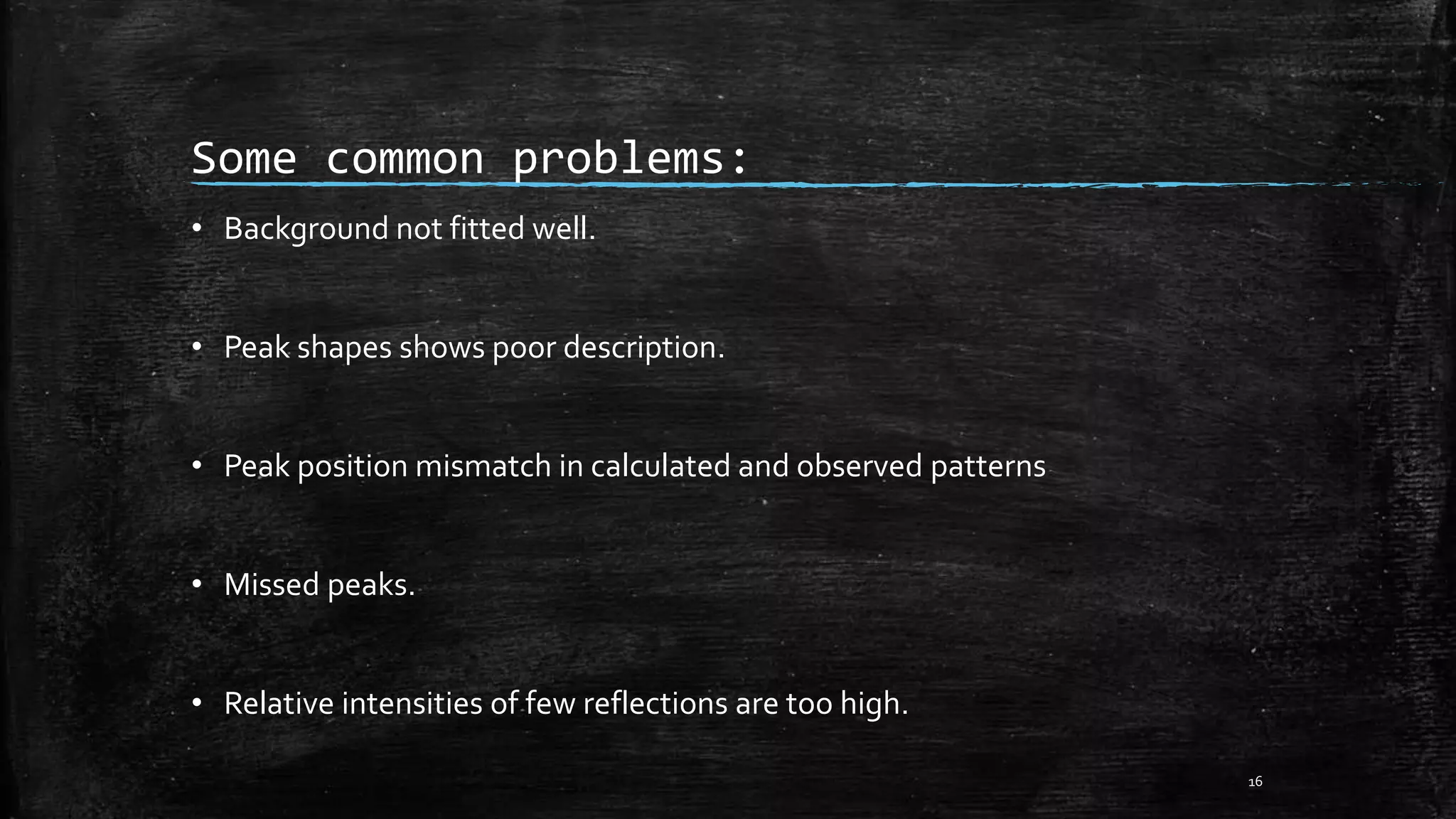
Some common problems:
• Background not fitted well.
• Peak shapes shows poor description.
• Peak position mismatch in calculated and observed patterns
• Missed peaks.
• Relative intensities of few reflections are too high.
16
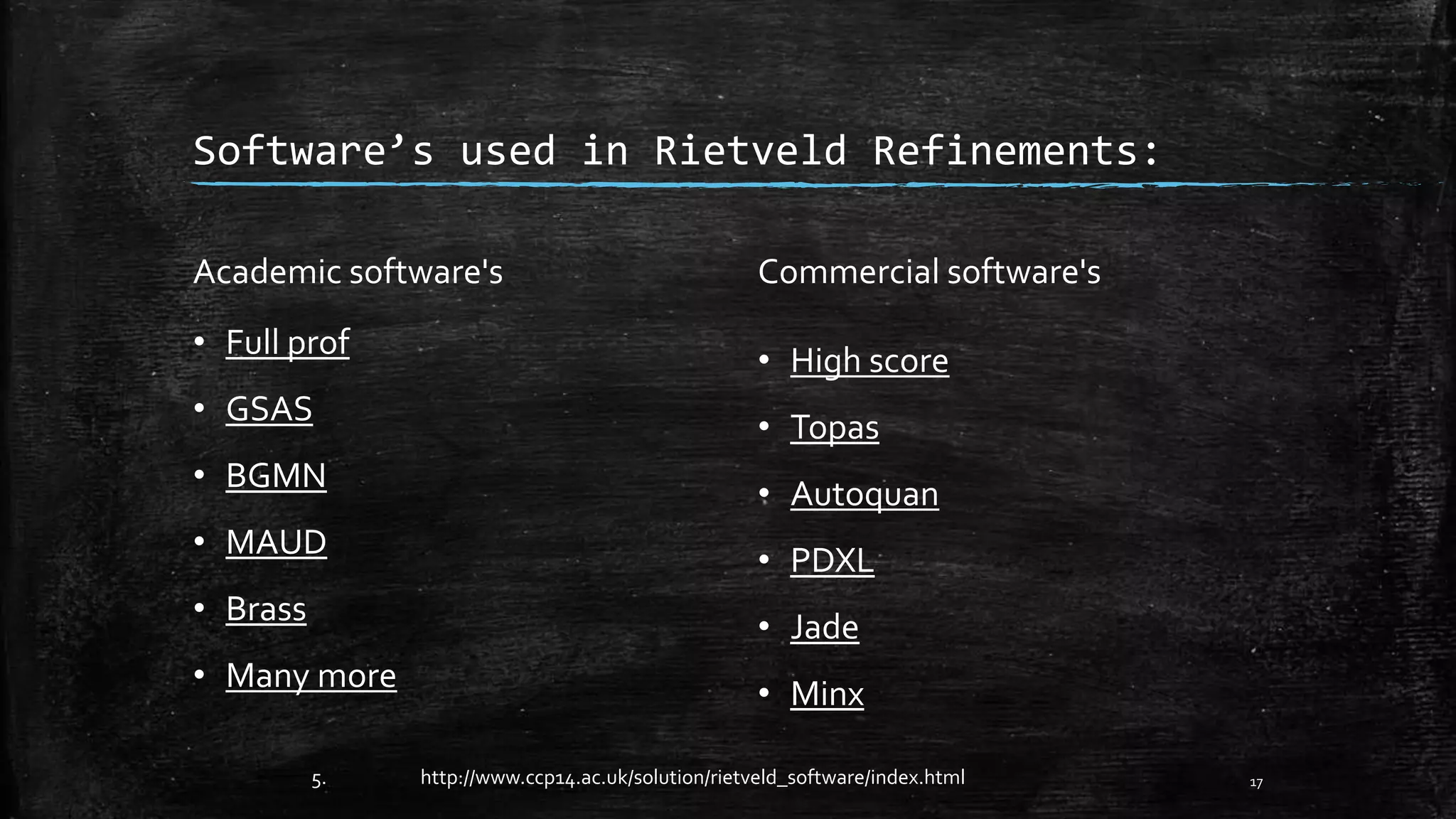
Software’s used in Rietveld Refinements:
Academic software's
• Full prof
• GSAS
• BGMN
• MAUD
• Brass
• Many more
Commercial software's
• High score
• Topas
• Autoquan
• PDXL
• Jade
• Minx
175. http://www.ccp14.ac.uk/solution/rietveld_software/index.html
Summary:
• Modern method for extracting structural details.
• Use directly measured intensity points.
• Use of computer software's.
• Best for peak separation.
• Used in different fields.
• Crystal structure determination.
18

Rietveld Refinements ppt

  • 1.
    Rietveld Refinements: Determination ofcrystal structure and crystal imperfections Speaker: Salman-ul-hassan Supervisor: Dr Nikolay. Zotov
  • 2.
    Outline: • Diffraction methods •What comes before Rietveld method • What is Rietveld Refinement? • Why Rietveld Refinements widely used? • Stages in Rietveld Refinements • Le-bail Method • Fit criteria • Peak shape function 2 • The background • Refinement parameter • Some common problems • Software's used in Rietveld refinements • Summary
  • 3.
    Diffraction Methods: • Identifycrystal structure & quantify the content of crystalline materials. • Bragg’s Equation: nλ=2dsinθ • Sources: X-ray Neutrons Electrons 1. B.DCULLITY, elements of x-ray diffraction, 2nd edition,Addison-wesley publishing, chapter 3 3
  • 4.
    What comes beforeRietveld method: • Debye & Paul Scherer Large and randomly oriented grains Difficulty in measuring intensities Increasing complexities 4 2. Fabio pulizzi, powder struggle, nature, (2014), 7.http://pd.chem.ucl.ac.uk/pdnn/mod1/ip.htm Figure 1: Debye-Scherrer rings[7]
  • 5.
    What is RietveldRefinement? 5 • Structure refinement technique • use of least square method: 𝑀𝑖𝑛 = 𝑖=0 𝑛=1 [𝑊𝑖(𝑌𝑜𝑏𝑠 𝑖 − 𝑌𝑐𝑎𝑙𝑐 𝑖)2 ] 𝑌𝑐𝑎𝑙𝑐 𝑖 can be expressed by following formation. 𝑌 𝑐𝑎𝑙𝑐 𝑖= 𝑝ℎ=1 𝑝ℎ𝑎𝑠𝑒𝑠 𝑆 𝑝ℎ ℎ𝑘𝑙(𝑝ℎ)(𝐾ℎ𝑘𝑙|𝐹ℎ𝑘𝑙 2|⏀ℎ𝑘𝑙(2θ𝑖−2θℎ𝑘𝑙) 3. Eric J. Mittemeijer ,U welzel, Modern Diffraction Methods,Chapter-2,WILEYVCH.
  • 6.
    6 Figure 2: minimizedifferences between calculated and observed pattern by least square method 6. profex.doebelin.org/wp-content/.../Lesson-4-Rietveld-Refinement.pdf
  • 7.
    Why Rietveld Refinementswidely used? 7 • Computational nature • Fast calculation • Uses the entire spectrum (as wide as possible) • Used in various fields • Provide information about defects & quantitative phase analysis
  • 8.
    Stages in RietveldRefinements. 84. McCusker,Von Dreele, D.E.Cox, D.Louer and P.Scardi. (1999).32, 36-50. J.Appl.Cryst Check model and closeness of fit Initial structure Background refinement Unit cell dimension refinement Refine zero point correction Refine peak shape Refine atomic coordinates and thermal parameters
  • 9.
    Le-bail Method: • Usefor Profile refinement • Crystal structure determination How to use? Modify Rietveld code to set all 𝐹ℎ𝑘𝑙 𝑐𝑎𝑙𝑐 = 1 Extract 𝐹ℎ𝑘𝑙 𝑜𝑏𝑠 using Rietveld algorithm Set 𝐹ℎ𝑘𝑙 𝑐𝑎𝑙𝑐 from extracted 𝐹ℎ𝑘𝑙 𝑜𝑏𝑠 Repeat 𝐹ℎ𝑘𝑙 𝑜𝑏𝑠 extraction now with 𝐹ℎ𝑘𝑙 𝑐𝑎𝑙𝑐 9 Figure 3: Peak fits of three selected reflections of LaB6.[3] 3. Eric J. Mittemeijer ,U welzel, Modern Diffraction Methods, Chapter-2,WILEYVCH.
  • 10.
    • Residual factors: 𝑅𝑃 = 𝑖=0 𝑛=1 𝑌𝑜𝑏𝑠 𝑖 − 𝑌𝑐𝑎𝑙𝑐 𝑖 𝑖=0 𝑛=1 𝑌𝑜𝑏𝑠 𝑖 𝑅 𝑤𝑝 = 𝑤 𝑌 𝑜𝑏𝑠 − 𝑌(𝑐𝑎𝑙𝑐)2 𝑤(𝑜𝑏𝑠)2 • Goodness of fit parameter 𝑋2 : 𝑥2 = 𝑖 𝑤𝑖 𝑌𝑜𝑏𝑠 𝑖 − 𝑌𝑐𝑎𝑙𝑐 𝑖 2 𝑀 − 𝑃 = 𝑅 𝑤𝑝 𝑅 𝑒𝑥𝑝 10 Fit criteria:
  • 11.
    Peak shape function: •Pseudo voigt function • Model over all line broadening 𝐹𝑊𝐻𝑀2 = 𝑈𝑡𝑎𝑛2 𝜃 + 𝑉𝑡𝑎𝑛𝜃 + 𝑤 11 Lorentzian Gaussian Pseudo-voigt Figure 4: Different peak profile functions profex.doebelin.org/wp-content/.../Lesson-4-Rietveld-Refinement.pdf
  • 12.
    12 Figure 5:The observed(circles), calculated (line) and difference (bottom)(a) a good fit of a peak, (b) a calculated intensity that is too high and (c) a calculated intensity that is too low McCusker,Von Dreele, D.E.Cox, D.Louer and P.Scardi. (1999).32, 36-50. J.Appl.Cryst
  • 13.
    The Background: • Scattering •Bragg peaks • Linearizing the background • Debye formula 𝐼 𝑄 = 𝑖𝑗=1.𝑁 𝑓𝑖(𝑄)𝑓𝑖(𝑄) sin(𝑄𝑟𝑖𝑗) (𝑄𝑟𝑖𝑗) , 𝑤𝑖𝑡ℎ 𝑄 = 4𝜋 𝑠𝑖𝑛𝜃 𝜆 13
  • 14.
    Refinement parameter: • Backgroundcoefficients, peak shape parameters • Structural parameters • Unit cell dimension • Atomic coordinates • Thermal parameters • Occupancy parameters. 14
  • 15.
    15 Figure 6: PbSO4X-ray Diffraction, Rietveld Refinement showing structure Refinement Cu Kα radiation, Pseudo-Voigt profile, h = 0.014*2Q, Rwp = 14% RB = 4.6%
  • 16.
    Some common problems: •Background not fitted well. • Peak shapes shows poor description. • Peak position mismatch in calculated and observed patterns • Missed peaks. • Relative intensities of few reflections are too high. 16
  • 17.
    Software’s used inRietveld Refinements: Academic software's • Full prof • GSAS • BGMN • MAUD • Brass • Many more Commercial software's • High score • Topas • Autoquan • PDXL • Jade • Minx 175. http://www.ccp14.ac.uk/solution/rietveld_software/index.html
  • 18.
    Summary: • Modern methodfor extracting structural details. • Use directly measured intensity points. • Use of computer software's. • Best for peak separation. • Used in different fields. • Crystal structure determination. 18