Nanocellulose: An Overview on Its Production,
Properties and Potential Applications
L. M. College of Pharmacy. Ahmedabad, Gujarat, India
RESEARCH STUDENT
Mehta Roshni Rajendra
M.Pharm (Pharmaceutics)
Dept. of Pharmaceutics and Pharmaceutical Technology
Gujarat Technological University
Email id:mehtaroshni1989@gmail.com
RESEARCH GUIDE
Dr. (Mrs.) Yamini Dushyant Shah
M. Pharm., Ph.D.(Associate Professor)
Dept. of Pharmaceutics and Pharmaceutical Technology
Email id:ydslmcp@gmail.com
1
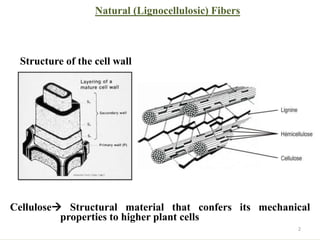
Natural (Lignocellulosic) Fibers
Structure of the cell wall
Cellulose Structural material that confers its mechanical
properties to higher plant cells
2
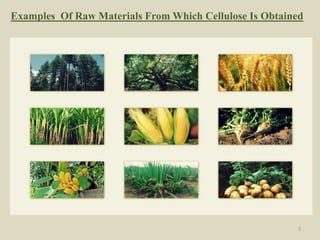
Examples Of Raw Materials From Which Cellulose Is Obtained
3
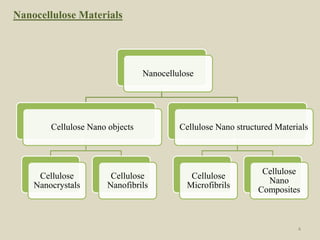
Nanocellulose
Cellulose Nano objects
Cellulose
Nanocrystals
Cellulose
Nanofibrils
Cellulose Nano structured Materials
Cellulose
Microfibrils
Cellulose
Nano
Composites
Nanocellulose Materials
4
Incentives For Manufacturing Industry
 New source of raw materials with wide largely, unexplored range of application
 New products
 New business opportunities
 Security of supply
 Sustainable and renewable sources
 Availability and price stability
 Source of green materials
 Reduced carbon foot print
 Recyclable and Reusable
 Compostable
Market Drivers
Green is the real value proposition for switching to nano crystalline cellulose-based
products composites must have bio-derived matrix polymers to be green 5
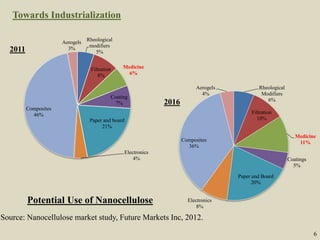
6
Rheological
Modifiers
6%
Filtration
10%
Medicine
11%
Coatings
5%
Paper and Board
20%
Electronics
8%
Composites
36%
Aerogels
4%
2016
Potential Use of Nanocellulose
Source: Nanocellulose market study, Future Markets Inc, 2012.
Rheological
modifiers
5%
Filtration
8%
Medicine
6%
Coating
7%
Paper and board
21%
Electronics
4%
Composites
46%
Aerogels
3%2011
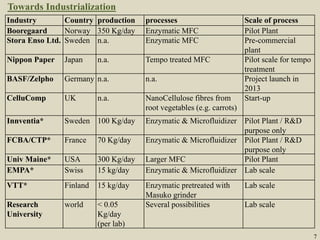
Towards Industrialization
7
Industry Country production processes Scale of process
Booregaard Norway 350 Kg/day Enzymatic MFC Pilot Plant
Stora Enso Ltd. Sweden n.a. Enzymatic MFC Pre-commercial
plant
Nippon Paper Japan n.a. Tempo treated MFC Pilot scale for tempo
treatment
BASF/Zelpho Germany n.a. n.a. Project launch in
2013
CelluComp UK n.a. NanoCellulose fibres from
root vegetables (e.g. carrots)
Start-up
Innventia* Sweden 100 Kg/day Enzymatic & Microfluidizer Pilot Plant / R&D
purpose only
FCBA/CTP* France 70 Kg/day Enzymatic & Microfluidizer Pilot Plant / R&D
purpose only
Univ Maine* USA 300 Kg/day Larger MFC Pilot Plant
EMPA* Swiss 15 kg/day Enzymatic & Microfluidizer Lab scale
VTT* Finland 15 kg/day Enzymatic pretreated with
Masuko grinder
Lab scale
Research
University
world < 0.05
Kg/day
(per lab)
Several possibilities Lab scale
Towards Industrialization
NC Manufacture
Process
Milling
Steam
Explosion
Ammonia
Fiber
Explosion
CO2
Explosion
Alkaline
hydrolysis
Acid
hydrolysis
Ozonolysis
Organosolv.
TEMPO
Oxidation
Enzymatic
treatment
Ionic
Liquids
8
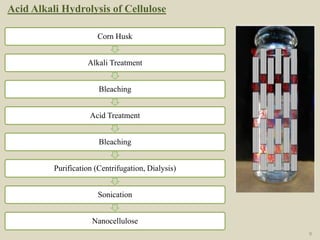
Corn Husk
Alkali Treatment
Bleaching
Acid Treatment
Bleaching
Purification (Centrifugation, Dialysis)
Sonication
Nanocellulose
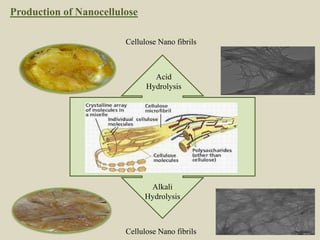
Acid Alkali Hydrolysis of Cellulose
9
Acid
Hydrolysis
Alkali
Hydrolysis
Cellulose Nano fibrils
Production of Nanocellulose
10
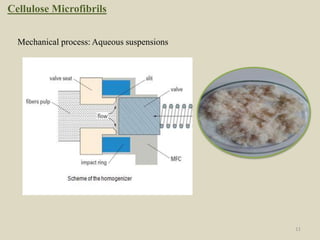
Cellulose Microfibrils
Mechanical process: Aqueous suspensions
11
Nano Cellulose (NC)
Details of the z-shaped interaction chamber of the
microfluidizer (Microfluidics Inc., USA)
Ultra-fine friction grinder
[http://www.masuko.com/English/product/
Masscolloder.html]
12
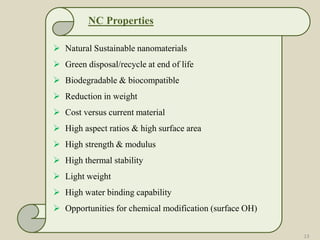
NC Properties
 Natural Sustainable nanomaterials
 Green disposal/recycle at end of life
 Biodegradable & biocompatible
 Reduction in weight
 Cost versus current material
 High aspect ratios & high surface area
 High strength & modulus
 High thermal stability
 Light weight
 High water binding capability
 Opportunities for chemical modification (surface OH)
13
14
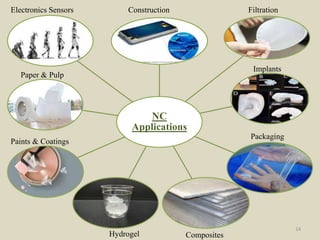
NC
Applications
Electronics Sensors Construction Filtration
Implants
Packaging
CompositesHydrogel
Paints & Coatings
Paper & Pulp
15
Characterization
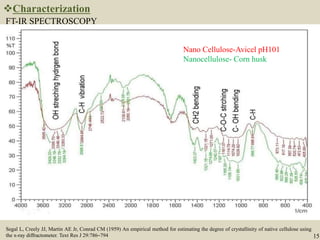
FT-IR SPECTROSCOPY
Segal L, Creely JJ, Martin AE Jr, Conrad CM (1959) An empirical method for estimating the degree of crystallinity of native cellulose using
the x-ray diffractometer. Text Res J 29:786–794
Nano Cellulose-Avicel pH101
Nanocellulose- Corn husk
Nelson ML, O'Connor RT (1964) Relation of certain infrared bands to cellulose crystallinity and crystal lattice type II. A new infrared ratio for
estimation of crystallinity in cellulose I and II. J ApplPolymSci 8:1325–1341 16
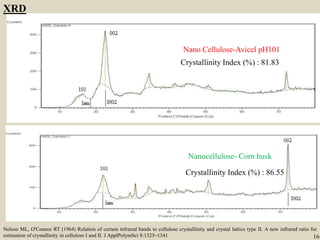
Nanocellulose- Corn husk
XRD
Nano Cellulose-Avicel pH101
Crystallinity Index (%) : 81.83
Crystallinity Index (%) : 86.55
17
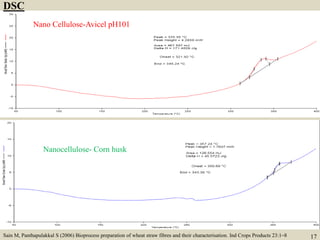
DSC
Sain M, Panthapulakkal S (2006) Bioprocess preparation of wheat straw fibres and their characterisation. Ind Crops Products 23:1–8
Nano Cellulose-Avicel pH101
Nanocellulose- Corn husk
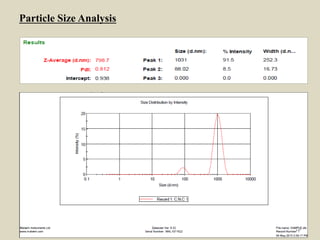
Particle Size Analysis
18
19
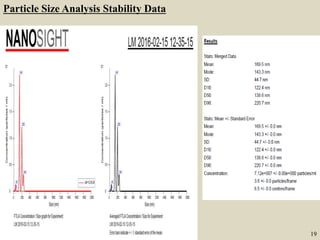
Particle Size Analysis Stability Data
Conclusions
 Our research product shall be utilized further in making new drug delivery
systems, co-processed excipients, composite materials and parenteral dosage
forms after performing stability studies
 Growing interest in both the non-food usage of renewable resources and
nanosized particles
 Polysaccharides : low cost materials, abundance, renewability,
 Preparation of nanoparticles with different morphologies and aspect ratios
 Nanosized particles : mechanical properties (strength, modulus,
 dimensional stability), decreased permeability to gases and water,
 Thermal stability
 Melt processing of nanocellulose based nanocomposites is challenging
20
21

Nano cellulose roshni

  • 1.
    Nanocellulose: An Overviewon Its Production, Properties and Potential Applications L. M. College of Pharmacy. Ahmedabad, Gujarat, India RESEARCH STUDENT Mehta Roshni Rajendra M.Pharm (Pharmaceutics) Dept. of Pharmaceutics and Pharmaceutical Technology Gujarat Technological University Email id:mehtaroshni1989@gmail.com RESEARCH GUIDE Dr. (Mrs.) Yamini Dushyant Shah M. Pharm., Ph.D.(Associate Professor) Dept. of Pharmaceutics and Pharmaceutical Technology Email id:ydslmcp@gmail.com 1
  • 2.
    Natural (Lignocellulosic) Fibers Structureof the cell wall Cellulose Structural material that confers its mechanical properties to higher plant cells 2
  • 3.
    Examples Of RawMaterials From Which Cellulose Is Obtained 3
  • 4.
    Nanocellulose Cellulose Nano objects Cellulose Nanocrystals Cellulose Nanofibrils CelluloseNano structured Materials Cellulose Microfibrils Cellulose Nano Composites Nanocellulose Materials 4
  • 5.
    Incentives For ManufacturingIndustry  New source of raw materials with wide largely, unexplored range of application  New products  New business opportunities  Security of supply  Sustainable and renewable sources  Availability and price stability  Source of green materials  Reduced carbon foot print  Recyclable and Reusable  Compostable Market Drivers Green is the real value proposition for switching to nano crystalline cellulose-based products composites must have bio-derived matrix polymers to be green 5
  • 6.
    6 Rheological Modifiers 6% Filtration 10% Medicine 11% Coatings 5% Paper and Board 20% Electronics 8% Composites 36% Aerogels 4% 2016 PotentialUse of Nanocellulose Source: Nanocellulose market study, Future Markets Inc, 2012. Rheological modifiers 5% Filtration 8% Medicine 6% Coating 7% Paper and board 21% Electronics 4% Composites 46% Aerogels 3%2011 Towards Industrialization
  • 7.
    7 Industry Country productionprocesses Scale of process Booregaard Norway 350 Kg/day Enzymatic MFC Pilot Plant Stora Enso Ltd. Sweden n.a. Enzymatic MFC Pre-commercial plant Nippon Paper Japan n.a. Tempo treated MFC Pilot scale for tempo treatment BASF/Zelpho Germany n.a. n.a. Project launch in 2013 CelluComp UK n.a. NanoCellulose fibres from root vegetables (e.g. carrots) Start-up Innventia* Sweden 100 Kg/day Enzymatic & Microfluidizer Pilot Plant / R&D purpose only FCBA/CTP* France 70 Kg/day Enzymatic & Microfluidizer Pilot Plant / R&D purpose only Univ Maine* USA 300 Kg/day Larger MFC Pilot Plant EMPA* Swiss 15 kg/day Enzymatic & Microfluidizer Lab scale VTT* Finland 15 kg/day Enzymatic pretreated with Masuko grinder Lab scale Research University world < 0.05 Kg/day (per lab) Several possibilities Lab scale Towards Industrialization
  • 8.
  • 9.
    Corn Husk Alkali Treatment Bleaching AcidTreatment Bleaching Purification (Centrifugation, Dialysis) Sonication Nanocellulose Acid Alkali Hydrolysis of Cellulose 9
  • 10.
    Acid Hydrolysis Alkali Hydrolysis Cellulose Nano fibrils CelluloseNano fibrils Production of Nanocellulose 10
  • 11.
  • 12.
    Nano Cellulose (NC) Detailsof the z-shaped interaction chamber of the microfluidizer (Microfluidics Inc., USA) Ultra-fine friction grinder [http://www.masuko.com/English/product/ Masscolloder.html] 12
  • 13.
    NC Properties  NaturalSustainable nanomaterials  Green disposal/recycle at end of life  Biodegradable & biocompatible  Reduction in weight  Cost versus current material  High aspect ratios & high surface area  High strength & modulus  High thermal stability  Light weight  High water binding capability  Opportunities for chemical modification (surface OH) 13
  • 14.
    14 NC Applications Electronics Sensors ConstructionFiltration Implants Packaging CompositesHydrogel Paints & Coatings Paper & Pulp
  • 15.
    15 Characterization FT-IR SPECTROSCOPY Segal L,Creely JJ, Martin AE Jr, Conrad CM (1959) An empirical method for estimating the degree of crystallinity of native cellulose using the x-ray diffractometer. Text Res J 29:786–794 Nano Cellulose-Avicel pH101 Nanocellulose- Corn husk
  • 16.
    Nelson ML, O'ConnorRT (1964) Relation of certain infrared bands to cellulose crystallinity and crystal lattice type II. A new infrared ratio for estimation of crystallinity in cellulose I and II. J ApplPolymSci 8:1325–1341 16 Nanocellulose- Corn husk XRD Nano Cellulose-Avicel pH101 Crystallinity Index (%) : 81.83 Crystallinity Index (%) : 86.55
  • 17.
    17 DSC Sain M, PanthapulakkalS (2006) Bioprocess preparation of wheat straw fibres and their characterisation. Ind Crops Products 23:1–8 Nano Cellulose-Avicel pH101 Nanocellulose- Corn husk
  • 18.
  • 19.
  • 20.
    Conclusions  Our researchproduct shall be utilized further in making new drug delivery systems, co-processed excipients, composite materials and parenteral dosage forms after performing stability studies  Growing interest in both the non-food usage of renewable resources and nanosized particles  Polysaccharides : low cost materials, abundance, renewability,  Preparation of nanoparticles with different morphologies and aspect ratios  Nanosized particles : mechanical properties (strength, modulus,  dimensional stability), decreased permeability to gases and water,  Thermal stability  Melt processing of nanocellulose based nanocomposites is challenging 20
  • 21.