Cellulose Nanofiber / Nanocellulose
G. M. Ahshanuzzaman
Student Id : 110515
4th Year 1st Term
Forestry and Wood Technology Discipline
Khulna University
Khulna
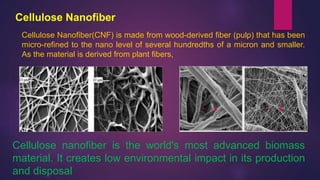
Cellulose Nanofiber(CNF) is made from wood-derived fiber (pulp) that has been
micro-refined to the nano level of several hundredths of a micron and smaller.
As the material is derived from plant fibers,
Cellulose Nanofiber
Cellulose nanofiber is the world's most advanced biomass
material. It creates low environmental impact in its production
and disposal
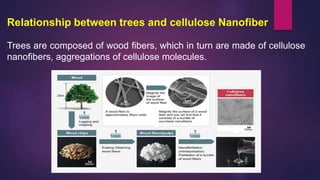
Relationship between trees and cellulose Nanofiber
Trees are composed of wood fibers, which in turn are made of cellulose
nanofibers, aggregations of cellulose molecules.
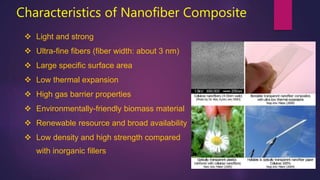
 Light and strong
 Ultra-fine fibers (fiber width: about 3 nm)
 Large specific surface area
 Low thermal expansion
 High gas barrier properties
 Environmentally-friendly biomass material
 Renewable resource and broad availability
 Low density and high strength compared
with inorganic fillers
Characteristics of Nanofiber Composite
Properties of Nanofiber Composite
Nanocellulose dimensions and crystallinity
They consist cellulose nanofibrils and nanofibril bundles. Typical values
for the degree of crystallinity around 63%.
Viscosity
The high viscosity at low nanocellulose concentrations makes
nanocellulose very interesting as a non-caloric stabilizer and gellant in
food applications,
Barrier properties
In semi-crystalline polymers, the crystalline regions are considered to be
gas impermeable. Due to relatively high crystallinity (high cohesive
energy density) it has been suggested that nanocellulose might act as a
barrier material.
 The modulus of elasticity has the same level of strength as that of
aramid fiber, which is known as a high-strength fiber,
 Thermal expansion on par with glass.
 Its tensile strength is about 500MPa
 Its stiffness is about 140–220 Gpa
 Films made from nanocellulose have high strength (over 200 MPa),
 High stiffness (around 20 GPa) and high strain
 Its strength/weight ratio is 8 times that of stainless steel.
Mechanical Properties
Applications of Nanofibers and Nanocomposites
 Paper and paperboard
 Composite
 Regenerated cellulose products, such as fibers films, cellulose derivatives
 Tobacco filter additive
 Organometallic modified nanocellulose in battery separators
 Reinforcement of conductive materials
 Loud-speaker membranes
 High-flux membranes
 Flexible electronic displays
 Computer components
 Lightweight body armour and ballistic glass
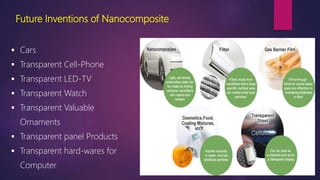
Future Inventions of Nanocomposite
 Cars
 Transparent Cell-Phone
 Transparent LED-TV
 Transparent Watch
 Transparent Valuable
Ornaments
 Transparent panel Products
 Transparent hard-wares for
Computer

Cellulose nanofiber

  • 1.
    Cellulose Nanofiber /Nanocellulose G. M. Ahshanuzzaman Student Id : 110515 4th Year 1st Term Forestry and Wood Technology Discipline Khulna University Khulna
  • 2.
    Cellulose Nanofiber(CNF) ismade from wood-derived fiber (pulp) that has been micro-refined to the nano level of several hundredths of a micron and smaller. As the material is derived from plant fibers, Cellulose Nanofiber Cellulose nanofiber is the world's most advanced biomass material. It creates low environmental impact in its production and disposal
  • 3.
    Relationship between treesand cellulose Nanofiber Trees are composed of wood fibers, which in turn are made of cellulose nanofibers, aggregations of cellulose molecules.
  • 4.
     Light andstrong  Ultra-fine fibers (fiber width: about 3 nm)  Large specific surface area  Low thermal expansion  High gas barrier properties  Environmentally-friendly biomass material  Renewable resource and broad availability  Low density and high strength compared with inorganic fillers Characteristics of Nanofiber Composite
  • 5.
    Properties of NanofiberComposite Nanocellulose dimensions and crystallinity They consist cellulose nanofibrils and nanofibril bundles. Typical values for the degree of crystallinity around 63%. Viscosity The high viscosity at low nanocellulose concentrations makes nanocellulose very interesting as a non-caloric stabilizer and gellant in food applications, Barrier properties In semi-crystalline polymers, the crystalline regions are considered to be gas impermeable. Due to relatively high crystallinity (high cohesive energy density) it has been suggested that nanocellulose might act as a barrier material.
  • 6.
     The modulusof elasticity has the same level of strength as that of aramid fiber, which is known as a high-strength fiber,  Thermal expansion on par with glass.  Its tensile strength is about 500MPa  Its stiffness is about 140–220 Gpa  Films made from nanocellulose have high strength (over 200 MPa),  High stiffness (around 20 GPa) and high strain  Its strength/weight ratio is 8 times that of stainless steel. Mechanical Properties
  • 7.
    Applications of Nanofibersand Nanocomposites  Paper and paperboard  Composite  Regenerated cellulose products, such as fibers films, cellulose derivatives  Tobacco filter additive  Organometallic modified nanocellulose in battery separators  Reinforcement of conductive materials  Loud-speaker membranes  High-flux membranes  Flexible electronic displays  Computer components  Lightweight body armour and ballistic glass
  • 8.
    Future Inventions ofNanocomposite  Cars  Transparent Cell-Phone  Transparent LED-TV  Transparent Watch  Transparent Valuable Ornaments  Transparent panel Products  Transparent hard-wares for Computer