Cellulose
Md. Sajjad Hossain Tuhin
Student ID: 100510
4th year, 1st term
Forestry and Wood Technology Discipline
Khulna University
10051024 Dec 2014 1
Cellulose
Structure of Cellulose
Cellulose formation in woody plants
Properties of Cellulose (Physical and Chemical)
Use
100510
Presentation outline
24 Dec 2014 2
Cellulose
 It is the most abundant naturally occurring organic substance
 Representing about1.5×1012 tons annual biomass production
 First described in 1838 by French chemist “Anselm Payen”
 It occurs in almost pure form in cotton fiber at around 98%.
 As a raw material, cellulose has been used about150 years
 First thermoplastic polymer material called “Celluloid”
Manufactured by Hyatt Manufacturing Company in 1870
10051024 Dec 2014 3
100510
 Tollens in 1895 and Nastukoff in 1900 recognized that cellulose is a
linear polymer of glucose by x-ray pattern analysis.
 In 1920 it is discovered that celluloses in delignified wood pulp,
flax, ramie, and cotton.
 The Chinese discovered the usefulness of cellulose and developed a
process in A.D. 100 that gave them that most wonderful of
inventions... paper.
 Create other products such as rayon and the transparent film called
cellophane.
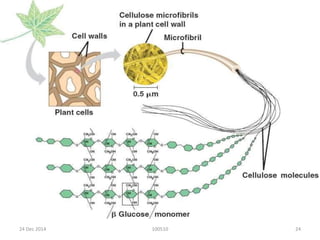
 In Vascular plants cellulose is synthesized at the plasma membrane
by rosette terminal complexes (RTCs) (Hexameric protein
structures, approximately 25 nm in diameter).
24 Dec 2014 4
100510
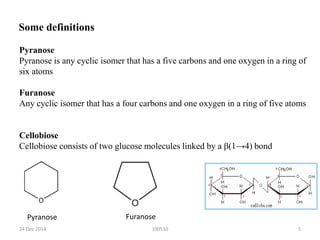
Pyranose
Pyranose is any cyclic isomer that has a five carbons and one oxygen in a ring of
six atoms
Furanose
Any cyclic isomer that has a four carbons and one oxygen in a ring of five atoms
Cellobiose
Cellobiose consists of two glucose molecules linked by a β(1→4) bond
Some definitions
Pyranose Furanose
24 Dec 2014 5
Structure of cellulose
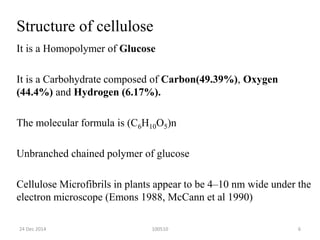
It is a Homopolymer of Glucose
It is a Carbohydrate composed of Carbon(49.39%), Oxygen
(44.4%) and Hydrogen (6.17%).
The molecular formula is (C6H10O5)n
Unbranched chained polymer of glucose
Cellulose Microfibrils in plants appear to be 4–10 nm wide under the
electron microscope (Emons 1988, McCann et al 1990)
10051024 Dec 2014 6
100510
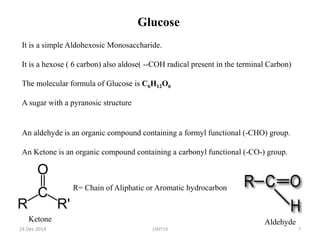
Glucose
It is a simple Aldohexosic Monosaccharide.
It is a hexose ( 6 carbon) also aldose( --COH radical present in the terminal Carbon)
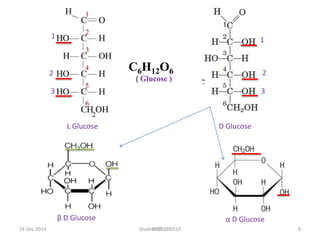
The molecular formula of Glucose is C6H12O6
A sugar with a pyranosic structure
An aldehyde is an organic compound containing a formyl functional (-CHO) group.
An Ketone is an organic compound containing a carbonyl functional (-CO-) group.
AldehydeKetone
R= Chain of Aliphatic or Aromatic hydrocarbon
24 Dec 2014 7
100510Student ID: 100510
1
2
3
C6H12O6
( Glucose )
1
2
3
D GlucoseL Glucose
β D Glucose α D Glucose
24 Dec 2014 8
100510
Pyranosic Structure of
Glucose
24 Dec 2014 9
100510
6
1
23
4 1
23
4
6
5 5
H2O
O
H2O
O
O O
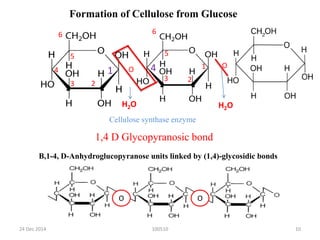
1,4 D Glycopyranosic bond
Formation of Cellulose from Glucose
B,1-4, D-Anhydroglucopyranose units linked by (1,4)-glycosidic bonds
Cellulose synthase enzyme
24 Dec 2014 10
100510
1
2
1
1
1
1
2
2
2
2
2
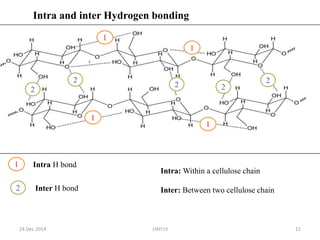
Intra H bond
Inter H bond
Intra and inter Hydrogen bonding
Intra: Within a cellulose chain
Inter: Between two cellulose chain
24 Dec 2014 11
100510
Crystalline and Amorphous region
Crystalline region: Intra and Inter molecular bonding is so strong
Do not absorb much moisture
Amorphous region: Bonding is week
Absorb too much moisture
24 Dec 2014 12
100510
Cellulose formation in woody plants
Photosynthesis
Sap conduction
(C6H12O6)
Plasma membrane
Rosette terminal complexes (RTCs)
Spins“ microfibril into cell wall
Cell division
6H20 + 6CO2
___________________ C6H12O6 + 6O2
Sunlight
Chlorophyll
24 Dec 2014 13
100510
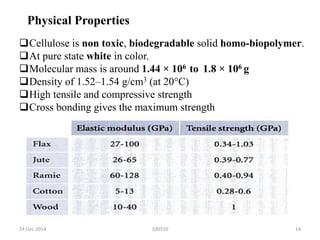
Physical Properties
Cellulose is non toxic, biodegradable solid homo-biopolymer.
At pure state white in color.
Molecular mass is around 1.44 × 10⁶ to 1.8 × 10⁶ g
Density of 1.52–1.54 g/cm3 (at 20°C)
High tensile and compressive strength
Cross bonding gives the maximum strength
24 Dec 2014 14
24 Dec 2014 100510 15
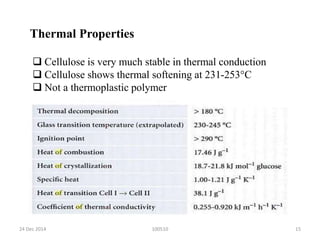
 Cellulose is very much stable in thermal conduction
 Cellulose shows thermal softening at 231-253°C
 Not a thermoplastic polymer
Thermal Properties
10051024 Dec 2014 16
Electrical Properties
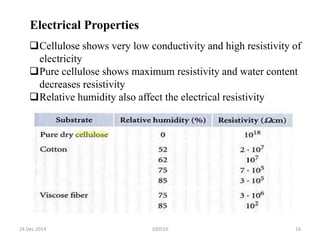
Cellulose shows very low conductivity and high resistivity of
electricity
Pure cellulose shows maximum resistivity and water content
decreases resistivity
Relative humidity also affect the electrical resistivity
10051024 Dec 2014 17
Chemical Properties
 DP is 8000-10000
 Isolable is water but uptake water around 8-14% at 60% relative
humidity and 20ᵒC
 Soluble in organic chemicals
 Give anhydrous reaction with concentrated acids
 Reacts with Hydrocarbons, alcohols, ketones, acids, esters, amides,
halogenated hydrocarbons, hydrazine etc.
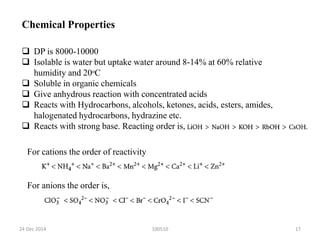
 Reacts with strong base. Reacting order is,
For cations the order of reactivity
For anions the order is,
24 Dec 2014 100510 18
Some swelling agents of cellulose
24 Dec 2014 100510 19
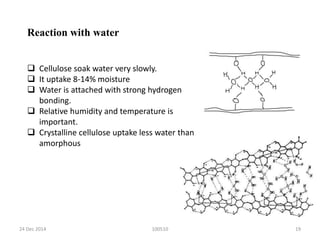
Reaction with water
 Cellulose soak water very slowly.
 It uptake 8-14% moisture
 Water is attached with strong hydrogen
bonding.
 Relative humidity and temperature is
important.
 Crystalline cellulose uptake less water than
amorphous
24 Dec 2014 100510 20
Reaction with strong base
Reacts with strong base quickly.
According to the reactivity with base it can be separated into three types:
(i) α cellulose, (ii) β cellulose, (iiii)γ cellulose
In 17.5% NaOH solution Insoluble: α cellulose
Soluble but precipitated in neutral solution: β cellulose
Very much soluble: γ cellulose
24 Dec 2014 100510 21
Cellulose Extraction from wood
24 Dec 2014 100510 22
Cellulose Extraction from wood cont…
100510
Use of cellulose
Cotton: composed of 87 -90% cellulose with the cotton fibers containing polymer
chains
Pharmaceuticals: Medicines are derived from plants cellulose, cellulose acetate , etc.
Cellophane: Can be obtained when a viscous cellulose reacts with acid (sulfuric acid)
Bomb: Cellulose trinitrate is used as a propellant for bullets due the fact that nitrate –OH
group can be explosive.
Energy Drinks: Glucuronolacton, vitamins, and carbohydrates
Industrial Sugar, biofuel production, using oil production, ester production
24 Dec 2014 23
10051024 Dec 2014 24
100510
1. Beck-Candanedo, S., Roman, M., & Gray, D. G. (2005). Effect of reaction
conditions on the properties and behavior of wood cellulose nanocrystal
suspensions. Biomacromolecules, Vol.6, No.2, pp. 1048-1054.
2. Boruvkova, K, and Wiener, J 2011, Water Absorption in Carboxymethyl Cellulose,
AUTEX Research Journal, Vol. 11, No4, December 2011
3. Duran, N., Lemes, A. P., Duran, M., Freer, J., & Baeza, J. (2011). A Mini review of
Cellulose Nanocrystals and Its Potential Integration as Co-Product in Bioethanol
Production. Journal of the Chilean Chemical Society, Vol.56, No.2, pp. 672-677
4. Emons AMC. 1988. Methods for visualizing cell wall texture. Acta Bot. Neerl.
37:31–38.
5. OSullivan, A. C. (1997). Cellulose: the structure slowly unravels. Cellulose, Vol.4,
No.3, pp. 173-207.
6. http://dx.doi.org/10.5772/46512
7. http://en.wikipedia.org
8. http://www.ethanolrfa.org
9. http://www.scienceclarified.com/Ca-Ch/Cellulose.html
References
24 Dec 2014 25
Question?????
10051024 Dec 2014 26
Thank You
10051024 Dec 2014 27

Cellulose and it's properties

  • 1.
    Cellulose Md. Sajjad HossainTuhin Student ID: 100510 4th year, 1st term Forestry and Wood Technology Discipline Khulna University 10051024 Dec 2014 1
  • 2.
    Cellulose Structure of Cellulose Celluloseformation in woody plants Properties of Cellulose (Physical and Chemical) Use 100510 Presentation outline 24 Dec 2014 2
  • 3.
    Cellulose  It isthe most abundant naturally occurring organic substance  Representing about1.5×1012 tons annual biomass production  First described in 1838 by French chemist “Anselm Payen”  It occurs in almost pure form in cotton fiber at around 98%.  As a raw material, cellulose has been used about150 years  First thermoplastic polymer material called “Celluloid” Manufactured by Hyatt Manufacturing Company in 1870 10051024 Dec 2014 3
  • 4.
    100510  Tollens in1895 and Nastukoff in 1900 recognized that cellulose is a linear polymer of glucose by x-ray pattern analysis.  In 1920 it is discovered that celluloses in delignified wood pulp, flax, ramie, and cotton.  The Chinese discovered the usefulness of cellulose and developed a process in A.D. 100 that gave them that most wonderful of inventions... paper.  Create other products such as rayon and the transparent film called cellophane.  In Vascular plants cellulose is synthesized at the plasma membrane by rosette terminal complexes (RTCs) (Hexameric protein structures, approximately 25 nm in diameter). 24 Dec 2014 4
  • 5.
    100510 Pyranose Pyranose is anycyclic isomer that has a five carbons and one oxygen in a ring of six atoms Furanose Any cyclic isomer that has a four carbons and one oxygen in a ring of five atoms Cellobiose Cellobiose consists of two glucose molecules linked by a β(1→4) bond Some definitions Pyranose Furanose 24 Dec 2014 5
  • 6.
    Structure of cellulose Itis a Homopolymer of Glucose It is a Carbohydrate composed of Carbon(49.39%), Oxygen (44.4%) and Hydrogen (6.17%). The molecular formula is (C6H10O5)n Unbranched chained polymer of glucose Cellulose Microfibrils in plants appear to be 4–10 nm wide under the electron microscope (Emons 1988, McCann et al 1990) 10051024 Dec 2014 6
  • 7.
    100510 Glucose It is asimple Aldohexosic Monosaccharide. It is a hexose ( 6 carbon) also aldose( --COH radical present in the terminal Carbon) The molecular formula of Glucose is C6H12O6 A sugar with a pyranosic structure An aldehyde is an organic compound containing a formyl functional (-CHO) group. An Ketone is an organic compound containing a carbonyl functional (-CO-) group. AldehydeKetone R= Chain of Aliphatic or Aromatic hydrocarbon 24 Dec 2014 7
  • 8.
    100510Student ID: 100510 1 2 3 C6H12O6 (Glucose ) 1 2 3 D GlucoseL Glucose β D Glucose α D Glucose 24 Dec 2014 8
  • 9.
  • 10.
    100510 6 1 23 4 1 23 4 6 5 5 H2O O H2O O OO 1,4 D Glycopyranosic bond Formation of Cellulose from Glucose B,1-4, D-Anhydroglucopyranose units linked by (1,4)-glycosidic bonds Cellulose synthase enzyme 24 Dec 2014 10
  • 11.
    100510 1 2 1 1 1 1 2 2 2 2 2 Intra H bond InterH bond Intra and inter Hydrogen bonding Intra: Within a cellulose chain Inter: Between two cellulose chain 24 Dec 2014 11
  • 12.
    100510 Crystalline and Amorphousregion Crystalline region: Intra and Inter molecular bonding is so strong Do not absorb much moisture Amorphous region: Bonding is week Absorb too much moisture 24 Dec 2014 12
  • 13.
    100510 Cellulose formation inwoody plants Photosynthesis Sap conduction (C6H12O6) Plasma membrane Rosette terminal complexes (RTCs) Spins“ microfibril into cell wall Cell division 6H20 + 6CO2 ___________________ C6H12O6 + 6O2 Sunlight Chlorophyll 24 Dec 2014 13
  • 14.
    100510 Physical Properties Cellulose isnon toxic, biodegradable solid homo-biopolymer. At pure state white in color. Molecular mass is around 1.44 × 10⁶ to 1.8 × 10⁶ g Density of 1.52–1.54 g/cm3 (at 20°C) High tensile and compressive strength Cross bonding gives the maximum strength 24 Dec 2014 14
  • 15.
    24 Dec 2014100510 15  Cellulose is very much stable in thermal conduction  Cellulose shows thermal softening at 231-253°C  Not a thermoplastic polymer Thermal Properties
  • 16.
    10051024 Dec 201416 Electrical Properties Cellulose shows very low conductivity and high resistivity of electricity Pure cellulose shows maximum resistivity and water content decreases resistivity Relative humidity also affect the electrical resistivity
  • 17.
    10051024 Dec 201417 Chemical Properties  DP is 8000-10000  Isolable is water but uptake water around 8-14% at 60% relative humidity and 20ᵒC  Soluble in organic chemicals  Give anhydrous reaction with concentrated acids  Reacts with Hydrocarbons, alcohols, ketones, acids, esters, amides, halogenated hydrocarbons, hydrazine etc.  Reacts with strong base. Reacting order is, For cations the order of reactivity For anions the order is,
  • 18.
    24 Dec 2014100510 18 Some swelling agents of cellulose
  • 19.
    24 Dec 2014100510 19 Reaction with water  Cellulose soak water very slowly.  It uptake 8-14% moisture  Water is attached with strong hydrogen bonding.  Relative humidity and temperature is important.  Crystalline cellulose uptake less water than amorphous
  • 20.
    24 Dec 2014100510 20 Reaction with strong base Reacts with strong base quickly. According to the reactivity with base it can be separated into three types: (i) α cellulose, (ii) β cellulose, (iiii)γ cellulose In 17.5% NaOH solution Insoluble: α cellulose Soluble but precipitated in neutral solution: β cellulose Very much soluble: γ cellulose
  • 21.
    24 Dec 2014100510 21 Cellulose Extraction from wood
  • 22.
    24 Dec 2014100510 22 Cellulose Extraction from wood cont…
  • 23.
    100510 Use of cellulose Cotton:composed of 87 -90% cellulose with the cotton fibers containing polymer chains Pharmaceuticals: Medicines are derived from plants cellulose, cellulose acetate , etc. Cellophane: Can be obtained when a viscous cellulose reacts with acid (sulfuric acid) Bomb: Cellulose trinitrate is used as a propellant for bullets due the fact that nitrate –OH group can be explosive. Energy Drinks: Glucuronolacton, vitamins, and carbohydrates Industrial Sugar, biofuel production, using oil production, ester production 24 Dec 2014 23
  • 24.
  • 25.
    100510 1. Beck-Candanedo, S.,Roman, M., & Gray, D. G. (2005). Effect of reaction conditions on the properties and behavior of wood cellulose nanocrystal suspensions. Biomacromolecules, Vol.6, No.2, pp. 1048-1054. 2. Boruvkova, K, and Wiener, J 2011, Water Absorption in Carboxymethyl Cellulose, AUTEX Research Journal, Vol. 11, No4, December 2011 3. Duran, N., Lemes, A. P., Duran, M., Freer, J., & Baeza, J. (2011). A Mini review of Cellulose Nanocrystals and Its Potential Integration as Co-Product in Bioethanol Production. Journal of the Chilean Chemical Society, Vol.56, No.2, pp. 672-677 4. Emons AMC. 1988. Methods for visualizing cell wall texture. Acta Bot. Neerl. 37:31–38. 5. OSullivan, A. C. (1997). Cellulose: the structure slowly unravels. Cellulose, Vol.4, No.3, pp. 173-207. 6. http://dx.doi.org/10.5772/46512 7. http://en.wikipedia.org 8. http://www.ethanolrfa.org 9. http://www.scienceclarified.com/Ca-Ch/Cellulose.html References 24 Dec 2014 25
  • 26.
  • 27.

Editor's Notes

  • #4 First described in 1838 by French chemist “Anselm Payen” after treatment of Various plant tissues with acids and ammonia.