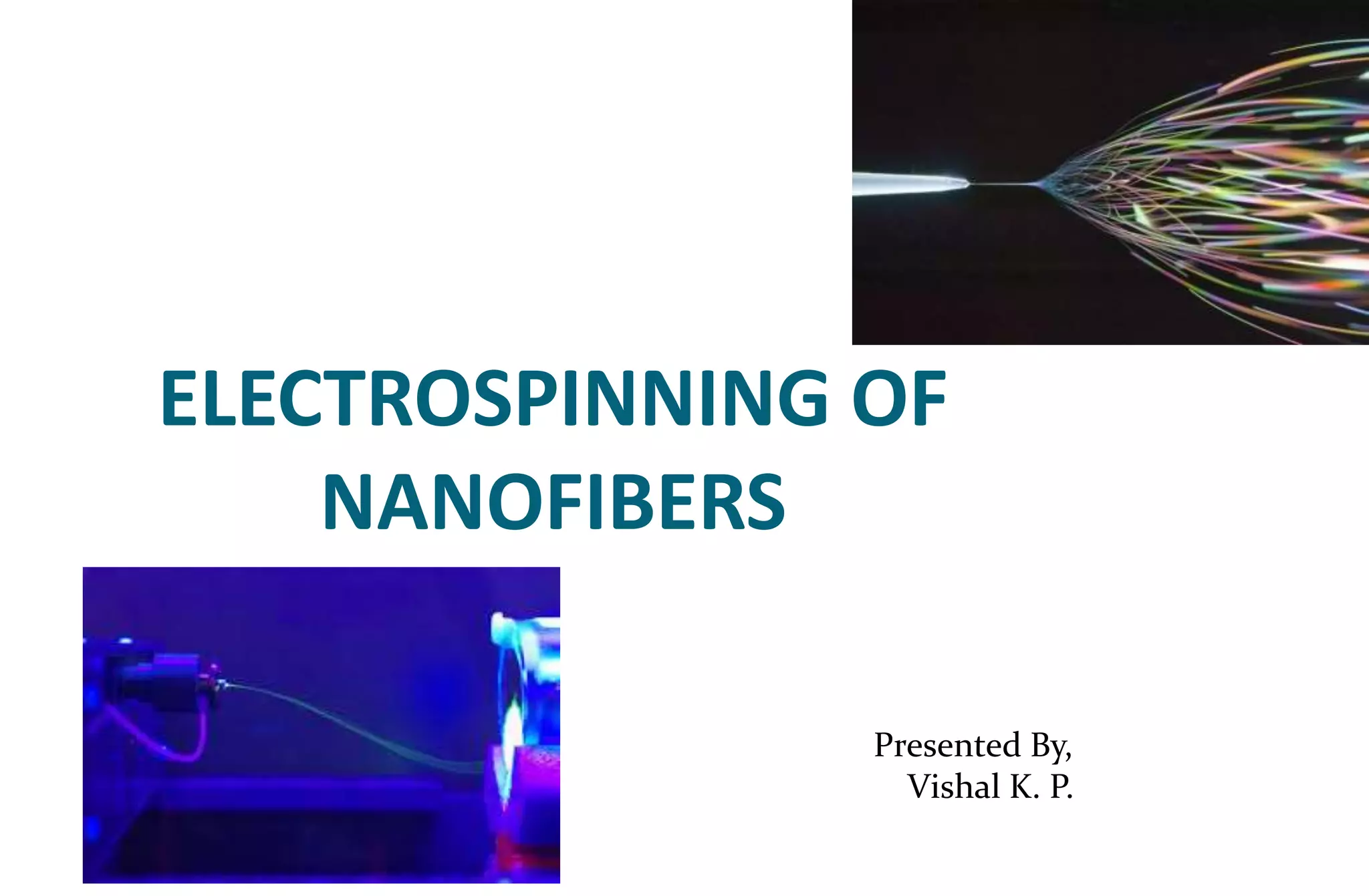
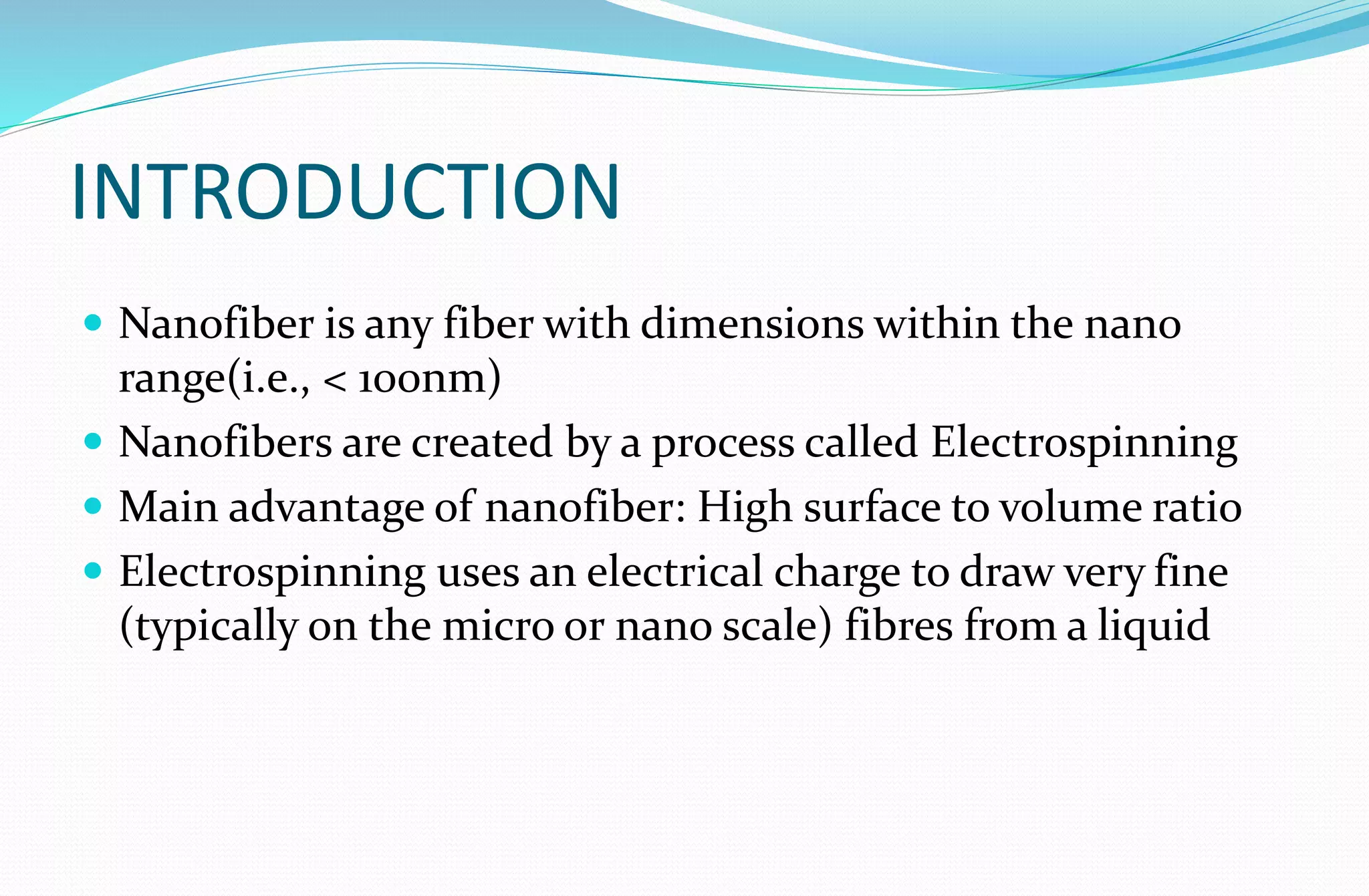
ELECTROSPINNING OF
NANOFIBERS
Presented By,
Vishal K. P.
INTRODUCTION
 Nanofiber is any fiber with dimensions within the nano
range(i.e., < 100nm)
 Nanofibers are created by a process called Electrospinning
 Main advantage of nanofiber: High surface to volume ratio
 Electrospinning uses an electrical charge to draw very fine
(typically on the micro or nano scale) fibres from a liquid
ELECTROSPINNING
 Electrospinning is a fiber production method which uses
electric force to draw charged threads of polymer solutions
or polymer melts up to fiber diameters in the order of some
hundred nanometers.
Strong mutual electrical repulsive forces overcome
weaker forces of surface tension in the charged polymer
liquid.
Principle:
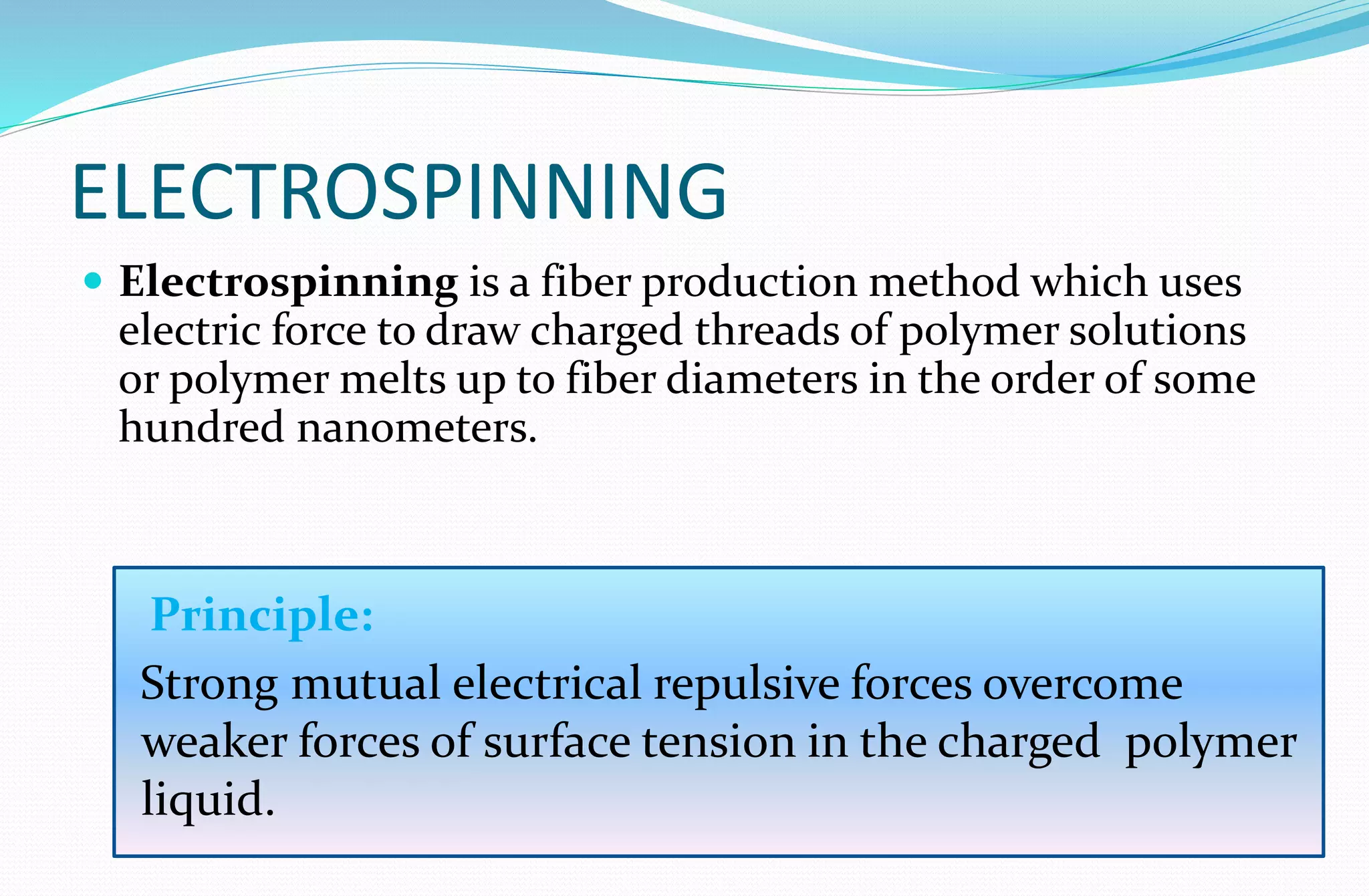
ELECTROSPINNING SETUP
1. A high voltage power supply (between 10 and
30kV)
2. A polymer reservoir that can maintain a
constant flow rate of solution
3. A conductive needle as polymer source
connected to the high voltage power supply
4. A conductive collector(Plate, drum, etc.)
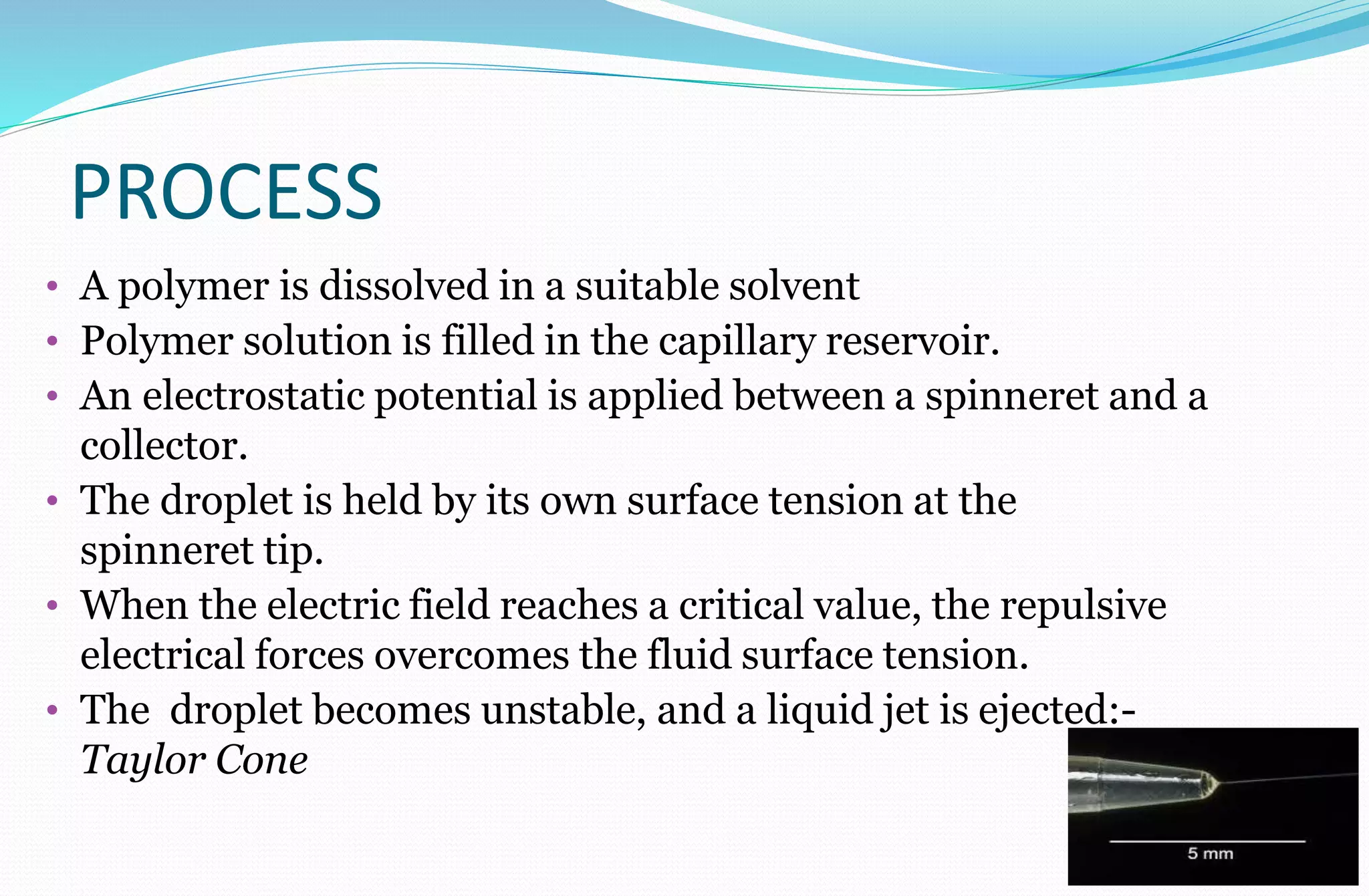
PROCESS
• A polymer is dissolved in a suitable solvent
• Polymer solution is filled in the capillary reservoir.
• An electrostatic potential is applied between a spinneret and a
collector.
• The droplet is held by its own surface tension at the
spinneret tip.
• When the electric field reaches a critical value, the repulsive
electrical forces overcomes the fluid surface tension.
• The droplet becomes unstable, and a liquid jet is ejected:-
Taylor Cone
The distribution of charge in the fiber changes as the fiber
dries out during eruption:
PARAMETERS
• Molecular Weight, Molecular-Weight Distribution and Architecture
(branched, linear etc.) of the polymer
• Solution properties (viscosity, conductivity & and surface
tension)
• Electric potential, Flow rate & Concentration
• Distance between the capillary and collection screen
• Ambient parameters (temperature, humidity and air velocity in
the chamber)
• Motion of target screen (collector)
ADVANTAGES
 High surface to volume ratio
 Very high porosity
 Enhanced physico-mechanical properties
 Manipulation of the solution and process parameters can be
easily done to get the desired fiber morphology and
mechanical strength
CHARACTERIZATIONS
 Geometric(fiber diameter, diameter distribution , fiber
orientation, and fiber morphology):
SEM, TEM, AFM
 Chemical(Molecular structure):
FTIR, NMR
 Mechanical(Mechanical properties):
nanoindentation, bending tests, resonance frequency
measurements, and microscale tension tests.
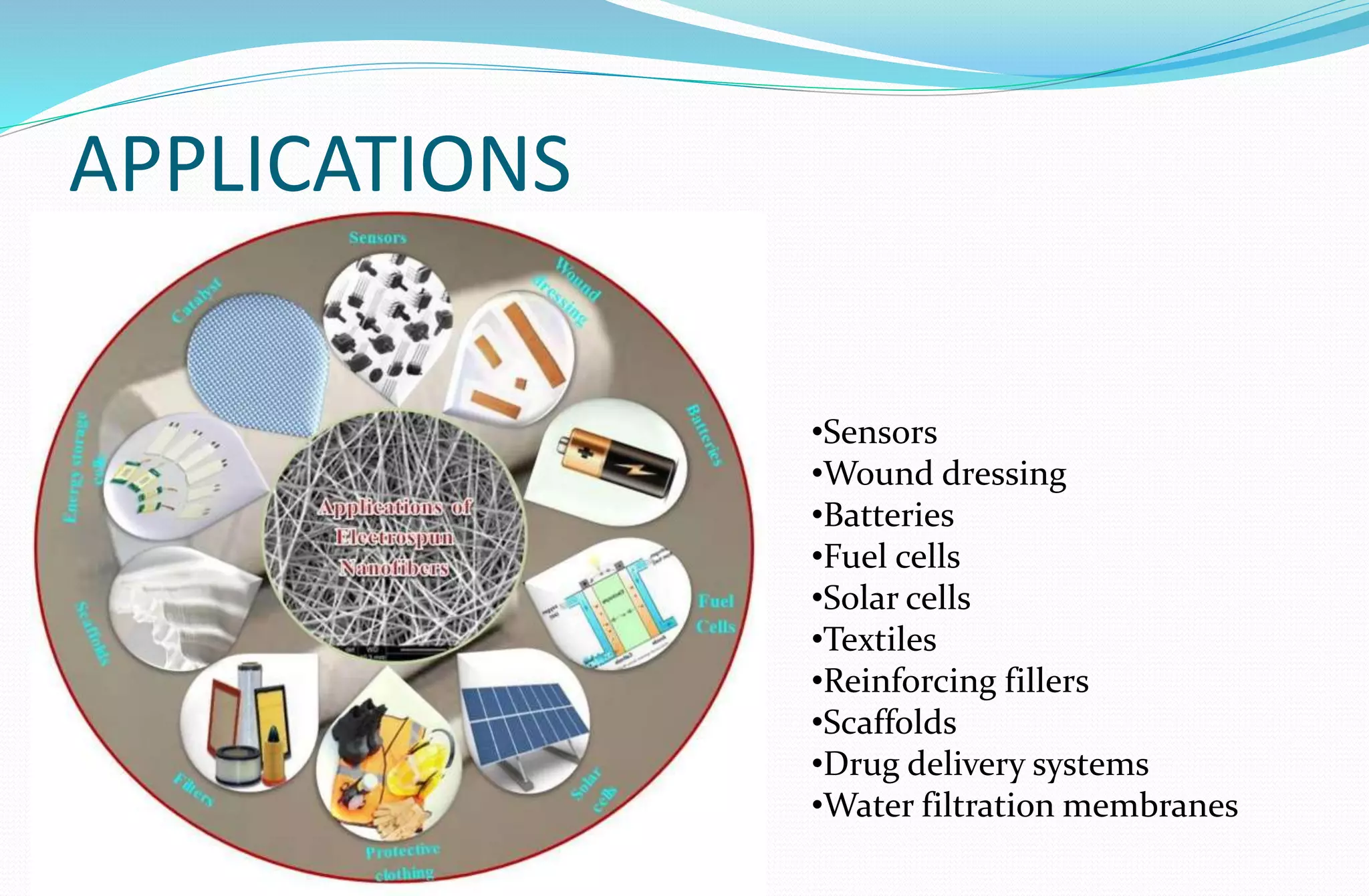
APPLICATIONS
•Sensors
•Wound dressing
•Batteries
•Fuel cells
•Solar cells
•Textiles
•Reinforcing fillers
•Scaffolds
•Drug delivery systems
•Water filtration membranes
Advantageous applications
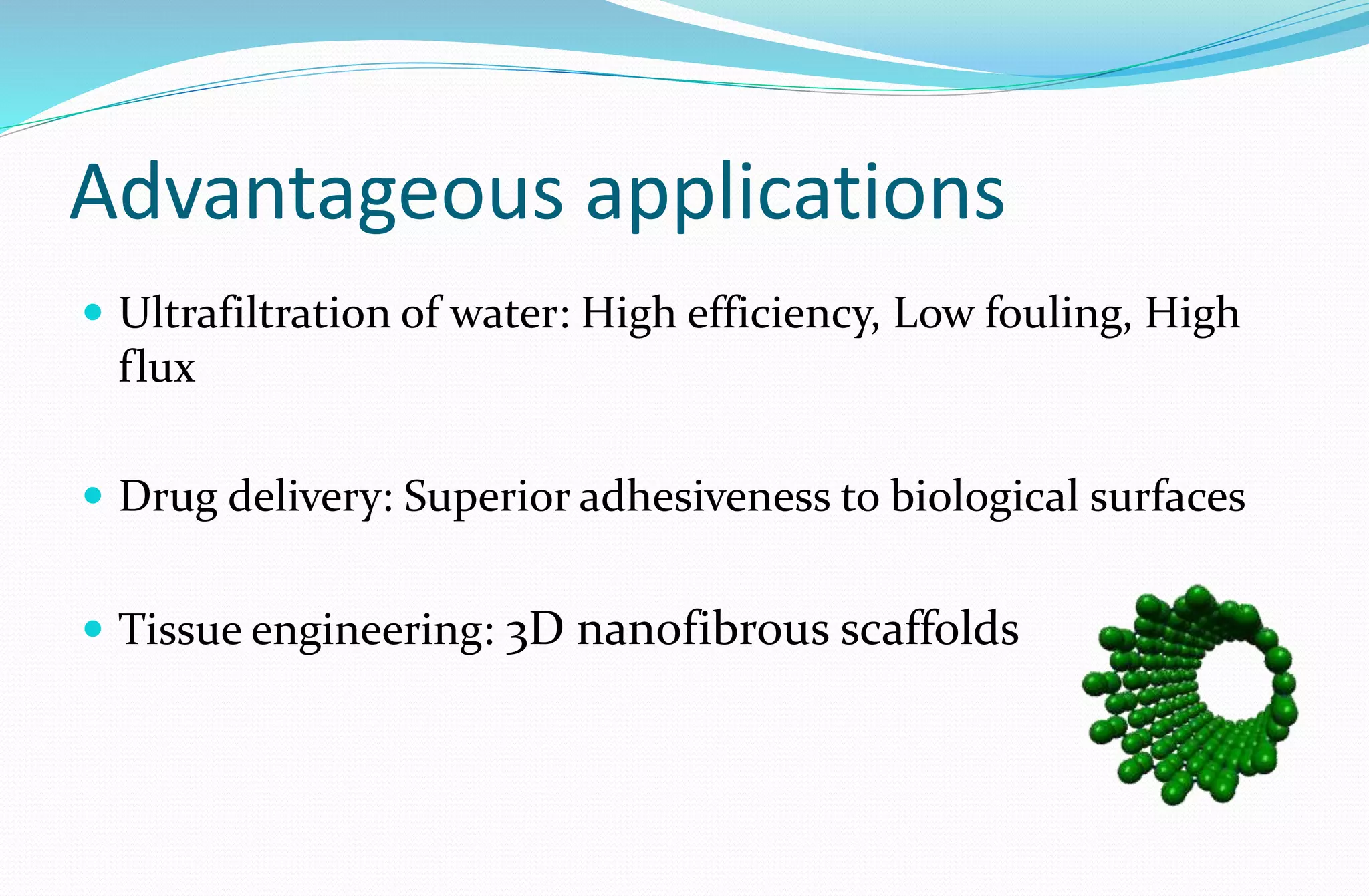
 Ultrafiltration of water: High efficiency, Low fouling, High
flux
 Drug delivery: Superior adhesiveness to biological surfaces
 Tissue engineering: 3D nanofibrous scaffolds
REFERENCES:
 Shaohua Jiang, Yiming Chen, et. al; Electrospun nanofiber
reinforced composites: a review; Journal of Polymer
Chemistry
 Nanomaterials Handbook; Yuri Gogotsi-2006
THANK YOU

Electrospinning of nanofibers

  • 1.
  • 2.
    INTRODUCTION  Nanofiber isany fiber with dimensions within the nano range(i.e., < 100nm)  Nanofibers are created by a process called Electrospinning  Main advantage of nanofiber: High surface to volume ratio  Electrospinning uses an electrical charge to draw very fine (typically on the micro or nano scale) fibres from a liquid
  • 3.
    ELECTROSPINNING  Electrospinning isa fiber production method which uses electric force to draw charged threads of polymer solutions or polymer melts up to fiber diameters in the order of some hundred nanometers. Strong mutual electrical repulsive forces overcome weaker forces of surface tension in the charged polymer liquid. Principle:
  • 4.
    ELECTROSPINNING SETUP 1. Ahigh voltage power supply (between 10 and 30kV) 2. A polymer reservoir that can maintain a constant flow rate of solution 3. A conductive needle as polymer source connected to the high voltage power supply 4. A conductive collector(Plate, drum, etc.)
  • 5.
    PROCESS • A polymeris dissolved in a suitable solvent • Polymer solution is filled in the capillary reservoir. • An electrostatic potential is applied between a spinneret and a collector. • The droplet is held by its own surface tension at the spinneret tip. • When the electric field reaches a critical value, the repulsive electrical forces overcomes the fluid surface tension. • The droplet becomes unstable, and a liquid jet is ejected:- Taylor Cone
  • 6.
    The distribution ofcharge in the fiber changes as the fiber dries out during eruption:
  • 7.
    PARAMETERS • Molecular Weight,Molecular-Weight Distribution and Architecture (branched, linear etc.) of the polymer • Solution properties (viscosity, conductivity & and surface tension) • Electric potential, Flow rate & Concentration • Distance between the capillary and collection screen • Ambient parameters (temperature, humidity and air velocity in the chamber) • Motion of target screen (collector)
  • 8.
    ADVANTAGES  High surfaceto volume ratio  Very high porosity  Enhanced physico-mechanical properties  Manipulation of the solution and process parameters can be easily done to get the desired fiber morphology and mechanical strength
  • 9.
    CHARACTERIZATIONS  Geometric(fiber diameter,diameter distribution , fiber orientation, and fiber morphology): SEM, TEM, AFM  Chemical(Molecular structure): FTIR, NMR  Mechanical(Mechanical properties): nanoindentation, bending tests, resonance frequency measurements, and microscale tension tests.
  • 10.
    APPLICATIONS •Sensors •Wound dressing •Batteries •Fuel cells •Solarcells •Textiles •Reinforcing fillers •Scaffolds •Drug delivery systems •Water filtration membranes
  • 11.
    Advantageous applications  Ultrafiltrationof water: High efficiency, Low fouling, High flux  Drug delivery: Superior adhesiveness to biological surfaces  Tissue engineering: 3D nanofibrous scaffolds
  • 12.
    REFERENCES:  Shaohua Jiang,Yiming Chen, et. al; Electrospun nanofiber reinforced composites: a review; Journal of Polymer Chemistry  Nanomaterials Handbook; Yuri Gogotsi-2006
  • 13.