NANOFIBERS AND ITS
RECENT TECHNOLOGIES
PRESENTED BY-
DEEPALI VERMA
M.PHARM(Phramaceutics), Semester-II
Dept. of Pharmaceutics, Amity Institute of Pharmacy
Amity University, Noida
INTRODUCTION
• Nanofibers are defined as fibers with diameters less
than 50-500 nanometers. National Science Foundation
(NSF) defines nanofibers as having at least one
dimension of 100 nanometer (nm) or less.
• There smaller size plays an important role in delivering
the drug to the appropriate site in the body.
• Either biodegradable or non-degradable materials can
be used to control whether drug release occurs via
diffusion alone or diffusion and scaffold degradation.
• Additionally, due to the flexibility in material selection a
number of drugs can be delivered including: antibiotics,
anticancer drugs, proteins, and DNA.
PROPERTIES OF NANOFIBERS
• Nanofibers exhibit low density, large surface area to mass,
diameter range (50 – 1000) nm, high pore volume, and tight
pore size make the nanofiber nonwoven appropriate for a
wide range of filtration applications.
• Physical properties- The differences in basic web properties
such as fiber area ,basis weights, thicknesses, permeability,
and strength. Electrospun Nanofibers have diameters that are
1to 2 orders of magnitude corresponding increase in fiber
surface area and decrease in basis weight.
• Filtration properties- Different fiber sizes can be made, some
as small as 40 nm. Fibers can be put on one side or on both
sides of a substrate. Nanofibers have been electrospun on to
a variety of substrates, including glass polyester , nylon, and
cellulose filter media substrates.
MATERIAL USED FOR PREPARATION OF
NANOFIBERS
• Natural Polymers include- collagen, cellulose, silk
fibroin, keratin, gelatin and polysaccharides such
as chitosan and alginate.(Using type I collagen
nanofibers produced via electrospinning, Shih et al.
found that the engineered collagen scaffold showed
an increase in cell adhesion and decrease in cell
migration with increasing fiber diameter.)
 Synthetic Polymers include- poly(lacticacid)(PLA),
polycaprolactone(PCL), polyurethane (PU), poly(la
ctic-co-glycolic acid)(PLGA), poly(3-
hydroxybutyrate-co-3-hydroxyvalerate)(PHBV),
and poly(ethylene-co-vinylacetate)(PEVA).
• PVA, PS, PAN, but also peptide amphiphiles .
PRINCIPLE OF NANOFIBRES
• Drug delivery with polymer nanofibers is based on the
principle that dissolution rate of a drug particulate
increases with increased surface area of both the drug
and the corresponding carrier if necessary.
• For controlled drug delivery, in addition to their large
surface area to volume ratio, polymer nanofibers also
have other additional advantages.
• For example, unlike common encapsulation involving,
Controlled delivery systems are used to improve the
therapeutic efficacy and safety of drugs by delivering
them to the site of action at a rate dictated by the need
of the physiological environment.
TECHNIQUES FOR PREPARING NANOFIBERS
METHOD PROCEDURE
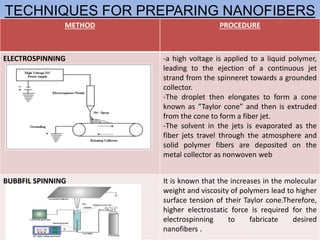
ELECTROSPINNING -a high voltage is applied to a liquid polymer,
leading to the ejection of a continuous jet
strand from the spinneret towards a grounded
collector.
-The droplet then elongates to form a cone
known as “Taylor cone” and then is extruded
from the cone to form a fiber jet.
-The solvent in the jets is evaporated as the
fiber jets travel through the atmosphere and
solid polymer fibers are deposited on the
metal collector as nonwoven web
BUBBFIL SPINNING It is known that the increases in the molecular
weight and viscosity of polymers lead to higher
surface tension of their Taylor cone.Therefore,
higher electrostatic force is required for the
electrospinning to fabricate desired
nanofibers .
SELF-ASSEMBLY -It involves the spontaneous organization of
individual components into an ordered and
stable structure with preprogrammed non-
covalent bonds.
-Compared with electrospinning, self-assembly
can produce much thinner nanofibers only
several nanometers in diameter, but requires
much more complicated procedures and
extremely elaborate techniques.
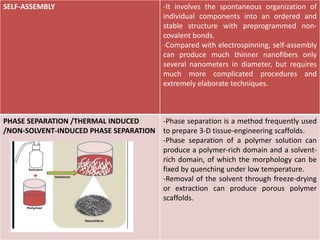
PHASE SEPARATION /THERMAL INDUCED
/NON-SOLVENT-INDUCED PHASE SEPARATION
-Phase separation is a method frequently used
to prepare 3-D tissue-engineering scaffolds.
-Phase separation of a polymer solution can
produce a polymer-rich domain and a solvent-
rich domain, of which the morphology can be
fixed by quenching under low temperature.
-Removal of the solvent through freeze-drying
or extraction can produce porous polymer
scaffolds.
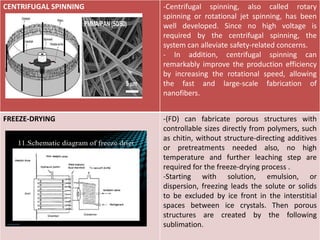
CENTRIFUGAL SPINNING -Centrifugal spinning, also called rotary
spinning or rotational jet spinning, has been
well developed. Since no high voltage is
required by the centrifugal spinning, the
system can alleviate safety-related concerns.
- In addition, centrifugal spinning can
remarkably improve the production efficiency
by increasing the rotational speed, allowing
the fast and large-scale fabrication of
nanofibers.
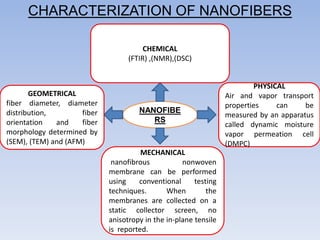
FREEZE-DRYING -(FD) can fabricate porous structures with
controllable sizes directly from polymers, such
as chitin, without structure-directing additives
or pretreatments needed also, no high
temperature and further leaching step are
required for the freeze-drying process .
-Starting with solution, emulsion, or
dispersion, freezing leads the solute or solids
to be excluded by ice front in the interstitial
spaces between ice crystals. Then porous
structures are created by the following
sublimation.
CHARACTERIZATION OF NANOFIBERS
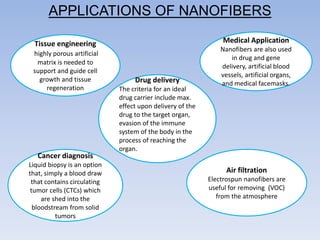
NANOFIBE
RS
GEOMETRICAL
fiber diameter, diameter
distribution, fiber
orientation and fiber
morphology determined by
(SEM), (TEM) and (AFM)
PHYSICAL
Air and vapor transport
properties can be
measured by an apparatus
called dynamic moisture
vapor permeation cell
(DMPC)
CHEMICAL
(FTIR) ,(NMR),(DSC)
MECHANICAL
nanofibrous nonwoven
membrane can be performed
using conventional testing
techniques. When the
membranes are collected on a
static collector screen, no
anisotropy in the in-plane tensile
is reported.
APPLICATIONS OF NANOFIBERS
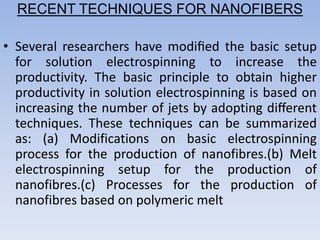
Tissue engineering
highly porous artificial
matrix is needed to
support and guide cell
growth and tissue
regeneration
Drug delivery
The criteria for an ideal
drug carrier include max.
effect upon delivery of the
drug to the target organ,
evasion of the immune
system of the body in the
process of reaching the
organ.
Cancer diagnosis
Liquid biopsy is an option
that, simply a blood draw
that contains circulating
tumor cells (CTCs) which
are shed into the
bloodstream from solid
tumors
Air filtration
Electrospun nanofibers are
useful for removing (VOC)
from the atmosphere
Medical Application
Nanofibers are also used
in drug and gene
delivery, artificial blood
vessels, artificial organs,
and medical facemasks.
RECENT TECHNIQUES FOR NANOFIBERS
• Several researchers have modified the basic setup
for solution electrospinning to increase the
productivity. The basic principle to obtain higher
productivity in solution electrospinning is based on
increasing the number of jets by adopting different
techniques. These techniques can be summarized
as: (a) Modifications on basic electrospinning
process for the production of nanofibres.(b) Melt
electrospinning setup for the production of
nanofibres.(c) Processes for the production of
nanofibres based on polymeric melt
Table 1. Modifications of basic electrospinning
process for the production of nanofibres
Process Features Advantages Disadvantages
Needless electrospinning
Polymer used: PEO
(Mw ¼ 600000),
Fibre diameter:
200–800 nm
Production rate:
12 times of the
conventional
electrospinning
Wider fibre
diameter
distribution
Bubble electrospinning
Polymers used: PVP
(Mw ¼ 40000 g/mol)
and PEO (Mw ¼
500000 g/mol)
Solution concentration for PVP ¼
30 wt% and
PEO ¼ 2 wt%
High production
rate, high efficiency,
free from clogging,
ease of operation,
simple process
and low cost
Solvent recovery
problem
Electroblowing
Polymer used: Hyaluronic
acid (HA) 2–3% (w/v); Fibre
diameter: 40–120 nm
High production
rate, and simple
process
Solvent
recovery
problem
Cylindrical porous hollow tube
Polymer used:
PVP (MW 360000);
Fibre diameter:
300–600 nm
High
productivity
Complex
design of the
equipmen
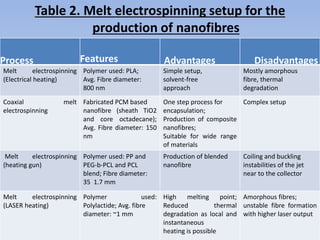
Table 2. Melt electrospinning setup for the
production of nanofibres
Process Features Advantages Disadvantages
Melt electrospinning
(Electrical heating)
Polymer used: PLA;
Avg. Fibre diameter:
800 nm
Simple setup,
solvent-free
approach
Mostly amorphous
fibre, thermal
degradation
Coaxial melt
electrospinning
Fabricated PCM based
nanofibre (sheath TiO2
and core octadecane);
Avg. Fibre diameter: 150
nm
One step process for
encapsulation;
Production of composite
nanofibres;
Suitable for wide range
of materials
Complex setup
Melt electrospinning
(heating gun)
Polymer used: PP and
PEG-b-PCL and PCL
blend; Fibre diameter:
35 1.7 mm
Production of blended
nanofibre
Coiling and buckling
instabilities of the jet
near to the collector
Melt electrospinning
(LASER heating)
Polymer used:
Polylactide; Avg. fibre
diameter: ~1 mm
High melting point;
Reduced thermal
degradation as local and
instantaneous
heating is possible
Amorphous fibres;
unstable fibre formation
with higher laser output
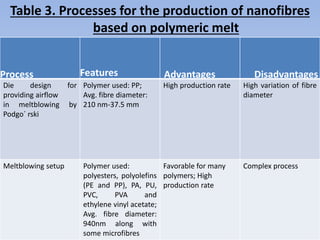
Table 3. Processes for the production of nanofibres
based on polymeric melt
Process Features Advantages Disadvantages
Die design for
providing airflow
in meltblowing by
Podgo´ rski
Polymer used: PP;
Avg. fibre diameter:
210 nm-37.5 mm
High production rate High variation of fibre
diameter
Meltblowing setup Polymer used:
polyesters, polyolefins
(PE and PP), PA, PU,
PVC, PVA and
ethylene vinyl acetate;
Avg. fibre diameter:
940nm along with
some microfibres
Favorable for many
polymers; High
production rate
Complex process
REFERENCES
• Rajkishore Nayak, Rajiv Padhye,” Recent advances in
nanofibre fabrication M Techniques , Textile Research Journal
82(2) 129–147,2011
• Ramakrishna S. An introduction to electrospinning and
nanofibers. World Scientific Pub Co Inc, 2005.
• Ying Zhao,Yihui Qiu, Preparation of Nanofibers with
Renewable Polymers and Their Application in Wound
Dressing, International Journal of Polymer Science
Volume 2016 (2016)
• O. Ayaz, N. Ucar, E. Bahar, et al., “Properties of composite
nanofiber produced by single and coaxial nozzle method used
for electrospinning technique,” International Journal of
Chemical and Biological Engineering, vol. 6, pp. 52–56, 2012.
• SeeramRamakrishna,KazutoshiFujihara,Electrospun
nanofibers: solving global issues, Volume 9, Issue 3, March
2006, Pages 40–50
Nanofibers and its recent technologies

Nanofibers and its recent technologies

  • 1.
    NANOFIBERS AND ITS RECENTTECHNOLOGIES PRESENTED BY- DEEPALI VERMA M.PHARM(Phramaceutics), Semester-II Dept. of Pharmaceutics, Amity Institute of Pharmacy Amity University, Noida
  • 2.
    INTRODUCTION • Nanofibers aredefined as fibers with diameters less than 50-500 nanometers. National Science Foundation (NSF) defines nanofibers as having at least one dimension of 100 nanometer (nm) or less. • There smaller size plays an important role in delivering the drug to the appropriate site in the body. • Either biodegradable or non-degradable materials can be used to control whether drug release occurs via diffusion alone or diffusion and scaffold degradation. • Additionally, due to the flexibility in material selection a number of drugs can be delivered including: antibiotics, anticancer drugs, proteins, and DNA.
  • 3.
    PROPERTIES OF NANOFIBERS •Nanofibers exhibit low density, large surface area to mass, diameter range (50 – 1000) nm, high pore volume, and tight pore size make the nanofiber nonwoven appropriate for a wide range of filtration applications. • Physical properties- The differences in basic web properties such as fiber area ,basis weights, thicknesses, permeability, and strength. Electrospun Nanofibers have diameters that are 1to 2 orders of magnitude corresponding increase in fiber surface area and decrease in basis weight. • Filtration properties- Different fiber sizes can be made, some as small as 40 nm. Fibers can be put on one side or on both sides of a substrate. Nanofibers have been electrospun on to a variety of substrates, including glass polyester , nylon, and cellulose filter media substrates.
  • 4.
    MATERIAL USED FORPREPARATION OF NANOFIBERS • Natural Polymers include- collagen, cellulose, silk fibroin, keratin, gelatin and polysaccharides such as chitosan and alginate.(Using type I collagen nanofibers produced via electrospinning, Shih et al. found that the engineered collagen scaffold showed an increase in cell adhesion and decrease in cell migration with increasing fiber diameter.)
  • 5.
     Synthetic Polymersinclude- poly(lacticacid)(PLA), polycaprolactone(PCL), polyurethane (PU), poly(la ctic-co-glycolic acid)(PLGA), poly(3- hydroxybutyrate-co-3-hydroxyvalerate)(PHBV), and poly(ethylene-co-vinylacetate)(PEVA). • PVA, PS, PAN, but also peptide amphiphiles .
  • 6.
    PRINCIPLE OF NANOFIBRES •Drug delivery with polymer nanofibers is based on the principle that dissolution rate of a drug particulate increases with increased surface area of both the drug and the corresponding carrier if necessary. • For controlled drug delivery, in addition to their large surface area to volume ratio, polymer nanofibers also have other additional advantages. • For example, unlike common encapsulation involving, Controlled delivery systems are used to improve the therapeutic efficacy and safety of drugs by delivering them to the site of action at a rate dictated by the need of the physiological environment.
  • 7.
    TECHNIQUES FOR PREPARINGNANOFIBERS METHOD PROCEDURE ELECTROSPINNING -a high voltage is applied to a liquid polymer, leading to the ejection of a continuous jet strand from the spinneret towards a grounded collector. -The droplet then elongates to form a cone known as “Taylor cone” and then is extruded from the cone to form a fiber jet. -The solvent in the jets is evaporated as the fiber jets travel through the atmosphere and solid polymer fibers are deposited on the metal collector as nonwoven web BUBBFIL SPINNING It is known that the increases in the molecular weight and viscosity of polymers lead to higher surface tension of their Taylor cone.Therefore, higher electrostatic force is required for the electrospinning to fabricate desired nanofibers .
  • 8.
    SELF-ASSEMBLY -It involvesthe spontaneous organization of individual components into an ordered and stable structure with preprogrammed non- covalent bonds. -Compared with electrospinning, self-assembly can produce much thinner nanofibers only several nanometers in diameter, but requires much more complicated procedures and extremely elaborate techniques. PHASE SEPARATION /THERMAL INDUCED /NON-SOLVENT-INDUCED PHASE SEPARATION -Phase separation is a method frequently used to prepare 3-D tissue-engineering scaffolds. -Phase separation of a polymer solution can produce a polymer-rich domain and a solvent- rich domain, of which the morphology can be fixed by quenching under low temperature. -Removal of the solvent through freeze-drying or extraction can produce porous polymer scaffolds.
  • 9.
    CENTRIFUGAL SPINNING -Centrifugalspinning, also called rotary spinning or rotational jet spinning, has been well developed. Since no high voltage is required by the centrifugal spinning, the system can alleviate safety-related concerns. - In addition, centrifugal spinning can remarkably improve the production efficiency by increasing the rotational speed, allowing the fast and large-scale fabrication of nanofibers. FREEZE-DRYING -(FD) can fabricate porous structures with controllable sizes directly from polymers, such as chitin, without structure-directing additives or pretreatments needed also, no high temperature and further leaching step are required for the freeze-drying process . -Starting with solution, emulsion, or dispersion, freezing leads the solute or solids to be excluded by ice front in the interstitial spaces between ice crystals. Then porous structures are created by the following sublimation.
  • 10.
    CHARACTERIZATION OF NANOFIBERS NANOFIBE RS GEOMETRICAL fiberdiameter, diameter distribution, fiber orientation and fiber morphology determined by (SEM), (TEM) and (AFM) PHYSICAL Air and vapor transport properties can be measured by an apparatus called dynamic moisture vapor permeation cell (DMPC) CHEMICAL (FTIR) ,(NMR),(DSC) MECHANICAL nanofibrous nonwoven membrane can be performed using conventional testing techniques. When the membranes are collected on a static collector screen, no anisotropy in the in-plane tensile is reported.
  • 11.
    APPLICATIONS OF NANOFIBERS Tissueengineering highly porous artificial matrix is needed to support and guide cell growth and tissue regeneration Drug delivery The criteria for an ideal drug carrier include max. effect upon delivery of the drug to the target organ, evasion of the immune system of the body in the process of reaching the organ. Cancer diagnosis Liquid biopsy is an option that, simply a blood draw that contains circulating tumor cells (CTCs) which are shed into the bloodstream from solid tumors Air filtration Electrospun nanofibers are useful for removing (VOC) from the atmosphere Medical Application Nanofibers are also used in drug and gene delivery, artificial blood vessels, artificial organs, and medical facemasks.
  • 12.
    RECENT TECHNIQUES FORNANOFIBERS • Several researchers have modified the basic setup for solution electrospinning to increase the productivity. The basic principle to obtain higher productivity in solution electrospinning is based on increasing the number of jets by adopting different techniques. These techniques can be summarized as: (a) Modifications on basic electrospinning process for the production of nanofibres.(b) Melt electrospinning setup for the production of nanofibres.(c) Processes for the production of nanofibres based on polymeric melt
  • 13.
    Table 1. Modificationsof basic electrospinning process for the production of nanofibres Process Features Advantages Disadvantages Needless electrospinning Polymer used: PEO (Mw ¼ 600000), Fibre diameter: 200–800 nm Production rate: 12 times of the conventional electrospinning Wider fibre diameter distribution Bubble electrospinning Polymers used: PVP (Mw ¼ 40000 g/mol) and PEO (Mw ¼ 500000 g/mol) Solution concentration for PVP ¼ 30 wt% and PEO ¼ 2 wt% High production rate, high efficiency, free from clogging, ease of operation, simple process and low cost Solvent recovery problem Electroblowing Polymer used: Hyaluronic acid (HA) 2–3% (w/v); Fibre diameter: 40–120 nm High production rate, and simple process Solvent recovery problem Cylindrical porous hollow tube Polymer used: PVP (MW 360000); Fibre diameter: 300–600 nm High productivity Complex design of the equipmen
  • 14.
    Table 2. Meltelectrospinning setup for the production of nanofibres Process Features Advantages Disadvantages Melt electrospinning (Electrical heating) Polymer used: PLA; Avg. Fibre diameter: 800 nm Simple setup, solvent-free approach Mostly amorphous fibre, thermal degradation Coaxial melt electrospinning Fabricated PCM based nanofibre (sheath TiO2 and core octadecane); Avg. Fibre diameter: 150 nm One step process for encapsulation; Production of composite nanofibres; Suitable for wide range of materials Complex setup Melt electrospinning (heating gun) Polymer used: PP and PEG-b-PCL and PCL blend; Fibre diameter: 35 1.7 mm Production of blended nanofibre Coiling and buckling instabilities of the jet near to the collector Melt electrospinning (LASER heating) Polymer used: Polylactide; Avg. fibre diameter: ~1 mm High melting point; Reduced thermal degradation as local and instantaneous heating is possible Amorphous fibres; unstable fibre formation with higher laser output
  • 15.
    Table 3. Processesfor the production of nanofibres based on polymeric melt Process Features Advantages Disadvantages Die design for providing airflow in meltblowing by Podgo´ rski Polymer used: PP; Avg. fibre diameter: 210 nm-37.5 mm High production rate High variation of fibre diameter Meltblowing setup Polymer used: polyesters, polyolefins (PE and PP), PA, PU, PVC, PVA and ethylene vinyl acetate; Avg. fibre diameter: 940nm along with some microfibres Favorable for many polymers; High production rate Complex process
  • 16.
    REFERENCES • Rajkishore Nayak,Rajiv Padhye,” Recent advances in nanofibre fabrication M Techniques , Textile Research Journal 82(2) 129–147,2011 • Ramakrishna S. An introduction to electrospinning and nanofibers. World Scientific Pub Co Inc, 2005. • Ying Zhao,Yihui Qiu, Preparation of Nanofibers with Renewable Polymers and Their Application in Wound Dressing, International Journal of Polymer Science Volume 2016 (2016) • O. Ayaz, N. Ucar, E. Bahar, et al., “Properties of composite nanofiber produced by single and coaxial nozzle method used for electrospinning technique,” International Journal of Chemical and Biological Engineering, vol. 6, pp. 52–56, 2012. • SeeramRamakrishna,KazutoshiFujihara,Electrospun nanofibers: solving global issues, Volume 9, Issue 3, March 2006, Pages 40–50