Prepared By:- Ms. Mali Sunayana M.
Asst.Professor
Subject:-Pharmaceutical Quality Assurance
Sahyadri College Of Pharmacy, Methwade,
Sangola
UNIT-I TOPIC-
VI
 INTRODUCTION:
 Laboratory studies form an important part of
assessing the quality of products.
 For results to be accepted at national and
international levels, the must be proven to be reliable.
 DEFINITION:-
 Accreditation of laboratories is a process through
which an authorized, independent agency examines
and certifies the competence and quality systems of a
laboratory based on particular predefined standards.
2
Prof. Mali Sunayana
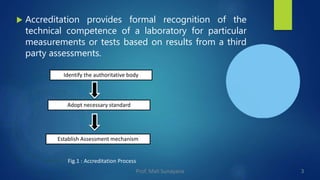
 Accreditation provides formal recognition of the
technical competence of a laboratory for particular
measurements or tests based on results from a third
party assessments.
Identify the authoritative body
Adopt necessary standard
Establish Assessment mechanism
Fig.1 : Accreditation Process
3
Prof. Mali Sunayana
What is NABL ?
 NABL is an autonomous society providing Accreditation
(Recognition) of Technical competence of a testing,
calibration, medical laboratory & Proficiency testing
provider (PTP) & Reference Material Producer (RMP).
 NABL specifies the general requirements for the
competence to carry out tests and calibrations,
including sampling. It covers testing and calibration
performed using standard methods, non-standard
methods, and laboratory-developed methods.
4
Prof. Mali Sunayana
• NABL is an autonomous body under the aegis of Department of
Science & Technology, Government of India, and is registered under
the Societies Act.
• NABL stands for National Accreditation Board For Testing And
Calibration Laboratories.
• NABL has agreements with ILAC (International Laboratory
Accreditation Conference) and APLAC (Asia Pacific Laboratory
Accreditation Cooperation).
5
Prof. Mali Sunayana
Benefits of Accreditation:
 Potential increase in business due to enhanced customer confidence
and satisfaction.
 Savings in terms of time and money due to reduction or elimination
of the need for re-testing .
 Better control of laboratory operations and feedback to laboratories
as to whether they have sound Quality Assurance System and are
technically competent.
6
Prof. Mali Sunayana
 Increase of confidence in Testing / Calibration data and personnel
performing work.
 Customers can search and identify the laboratories accredited by
NABL for their specific requirements from the directory of Accredited
Laboratories.
 Users of accredited laboratories will enjoy greater access for their
products, in both domestic and international markets, when tested
by accredited laboratories.
7
Prof. Mali Sunayana
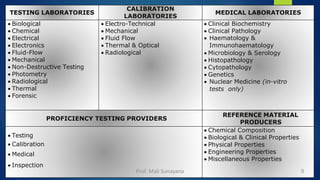
Types Of Laboratory Can Seek
Accreditation:
 Laboratories undertaking any sort of testing or calibration in
the specified fields.
 Private or government laboratories.
 Small operations to large multi-field laboratories.
 Site facilities, temporary field operations and mobile
laboratories.
8
Prof. Mali Sunayana
TESTING LABORATORIES
CALIBRATION
LABORATORIES
MEDICAL LABORATORIES
 Biological
 Chemical
 Electrical
 Electronics
 Fluid-Flow
 Mechanical
 Non-Destructive Testing
 Photometry
 Radiological
 Thermal
 Forensic
 Electro-Technical
 Mechanical
 Fluid Flow
 Thermal & Optical
 Radiological
 Clinical Biochemistry
 Clinical Pathology
 Haematology &
Immunohaematology
 Microbiology & Serology
 Histopathology
 Cytopathology
 Genetics
 Nuclear Medicine (in-vitro
tests only)
PROFICIENCY TESTING PROVIDERS
REFERENCE MATERIAL
PRODUCERS
 Testing
 Calibration
 Medical
 Inspection
 Chemical Composition
 Biological & Clinical Properties
 Physical Properties
 Engineering Properties
 Miscellaneous Properties
9
Prof. Mali Sunayana
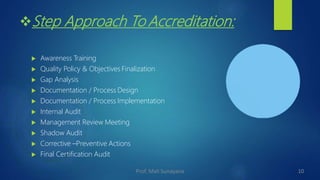
Step Approach To Accreditation:
 Awareness Training
 Quality Policy & Objectives Finalization
 Gap Analysis
 Documentation / Process Design
 Documentation / Process Implementation
 Internal Audit
 Management Review Meeting
 Shadow Audit
 Corrective –Preventive Actions
 Final Certification Audit
10
Prof. Mali Sunayana
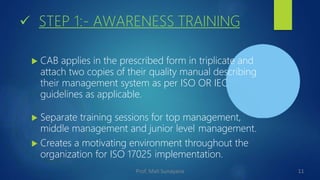
 STEP 1:- AWARENESS TRAINING
 CAB applies in the prescribed form in triplicate and
attach two copies of their quality manual describing
their management system as per ISO OR IEC
guidelines as applicable.
 Separate training sessions for top management,
middle management and junior level management.
 Creates a motivating environment throughout the
organization for ISO 17025 implementation.
11
Prof. Mali Sunayana
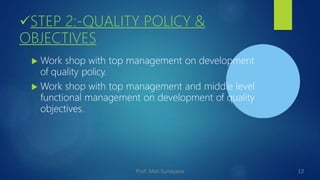
STEP 2:-QUALITY POLICY &
OBJECTIVES
 Work shop with top management on development
of quality policy.
 Work shop with top management and middle level
functional management on development of quality
objectives.
12
Prof. Mali Sunayana
Step 3:-Gap Analysis
 Understanding of all the operations of the
organization.
 Development of process map for the activities of the
organization.
 Comparing existing operations with requirements of
ISO 17025:2005 standard.
13
Prof. Mali Sunayana
Step 4:-Documentation / Process
Design
 Quality Manual
 Functional Procedures
 Work Instructions
 System Procedures
 Formats
14
Prof. Mali Sunayana
Step 5:-Documentation / Process
Implementation
 Work–shop on process / document implementation
as per ISO 17025 requirements.
 Departmental / Individual assistance in
implementing the new processes / documents.
15
Prof. Mali Sunayana
Step 6:-Internal Audit
 Internal Audit Training & Examination (Optional).
 Successful employees / we carry out internal audit
of the organization covering all the departments
and operations.
 Suggest corrective and preventive actions for
improvements in each of the audited departments.
16
Prof. Mali Sunayana
Step 7:-Management Review Meeting
 Quality Policy & Objectives
 Results of internal audit
 Results of supplier evaluation
 Results of customer complaints
 Results of customer feedback etc.
17
Prof. Mali Sunayana
Step 8:-Shadow Audit
 A replica of final certification audit.
 Finds degree of compliance with ISO 17025
standard.
 Gives an idea to the employees about the conduct
of the final certification audit.
18
Prof. Mali Sunayana
Step 9:-Corrective –Preventive
Actions
 On the basis of shadow audit conducted in the last
step, all the non-conformities will be assigned
corrective and preventive actions.
 A check will ensure that all the NCs are closed and
the organization is ready for the final certification
audit.
19
Prof. Mali Sunayana
Step 10:-Final Certification Audit
 Upon completion of various stages of accreditation
audit, the audit, your organization will be awarded
accreditation.
20
Prof. Mali Sunayana
 Obtain NABL documents from the NABL Secretariat to get
familiar with the assessment process and details required
for the application.
 Ensure training of one person by NABL on quality
Management System and Internal Audit.
 Prepare a quality manual in keeping with the standards.
 For each test / investigation done in the laboratory,
prepare a SOP
.
 Calibrate instruments and equipment used in testing.
Preparing for Accreditation:-
21
Prof. Mali Sunayana
 Train Personal on documentation aspects.
 Check the status of current technical competence and quality
system by comparing with NABL Standards and address
deficiencies encountered.
 Prepare a quality manual and all other documents required by
NABL.
 Include Internal Quality Control(IQC) in sample analysis.
 Take part in External Quality Assessment Schemes(EQAs)
 Evaluate compliance with IQC and EQAs; take corrective actions
where necessary.
 Perform internal audit and management review to assess
preparedness for NABL assessment.
 After everything is satisfactory, apply for accreditation to NABL
with the prescribed fees.
22
Prof. Mali Sunayana
1) Define the terms ‘Accreditation ‘ and ‘NABL’.
2) Write a note on NABL Accreditation in INDIA.
3) Describe how a laboratory must prepare for
NABL Accreditation.
 REVIEW QUESTIONS
23
Prof. Mali Sunayana
 REFERENCE
1) A Text book of Pharmaceutical Quality Assurance by the
author Anusuya R.Kashi, Bindu Sukumaran, And Veena
P. Nirali Prakashan. Page No.6.1-6.5
2) www.slideshare.com
3) www.google.com
24
Prof. Mali Sunayana
25
Prof. Mali Sunayana

NABL accreditation

  • 1.
    Prepared By:- Ms.Mali Sunayana M. Asst.Professor Subject:-Pharmaceutical Quality Assurance Sahyadri College Of Pharmacy, Methwade, Sangola UNIT-I TOPIC- VI
  • 2.
     INTRODUCTION:  Laboratorystudies form an important part of assessing the quality of products.  For results to be accepted at national and international levels, the must be proven to be reliable.  DEFINITION:-  Accreditation of laboratories is a process through which an authorized, independent agency examines and certifies the competence and quality systems of a laboratory based on particular predefined standards. 2 Prof. Mali Sunayana
  • 3.
     Accreditation providesformal recognition of the technical competence of a laboratory for particular measurements or tests based on results from a third party assessments. Identify the authoritative body Adopt necessary standard Establish Assessment mechanism Fig.1 : Accreditation Process 3 Prof. Mali Sunayana
  • 4.
    What is NABL?  NABL is an autonomous society providing Accreditation (Recognition) of Technical competence of a testing, calibration, medical laboratory & Proficiency testing provider (PTP) & Reference Material Producer (RMP).  NABL specifies the general requirements for the competence to carry out tests and calibrations, including sampling. It covers testing and calibration performed using standard methods, non-standard methods, and laboratory-developed methods. 4 Prof. Mali Sunayana
  • 5.
    • NABL isan autonomous body under the aegis of Department of Science & Technology, Government of India, and is registered under the Societies Act. • NABL stands for National Accreditation Board For Testing And Calibration Laboratories. • NABL has agreements with ILAC (International Laboratory Accreditation Conference) and APLAC (Asia Pacific Laboratory Accreditation Cooperation). 5 Prof. Mali Sunayana
  • 6.
    Benefits of Accreditation: Potential increase in business due to enhanced customer confidence and satisfaction.  Savings in terms of time and money due to reduction or elimination of the need for re-testing .  Better control of laboratory operations and feedback to laboratories as to whether they have sound Quality Assurance System and are technically competent. 6 Prof. Mali Sunayana
  • 7.
     Increase ofconfidence in Testing / Calibration data and personnel performing work.  Customers can search and identify the laboratories accredited by NABL for their specific requirements from the directory of Accredited Laboratories.  Users of accredited laboratories will enjoy greater access for their products, in both domestic and international markets, when tested by accredited laboratories. 7 Prof. Mali Sunayana
  • 8.
    Types Of LaboratoryCan Seek Accreditation:  Laboratories undertaking any sort of testing or calibration in the specified fields.  Private or government laboratories.  Small operations to large multi-field laboratories.  Site facilities, temporary field operations and mobile laboratories. 8 Prof. Mali Sunayana
  • 9.
    TESTING LABORATORIES CALIBRATION LABORATORIES MEDICAL LABORATORIES Biological  Chemical  Electrical  Electronics  Fluid-Flow  Mechanical  Non-Destructive Testing  Photometry  Radiological  Thermal  Forensic  Electro-Technical  Mechanical  Fluid Flow  Thermal & Optical  Radiological  Clinical Biochemistry  Clinical Pathology  Haematology & Immunohaematology  Microbiology & Serology  Histopathology  Cytopathology  Genetics  Nuclear Medicine (in-vitro tests only) PROFICIENCY TESTING PROVIDERS REFERENCE MATERIAL PRODUCERS  Testing  Calibration  Medical  Inspection  Chemical Composition  Biological & Clinical Properties  Physical Properties  Engineering Properties  Miscellaneous Properties 9 Prof. Mali Sunayana
  • 10.
    Step Approach ToAccreditation:  Awareness Training  Quality Policy & Objectives Finalization  Gap Analysis  Documentation / Process Design  Documentation / Process Implementation  Internal Audit  Management Review Meeting  Shadow Audit  Corrective –Preventive Actions  Final Certification Audit 10 Prof. Mali Sunayana
  • 11.
     STEP 1:-AWARENESS TRAINING  CAB applies in the prescribed form in triplicate and attach two copies of their quality manual describing their management system as per ISO OR IEC guidelines as applicable.  Separate training sessions for top management, middle management and junior level management.  Creates a motivating environment throughout the organization for ISO 17025 implementation. 11 Prof. Mali Sunayana
  • 12.
    STEP 2:-QUALITY POLICY& OBJECTIVES  Work shop with top management on development of quality policy.  Work shop with top management and middle level functional management on development of quality objectives. 12 Prof. Mali Sunayana
  • 13.
    Step 3:-Gap Analysis Understanding of all the operations of the organization.  Development of process map for the activities of the organization.  Comparing existing operations with requirements of ISO 17025:2005 standard. 13 Prof. Mali Sunayana
  • 14.
    Step 4:-Documentation /Process Design  Quality Manual  Functional Procedures  Work Instructions  System Procedures  Formats 14 Prof. Mali Sunayana
  • 15.
    Step 5:-Documentation /Process Implementation  Work–shop on process / document implementation as per ISO 17025 requirements.  Departmental / Individual assistance in implementing the new processes / documents. 15 Prof. Mali Sunayana
  • 16.
    Step 6:-Internal Audit Internal Audit Training & Examination (Optional).  Successful employees / we carry out internal audit of the organization covering all the departments and operations.  Suggest corrective and preventive actions for improvements in each of the audited departments. 16 Prof. Mali Sunayana
  • 17.
    Step 7:-Management ReviewMeeting  Quality Policy & Objectives  Results of internal audit  Results of supplier evaluation  Results of customer complaints  Results of customer feedback etc. 17 Prof. Mali Sunayana
  • 18.
    Step 8:-Shadow Audit A replica of final certification audit.  Finds degree of compliance with ISO 17025 standard.  Gives an idea to the employees about the conduct of the final certification audit. 18 Prof. Mali Sunayana
  • 19.
    Step 9:-Corrective –Preventive Actions On the basis of shadow audit conducted in the last step, all the non-conformities will be assigned corrective and preventive actions.  A check will ensure that all the NCs are closed and the organization is ready for the final certification audit. 19 Prof. Mali Sunayana
  • 20.
    Step 10:-Final CertificationAudit  Upon completion of various stages of accreditation audit, the audit, your organization will be awarded accreditation. 20 Prof. Mali Sunayana
  • 21.
     Obtain NABLdocuments from the NABL Secretariat to get familiar with the assessment process and details required for the application.  Ensure training of one person by NABL on quality Management System and Internal Audit.  Prepare a quality manual in keeping with the standards.  For each test / investigation done in the laboratory, prepare a SOP .  Calibrate instruments and equipment used in testing. Preparing for Accreditation:- 21 Prof. Mali Sunayana
  • 22.
     Train Personalon documentation aspects.  Check the status of current technical competence and quality system by comparing with NABL Standards and address deficiencies encountered.  Prepare a quality manual and all other documents required by NABL.  Include Internal Quality Control(IQC) in sample analysis.  Take part in External Quality Assessment Schemes(EQAs)  Evaluate compliance with IQC and EQAs; take corrective actions where necessary.  Perform internal audit and management review to assess preparedness for NABL assessment.  After everything is satisfactory, apply for accreditation to NABL with the prescribed fees. 22 Prof. Mali Sunayana
  • 23.
    1) Define theterms ‘Accreditation ‘ and ‘NABL’. 2) Write a note on NABL Accreditation in INDIA. 3) Describe how a laboratory must prepare for NABL Accreditation.  REVIEW QUESTIONS 23 Prof. Mali Sunayana
  • 24.
     REFERENCE 1) AText book of Pharmaceutical Quality Assurance by the author Anusuya R.Kashi, Bindu Sukumaran, And Veena P. Nirali Prakashan. Page No.6.1-6.5 2) www.slideshare.com 3) www.google.com 24 Prof. Mali Sunayana
  • 25.