
ByBy
AKMA LIZAAKMA LIZA
 ISO/IEC 17025 is the international
standard used by laboratories in
developing their quality,
administrative and technical systems
that govern their operations.
 The two main clauses are:
o Clause No. 4.0 Management
Requirements
o Clause No. 5.0 Technical
Requirements
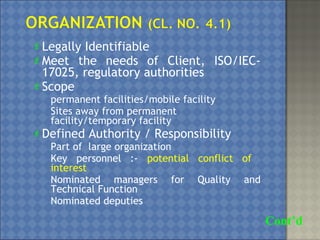
Legally Identifiable
Meet the needs of Client, ISO/IEC-
17025, regulatory authorities
Scope
• permanent facilities/mobile facility
• Sites away from permanent
facility/temporary facility
Defined Authority / Responsibility
• Part of large organization
• Key personnel :- potential conflict of
interest
• Nominated managers for Quality and
Technical Function
• Nominated deputies
Cont’d
 Free from commercial , financial
pressure.
 Clients confidential information,
proprietary rights.
 Competence, Impartiality, judgment
and Integrity
 Organization chart indicating
relationship between Quality Manager,
Technical operations and support
services
 Inter-personnel relationship
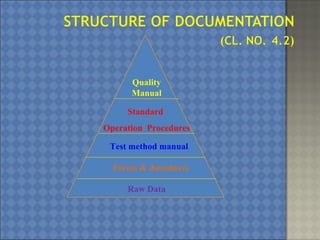
 Quality system documentation
shall be communicated to,
understood by , available to,
and implemented by the
appropriate personnel.
“a document stating the quality
policy and describing the
quality system of an
organization”
ISO 10013
Quality
Manual
Standard
Operation Procedures
Test method manual
Forms & datasheets
Raw Data
- It is to ensure that each person
working in laboratory has with
him/her, the current version of
document, to perform his/her
work.
 Review and approval of documents
 Master List of procedure
• availability
• Review, revision & amendment
• Externally-generated Documents
• removal of obsolete documents
• identification of obsolete documents
retained for other reasons
Cont’d
 Identification of Document
• Title
• date of issue
• revision status
• page numbering to signify end of
document
• authority for issue
The laboratory must have a format procedure
for the planned and systematic evaluation of
its capability to undertake each new request
to provide a testing or measuring service.
The procedure will also apply to undertaking
or accepting a significant increase in the
volume of testing work currently performed.
 Approval from client, preferably in
writing, when the lab intends to
subcontract.
 Ensure and demonstrate subcontractors
competence and compliance with 17025.
 Laboratory maintains responsibility.
 Maintain a register of all subcontracting
work.
 Procedures for selection and purchasing of
service and supplies that affect the quality of
tests
 Procedures for handling consumable
materials
 Purchasing document contains description
 Inspected or otherwise verified as complying
 Record of evaluation of suppliers of critical
service
 Clients allowed to clarify requirements
and monitor performance of laboratory.
 Laboratory to ensure confidentiality to
other clients.
 Policy and procedure for resolution of
complaints
 Records of complaints, including all
investigations and corrective actions
 Policy and procedures for nonconformance in
testing. Procedure shall include:
• responsibilities and authorities are
defined
• evaluation of significance
• remedial actions
• recall of nonconforming work released to
clients
• responsibility for resumption of work
 Corrective actions focuses on fixing
problems that already exist.
 Corrective action must be implemented
when departures from acceptable
practices are identified.
 Cause analysis - root cause.
 Eliminate the problem, prevent
recurrence.
Cont’d
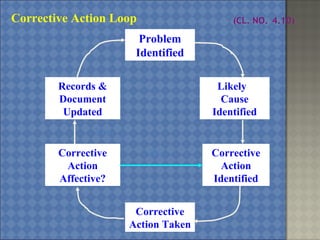
Problem
Identified
Records &
Document
Updated
Corrective
Action
Affective?
Likely
Cause
Identified
Corrective
Action
Identified
Corrective
Action Taken
No
Yes
Corrective Action Loop
 Identify potential sources for
nonconformance, technical or relating to
quality system.
 Procedures
• initiation of action , implementation
• controls to ensure effectiveness
 Procedure for identification, collection,
indexing, access, storage, maintenance,
disposal of quality and technical records.
 Records legible, readily retrievable,
stored in a suitable environment.
 Secure and in confidence.
 Protection and backup of computer
records.
 Predetermined schedule.
 Comply with requirements of Quality
System and ISO/IEC 17025.
 All elements of Quality System.
 Trained and qualified personnel,
independence & Conflict of Interest.
 Records maintained of audits findings
and corrective actions.
 Management with executive responsibility.
 Predetermined schedule.
 Suitability and effectiveness.
 Changes for improvements.
 Record the findings and also corrective actions.
 Quality manager is responsible to prepare the
agenda.
 Quality manager is responsible for action taking
as decided by Management Review.
Technical Requirements
Clause No. 5.0
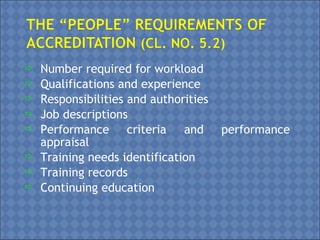
 Number required for workload
 Qualifications and experience
 Responsibilities and authorities
 Job descriptions
 Performance criteria and performance
appraisal
 Training needs identification
 Training records
 Continuing education
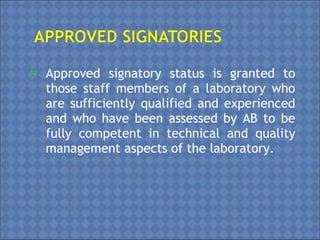
 Approved signatory status is granted to
those staff members of a laboratory who
are sufficiently qualified and experienced
and who have been assessed by AB to be
fully competent in technical and quality
management aspects of the laboratory.
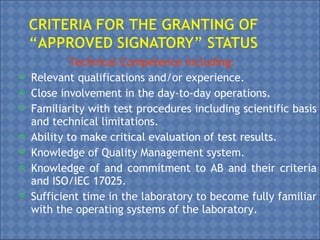
Technical Competence including:
 Relevant qualifications and/or experience.
 Close involvement in the day-to-day operations.
 Familiarity with test procedures including scientific basis
and technical limitations.
 Ability to make critical evaluation of test results.
 Knowledge of Quality Management system.
 Knowledge of and commitment to AB and their criteria
and ISO/IEC 17025.
 Sufficient time in the laboratory to become fully familiar
with the operating systems of the laboratory.
A laboratory is any place, in a building or in
the field where measurements, tests,
calibrations are carried out.
ISO/IEC 17025
“The laboratory facilities for testing and/or
calibration shall be such as to facilitate
correct performance of tests and/or
calibrations. The laboratory shall ensure
that the environment does not invalidate
the results or adversely affect the required
quality of any measurement.
The environment is the set of conditions that may
influence the test and/or measurement results.
Considerations :
• Temperature and humidity
• Dust, biological sterility,chemical cleanliness
• Ventilation and fume extraction
• Noise levels and acoustics and ergonomics
• Vibration and radiation
• Cross contamination prevention
• Power Supply and electromagnetic
compatibility
• Lighting
• People access and security issues
ISO/IEC 17025 :1999 - the laboratory shall have
instructions on the use of equipment, on the
handling, and preparation of items and for test
and calibration procedures and the calculation
of uncertainty of measurement.
 Meets Clients requirements
 Test methods from standard writing institution
 Laboratory developed test methods
 Non standard test methods
Consider:
 Client’s wants and needs
 Regulatory or standard requirements
 Industry acceptance
 Sampling and sample preparation
 Environmental and accommodation requirements
 Staff capability requirements
 Repeatability, reproducibility and uncertainty
 Recovery or matrix effects
 Safety
 Cost and time
 Selectivity & specificity
 Range
 Linearity
 Limit of detection
 Limit of repeatability
 Reproducibility
 Ruggedness
 Bias
 Precision
ISO/IEC 17025 (5.4.6)
Calibration laboratory or testing laboratory
doing calibrations must formally estimate
uncertainty for all calibrations.
Testing laboratories must estimate
uncertainty but may be with less rigor:-
…..They must make a “reasonable estimation”
and “attempt to identify all components”.
 Sufficient and appropriate for workload
 Fit for purpose
 Instillation, Environment
 Commissioning and Verification
 In-use status to prevent other staff
interfering
 Maintenance schedules
 Operational status - damaged?
 Control and repair procedures
 Calibrations and schedules
 Records of all above items.
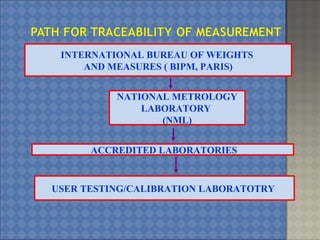
Property of the result of a measurement or
the value of a standard whereby it can be
related to stated references, usually ,
national or international standards , through
an unbroken chain of comparisons all having
stated uncertainties
NOTES
1. The concept is often expressed by the
adjective Traceable
2. The unbroken chain of comparisons is called
a Traceability chain.
INTERNATIONAL BUREAU OF WEIGHTS
AND MEASURES ( BIPM, PARIS)
NATIONAL METROLOGY
LABORATORY
(NML)
ACCREDITED LABORATORIES
USER TESTING/CALIBRATION LABORATOTRY
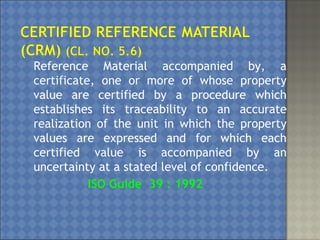
Reference Material accompanied by, a
certificate, one or more of whose property
value are certified by a procedure which
establishes its traceability to an accurate
realization of the unit in which the property
values are expressed and for which each
certified value is accompanied by an
uncertainty at a stated level of confidence.
ISO Guide 39 : 1992
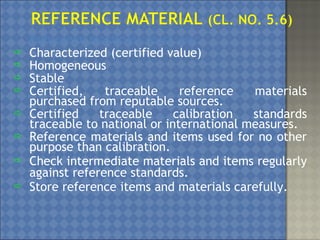
Reference materials must be:
 Characterized (certified value)
 Homogeneous
 Stable
 Certified, traceable reference materials
purchased from reputable sources.
 Certified traceable calibration standards
traceable to national or international measures.
 Reference materials and items used for no other
purpose than calibration.
 Check intermediate materials and items regularly
against reference standards.
 Store reference items and materials carefully.
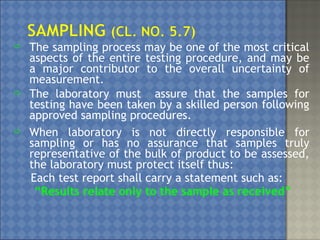
 The sampling process may be one of the most critical
aspects of the entire testing procedure, and may be
a major contributor to the overall uncertainty of
measurement.
 The laboratory must assure that the samples for
testing have been taken by a skilled person following
approved sampling procedures.
 When laboratory is not directly responsible for
sampling or has no assurance that samples truly
representative of the bulk of product to be assessed,
the laboratory must protect itself thus:
Each test report shall carry a statement such as:
“Results relate only to the sample as received”
ISO/IEC 17025:1999 “the laboratory shall have
procedure to protect the integrity of
test/calibration items ”
 Identify test/calibration items & sub- samples
throughout.
 Record abnormalities of items & consult client for
advice.
 Prevent deterioration during storage & handing –
monitor and record conditions.
 Security during storage.
 In non-destructive testing, prevent damage/injury
to samples/people.
 Sampling plan & handling procedures available to
sampling staff.
 Quality Control – Operational activities aimed at
monitoring the quality of testing throughout the
process and at identifying unsatisfactory results.
Checking calculations and data transcriptions
Blanks, standards, reference items, retest of
retained items
Replicate testing and statistical calculations
(confidence limits)
Trends analysis and trend charts
The laboratory Comparison Programmes
( Proficiency testing)
QUALITY CONTROL INCLUDES PROFICIENCY
TESTING
 ILAC Guidance to Clause 5.10
(G.5.10.1)
G.5.10.1 laboratories that are accredited by
an accreditation body which is a signatory of
the ILAC or regional multilateral agreement in
the field of testing or calibration, may state
on certificates and reports, in the appropriate
language: xxxxx (full name or acronym of
accreditation body) is one of the signatories to
the yyyyy (full name or acronym of the
regional or international organization)
multilateral agreement / arrangement for the
mutual recognition of test reports and/or
calibration certificates (whichever is
relevant).
Cont’d.
 ILAC Guidance to Clause 5.10.4.2. (G.5.10.4.2.1.)
G.5.10.4.2.1 accreditation bodies should provide rules
for the way in which measurement uncertainty has to
be taken into account when statements of compliance
are made. Such rules should follow ILAC G8 or EA5/01.
 Clause 5.10.6 testing and calibration results obtained
from subcontractors.
 ILAC Guidance to Clause 5.10.6. (G.5.10.6.1)
G.5.10.6.1 accreditation bodies should ensure that
when the laboratory does not take responsibility for
the subcontracted work, as provided for in ISO/IEC
17025 clause 4.5.3 this fact is clearly stated in the
report.
 Laboratory clients want the solution to
their problem, not a list of numbers
 Opinions and interpretations include
 Opinions on conformity of samples/items with
requirements
 Fulfillment of contractual requirements
 Recommendation on how to use test results
 Guidance on improvements
 Special staff will be granted signatory
approval for opinions and interpretations.
 They may have special technical
qualifications.
 Knowledge and experience assessed by the
technical assessor.
Example: Medical Pathologists verses
Technologists
ISO/IEC 17025

ISO/IEC 17025

  • 1.
  • 2.
     ISO/IEC 17025is the international standard used by laboratories in developing their quality, administrative and technical systems that govern their operations.
  • 3.
     The twomain clauses are: o Clause No. 4.0 Management Requirements o Clause No. 5.0 Technical Requirements
  • 4.
    Legally Identifiable Meet theneeds of Client, ISO/IEC- 17025, regulatory authorities Scope • permanent facilities/mobile facility • Sites away from permanent facility/temporary facility Defined Authority / Responsibility • Part of large organization • Key personnel :- potential conflict of interest • Nominated managers for Quality and Technical Function • Nominated deputies Cont’d
  • 5.
     Free fromcommercial , financial pressure.  Clients confidential information, proprietary rights.  Competence, Impartiality, judgment and Integrity  Organization chart indicating relationship between Quality Manager, Technical operations and support services  Inter-personnel relationship
  • 6.
     Quality systemdocumentation shall be communicated to, understood by , available to, and implemented by the appropriate personnel.
  • 7.
    “a document statingthe quality policy and describing the quality system of an organization” ISO 10013
  • 8.
  • 9.
    - It isto ensure that each person working in laboratory has with him/her, the current version of document, to perform his/her work.
  • 10.
     Review andapproval of documents  Master List of procedure • availability • Review, revision & amendment • Externally-generated Documents • removal of obsolete documents • identification of obsolete documents retained for other reasons Cont’d
  • 11.
     Identification ofDocument • Title • date of issue • revision status • page numbering to signify end of document • authority for issue
  • 12.
    The laboratory musthave a format procedure for the planned and systematic evaluation of its capability to undertake each new request to provide a testing or measuring service. The procedure will also apply to undertaking or accepting a significant increase in the volume of testing work currently performed.
  • 13.
     Approval fromclient, preferably in writing, when the lab intends to subcontract.  Ensure and demonstrate subcontractors competence and compliance with 17025.  Laboratory maintains responsibility.  Maintain a register of all subcontracting work.
  • 14.
     Procedures forselection and purchasing of service and supplies that affect the quality of tests  Procedures for handling consumable materials  Purchasing document contains description  Inspected or otherwise verified as complying  Record of evaluation of suppliers of critical service
  • 15.
     Clients allowedto clarify requirements and monitor performance of laboratory.  Laboratory to ensure confidentiality to other clients.
  • 16.
     Policy andprocedure for resolution of complaints  Records of complaints, including all investigations and corrective actions
  • 17.
     Policy andprocedures for nonconformance in testing. Procedure shall include: • responsibilities and authorities are defined • evaluation of significance • remedial actions • recall of nonconforming work released to clients • responsibility for resumption of work
  • 18.
     Corrective actionsfocuses on fixing problems that already exist.  Corrective action must be implemented when departures from acceptable practices are identified.  Cause analysis - root cause.  Eliminate the problem, prevent recurrence. Cont’d
  • 19.
  • 20.
     Identify potentialsources for nonconformance, technical or relating to quality system.  Procedures • initiation of action , implementation • controls to ensure effectiveness
  • 21.
     Procedure foridentification, collection, indexing, access, storage, maintenance, disposal of quality and technical records.  Records legible, readily retrievable, stored in a suitable environment.  Secure and in confidence.  Protection and backup of computer records.
  • 22.
     Predetermined schedule. Comply with requirements of Quality System and ISO/IEC 17025.  All elements of Quality System.  Trained and qualified personnel, independence & Conflict of Interest.  Records maintained of audits findings and corrective actions.
  • 23.
     Management withexecutive responsibility.  Predetermined schedule.  Suitability and effectiveness.  Changes for improvements.  Record the findings and also corrective actions.  Quality manager is responsible to prepare the agenda.  Quality manager is responsible for action taking as decided by Management Review.
  • 24.
  • 25.
     Number requiredfor workload  Qualifications and experience  Responsibilities and authorities  Job descriptions  Performance criteria and performance appraisal  Training needs identification  Training records  Continuing education
  • 26.
     Approved signatorystatus is granted to those staff members of a laboratory who are sufficiently qualified and experienced and who have been assessed by AB to be fully competent in technical and quality management aspects of the laboratory.
  • 27.
    Technical Competence including: Relevant qualifications and/or experience.  Close involvement in the day-to-day operations.  Familiarity with test procedures including scientific basis and technical limitations.  Ability to make critical evaluation of test results.  Knowledge of Quality Management system.  Knowledge of and commitment to AB and their criteria and ISO/IEC 17025.  Sufficient time in the laboratory to become fully familiar with the operating systems of the laboratory.
  • 28.
    A laboratory isany place, in a building or in the field where measurements, tests, calibrations are carried out. ISO/IEC 17025 “The laboratory facilities for testing and/or calibration shall be such as to facilitate correct performance of tests and/or calibrations. The laboratory shall ensure that the environment does not invalidate the results or adversely affect the required quality of any measurement.
  • 29.
    The environment isthe set of conditions that may influence the test and/or measurement results. Considerations : • Temperature and humidity • Dust, biological sterility,chemical cleanliness • Ventilation and fume extraction • Noise levels and acoustics and ergonomics • Vibration and radiation • Cross contamination prevention • Power Supply and electromagnetic compatibility • Lighting • People access and security issues
  • 30.
    ISO/IEC 17025 :1999- the laboratory shall have instructions on the use of equipment, on the handling, and preparation of items and for test and calibration procedures and the calculation of uncertainty of measurement.  Meets Clients requirements  Test methods from standard writing institution  Laboratory developed test methods  Non standard test methods
  • 31.
    Consider:  Client’s wantsand needs  Regulatory or standard requirements  Industry acceptance  Sampling and sample preparation  Environmental and accommodation requirements  Staff capability requirements  Repeatability, reproducibility and uncertainty  Recovery or matrix effects  Safety  Cost and time
  • 32.
     Selectivity &specificity  Range  Linearity  Limit of detection  Limit of repeatability  Reproducibility  Ruggedness  Bias  Precision
  • 33.
    ISO/IEC 17025 (5.4.6) Calibrationlaboratory or testing laboratory doing calibrations must formally estimate uncertainty for all calibrations. Testing laboratories must estimate uncertainty but may be with less rigor:- …..They must make a “reasonable estimation” and “attempt to identify all components”.
  • 34.
     Sufficient andappropriate for workload  Fit for purpose  Instillation, Environment  Commissioning and Verification  In-use status to prevent other staff interfering  Maintenance schedules  Operational status - damaged?  Control and repair procedures  Calibrations and schedules  Records of all above items.
  • 35.
    Property of theresult of a measurement or the value of a standard whereby it can be related to stated references, usually , national or international standards , through an unbroken chain of comparisons all having stated uncertainties NOTES 1. The concept is often expressed by the adjective Traceable 2. The unbroken chain of comparisons is called a Traceability chain.
  • 36.
    INTERNATIONAL BUREAU OFWEIGHTS AND MEASURES ( BIPM, PARIS) NATIONAL METROLOGY LABORATORY (NML) ACCREDITED LABORATORIES USER TESTING/CALIBRATION LABORATOTRY
  • 37.
    Reference Material accompaniedby, a certificate, one or more of whose property value are certified by a procedure which establishes its traceability to an accurate realization of the unit in which the property values are expressed and for which each certified value is accompanied by an uncertainty at a stated level of confidence. ISO Guide 39 : 1992
  • 38.
    Reference materials mustbe:  Characterized (certified value)  Homogeneous  Stable  Certified, traceable reference materials purchased from reputable sources.  Certified traceable calibration standards traceable to national or international measures.  Reference materials and items used for no other purpose than calibration.  Check intermediate materials and items regularly against reference standards.  Store reference items and materials carefully.
  • 39.
     The samplingprocess may be one of the most critical aspects of the entire testing procedure, and may be a major contributor to the overall uncertainty of measurement.  The laboratory must assure that the samples for testing have been taken by a skilled person following approved sampling procedures.  When laboratory is not directly responsible for sampling or has no assurance that samples truly representative of the bulk of product to be assessed, the laboratory must protect itself thus: Each test report shall carry a statement such as: “Results relate only to the sample as received”
  • 40.
    ISO/IEC 17025:1999 “thelaboratory shall have procedure to protect the integrity of test/calibration items ”  Identify test/calibration items & sub- samples throughout.  Record abnormalities of items & consult client for advice.  Prevent deterioration during storage & handing – monitor and record conditions.  Security during storage.  In non-destructive testing, prevent damage/injury to samples/people.  Sampling plan & handling procedures available to sampling staff.
  • 41.
     Quality Control– Operational activities aimed at monitoring the quality of testing throughout the process and at identifying unsatisfactory results. Checking calculations and data transcriptions Blanks, standards, reference items, retest of retained items Replicate testing and statistical calculations (confidence limits) Trends analysis and trend charts The laboratory Comparison Programmes ( Proficiency testing) QUALITY CONTROL INCLUDES PROFICIENCY TESTING
  • 42.
     ILAC Guidanceto Clause 5.10 (G.5.10.1) G.5.10.1 laboratories that are accredited by an accreditation body which is a signatory of the ILAC or regional multilateral agreement in the field of testing or calibration, may state on certificates and reports, in the appropriate language: xxxxx (full name or acronym of accreditation body) is one of the signatories to the yyyyy (full name or acronym of the regional or international organization) multilateral agreement / arrangement for the mutual recognition of test reports and/or calibration certificates (whichever is relevant). Cont’d.
  • 43.
     ILAC Guidanceto Clause 5.10.4.2. (G.5.10.4.2.1.) G.5.10.4.2.1 accreditation bodies should provide rules for the way in which measurement uncertainty has to be taken into account when statements of compliance are made. Such rules should follow ILAC G8 or EA5/01.  Clause 5.10.6 testing and calibration results obtained from subcontractors.  ILAC Guidance to Clause 5.10.6. (G.5.10.6.1) G.5.10.6.1 accreditation bodies should ensure that when the laboratory does not take responsibility for the subcontracted work, as provided for in ISO/IEC 17025 clause 4.5.3 this fact is clearly stated in the report.
  • 44.
     Laboratory clientswant the solution to their problem, not a list of numbers  Opinions and interpretations include  Opinions on conformity of samples/items with requirements  Fulfillment of contractual requirements  Recommendation on how to use test results  Guidance on improvements  Special staff will be granted signatory approval for opinions and interpretations.  They may have special technical qualifications.  Knowledge and experience assessed by the technical assessor. Example: Medical Pathologists verses Technologists