PREPARED BY:- MS. MALI SUNAYANA M
ASST.PROFESSOR
THIRD YEAR B.PHARMACY SEM -VI
SAHYADRI COLLEGE OF PHARMACY,METHWADE
1
• This course deals with the various aspects of
quality control and quality assurance aspects of
pharmaceutical industries.
• It deals with the important aspects like cGMP,
QC tests, documentation, quality certifications
and regulatory affairs.
2
PROF.MALI SUNAYANA
• Upon completion of the course student shall be
able to:
• Understand the cGMP aspects in a pharmaceutical
industry.
• Appreciate the importance of documentation.
• Understand the scope of quality certifications
applicable to pharmaceutical industries.
• Understand the responsibilities of QA & QC
departments.
3
PROF.MALI SUNAYANA
4
PROF.MALI SUNAYANA
Unit-I
• Quality Assurance and Quality Management
concepts: Definition and concept of Quality control,
Quality assurance and GMP
• Total Quality Management (TQM): Definition,
elements, philosophies
• ICH Guidelines: purpose, participants, process of
harmonization, Brief overview of QSEM, with special
emphasis on Q-series guidelines, ICH stability testing
guidelines
• Quality by design (QbD): Definition, overview,
elements of QbD program, tools
• ISO 9000 & ISO14000: Overview, Benefits,
Elements, steps for registration
• NABL accreditation: Principles and procedures
5
PROF.MALI SUNAYANA
Unit-II
• Organization and personnel: Personnel
responsibilities, training, hygiene and personal
records.
• Premises: Design, construction and plant layout,
maintenance, sanitation, environmental control,
utilities and maintenance of sterile areas,
control of contamination.
• Equipments and raw materials: Equipment
selection, purchase specifications, maintenance,
purchase specifications and maintenance of
stores for raw materials.
6
PROF.MALI SUNAYANA
Unit-III
• Quality Control: Quality control test for
containers, rubber closures and secondary
packing materials.
• Good Laboratory Practices: General Provisions,
Organization and Personnel,
Facilities,Equipment, Testing Facilities
Operation, Test and Control Articles, Protocol
for Conduct of a Nonclinical Laboratory Study,
Records and Reports, Disqualification of
Testing Facilities
7
PROF.MALI SUNAYANA
Unit-IV
• Complaints: Complaints and evaluation of
complaints, Handling of return good, recalling
and waste disposal.
• Document maintenance in pharmaceutical
industry: Batch Formula Record, Master
Formula Record, SOP, Quality audit, Quality
Review and Quality documentation, Reports
and documents, distribution records.
8
PROF.MALI SUNAYANA
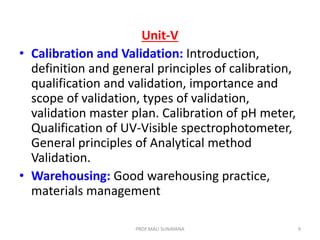
Unit-V
• Calibration and Validation: Introduction,
definition and general principles of calibration,
qualification and validation, importance and
scope of validation, types of validation,
validation master plan. Calibration of pH meter,
Qualification of UV-Visible spectrophotometer,
General principles of Analytical method
Validation.
• Warehousing: Good warehousing practice,
materials management
9
PROF.MALI SUNAYANA
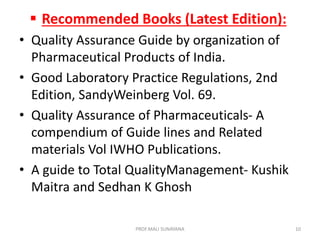
 Recommended Books (Latest Edition):
• Quality Assurance Guide by organization of
Pharmaceutical Products of India.
• Good Laboratory Practice Regulations, 2nd
Edition, SandyWeinberg Vol. 69.
• Quality Assurance of Pharmaceuticals- A
compendium of Guide lines and Related
materials Vol IWHO Publications.
• A guide to Total QualityManagement- Kushik
Maitra and Sedhan K Ghosh
10
PROF.MALI SUNAYANA
PROF.MALI SUNAYANA 11
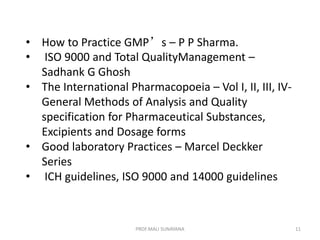
• How to Practice GMP’s – P P Sharma.
• ISO 9000 and Total QualityManagement –
Sadhank G Ghosh
• The International Pharmacopoeia – Vol I, II, III, IV-
General Methods of Analysis and Quality
specification for Pharmaceutical Substances,
Excipients and Dosage forms
• Good laboratory Practices – Marcel Deckker
Series
• ICH guidelines, ISO 9000 and 14000 guidelines
12
PROF.MALI SUNAYANA

Syllabus Copy

  • 1.
    PREPARED BY:- MS.MALI SUNAYANA M ASST.PROFESSOR THIRD YEAR B.PHARMACY SEM -VI SAHYADRI COLLEGE OF PHARMACY,METHWADE 1
  • 2.
    • This coursedeals with the various aspects of quality control and quality assurance aspects of pharmaceutical industries. • It deals with the important aspects like cGMP, QC tests, documentation, quality certifications and regulatory affairs. 2 PROF.MALI SUNAYANA
  • 3.
    • Upon completionof the course student shall be able to: • Understand the cGMP aspects in a pharmaceutical industry. • Appreciate the importance of documentation. • Understand the scope of quality certifications applicable to pharmaceutical industries. • Understand the responsibilities of QA & QC departments. 3 PROF.MALI SUNAYANA
  • 4.
  • 5.
    Unit-I • Quality Assuranceand Quality Management concepts: Definition and concept of Quality control, Quality assurance and GMP • Total Quality Management (TQM): Definition, elements, philosophies • ICH Guidelines: purpose, participants, process of harmonization, Brief overview of QSEM, with special emphasis on Q-series guidelines, ICH stability testing guidelines • Quality by design (QbD): Definition, overview, elements of QbD program, tools • ISO 9000 & ISO14000: Overview, Benefits, Elements, steps for registration • NABL accreditation: Principles and procedures 5 PROF.MALI SUNAYANA
  • 6.
    Unit-II • Organization andpersonnel: Personnel responsibilities, training, hygiene and personal records. • Premises: Design, construction and plant layout, maintenance, sanitation, environmental control, utilities and maintenance of sterile areas, control of contamination. • Equipments and raw materials: Equipment selection, purchase specifications, maintenance, purchase specifications and maintenance of stores for raw materials. 6 PROF.MALI SUNAYANA
  • 7.
    Unit-III • Quality Control:Quality control test for containers, rubber closures and secondary packing materials. • Good Laboratory Practices: General Provisions, Organization and Personnel, Facilities,Equipment, Testing Facilities Operation, Test and Control Articles, Protocol for Conduct of a Nonclinical Laboratory Study, Records and Reports, Disqualification of Testing Facilities 7 PROF.MALI SUNAYANA
  • 8.
    Unit-IV • Complaints: Complaintsand evaluation of complaints, Handling of return good, recalling and waste disposal. • Document maintenance in pharmaceutical industry: Batch Formula Record, Master Formula Record, SOP, Quality audit, Quality Review and Quality documentation, Reports and documents, distribution records. 8 PROF.MALI SUNAYANA
  • 9.
    Unit-V • Calibration andValidation: Introduction, definition and general principles of calibration, qualification and validation, importance and scope of validation, types of validation, validation master plan. Calibration of pH meter, Qualification of UV-Visible spectrophotometer, General principles of Analytical method Validation. • Warehousing: Good warehousing practice, materials management 9 PROF.MALI SUNAYANA
  • 10.
     Recommended Books(Latest Edition): • Quality Assurance Guide by organization of Pharmaceutical Products of India. • Good Laboratory Practice Regulations, 2nd Edition, SandyWeinberg Vol. 69. • Quality Assurance of Pharmaceuticals- A compendium of Guide lines and Related materials Vol IWHO Publications. • A guide to Total QualityManagement- Kushik Maitra and Sedhan K Ghosh 10 PROF.MALI SUNAYANA
  • 11.
    PROF.MALI SUNAYANA 11 •How to Practice GMP’s – P P Sharma. • ISO 9000 and Total QualityManagement – Sadhank G Ghosh • The International Pharmacopoeia – Vol I, II, III, IV- General Methods of Analysis and Quality specification for Pharmaceutical Substances, Excipients and Dosage forms • Good laboratory Practices – Marcel Deckker Series • ICH guidelines, ISO 9000 and 14000 guidelines
  • 12.