UNIT - I CHAPTER-II
Prepared By:- Ms. Mali Sunayana M.
Asst. Professor
Subject:- Pharmaceutical Quality Assurance
Sahyadri College Of Pharmacy, Methwade, Sangola.
CONTENT
 Evaluation of Quality Mangaement
 Defination of TQM
 Key Elements Of TQM
 Philosophies of TQM
 TQM Drug Industry
 Quality of Design
 Review Questions
2
Prof. Mali Sunayana
OBJECTIVES
Upon completion of this section, the student should be able to
• Explain the major stages in the quality movement.
• Define ’Total Quality Management’ (TQM).
• List and explain the key elements of TQM.
• List the philosophies and tools of TQM.
• Explain the concept of quality in the pharmaceutical industry.
3
Prof. Mali Sunayana
INTRODUCTION
 Total - made up of the whole
 Quality - degree of excellence a product or service provides
 Management-act, art or manner of planning, controlling, directing.
Therefore, TQM is the art of managing the whole to achieve
excellence.
Quality is a term that is widely used when talking about how good or
poor a product or service is. However, defining this term is not so easy.
 In most cases, it refers to how well the product is able to match the
specifications and meet the customer’s expectations. ISO defines
quality as “The degree to which a set of inherent characteristics fulfills
the requirements." 4
Prof. Mali Sunayana
• In the early 1900s, businesses were looking for ways to reduce the
number of faulty products being produced.
• In 1911, Frederick W. Taylor published a book titled “The
Principles of Scientific Management" which focused on how
organizations must use people-effectively.
• He proposed the concept of ‘clearly defined tasks’ and ‘standard
conditions’ and proposed people be assigned for the purpose of
‘inspection’ of goods.
• This led to the birth of the "Inspection Department" and its focus
was on preventing defects which in turn, developed into the concept
of Quality Control.
5
Prof. Mali Sunayana
• During the 1930s, Dr. W. Shewhart developed methods for statistical
analysis of production processes. Through use of a ‘control chart’ he
showed how variations in manufacturing processes lead to variations
in quality of the product.
• His theory of Statistical Quality Control highlighted the detection
and control of problems in quality by testing several samples at
different stages of the production process.
• During the 1940s, Japanese industry leaders wanted to change the
quality of their products which were largely seen as cheap imitations.
• At their invitation, western quality experts such as W. Edwards
Deming, Joseph M. Juran and Armand V. Feigenbaum visit Japan to
guide these industries with their quality needs.
6
Prof. Mali Sunayana
• Deming taught the Japanese the concepts of statistical analysis and
using it for quality control. Juran' s teachings focused on the idea of
getting managers involved with the quality process.
• In the early 60s, the Japanese firms came up with 'quality circles’ that
comprised a voluntary group of workers who met to discuss about
improving some aspect of their work and then presented their thoughts
to the management.
• This led to employees feeling more motivated to contribute to the
workplace. Gradually, the discussions began to center around
improvements that could be made in all organizational areas and not
merely the quality 0f products. This is how the idea of ‘Total Quality’
originated.
7
Prof. Mali Sunayana
• In 1969, Feigenbaum presented a paper at the first international
conference on quality control in Tokyo. In it, he used the term ‘Total
Quality’ for the first time. Around the same time, Ishikawa in Japan
also came up with the concept of ‘Total Quality Control’ which
differed from the western theory of total quality.
• By observing the great strides made by Japan in dealing with
quality issues, industry leaders in the West began their own set of
quality initiatives in the 1980s and 1990s. These ideas covered a
large spectrum of techniques and strategies, and it was all covered
by the term ‘Total Quality Management’ or “TQM”
8
Prof. Mali Sunayana
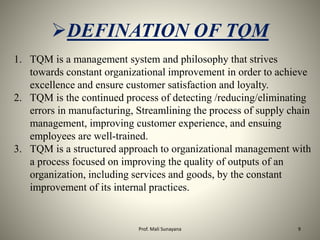
DEFINATION OF TQM
1. TQM is a management system and philosophy that strives
towards constant organizational improvement in order to achieve
excellence and ensure customer satisfaction and loyalty.
2. TQM is the continued process of detecting /reducing/eliminating
errors in manufacturing, Streamlining the process of supply chain
management, improving customer experience, and ensuing
employees are well-trained.
3. TQM is a structured approach to organizational management with
a process focused on improving the quality of outputs of an
organization, including services and goods, by the constant
improvement of its internal practices.
9
Prof. Mali Sunayana
 The main components of TQM include:
1. Focus on consumer
2. Analysis of process
3.Work in quality teams
4.Systematic analysis of problems
5. Implement planned Changes and evaluate results.
6. Use data to identify problems and solutions
7. Implement changes
10
Prof. Mali Sunayana
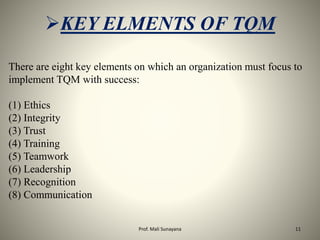
KEY ELMENTS OF TQM
There are eight key elements on which an organization must focus to
implement TQM with success:
(1) Ethics
(2) Integrity
(3) Trust
(4) Training
(5) Teamwork
(6) Leadership
(7) Recognition
(8) Communication
11
Prof. Mali Sunayana
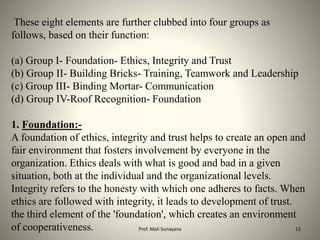
These eight elements are further clubbed into four groups as
follows, based on their function:
(a) Group I- Foundation- Ethics, Integrity and Trust
(b) Group II- Building Bricks- Training, Teamwork and Leadership
(c) Group III- Binding Mortar- Communication
(d) Group IV-Roof Recognition- Foundation
1. Foundation:-
A foundation of ethics, integrity and trust helps to create an open and
fair environment that fosters involvement by everyone in the
organization. Ethics deals with what is good and bad in a given
situation, both at the individual and the organizational levels.
Integrity refers to the honesty with which one adheres to facts. When
ethics are followed with integrity, it leads to development of trust.
the third element of the 'foundation', which creates an environment
of cooperativeness. 12
Prof. Mali Sunayana
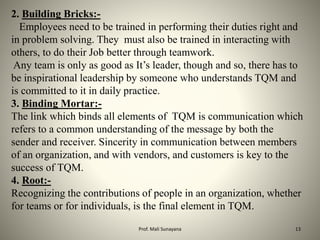
2. Building Bricks:-
Employees need to be trained in performing their duties right and
in problem solving. They must also be trained in interacting with
others, to do their Job better through teamwork.
Any team is only as good as It’s leader, though and so, there has to
be inspirational leadership by someone who understands TQM and
is committed to it in daily practice.
3. Binding Mortar:-
The link which binds all elements of TQM is communication which
refers to a common understanding of the message by both the
sender and receiver. Sincerity in communication between members
of an organization, and with vendors, and customers is key to the
success of TQM.
4. Root:-
Recognizing the contributions of people in an organization, whether
for teams or for individuals, is the final element in TQM.
13
Prof. Mali Sunayana
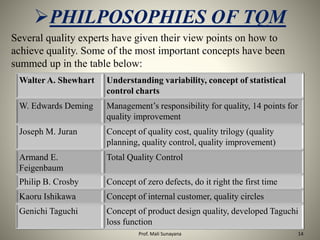
Several quality experts have given their view points on how to
achieve quality. Some of the most important concepts have been
summed up in the table below:
PHILPOSOPHIES OF TQM
Walter A. Shewhart Understanding variability, concept of statistical
control charts
W. Edwards Deming Management’s responsibility for quality, 14 points for
quality improvement
Joseph M. Juran Concept of quality cost, quality trilogy (quality
planning, quality control, quality improvement)
Armand E.
Feigenbaum
Total Quality Control
Philip B. Crosby Concept of zero defects, do it right the first time
Kaoru Ishikawa Concept of internal customer, quality circles
Genichi Taguchi Concept of product design quality, developed Taguchi
loss function
14
Prof. Mali Sunayana
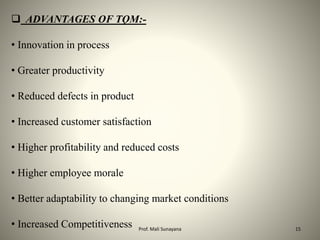
 ADVANTAGES OF TQM:-
• Innovation in process
• Greater productivity
• Reduced defects in product
• Increased customer satisfaction
• Higher profitability and reduced costs
• Higher employee morale
• Better adaptability to changing market conditions
• Increased Competitiveness 15
Prof. Mali Sunayana
Tools used In TQM
TOOL PURPOSE
Cause and effect diagram/fishbone
diagram
Identify and analyze of a problem
Checklists Gathering of data
Flowcharts Document detailed steps of a process
Scatter diagrams Relation between two variables
Control charts Identify variations in process
Histograms Graphical display of frequency distribution
of data
Pareto analysis Degree of importance of each element
16
Prof. Mali Sunayana
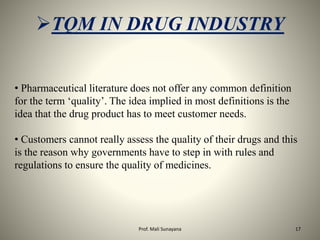
• Pharmaceutical literature does not offer any common definition
for the term ‘quality’. The idea implied in most definitions is the
idea that the drug product has to meet customer needs.
• Customers cannot really assess the quality of their drugs and this
is the reason why governments have to step in with rules and
regulations to ensure the quality of medicines.
TQM IN DRUG INDUSTRY
17
Prof. Mali Sunayana
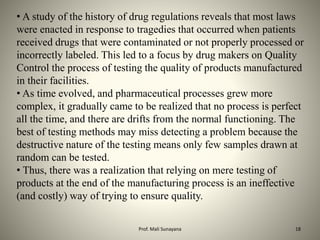
• A study of the history of drug regulations reveals that most laws
were enacted in response to tragedies that occurred when patients
received drugs that were contaminated or not properly processed or
incorrectly labeled. This led to a focus by drug makers on Quality
Control the process of testing the quality of products manufactured
in their facilities.
• As time evolved, and pharmaceutical processes grew more
complex, it gradually came to be realized that no process is perfect
all the time, and there are drifts from the normal functioning. The
best of testing methods may miss detecting a problem because the
destructive nature of the testing means only few samples drawn at
random can be tested.
• Thus, there was a realization that relying on mere testing of
products at the end of the manufacturing process is an ineffective
(and costly) way of trying to ensure quality.
18
Prof. Mali Sunayana
• According to regulatory bodies across the world, high quality drug
products are those that can be relied upon to deliver the desired
clinical effects with consistency.
• Consumers of medicines need to know for sure that the drug
product they are consuming are of good quality, safe for
consumption, and will be effective in relieving them of their ailment.
• This quality can be guaranteed only if the products have it built
into them right from the very first stage of design of the product and
process.
• Realization of this basic principle led to the International
Conference on Harmonization (ICH) in 2002, introducing a hitherto
unheard of term in the drug processing field the concept of - Quality
by Design' or QbD.
19
Prof. Mali Sunayana
 Quality by Design:
The ICH guideline Q8 (R2) Pharmaceutical Development
defines QbD as, "A systematic approach to development that
begins with predefined objectives, emphasizes product, process
understanding and process control, based oh sound science and
quality risk management.“
To achieve the objective of QbD, it is important to understand
product characteristics End study process characteristics using a
combination of prior knowledge and experimental studies.
From this data generated during product development, it becomes
possible to decide which quality parameters in starting materials
are the most important, and which critical processing factors need
to be controlled to achieve a product with all the desired quality
attributes.
20
Prof. Mali Sunayana
• The ICH Q10 guideline says that a Pharmaceutical Quality System
is one that “assures that the desired product quality is routinely met,
suitable process performance is achieved the set of controls are
appropriate, improvement opportunities are identified and evaluated
and the body of knowledge is continually expanded.”
• In other words, a robust pharmaceutical quality system is the key to
supplying customers with high quality drugs. Such a system has the
following characteristics:
 Aligned with requirements of current Good Manufacturing
Practices (cGMP)
 Science-based and risk-based
 Comprehensive
 Proactive and accountable
21
Prof. Mali Sunayana
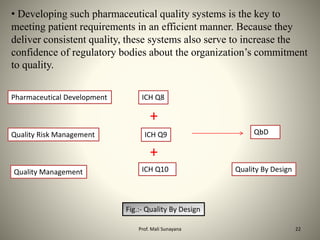
• Developing such pharmaceutical quality systems is the key to
meeting patient requirements in an efficient manner. Because they
deliver consistent quality, these systems also serve to increase the
confidence of regulatory bodies about the organization’s commitment
to quality.
22
Prof. Mali Sunayana
Pharmaceutical Development
Quality Risk Management
Quality Management Quality By Design
ICH Q8
ICH Q9
ICH Q10
QbD
+
+
Fig.:- Quality By Design
1. Name the key thinkers of the quality movement and write
about their concepts of quality.
2. Define TQM and discuss its advantages.
3. List the key elements of TQM and the tools it uses.
4. Explain how TQM principles are applied in the
pharmaceutical industry.
5. Write a brief note about the concept of Quality by Design
(QbD) in pharma industry.
REVIEW QUESTIONS
23
Prof. Mali Sunayana
1) A Text book of Pharmaceutical Quality Assurance by the
author Anusuya R.Kashi, Bindu Sukumaran, And Veena P.
Nirali Prakashan. Page No.2.1-2.6
2) Text book of Total Quality Management by L.Suganthi
and Anand A.Samuel,2nd edition,2005,page no.49-61.
3) Total Quality Management by R.S Nagarajan,
A.A.Arivalangar,new age international publishers,1st
edition,2009,page no.21.
4) www.slideshare.com/tqm in pharma industry.
5) www.google.com
REFERENCE
24
Prof. Mali Sunayana
25

Total Management (TQM)

  • 1.
    UNIT - ICHAPTER-II Prepared By:- Ms. Mali Sunayana M. Asst. Professor Subject:- Pharmaceutical Quality Assurance Sahyadri College Of Pharmacy, Methwade, Sangola.
  • 2.
    CONTENT  Evaluation ofQuality Mangaement  Defination of TQM  Key Elements Of TQM  Philosophies of TQM  TQM Drug Industry  Quality of Design  Review Questions 2 Prof. Mali Sunayana
  • 3.
    OBJECTIVES Upon completion ofthis section, the student should be able to • Explain the major stages in the quality movement. • Define ’Total Quality Management’ (TQM). • List and explain the key elements of TQM. • List the philosophies and tools of TQM. • Explain the concept of quality in the pharmaceutical industry. 3 Prof. Mali Sunayana
  • 4.
    INTRODUCTION  Total -made up of the whole  Quality - degree of excellence a product or service provides  Management-act, art or manner of planning, controlling, directing. Therefore, TQM is the art of managing the whole to achieve excellence. Quality is a term that is widely used when talking about how good or poor a product or service is. However, defining this term is not so easy.  In most cases, it refers to how well the product is able to match the specifications and meet the customer’s expectations. ISO defines quality as “The degree to which a set of inherent characteristics fulfills the requirements." 4 Prof. Mali Sunayana
  • 5.
    • In theearly 1900s, businesses were looking for ways to reduce the number of faulty products being produced. • In 1911, Frederick W. Taylor published a book titled “The Principles of Scientific Management" which focused on how organizations must use people-effectively. • He proposed the concept of ‘clearly defined tasks’ and ‘standard conditions’ and proposed people be assigned for the purpose of ‘inspection’ of goods. • This led to the birth of the "Inspection Department" and its focus was on preventing defects which in turn, developed into the concept of Quality Control. 5 Prof. Mali Sunayana
  • 6.
    • During the1930s, Dr. W. Shewhart developed methods for statistical analysis of production processes. Through use of a ‘control chart’ he showed how variations in manufacturing processes lead to variations in quality of the product. • His theory of Statistical Quality Control highlighted the detection and control of problems in quality by testing several samples at different stages of the production process. • During the 1940s, Japanese industry leaders wanted to change the quality of their products which were largely seen as cheap imitations. • At their invitation, western quality experts such as W. Edwards Deming, Joseph M. Juran and Armand V. Feigenbaum visit Japan to guide these industries with their quality needs. 6 Prof. Mali Sunayana
  • 7.
    • Deming taughtthe Japanese the concepts of statistical analysis and using it for quality control. Juran' s teachings focused on the idea of getting managers involved with the quality process. • In the early 60s, the Japanese firms came up with 'quality circles’ that comprised a voluntary group of workers who met to discuss about improving some aspect of their work and then presented their thoughts to the management. • This led to employees feeling more motivated to contribute to the workplace. Gradually, the discussions began to center around improvements that could be made in all organizational areas and not merely the quality 0f products. This is how the idea of ‘Total Quality’ originated. 7 Prof. Mali Sunayana
  • 8.
    • In 1969,Feigenbaum presented a paper at the first international conference on quality control in Tokyo. In it, he used the term ‘Total Quality’ for the first time. Around the same time, Ishikawa in Japan also came up with the concept of ‘Total Quality Control’ which differed from the western theory of total quality. • By observing the great strides made by Japan in dealing with quality issues, industry leaders in the West began their own set of quality initiatives in the 1980s and 1990s. These ideas covered a large spectrum of techniques and strategies, and it was all covered by the term ‘Total Quality Management’ or “TQM” 8 Prof. Mali Sunayana
  • 9.
    DEFINATION OF TQM 1.TQM is a management system and philosophy that strives towards constant organizational improvement in order to achieve excellence and ensure customer satisfaction and loyalty. 2. TQM is the continued process of detecting /reducing/eliminating errors in manufacturing, Streamlining the process of supply chain management, improving customer experience, and ensuing employees are well-trained. 3. TQM is a structured approach to organizational management with a process focused on improving the quality of outputs of an organization, including services and goods, by the constant improvement of its internal practices. 9 Prof. Mali Sunayana
  • 10.
     The maincomponents of TQM include: 1. Focus on consumer 2. Analysis of process 3.Work in quality teams 4.Systematic analysis of problems 5. Implement planned Changes and evaluate results. 6. Use data to identify problems and solutions 7. Implement changes 10 Prof. Mali Sunayana
  • 11.
    KEY ELMENTS OFTQM There are eight key elements on which an organization must focus to implement TQM with success: (1) Ethics (2) Integrity (3) Trust (4) Training (5) Teamwork (6) Leadership (7) Recognition (8) Communication 11 Prof. Mali Sunayana
  • 12.
    These eight elementsare further clubbed into four groups as follows, based on their function: (a) Group I- Foundation- Ethics, Integrity and Trust (b) Group II- Building Bricks- Training, Teamwork and Leadership (c) Group III- Binding Mortar- Communication (d) Group IV-Roof Recognition- Foundation 1. Foundation:- A foundation of ethics, integrity and trust helps to create an open and fair environment that fosters involvement by everyone in the organization. Ethics deals with what is good and bad in a given situation, both at the individual and the organizational levels. Integrity refers to the honesty with which one adheres to facts. When ethics are followed with integrity, it leads to development of trust. the third element of the 'foundation', which creates an environment of cooperativeness. 12 Prof. Mali Sunayana
  • 13.
    2. Building Bricks:- Employeesneed to be trained in performing their duties right and in problem solving. They must also be trained in interacting with others, to do their Job better through teamwork. Any team is only as good as It’s leader, though and so, there has to be inspirational leadership by someone who understands TQM and is committed to it in daily practice. 3. Binding Mortar:- The link which binds all elements of TQM is communication which refers to a common understanding of the message by both the sender and receiver. Sincerity in communication between members of an organization, and with vendors, and customers is key to the success of TQM. 4. Root:- Recognizing the contributions of people in an organization, whether for teams or for individuals, is the final element in TQM. 13 Prof. Mali Sunayana
  • 14.
    Several quality expertshave given their view points on how to achieve quality. Some of the most important concepts have been summed up in the table below: PHILPOSOPHIES OF TQM Walter A. Shewhart Understanding variability, concept of statistical control charts W. Edwards Deming Management’s responsibility for quality, 14 points for quality improvement Joseph M. Juran Concept of quality cost, quality trilogy (quality planning, quality control, quality improvement) Armand E. Feigenbaum Total Quality Control Philip B. Crosby Concept of zero defects, do it right the first time Kaoru Ishikawa Concept of internal customer, quality circles Genichi Taguchi Concept of product design quality, developed Taguchi loss function 14 Prof. Mali Sunayana
  • 15.
     ADVANTAGES OFTQM:- • Innovation in process • Greater productivity • Reduced defects in product • Increased customer satisfaction • Higher profitability and reduced costs • Higher employee morale • Better adaptability to changing market conditions • Increased Competitiveness 15 Prof. Mali Sunayana
  • 16.
    Tools used InTQM TOOL PURPOSE Cause and effect diagram/fishbone diagram Identify and analyze of a problem Checklists Gathering of data Flowcharts Document detailed steps of a process Scatter diagrams Relation between two variables Control charts Identify variations in process Histograms Graphical display of frequency distribution of data Pareto analysis Degree of importance of each element 16 Prof. Mali Sunayana
  • 17.
    • Pharmaceutical literaturedoes not offer any common definition for the term ‘quality’. The idea implied in most definitions is the idea that the drug product has to meet customer needs. • Customers cannot really assess the quality of their drugs and this is the reason why governments have to step in with rules and regulations to ensure the quality of medicines. TQM IN DRUG INDUSTRY 17 Prof. Mali Sunayana
  • 18.
    • A studyof the history of drug regulations reveals that most laws were enacted in response to tragedies that occurred when patients received drugs that were contaminated or not properly processed or incorrectly labeled. This led to a focus by drug makers on Quality Control the process of testing the quality of products manufactured in their facilities. • As time evolved, and pharmaceutical processes grew more complex, it gradually came to be realized that no process is perfect all the time, and there are drifts from the normal functioning. The best of testing methods may miss detecting a problem because the destructive nature of the testing means only few samples drawn at random can be tested. • Thus, there was a realization that relying on mere testing of products at the end of the manufacturing process is an ineffective (and costly) way of trying to ensure quality. 18 Prof. Mali Sunayana
  • 19.
    • According toregulatory bodies across the world, high quality drug products are those that can be relied upon to deliver the desired clinical effects with consistency. • Consumers of medicines need to know for sure that the drug product they are consuming are of good quality, safe for consumption, and will be effective in relieving them of their ailment. • This quality can be guaranteed only if the products have it built into them right from the very first stage of design of the product and process. • Realization of this basic principle led to the International Conference on Harmonization (ICH) in 2002, introducing a hitherto unheard of term in the drug processing field the concept of - Quality by Design' or QbD. 19 Prof. Mali Sunayana
  • 20.
     Quality byDesign: The ICH guideline Q8 (R2) Pharmaceutical Development defines QbD as, "A systematic approach to development that begins with predefined objectives, emphasizes product, process understanding and process control, based oh sound science and quality risk management.“ To achieve the objective of QbD, it is important to understand product characteristics End study process characteristics using a combination of prior knowledge and experimental studies. From this data generated during product development, it becomes possible to decide which quality parameters in starting materials are the most important, and which critical processing factors need to be controlled to achieve a product with all the desired quality attributes. 20 Prof. Mali Sunayana
  • 21.
    • The ICHQ10 guideline says that a Pharmaceutical Quality System is one that “assures that the desired product quality is routinely met, suitable process performance is achieved the set of controls are appropriate, improvement opportunities are identified and evaluated and the body of knowledge is continually expanded.” • In other words, a robust pharmaceutical quality system is the key to supplying customers with high quality drugs. Such a system has the following characteristics:  Aligned with requirements of current Good Manufacturing Practices (cGMP)  Science-based and risk-based  Comprehensive  Proactive and accountable 21 Prof. Mali Sunayana
  • 22.
    • Developing suchpharmaceutical quality systems is the key to meeting patient requirements in an efficient manner. Because they deliver consistent quality, these systems also serve to increase the confidence of regulatory bodies about the organization’s commitment to quality. 22 Prof. Mali Sunayana Pharmaceutical Development Quality Risk Management Quality Management Quality By Design ICH Q8 ICH Q9 ICH Q10 QbD + + Fig.:- Quality By Design
  • 23.
    1. Name thekey thinkers of the quality movement and write about their concepts of quality. 2. Define TQM and discuss its advantages. 3. List the key elements of TQM and the tools it uses. 4. Explain how TQM principles are applied in the pharmaceutical industry. 5. Write a brief note about the concept of Quality by Design (QbD) in pharma industry. REVIEW QUESTIONS 23 Prof. Mali Sunayana
  • 24.
    1) A Textbook of Pharmaceutical Quality Assurance by the author Anusuya R.Kashi, Bindu Sukumaran, And Veena P. Nirali Prakashan. Page No.2.1-2.6 2) Text book of Total Quality Management by L.Suganthi and Anand A.Samuel,2nd edition,2005,page no.49-61. 3) Total Quality Management by R.S Nagarajan, A.A.Arivalangar,new age international publishers,1st edition,2009,page no.21. 4) www.slideshare.com/tqm in pharma industry. 5) www.google.com REFERENCE 24 Prof. Mali Sunayana
  • 25.