UNIT - I CHAPTER-I
Prepared By:- Ms. Mali Sunayana M.
Asst. Professor
Subject:- Pharmaceutical Quality Assurance
Sahyadri College Of Pharmacy, Methwade, Sangola.
 History Of Drug Regulation
 The Regulatory Drug Approval Process
 Quality Assurance
- Objectives Of Quality Assurance
 Current Good Manufacturing Practices (cGMP)
 Quality Control
- Objectives Of Quality Control
2
Prof. Mali Sunayana
After completing of this chapter , the student should be able to ;
o Illustrate the major events that led to the enlargement of quality
concepts in the pharmaceutical industry.
o List the important pharmaceutical regulatory bodies across the world.
o Understand the drug approval process.
o Define the terms ’Quality Assurance’ and ’Quality Control’ and their
objectives.
o Differentiate between Quality Assurance and Quality Control.
o Define the term Good Manufacturing Practices (GMPs).
o Explain the areas covered under current Good Manufacturing Practices
(cGMPs)
3
Prof. Mali Sunayana
 Quality Assurance (QA) :
Sum of all activities and responsibilities required to ensure that
the medicine that reaches the patient is safe, effective, and
acceptable to the patient.
 Quality Control (QC):
Process concerned with medicine sampling, specifications,
and testing, and with the organization’s release procedures that
ensure that the necessary tests are carried out and that the
materials are not released for use, nor products released for sale
or supply, until their quality has been judged satisfactory.
4
Prof. Mali Sunayana
 Quality Management (QM)—
A quality management system is a management technique used to
communicate to employees what is required to produce the desired
quality of products and services andto influence employee actions
to complete tasks according to the quality specifications.
 Good Manufacturing Practices (GMP)—
Performance standards that WHO and many national governments
established for pharmaceutical manufacturers covering, for example,
personnel, facilities, packaging, and quality control.
5
Prof. Mali Sunayana
• Quality is “totality of characteristics of an entity that bear on its
ability to satisfy stated and implied needs”.
• The ability to make the same thing the same way, over and over
again.
• Customer buys today is same as what they bought last week or
will buy next week.
• Product meets customer’s expectations 100% of the time.
6
Prof. Mali Sunayana
 Business success may simply be the extent to which any
organization can produce a higher-quality product or service than
its competitors are able to do at a competitive price.
 When quality is the key to a company’s success, Quality
Management system allow organizations to:
• Keep up with and meet current quality levels.
• Meet the consumer’s requirement for quality
• Retain employees through competitive compensation programs.
• Keep up with the latest technology.
7
Prof. Mali Sunayana
• Quality is an important requirement for products. In any
industry because it directly decides the profits realized from
their sale. However, in the pharmaceutical industry, there is yet
another important cause is there and that is why quality products
are necessary.
• In fact, this is one of the major reasons why this industry is so
highly regulated - because any errors in the manufacturing
process can lead to dangerous and even fatal results for the
patients consuming the products. Therefore, it is vital that
pharmaceutical products must be manufactured to meet stringent
regulatory standards.
8
Prof. Mali Sunayana
• In the field of drug products, it is the United States of America that
has always been at the forefront of developing the necessary
regulatory guidelines, and the trend continues to this day. Much of
the history of drug regulations therefore cover events in the US.
• In the olden days, medicines were prepared mainly in the form of
elixirs, ointments and pills, and sold by the person making them.
• These medicine containers were labeled with nothing much
beyond the name of the product they contained, and the troubles
they promised to cure.
• Later, as science and technology advanced, some small family
businesses began manufacturing other products like vaccines and
anti-toxins too, but there was almost no control over these
operations.
9
Prof. Mali Sunayana
• In 1902, a mishap occurred to focus attention on the dangers of such
manufacturing. Twelve children died after being administered an
antitoxin for diphtheria and it was found that the product had been
contaminated with live tetanus bacilli.
• In response to strong protests from the public, the United States
Congress passed the Biologics Control Act. Under this Act, the
manufacturers and sellers of such biological products had to test their
products for strength and purity; they also had to undergo regular
inspections by the health authorities
10
Prof. Mali Sunayana
•In 1906, the US Congress passed the Pure Food and Drug Act.
This made it illegal for people to sell adulterated/contaminated food
or meat. Out of this Act was born one of the world’s first
government regulatory bodies, which we now known as the United
States Food and Drug Administration (USFDA). " .
•In 1935, 107 people, a majority of them children, died after
consuming oral sulfanilamide elixir. An investigation showed that
this product had been made using a solvent called diethylene glycol
which is a poisonous solvent!
• The public was incensed and demanded stricter laws;
11
Prof. Mali Sunayana
•In response, in the year of 1938 the US Congress passed the Federal
Food, Drug and Cosmetic Act.
• In 1941, yet another disaster occurred in which near about 300
people died. The cause was Sulfathiazole tablets had got
contaminated with a sedative Phenobarbital. This led to significant
changes in the regulations controlling manufacturing and quality
control requirements for drugs.
• In 1944 , The Public Health Services (PHS) Act that was passed for
further expanded the scope of regulations to biological products..
• In 1955, days after a mass polio vaccination drive began using the
newly developed Salk polio vaccine, it had to be abandoned. The
reason was children who received the vaccine (from batches made by
Cutter Laboratories) were found to have developed the disease.
12
Prof. Mali Sunayana
• In 1957. a pharmaceutical company in Germany called Chemie
Grunenthal GmbH developed the world's first non-barbiturate anti-
convulsant drug called as Thalidomide.
• It was found, to also have a sedative effect and doctors began
prescribing it as a tranquilizer.
• Around 1960, an Australian obstetrician McBride noticed that the
drug also helped to reduce the morning sickness associated with
pregnancy.
• He began recommending it to his pregnant patients, and through
word-of-mouth reports in the medical fraternity, this practice, too
spread across the world.
13
Prof. Mali Sunayana
• Only in the USA, the drug had not been approved for use by the
FDA’s drug examiner named Frances Kelsey. (Years later, she was
conferred with awands for the service she had rendered to the
American public through this act.)
• However. by 1961, McBride began noticing a severe birth defect
called phocomelia in babies delivered by his patients who had taken
Thalidomide. Phocomelia is the condition where a baby has no limbs,
or shortened or flipper-like limbs.
• A newspaper in Germany reported that close to 161 babies had been
thus adversely affected by the drug and the distribution of
Thalidomide in Germany was stopped, with other countries following
suit. 14
Prof. Mali Sunayana
• By 1962, after at least 10,000 cases of deformed infants had been
born, Thalidomide was finally completely banned.
• It was only In 1963 that the USFDA published the first ever set of
Good Manufacturing Practices (GMP) for finished pharmaceuticals.
• Today, GMP or current Good Manufacturing Practices (cGMP), as it
is now known is the very backbone of ensuring the quality, safety and
efficacy of drug products.
• Every country has regulatory bodies to oversee the drug
development, manufacturing and distribution process. These bodies
lay down cGMP guidelines that ensure all processes right from
procuring materials to drug manufacturing to their distribution occurs
under the most stringent of controols.
15
Prof. Mali Sunayana
SR.NO. COUNTRY REGULATORY BODY
1. USA Food & Drug Administration(FDA)
2. Japan Ministry of Health Labour and Welfare
3. Australia Therapeutic Goods Administration (TGA)
4. UK Medicines & Healthcare products
Regulatory Agency (MHRA)
5. South Africa Medicine Control Council(MCC)
6. India Central Drugs Standard Control
Organization(CDSCO)
7. China State Food & Drug Administration
16
Prof. Mali Sunayana
• Drug development is a complex process and the transition of a
molecule from the laboratory bench to the patient's bedside is a long
and arduous journey that can take any where from 10-15 years at the
very least.
• A drug company first chooses a biochemical mechanism that is the
basis of some disease, and begins screening molecules to overcome
that condition. Through the use of proteomics, functional genomics
and other screening methods, a few lead molecules that
show promise are chosen for characterization.
17
Prof. Mali Sunayana
• Characterization involves the study of the molecule’s shape, size,
strengths, bioactivity, weaknesses toxicity, bioavailability and the
possible mechanism of its action.
• Next, work commences on formulating the molecule into a suitable
dosage form for administration.
• This involves a study of the drug’s stability to heat, light, and within
the formulation itself.
•This stage is followed by an investigation of the pharmacokinetics
of the drug and ADME
(Absorption/Distribution/Metabolism/Excretion) studies to get
information that also helps to improve the formulation.
18
Prof. Mali Sunayana
• Next come the pre-clinical toxicology tests for acute toxicity,
repeated dose toxicity, and genetic and, reproductive toxicity,
carcinogenicity etc; Armed with results from all these tests, the
company files an Investigative New Drug Application (INDA) with
the FDA. Who scrutinizes the application and if satisfied, gives the
green signal for the clinical trials to begin.
•Clinical research trials are held In three phases:-
-the first is to test the safety of the drug in healthy human volunteers
-the second phase is run with 100-250 patients who suffer from the
disease
- the third phase is performed on even larger groups of patients in
multi – center trials.
19
Prof. Mali Sunayana
20
Prof. Mali Sunayana
• Getting FDA approval is however only the start of yet another
equally tough journey. The drug formulation has to transit from the
laboratory to the manufacturing floor, which has its own challenges.
• As obvious from the history of how cGMP came into being, there
are many things that can go wrong and it is vital to have sufficient
control over all the factors that can influence the quality of the final
drug product.
•For several years, pharmaceutical companies relied a lot on Quality
Control (QC) for adequate testing of the quality of their products.
•This realization led to the development of the concept of Quality
Assurance (QA) which seeks to build quality into the products from
the very beginning of the process of drug manufacture.
The World Health Organization (WHO) defines QA as, “ The totality of
arrangements made with the object of ensuring that pharmaceutical products
are of the quality required for their intended use”
21
Prof. Mali Sunayana
 Product design and development is in accordance with requirements
of cGMP, Good Laboratory Practices (for non-clinical developmental
studies) and Good Clinical Practices (for clinical studies).
 All operations in production and control steps are specified clearly in
writing
 Managerial responsibility Is specified clearly In each job description.
 Correct starting materials and packaging materials are used to
manufacture drug products.
 Appropriate controls-such as in-process checks, calibrations and
validations exist ,to ensure quality of raw-materials, intermediate
products and finished products.
 Finished products are appropriately checked in accordance with pre-
determined procedures.
22
Prof. Mali Sunayana
 cGMP is the aspect of QA that ensures the consistent production and
control of products to meet pre-determined quality standards. The
primary aim of cGMP is to reduce two inherent risks involved in
pharmaceutical production mix-ups and cross-contamination.
 cGMP guidelines are prescribed by every country's drug regulatory
authority and according to WHO, cGMP requires that :
(a) All manufacturing processes are clearly dehned, systematically
reviewed in the light of experience, and shown to be capable of
consistently manufacturing pharmaceutical products of the required
quality that comply with their specifications;
(b) Qualification and validation are performed.
23
Prof. Mali Sunayana
c) All necessary resources are provided, including:
(i) Appropriately qualified and trained personnel;
(ii) Adequate premises and space;
(iii) Suitable equipment and services;
(iv) Appropriate materials, containers and labels;
(v) Approved procedures and instructions;
(vi) Suitable storage and transport;
(vii) Adequate personnel, laboratories and equipment for in-
process controls;
24
Prof. Mali Sunayana
d) Instructions and procedures are written in clear and unambiguous
language, specifically applicable to the facilities provided;
(e) Operators are trained to carry out procedures correctly;
(f) Records are made (manually and/or by recording instruments)
during manufacture to show that all the steps required by the defined
procedures and instructions have in fact been taken and that the
quantity and quality of the product are as expected; any significant
deviations are fully recorded and investigated
25
Prof. Mali Sunayana
26
Prof. Mali Sunayana
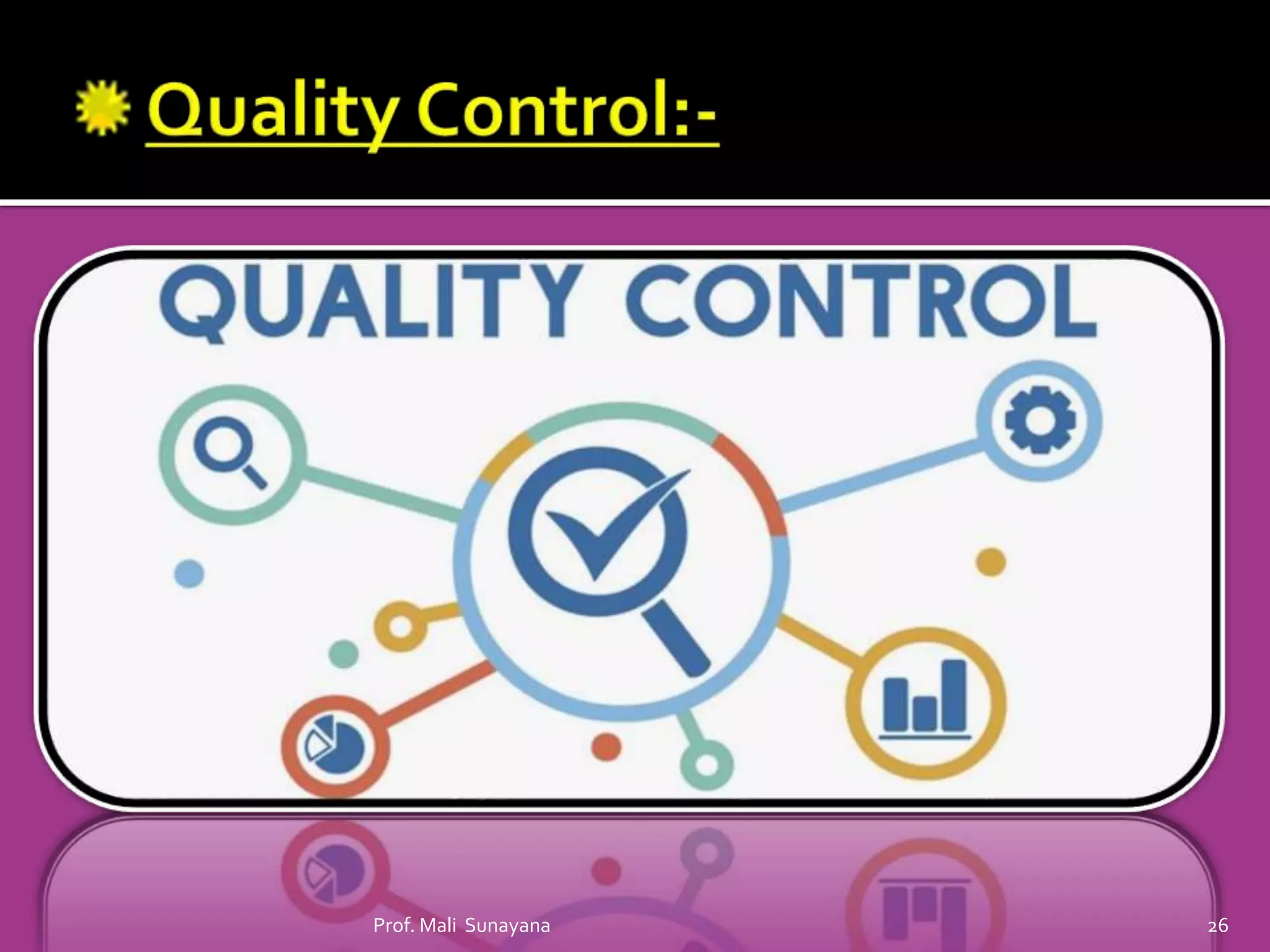
• As per ISO 9000, Quality Control (QC) is detined as, “A part of
quality management focused on fulfilling quality requirements.”
• WHO defines QC as, “The sum of all procedures undertaken to
ensure the identity and purity of a particular pharmaceutical.”
• QC is the part of GMP that deals with developing specifications,
sampling input materials, intermediates and finished products;
testing them, documenting results, and setting up release procedures
to ensure that all relevant testing has been performed and only
products with ascertained quality are released for use.
27
Prof. Mali Sunayana
 There is a day-to-day control maintained over the quality aspects of
drug products.
 Incoming raw materials, in-process goods and finished products are
all tested for compliance with predetermined quality specifications.
 Environmental monitoring is performed to make sure products are
manufactured,packed and stored under prescribed conditions.
 Instruments are calibrated and working as expected.
 Analytical methods are developed and validated to assure they stay
capable of providing results that are accurate and predictable.
28
Prof. Mali Sunayana
ATTRIBUTE QUALITY ASSURANCE QUALITY CONTROL
Goal Preventing Defects Identifying Defects
Focus Building quality into product
from design stage itself
Testing if quality exists in product after
its manufacture
Work Flow Establish quality management
system, continuous monitoring
of processes
Find source of problems in quality
Type of tool Managerial Corrective
29
Prof. Mali Sunayana
30
Prof. Mali Sunayana
1) Name the important regulatory bodies that govern the
pharmaceutical industry.
2) Discuss how the cGMPs were developed by the USFDA.
3) Explain the steps involved in developing a drug from initial
discovery to final marketing of the formulation.
4) Define the terms QA and QC and explain the differences between
them.
5) Describe the functions of QA and QC in a pharmaceutical
company.
6) What is cGMP ? Highlight the important areas covered under
cGMP guidelines.
31
Prof. Mali Sunayana
1) A Text book of Pharmaceutical Quality Assurance by the author Anusuya
R.Kashi, Bindu Sukumaran, And Veena P. Nirali Prakashan. Page No.1.1-1.8
2) www.ncbi.nlm.nih.gov/pubmed/19289341
3) https://www.fda.gov/about-fda/fda-leadership-1907-today/brochure-history-
drug-regulation-united-stateswww.fda.gov
4) www.fda.gov/downloads/ICECI/ComplianceManuals/.../UCM125 420.Pd
5) Quality Assurance Of Drugs in Pharmaceuticals, P.D.Sethi, Vandana Publ,
New Delhi.
6) Quality Assurance of Pharmaceuticals: A Compendium of Guidelines and
Related Materials. Good manufacturing practices and inspection, Volume 2,
WHO.
7) www,google.com
8) https://www.pinterest.com/pin/343118065336801880/
32
Prof. Mali Sunayana
33

Quality Assurance and Quality Management concepts

  • 1.
    UNIT - ICHAPTER-I Prepared By:- Ms. Mali Sunayana M. Asst. Professor Subject:- Pharmaceutical Quality Assurance Sahyadri College Of Pharmacy, Methwade, Sangola.
  • 2.
     History OfDrug Regulation  The Regulatory Drug Approval Process  Quality Assurance - Objectives Of Quality Assurance  Current Good Manufacturing Practices (cGMP)  Quality Control - Objectives Of Quality Control 2 Prof. Mali Sunayana
  • 3.
    After completing ofthis chapter , the student should be able to ; o Illustrate the major events that led to the enlargement of quality concepts in the pharmaceutical industry. o List the important pharmaceutical regulatory bodies across the world. o Understand the drug approval process. o Define the terms ’Quality Assurance’ and ’Quality Control’ and their objectives. o Differentiate between Quality Assurance and Quality Control. o Define the term Good Manufacturing Practices (GMPs). o Explain the areas covered under current Good Manufacturing Practices (cGMPs) 3 Prof. Mali Sunayana
  • 4.
     Quality Assurance(QA) : Sum of all activities and responsibilities required to ensure that the medicine that reaches the patient is safe, effective, and acceptable to the patient.  Quality Control (QC): Process concerned with medicine sampling, specifications, and testing, and with the organization’s release procedures that ensure that the necessary tests are carried out and that the materials are not released for use, nor products released for sale or supply, until their quality has been judged satisfactory. 4 Prof. Mali Sunayana
  • 5.
     Quality Management(QM)— A quality management system is a management technique used to communicate to employees what is required to produce the desired quality of products and services andto influence employee actions to complete tasks according to the quality specifications.  Good Manufacturing Practices (GMP)— Performance standards that WHO and many national governments established for pharmaceutical manufacturers covering, for example, personnel, facilities, packaging, and quality control. 5 Prof. Mali Sunayana
  • 6.
    • Quality is“totality of characteristics of an entity that bear on its ability to satisfy stated and implied needs”. • The ability to make the same thing the same way, over and over again. • Customer buys today is same as what they bought last week or will buy next week. • Product meets customer’s expectations 100% of the time. 6 Prof. Mali Sunayana
  • 7.
     Business successmay simply be the extent to which any organization can produce a higher-quality product or service than its competitors are able to do at a competitive price.  When quality is the key to a company’s success, Quality Management system allow organizations to: • Keep up with and meet current quality levels. • Meet the consumer’s requirement for quality • Retain employees through competitive compensation programs. • Keep up with the latest technology. 7 Prof. Mali Sunayana
  • 8.
    • Quality isan important requirement for products. In any industry because it directly decides the profits realized from their sale. However, in the pharmaceutical industry, there is yet another important cause is there and that is why quality products are necessary. • In fact, this is one of the major reasons why this industry is so highly regulated - because any errors in the manufacturing process can lead to dangerous and even fatal results for the patients consuming the products. Therefore, it is vital that pharmaceutical products must be manufactured to meet stringent regulatory standards. 8 Prof. Mali Sunayana
  • 9.
    • In thefield of drug products, it is the United States of America that has always been at the forefront of developing the necessary regulatory guidelines, and the trend continues to this day. Much of the history of drug regulations therefore cover events in the US. • In the olden days, medicines were prepared mainly in the form of elixirs, ointments and pills, and sold by the person making them. • These medicine containers were labeled with nothing much beyond the name of the product they contained, and the troubles they promised to cure. • Later, as science and technology advanced, some small family businesses began manufacturing other products like vaccines and anti-toxins too, but there was almost no control over these operations. 9 Prof. Mali Sunayana
  • 10.
    • In 1902,a mishap occurred to focus attention on the dangers of such manufacturing. Twelve children died after being administered an antitoxin for diphtheria and it was found that the product had been contaminated with live tetanus bacilli. • In response to strong protests from the public, the United States Congress passed the Biologics Control Act. Under this Act, the manufacturers and sellers of such biological products had to test their products for strength and purity; they also had to undergo regular inspections by the health authorities 10 Prof. Mali Sunayana
  • 11.
    •In 1906, theUS Congress passed the Pure Food and Drug Act. This made it illegal for people to sell adulterated/contaminated food or meat. Out of this Act was born one of the world’s first government regulatory bodies, which we now known as the United States Food and Drug Administration (USFDA). " . •In 1935, 107 people, a majority of them children, died after consuming oral sulfanilamide elixir. An investigation showed that this product had been made using a solvent called diethylene glycol which is a poisonous solvent! • The public was incensed and demanded stricter laws; 11 Prof. Mali Sunayana
  • 12.
    •In response, inthe year of 1938 the US Congress passed the Federal Food, Drug and Cosmetic Act. • In 1941, yet another disaster occurred in which near about 300 people died. The cause was Sulfathiazole tablets had got contaminated with a sedative Phenobarbital. This led to significant changes in the regulations controlling manufacturing and quality control requirements for drugs. • In 1944 , The Public Health Services (PHS) Act that was passed for further expanded the scope of regulations to biological products.. • In 1955, days after a mass polio vaccination drive began using the newly developed Salk polio vaccine, it had to be abandoned. The reason was children who received the vaccine (from batches made by Cutter Laboratories) were found to have developed the disease. 12 Prof. Mali Sunayana
  • 13.
    • In 1957.a pharmaceutical company in Germany called Chemie Grunenthal GmbH developed the world's first non-barbiturate anti- convulsant drug called as Thalidomide. • It was found, to also have a sedative effect and doctors began prescribing it as a tranquilizer. • Around 1960, an Australian obstetrician McBride noticed that the drug also helped to reduce the morning sickness associated with pregnancy. • He began recommending it to his pregnant patients, and through word-of-mouth reports in the medical fraternity, this practice, too spread across the world. 13 Prof. Mali Sunayana
  • 14.
    • Only inthe USA, the drug had not been approved for use by the FDA’s drug examiner named Frances Kelsey. (Years later, she was conferred with awands for the service she had rendered to the American public through this act.) • However. by 1961, McBride began noticing a severe birth defect called phocomelia in babies delivered by his patients who had taken Thalidomide. Phocomelia is the condition where a baby has no limbs, or shortened or flipper-like limbs. • A newspaper in Germany reported that close to 161 babies had been thus adversely affected by the drug and the distribution of Thalidomide in Germany was stopped, with other countries following suit. 14 Prof. Mali Sunayana
  • 15.
    • By 1962,after at least 10,000 cases of deformed infants had been born, Thalidomide was finally completely banned. • It was only In 1963 that the USFDA published the first ever set of Good Manufacturing Practices (GMP) for finished pharmaceuticals. • Today, GMP or current Good Manufacturing Practices (cGMP), as it is now known is the very backbone of ensuring the quality, safety and efficacy of drug products. • Every country has regulatory bodies to oversee the drug development, manufacturing and distribution process. These bodies lay down cGMP guidelines that ensure all processes right from procuring materials to drug manufacturing to their distribution occurs under the most stringent of controols. 15 Prof. Mali Sunayana
  • 16.
    SR.NO. COUNTRY REGULATORYBODY 1. USA Food & Drug Administration(FDA) 2. Japan Ministry of Health Labour and Welfare 3. Australia Therapeutic Goods Administration (TGA) 4. UK Medicines & Healthcare products Regulatory Agency (MHRA) 5. South Africa Medicine Control Council(MCC) 6. India Central Drugs Standard Control Organization(CDSCO) 7. China State Food & Drug Administration 16 Prof. Mali Sunayana
  • 17.
    • Drug developmentis a complex process and the transition of a molecule from the laboratory bench to the patient's bedside is a long and arduous journey that can take any where from 10-15 years at the very least. • A drug company first chooses a biochemical mechanism that is the basis of some disease, and begins screening molecules to overcome that condition. Through the use of proteomics, functional genomics and other screening methods, a few lead molecules that show promise are chosen for characterization. 17 Prof. Mali Sunayana
  • 18.
    • Characterization involvesthe study of the molecule’s shape, size, strengths, bioactivity, weaknesses toxicity, bioavailability and the possible mechanism of its action. • Next, work commences on formulating the molecule into a suitable dosage form for administration. • This involves a study of the drug’s stability to heat, light, and within the formulation itself. •This stage is followed by an investigation of the pharmacokinetics of the drug and ADME (Absorption/Distribution/Metabolism/Excretion) studies to get information that also helps to improve the formulation. 18 Prof. Mali Sunayana
  • 19.
    • Next comethe pre-clinical toxicology tests for acute toxicity, repeated dose toxicity, and genetic and, reproductive toxicity, carcinogenicity etc; Armed with results from all these tests, the company files an Investigative New Drug Application (INDA) with the FDA. Who scrutinizes the application and if satisfied, gives the green signal for the clinical trials to begin. •Clinical research trials are held In three phases:- -the first is to test the safety of the drug in healthy human volunteers -the second phase is run with 100-250 patients who suffer from the disease - the third phase is performed on even larger groups of patients in multi – center trials. 19 Prof. Mali Sunayana
  • 20.
  • 21.
    • Getting FDAapproval is however only the start of yet another equally tough journey. The drug formulation has to transit from the laboratory to the manufacturing floor, which has its own challenges. • As obvious from the history of how cGMP came into being, there are many things that can go wrong and it is vital to have sufficient control over all the factors that can influence the quality of the final drug product. •For several years, pharmaceutical companies relied a lot on Quality Control (QC) for adequate testing of the quality of their products. •This realization led to the development of the concept of Quality Assurance (QA) which seeks to build quality into the products from the very beginning of the process of drug manufacture. The World Health Organization (WHO) defines QA as, “ The totality of arrangements made with the object of ensuring that pharmaceutical products are of the quality required for their intended use” 21 Prof. Mali Sunayana
  • 22.
     Product designand development is in accordance with requirements of cGMP, Good Laboratory Practices (for non-clinical developmental studies) and Good Clinical Practices (for clinical studies).  All operations in production and control steps are specified clearly in writing  Managerial responsibility Is specified clearly In each job description.  Correct starting materials and packaging materials are used to manufacture drug products.  Appropriate controls-such as in-process checks, calibrations and validations exist ,to ensure quality of raw-materials, intermediate products and finished products.  Finished products are appropriately checked in accordance with pre- determined procedures. 22 Prof. Mali Sunayana
  • 23.
     cGMP isthe aspect of QA that ensures the consistent production and control of products to meet pre-determined quality standards. The primary aim of cGMP is to reduce two inherent risks involved in pharmaceutical production mix-ups and cross-contamination.  cGMP guidelines are prescribed by every country's drug regulatory authority and according to WHO, cGMP requires that : (a) All manufacturing processes are clearly dehned, systematically reviewed in the light of experience, and shown to be capable of consistently manufacturing pharmaceutical products of the required quality that comply with their specifications; (b) Qualification and validation are performed. 23 Prof. Mali Sunayana
  • 24.
    c) All necessaryresources are provided, including: (i) Appropriately qualified and trained personnel; (ii) Adequate premises and space; (iii) Suitable equipment and services; (iv) Appropriate materials, containers and labels; (v) Approved procedures and instructions; (vi) Suitable storage and transport; (vii) Adequate personnel, laboratories and equipment for in- process controls; 24 Prof. Mali Sunayana
  • 25.
    d) Instructions andprocedures are written in clear and unambiguous language, specifically applicable to the facilities provided; (e) Operators are trained to carry out procedures correctly; (f) Records are made (manually and/or by recording instruments) during manufacture to show that all the steps required by the defined procedures and instructions have in fact been taken and that the quantity and quality of the product are as expected; any significant deviations are fully recorded and investigated 25 Prof. Mali Sunayana
  • 26.
  • 27.
    • As perISO 9000, Quality Control (QC) is detined as, “A part of quality management focused on fulfilling quality requirements.” • WHO defines QC as, “The sum of all procedures undertaken to ensure the identity and purity of a particular pharmaceutical.” • QC is the part of GMP that deals with developing specifications, sampling input materials, intermediates and finished products; testing them, documenting results, and setting up release procedures to ensure that all relevant testing has been performed and only products with ascertained quality are released for use. 27 Prof. Mali Sunayana
  • 28.
     There isa day-to-day control maintained over the quality aspects of drug products.  Incoming raw materials, in-process goods and finished products are all tested for compliance with predetermined quality specifications.  Environmental monitoring is performed to make sure products are manufactured,packed and stored under prescribed conditions.  Instruments are calibrated and working as expected.  Analytical methods are developed and validated to assure they stay capable of providing results that are accurate and predictable. 28 Prof. Mali Sunayana
  • 29.
    ATTRIBUTE QUALITY ASSURANCEQUALITY CONTROL Goal Preventing Defects Identifying Defects Focus Building quality into product from design stage itself Testing if quality exists in product after its manufacture Work Flow Establish quality management system, continuous monitoring of processes Find source of problems in quality Type of tool Managerial Corrective 29 Prof. Mali Sunayana
  • 30.
  • 31.
    1) Name theimportant regulatory bodies that govern the pharmaceutical industry. 2) Discuss how the cGMPs were developed by the USFDA. 3) Explain the steps involved in developing a drug from initial discovery to final marketing of the formulation. 4) Define the terms QA and QC and explain the differences between them. 5) Describe the functions of QA and QC in a pharmaceutical company. 6) What is cGMP ? Highlight the important areas covered under cGMP guidelines. 31 Prof. Mali Sunayana
  • 32.
    1) A Textbook of Pharmaceutical Quality Assurance by the author Anusuya R.Kashi, Bindu Sukumaran, And Veena P. Nirali Prakashan. Page No.1.1-1.8 2) www.ncbi.nlm.nih.gov/pubmed/19289341 3) https://www.fda.gov/about-fda/fda-leadership-1907-today/brochure-history- drug-regulation-united-stateswww.fda.gov 4) www.fda.gov/downloads/ICECI/ComplianceManuals/.../UCM125 420.Pd 5) Quality Assurance Of Drugs in Pharmaceuticals, P.D.Sethi, Vandana Publ, New Delhi. 6) Quality Assurance of Pharmaceuticals: A Compendium of Guidelines and Related Materials. Good manufacturing practices and inspection, Volume 2, WHO. 7) www,google.com 8) https://www.pinterest.com/pin/343118065336801880/ 32 Prof. Mali Sunayana
  • 33.