p.2-30
1
2
 Speak effectively, express themselves and convey
information clearly
 Listen well
 Provide sensible feedback
 Maintain sound interpersonal relationships
 Motivate, encourage and persuade co-workers
towards achieving specific goals
 Consider problems logically and solve them
adequately
 Minimise and resolve conflict
 Ensure effective team work and group
discussions
 Increase productivity
 Ensure objectives of the organisation are
achieved
 Maintain good external public relations
3
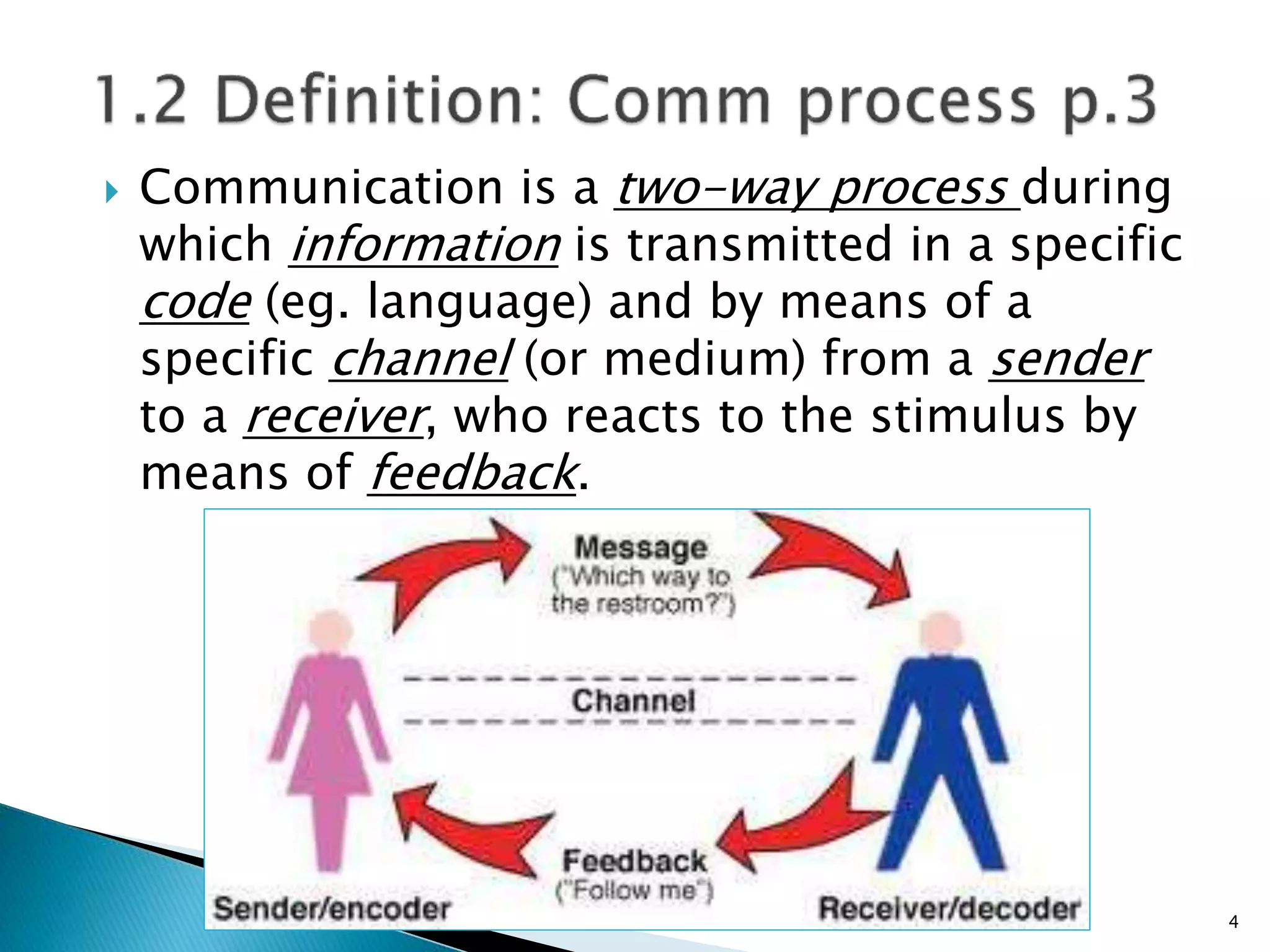
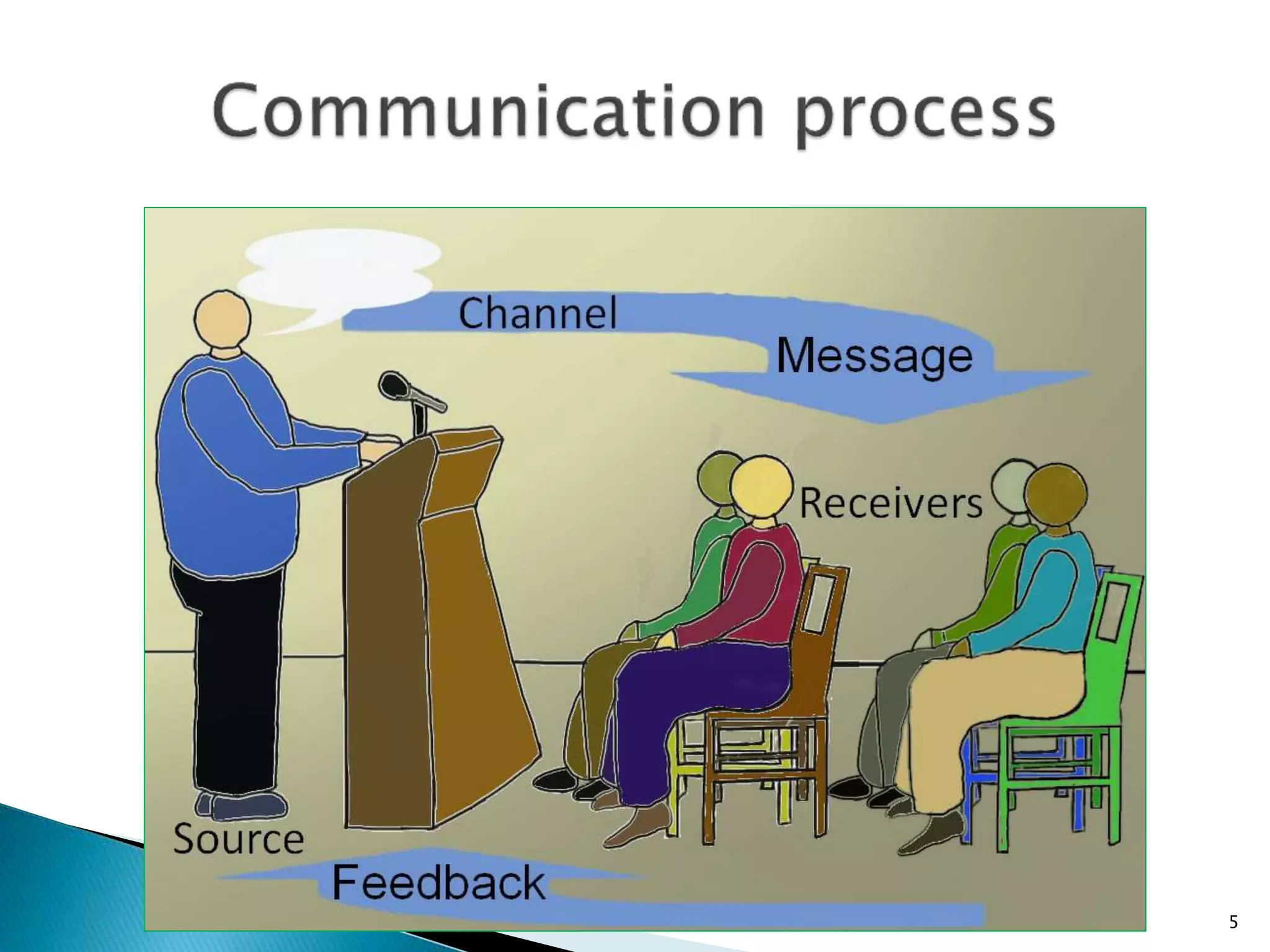
 Communication is a two-way process during
which information is transmitted in a specific
code (eg. language) and by means of a
specific channel (or medium) from a sender
to a receiver, who reacts to the stimulus by
means of feedback.
4
5
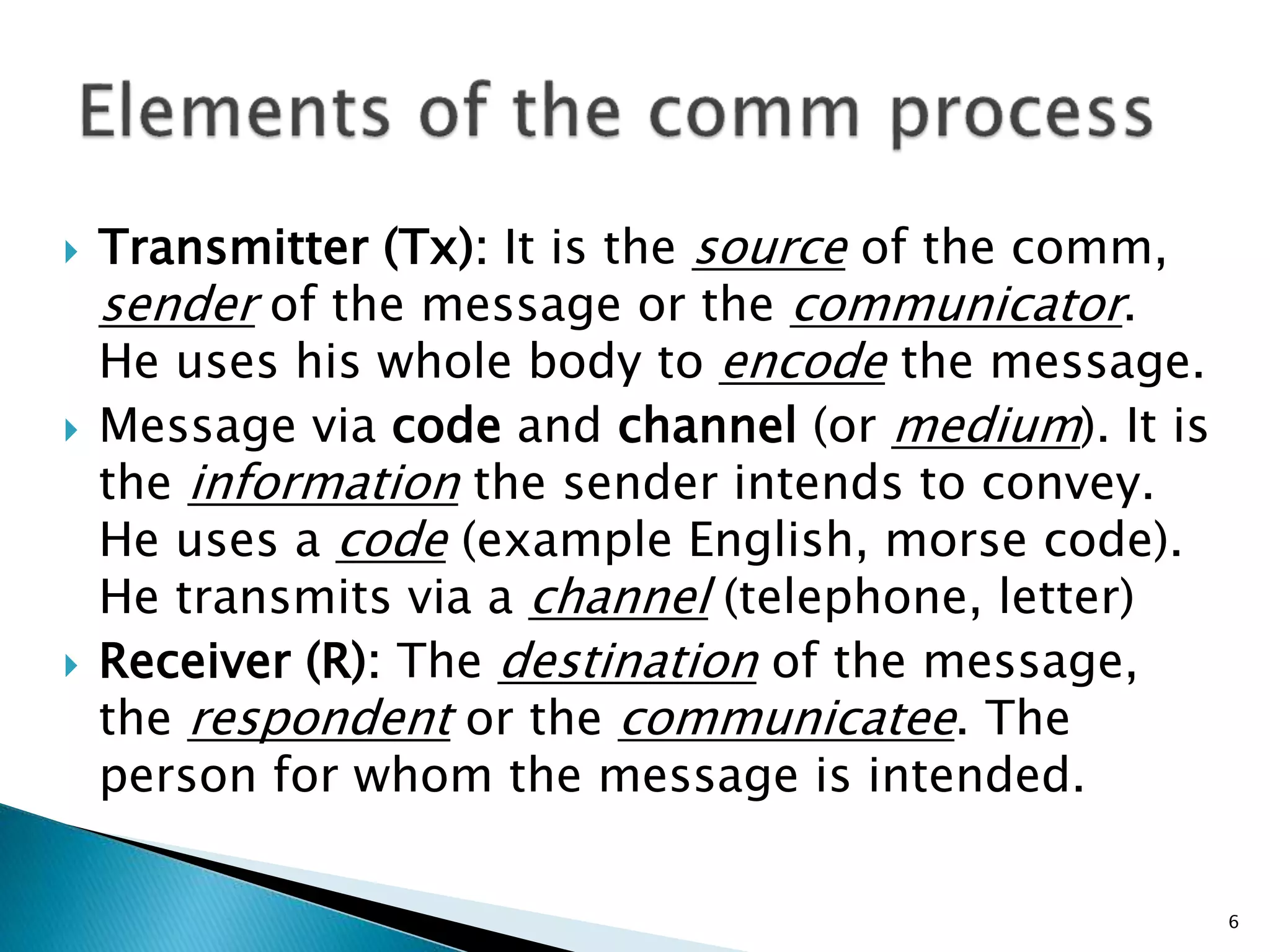
 Transmitter (Tx): It is the source of the comm,
sender of the message or the communicator.
He uses his whole body to encode the message.
 Message via code and channel (or medium). It is
the information the sender intends to convey.
He uses a code (example English, morse code).
He transmits via a channel (telephone, letter)
 Receiver (R): The destination of the message,
the respondent or the communicatee. The
person for whom the message is intended.
6
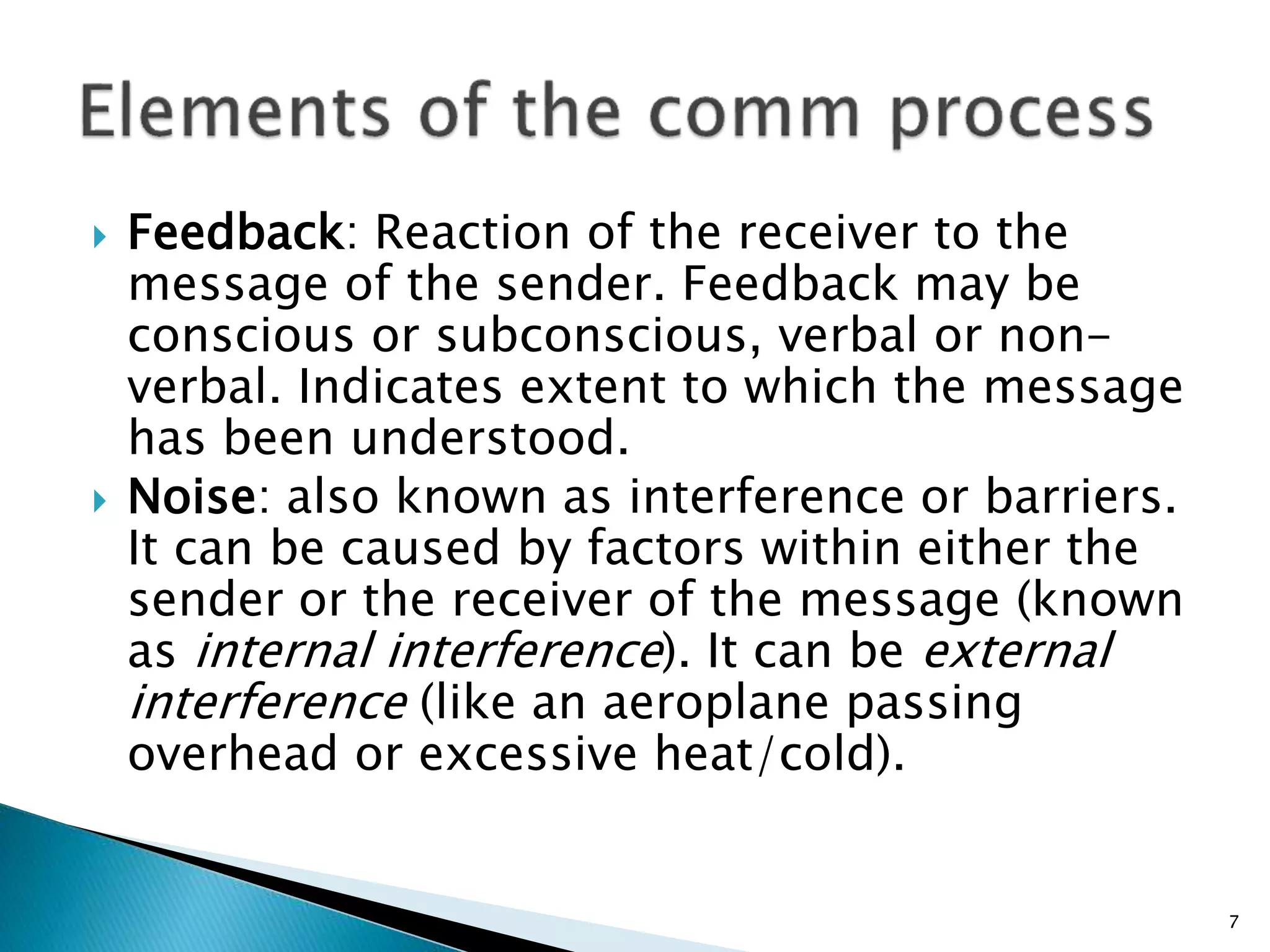
 Feedback: Reaction of the receiver to the
message of the sender. Feedback may be
conscious or subconscious, verbal or non-
verbal. Indicates extent to which the message
has been understood.
 Noise: also known as interference or barriers.
It can be caused by factors within either the
sender or the receiver of the message (known
as internal interference). It can be external
interference (like an aeroplane passing
overhead or excessive heat/cold).
7
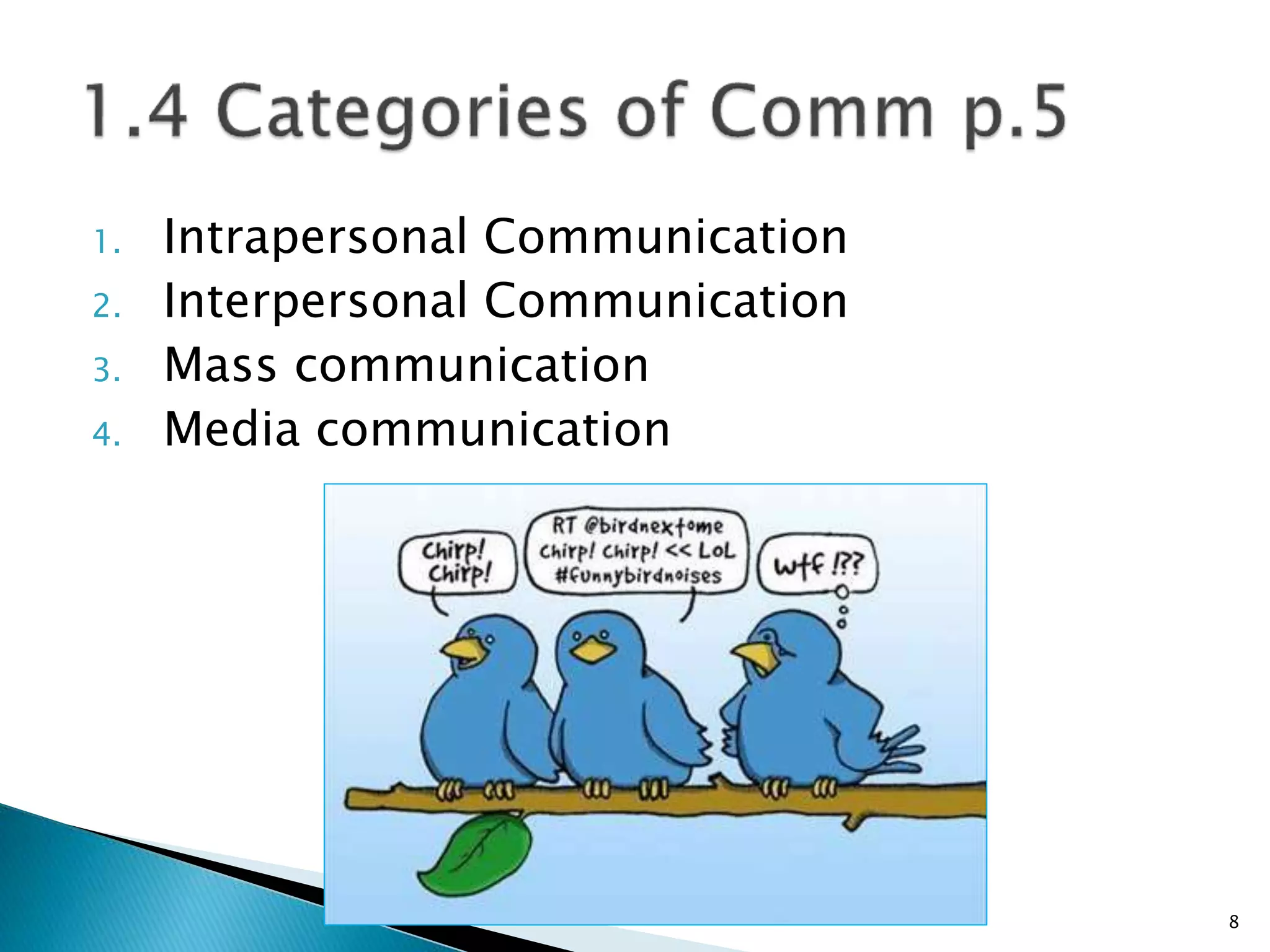
1. Intrapersonal Communication
2. Interpersonal Communication
3. Mass communication
4. Media communication
8
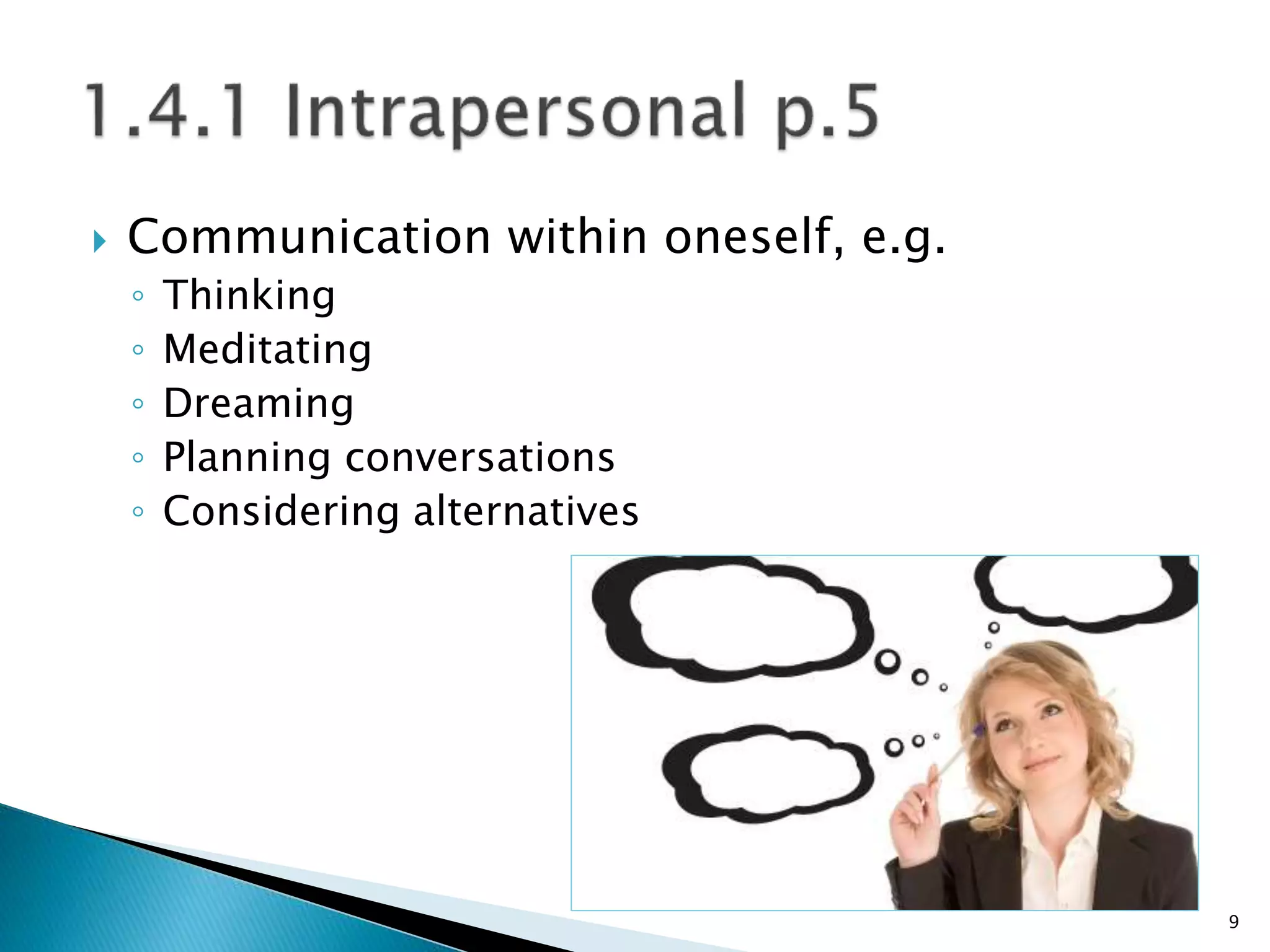
 Communication within oneself, e.g.
◦ Thinking
◦ Meditating
◦ Dreaming
◦ Planning conversations
◦ Considering alternatives
9
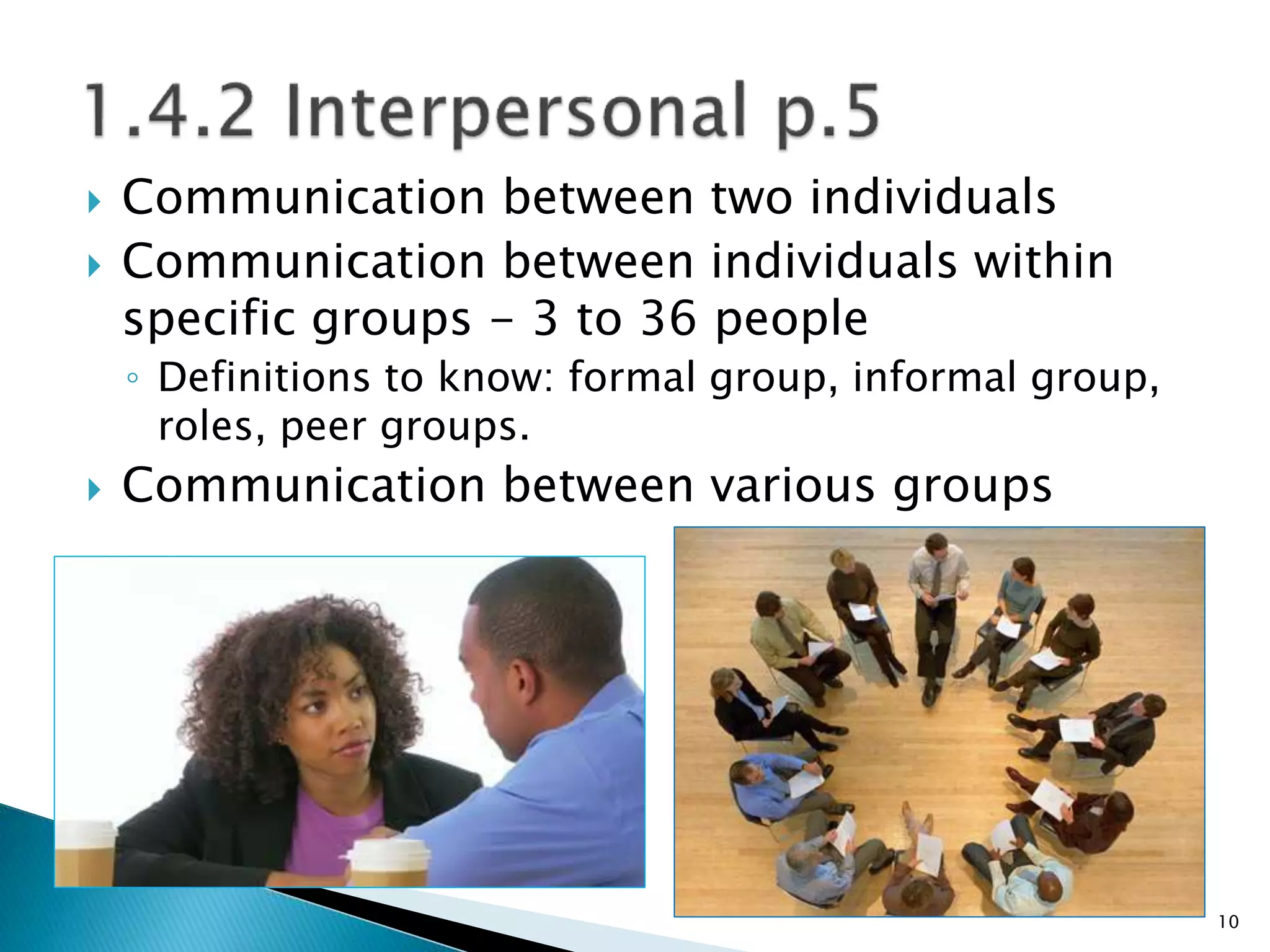
 Communication between two individuals
 Communication between individuals within
specific groups - 3 to 36 people
◦ Definitions to know: formal group, informal group,
roles, peer groups.
 Communication between various groups
10
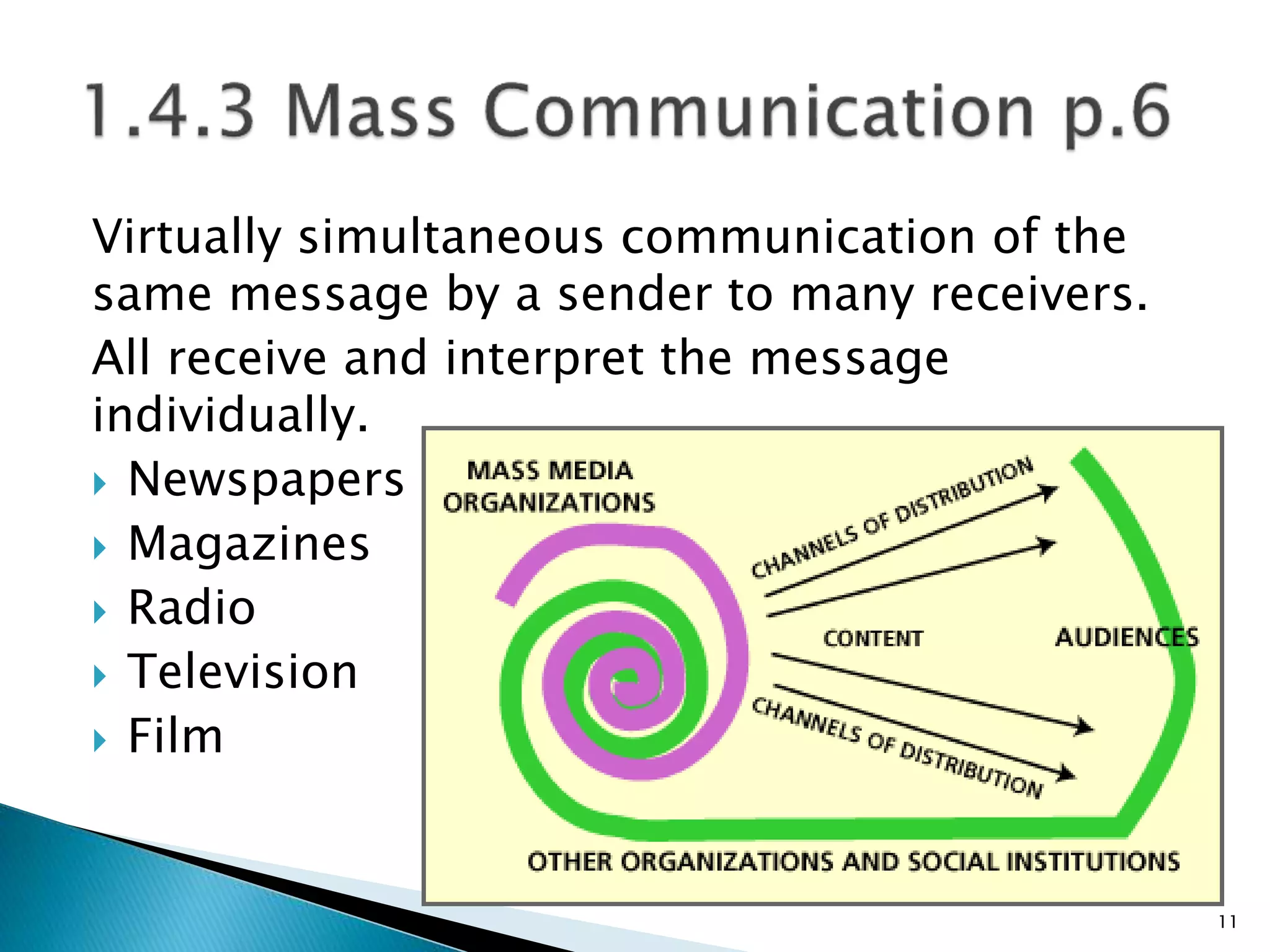
Virtually simultaneous communication of the
same message by a sender to many receivers.
All receive and interpret the message
individually.
 Newspapers
 Magazines
 Radio
 Television
 Film
11
12
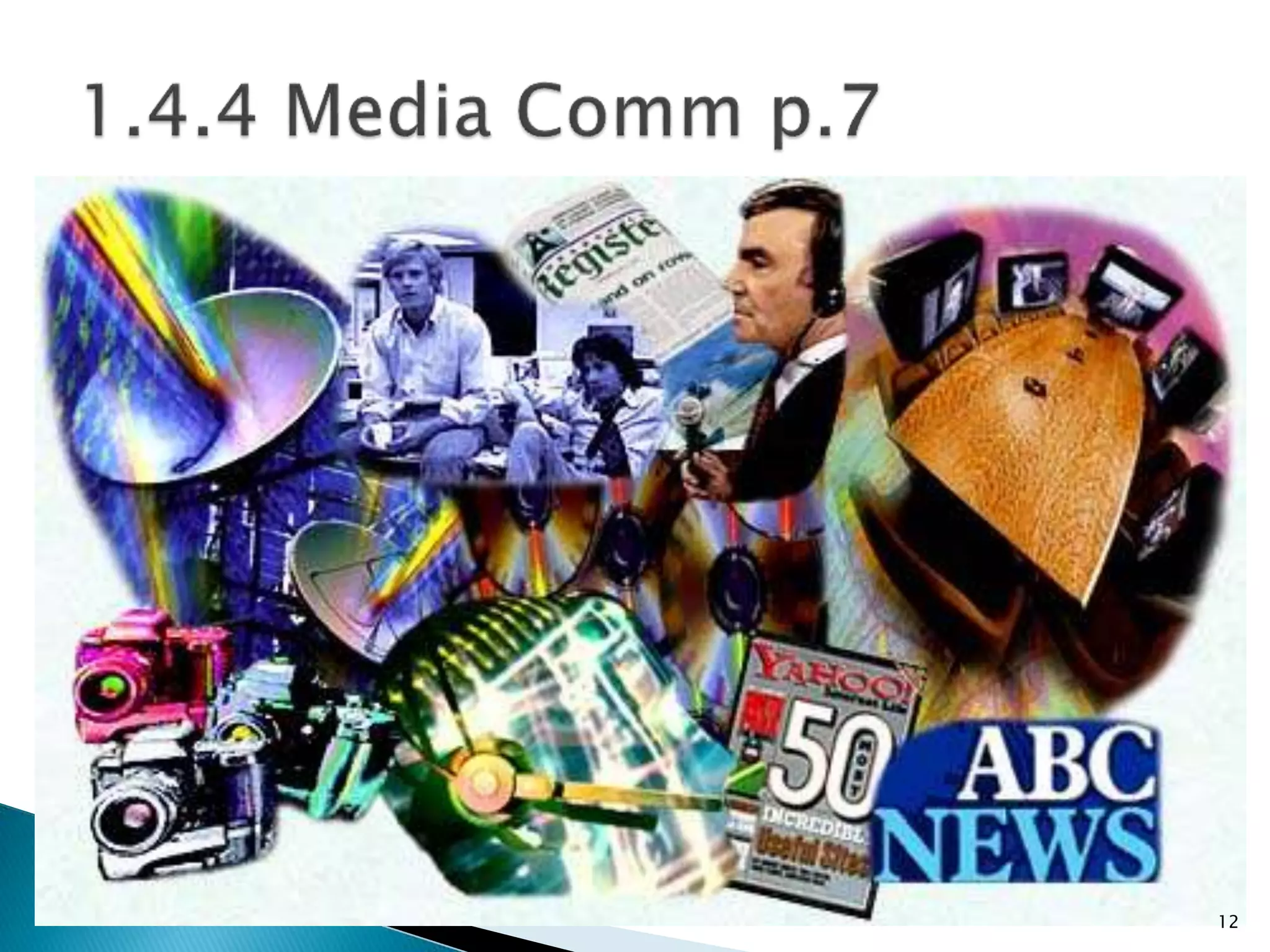
 This term refers to the channels of
communication in general. Also used as a
synonym for the term sender.
 It also refers to the complete spectrum of
audio-visual aids used by communicators
 Examples: charts, graphic representations,
notice boards, chalk boards, flip charts,
overhead projector, slides, films, videos
 Choice is determined by
◦ The objective which the sender wants to achieve
◦ The needs and expectations of the target audience
13
 Personality
◦ Integrated organisation of an individual’s
psychological, social, moral and physical qualities, as
expressed in his interaction with his environment and
particularly in his interaction with other people.
 Frame of reference
◦ Total context (background) within which an individual
perceives and judges matters.
 Reasoning
◦ Logical, coherent process of thinking
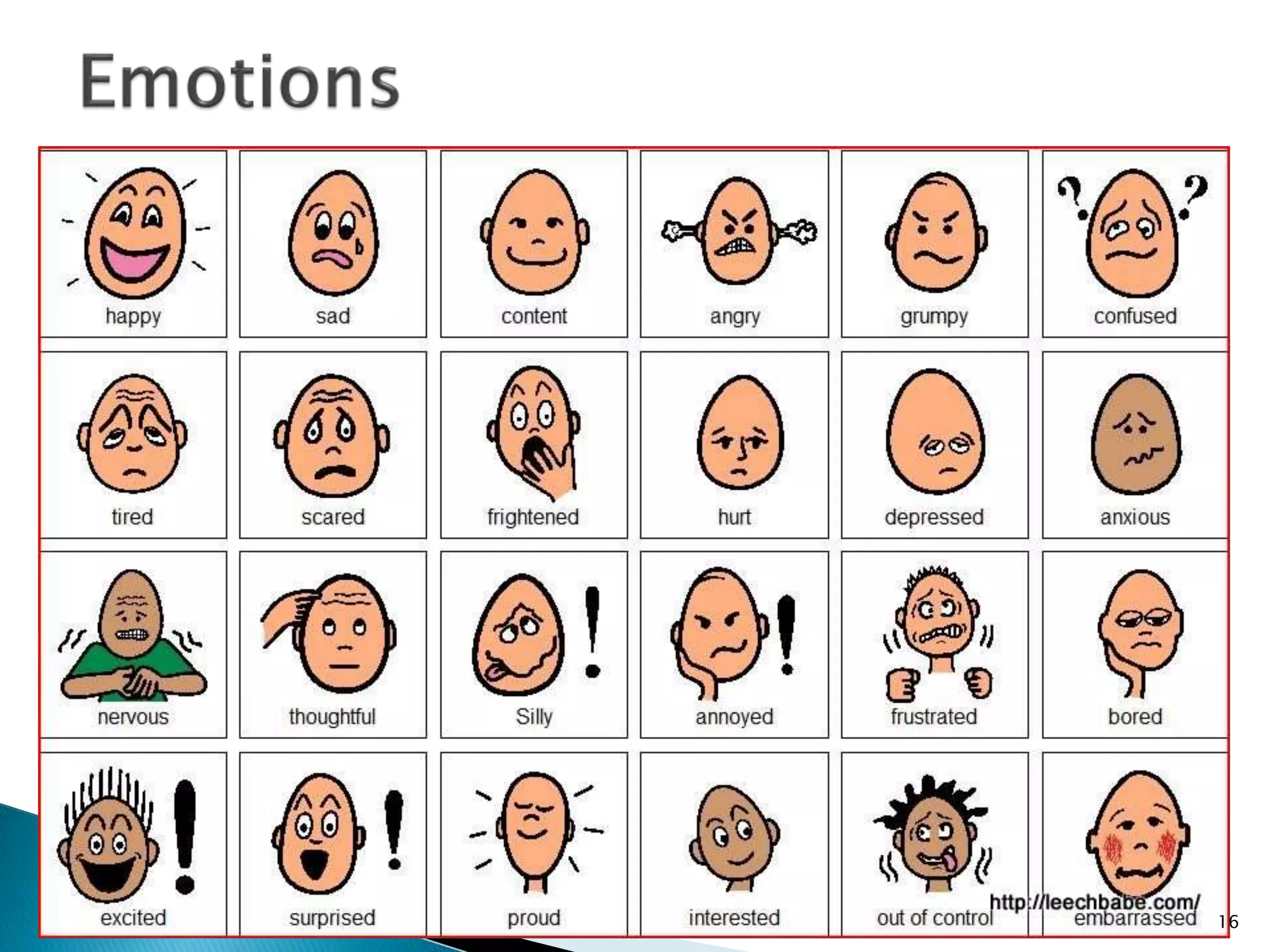
 Emotions
◦ Feelings such as hatred, love, fear, happiness, anguish,
etc. experienced by a person
14
15
16
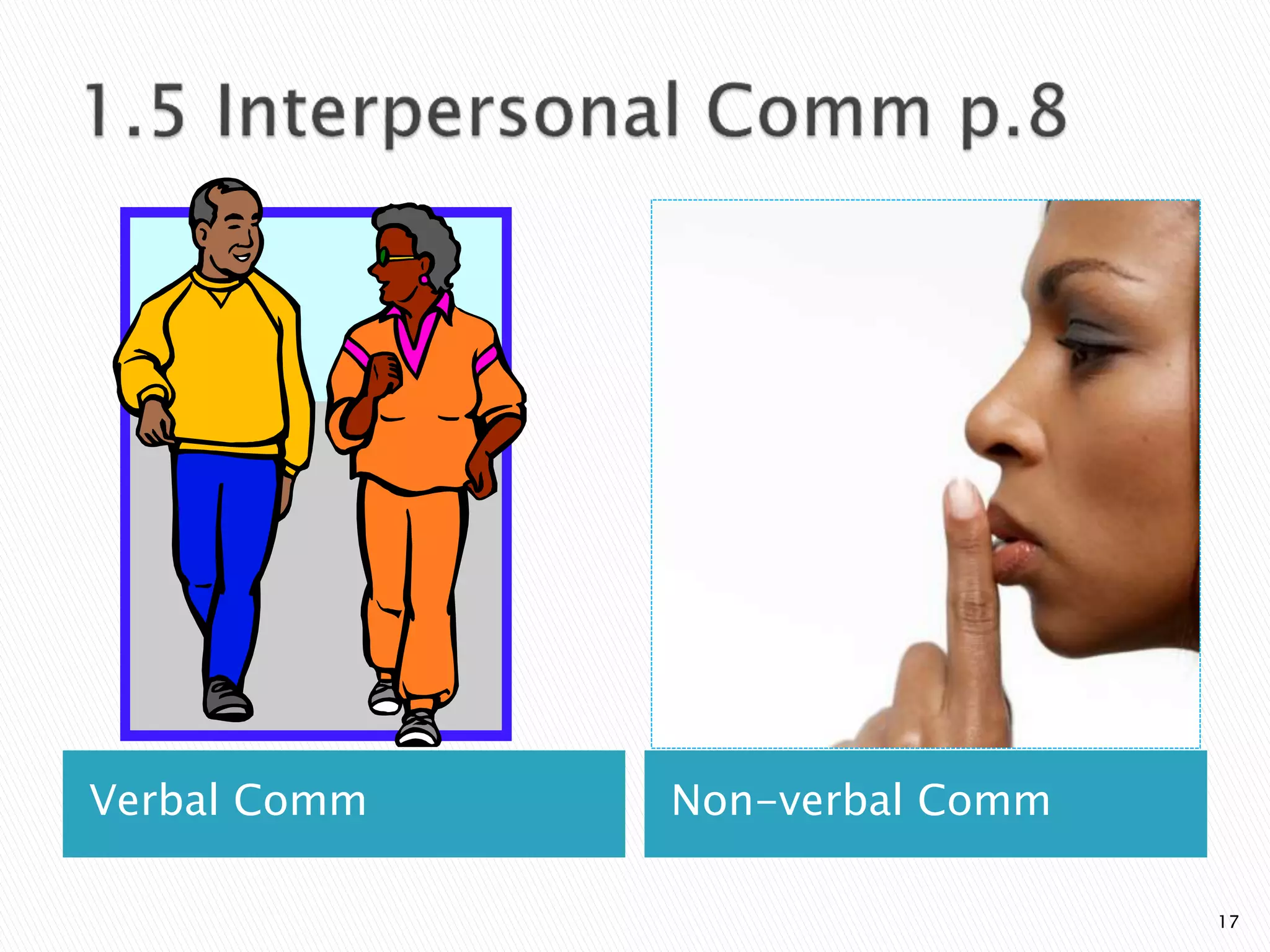
Verbal Comm Non-verbal Comm
17
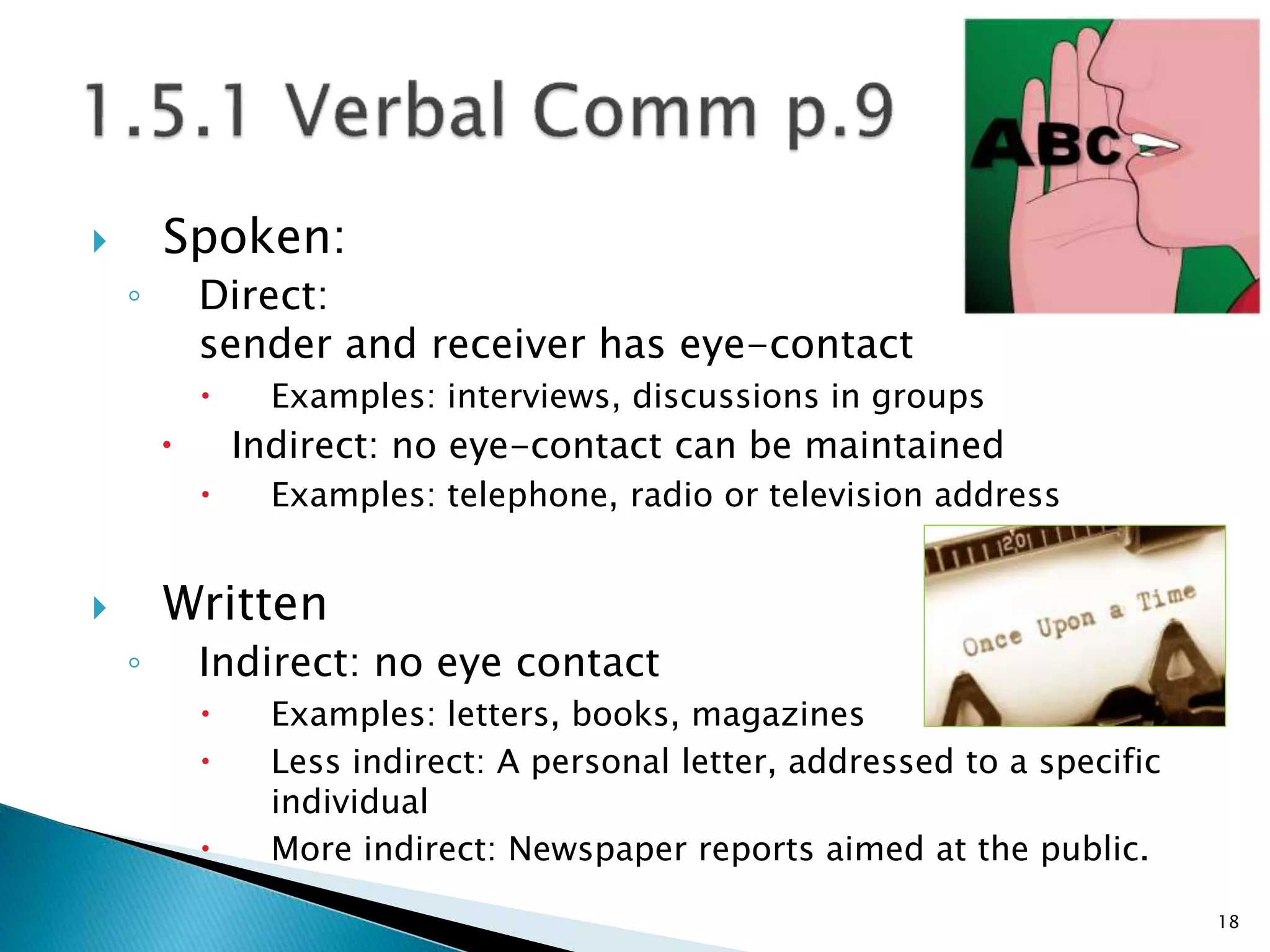
 Spoken:
◦ Direct:
sender and receiver has eye-contact
 Examples: interviews, discussions in groups
 Indirect: no eye-contact can be maintained
 Examples: telephone, radio or television address
 Written
◦ Indirect: no eye contact
 Examples: letters, books, magazines
 Less indirect: A personal letter, addressed to a specific
individual
 More indirect: Newspaper reports aimed at the public.
18
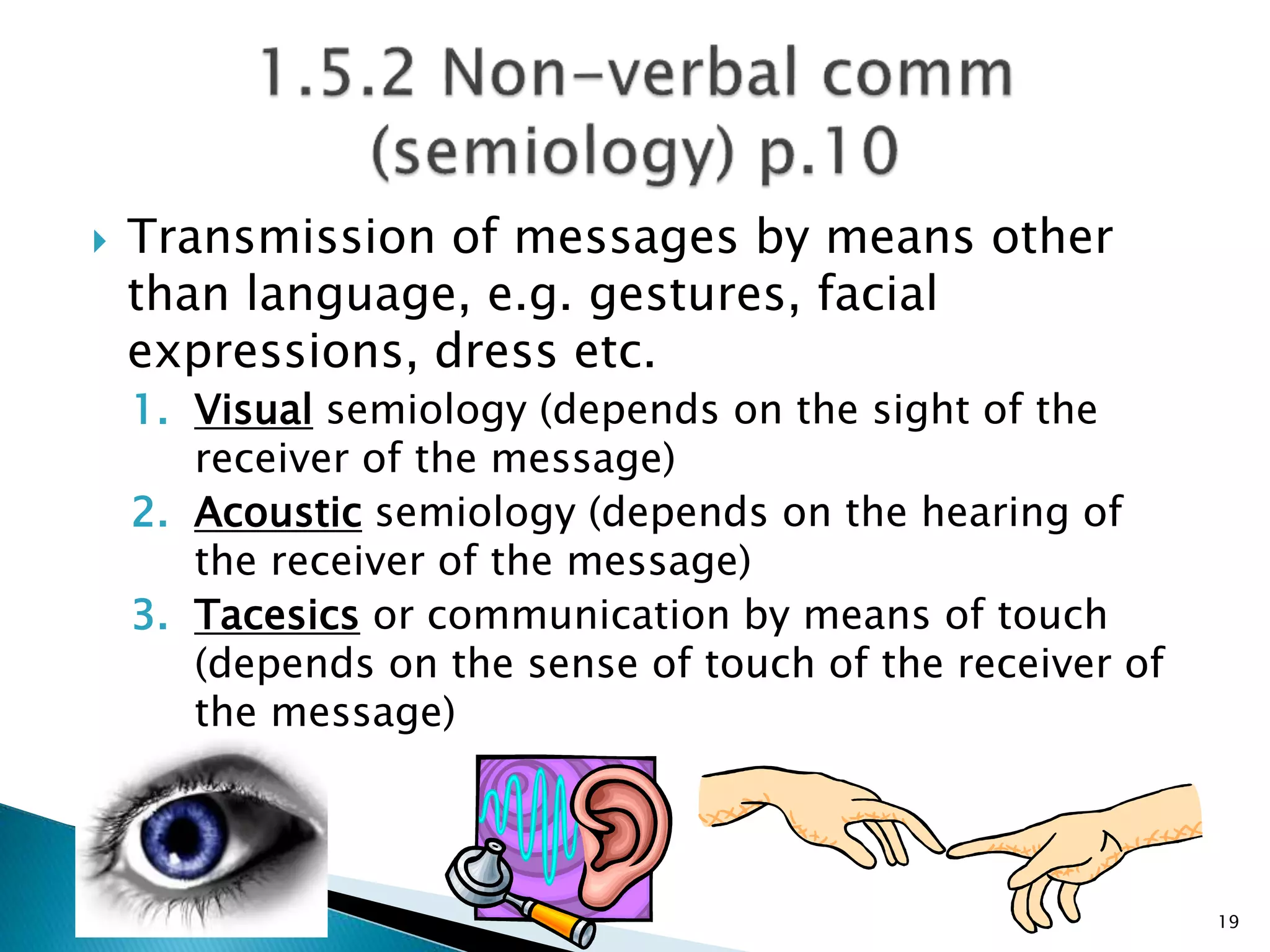
 Transmission of messages by means other
than language, e.g. gestures, facial
expressions, dress etc.
1. Visual semiology (depends on the sight of the
receiver of the message)
2. Acoustic semiology (depends on the hearing of
the receiver of the message)
3. Tacesics or communication by means of touch
(depends on the sense of touch of the receiver of
the message)
19
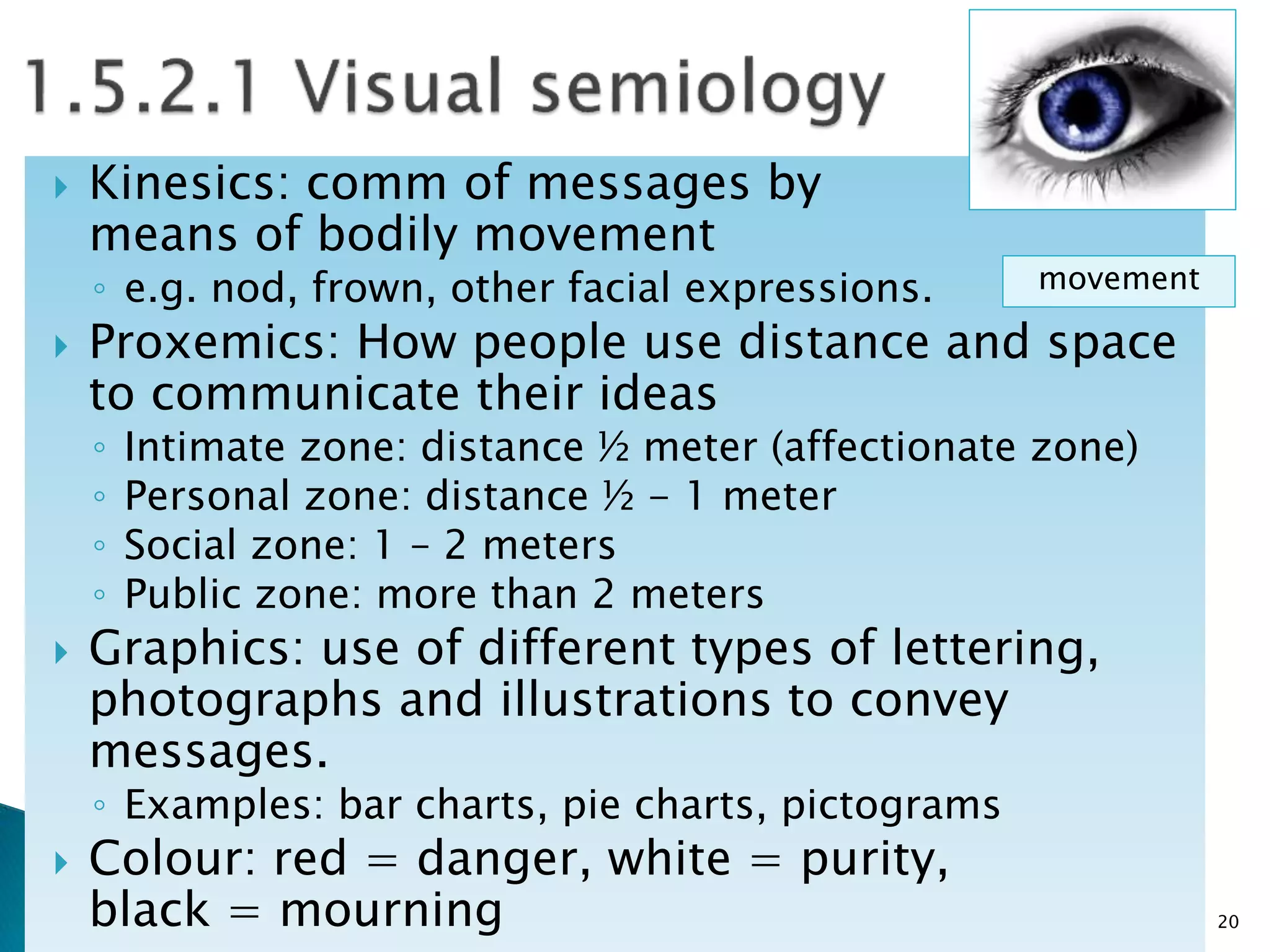
 Kinesics: comm of messages by
means of bodily movement
◦ e.g. nod, frown, other facial expressions.
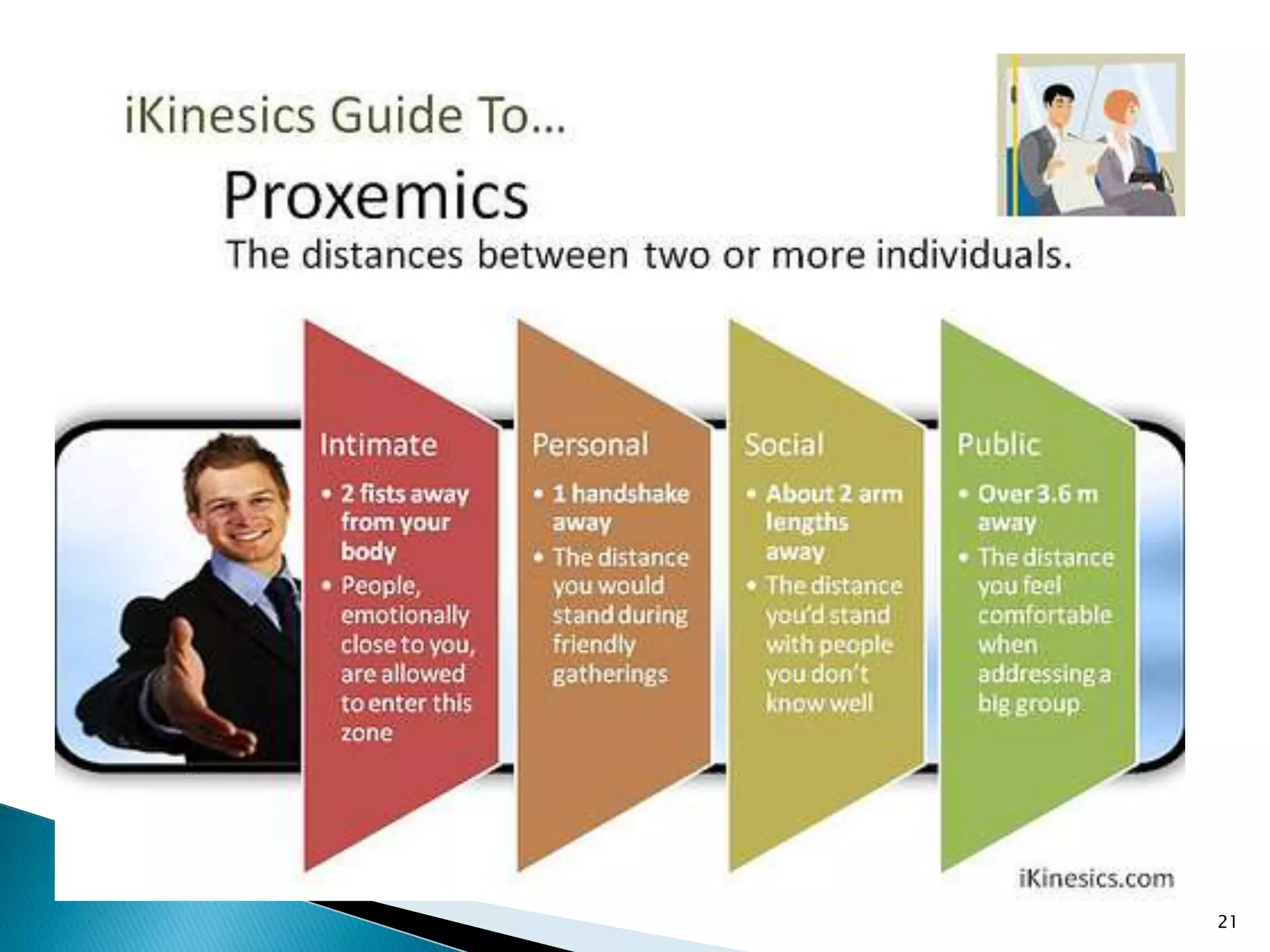
 Proxemics: How people use distance and space
to communicate their ideas
◦ Intimate zone: distance ½ meter (affectionate zone)
◦ Personal zone: distance ½ - 1 meter
◦ Social zone: 1 – 2 meters
◦ Public zone: more than 2 meters
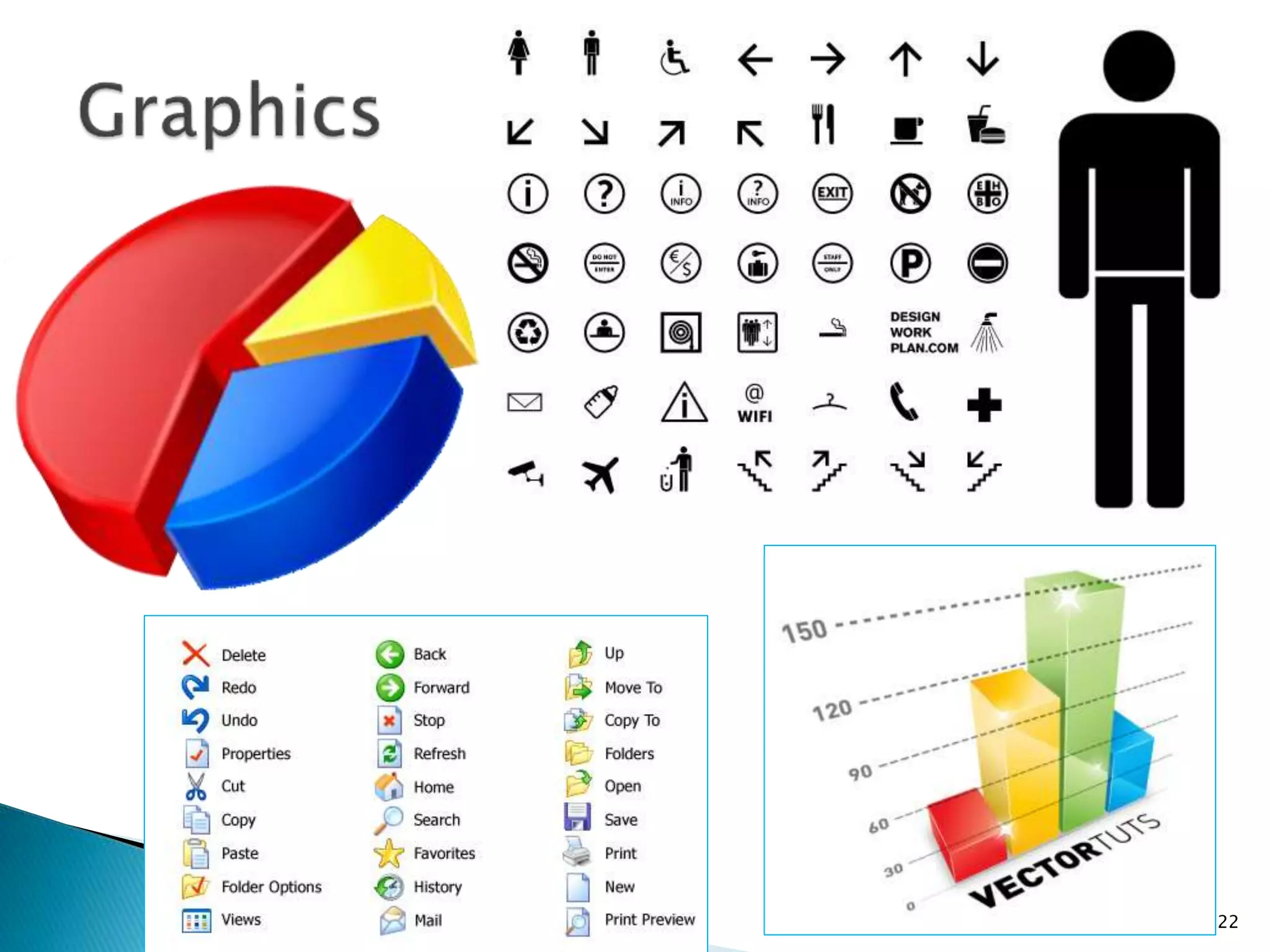
 Graphics: use of different types of lettering,
photographs and illustrations to convey
messages.
◦ Examples: bar charts, pie charts, pictograms
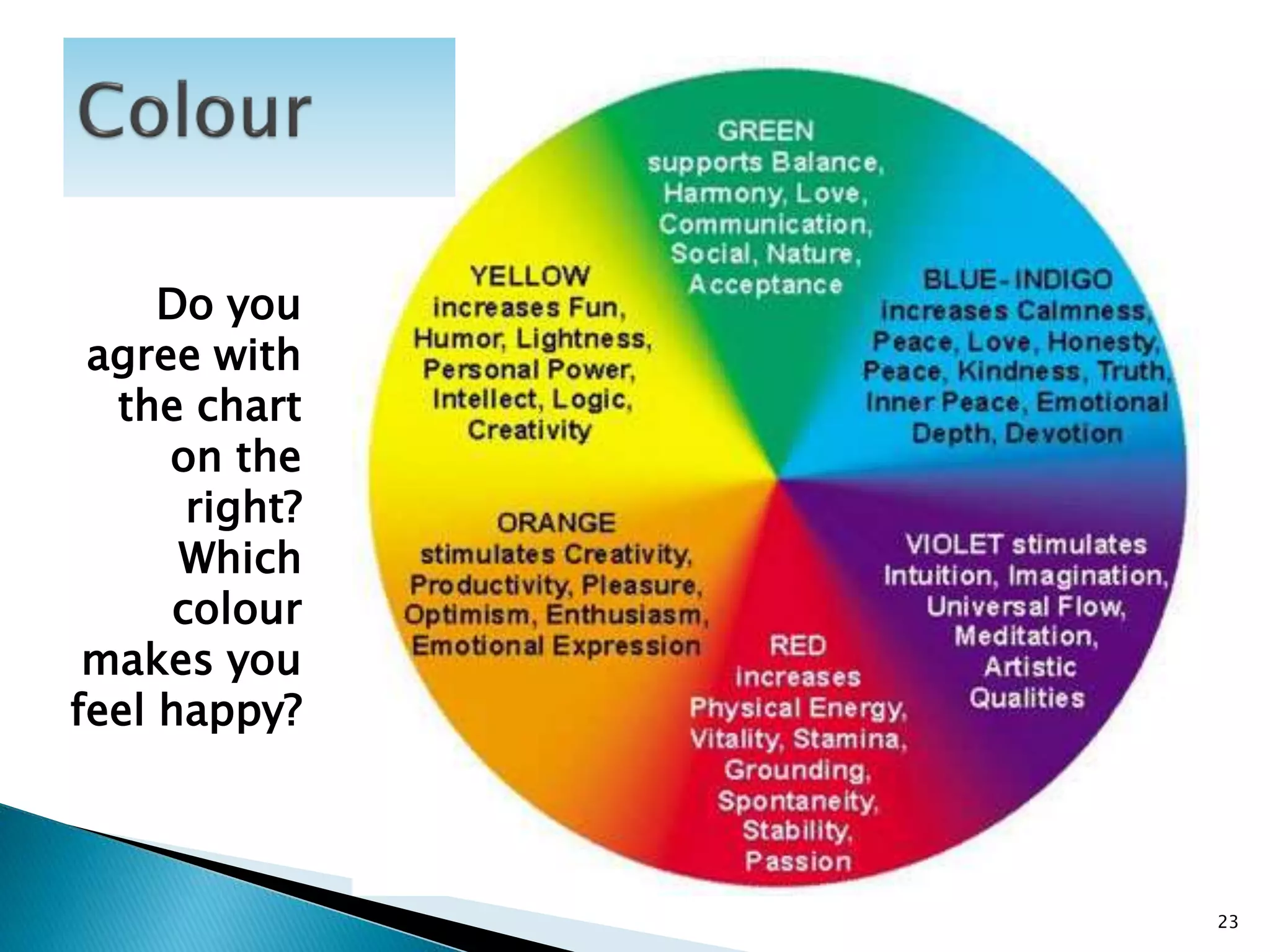
 Colour: red = danger, white = purity,
black = mourning
movement
20
21
22
Do you
agree with
the chart
on the
right?
Which
colour
makes you
feel happy?
23
It involves “reading” messages from certain
sounds or auditive signals other than language.
 Paralinguistics (i.e. semi-language)
1. Pitch
2. Tempo/Rhythm
3. Intensity
4. Accent
 Filler sounds: interjections in the form of
sounds.
 Music: soft music=soothing, loud=frighten
 Silence: Strategic use of silence conveys
various messages.
24
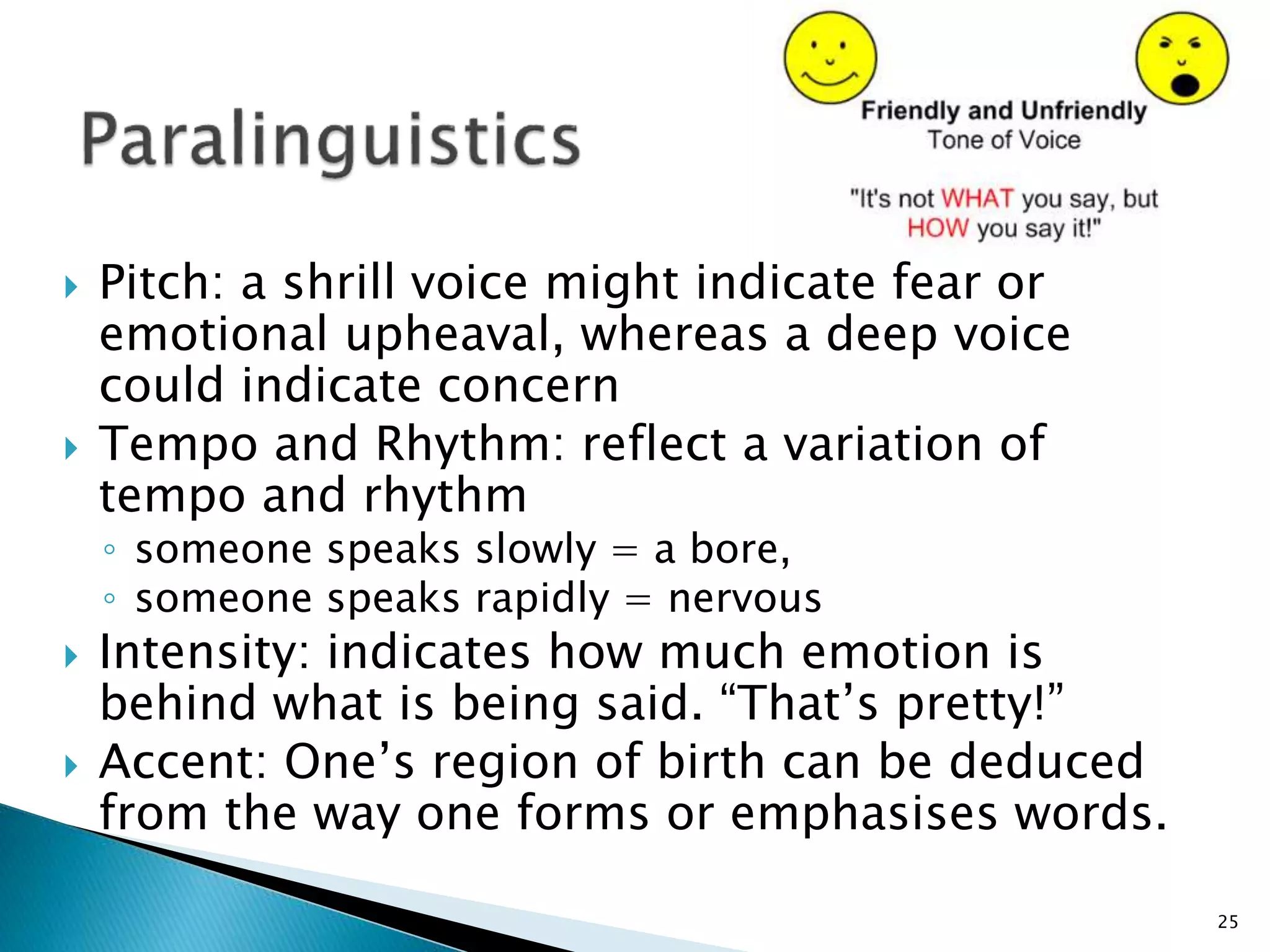
 Pitch: a shrill voice might indicate fear or
emotional upheaval, whereas a deep voice
could indicate concern
 Tempo and Rhythm: reflect a variation of
tempo and rhythm
◦ someone speaks slowly = a bore,
◦ someone speaks rapidly = nervous
 Intensity: indicates how much emotion is
behind what is being said. “That’s pretty!”
 Accent: One’s region of birth can be deduced
from the way one forms or emphasises words.
25
1. Cultural relativity of non-verbal comm p.17
◦ Cultural relativity: (definition): members of
different culture groups attach different meanings
to identical, non-verbal cues. (page 18)
 Examples:
 Use of space: Western males feel uncomfortable
when sharing personal space. Arabs find it
acceptable.
 Eye contact: Westerners look you in the eye. Africans
see it as a sign of disrespect.
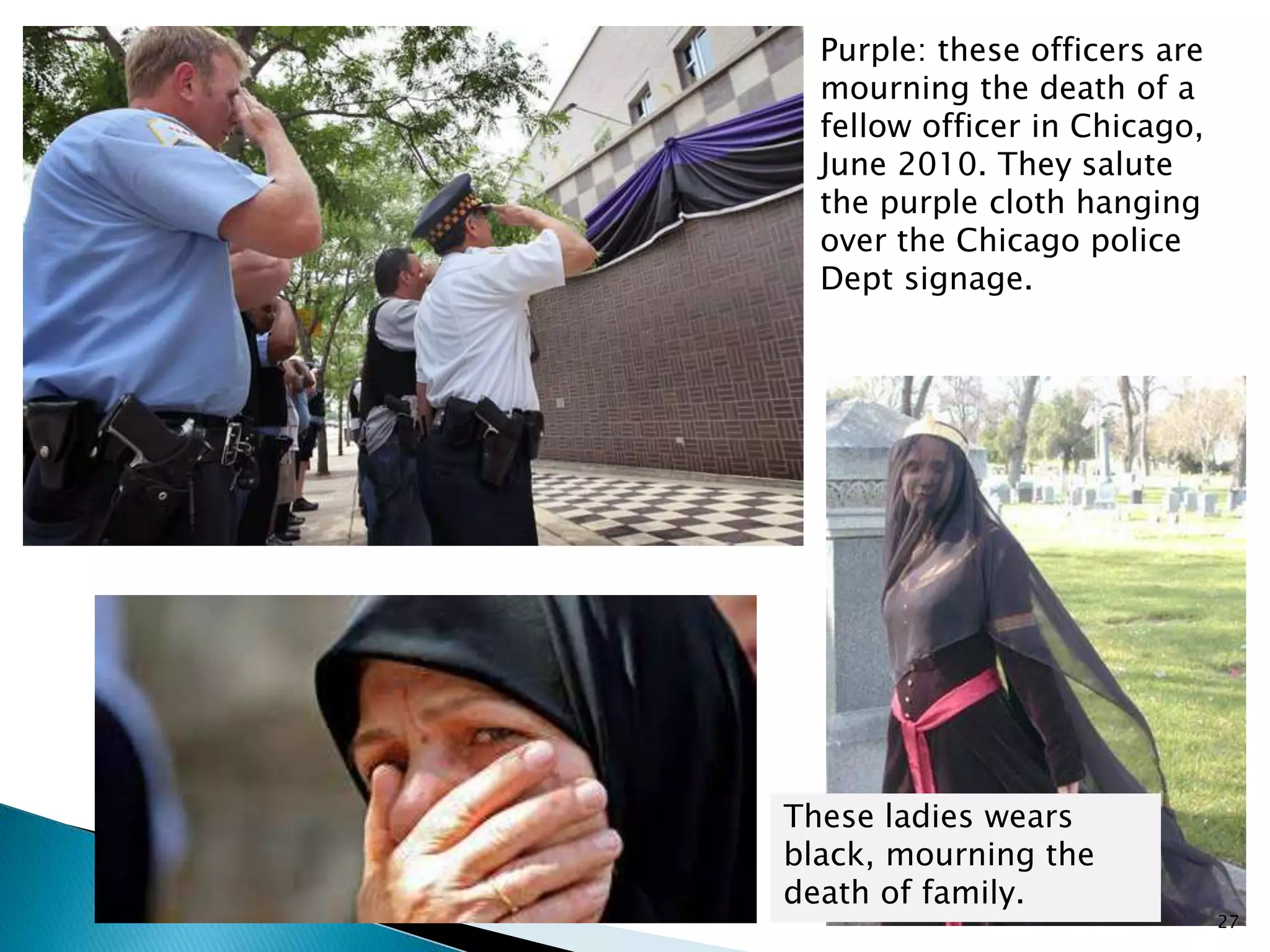
 Colour symbolism : purple shows mourning in some
cultures, in other it shows wealth
26
Purple: these officers are
mourning the death of a
fellow officer in Chicago,
June 2010. They salute
the purple cloth hanging
over the Chicago police
Dept signage.
These ladies wears
black, mourning the
death of family.
27
 An effective communicator uses non-verbal
comm to support/emphasise his verbal comm
◦ Using strategic use of gestures
◦ Dressing appropriately
 Opposite is true: transmitting two
contradictory messages simultaneously – one
verbal, one non-verbal
◦ “Come inside, let’s discuss your problem”, the
manager says but he glances anxiously at his watch
whilst letting the employee into his office.
28
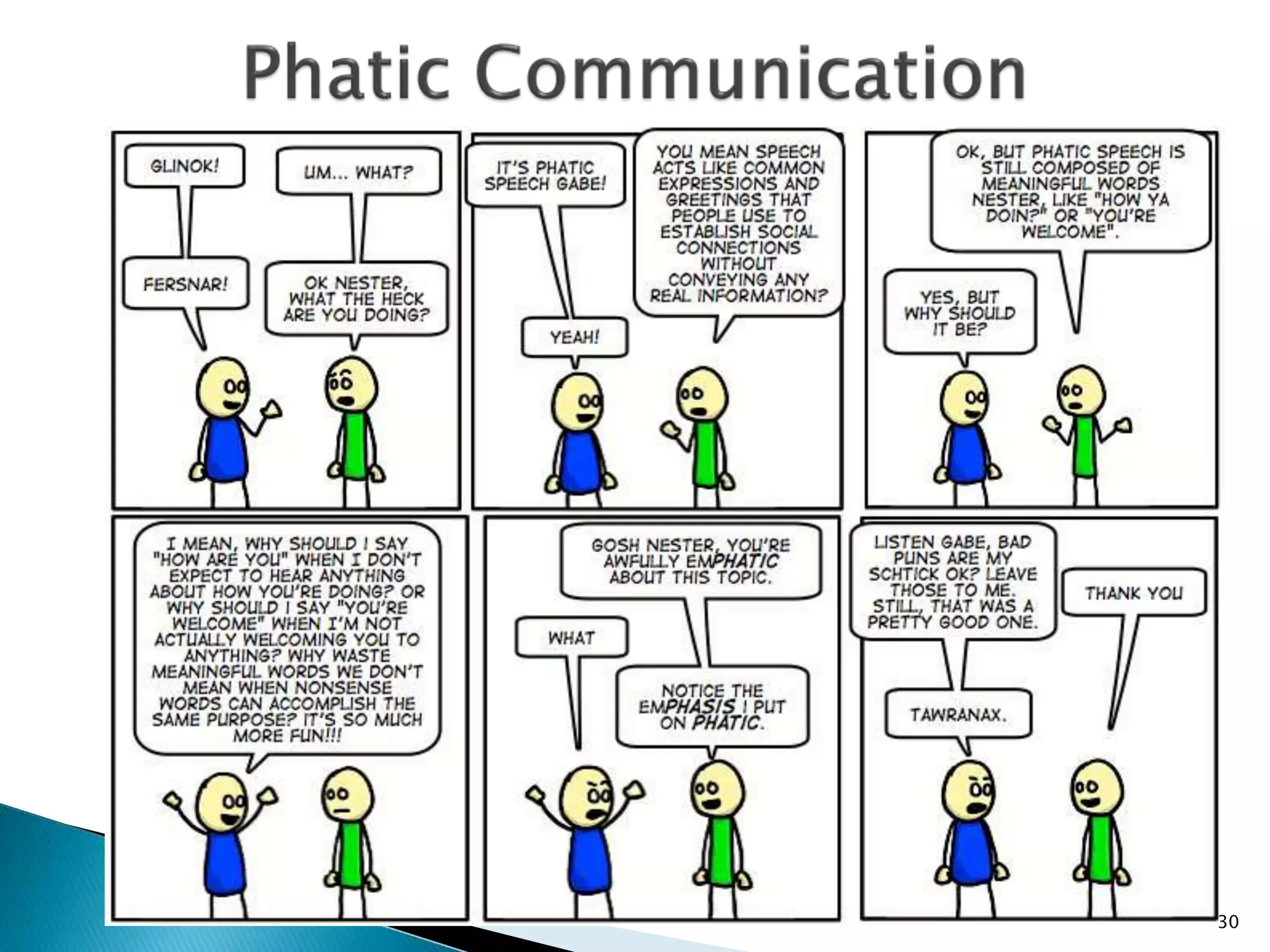
 The use of words in order to establish rapport
or indicate a particular interpersonal or social
relationship rather than to convey meaning.
 Meta-communication: used to indicate mainly
non-verbal but also verbal clues which
indicate how a particular message should be
understood.
 Both indicate the attitude of the sender of the
message, rather than specific factual
information.
29
30
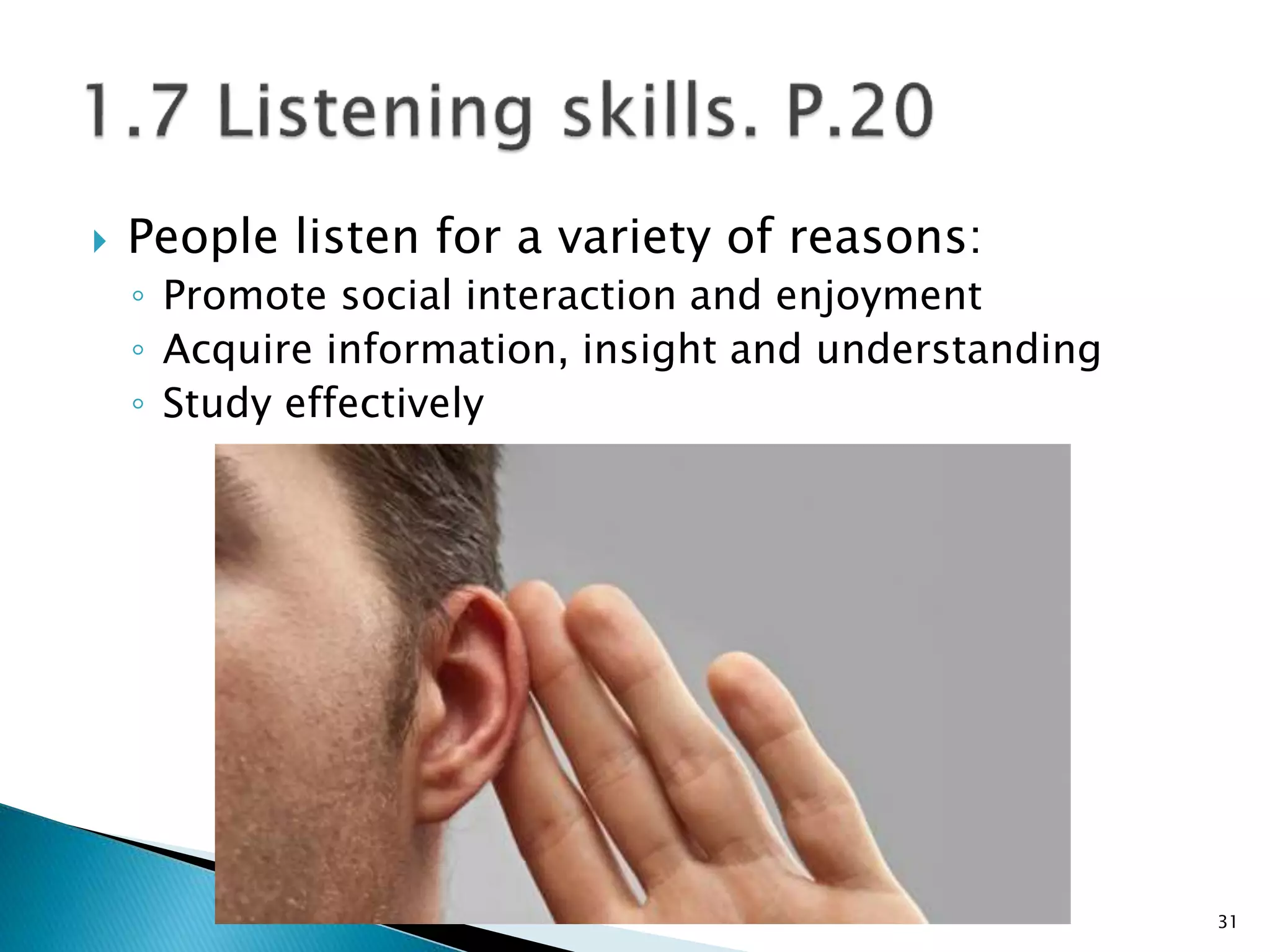
 People listen for a variety of reasons:
◦ Promote social interaction and enjoyment
◦ Acquire information, insight and understanding
◦ Study effectively
31
 Thinking speed is 3 to 4 times faster than talking
speed (125 to 200 words per min.)
 Man’s attention is distracted easily and his memory
span is limited.
 Man’s motivation to listen – his interest and will to
listen – is often lacking
 Receiver’s listening skills are impeded by a negative
attitude and prejudice
 Listener ignores verbal context within which a
specific message is conveyed.
 Listener ignores non-verbal cues which qualify the
accompanying verbal message.
 People pretend they are listening.
 External and internal barriers: noise, telephones (ext)
Exhaustion, lack of interest, prejudice, depression (int)
32
 Prepare yourself physically, psychologically
 Listen actively and show interest in subject.
 Coordinate your thoughts with those of the
speaker. Identify prejudices, resist temptation to
transfer them to the content matter discussed.
 Distinguish between the main ideas and
supporting details. Listen selectively
 Be alert for verbal clues indicating specific
emphasis or a twist in the sender’s message or
attitude.
 Interpret meanings of expressions in terms of
the total context from within they are uttered.
33
 Enable the listener to broaden his basis of
knowledge
 Lead to improved interpersonal relationships
 They reduce the possibility of
misunderstandings
 They improve personal efficiency
 They result in grievances and problems being
identified timeously
 They save time and money
 They ensure goodwill and win clients
34
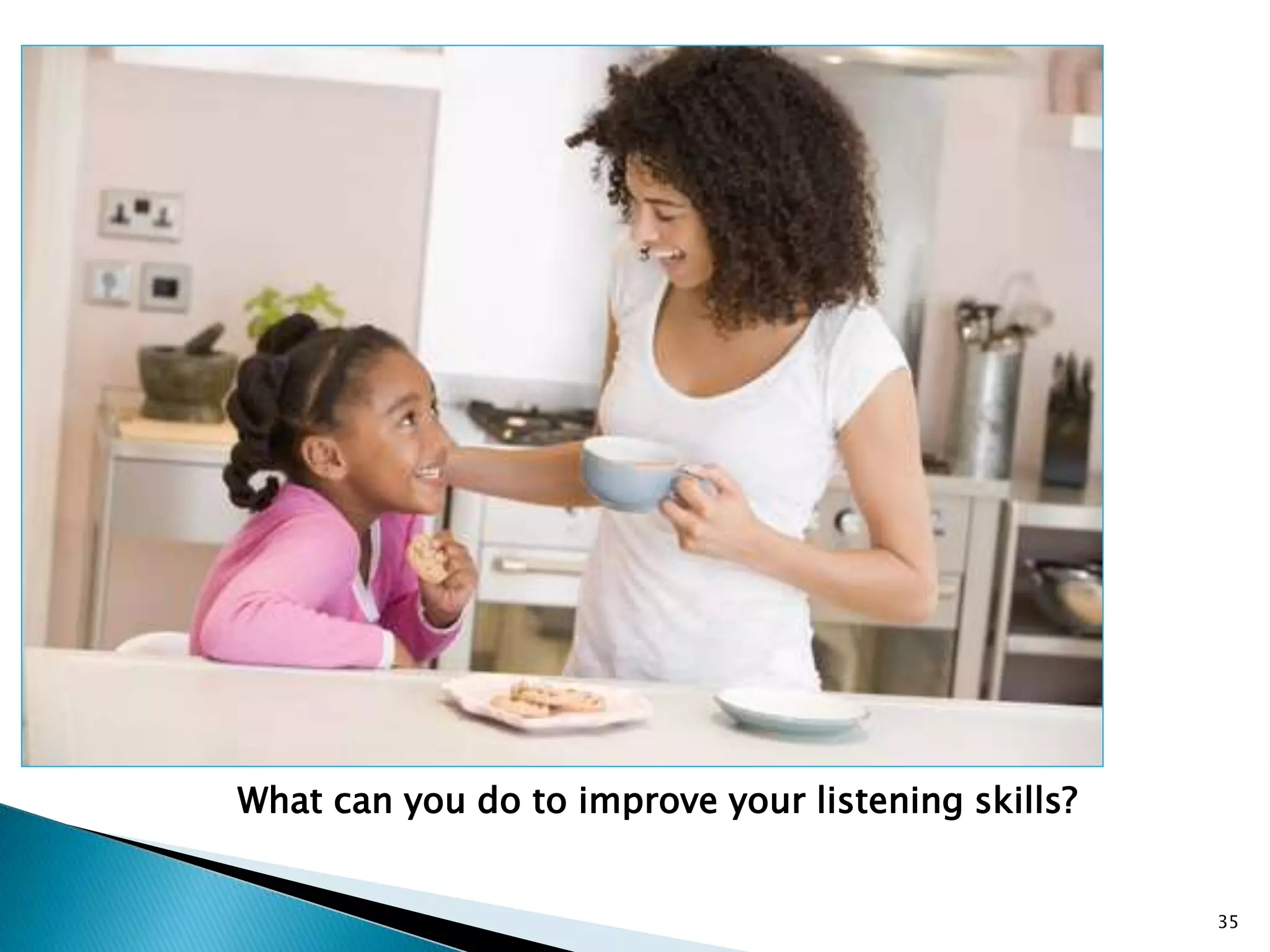
What can you do to improve your listening skills?
35
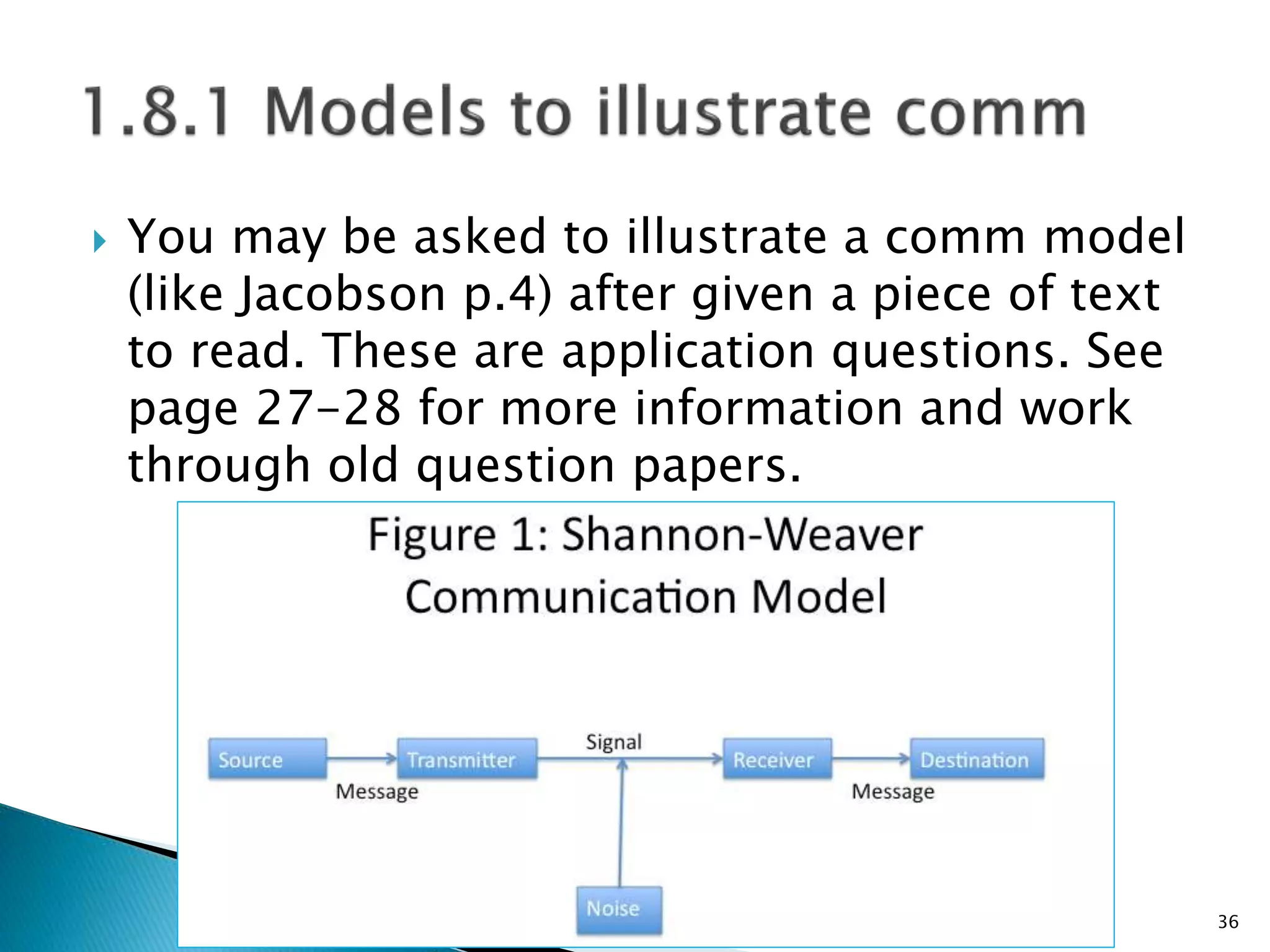
 You may be asked to illustrate a comm model
(like Jacobson p.4) after given a piece of text
to read. These are application questions. See
page 27-28 for more information and work
through old question papers.
36
The following small groups are operative in most
organisations:
 Command (executive groups):
◦ Superior and his subordinates
 Democratic groups
◦ Coordination of members and their expertise
 Consensus groups
◦ Formed to solve problems
 Buzz groups
◦ Used for brainstorming rather than decision-making
 Information-sharing groups
◦ One member have info to share with rest of group
37
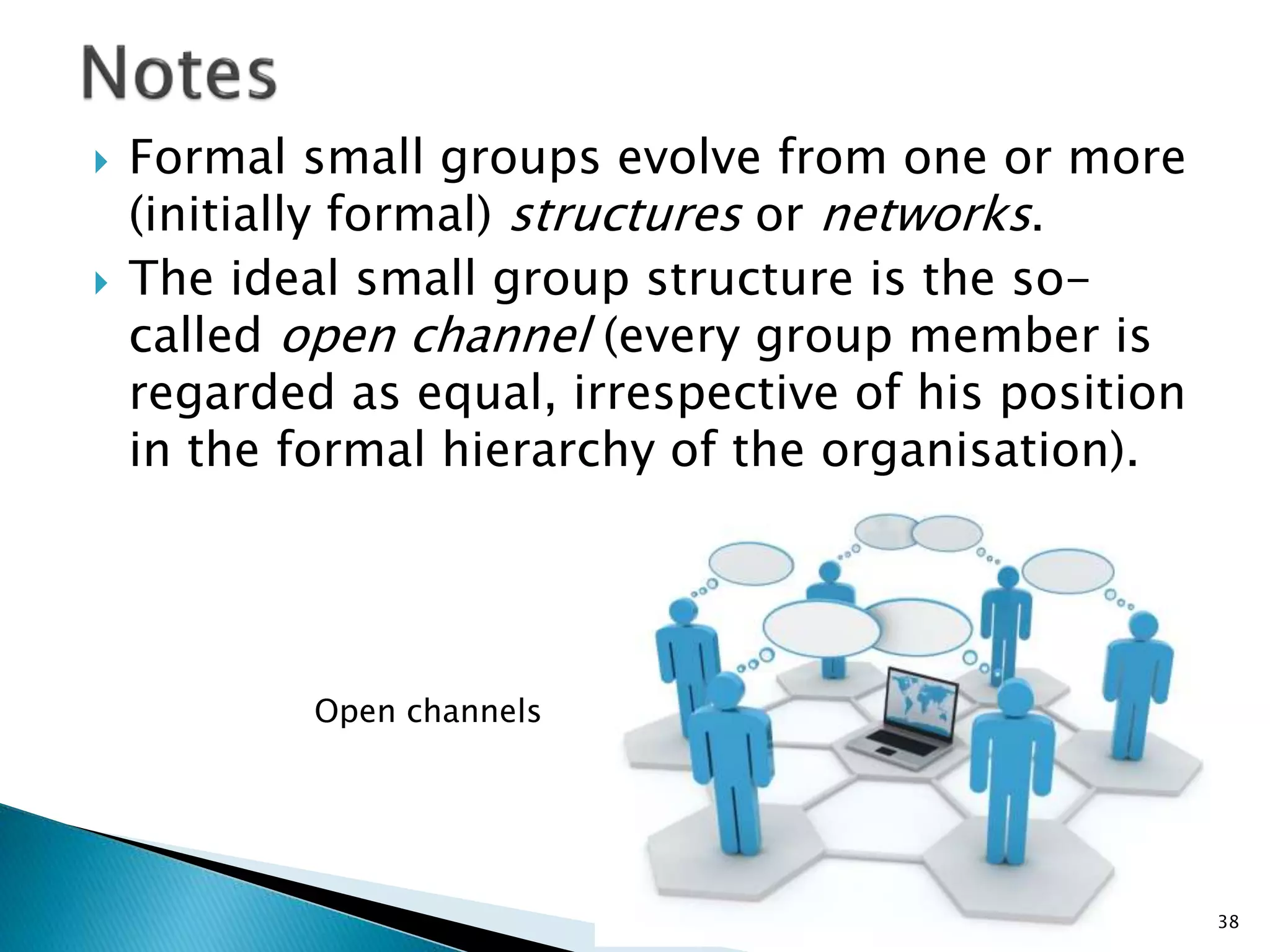
 Formal small groups evolve from one or more
(initially formal) structures or networks.
 The ideal small group structure is the so-
called open channel (every group member is
regarded as equal, irrespective of his position
in the formal hierarchy of the organisation).
Open channels
38
39

N4 Communication - Basic Communication Principles for N4 students at TVET Colleges

  • 1.
  • 2.
  • 3.
     Speak effectively,express themselves and convey information clearly  Listen well  Provide sensible feedback  Maintain sound interpersonal relationships  Motivate, encourage and persuade co-workers towards achieving specific goals  Consider problems logically and solve them adequately  Minimise and resolve conflict  Ensure effective team work and group discussions  Increase productivity  Ensure objectives of the organisation are achieved  Maintain good external public relations 3
  • 4.
     Communication isa two-way process during which information is transmitted in a specific code (eg. language) and by means of a specific channel (or medium) from a sender to a receiver, who reacts to the stimulus by means of feedback. 4
  • 5.
  • 6.
     Transmitter (Tx):It is the source of the comm, sender of the message or the communicator. He uses his whole body to encode the message.  Message via code and channel (or medium). It is the information the sender intends to convey. He uses a code (example English, morse code). He transmits via a channel (telephone, letter)  Receiver (R): The destination of the message, the respondent or the communicatee. The person for whom the message is intended. 6
  • 7.
     Feedback: Reactionof the receiver to the message of the sender. Feedback may be conscious or subconscious, verbal or non- verbal. Indicates extent to which the message has been understood.  Noise: also known as interference or barriers. It can be caused by factors within either the sender or the receiver of the message (known as internal interference). It can be external interference (like an aeroplane passing overhead or excessive heat/cold). 7
  • 8.
    1. Intrapersonal Communication 2.Interpersonal Communication 3. Mass communication 4. Media communication 8
  • 9.
     Communication withinoneself, e.g. ◦ Thinking ◦ Meditating ◦ Dreaming ◦ Planning conversations ◦ Considering alternatives 9
  • 10.
     Communication betweentwo individuals  Communication between individuals within specific groups - 3 to 36 people ◦ Definitions to know: formal group, informal group, roles, peer groups.  Communication between various groups 10
  • 11.
    Virtually simultaneous communicationof the same message by a sender to many receivers. All receive and interpret the message individually.  Newspapers  Magazines  Radio  Television  Film 11
  • 12.
  • 13.
     This termrefers to the channels of communication in general. Also used as a synonym for the term sender.  It also refers to the complete spectrum of audio-visual aids used by communicators  Examples: charts, graphic representations, notice boards, chalk boards, flip charts, overhead projector, slides, films, videos  Choice is determined by ◦ The objective which the sender wants to achieve ◦ The needs and expectations of the target audience 13
  • 14.
     Personality ◦ Integratedorganisation of an individual’s psychological, social, moral and physical qualities, as expressed in his interaction with his environment and particularly in his interaction with other people.  Frame of reference ◦ Total context (background) within which an individual perceives and judges matters.  Reasoning ◦ Logical, coherent process of thinking  Emotions ◦ Feelings such as hatred, love, fear, happiness, anguish, etc. experienced by a person 14
  • 15.
  • 16.
  • 17.
  • 18.
     Spoken: ◦ Direct: senderand receiver has eye-contact  Examples: interviews, discussions in groups  Indirect: no eye-contact can be maintained  Examples: telephone, radio or television address  Written ◦ Indirect: no eye contact  Examples: letters, books, magazines  Less indirect: A personal letter, addressed to a specific individual  More indirect: Newspaper reports aimed at the public. 18
  • 19.
     Transmission ofmessages by means other than language, e.g. gestures, facial expressions, dress etc. 1. Visual semiology (depends on the sight of the receiver of the message) 2. Acoustic semiology (depends on the hearing of the receiver of the message) 3. Tacesics or communication by means of touch (depends on the sense of touch of the receiver of the message) 19
  • 20.
     Kinesics: commof messages by means of bodily movement ◦ e.g. nod, frown, other facial expressions.  Proxemics: How people use distance and space to communicate their ideas ◦ Intimate zone: distance ½ meter (affectionate zone) ◦ Personal zone: distance ½ - 1 meter ◦ Social zone: 1 – 2 meters ◦ Public zone: more than 2 meters  Graphics: use of different types of lettering, photographs and illustrations to convey messages. ◦ Examples: bar charts, pie charts, pictograms  Colour: red = danger, white = purity, black = mourning movement 20
  • 21.
  • 22.
  • 23.
    Do you agree with thechart on the right? Which colour makes you feel happy? 23
  • 24.
    It involves “reading”messages from certain sounds or auditive signals other than language.  Paralinguistics (i.e. semi-language) 1. Pitch 2. Tempo/Rhythm 3. Intensity 4. Accent  Filler sounds: interjections in the form of sounds.  Music: soft music=soothing, loud=frighten  Silence: Strategic use of silence conveys various messages. 24
  • 25.
     Pitch: ashrill voice might indicate fear or emotional upheaval, whereas a deep voice could indicate concern  Tempo and Rhythm: reflect a variation of tempo and rhythm ◦ someone speaks slowly = a bore, ◦ someone speaks rapidly = nervous  Intensity: indicates how much emotion is behind what is being said. “That’s pretty!”  Accent: One’s region of birth can be deduced from the way one forms or emphasises words. 25
  • 26.
    1. Cultural relativityof non-verbal comm p.17 ◦ Cultural relativity: (definition): members of different culture groups attach different meanings to identical, non-verbal cues. (page 18)  Examples:  Use of space: Western males feel uncomfortable when sharing personal space. Arabs find it acceptable.  Eye contact: Westerners look you in the eye. Africans see it as a sign of disrespect.  Colour symbolism : purple shows mourning in some cultures, in other it shows wealth 26
  • 27.
    Purple: these officersare mourning the death of a fellow officer in Chicago, June 2010. They salute the purple cloth hanging over the Chicago police Dept signage. These ladies wears black, mourning the death of family. 27
  • 28.
     An effectivecommunicator uses non-verbal comm to support/emphasise his verbal comm ◦ Using strategic use of gestures ◦ Dressing appropriately  Opposite is true: transmitting two contradictory messages simultaneously – one verbal, one non-verbal ◦ “Come inside, let’s discuss your problem”, the manager says but he glances anxiously at his watch whilst letting the employee into his office. 28
  • 29.
     The useof words in order to establish rapport or indicate a particular interpersonal or social relationship rather than to convey meaning.  Meta-communication: used to indicate mainly non-verbal but also verbal clues which indicate how a particular message should be understood.  Both indicate the attitude of the sender of the message, rather than specific factual information. 29
  • 30.
  • 31.
     People listenfor a variety of reasons: ◦ Promote social interaction and enjoyment ◦ Acquire information, insight and understanding ◦ Study effectively 31
  • 32.
     Thinking speedis 3 to 4 times faster than talking speed (125 to 200 words per min.)  Man’s attention is distracted easily and his memory span is limited.  Man’s motivation to listen – his interest and will to listen – is often lacking  Receiver’s listening skills are impeded by a negative attitude and prejudice  Listener ignores verbal context within which a specific message is conveyed.  Listener ignores non-verbal cues which qualify the accompanying verbal message.  People pretend they are listening.  External and internal barriers: noise, telephones (ext) Exhaustion, lack of interest, prejudice, depression (int) 32
  • 33.
     Prepare yourselfphysically, psychologically  Listen actively and show interest in subject.  Coordinate your thoughts with those of the speaker. Identify prejudices, resist temptation to transfer them to the content matter discussed.  Distinguish between the main ideas and supporting details. Listen selectively  Be alert for verbal clues indicating specific emphasis or a twist in the sender’s message or attitude.  Interpret meanings of expressions in terms of the total context from within they are uttered. 33
  • 34.
     Enable thelistener to broaden his basis of knowledge  Lead to improved interpersonal relationships  They reduce the possibility of misunderstandings  They improve personal efficiency  They result in grievances and problems being identified timeously  They save time and money  They ensure goodwill and win clients 34
  • 35.
    What can youdo to improve your listening skills? 35
  • 36.
     You maybe asked to illustrate a comm model (like Jacobson p.4) after given a piece of text to read. These are application questions. See page 27-28 for more information and work through old question papers. 36
  • 37.
    The following smallgroups are operative in most organisations:  Command (executive groups): ◦ Superior and his subordinates  Democratic groups ◦ Coordination of members and their expertise  Consensus groups ◦ Formed to solve problems  Buzz groups ◦ Used for brainstorming rather than decision-making  Information-sharing groups ◦ One member have info to share with rest of group 37
  • 38.
     Formal smallgroups evolve from one or more (initially formal) structures or networks.  The ideal small group structure is the so- called open channel (every group member is regarded as equal, irrespective of his position in the formal hierarchy of the organisation). Open channels 38
  • 39.