Communication and Consumer
Behaviour
Consumer Behaviour
Presentation
Ma’am Farasat
Waqas
Javed

MB12-05
What is Communication?
 The

transmission of a message from a sender to a
receiver via a medium of transmission.
Elements of the Communication Process


The Message Initiator (the Source)
 The Sender
 The Receiver
 The Medium
 The Message
 The Target Audience (the Receivers)
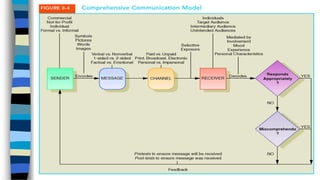
 Feedback - the Receiver’s Response
Basic Communication Model
■

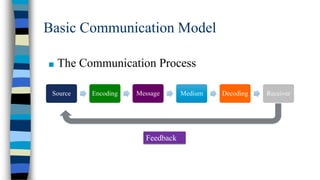
The Communication Process

Source

Encoding

Message

Feedback

Medium

Decoding

Receiver
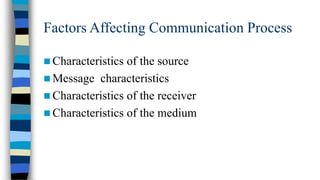
Factors Affecting Communication Process
 Characteristics

of the source
 Message characteristics
 Characteristics of the receiver
 Characteristics of the medium
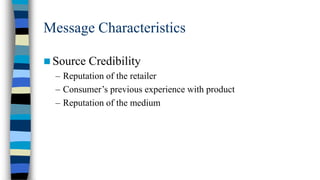
Message Characteristics
 Source Credibility
– Reputation of the retailer
– Consumer’s previous experience with product
– Reputation of the medium
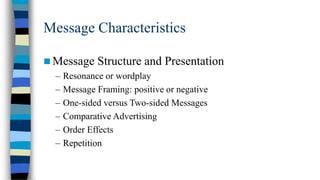
Message Characteristics
 Message Structure and Presentation
– Resonance or wordplay
– Message Framing: positive or negative
– One-sided versus Two-sided Messages

– Comparative Advertising
– Order Effects
– Repetition
Message Characteristics
 Advertising Appeal
– Factual or Emotional

Used

 Types of Emotional Appeals
– Fear
– Humor
– Abrasive advertising
– Sex in advertising
M. Amir
MB-12-50
Medium
 Medium can be:
– Impersonal (mass media)
– Interpersonal (with salesperson or a friend)
– Interactive (direct feedback possibility exists)
Characteristics of the Medium - Newspaper
 Access

to large
audiences
 Effective for local reach
 Flexible
 Fast
 Feedback possible
through coupon
redemption, etc.

 Not

selective
 Short message life
 Clutter
 Cost varies based on ad
size and vehicle
circulation
Characteristics of the Medium - Magazines
 Highly

selective
 Selective binding
possible
 High quality production
 High credibility
 Long message life
 High pass along rate

 High

clutter
 Delayed and indirect
feedback
 Rates vary based on
circulation and
selectivity
Characteristics of the Medium - Television
 Large

audiences
possible
 Appeals to many senses
 Emotion and attention
possible
 Demonstration possible
 Very high costs overall

 Long

lead time
 High clutter
 Short message life
 Viewers can avoid
exposure with zapping
 Day-after recall tests for
feedback
Characteristics of the Medium - Radio
 High

geographic and
demographic selectivity
 Audio only
 Relatively inexpensive
 Good local coverage

 Short

exposure time
 High clutter
 Zapping possible
 Delayed feedback
through day-after recall
tests
Characteristics of the Medium - Internet
 Potential

for audience
selectivity
 Customized tracking
possible and other
feedback tools possible
 Useful for branding and
reinforcement of
messages

 Demographic

skew to

audience
 Very high clutter
 Zapping possible
 Great variation in
pricing
 Privacy concerns
Characteristics of the Medium – Direct Mail
 High

audience
selectivity
 Personalization possible
 Novel, interesting
stimuli possible
 Low clutter

 Perception

of junk mail
 Feedback possible
through response
Characteristics of the Medium – Direct Marketing
 Development

of

databases
 High audience
selectivity
 Relatively free of clutter

 Privacy

concerns
 Measurable responses
 Cost per inquiry, cost
per sale, revenue per ad
can be calculated
Characteristics of the Target Market
 Personal

characteristics and comprehension
 Involvement and congruency
 Mood
 Barriers to communication
– Selective exposure to messages
– Psychological noise
Feedback: The Receiver’s Response
 Feedback should
– Promptly
– Accurately

be gathered:
Humayoon Askry
MB-12-14
Issues in Credibility


Credibility of Informal Sources
 Credibility of Impersonal, Neutral Sources
 Credibility of Spokespersons and Endorsers
 Sleeper Effect
The Message Source
Issues with
Credibility


Credibility of Informal
Sources
 Credibility of Formal
Sources
 Credibility of
Spokespersons and
Endorsers
 Message Credibility




Includes word of mouth
These sources also
called opinion leaders
 Informal sources may
not always be credible
The Message Source
Issues with
Credibility


Credibility of Informal
Sources
 Credibility of Formal
Sources
 Credibility of
Spokespersons and
Endorsers
 Message Credibility






Neutral sources have the
greatest credibility
Source credibility judged on
past
performance, reputation, servic
e, quality, spokesperson
image, retailers, social
responsibility
Institutional advertising used to
promote favorable company
image
The Message Source
Issues with
Credibility


Credibility of Informal
Sources
 Credibility of Formal
Sources
 Credibility of
Spokespersons and
Endorsers
 Message Credibility



Effectiveness related to:
– The message
– Synergy between endorser
and type of product
– Demographic characteristics
of endorser
– Corporate credibility
– Endorsement wording
This ad has
strong synergy
between the
endorser and
the type of
product.
The Message Source
Issues with
Credibility


Credibility of Informal
Sources
 Credibility of Formal
Sources
 Credibility of
Spokespersons and
Endorsers
 Message Credibility




Credibility of retailers
Reputation of the
medium that carries the
ad
 Consumer’s previous
experience with product
MB-12-32

Khurram
Khalil
Sleeper Effect
 The

idea that both positive and negative credibility
effects tend to disappear after a period of time.
Barriers to Communication
 Selective

Perception
 Psychological Noise
Communication and Marketing Strategy


Establish communication objectives
 Select target audience
 Choose the best media
 Develop suitable message strategies
– Match message with audience characteristics
– Develop suitable message structure, presentation
– Develop suitable message appeals



Reduce barriers to effective communication
 Measure effectiveness of marketing communications
Designing Persuasive Communications
 Message Presentation
– Resonance
– Message Framing
– Comparative advertising
– One-sided Versus Two-sided Messages
– Order Effects
Omer
Shahzad
MB-12-08
Designing Persuasive Communications
 Message Presentation
– Resonance
– Message Framing
– Comparative advertising
– One-sided Versus Two-sided Messages
– Order Effects
Designing Persuasive Communications
Message Structure
and Presentation


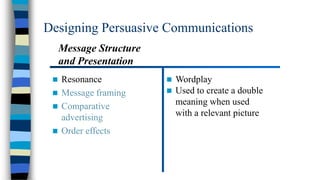
Resonance
 Message framing
 Comparative
advertising
 Order effects




Wordplay
Used to create a double
meaning when used
with a relevant picture
Wordplay on
Cigarettes
Cases of
Morven Gold
Designing Persuasive Communications
Message Structure
and Presentation


Resonance
 Message framing
 Comparative
advertising
 Order effects





Positive framing
Negative framing
One-sided vs. two-sided
Positive Framing in Fair & Lovely Ad
This ad uses
negative
framing.
Designing Persuasive Communications
Message Structure
and Presentation


Resonance
 Message framing
 Comparative
advertising
 Order effects



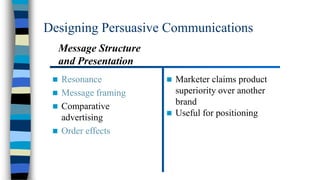
Marketer claims product
superiority over another
brand
 Useful for positioning
Wordplay on
Death
Cigarettes
Comparative
ad scenario
between
GoAir and
KingFisher
Airlines
Dove in a comparative ad against Pantene
Designing Persuasive Communications
Message Structure
and Presentation


Resonance
 Message framing
 Comparative
advertising
 Order effects




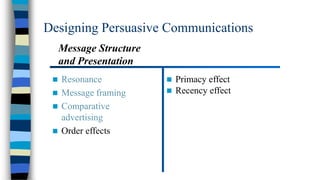
Primacy effect
Recency effect
MB-12-48

Nouman
Ashraf
Advertising Appeals
 Fear
 Humor
 Abrasive

advertising
 Sex in advertising
 Audience participation
Fear Appeal
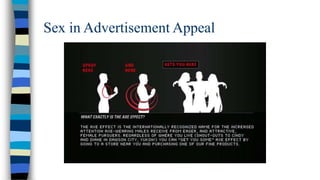
Sex in Advertisement Appeal
Humor Appeal
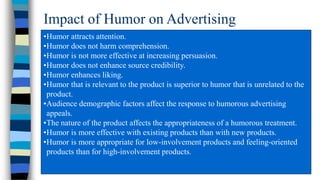
Impact of Humor on Advertising
•Humor attracts attention.
•Humor does not harm comprehension.
•Humor is not more effective at increasing persuasion.
•Humor does not enhance source credibility.
•Humor enhances liking.
•Humor that is relevant to the product is superior to humor that is unrelated to the
product.
•Audience demographic factors affect the response to humorous advertising
appeals.
•The nature of the product affects the appropriateness of a humorous treatment.
•Humor is more effective with existing products than with new products.
•Humor is more appropriate for low-involvement products and feeling-oriented
products than for high-involvement products.
Message Effectiveness
 Market

communications are designed for a target
audience
 The effectiveness can be measured through
communication feedback
Communication Feedback
 Exposure

effects
 Persuasion effects
 Sales effects
Summary
 Communication

process
 Barriers to communication
 Modes of designing an effective message
 Effective advertising appeals
 Feedback importance for message effectiveness

Communication and Consumer Behavior

  • 1.
    Communication and Consumer Behaviour ConsumerBehaviour Presentation Ma’am Farasat
  • 2.
  • 3.
    What is Communication? The transmission of a message from a sender to a receiver via a medium of transmission.
  • 4.
    Elements of theCommunication Process  The Message Initiator (the Source)  The Sender  The Receiver  The Medium  The Message  The Target Audience (the Receivers)  Feedback - the Receiver’s Response
  • 5.
    Basic Communication Model ■ TheCommunication Process Source Encoding Message Feedback Medium Decoding Receiver
  • 6.
    Factors Affecting CommunicationProcess  Characteristics of the source  Message characteristics  Characteristics of the receiver  Characteristics of the medium
  • 7.
    Message Characteristics  SourceCredibility – Reputation of the retailer – Consumer’s previous experience with product – Reputation of the medium
  • 8.
    Message Characteristics  MessageStructure and Presentation – Resonance or wordplay – Message Framing: positive or negative – One-sided versus Two-sided Messages – Comparative Advertising – Order Effects – Repetition
  • 9.
    Message Characteristics  AdvertisingAppeal – Factual or Emotional Used  Types of Emotional Appeals – Fear – Humor – Abrasive advertising – Sex in advertising
  • 10.
  • 11.
    Medium  Medium canbe: – Impersonal (mass media) – Interpersonal (with salesperson or a friend) – Interactive (direct feedback possibility exists)
  • 12.
    Characteristics of theMedium - Newspaper  Access to large audiences  Effective for local reach  Flexible  Fast  Feedback possible through coupon redemption, etc.  Not selective  Short message life  Clutter  Cost varies based on ad size and vehicle circulation
  • 13.
    Characteristics of theMedium - Magazines  Highly selective  Selective binding possible  High quality production  High credibility  Long message life  High pass along rate  High clutter  Delayed and indirect feedback  Rates vary based on circulation and selectivity
  • 14.
    Characteristics of theMedium - Television  Large audiences possible  Appeals to many senses  Emotion and attention possible  Demonstration possible  Very high costs overall  Long lead time  High clutter  Short message life  Viewers can avoid exposure with zapping  Day-after recall tests for feedback
  • 15.
    Characteristics of theMedium - Radio  High geographic and demographic selectivity  Audio only  Relatively inexpensive  Good local coverage  Short exposure time  High clutter  Zapping possible  Delayed feedback through day-after recall tests
  • 16.
    Characteristics of theMedium - Internet  Potential for audience selectivity  Customized tracking possible and other feedback tools possible  Useful for branding and reinforcement of messages  Demographic skew to audience  Very high clutter  Zapping possible  Great variation in pricing  Privacy concerns
  • 17.
    Characteristics of theMedium – Direct Mail  High audience selectivity  Personalization possible  Novel, interesting stimuli possible  Low clutter  Perception of junk mail  Feedback possible through response
  • 18.
    Characteristics of theMedium – Direct Marketing  Development of databases  High audience selectivity  Relatively free of clutter  Privacy concerns  Measurable responses  Cost per inquiry, cost per sale, revenue per ad can be calculated
  • 19.
    Characteristics of theTarget Market  Personal characteristics and comprehension  Involvement and congruency  Mood  Barriers to communication – Selective exposure to messages – Psychological noise
  • 20.
    Feedback: The Receiver’sResponse  Feedback should – Promptly – Accurately be gathered:
  • 22.
  • 23.
    Issues in Credibility  Credibilityof Informal Sources  Credibility of Impersonal, Neutral Sources  Credibility of Spokespersons and Endorsers  Sleeper Effect
  • 24.
    The Message Source Issueswith Credibility  Credibility of Informal Sources  Credibility of Formal Sources  Credibility of Spokespersons and Endorsers  Message Credibility   Includes word of mouth These sources also called opinion leaders  Informal sources may not always be credible
  • 25.
    The Message Source Issueswith Credibility  Credibility of Informal Sources  Credibility of Formal Sources  Credibility of Spokespersons and Endorsers  Message Credibility    Neutral sources have the greatest credibility Source credibility judged on past performance, reputation, servic e, quality, spokesperson image, retailers, social responsibility Institutional advertising used to promote favorable company image
  • 26.
    The Message Source Issueswith Credibility  Credibility of Informal Sources  Credibility of Formal Sources  Credibility of Spokespersons and Endorsers  Message Credibility  Effectiveness related to: – The message – Synergy between endorser and type of product – Demographic characteristics of endorser – Corporate credibility – Endorsement wording
  • 27.
    This ad has strongsynergy between the endorser and the type of product.
  • 28.
    The Message Source Issueswith Credibility  Credibility of Informal Sources  Credibility of Formal Sources  Credibility of Spokespersons and Endorsers  Message Credibility   Credibility of retailers Reputation of the medium that carries the ad  Consumer’s previous experience with product
  • 29.
  • 30.
    Sleeper Effect  The ideathat both positive and negative credibility effects tend to disappear after a period of time.
  • 31.
    Barriers to Communication Selective Perception  Psychological Noise
  • 32.
    Communication and MarketingStrategy  Establish communication objectives  Select target audience  Choose the best media  Develop suitable message strategies – Match message with audience characteristics – Develop suitable message structure, presentation – Develop suitable message appeals  Reduce barriers to effective communication  Measure effectiveness of marketing communications
  • 33.
    Designing Persuasive Communications Message Presentation – Resonance – Message Framing – Comparative advertising – One-sided Versus Two-sided Messages – Order Effects
  • 34.
  • 35.
    Designing Persuasive Communications Message Presentation – Resonance – Message Framing – Comparative advertising – One-sided Versus Two-sided Messages – Order Effects
  • 36.
    Designing Persuasive Communications MessageStructure and Presentation  Resonance  Message framing  Comparative advertising  Order effects   Wordplay Used to create a double meaning when used with a relevant picture
  • 37.
  • 38.
    Designing Persuasive Communications MessageStructure and Presentation  Resonance  Message framing  Comparative advertising  Order effects    Positive framing Negative framing One-sided vs. two-sided
  • 39.
    Positive Framing inFair & Lovely Ad
  • 40.
  • 41.
    Designing Persuasive Communications MessageStructure and Presentation  Resonance  Message framing  Comparative advertising  Order effects  Marketer claims product superiority over another brand  Useful for positioning
  • 42.
  • 43.
  • 44.
    Dove in acomparative ad against Pantene
  • 45.
    Designing Persuasive Communications MessageStructure and Presentation  Resonance  Message framing  Comparative advertising  Order effects   Primacy effect Recency effect
  • 47.
  • 48.
    Advertising Appeals  Fear Humor  Abrasive advertising  Sex in advertising  Audience participation
  • 49.
  • 50.
  • 51.
  • 52.
    Impact of Humoron Advertising •Humor attracts attention. •Humor does not harm comprehension. •Humor is not more effective at increasing persuasion. •Humor does not enhance source credibility. •Humor enhances liking. •Humor that is relevant to the product is superior to humor that is unrelated to the product. •Audience demographic factors affect the response to humorous advertising appeals. •The nature of the product affects the appropriateness of a humorous treatment. •Humor is more effective with existing products than with new products. •Humor is more appropriate for low-involvement products and feeling-oriented products than for high-involvement products.
  • 53.
    Message Effectiveness  Market communicationsare designed for a target audience  The effectiveness can be measured through communication feedback
  • 54.
    Communication Feedback  Exposure effects Persuasion effects  Sales effects
  • 55.
    Summary  Communication process  Barriersto communication  Modes of designing an effective message  Effective advertising appeals  Feedback importance for message effectiveness