COMMUNICATION PROCESS
AND FACTORS AFFECTING
COMMUNICATION
INTRODUCTION
 The word communication comes from Latin word ‘communicare’ which
means to share, to impart, etc.
 Communication is the basic element of human interactions that allows
people to establish, maintain and improve contacts with others.
 Nursing is a communicative intervention
and the foundation of nursing lies in
the “communicative attitude.”
DEFINITION
 According to Paul Leagens, it is “a process by which two or more
people exchange ideas, facts, feelings or impressions in ways that
each gains a ‘common understanding’ of meaning, intent and use of a
message.”
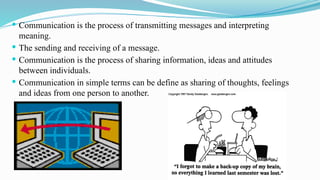
 Communication is the process of transmitting messages and interpreting
meaning.
 The sending and receiving of a message.
 Communication is the process of sharing information, ideas and attitudes
between individuals.
 Communication in simple terms can be define as sharing of thoughts, feelings
and ideas from one person to another.
IMPORTANCE OF COMMMUNICATION
 Necessary for planning
 Understanding each other
 Establishment of effective leadership
 Increases Efficiency
 Basis of Decision-making
 Motivation
 Co-ordination
PRINCIPLES OF COMMUNICATION
 Communication should have objective and
Purpose.
 Systematic analysis of the message, i.e., the idea, the
thought to be communicated, so that one is clear about it.
 Selection and determination of appropriate
language and medium of communication
according to its purpose.
Contd…
 Organizational climate, appropriate timing and physical setting to convey the
desired meaning of communication.
 Consultation with others for planning of
communication; involves special preparation.
 Message should convey something of value to the
receiver in the light of his needs and interests.
Contd…
 The sender has to understand the receivers attitudes and reaction by careful, alert
and proper listening to ensure that the desired meaning of the message has been
comprehended by the receiver.
 Credibility is very important.
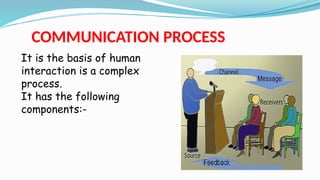
COMMUNICATION PROCESS
It is the basis of human
interaction is a complex
process.
It has the following
components:-
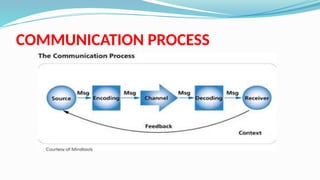
COMMUNICATION PROCESS
 Components of communication process:
 Sender (source)
 Message (content)
 Channels (medium)
 Receiver (audience)
 Feedback (effect)
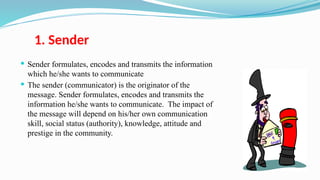
1. Sender
 Sender formulates, encodes and transmits the information
which he/she wants to communicate
 The sender (communicator) is the originator of the
message. Sender formulates, encodes and transmits the
information he/she wants to communicate. The impact of
the message will depend on his/her own communication
skill, social status (authority), knowledge, attitude and
prestige in the community.
To be an effective communicator one must have:
 Objectives, has to be clearly defined
 Audience, its interests and needs
 Message, what actually wants to convey
 Professional abilities and limitations.
2. Message
 A message is the information/desired behaviour in physical form which the
communicator transmits to his audience to receive, understand, accept and act upon.
 The message may be in the form of words, pictures or signs
 Natural sign: a part of the larger thing or event or condition signified by it. Eg.
Blood on surgical dressing ia a sign of haemorrhage.
 Non - natural sign: which symbolizes something is designated. Eg. Body cast
signifies some physical health.
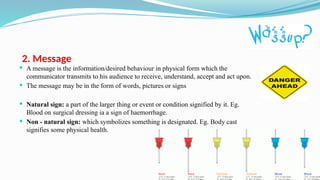
 Iconic sign: a sign is like the thing it signifies. Eg: danger sign.
 Digital sign: independent of their physical parameters for their meaning. Eg.
Pattern, size etc. (needle size- 23G, 18G).
 COMPONENTS OF MESSAGE:
 Message code - any group of symbols that can be structured in a way that is
meaningful to same person, eg. Language.
 Message content – the material in the message i.e., selected by the source to
express his purpose.
 Message treatment – i.e. decisions which the communication source makes in
selecting, arranging both codes and contents.
 Health communication may fails in many cases, if its message is not adequate.
 QUALITIES OF A GOOD MESSAGE:
 In line with the objectives
 Meaningful
 Based on the felt needs
 Clear and understandable
 Specific and accurate
 Timely and adequate
 Fitting the audience
 Interesting
 Culturally and socially appropriate
 Transmitting the right message to the right person at right time is a crucial factor in
successful communication.
3.channel
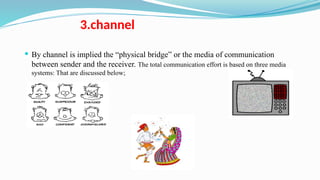
 By channel is implied the “physical bridge” or the media of communication
between sender and the receiver. The total communication effort is based on three media
systems: That are discussed below;
 Interpersonal communication: i.e., face to face communication most common
channel of communication. The encoding function is performed and channelled
directly by the intellectual, the sensory and the motor skill of the source, e.g., vocal
mechanism for oral communication, posture – gesture, facial expressions for non –
verbal communication.
 Mass media: viz TV, radio, printed media etc.
 Traditional or folk media: every community has its own network of traditional of
folk media such as folk dances, singing, dramas, and religious meetings.
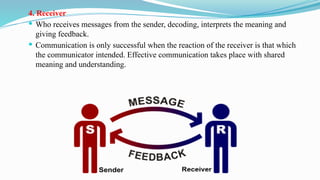
4. Receiver
 Who receives messages from the sender, decoding, interprets the meaning and
giving feedback.
 Communication is only successful when the reaction of the receiver is that which
the communicator intended. Effective communication takes place with shared
meaning and understanding.
5. Feedback
It is the flow of information from the sender, the reaction to the message,. If the message is rejecting or
not understandable by receiver, feedback provides an opportunity to the sender to modify his/ her
message and render it acceptable.
OR,
Feedback is the message returned to the original sender by the receiver. It can be a verbal or nonverbal
reaction or response. Without feedback, there would be no way of knowing if meaning had been shared
or if understanding had taken place.
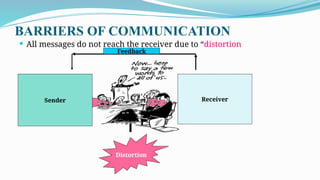
BARRIERS OF COMMUNICATION
 All messages do not reach the receiver due to “distortion
Sender Receiver
Feedback
Distortion
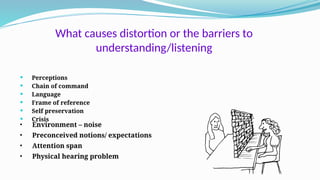
What causes distortion or the barriers to
understanding/listening
 Perceptions
 Chain of command
 Language
 Frame of reference
 Self preservation
 Crisis
• Environment – noise
• Preconceived notions/ expectations
• Attention span
• Physical hearing problem
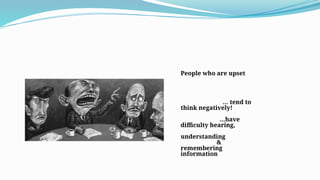
People who are upset
… tend to
think negatively!
…have
difficulty hearing,
understanding
&
remembering
information
LISTENING
 Is used more than reading and writing combined to collect information…
 If you listen well, others will think:
• You take them seriously
• You value them
 If you dont listen poorly, others will think:
• You are ignoring them
• You do not appreciate them
PERSONAL BARRIERS
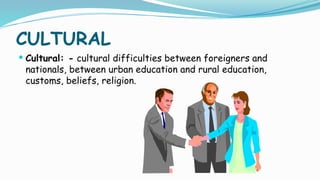
CULTURAL
 Cultural: - cultural difficulties between foreigners and
nationals, between urban education and rural education,
customs, beliefs, religion.
Emotional barriers
Emotional factors like fear, worry, anxiety, suspicion also can block communication.
Language barriers
language is a vehicle for communication. When the person is not familiar with expression,
words, jargon can block communication.
Muddled barriers
Effective communication starts with clear message. when the sender leaves message unclear
receiver cannot receive the message properly finally it cause confusion.
Gender barriers
when a man speaks, his speech is located in the left side of the brain but in no specific areas.
When a women talks, her speech is located in both hemisphere and in 2 specific locations. This
means man speaks in a linear, logical and compartmentalized way whereas woman talks freely,
mixing logic and emotions.
of
MODES
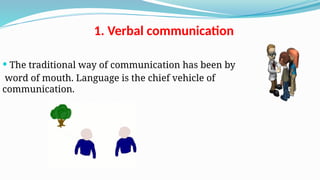
1. Verbal communication
 The traditional way of communication has been by
word of mouth. Language is the chief vehicle of
communication.
Advantages –
Receiver may ask questions and add their own information, ideas and opinions to the subject.
The process of learning is active and democratic.
It is more likely to influence behaviour than
one way communication.
Disadvantage –
its relatively noisy, and disorderly with people interrupting the sender and one another; sender
finds him/herself psychologically under attack because his receivers pickup his mistakes.
To make a message clear few effective verbal communication techniques should be
used:
•Clarity and brevity – clarity can be achieved by speaking slowly and enunciating
clarity or by using examples. Brevity is best achieved by using words that express an
idea simply; eg. ‘tell me what is your problem’.
Vocabulary – instead of using purely technical words use, local words synonymes to
technical words for better understanding.
 Denotative and connotative meaning – a denotative meaning is one shared by
individuals who use a common language that is used to define a word so that means the
same to everyone. The connotative meaning of words is thoughts, feelings or ideas that
people have about the word.
Pacing – verbal communication is successful when expressed in an appropriate speed or
pace.
Timing and relevance – timing is critical to perception. for example if the supervisor/ manager is in the
bad mood, the time is wrong to ask for a raise. and relevance is also important, i.e. message have to be
of receiver’s interest and needs
HUMOUR – It can be a powerfull tool in promoting all aspects in communicating anything when it is
used in good sense according to circumstances and events.
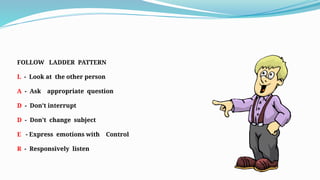
FOLLOW LADDER PATTERN
L - Look at the other person
A - Ask appropriate question
D - Don’t interrupt
D - Don’t change subject
E - Express emotions with Control
R - Responsively listen
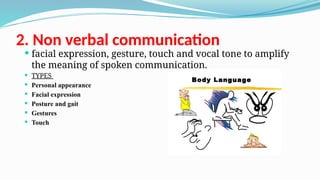
2. Non verbal communication
 facial expression, gesture, touch and vocal tone to amplify
the meaning of spoken communication.
 TYPES
 Personal appearance
 Facial expression
 Posture and gait
 Gestures
 Touch
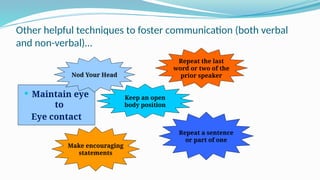
Other helpful techniques to foster communication (both verbal
and non-verbal)…
 Maintain eye
to
Eye contact
Make encouraging
statements
Nod Your Head
Keep an open
body position
Repeat a sentence
or part of one
Repeat the last
word or two of the
prior speaker
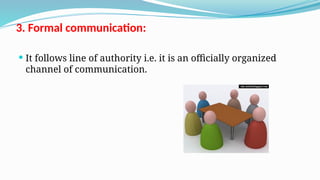
3. Formal communication:
 It follows line of authority i.e. it is an officially organized
channel of communication.
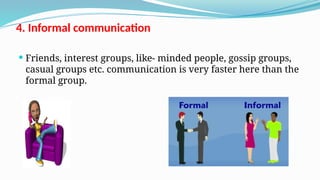
4. Informal communication
 Friends, interest groups, like- minded people, gossip groups,
casual groups etc. communication is very faster here than the
formal group.
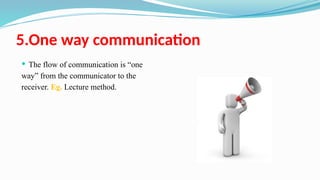
5.One way communication
 The flow of communication is “one
way” from the communicator to the
receiver. Eg. Lecture method.
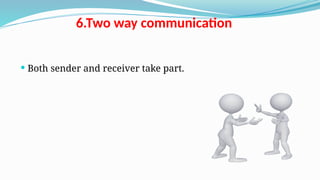
6.Two way communication
 Both sender and receiver take part.
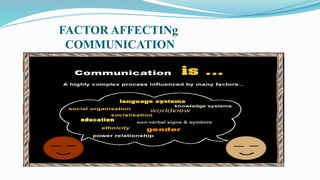
FACTOR AFFECTINg
COMMUNICATION
FACTORS AFFECTING COMMUNICATION
 Perceptions – it is the personal view of events, i.e. each person senses, interprets and
understands the event differently; it is formed by experience and expectations.
 Values – these are standards that influence behaviour; what person considers
important in life and thus influence expresssions of thoughts and ideas.
 Emotions – subjective feelings about events. The way a person communicates with
the others is influenced by emotions.
 Socio-cultural background – culture is the sum total of the learned ways of doing,
feeling, and thinking.
•Knowledge – knowledge of handling different level persons is essential for
communication.
•Role and relationships – communication is more effective when the participants
remain aware of their role in a relationship.
•Environment – worm and comfortable environment facilitates good
communication.
•Space and territoriality – territoriality is the drive to gain, maintain and defend an
exclusive right to an area of space. It provides people with a sense of identity, security
and control.
CONCLUSION
 Communication is the art of transmitting knowledge, ideas, information and thoughts
From one person to another. The transfer should be such that the receiver
understands. The meaning and the intent of the message and give proper feedback.
SUMMARY
In the lecture we have discussed about :
 Introduction
 Definition
 Importance of communication
 Principles of communication
 Communication process
 Barriers to communication
 modes of communication
 Factors affecting communication process
BIBLIOGRAPHY
BOOKS
 Sharma Pawan. Book of Psychiatric Nursing 1st ed. Published by Jaypee Brothers
pvt.ltd;2013
 Neeraja K.P Textbook of Nursing Education Jaypee brother publisher
 Howard S.R. & Beatrice L.R. Nursing Administration Handbook.
 Basavanthappa B.T (2007) nursing Administration (1st
edn.). Jaypee
Brothers: New Delhi.
INTERNET
 www.wikipedia.org>wiki>communicationtechnique

COMMUNICATION, barriers & techniques to overcome.pptx

  • 1.
    COMMUNICATION PROCESS AND FACTORSAFFECTING COMMUNICATION
  • 2.
    INTRODUCTION  The wordcommunication comes from Latin word ‘communicare’ which means to share, to impart, etc.  Communication is the basic element of human interactions that allows people to establish, maintain and improve contacts with others.  Nursing is a communicative intervention and the foundation of nursing lies in the “communicative attitude.”
  • 3.
    DEFINITION  According toPaul Leagens, it is “a process by which two or more people exchange ideas, facts, feelings or impressions in ways that each gains a ‘common understanding’ of meaning, intent and use of a message.”
  • 4.
     Communication isthe process of transmitting messages and interpreting meaning.  The sending and receiving of a message.  Communication is the process of sharing information, ideas and attitudes between individuals.  Communication in simple terms can be define as sharing of thoughts, feelings and ideas from one person to another.
  • 5.
    IMPORTANCE OF COMMMUNICATION Necessary for planning  Understanding each other  Establishment of effective leadership  Increases Efficiency  Basis of Decision-making  Motivation  Co-ordination
  • 6.
    PRINCIPLES OF COMMUNICATION Communication should have objective and Purpose.  Systematic analysis of the message, i.e., the idea, the thought to be communicated, so that one is clear about it.  Selection and determination of appropriate language and medium of communication according to its purpose.
  • 7.
    Contd…  Organizational climate,appropriate timing and physical setting to convey the desired meaning of communication.  Consultation with others for planning of communication; involves special preparation.  Message should convey something of value to the receiver in the light of his needs and interests.
  • 8.
    Contd…  The senderhas to understand the receivers attitudes and reaction by careful, alert and proper listening to ensure that the desired meaning of the message has been comprehended by the receiver.  Credibility is very important.
  • 9.
    COMMUNICATION PROCESS It isthe basis of human interaction is a complex process. It has the following components:-
  • 10.
  • 11.
    COMMUNICATION PROCESS  Componentsof communication process:  Sender (source)  Message (content)  Channels (medium)  Receiver (audience)  Feedback (effect)
  • 12.
    1. Sender  Senderformulates, encodes and transmits the information which he/she wants to communicate  The sender (communicator) is the originator of the message. Sender formulates, encodes and transmits the information he/she wants to communicate. The impact of the message will depend on his/her own communication skill, social status (authority), knowledge, attitude and prestige in the community.
  • 13.
    To be aneffective communicator one must have:  Objectives, has to be clearly defined  Audience, its interests and needs  Message, what actually wants to convey  Professional abilities and limitations.
  • 14.
    2. Message  Amessage is the information/desired behaviour in physical form which the communicator transmits to his audience to receive, understand, accept and act upon.  The message may be in the form of words, pictures or signs  Natural sign: a part of the larger thing or event or condition signified by it. Eg. Blood on surgical dressing ia a sign of haemorrhage.  Non - natural sign: which symbolizes something is designated. Eg. Body cast signifies some physical health.
  • 15.
     Iconic sign:a sign is like the thing it signifies. Eg: danger sign.  Digital sign: independent of their physical parameters for their meaning. Eg. Pattern, size etc. (needle size- 23G, 18G).  COMPONENTS OF MESSAGE:  Message code - any group of symbols that can be structured in a way that is meaningful to same person, eg. Language.  Message content – the material in the message i.e., selected by the source to express his purpose.  Message treatment – i.e. decisions which the communication source makes in selecting, arranging both codes and contents.  Health communication may fails in many cases, if its message is not adequate.
  • 16.
     QUALITIES OFA GOOD MESSAGE:  In line with the objectives  Meaningful  Based on the felt needs  Clear and understandable  Specific and accurate  Timely and adequate  Fitting the audience  Interesting  Culturally and socially appropriate  Transmitting the right message to the right person at right time is a crucial factor in successful communication.
  • 17.
    3.channel  By channelis implied the “physical bridge” or the media of communication between sender and the receiver. The total communication effort is based on three media systems: That are discussed below;
  • 18.
     Interpersonal communication:i.e., face to face communication most common channel of communication. The encoding function is performed and channelled directly by the intellectual, the sensory and the motor skill of the source, e.g., vocal mechanism for oral communication, posture – gesture, facial expressions for non – verbal communication.  Mass media: viz TV, radio, printed media etc.  Traditional or folk media: every community has its own network of traditional of folk media such as folk dances, singing, dramas, and religious meetings.
  • 19.
    4. Receiver  Whoreceives messages from the sender, decoding, interprets the meaning and giving feedback.  Communication is only successful when the reaction of the receiver is that which the communicator intended. Effective communication takes place with shared meaning and understanding.
  • 20.
    5. Feedback It isthe flow of information from the sender, the reaction to the message,. If the message is rejecting or not understandable by receiver, feedback provides an opportunity to the sender to modify his/ her message and render it acceptable. OR, Feedback is the message returned to the original sender by the receiver. It can be a verbal or nonverbal reaction or response. Without feedback, there would be no way of knowing if meaning had been shared or if understanding had taken place.
  • 21.
    BARRIERS OF COMMUNICATION All messages do not reach the receiver due to “distortion Sender Receiver Feedback Distortion
  • 22.
    What causes distortionor the barriers to understanding/listening  Perceptions  Chain of command  Language  Frame of reference  Self preservation  Crisis • Environment – noise • Preconceived notions/ expectations • Attention span • Physical hearing problem
  • 23.
    People who areupset … tend to think negatively! …have difficulty hearing, understanding & remembering information
  • 24.
    LISTENING  Is usedmore than reading and writing combined to collect information…  If you listen well, others will think: • You take them seriously • You value them  If you dont listen poorly, others will think: • You are ignoring them • You do not appreciate them
  • 25.
  • 26.
    CULTURAL  Cultural: -cultural difficulties between foreigners and nationals, between urban education and rural education, customs, beliefs, religion.
  • 27.
    Emotional barriers Emotional factorslike fear, worry, anxiety, suspicion also can block communication. Language barriers language is a vehicle for communication. When the person is not familiar with expression, words, jargon can block communication. Muddled barriers Effective communication starts with clear message. when the sender leaves message unclear receiver cannot receive the message properly finally it cause confusion. Gender barriers when a man speaks, his speech is located in the left side of the brain but in no specific areas. When a women talks, her speech is located in both hemisphere and in 2 specific locations. This means man speaks in a linear, logical and compartmentalized way whereas woman talks freely, mixing logic and emotions.
  • 28.
  • 29.
    1. Verbal communication The traditional way of communication has been by word of mouth. Language is the chief vehicle of communication.
  • 30.
    Advantages – Receiver mayask questions and add their own information, ideas and opinions to the subject. The process of learning is active and democratic. It is more likely to influence behaviour than one way communication. Disadvantage – its relatively noisy, and disorderly with people interrupting the sender and one another; sender finds him/herself psychologically under attack because his receivers pickup his mistakes.
  • 31.
    To make amessage clear few effective verbal communication techniques should be used: •Clarity and brevity – clarity can be achieved by speaking slowly and enunciating clarity or by using examples. Brevity is best achieved by using words that express an idea simply; eg. ‘tell me what is your problem’. Vocabulary – instead of using purely technical words use, local words synonymes to technical words for better understanding.  Denotative and connotative meaning – a denotative meaning is one shared by individuals who use a common language that is used to define a word so that means the same to everyone. The connotative meaning of words is thoughts, feelings or ideas that people have about the word. Pacing – verbal communication is successful when expressed in an appropriate speed or pace.
  • 32.
    Timing and relevance– timing is critical to perception. for example if the supervisor/ manager is in the bad mood, the time is wrong to ask for a raise. and relevance is also important, i.e. message have to be of receiver’s interest and needs HUMOUR – It can be a powerfull tool in promoting all aspects in communicating anything when it is used in good sense according to circumstances and events.
  • 33.
    FOLLOW LADDER PATTERN L- Look at the other person A - Ask appropriate question D - Don’t interrupt D - Don’t change subject E - Express emotions with Control R - Responsively listen
  • 34.
    2. Non verbalcommunication  facial expression, gesture, touch and vocal tone to amplify the meaning of spoken communication.  TYPES  Personal appearance  Facial expression  Posture and gait  Gestures  Touch
  • 35.
    Other helpful techniquesto foster communication (both verbal and non-verbal)…  Maintain eye to Eye contact Make encouraging statements Nod Your Head Keep an open body position Repeat a sentence or part of one Repeat the last word or two of the prior speaker
  • 36.
    3. Formal communication: It follows line of authority i.e. it is an officially organized channel of communication.
  • 37.
    4. Informal communication Friends, interest groups, like- minded people, gossip groups, casual groups etc. communication is very faster here than the formal group.
  • 38.
    5.One way communication The flow of communication is “one way” from the communicator to the receiver. Eg. Lecture method.
  • 39.
    6.Two way communication Both sender and receiver take part.
  • 40.
  • 41.
    FACTORS AFFECTING COMMUNICATION Perceptions – it is the personal view of events, i.e. each person senses, interprets and understands the event differently; it is formed by experience and expectations.  Values – these are standards that influence behaviour; what person considers important in life and thus influence expresssions of thoughts and ideas.  Emotions – subjective feelings about events. The way a person communicates with the others is influenced by emotions.  Socio-cultural background – culture is the sum total of the learned ways of doing, feeling, and thinking.
  • 42.
    •Knowledge – knowledgeof handling different level persons is essential for communication. •Role and relationships – communication is more effective when the participants remain aware of their role in a relationship. •Environment – worm and comfortable environment facilitates good communication. •Space and territoriality – territoriality is the drive to gain, maintain and defend an exclusive right to an area of space. It provides people with a sense of identity, security and control.
  • 43.
    CONCLUSION  Communication isthe art of transmitting knowledge, ideas, information and thoughts From one person to another. The transfer should be such that the receiver understands. The meaning and the intent of the message and give proper feedback.
  • 44.
    SUMMARY In the lecturewe have discussed about :  Introduction  Definition  Importance of communication  Principles of communication  Communication process  Barriers to communication  modes of communication  Factors affecting communication process
  • 45.
    BIBLIOGRAPHY BOOKS  Sharma Pawan.Book of Psychiatric Nursing 1st ed. Published by Jaypee Brothers pvt.ltd;2013  Neeraja K.P Textbook of Nursing Education Jaypee brother publisher  Howard S.R. & Beatrice L.R. Nursing Administration Handbook.  Basavanthappa B.T (2007) nursing Administration (1st edn.). Jaypee Brothers: New Delhi. INTERNET  www.wikipedia.org>wiki>communicationtechnique