Chapter 11

Intercultural Negotiation
      Components

     Intercultural Business Communication, 4th ed., Chaney & Martin
Topics
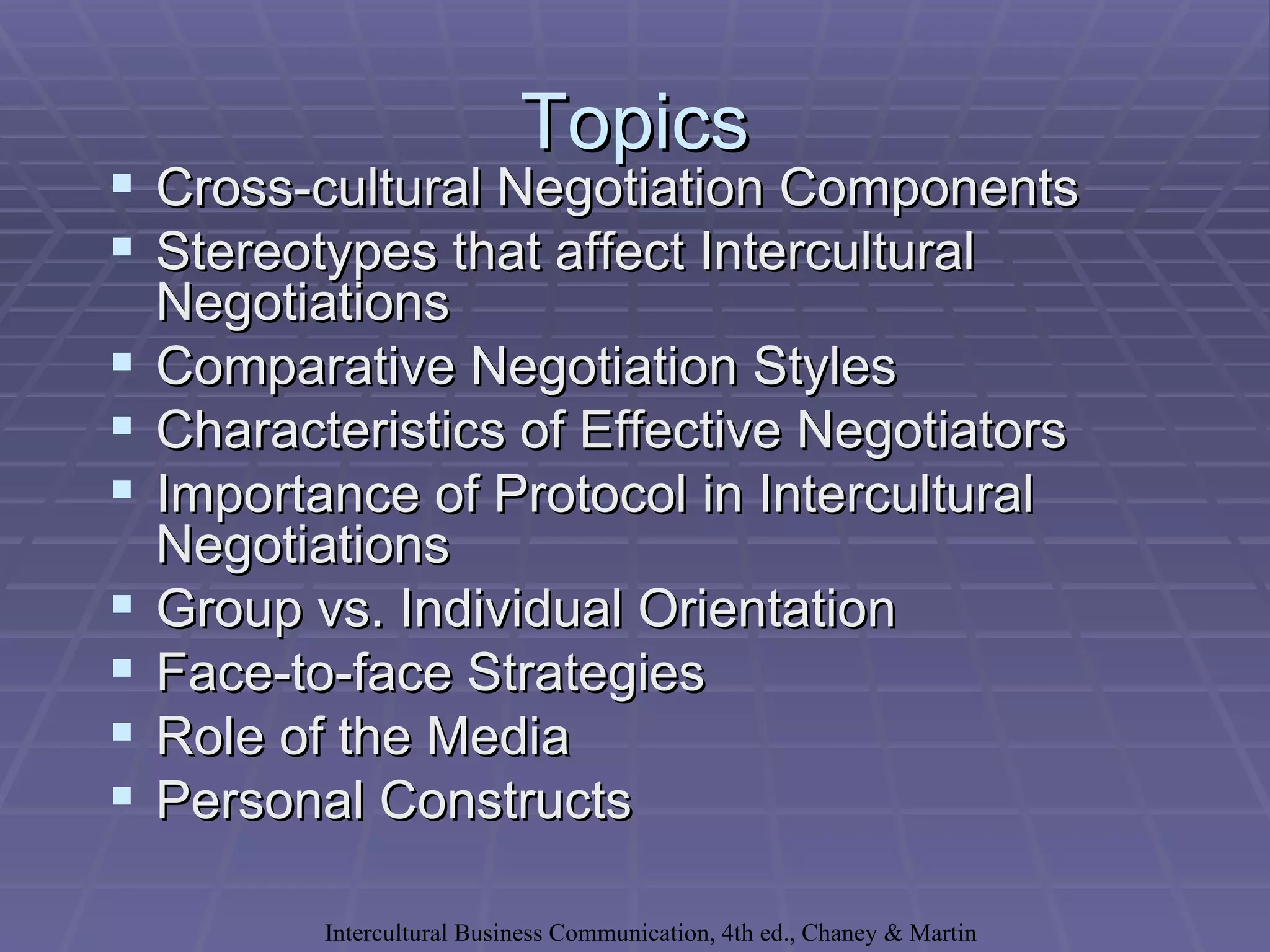
 Cross-cultural Negotiation Components
 Stereotypes that affect Intercultural
    Negotiations
   Comparative Negotiation Styles
   Characteristics of Effective Negotiators
   Importance of Protocol in Intercultural
    Negotiations
   Group vs. Individual Orientation
   Face-to-face Strategies
   Role of the Media
   Personal Constructs

           Intercultural Business Communication, 4th ed., Chaney & Martin
Cross-Cultural Negotiation Components

     The players and situation
     Cultural noise
     National culture
     Power and authority
     Perception
     Interpreters and translators
     Gender
     Environment
     Relationship and substantive conflicts
               Intercultural Business Communication, 4th ed., Chaney & Martin
The Players and the Situation
 Learn the background of the players
 Determine expectations of negotiators
 Determine negotiating style
 Determine role negotiators have played in the
  past
 Provide an environment free of tension,
  conducive to exchange of ideas, and problem
  resolution


          Intercultural Business Communication, 4th ed., Chaney & Martin
Cultural Noise
 Anything that distracts or interferes with
  the message
   Low- or high- context
   Arguments emotional or logical
   Trust based on laws or friendship
   High or low risk takers
   View of time
   Authoritative or consensual decision-making
    style
   Oral or written agreement
          Intercultural Business Communication, 4th ed., Chaney & Martin
National Culture

 Patterns of personality
 Governance structure
 Integrate negotiators’ interests
 Other cultures include: professional, social
 class, ethnic, regional, gender, and
 organizational


          Intercultural Business Communication, 4th ed., Chaney & Martin
Power and Authority

 Power is the ability to influence others
 Authority is the power to give commands
 Power has to be accepted to be meaningful
 Balanced authority – is shared decision-
  making
 Authority advantage – one partner claims
  superior resources or superior position


         Intercultural Business Communication, 4th ed., Chaney & Martin
Perception

 Process used to ascribe meaning to the
  environment
 Is culturally based
 Stimuli have both physical size and socio-
  environmental meaning; our experiences
  determine to what stimuli we are sensitive


         Intercultural Business Communication, 4th ed., Chaney & Martin
Interpreters and Translators

 Language issues are key in negotiations
 Interpreters and translators slow down
  negotiations
 Using interpreters and translators can
  have both positive and negative impacts


         Intercultural Business Communication, 4th ed., Chaney & Martin
Gender


Use of women as negotiators; viewed
 as “window dressing” in some
 countries – viewed as equals in
 others.


        Intercultural Business Communication, 4th ed., Chaney & Martin
Environment


 “Home court” advantage
 The room and furniture arrangement
 Seating arrangement


         Intercultural Business Communication, 4th ed., Chaney & Martin
Relationship and Substantive Conflicts
 Relationship conflicts are issues of long-
  term friendships or partnerships
 Substantive issues are use and control of
  resources
 Cognitive dissonance - the psychological
  conflict or anxiety that results from
  inconsistencies between what one does
  and what one believes


           Intercultural Business Communication, 4th ed., Chaney & Martin
Stereotypes That Affect Intercultural
           Negotiations


 How we view ourselves is probably not
  how the other team views us.
 Find out how others view your culture,
  gender, and organization.


         Intercultural Business Communication, 4th ed., Chaney & Martin
Comparative Negotiation Styles

 A successful negotiator within a culture
  may not be successful in another culture.
 A successful negotiator needs to be able
  to ascertain where the opposition is
  coming from.
 Successful negotiators need to be able to
  adjust their behavior appropriately.

          Intercultural Business Communication, 4th ed., Chaney & Martin
Characteristics of Effective Negotiators

  Effective negotiators are
    observant, patient, adaptable, and good
     listeners
    mentally sharp
    think before they speak
    do their country homework
    praise what is praiseworthy and refrain from
     criticizing the other side
    keep their promises and negotiate in good
     faith

           Intercultural Business Communication, 4th ed., Chaney & Martin
Importance of Protocol in Intercultural
           Negotiations

 Three protocol types
      Tribal
      Collective
      Pluralist
 All cultures share the need for honesty, courage,
  respect for human dignity, fairness, and love;
  however, these have different meanings in
  different cultures.
 Reality is not always the same in every culture.

              Intercultural Business Communication, 4th ed., Chaney & Martin
Group vs. Individual Orientation
 Group orientation
     Your identity belongs to the group
     Decisions reached by consensus
     Contracts are flexible
 Individual orientation
     Your identity belongs to you
     Decisions can be made by individuals
     Contracts are inflexible

            Intercultural Business Communication, 4th ed., Chaney & Martin
Face-to-Face Strategies

 Negotiating in person rather than through
  the mail, fax, telephone, lawyers, or other
  intermediaries
 Face-to-face negotiators’ behaviors
     Irritators
     Counterproposals
     Argument dilution
     Reviewing the negotiation

            Intercultural Business Communication, 4th ed., Chaney & Martin
Role of the Media

 Media may support or tear down
 Media is a culture with cultural biases
 Tend to have a stereotypical view of
  business
 See other cultures through the bias of the
  U.S. perceptual grid
 Movies promote stereotypes

          Intercultural Business Communication, 4th ed., Chaney & Martin
Personal Constructs
 An individual’s belief system and attitudes
 Can differ within a culture as well as between
  cultures
 Expectations are based on learned life
  experiences
 Adaptability is important to success
 Adages
     Birds of a feather flock together
     They’re in America; they should act like Americans
     When in Rome, do as the Romans do


             Intercultural Business Communication, 4th ed., Chaney & Martin
Negotiations - The Four Cs
 Common Interest - each has something
  the other wants
 Conflicting Interests - include payment,
  distribution, profits, contractual
  responsibilities, and quality
 Compromise - areas of disagreement
 Criteria - conditions under which the
  negotiations take place


         Intercultural Business Communication, 4th ed., Chaney & Martin
Mindsets

 Mindsets are controlled by language and
  culture.
 Realize the other side is having mindset
  difficulties in the negotiation also.
 People can alter their strategies based
  upon their first-hand knowledge and
  adaptability.

         Intercultural Business Communication, 4th ed., Chaney & Martin
U.S. Negotiators
 Focused on completing the deal
 Profit oriented and direct
 Do not need personal relationships with
  other negotiators
 Work during meals, golf, at any time
 Tend to be informal
 Individually oriented

         Intercultural Business Communication, 4th ed., Chaney & Martin
Canada

 Two groups: the Anglophones and the
    Francophones
   Well informed and analytical
   Sense of self-determination
   Trust is an important component
   Individually oriented
   Mixture of tribal and pluralistic

            Intercultural Business Communication, 4th ed., Chaney & Martin
China
 The Chinese want a win-win strategy
 Harmony is important
 Neutral site is important
 Team members need to be matched on
  both sides
 Relationship building is important
 Group oriented and prefer face-to-face
  negotiations
         Intercultural Business Communication, 4th ed., Chaney & Martin
England

 Objective, matter-of-fact about
    negotiations
   Tend to understate their position
   Individualistic but company policy followed
    without question
   Relationships not necessary
   Very deadline oriented


            Intercultural Business Communication, 4th ed., Chaney & Martin
France
 Negotiators should have the correct social
    and education background and authority
    to make decisions
   A relationship will help negotiations
   Enjoy debates; are indirect
   Quality more important than speed
   Individualistic and prefer face-to-face
    negotiations
   Mealtime is not a time to talk business
           Intercultural Business Communication, 4th ed., Chaney & Martin
Germany

 Permanent and stringent contracts
 No-nonsense negotiators
 Relationships not necessary
 Individualistic and prefer face-to-face
  negotiations


          Intercultural Business Communication, 4th ed., Chaney & Martin
Japan

 The Japanese want a win-win situation
 Negotiation takes place away from the
  negotiation table
 Relationships are important
 Group and consensus oriented
 Prefer face-to-face negotiations

          Intercultural Business Communication, 4th ed., Chaney & Martin
Mexico
 Relationships and connections very
    important
   Senior executives make the decisions
   Time is fluid
   Emotional arguments are considered to be
    persuasive arguments
   Strategies are more win-win
   Neutral sites are preferred
   Leave room to bargain
           Intercultural Business Communication, 4th ed., Chaney & Martin
The Netherlands

 Averse to chaos; very organized
 The Dutch are direct and pragmatic
 Decision is based on consensus
 Will tend to move fast and expect you to
 also move fast


         Intercultural Business Communication, 4th ed., Chaney & Martin
South Korea

 Rank/status very important
 Harmony is important
 Can be direct, express emotion, and use
  aggression
 Need to be introduced and develop a
  relationship
 South Korea is a collective culture

         Intercultural Business Communication, 4th ed., Chaney & Martin
Taiwan

 Relationships need to be developed
 Seating protocol is important as is
  matching team members
 Self-control and harmony are very
  important
 Taiwanese are collectivistic

         Intercultural Business Communication, 4th ed., Chaney & Martin

Intercultural Negotiation Components Chapter 11

  • 1.
    Chapter 11 Intercultural Negotiation Components Intercultural Business Communication, 4th ed., Chaney & Martin
  • 2.
    Topics  Cross-cultural NegotiationComponents  Stereotypes that affect Intercultural Negotiations  Comparative Negotiation Styles  Characteristics of Effective Negotiators  Importance of Protocol in Intercultural Negotiations  Group vs. Individual Orientation  Face-to-face Strategies  Role of the Media  Personal Constructs Intercultural Business Communication, 4th ed., Chaney & Martin
  • 3.
    Cross-Cultural Negotiation Components  The players and situation  Cultural noise  National culture  Power and authority  Perception  Interpreters and translators  Gender  Environment  Relationship and substantive conflicts Intercultural Business Communication, 4th ed., Chaney & Martin
  • 4.
    The Players andthe Situation  Learn the background of the players  Determine expectations of negotiators  Determine negotiating style  Determine role negotiators have played in the past  Provide an environment free of tension, conducive to exchange of ideas, and problem resolution Intercultural Business Communication, 4th ed., Chaney & Martin
  • 5.
    Cultural Noise  Anythingthat distracts or interferes with the message  Low- or high- context  Arguments emotional or logical  Trust based on laws or friendship  High or low risk takers  View of time  Authoritative or consensual decision-making style  Oral or written agreement Intercultural Business Communication, 4th ed., Chaney & Martin
  • 6.
    National Culture  Patternsof personality  Governance structure  Integrate negotiators’ interests  Other cultures include: professional, social class, ethnic, regional, gender, and organizational Intercultural Business Communication, 4th ed., Chaney & Martin
  • 7.
    Power and Authority Power is the ability to influence others  Authority is the power to give commands  Power has to be accepted to be meaningful  Balanced authority – is shared decision- making  Authority advantage – one partner claims superior resources or superior position Intercultural Business Communication, 4th ed., Chaney & Martin
  • 8.
    Perception  Process usedto ascribe meaning to the environment  Is culturally based  Stimuli have both physical size and socio- environmental meaning; our experiences determine to what stimuli we are sensitive Intercultural Business Communication, 4th ed., Chaney & Martin
  • 9.
    Interpreters and Translators Language issues are key in negotiations  Interpreters and translators slow down negotiations  Using interpreters and translators can have both positive and negative impacts Intercultural Business Communication, 4th ed., Chaney & Martin
  • 10.
    Gender Use of womenas negotiators; viewed as “window dressing” in some countries – viewed as equals in others. Intercultural Business Communication, 4th ed., Chaney & Martin
  • 11.
    Environment  “Home court”advantage  The room and furniture arrangement  Seating arrangement Intercultural Business Communication, 4th ed., Chaney & Martin
  • 12.
    Relationship and SubstantiveConflicts  Relationship conflicts are issues of long- term friendships or partnerships  Substantive issues are use and control of resources  Cognitive dissonance - the psychological conflict or anxiety that results from inconsistencies between what one does and what one believes Intercultural Business Communication, 4th ed., Chaney & Martin
  • 13.
    Stereotypes That AffectIntercultural Negotiations  How we view ourselves is probably not how the other team views us.  Find out how others view your culture, gender, and organization. Intercultural Business Communication, 4th ed., Chaney & Martin
  • 14.
    Comparative Negotiation Styles A successful negotiator within a culture may not be successful in another culture.  A successful negotiator needs to be able to ascertain where the opposition is coming from.  Successful negotiators need to be able to adjust their behavior appropriately. Intercultural Business Communication, 4th ed., Chaney & Martin
  • 15.
    Characteristics of EffectiveNegotiators  Effective negotiators are  observant, patient, adaptable, and good listeners  mentally sharp  think before they speak  do their country homework  praise what is praiseworthy and refrain from criticizing the other side  keep their promises and negotiate in good faith Intercultural Business Communication, 4th ed., Chaney & Martin
  • 16.
    Importance of Protocolin Intercultural Negotiations  Three protocol types  Tribal  Collective  Pluralist  All cultures share the need for honesty, courage, respect for human dignity, fairness, and love; however, these have different meanings in different cultures.  Reality is not always the same in every culture. Intercultural Business Communication, 4th ed., Chaney & Martin
  • 17.
    Group vs. IndividualOrientation  Group orientation  Your identity belongs to the group  Decisions reached by consensus  Contracts are flexible  Individual orientation  Your identity belongs to you  Decisions can be made by individuals  Contracts are inflexible Intercultural Business Communication, 4th ed., Chaney & Martin
  • 18.
    Face-to-Face Strategies  Negotiatingin person rather than through the mail, fax, telephone, lawyers, or other intermediaries  Face-to-face negotiators’ behaviors  Irritators  Counterproposals  Argument dilution  Reviewing the negotiation Intercultural Business Communication, 4th ed., Chaney & Martin
  • 19.
    Role of theMedia  Media may support or tear down  Media is a culture with cultural biases  Tend to have a stereotypical view of business  See other cultures through the bias of the U.S. perceptual grid  Movies promote stereotypes Intercultural Business Communication, 4th ed., Chaney & Martin
  • 20.
    Personal Constructs  Anindividual’s belief system and attitudes  Can differ within a culture as well as between cultures  Expectations are based on learned life experiences  Adaptability is important to success  Adages  Birds of a feather flock together  They’re in America; they should act like Americans  When in Rome, do as the Romans do Intercultural Business Communication, 4th ed., Chaney & Martin
  • 21.
    Negotiations - TheFour Cs  Common Interest - each has something the other wants  Conflicting Interests - include payment, distribution, profits, contractual responsibilities, and quality  Compromise - areas of disagreement  Criteria - conditions under which the negotiations take place Intercultural Business Communication, 4th ed., Chaney & Martin
  • 22.
    Mindsets  Mindsets arecontrolled by language and culture.  Realize the other side is having mindset difficulties in the negotiation also.  People can alter their strategies based upon their first-hand knowledge and adaptability. Intercultural Business Communication, 4th ed., Chaney & Martin
  • 23.
    U.S. Negotiators  Focusedon completing the deal  Profit oriented and direct  Do not need personal relationships with other negotiators  Work during meals, golf, at any time  Tend to be informal  Individually oriented Intercultural Business Communication, 4th ed., Chaney & Martin
  • 24.
    Canada  Two groups:the Anglophones and the Francophones  Well informed and analytical  Sense of self-determination  Trust is an important component  Individually oriented  Mixture of tribal and pluralistic Intercultural Business Communication, 4th ed., Chaney & Martin
  • 25.
    China  The Chinesewant a win-win strategy  Harmony is important  Neutral site is important  Team members need to be matched on both sides  Relationship building is important  Group oriented and prefer face-to-face negotiations Intercultural Business Communication, 4th ed., Chaney & Martin
  • 26.
    England  Objective, matter-of-factabout negotiations  Tend to understate their position  Individualistic but company policy followed without question  Relationships not necessary  Very deadline oriented Intercultural Business Communication, 4th ed., Chaney & Martin
  • 27.
    France  Negotiators shouldhave the correct social and education background and authority to make decisions  A relationship will help negotiations  Enjoy debates; are indirect  Quality more important than speed  Individualistic and prefer face-to-face negotiations  Mealtime is not a time to talk business Intercultural Business Communication, 4th ed., Chaney & Martin
  • 28.
    Germany  Permanent andstringent contracts  No-nonsense negotiators  Relationships not necessary  Individualistic and prefer face-to-face negotiations Intercultural Business Communication, 4th ed., Chaney & Martin
  • 29.
    Japan  The Japanesewant a win-win situation  Negotiation takes place away from the negotiation table  Relationships are important  Group and consensus oriented  Prefer face-to-face negotiations Intercultural Business Communication, 4th ed., Chaney & Martin
  • 30.
    Mexico  Relationships andconnections very important  Senior executives make the decisions  Time is fluid  Emotional arguments are considered to be persuasive arguments  Strategies are more win-win  Neutral sites are preferred  Leave room to bargain Intercultural Business Communication, 4th ed., Chaney & Martin
  • 31.
    The Netherlands  Averseto chaos; very organized  The Dutch are direct and pragmatic  Decision is based on consensus  Will tend to move fast and expect you to also move fast Intercultural Business Communication, 4th ed., Chaney & Martin
  • 32.
    South Korea  Rank/statusvery important  Harmony is important  Can be direct, express emotion, and use aggression  Need to be introduced and develop a relationship  South Korea is a collective culture Intercultural Business Communication, 4th ed., Chaney & Martin
  • 33.
    Taiwan  Relationships needto be developed  Seating protocol is important as is matching team members  Self-control and harmony are very important  Taiwanese are collectivistic Intercultural Business Communication, 4th ed., Chaney & Martin