DR DAVIS NADAKKAVUKARAN M.D.S
READER
MALABAR DENTAL COLLEGE EDAPPAL
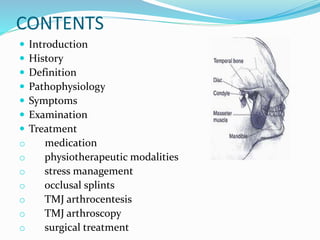
CONTENTS
 Introduction
 History
 Definition
 Pathophysiology
 Symptoms
 Examination
 Treatment
o medication
o physiotherapeutic modalities
o stress management
o occlusal splints
o TMJ arthrocentesis
o TMJ arthroscopy
o surgical treatment
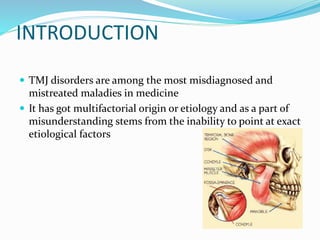
INTRODUCTION
 TMJ disorders are among the most misdiagnosed and
mistreated maladies in medicine
 It has got multifactorial origin or etiology and as a part of
misunderstanding stems from the inability to point at exact
etiological factors
HISTORY
Costen[1934]-occlusal etiology in TMJ pain
Schwartz[1956]-term TMJ pain dysfunction
syndrome
Laskin[1969]-provocative paper on MPDS
Mackenzie and Banks and Toller and
Poswillo[1975]-diagnosis & treatment of intrinsic
joint disorders
DEFINITION
 The MPDS is a pain disorder, in which unilateral pain is
referred from the trigger points in myofascial structures ,to
the muscles of head and neck. Pain is contrast to the
sudden sharp ,shooting ,intermittent pain of neuralgias.
But the pain may range from mild to intolerable
PATHOPHYSIOLOGY[ETIOLOGY ]
Extrinsic factors
-Trauma
-Occlusal
disharmony
-Habits
-Psychological
Intrinsic factors
-Internal
derangement of
TMJ
-Anterior locking of
disc
-Meniscal
displacement due to
trauma
DIAGNOSIS
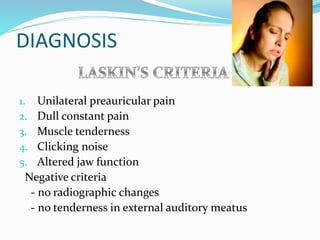
1. Unilateral preauricular pain
2. Dull constant pain
3. Muscle tenderness
4. Clicking noise
5. Altered jaw function
Negative criteria
- no radiographic changes
- no tenderness in external auditory meatus
SYMPTOMS
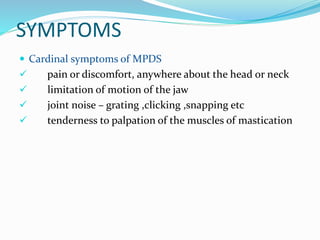
 Cardinal symptoms of MPDS
 pain or discomfort, anywhere about the head or neck
 limitation of motion of the jaw
 joint noise – grating ,clicking ,snapping etc
 tenderness to palpation of the muscles of mastication
Neurologic
Gastrointest
inal tract
Musculoskel
etal
otologic
oTingling
oNumbness
oTwitches
oTrembling
olacrimation
oNausea
oVomiting
oDiarrhea
oConstipation
oDry mouth
oFatigue
oTension
oWeakness
oTiredness
oShift joint
pain
oTinnitus
oEar pain
oVertigo
oDizziness
oDiminished
hearing
Associated symptoms of MPDS
EXAMINATION
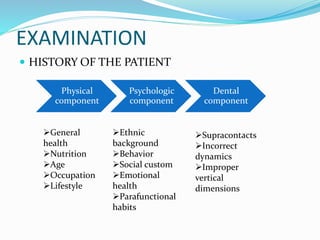
 HISTORY OF THE PATIENT
Physical
component
Psychologic
component
Dental
component
General
health
Nutrition
Age
Occupation
Lifestyle
Ethnic
background
Behavior
Social custom
Emotional
health
Parafunctional
habits
Supracontacts
Incorrect
dynamics
Improper
vertical
dimensions
PHYSICAL EXAMINATION
 Consists of an evaluation of entire masticatory system
along with head and neck region
AURICULAR
MUSCULAR
DENTAL
CERVICAL
ARTICULAR OR TMJ FUNCTION
 Amount of oral opening and excursion
 Palpitation for tenderness
 Grading of click or crepitus – noise evaluation
 Auscultation
 Extent of movement
ROM range of motion
AROM active range of motion
PROM passive range of motion
Normal vertical range of motion in adult – 40-50 mm
The AROM and PROM test should be carried out to delineate
the source of restrictions .whether articular or muscular
or both
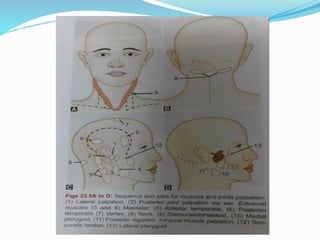
MUSCULAR EXAMINATION
 Systemic palpitation of the muscle and tendon is the
best way to ascertain both subclinical and clinical
existing levels of dysfunction
 Areas responsive to palpitation TRIGGER POINTS
 Muscle palpitation helps in
1.location of muscle pathology
2.evaluation of muscle tone
3.location of trigger points
4.location of swelling
5.identification of anatomical landmarks
DENTAL /OCCLUSAL EVALUATION
1.Gross occlusal discrepancies ,prematurities or interference
2.Anterior openbite, collapsed bite ,cross bite ,reduced
vertical dimension
3.Attrision ,wear facets ,mobility of teeth ,missing teeth
4.Type of malocclusion ,skeletal or dentofacial deformities
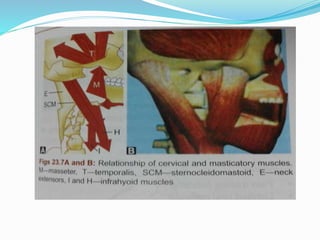
CERVICAL EXAMINATION
 TMJ is in close proximity to the upper part of the cervical
spine
 Functionally ,the cervical spine and the TMJ occlusion are
interrelated
 Any change in one of these can affect the function or the
position of the other
 Shoulder and neck muscles are palpated incline the
patient’s head forward for shoulder and neck examination.
Look for tender points
RADIOGRAPHIC EVALUATION
 Helpful in diagnosing intra- articular pathologies , soft
tissue pathologies ,osseous pathologies
1.Panoramic radiography
2.Tomograms
3.Transcranial radiography
4.TMJ arthrography
5.Computed radiography
6.CT scan and MRI
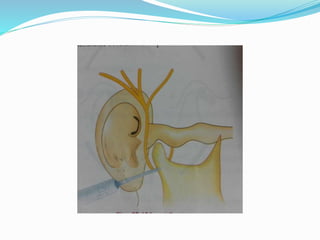
AURICULOTEMPORAL NERVE BLOCK
 Usually 27 or 26 gauge needle is inserted through the skin
just anterior to the junction of tragus and ear lobe
 The needle is then advanced behind the posterior aspect of
the condyle in an anteromedial direction to a depth of 1 cm
where 1.5 ml of anesthetic solution is deposited after
aspiration
 If the true source of pain is the joint ,then the pain should
be eliminated or decreased within 5 min
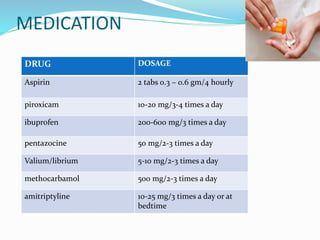
MEDICATION
DRUG DOSAGE
Aspirin 2 tabs 0.3 – 0.6 gm/4 hourly
piroxicam 10-20 mg/3-4 times a day
ibuprofen 200-600 mg/3 times a day
pentazocine 50 mg/2-3 times a day
Valium/librium 5-10 mg/2-3 times a day
methocarbamol 500 mg/2-3 times a day
amitriptyline 10-25 mg/3 times a day or at
bedtime
NSAIDS
• To reduce inflammation and to provide pain relief
• 14 -21 days
MUSCLE
RELAXANT
• Recommended only for short duration
• Diazepam[2-5mg] ,cyclobenzapine 10mg at bedtime
[10 days ]
ETHYL
CHLORIDE
SPRAY
• or intramuscular injection
• 2% lignocaine or 0.05 % bupivacaine can be used
PHYSIOTHERAPEUTIC MODALITIES
 Heat application
 Ultrasound
 Cryotherapy
 Massage with counter –irritants and vibrators
 Use of vapocoolent spray
 Tetanizing and sinusoidal currents
 Electrogalvanic stimulation
 Active stretch exercises
 Transcutaneous electronic nerve stimulator
STRESS MANAGEMENT
• Biofeedback technique teaches how to relax
• Acupuncture
• Acupressure
• Yoga
• Hypnosis deep breathing relaxation
• Biofeedback instrument provides audio as well as visual
output allowing patient to hear and see increased muscle
activity and then relax
OCCLUSAL SPLINTS
 They are used
 To temporarily disengage the teeth
 To improve /restore the vertical dimension
 To serve as safety or protective appliance
 To reduce spams, contracture and hyperactivity of
musculature
 To create a balanced joint –tooth stabilization of the
mandible
• Two types mainly used
stabilization splint
relaxation splint
 STABILIZATION SPLINT
 Reduces the load on the retrodiskal area and thereby
reduce the pain
 Used to eliminate occlusal interference with bruxism
 12-18 hours use is advocated up to 4-6 months
 Follow up is done until the occlusion is stabilized and
muscles are free of tenderness
• RELAXATION SPLINT
 Used for disengagement of teeth and only for short periods
[up to 4 weeks ]
 Fabricated over the maxillary teeth and a platform is added
to disengage mandibular anterior
TMJ ARTHROCENTESIS
 Simple treatment for limited mouth opening accompanied by
severe pain
 OBJECTIVE
 Improve the disk mobility
 Eliminate joint inflammation
 Eliminate pain
 Early physiotherapy
 Remove the resistance to condyle translation .return to
normal function
• INDICATION
 All patients who had proved refractory to conservative
treatment [medication ,bite appliances ,physiotherapy and
manipulation of joint ]
 ADVANTAGE
 Simple technique
 Minimum armamentarium
 Less invasive
 Therapeutic benefit
 Highly effective
• TECHNIQUE
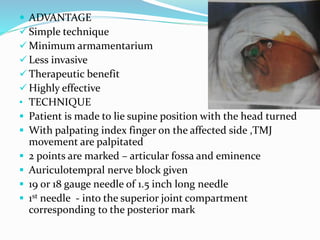
 Patient is made to lie supine position with the head turned
 With palpating index finger on the affected side ,TMJ
movement are palpitated
 2 points are marked – articular fossa and eminence
 Auriculotempral nerve block given
 19 or 18 gauge needle of 1.5 inch long needle
 1st needle - into the superior joint compartment
corresponding to the posterior mark
 2nd needle –into the articular eminence
 A 10 cc syringe is filled with Ringer lactate solution and
connected to the 1st needle
 Solution is pushed to distend the joint space
 Initially ,the solution which will flow out of 2nd needle
will be blood tinged or turbid ,but as more solution is
pushed through the 1st needle ,the flow of clear
solution will be noticed
 Atlast 1 ml of hydrocortisone is injected into the joint
space followed by removal of needle
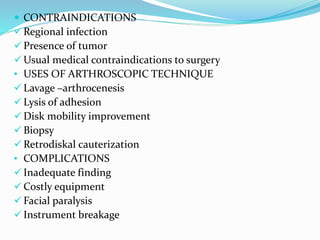
TMJ ARTHROSCOPY
 Consists of the insertion of a specially designed fiberoptic
endoscope into a joint compartment for diagnosis and
therapeutic purpose
 TECHNIQUE
 basic single puncture diagnostic technique
 double puncture technique for therapeutic as well as
surgical purpose
• INDICATION
 disk dysfunction
 Osteoarthrosis
 Synovial disease
 Hypermobility associated with severe pain
 CONTRAINDICATIONS
 Regional infection
 Presence of tumor
 Usual medical contraindications to surgery
• USES OF ARTHROSCOPIC TECHNIQUE
 Lavage –arthrocenesis
 Lysis of adhesion
 Disk mobility improvement
 Biopsy
 Retrodiskal cauterization
• COMPLICATIONS
 Inadequate finding
 Costly equipment
 Facial paralysis
 Instrument breakage
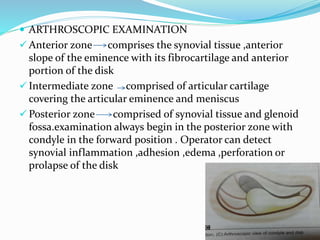
 ARTHROSCOPIC EXAMINATION
 Anterior zone comprises the synovial tissue ,anterior
slope of the eminence with its fibrocartilage and anterior
portion of the disk
 Intermediate zone comprised of articular cartilage
covering the articular eminence and meniscus
 Posterior zone comprised of synovial tissue and glenoid
fossa.examination always begin in the posterior zone with
condyle in the forward position . Operator can detect
synovial inflammation ,adhesion ,edema ,perforation or
prolapse of the disk
SURGICAL TREATMENT
1.Condylar shave and arthroplasty
2.Condylectomy
3.Eminectomy
4.Disk surgery
 Condylar shave and arthroplasty- consists of removing several
millimeters of articular surface. Recontouring should be done
 Condylectomy – excision of the condyle.this procedure has
mixes results and multiple complications ,particularly an open
bite,malocclusion and deviation of mandible on opening
 Eminectomy –performed to increase an access to the joint
space for reconstruction of the disc,as well as to diminish the
obstacles in the path of translocation
 Disk surgery –autogenous grafts like dermis ,temporalis fascia
,myofascial flaps etc have been used after removal of the
disk.alloplastic materials like silastic, proplast, teflon also been
used after diskectomy
REFERENCE
 Textbook of oral and maxillofacial surgery –Neelima Anil
Malik[3rd edition ]
 Textbook of oral and maxillofacial surgery –
Chitra Chakravarthy (2nd edition )
MYOFACIAL PAIN DYSFUNCTION SYNDROME.pptx

MYOFACIAL PAIN DYSFUNCTION SYNDROME.pptx

  • 1.
    DR DAVIS NADAKKAVUKARANM.D.S READER MALABAR DENTAL COLLEGE EDAPPAL
  • 2.
    CONTENTS  Introduction  History Definition  Pathophysiology  Symptoms  Examination  Treatment o medication o physiotherapeutic modalities o stress management o occlusal splints o TMJ arthrocentesis o TMJ arthroscopy o surgical treatment
  • 3.
    INTRODUCTION  TMJ disordersare among the most misdiagnosed and mistreated maladies in medicine  It has got multifactorial origin or etiology and as a part of misunderstanding stems from the inability to point at exact etiological factors
  • 4.
    HISTORY Costen[1934]-occlusal etiology inTMJ pain Schwartz[1956]-term TMJ pain dysfunction syndrome Laskin[1969]-provocative paper on MPDS Mackenzie and Banks and Toller and Poswillo[1975]-diagnosis & treatment of intrinsic joint disorders
  • 5.
    DEFINITION  The MPDSis a pain disorder, in which unilateral pain is referred from the trigger points in myofascial structures ,to the muscles of head and neck. Pain is contrast to the sudden sharp ,shooting ,intermittent pain of neuralgias. But the pain may range from mild to intolerable
  • 6.
    PATHOPHYSIOLOGY[ETIOLOGY ] Extrinsic factors -Trauma -Occlusal disharmony -Habits -Psychological Intrinsicfactors -Internal derangement of TMJ -Anterior locking of disc -Meniscal displacement due to trauma
  • 7.
    DIAGNOSIS 1. Unilateral preauricularpain 2. Dull constant pain 3. Muscle tenderness 4. Clicking noise 5. Altered jaw function Negative criteria - no radiographic changes - no tenderness in external auditory meatus
  • 8.
    SYMPTOMS  Cardinal symptomsof MPDS  pain or discomfort, anywhere about the head or neck  limitation of motion of the jaw  joint noise – grating ,clicking ,snapping etc  tenderness to palpation of the muscles of mastication
  • 9.
  • 10.
    EXAMINATION  HISTORY OFTHE PATIENT Physical component Psychologic component Dental component General health Nutrition Age Occupation Lifestyle Ethnic background Behavior Social custom Emotional health Parafunctional habits Supracontacts Incorrect dynamics Improper vertical dimensions
  • 11.
    PHYSICAL EXAMINATION  Consistsof an evaluation of entire masticatory system along with head and neck region AURICULAR MUSCULAR DENTAL CERVICAL
  • 12.
    ARTICULAR OR TMJFUNCTION  Amount of oral opening and excursion  Palpitation for tenderness  Grading of click or crepitus – noise evaluation  Auscultation  Extent of movement ROM range of motion AROM active range of motion PROM passive range of motion Normal vertical range of motion in adult – 40-50 mm The AROM and PROM test should be carried out to delineate the source of restrictions .whether articular or muscular or both
  • 13.
    MUSCULAR EXAMINATION  Systemicpalpitation of the muscle and tendon is the best way to ascertain both subclinical and clinical existing levels of dysfunction  Areas responsive to palpitation TRIGGER POINTS  Muscle palpitation helps in 1.location of muscle pathology 2.evaluation of muscle tone 3.location of trigger points 4.location of swelling 5.identification of anatomical landmarks
  • 15.
    DENTAL /OCCLUSAL EVALUATION 1.Grossocclusal discrepancies ,prematurities or interference 2.Anterior openbite, collapsed bite ,cross bite ,reduced vertical dimension 3.Attrision ,wear facets ,mobility of teeth ,missing teeth 4.Type of malocclusion ,skeletal or dentofacial deformities
  • 16.
    CERVICAL EXAMINATION  TMJis in close proximity to the upper part of the cervical spine  Functionally ,the cervical spine and the TMJ occlusion are interrelated  Any change in one of these can affect the function or the position of the other  Shoulder and neck muscles are palpated incline the patient’s head forward for shoulder and neck examination. Look for tender points
  • 18.
    RADIOGRAPHIC EVALUATION  Helpfulin diagnosing intra- articular pathologies , soft tissue pathologies ,osseous pathologies 1.Panoramic radiography 2.Tomograms 3.Transcranial radiography 4.TMJ arthrography 5.Computed radiography 6.CT scan and MRI
  • 20.
    AURICULOTEMPORAL NERVE BLOCK Usually 27 or 26 gauge needle is inserted through the skin just anterior to the junction of tragus and ear lobe  The needle is then advanced behind the posterior aspect of the condyle in an anteromedial direction to a depth of 1 cm where 1.5 ml of anesthetic solution is deposited after aspiration  If the true source of pain is the joint ,then the pain should be eliminated or decreased within 5 min
  • 22.
    MEDICATION DRUG DOSAGE Aspirin 2tabs 0.3 – 0.6 gm/4 hourly piroxicam 10-20 mg/3-4 times a day ibuprofen 200-600 mg/3 times a day pentazocine 50 mg/2-3 times a day Valium/librium 5-10 mg/2-3 times a day methocarbamol 500 mg/2-3 times a day amitriptyline 10-25 mg/3 times a day or at bedtime
  • 23.
    NSAIDS • To reduceinflammation and to provide pain relief • 14 -21 days MUSCLE RELAXANT • Recommended only for short duration • Diazepam[2-5mg] ,cyclobenzapine 10mg at bedtime [10 days ] ETHYL CHLORIDE SPRAY • or intramuscular injection • 2% lignocaine or 0.05 % bupivacaine can be used
  • 24.
    PHYSIOTHERAPEUTIC MODALITIES  Heatapplication  Ultrasound  Cryotherapy  Massage with counter –irritants and vibrators  Use of vapocoolent spray  Tetanizing and sinusoidal currents  Electrogalvanic stimulation  Active stretch exercises  Transcutaneous electronic nerve stimulator
  • 25.
    STRESS MANAGEMENT • Biofeedbacktechnique teaches how to relax • Acupuncture • Acupressure • Yoga • Hypnosis deep breathing relaxation • Biofeedback instrument provides audio as well as visual output allowing patient to hear and see increased muscle activity and then relax
  • 26.
    OCCLUSAL SPLINTS  Theyare used  To temporarily disengage the teeth  To improve /restore the vertical dimension  To serve as safety or protective appliance  To reduce spams, contracture and hyperactivity of musculature  To create a balanced joint –tooth stabilization of the mandible • Two types mainly used stabilization splint relaxation splint
  • 27.
     STABILIZATION SPLINT Reduces the load on the retrodiskal area and thereby reduce the pain  Used to eliminate occlusal interference with bruxism  12-18 hours use is advocated up to 4-6 months  Follow up is done until the occlusion is stabilized and muscles are free of tenderness • RELAXATION SPLINT  Used for disengagement of teeth and only for short periods [up to 4 weeks ]  Fabricated over the maxillary teeth and a platform is added to disengage mandibular anterior
  • 28.
    TMJ ARTHROCENTESIS  Simpletreatment for limited mouth opening accompanied by severe pain  OBJECTIVE  Improve the disk mobility  Eliminate joint inflammation  Eliminate pain  Early physiotherapy  Remove the resistance to condyle translation .return to normal function • INDICATION  All patients who had proved refractory to conservative treatment [medication ,bite appliances ,physiotherapy and manipulation of joint ]
  • 29.
     ADVANTAGE  Simpletechnique  Minimum armamentarium  Less invasive  Therapeutic benefit  Highly effective • TECHNIQUE  Patient is made to lie supine position with the head turned  With palpating index finger on the affected side ,TMJ movement are palpitated  2 points are marked – articular fossa and eminence  Auriculotempral nerve block given  19 or 18 gauge needle of 1.5 inch long needle  1st needle - into the superior joint compartment corresponding to the posterior mark
  • 30.
     2nd needle–into the articular eminence  A 10 cc syringe is filled with Ringer lactate solution and connected to the 1st needle  Solution is pushed to distend the joint space  Initially ,the solution which will flow out of 2nd needle will be blood tinged or turbid ,but as more solution is pushed through the 1st needle ,the flow of clear solution will be noticed  Atlast 1 ml of hydrocortisone is injected into the joint space followed by removal of needle
  • 31.
    TMJ ARTHROSCOPY  Consistsof the insertion of a specially designed fiberoptic endoscope into a joint compartment for diagnosis and therapeutic purpose  TECHNIQUE  basic single puncture diagnostic technique  double puncture technique for therapeutic as well as surgical purpose • INDICATION  disk dysfunction  Osteoarthrosis  Synovial disease  Hypermobility associated with severe pain
  • 32.
     CONTRAINDICATIONS  Regionalinfection  Presence of tumor  Usual medical contraindications to surgery • USES OF ARTHROSCOPIC TECHNIQUE  Lavage –arthrocenesis  Lysis of adhesion  Disk mobility improvement  Biopsy  Retrodiskal cauterization • COMPLICATIONS  Inadequate finding  Costly equipment  Facial paralysis  Instrument breakage
  • 33.
     ARTHROSCOPIC EXAMINATION Anterior zone comprises the synovial tissue ,anterior slope of the eminence with its fibrocartilage and anterior portion of the disk  Intermediate zone comprised of articular cartilage covering the articular eminence and meniscus  Posterior zone comprised of synovial tissue and glenoid fossa.examination always begin in the posterior zone with condyle in the forward position . Operator can detect synovial inflammation ,adhesion ,edema ,perforation or prolapse of the disk
  • 34.
    SURGICAL TREATMENT 1.Condylar shaveand arthroplasty 2.Condylectomy 3.Eminectomy 4.Disk surgery
  • 35.
     Condylar shaveand arthroplasty- consists of removing several millimeters of articular surface. Recontouring should be done  Condylectomy – excision of the condyle.this procedure has mixes results and multiple complications ,particularly an open bite,malocclusion and deviation of mandible on opening  Eminectomy –performed to increase an access to the joint space for reconstruction of the disc,as well as to diminish the obstacles in the path of translocation  Disk surgery –autogenous grafts like dermis ,temporalis fascia ,myofascial flaps etc have been used after removal of the disk.alloplastic materials like silastic, proplast, teflon also been used after diskectomy
  • 36.
    REFERENCE  Textbook oforal and maxillofacial surgery –Neelima Anil Malik[3rd edition ]  Textbook of oral and maxillofacial surgery – Chitra Chakravarthy (2nd edition )