* Introduction
* Anatomy
* Radiographic examination
* Myo functional pain dysfunction syndrome
* TMJ disorder
* Dx of TMJ disorder
* Rx of TMJ disorders
Definition :
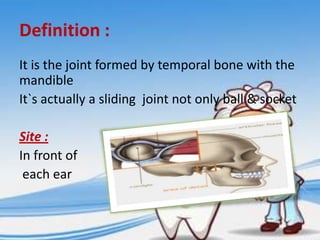
It is the joint formed by temporal bone with the
mandible
It`s actually a sliding joint not only ball & socket

Site :
In front of
each ear
Structure of TMJ
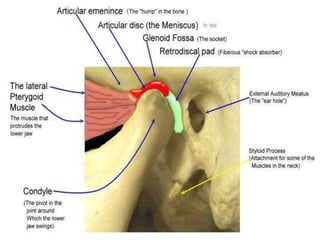
1- articulating surfaces
A (bony elements)
condyle

Glinoid fossa
Interatricular disc
Cartilaginous disc placed between the 2 bony
elements
The disc is attached to a muscle (lateral
pterygoid) & moves with certain movement of
TMJ
Joint capsule
It surrounds TMJ
It is attached to glinoid
fossa margin & the neck of
condyle
*It maintain proximity of
joint parts during
function
*It limits forward
translation of the condyle
Synovial membrane
It is the internal
lining of external
capsule
It contains synovial
fluid for lubricating
the joint
Diagnosis of TMJ disorder
Comprehensive history
(onset,duration,course,pasthistory,surgical procedures,family history)

Physical examination
(palpation ,stethoscope,dentition)

Radiographic diagnosis
Lab investigations
Radiographic examination
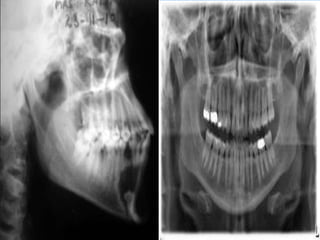
To evaluate condition of teeth , bone
, surrounding hard & soft tissue
Plain x-ray (a
To see changes in bony structure only
Ex : panoramic , oblique lateral
Tomography
It is of a great value in dx of TMJD…
It has the property of elimination of
superimposition in plain x rays
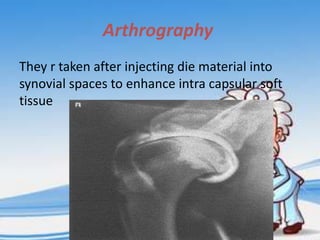
Arthrography
They r taken after injecting die material into
synovial spaces to enhance intra capsular soft
tissue
C.T scan
It`s x-ray images in serial manner with different
levels showing hard & soft structures
v. Helpful in Dx of TMJD inspite of high dose of
exposure
MRI
It`s efficient in detecting changes in soft tissues
Limited accuracy in detecting bony elements
Helpful in DX of (internal derangement)
Arthroscopy
It allows detection of internal abnormality by
direct vision through arthroscope
Lab investigations
CBC
Serum calcium
Serum phosphorus & alkaline phosphatase
Serum uric acid
ESR
Serum RF
functional
Myofunctional pain dysfunction syndrome
Organic
Acquired (arthritis-dislocation-ankylosisinternal derangement)

Congenital (condylar hypo/hyperplasia)
It`s a painful condition of skeletal muscles
specially the muscles of mastication
Characterized by development of trigger points
or sensitive painful area in muscle or junction
bet muscle & facia
Signs & symptoms
1- Pain
-it`s the most complain
-mostly unilateral
-dull - sharp & acute
Location
Back of head & neck
Temporal area
Angle of jaw
The area in front of ear
2-tenderness of muscles of mastication
Temporal muscle
is the common muscle
to produce temporal pain

Masseter : trigger points
Refer pain to : (sinus area,
Ear , above eye & even into molar region )
Trapezius muscle :
Pain almost referred to head & face
Medial pterygoid muscle :
Trigger points refer to ( TMJ ,
nose ,ear , lower jaw & lateral
side of neck )
Sternomastoid muscle:
Develops trigger points with
or
w/out TMJ problems
Cause forehead headache
(misdiagnosed with frontal sinusitis )
Also may cause pain in (ear, over &around aye
,chin & below the eye (mis diagnosed with max
sinusitis ) )
3-clicking in TMJ during movement
- It is the most common symptom (it may be so
loud )
- There may be pain in joint during chewing
4- limitation of mandibular
movement
5-absence of clinical or radiographic evidence
of
Organic changes in TMJ
6- No tenderness of TMJ during examination
Etiology of MPD
occlusal disharmony

psychological stress
Diagnosis of MPD
1- History.
2-Determine the range of mouth opening.
3- Radiographic examination showing
no organic changes.
4-Determine the direction & amount of mandibular deviation during
opening.
5-Examination of TMJ by palpation & auscultation & palpation of
muscles of mastication
Treatment of MPD

Control pain
& discomfort

Correction of
occlusal
disharmony

Removal of
psychological
stress &
tension
Immobilization of jaw
It produce complete rest for 2-3 weeks
Use of Boxer`s mouth guard (to separate
occlusal surfaces )
Correction of occlusal disharmony
1- occlusal adjustment : by selective grinding to
remove cusp interference between teeth
To maintain occlusal stability & equilibrium of
muscle during rest position
2- Anterior deprogrammer :
* Suppresses clenching intensity
** Prevent occlusal wear & trauma
3-splints & occlusal bite planes :
Acrylic splints made with
simultaneous contact of
mandibular teeth in
centric occlusion
to eliminate muscular spasm
Thermo therapy
By heat application to activate blood circulation
of spastic muscles
Muscle exercise
It stimulate weak muscles & wash metabolites
so decrease spasm

Intra muscular injection of L.A :
Help in diagnosis of the syndrome & in cuts
cycle of pain
Psychological therapy
Emotional stress stimulate vascular dynamics
(contraction & dilatation ) so increasing
muscular tone leading to spasm

Administration of muscle relaxant
Acquired organic disorders of TMJ
1- Inflammatory.
2- Degenerative.
3- Infectious.

4- Traumatic.
Rheumatoid arthritis
It`s a systemic inflammatory
disease that produce destructive
changes to the joints (may affect
more than one joint )

c/p:
Pain , joint noise ,limitation of
movement , malocclusion )
Juvenile RA : impairment of jaw
growth & may lead to ankylosis
Diagnosis of R.A
Clinically : multiple joint involvement
Lab investigations : RH factor
Radiographic examination : (lack of joint space d.t condylar
destruction )
- Condyle is eroded ,flattened & rarefied
- Glinoid fossa is shallow
Treatment
*application of moist heat
*anti inflammatory drugs
*immunosuppressive drugs
*Gold salts
*steroids (oral – joint injection)
Degenerative arthritis (osteoarthritis)
Non inflammatory focal degenerative disorder that affect
primarily articular cartilage and sub condylar bone (initiated
by deterioration of articular soft tissue cover & exposure of
bone )
Cause : long term functional abuse
C/P :
*Crepitation sound from joints
*Restricted or normal mouth opening
*With or w/out pain
*Occasionally may joints show inflammatory signs
*Women > Men
*Tenderness of muscles of mastication
*Limitation of mandibular movement & deviation
to the affected side
*Tenderness over condyle
Diagnosis
Based on clinical & radiographic examination
(irregularity of condylar surface & radiolucency
in substance of condyle )
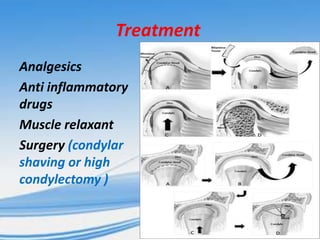
Treatment
Analgesics
Anti inflammatory
drugs
Muscle relaxant
Surgery (condylar
shaving or high
condylectomy )
Infectious arthritis
It is the consequence of direct extension from
middle ear , parotid gland & posterior areas of
mandible
it is also happened after trauma followed by
infection from septseamia
Leads to inflammation of synovial tissues
Leads to destruction of fibro cartilage & bone
leading to ankylosis
Treatment
Administration of
antibiotics
Drainage of source of
infection
Rest
analgesics
Occurs d.t trauma to the joint
There is muscular tear ,
ligamentous injury
Hemarthrosis may be present
Mechanical damage to
surrounding structure may be
present
Diagnosis
History of severe trauma with pain , swelling , &
dysfunction
Only the affected joint showing inflammation
Presence of normal joint function before trauma
Treatment : Rest ,
Administration of analgesics , anti inflammatory
drugs
Congenital condylar disorders
Condylar hypoplasia

Condylar hyperplasia

Others
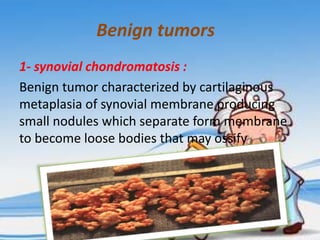
Benign tumors
1- synovial chondromatosis :
Benign tumor characterized by cartilaginous
metaplasia of synovial membrane producing
small nodules which separate form membrane
to become loose bodies that may ossify
2- osteochondroma
Benign tumor characterized by normal bone &
cartilage near growth zones
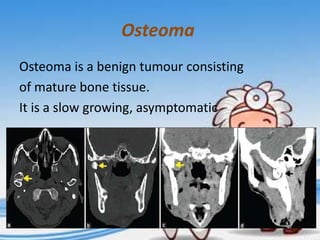
Osteoma
Osteoma is a benign tumour consisting
of mature bone tissue.
It is a slow growing, asymptomatic
Anterior (to
eminence)

Lateral (in
temporal
fossa)

Dislocation
of TMJ

Posterior (in
fracture of
base of skull
)

Superior
(into medial
cranial
fossa)
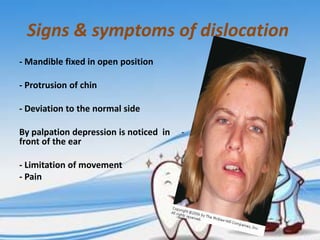
Signs & symptoms of dislocation
- Mandible fixed in open position

- Protrusion of chin
- Deviation to the normal side
By palpation depression is noticed in
front of the ear
- Limitation of movement
- Pain

-
Treatment of dislocation
Acute dislocation :
Manual reduction under sedation or even under
G.A with muscle relaxant
Then immobilization for several days ..
Chronic dislocation
- Manual reduction with L.A or G.A & muscle
relaxant
- Surgical exposure of joint & direct reduction
- Condylectomy
- Condylotomy
3- Recurrent dislocation
Conservative RX : immobilization for several days
Injection of sclerozing material around capsule to
produce fibrosis
Surgical RX : re-situation of capsule & ligament
Ligation of condyle
Removal of eminence
Removal of activating muscle
TMJ ankylosis
It is fibrous or bony
union between joint
components
It is unilateral or bilateral
Partial or complete
True or false (When the
structures outside the joint
are affected)
False ankylosis
Muscular trismus
Muscular atrophy or fibrosis
Myositis ossificans
Tetanus

Neurogenic closure of mouth
Etiology
Birth trauma
Heamarthrosis
Suppurative arthritis
Rheumatoid arthritis
Osteomyelitis
Fracture condyle
Clinical findings
- Inability to open
mouth
- Gradual
development of jaw
immobilization
- Slight opening mouth
in unilateral affection
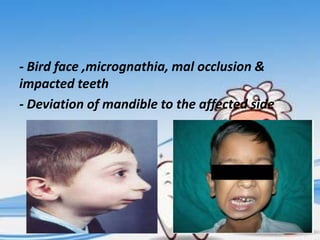
- Bird face ,micrognathia, mal occlusion &
impacted teeth
- Deviation of mandible to the affected side
Treatment
* If fibrous ankylosis :
Open the mandible
manually under G.A
* Condylectomy
* Osteoarthrotomy
* Repalcement
of condyle
Abnormal relationship between articular disc to
condyle & eminence
Symptoms
Pain during function
Joint clicking or noise
Earache or headache
Facial pain
Ant. Displacement of the
disc (with
reduction)(clicking)

Ant. dislocation of the disc
(w/out reduction) (locked
joint).
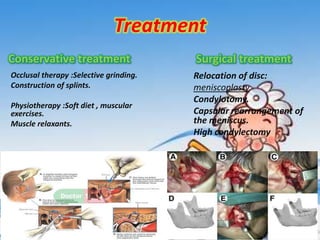
Treatment
Conservative treatment

Surgical treatment

Occlusal therapy :Selective grinding.
Construction of splints.

Relocation of disc:
meniscoplasty
Condylotomy.
Capsular rearrangement of
the meniscus.
High condylectomy

Physiotherapy :Soft diet , muscular
exercises.
Muscle relaxants.

TMJ

  • 2.
    * Introduction * Anatomy *Radiographic examination * Myo functional pain dysfunction syndrome * TMJ disorder * Dx of TMJ disorder * Rx of TMJ disorders
  • 3.
    Definition : It isthe joint formed by temporal bone with the mandible It`s actually a sliding joint not only ball & socket Site : In front of each ear
  • 4.
    Structure of TMJ 1-articulating surfaces A (bony elements) condyle Glinoid fossa
  • 5.
    Interatricular disc Cartilaginous discplaced between the 2 bony elements The disc is attached to a muscle (lateral pterygoid) & moves with certain movement of TMJ
  • 7.
    Joint capsule It surroundsTMJ It is attached to glinoid fossa margin & the neck of condyle *It maintain proximity of joint parts during function *It limits forward translation of the condyle
  • 8.
    Synovial membrane It isthe internal lining of external capsule It contains synovial fluid for lubricating the joint
  • 11.
    Diagnosis of TMJdisorder Comprehensive history (onset,duration,course,pasthistory,surgical procedures,family history) Physical examination (palpation ,stethoscope,dentition) Radiographic diagnosis Lab investigations
  • 12.
    Radiographic examination To evaluatecondition of teeth , bone , surrounding hard & soft tissue Plain x-ray (a To see changes in bony structure only Ex : panoramic , oblique lateral
  • 14.
    Tomography It is ofa great value in dx of TMJD… It has the property of elimination of superimposition in plain x rays
  • 15.
    Arthrography They r takenafter injecting die material into synovial spaces to enhance intra capsular soft tissue
  • 16.
    C.T scan It`s x-rayimages in serial manner with different levels showing hard & soft structures v. Helpful in Dx of TMJD inspite of high dose of exposure
  • 17.
    MRI It`s efficient indetecting changes in soft tissues Limited accuracy in detecting bony elements Helpful in DX of (internal derangement)
  • 18.
    Arthroscopy It allows detectionof internal abnormality by direct vision through arthroscope
  • 19.
    Lab investigations CBC Serum calcium Serumphosphorus & alkaline phosphatase Serum uric acid ESR Serum RF
  • 20.
    functional Myofunctional pain dysfunctionsyndrome Organic Acquired (arthritis-dislocation-ankylosisinternal derangement) Congenital (condylar hypo/hyperplasia)
  • 21.
    It`s a painfulcondition of skeletal muscles specially the muscles of mastication Characterized by development of trigger points or sensitive painful area in muscle or junction bet muscle & facia
  • 23.
    Signs & symptoms 1-Pain -it`s the most complain -mostly unilateral -dull - sharp & acute Location Back of head & neck Temporal area Angle of jaw The area in front of ear
  • 24.
    2-tenderness of musclesof mastication Temporal muscle is the common muscle to produce temporal pain Masseter : trigger points Refer pain to : (sinus area, Ear , above eye & even into molar region )
  • 25.
    Trapezius muscle : Painalmost referred to head & face Medial pterygoid muscle : Trigger points refer to ( TMJ , nose ,ear , lower jaw & lateral side of neck )
  • 26.
    Sternomastoid muscle: Develops triggerpoints with or w/out TMJ problems Cause forehead headache (misdiagnosed with frontal sinusitis ) Also may cause pain in (ear, over &around aye ,chin & below the eye (mis diagnosed with max sinusitis ) )
  • 27.
    3-clicking in TMJduring movement - It is the most common symptom (it may be so loud ) - There may be pain in joint during chewing
  • 28.
    4- limitation ofmandibular movement 5-absence of clinical or radiographic evidence of Organic changes in TMJ 6- No tenderness of TMJ during examination
  • 29.
    Etiology of MPD occlusaldisharmony psychological stress
  • 30.
    Diagnosis of MPD 1-History. 2-Determine the range of mouth opening. 3- Radiographic examination showing no organic changes. 4-Determine the direction & amount of mandibular deviation during opening. 5-Examination of TMJ by palpation & auscultation & palpation of muscles of mastication
  • 31.
    Treatment of MPD Controlpain & discomfort Correction of occlusal disharmony Removal of psychological stress & tension
  • 32.
    Immobilization of jaw Itproduce complete rest for 2-3 weeks Use of Boxer`s mouth guard (to separate occlusal surfaces )
  • 33.
    Correction of occlusaldisharmony 1- occlusal adjustment : by selective grinding to remove cusp interference between teeth To maintain occlusal stability & equilibrium of muscle during rest position
  • 34.
    2- Anterior deprogrammer: * Suppresses clenching intensity ** Prevent occlusal wear & trauma 3-splints & occlusal bite planes : Acrylic splints made with simultaneous contact of mandibular teeth in centric occlusion to eliminate muscular spasm
  • 35.
    Thermo therapy By heatapplication to activate blood circulation of spastic muscles
  • 36.
    Muscle exercise It stimulateweak muscles & wash metabolites so decrease spasm Intra muscular injection of L.A : Help in diagnosis of the syndrome & in cuts cycle of pain
  • 37.
    Psychological therapy Emotional stressstimulate vascular dynamics (contraction & dilatation ) so increasing muscular tone leading to spasm Administration of muscle relaxant
  • 38.
    Acquired organic disordersof TMJ 1- Inflammatory. 2- Degenerative. 3- Infectious. 4- Traumatic.
  • 39.
    Rheumatoid arthritis It`s asystemic inflammatory disease that produce destructive changes to the joints (may affect more than one joint ) c/p: Pain , joint noise ,limitation of movement , malocclusion ) Juvenile RA : impairment of jaw growth & may lead to ankylosis
  • 40.
    Diagnosis of R.A Clinically: multiple joint involvement Lab investigations : RH factor Radiographic examination : (lack of joint space d.t condylar destruction ) - Condyle is eroded ,flattened & rarefied - Glinoid fossa is shallow
  • 41.
    Treatment *application of moistheat *anti inflammatory drugs *immunosuppressive drugs *Gold salts *steroids (oral – joint injection)
  • 42.
    Degenerative arthritis (osteoarthritis) Noninflammatory focal degenerative disorder that affect primarily articular cartilage and sub condylar bone (initiated by deterioration of articular soft tissue cover & exposure of bone ) Cause : long term functional abuse
  • 43.
    C/P : *Crepitation soundfrom joints *Restricted or normal mouth opening *With or w/out pain *Occasionally may joints show inflammatory signs *Women > Men *Tenderness of muscles of mastication *Limitation of mandibular movement & deviation to the affected side *Tenderness over condyle
  • 44.
    Diagnosis Based on clinical& radiographic examination (irregularity of condylar surface & radiolucency in substance of condyle )
  • 45.
  • 46.
    Infectious arthritis It isthe consequence of direct extension from middle ear , parotid gland & posterior areas of mandible it is also happened after trauma followed by infection from septseamia Leads to inflammation of synovial tissues Leads to destruction of fibro cartilage & bone leading to ankylosis
  • 48.
    Treatment Administration of antibiotics Drainage ofsource of infection Rest analgesics
  • 49.
    Occurs d.t traumato the joint There is muscular tear , ligamentous injury Hemarthrosis may be present Mechanical damage to surrounding structure may be present
  • 50.
    Diagnosis History of severetrauma with pain , swelling , & dysfunction Only the affected joint showing inflammation Presence of normal joint function before trauma Treatment : Rest , Administration of analgesics , anti inflammatory drugs
  • 51.
    Congenital condylar disorders Condylarhypoplasia Condylar hyperplasia Others
  • 52.
    Benign tumors 1- synovialchondromatosis : Benign tumor characterized by cartilaginous metaplasia of synovial membrane producing small nodules which separate form membrane to become loose bodies that may ossify
  • 54.
    2- osteochondroma Benign tumorcharacterized by normal bone & cartilage near growth zones
  • 55.
    Osteoma Osteoma is abenign tumour consisting of mature bone tissue. It is a slow growing, asymptomatic
  • 56.
    Anterior (to eminence) Lateral (in temporal fossa) Dislocation ofTMJ Posterior (in fracture of base of skull ) Superior (into medial cranial fossa)
  • 59.
    Signs & symptomsof dislocation - Mandible fixed in open position - Protrusion of chin - Deviation to the normal side By palpation depression is noticed in front of the ear - Limitation of movement - Pain -
  • 60.
    Treatment of dislocation Acutedislocation : Manual reduction under sedation or even under G.A with muscle relaxant Then immobilization for several days ..
  • 61.
    Chronic dislocation - Manualreduction with L.A or G.A & muscle relaxant - Surgical exposure of joint & direct reduction - Condylectomy - Condylotomy
  • 62.
    3- Recurrent dislocation ConservativeRX : immobilization for several days Injection of sclerozing material around capsule to produce fibrosis Surgical RX : re-situation of capsule & ligament Ligation of condyle Removal of eminence Removal of activating muscle
  • 63.
    TMJ ankylosis It isfibrous or bony union between joint components It is unilateral or bilateral Partial or complete True or false (When the structures outside the joint are affected)
  • 64.
    False ankylosis Muscular trismus Muscularatrophy or fibrosis Myositis ossificans Tetanus Neurogenic closure of mouth
  • 65.
  • 66.
    Clinical findings - Inabilityto open mouth - Gradual development of jaw immobilization - Slight opening mouth in unilateral affection
  • 67.
    - Bird face,micrognathia, mal occlusion & impacted teeth - Deviation of mandible to the affected side
  • 68.
    Treatment * If fibrousankylosis : Open the mandible manually under G.A
  • 69.
    * Condylectomy * Osteoarthrotomy *Repalcement of condyle
  • 70.
    Abnormal relationship betweenarticular disc to condyle & eminence
  • 71.
    Symptoms Pain during function Jointclicking or noise Earache or headache Facial pain
  • 72.
    Ant. Displacement ofthe disc (with reduction)(clicking) Ant. dislocation of the disc (w/out reduction) (locked joint).
  • 73.
    Treatment Conservative treatment Surgical treatment Occlusaltherapy :Selective grinding. Construction of splints. Relocation of disc: meniscoplasty Condylotomy. Capsular rearrangement of the meniscus. High condylectomy Physiotherapy :Soft diet , muscular exercises. Muscle relaxants.