DR DAVIS NADAKKAVUKARAN
READER
MALABAR DENTAL COLLEGE
1. Introduction
2. Anatomy of mandible
3. Etiology
4. Location
5. Classification of mandibular fracture
6. Diagnosis
7. Management
 Most prominent jaw bone in the lower third of the
face
 Fracture occur more frequently when compared to
other bones
 For the management , proper anatomy and
attachment of muscle of this jaw
 Largest , strongest bone in face
 Horse shoe or parabola shape
 Angle of curvature is 110 -140
 Inferior border of the mandible is made of dense cortical
bone only no medullary
 Cortical bone is thickest at lower border
 Gradually thins down as it goes posterioly .
 Composed of symphysis region which is the region where
the two sides of developing mandible fuse during formation
 Horizontal aspect –body
 Vertical aspect –rami
 At end two process – coronoid and condylar aspect
1. Muscles of mastication
2. Muscles on lingual side of mandible
 Geniohyoid
 Genioglossus
 Mylohyoid
 Anterior belly of digastric
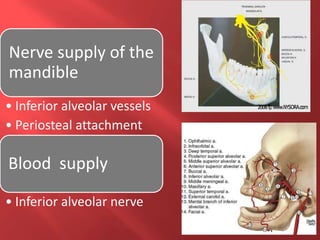
Nerve supply of the
mandible
• Inferior alveolar vessels
• Periosteal attachment
Blood supply
• Inferior alveolar nerve
 External violence
1. Vehicle accidents
2. Industrial accidents
3. Assaults
4. Gunshots
 Sports trauma
1. Contact sports such as boxing
2. Fall froma height
3. Sports
 Due to pathologies in the mandible
 Due to surgical procedures in the mandible
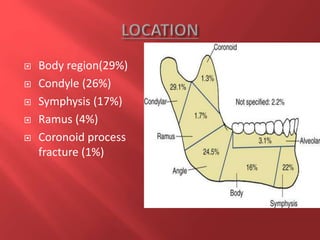
 Body region(29%)
 Condyle (26%)
 Symphysis (17%)
 Ramus (4%)
 Coronoid process
fracture (1%)
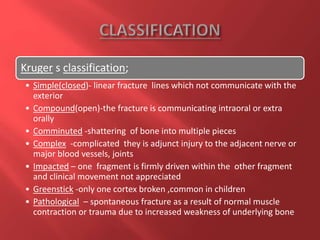
Kruger s classification;
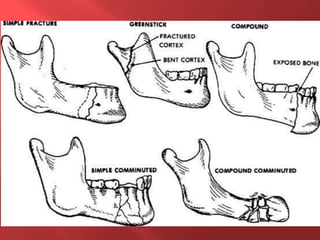
• Simple(closed)- linear fracture lines which not communicate with the
exterior
• Compound(open)-the fracture is communicating intraoral or extra
orally
• Comminuted -shattering of bone into multiple pieces
• Complex -complicated they is adjunct injury to the adjacent nerve or
major blood vessels, joints
• Impacted – one fragment is firmly driven within the other fragment
and clinical movement not appreciated
• Greenstick -only one cortex broken ,common in children
• Pathological – spontaneous fracture as a result of normal muscle
contraction or trauma due to increased weakness of underlying bone
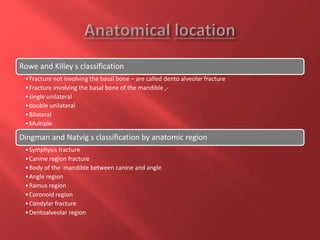
Rowe and Killey s classification
•Fracture not involving the basal bone – are called dento alveolar fracture
•Fracture involving the basal bone of the mandible ,-
•single unilateral
•double unilateral
•Bilateral
•Multiple
Dingman and Natvig s classification by anatomic region
•Symphysis fracture
•Canine region fracture
•Body of the mandible between canine and angle
•Angle region
•Ramus region
•Coronoid region
•Condylar fracture
•Dentoalveolar region
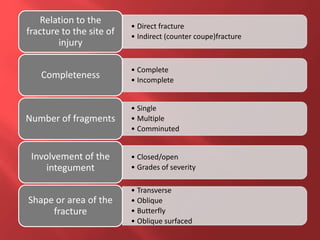
• Direct fracture
• Indirect (counter coupe)fracture
Relation to the
fracture to the site of
injury
• Complete
• Incomplete
Completeness
• Single
• Multiple
• Comminuted
Number of fragments
• Closed/open
• Grades of severity
Involvement of the
integument
• Transverse
• Oblique
• Butterfly
• Oblique surfaced
Shape or area of the
fracture
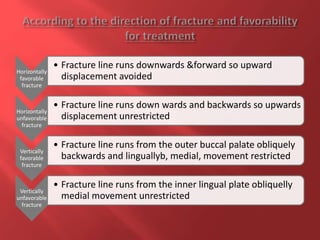
Horizontally
favorable
fracture
• Fracture line runs downwards &forward so upward
displacement avoided
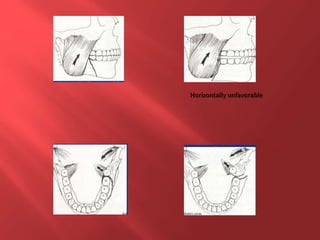
Horizontally
unfavorable
fracture
• Fracture line runs down wards and backwards so upwards
displacement unrestricted
Vertically
favorable
fracture
• Fracture line runs from the outer buccal palate obliquely
backwards and linguallyb, medial, movement restricted
Vertically
unfavorable
fracture
• Fracture line runs from the inner lingual plate obliquelly
medial movement unrestricted
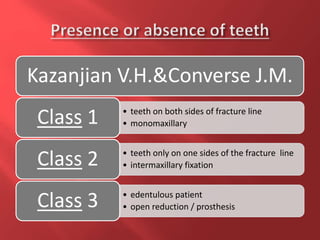
Kazanjian V.H.&Converse J.M.
• teeth on both sides of fracture line
• monomaxillary
Class 1
• teeth only on one sides of the fracture line
• intermaxillary fixation
Class 2
• edentulous patient
• open reduction / prosthesis
Class 3
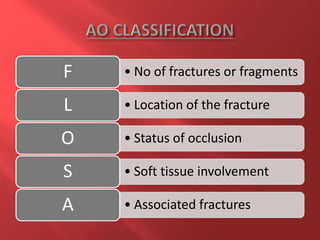
• No of fractures or fragments
F
• Location of the fracture
L
• Status of occlusion
O
• Soft tissue involvement
S
• Associated fractures
A
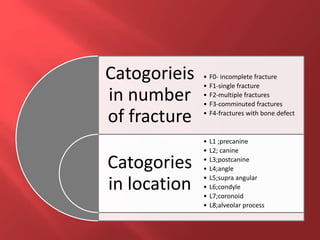
Catogorieis
in number
of fracture
Catogories
in location
• F0- incomplete fracture
• F1-single fracture
• F2-multiple fractures
• F3-comminuted fractures
• F4-fractures with bone defect
• L1 ;precanine
• L2; canine
• L3;postcanine
• L4;angle
• L5;supra angular
• L6;condyle
• L7;coronoid
• L8;alveolar process
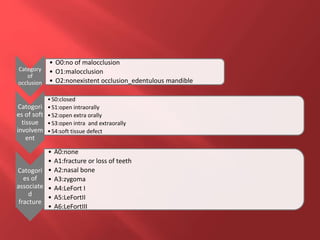
Category
of
occlusion
• O0:no of malocclusion
• O1:malocclusion
• O2:nonexistent occlusion_edentulous mandible
Catogori
es of soft
tissue
involvem
ent
•S0:closed
•S1:open intraorally
•S2:open extra orally
•S3:open intra and extraorally
•S4:soft tissue defect
Catogori
es of
associate
d
fracture
• A0:none
• A1:fracture or loss of teeth
• A2:nasal bone
• A3:zygoma
• A4:LeFort I
• A5:LeFortII
• A6:LeFortIII
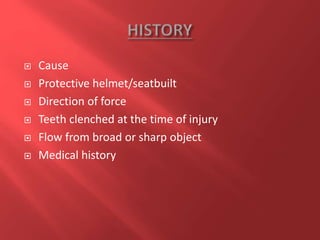
 Cause
 Protective helmet/seatbuilt
 Direction of force
 Teeth clenched at the time of injury
 Flow from broad or sharp object
 Medical history
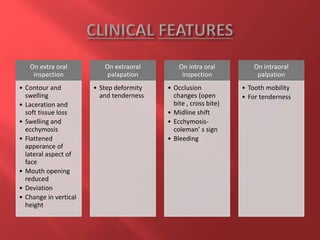
On extra oral
inspection
• Contour and
swelling
• Laceration and
soft tissue loss
• Swelling and
ecchymosis
• Flattened
apperance of
lateral aspect of
face
• Mouth opening
reduced
• Deviation
• Change in vertical
height
On extraoral
palapation
• Step deformity
and tenderness
On intra oral
inspection
• Occlusion
changes (open
bite , cross bite)
• Midline shift
• Ecchymosis-
coleman’ s sign
• Bleeding
On intraoral
palpation
• Tooth mobility
• For tenderness
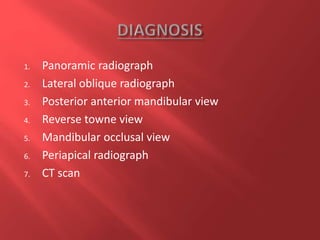
1. Panoramic radiograph
2. Lateral oblique radiograph
3. Posterior anterior mandibular view
4. Reverse towne view
5. Mandibular occlusal view
6. Periapical radiograph
7. CT scan
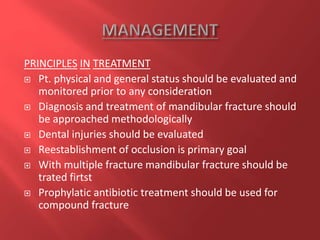
PRINCIPLES IN TREATMENT
 Pt. physical and general status should be evaluated and
monitored prior to any consideration
 Diagnosis and treatment of mandibular fracture should
be approached methodologically
 Dental injuries should be evaluated
 Reestablishment of occlusion is primary goal
 With multiple fracture mandibular fracture should be
trated firtst
 Prophylatic antibiotic treatment should be used for
compound fracture
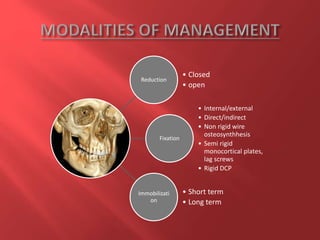
Reduction
• Closed
• open
Fixation
• Internal/external
• Direct/indirect
• Non rigid wire
osteosynthhesis
• Semi rigid
monocortical plates,
lag screws
• Rigid DCP
Immobilizati
on
• Short term
• Long term
 Intermaxillary fixation with osteosynthesis
1. Transosseous wiring
2. Circumferential wiring
3. External in fixation
4. Bone clamps
5. Transfixation with kirschner wires
 Intermaxillary fixation
1. Dental arch wires
2. Arch bars
Methods of immobilization
 Osteosynthesis without intermaxillary fixation
1. Non compression small plates
2. Compression plates
3. Mini plates
4. Lag screws
•Simple , low cost, and non invasive treatment procedure
•Presence of teeth provide an accuarate guide for reduction
Closed reduction
•Non displaced favourable fracture
•Grossly comminuted fracture
•Sevrrely atrophic edentulous mandible
•Lack of soft tissue over mandible
•Fracture in childeren with developing teeth bud
•Coronoid process fracture
Indication
•History of siezure
•Comprmised pulmonary function
•Psychatric conditions
•GI disorder
Contraindication
1. Arch bar fixation
2. Bridle wiring
3. Figure of eight wiring
4. Gilmer’s direct interdental wiring
5. Eyelet wiring
6. Essig’s wiring
7. Stout’s continuous loop wiring
8. Risdon s wiring
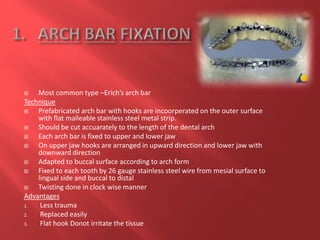
 Most common type –Erich’s arch bar
Technique
 Prefabricated arch bar with hooks are incoorperated on the outer surface
with flat malleable stainless steel metal strip.
 Should be cut accuarately to the length of the dental arch
 Each arch bar is fixed to upper and lower jaw
 On upper jaw hooks are arranged in upward direction and lower jaw with
downward direction
 Adapted to buccal surface according to arch form
 Fixed to each tooth by 26 gauge stainless steel wire from mesial surface to
lingual side and buccal to distal
 Twisting done in clock wise manner
Advantages
1. Less trauma
2. Replaced easily
3. Flat hook Donot irritate the tissue
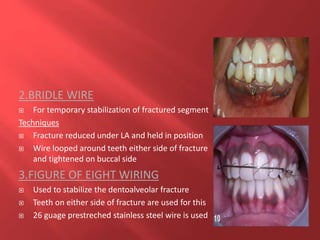
2.BRIDLE WIRE
 For temporary stabilization of fractured segment
Techniques
 Fracture reduced under LA and held in position
 Wire looped around teeth either side of fracture
and tightened on buccal side
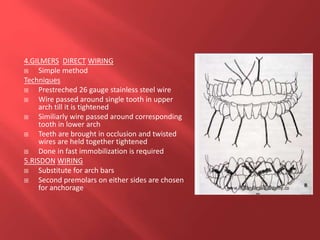
3.FIGURE OF EIGHT WIRING
 Used to stabilize the dentoalveolar fracture
 Teeth on either side of fracture are used for this
 26 guage prestreched stainless steel wire is used
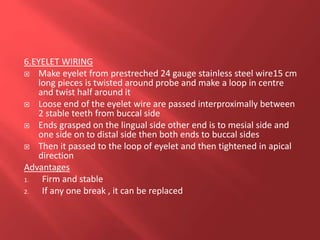
4.GILMERS DIRECT WIRING
 Simple method
Techniques
 Prestreched 26 gauge stainless steel wire
 Wire passed around single tooth in upper
arch till it is tightened
 Similiarly wire passed around corresponding
tooth in lower arch
 Teeth are brought in occlusion and twisted
wires are held together tightened
 Done in fast immobilization is required
5.RISDON WIRING
 Substitute for arch bars
 Second premolars on either sides are chosen
for anchorage
6.EYELET WIRING
 Make eyelet from prestreched 24 gauge stainless steel wire15 cm
long pieces is twisted around probe and make a loop in centre
and twist half around it
 Loose end of the eyelet wire are passed interproximally between
2 stable teeth from buccal side
 Ends grasped on the lingual side other end is to mesial side and
one side on to distal side then both ends to buccal sides
 Then it passed to the loop of eyelet and then tightened in apical
direction
Advantages
1. Firm and stable
2. If any one break , it can be replaced
7.ESSIG S WIRING
 When many teeth adjacent to the fracture line are
not much strong to stabilize the fracture
 Luxated teeth should be pushed back into their
sockets and stabilization area choosen should be at
leat 3 teeth away from fracture line
8.STOUT S CONTINOUES LOOP WIRING
 Posterior quadrent are used for wiring
 A piece of solder wire is dapted to the buccal side in
first quardrent from where wiring is started
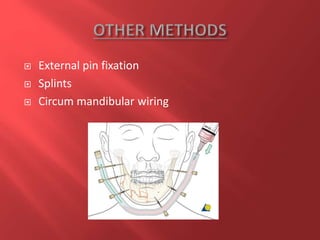
 External pin fixation
 Splints
 Circum mandibular wiring
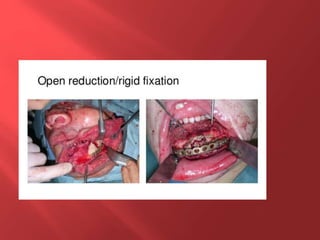
Indication
1. Unfavorable displaced fracture
2. Panfacial fracture
3. Nonunited fracture
4. Malunited fracture
5. If occlusion is not achieved by closed reduction
Contra indication
1. Medically unfit patient
Advantage
1. Anatomic reduction
2. Fixation in desired position
3. Return of function eralier
4. No airway compramise
Disadvanatges
1. Surgical procedure
2. Complication of sugery
1. Symhysis , parasymphysis and body regions of the
mandible- intraoral incision in labial mucosa
- extraoral incision
 Plates andscrew osteosynthesis are used
 Popularised by AO/ASIF
 Variuos types are
1. Dynamic compression plates
2. Eccentric dynamic compression plates
3. Self compression plates
Advanatges
1. No MMF
2. Airway safty
3. Return of jaw function faster
4. Patient nutrition is not compramised
Disadvanatages
1. Require surgical skill and training
2. Fixation plates are bulky
3. Stress shielding effect
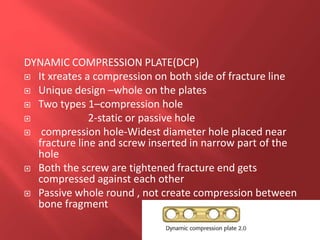
DYNAMIC COMPRESSION PLATE(DCP)
 It xreates a compression on both side of fracture line
 Unique design –whole on the plates
 Two types 1–compression hole
 2-static or passive hole
 compression hole-Widest diameter hole placed near
fracture line and screw inserted in narrow part of the
hole
 Both the screw are tightened fracture end gets
compressed against each other
 Passive whole round , not create compression between
bone fragment
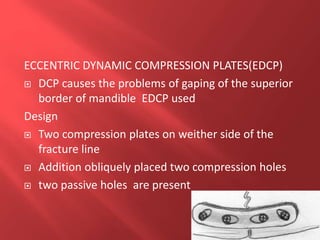
ECCENTRIC DYNAMIC COMPRESSION PLATES(EDCP)
 DCP causes the problems of gaping of the superior
border of mandible EDCP used
Design
 Two compression plates on weither side of the
fracture line
 Addition obliquely placed two compression holes
 two passive holes are present
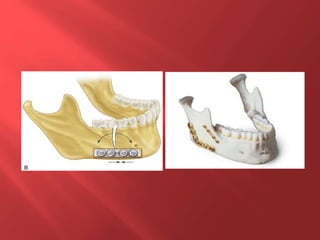
 Champy introduced , in which material used was able to resist these unfavorable
masticatory forces
Designs of the plates
 Miniplates are mono cortical
 1mm thick and 6mm wide
 They have a standard distance between the holes
 Screws are self tapping
Technique of placement
 Fracture is exposed and reduced using manual manipulatio n or bone holding
forceps
 Bones are held in the position and plates are applied on it
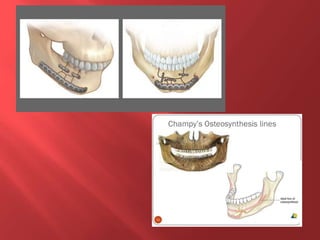
 Placed along the osteosynthesis lines
 Hole is placed away from the fracture line nad drilled perpendicular to the plates
surface
 First screw is inserted and tightened
 Next screw is placed near to fracture line
Lag screws
 By brons and boering
 If fracture with bicortical section
Bioresorbable plates
 Made up of polydioxanone,polyglycolic acid, polylactic acid
 Once a plates are placed , over a period o0f time, the
material gets resorbed as the glycolic acid by citric acid cycle
 Eliminated as CO2
Disadvanatges
 Foreign body reaction
 Inflammatory reaction
 Osteolytic changes
 Plate may not be rigid to support the fracture
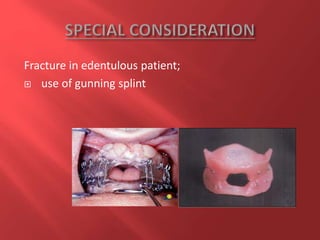
Fracture in edentulous patient;
 use of gunning splint
 If the tooth present in the line of fracture,
 Indication for extraction
1. Excessive mobility
2. Fracture of the root
3. Teeth that prevent reduction of fracture must be
moved
 Indication for preservation
1. Tooth with crown fracture
2. Tooth that appears non –vital time of fracture
3. Completely impacted teeth should be retained to
provide additional bone for plating

MANDIBULAR FRACTURE.pptx

  • 1.
  • 2.
    1. Introduction 2. Anatomyof mandible 3. Etiology 4. Location 5. Classification of mandibular fracture 6. Diagnosis 7. Management
  • 3.
     Most prominentjaw bone in the lower third of the face  Fracture occur more frequently when compared to other bones  For the management , proper anatomy and attachment of muscle of this jaw
  • 4.
     Largest ,strongest bone in face  Horse shoe or parabola shape  Angle of curvature is 110 -140  Inferior border of the mandible is made of dense cortical bone only no medullary  Cortical bone is thickest at lower border  Gradually thins down as it goes posterioly .  Composed of symphysis region which is the region where the two sides of developing mandible fuse during formation  Horizontal aspect –body  Vertical aspect –rami  At end two process – coronoid and condylar aspect
  • 5.
    1. Muscles ofmastication 2. Muscles on lingual side of mandible  Geniohyoid  Genioglossus  Mylohyoid  Anterior belly of digastric
  • 6.
    Nerve supply ofthe mandible • Inferior alveolar vessels • Periosteal attachment Blood supply • Inferior alveolar nerve
  • 7.
     External violence 1.Vehicle accidents 2. Industrial accidents 3. Assaults 4. Gunshots  Sports trauma 1. Contact sports such as boxing 2. Fall froma height 3. Sports  Due to pathologies in the mandible  Due to surgical procedures in the mandible
  • 8.
     Body region(29%) Condyle (26%)  Symphysis (17%)  Ramus (4%)  Coronoid process fracture (1%)
  • 9.
    Kruger s classification; •Simple(closed)- linear fracture lines which not communicate with the exterior • Compound(open)-the fracture is communicating intraoral or extra orally • Comminuted -shattering of bone into multiple pieces • Complex -complicated they is adjunct injury to the adjacent nerve or major blood vessels, joints • Impacted – one fragment is firmly driven within the other fragment and clinical movement not appreciated • Greenstick -only one cortex broken ,common in children • Pathological – spontaneous fracture as a result of normal muscle contraction or trauma due to increased weakness of underlying bone
  • 11.
    Rowe and Killeys classification •Fracture not involving the basal bone – are called dento alveolar fracture •Fracture involving the basal bone of the mandible ,- •single unilateral •double unilateral •Bilateral •Multiple Dingman and Natvig s classification by anatomic region •Symphysis fracture •Canine region fracture •Body of the mandible between canine and angle •Angle region •Ramus region •Coronoid region •Condylar fracture •Dentoalveolar region
  • 12.
    • Direct fracture •Indirect (counter coupe)fracture Relation to the fracture to the site of injury • Complete • Incomplete Completeness • Single • Multiple • Comminuted Number of fragments • Closed/open • Grades of severity Involvement of the integument • Transverse • Oblique • Butterfly • Oblique surfaced Shape or area of the fracture
  • 13.
    Horizontally favorable fracture • Fracture lineruns downwards &forward so upward displacement avoided Horizontally unfavorable fracture • Fracture line runs down wards and backwards so upwards displacement unrestricted Vertically favorable fracture • Fracture line runs from the outer buccal palate obliquely backwards and linguallyb, medial, movement restricted Vertically unfavorable fracture • Fracture line runs from the inner lingual plate obliquelly medial movement unrestricted
  • 15.
    Kazanjian V.H.&Converse J.M. •teeth on both sides of fracture line • monomaxillary Class 1 • teeth only on one sides of the fracture line • intermaxillary fixation Class 2 • edentulous patient • open reduction / prosthesis Class 3
  • 16.
    • No offractures or fragments F • Location of the fracture L • Status of occlusion O • Soft tissue involvement S • Associated fractures A
  • 17.
    Catogorieis in number of fracture Catogories inlocation • F0- incomplete fracture • F1-single fracture • F2-multiple fractures • F3-comminuted fractures • F4-fractures with bone defect • L1 ;precanine • L2; canine • L3;postcanine • L4;angle • L5;supra angular • L6;condyle • L7;coronoid • L8;alveolar process
  • 18.
    Category of occlusion • O0:no ofmalocclusion • O1:malocclusion • O2:nonexistent occlusion_edentulous mandible Catogori es of soft tissue involvem ent •S0:closed •S1:open intraorally •S2:open extra orally •S3:open intra and extraorally •S4:soft tissue defect Catogori es of associate d fracture • A0:none • A1:fracture or loss of teeth • A2:nasal bone • A3:zygoma • A4:LeFort I • A5:LeFortII • A6:LeFortIII
  • 19.
     Cause  Protectivehelmet/seatbuilt  Direction of force  Teeth clenched at the time of injury  Flow from broad or sharp object  Medical history
  • 20.
    On extra oral inspection •Contour and swelling • Laceration and soft tissue loss • Swelling and ecchymosis • Flattened apperance of lateral aspect of face • Mouth opening reduced • Deviation • Change in vertical height On extraoral palapation • Step deformity and tenderness On intra oral inspection • Occlusion changes (open bite , cross bite) • Midline shift • Ecchymosis- coleman’ s sign • Bleeding On intraoral palpation • Tooth mobility • For tenderness
  • 21.
    1. Panoramic radiograph 2.Lateral oblique radiograph 3. Posterior anterior mandibular view 4. Reverse towne view 5. Mandibular occlusal view 6. Periapical radiograph 7. CT scan
  • 22.
    PRINCIPLES IN TREATMENT Pt. physical and general status should be evaluated and monitored prior to any consideration  Diagnosis and treatment of mandibular fracture should be approached methodologically  Dental injuries should be evaluated  Reestablishment of occlusion is primary goal  With multiple fracture mandibular fracture should be trated firtst  Prophylatic antibiotic treatment should be used for compound fracture
  • 23.
    Reduction • Closed • open Fixation •Internal/external • Direct/indirect • Non rigid wire osteosynthhesis • Semi rigid monocortical plates, lag screws • Rigid DCP Immobilizati on • Short term • Long term
  • 24.
     Intermaxillary fixationwith osteosynthesis 1. Transosseous wiring 2. Circumferential wiring 3. External in fixation 4. Bone clamps 5. Transfixation with kirschner wires  Intermaxillary fixation 1. Dental arch wires 2. Arch bars
  • 25.
    Methods of immobilization Osteosynthesis without intermaxillary fixation 1. Non compression small plates 2. Compression plates 3. Mini plates 4. Lag screws
  • 26.
    •Simple , lowcost, and non invasive treatment procedure •Presence of teeth provide an accuarate guide for reduction Closed reduction •Non displaced favourable fracture •Grossly comminuted fracture •Sevrrely atrophic edentulous mandible •Lack of soft tissue over mandible •Fracture in childeren with developing teeth bud •Coronoid process fracture Indication •History of siezure •Comprmised pulmonary function •Psychatric conditions •GI disorder Contraindication
  • 27.
    1. Arch barfixation 2. Bridle wiring 3. Figure of eight wiring 4. Gilmer’s direct interdental wiring 5. Eyelet wiring 6. Essig’s wiring 7. Stout’s continuous loop wiring 8. Risdon s wiring
  • 28.
     Most commontype –Erich’s arch bar Technique  Prefabricated arch bar with hooks are incoorperated on the outer surface with flat malleable stainless steel metal strip.  Should be cut accuarately to the length of the dental arch  Each arch bar is fixed to upper and lower jaw  On upper jaw hooks are arranged in upward direction and lower jaw with downward direction  Adapted to buccal surface according to arch form  Fixed to each tooth by 26 gauge stainless steel wire from mesial surface to lingual side and buccal to distal  Twisting done in clock wise manner Advantages 1. Less trauma 2. Replaced easily 3. Flat hook Donot irritate the tissue
  • 29.
    2.BRIDLE WIRE  Fortemporary stabilization of fractured segment Techniques  Fracture reduced under LA and held in position  Wire looped around teeth either side of fracture and tightened on buccal side 3.FIGURE OF EIGHT WIRING  Used to stabilize the dentoalveolar fracture  Teeth on either side of fracture are used for this  26 guage prestreched stainless steel wire is used
  • 30.
    4.GILMERS DIRECT WIRING Simple method Techniques  Prestreched 26 gauge stainless steel wire  Wire passed around single tooth in upper arch till it is tightened  Similiarly wire passed around corresponding tooth in lower arch  Teeth are brought in occlusion and twisted wires are held together tightened  Done in fast immobilization is required 5.RISDON WIRING  Substitute for arch bars  Second premolars on either sides are chosen for anchorage
  • 31.
    6.EYELET WIRING  Makeeyelet from prestreched 24 gauge stainless steel wire15 cm long pieces is twisted around probe and make a loop in centre and twist half around it  Loose end of the eyelet wire are passed interproximally between 2 stable teeth from buccal side  Ends grasped on the lingual side other end is to mesial side and one side on to distal side then both ends to buccal sides  Then it passed to the loop of eyelet and then tightened in apical direction Advantages 1. Firm and stable 2. If any one break , it can be replaced
  • 32.
    7.ESSIG S WIRING When many teeth adjacent to the fracture line are not much strong to stabilize the fracture  Luxated teeth should be pushed back into their sockets and stabilization area choosen should be at leat 3 teeth away from fracture line 8.STOUT S CONTINOUES LOOP WIRING  Posterior quadrent are used for wiring  A piece of solder wire is dapted to the buccal side in first quardrent from where wiring is started
  • 33.
     External pinfixation  Splints  Circum mandibular wiring
  • 34.
    Indication 1. Unfavorable displacedfracture 2. Panfacial fracture 3. Nonunited fracture 4. Malunited fracture 5. If occlusion is not achieved by closed reduction Contra indication 1. Medically unfit patient Advantage 1. Anatomic reduction 2. Fixation in desired position 3. Return of function eralier 4. No airway compramise Disadvanatges 1. Surgical procedure 2. Complication of sugery
  • 36.
    1. Symhysis ,parasymphysis and body regions of the mandible- intraoral incision in labial mucosa - extraoral incision
  • 37.
     Plates andscrewosteosynthesis are used  Popularised by AO/ASIF  Variuos types are 1. Dynamic compression plates 2. Eccentric dynamic compression plates 3. Self compression plates Advanatges 1. No MMF 2. Airway safty 3. Return of jaw function faster 4. Patient nutrition is not compramised Disadvanatages 1. Require surgical skill and training 2. Fixation plates are bulky 3. Stress shielding effect
  • 38.
    DYNAMIC COMPRESSION PLATE(DCP) It xreates a compression on both side of fracture line  Unique design –whole on the plates  Two types 1–compression hole  2-static or passive hole  compression hole-Widest diameter hole placed near fracture line and screw inserted in narrow part of the hole  Both the screw are tightened fracture end gets compressed against each other  Passive whole round , not create compression between bone fragment
  • 39.
    ECCENTRIC DYNAMIC COMPRESSIONPLATES(EDCP)  DCP causes the problems of gaping of the superior border of mandible EDCP used Design  Two compression plates on weither side of the fracture line  Addition obliquely placed two compression holes  two passive holes are present
  • 41.
     Champy introduced, in which material used was able to resist these unfavorable masticatory forces Designs of the plates  Miniplates are mono cortical  1mm thick and 6mm wide  They have a standard distance between the holes  Screws are self tapping Technique of placement  Fracture is exposed and reduced using manual manipulatio n or bone holding forceps  Bones are held in the position and plates are applied on it  Placed along the osteosynthesis lines  Hole is placed away from the fracture line nad drilled perpendicular to the plates surface  First screw is inserted and tightened  Next screw is placed near to fracture line
  • 43.
    Lag screws  Bybrons and boering  If fracture with bicortical section Bioresorbable plates  Made up of polydioxanone,polyglycolic acid, polylactic acid  Once a plates are placed , over a period o0f time, the material gets resorbed as the glycolic acid by citric acid cycle  Eliminated as CO2 Disadvanatges  Foreign body reaction  Inflammatory reaction  Osteolytic changes  Plate may not be rigid to support the fracture
  • 44.
    Fracture in edentulouspatient;  use of gunning splint
  • 45.
     If thetooth present in the line of fracture,  Indication for extraction 1. Excessive mobility 2. Fracture of the root 3. Teeth that prevent reduction of fracture must be moved  Indication for preservation 1. Tooth with crown fracture 2. Tooth that appears non –vital time of fracture 3. Completely impacted teeth should be retained to provide additional bone for plating