GINGIVAL SULCUS
AND
GINGIVAL
CREVICULAR FLUID
PRESENTED BY:
SURBHI KAPOOR
MDS 1ST YEAR
GINGIVAL SULCUS
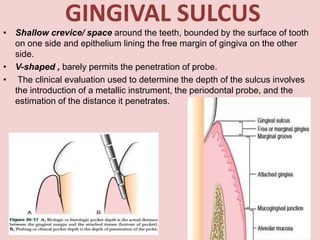
• Shallow crevice/ space around the teeth, bounded by the surface of tooth
on one side and epithelium lining the free margin of gingiva on the other
side.
• V-shaped , barely permits the penetration of probe.
• The clinical evaluation used to determine the depth of the sulcus involves
the introduction of a metallic instrument, the periodontal probe, and the
estimation of the distance it penetrates.
• Under normal conditions , the depth is 0mm or close to 0mm.
(Gottleib B, Orban B, 1993)
• Depth in histological sections : 1.8mm, with variations from 0-
6 mm.
(Orban B, Kohler J, 1924)
• Other studies have reported 1.5 mm and 0.69 mm.
• The histologic depth of a sulcus does not need to be exactly
equal to the depth of penetration of the probe.
• The so-called probing depth of a clinically normal gingival
sulcus in humans is 2 to 3 mm
GINGIVAL CREVICULAR FLUID
• Pioneer research by Waerhaug (1950) focussed on the anatomy of sulcus
and its transformation into a gingival pocket during the course of
periodontitis.
• Brill et al. (1950) laid the foundation of understanding the physiology of
gingival crevicular fluid formation and its composition.
• Loe et al.(1965) used gingival crevicular fluid as an indicator of periodontal
disease.
• Goodson thoroughly studied major issues in gingival crevicular fluid flow
rate and its method of collection.
• Egelberg focussed the studies on dentogingival blood vessels and their
permeability as they relate to the gingival crevicular fluid flow.
(Journal of Periodontal Research 1971).
• The presence of sulcular fluid, or gingival crevicular fluid (GCF), has
been known since the nineteenth century, but its composition and
possible role in oral defense mechanisms were elucidated by the
pioneering work of Waerhaug and Brill and Krasse in the 1950s.
• Brill and Krasse (1958) introduced filter paper into the gingival sulci
of dogs previously injected intramuscularly with fluorescein; within
3 minutes the fluorescent material was recovered on the paper
strips.
• This indicated the passage of fluid from the blood- stream through
the tissues and exiting via the gingival sulcus.
(Brill N, Krasse B: The passage of tissue fluid into the clinically healthy gingival
pocket, Acta Odontol Scand 1958; 16:223)
GCF: Transudate or Exudate??
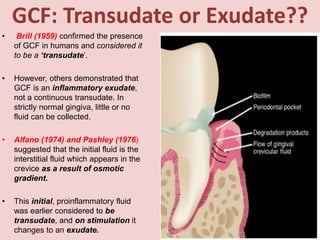
• Brill (1959) confirmed the presence
of GCF in humans and considered it
to be a ‘transudate’.
• However, others demonstrated that
GCF is an inflammatory exudate,
not a continuous transudate. In
strictly normal gingiva, little or no
fluid can be collected.
• Alfano (1974) and Pashley (1976)
suggested that the initial fluid is the
interstitial fluid which appears in the
crevice as a result of osmotic
gradient.
• This initial, proinflammatory fluid
was earlier considered to be
transudate, and on stimulation it
changes to an exudate.
MODEL BY PASHLEY (1976)
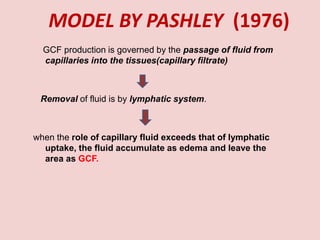
GCF production is governed by the passage of fluid from
capillaries into the tissues(capillary filtrate)
Removal of fluid is by lymphatic system.
when the role of capillary fluid exceeds that of lymphatic
uptake, the fluid accumulate as edema and leave the
area as GCF.
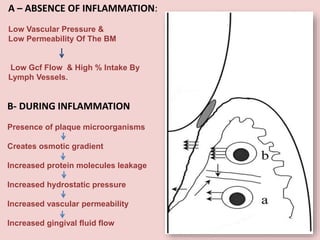
A – ABSENCE OF INFLAMMATION:
Low Vascular Pressure &
Low Permeability Of The BM
Low Gcf Flow & High % Intake By
Lymph Vessels.
B- DURING INFLAMMATION
Presence of plaque microorganisms
Creates osmotic gradient
Increased protein molecules leakage
Increased hydrostatic pressure
Increased vascular permeability
Increased gingival fluid flow
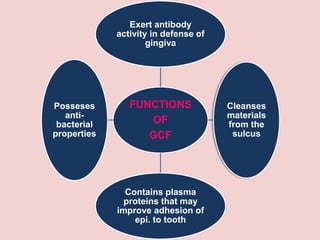
FUNCTIONS
OF
GCF
Exert antibody
activity in defense of
gingiva
Cleanses
materials
from the
sulcus
Contains plasma
proteins that may
improve adhesion of
epi. to tooth
Posseses
anti-
bacterial
properties
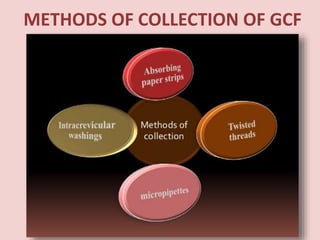
METHODS OF COLLECTION OF GCF
The most common method of collection is by using filter paper
strips.
Originally, these were pieces of laboratory filter paper of various
types cut to size by researchers.
 It has been reported that recovery of proteins in gingival crevicular
fluid samples varies considerably according to the type of filter paper
on which the gingival crevicular fluid sample is collected , but this
problem is likely to be less of an issue now as most researchers appear
to use PERIOPAPERS (ORAflOW INC.).
These are presterilized filter paper strips of standard size that can
absorb fluid volumes of up to approximately 1.2 l (larger Periocol
paper strips are also available for collecting larger volumes of up to
2.0 l).
ABSORBENT FILTER PAPER STRIPS
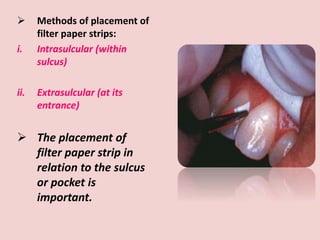
 Methods of placement of
filter paper strips:
i. Intrasulcular (within
sulcus)
ii. Extrasulcular (at its
entrance)
 The placement of
filter paper strip in
relation to the sulcus
or pocket is
important.
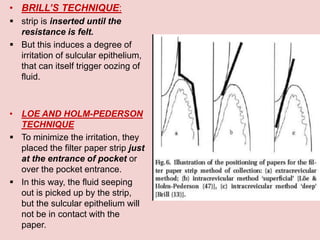
• BRILL’S TECHNIQUE:
 strip is inserted until the
resistance is felt.
 But this induces a degree of
irritation of sulcular epithelium,
that can itself trigger oozing of
fluid.
• LOE AND HOLM-PEDERSON
TECHNIQUE
 To minimize the irritation, they
placed the filter paper strip just
at the entrance of pocket or
over the pocket entrance.
 In this way, the fluid seeping
out is picked up by the strip,
but the sulcular epithelium will
not be in contact with the
paper.
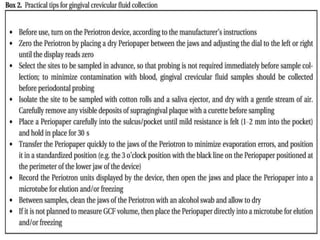
Typically, Periopapers are placed just into the entrance of the
sulcus/pocket until mild resistance is felt (i.e. utilizing the
intracrevicular method of placement) .
Attempts to position Periopapers to the known depth of a particular
periodontal pocket are typically unsuccessful because the paper has a
tendency to crumple up under the pressure of insertion as it becomes
increasingly saturated with fluid.
 Furthermore, contamination with blood is also very common if
trying to position a Periopaper to the full depth of a pocket.
Therefore, the Periopapers are typically inserted no more than 1–2
mm into the sulcus/ pocket to permit absorption of gingival
crevicular fluid from the site, with gentle placement until mild
resistance is felt.
The length of time that the Periopaper is held in place is an
important consideration.
 Some authors have advocated holding the Periopaper in place
until it is ‘visibly wet’, but, more commonly, the Periopaper is held in
place for a fixed period of time (typically 30 s).
(Kinney et al 2014, Fiorini et al 2013, Eltas & Orbak, 2012)
Most researchers currently adopt a standardized method in which
the Periopaper is held in place for 30 s before removal.
This runs a potential risk of the Periopaper becoming saturated at
very inflamed sites with abundant gingival crevicular fluid flow.
On the other hand, if the Periopaper is held in place ‘until visibly
wet’, it can take a very long time to see any evidence of gingival
crevicular fluid wetting the paper, particularly at noninflamed
periodontal sites.
Therefore, on balance, the most appropriate method is to adopt a
standardized sampling protocol, with the Periopaper being placed
1–2 mm into the sulcus/pocket (after careful drying and isolation)
and held in place for 30 s.
(WASSALL RR , PRESHAW PM. Clinical and technical
considerations in the analysis of gingival crevicular
fluid. Periodontology 2000 2016; 70: 65-79)
PREWEIGHTED TWISTED THREADS
• This method was used by Weinstein et al.
• Threads were placed in the gingival crevice around
the tooth and the amount of fluid collected was estimated
by the weight of sample thread.
• The thread were weighed before collection within a
sealed microcentrifugation plastic tube and the weighing
was repeated immediately after the collection
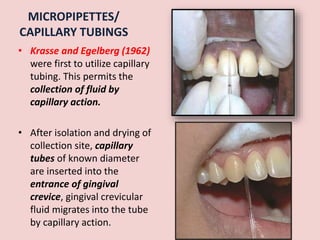
MICROPIPETTES/
CAPILLARY TUBINGS
• Krasse and Egelberg (1962)
were first to utilize capillary
tubing. This permits the
collection of fluid by
capillary action.
• After isolation and drying of
collection site, capillary
tubes of known diameter
are inserted into the
entrance of gingival
crevice, gingival crevicular
fluid migrates into the tube
by capillary action.
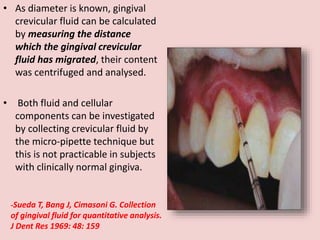
• As diameter is known, gingival
crevicular fluid can be calculated
by measuring the distance
which the gingival crevicular
fluid has migrated, their content
was centrifuged and analysed.
• Both fluid and cellular
components can be investigated
by collecting crevicular fluid by
the micro-pipette technique but
this is not practicable in subjects
with clinically normal gingiva.
-Sueda T, Bang J, Cimasoni G. Collection
of gingival fluid for quantitative analysis.
J Dent Res 1969: 48: 159
Advantage:
it provides an undiluted sample of native GCF whose volume can be
accurately assessed.
Disadvantages:
• It has a long collection period.
• The collection of fluid is difficult because the viscosity of fluid
makes the aspiration difficult.
• Difficult to hold capillary tube at the entrance of gingival crevice for
such lengthy periods
• It is also difficult to remove the complete sample from the tubing
CREVICULAR WASHINGS
• Gingival sulcus is perfused with an isotonic solution such as Hank’s
balanced salt solution of fixed volume.
• Two methods are used: one is the simplest method involving the
instillation and re-aspiration of 10 μl of Hank’s balanced salt
solution at the interdental papilla. It is repeated 12 times to allow
thorough mixing of transport solution and GCF.
• The fluid collected then represents a dilution of crevicular fluid and
contains both cells and soluble constituents such as plasma proteins.
• This technique could therefore be applied either to individual
interdental units or to multiple units which were then pooled.
Skapski H, Lehner T. A crevicular washing method for investigating immune
components of crevicular fluid in man. J Periodontal Res 1976: 11: 19– 24.
• Second method is more complicated which involves the
construction of a customized acrylic stent that isolates the
gingival tissue from the rest of the mouth. The tissues are
irrigated with a saline solution, using a peristaltic pump and the
diluted GCF is removed.
• This method uses an appliance consisting of a hard acrylic plate
covering the maxilla with soft borders and a groove following
the gingival margin, connected to four collection tubes.
• The washings are obtained by rinsing the crevicular area from
one side to the other, using a peristaltic pump.
-Oppenheim FG. Preliminary observations on the presence and origin of serum
albumin in human saliva. Helv Odontol Acta 1970: 14: 10–17
LIMITATIONS :
• Production of customized acrylic stents is complicated and
technically demanding.
• It is been useful only in maxillary arch, due to the difficulties of
producing a technically satisfactory appliance for the
mandibular arch.
• GCF from individual sites cannot be analyzed.
• All the fluid may not be recovered during the aspiration and re-
aspiration procedures.
• Precise dilution factor cannot be determined
MODIFICATION
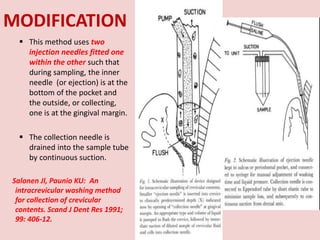
 This method uses two
injection needles fitted one
within the other such that
during sampling, the inner
needle (or ejection) is at the
bottom of the pocket and
the outside, or collecting,
one is at the gingival margin.
 The collection needle is
drained into the sample tube
by continuous suction.
Salonen Jl, Paunio KU: An
intracrevicular washing method
for collection of crevicular
contents. Scand J Dent Res 1991;
99: 406-12.
Advantages:
• Useful in cases of clinically normal gingiva.
• Useful for studying the state and number of cells and bacteria
from crevicular area.
Disadvantages:
• Does not permit the absolute assessment as the dilution
factor cannot be determined.
PERMEABILITY OF JUNCTIONAL AND SULCULAR
EPITHELIA
• Initial studies by Brill and Krasse with fluorescein were later confirmed with
substances such as India ink and saccharated iron oxide.
• Substances shown to penetrate the sulcular epithelium include ALBUMIN,
ENDOTOXIN, THYMIDINE, HISTAMINE, PHENYTOIN AND HORSERADISH
PEROXIDE. (these indicate permeability to substances with a molecular
weight upto 1000 KD).
• Squeir and Johnson reviewed the mechanism of penetration through an
intact epithelium.
• Intercellular movement of molecules and ions along intercellular spaces
appear to be a possible mechanism. Substances taking this route donot
traverse the cell membrane.
METHODS OF ESTIMATING THE VOLUME
COLLECTED
• Amount on the strip is assessed by the distance the fluid has
migrated up the strip.
• More accurate method is assessing the area of filter paper wetted by
GCF sample.
• Weighing the strips before and after sample collection.
(Weinstein E; 1967, Valazza A; 1972).
This has been successful but requires a very sensitive balance to
estimate the very small amounts of fluid which maybe collected
from a healthy crevice.
• STAINING OF STRIPS.
 Wetted area can be made more visible by staining with ninhydrin
which produces a purple color in the area where GCF had
accumulated (Cimasoni G, 1983).
 It is then measured planimetrically on an enlarged photograph or
with a magnifying glass or microscope.
 Similar result was shown with 2g fluorescein given systemically to
each patient 2 hours prior to the collection of GCF, following which
the strips were examined under ultraviolet light (Weinstein E,1967)
fluorescein labeling was 100 times more sensitive than ninhydrin for
staining protein.
Disadvantages:
 Not easily applied chairside.
 Delay in measuring the strip may result in
increased variation in the reported volume due to
evaporation.
 Staining of strips for protein labelling limits the
technique to that of volume determination.
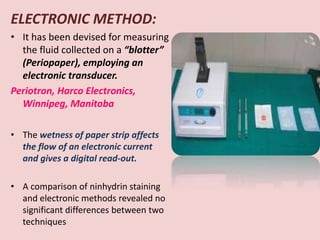
ELECTRONIC METHOD:
• It has been devised for measuring
the fluid collected on a “blotter”
(Periopaper), employing an
electronic transducer.
Periotron, Harco Electronics,
Winnipeg, Manitoba
• The wetness of paper strip affects
the flow of an electronic current
and gives a digital read-out.
• A comparison of ninhydrin staining
and electronic methods revealed no
significant differences between two
techniques
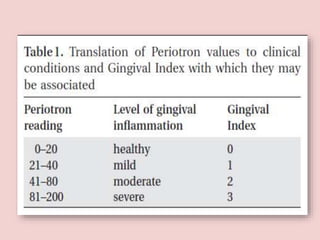
PERIOTRON
• The volume of gingival crevicular fluid absorbed by Periopaper strips
can be quantified using a Periotron device.
• Periotron is an electronic instrument that measures the effect of
wetness of filter paper strips on the capacitance between the ‘jaws’
of the device, between which the filter paper is placed after the
sample has been collected.
• In order to calculate volume from the Periotron read-out, the device
must be calibrated with known volumes of fluid pipetted onto
Periopaper strips.
• Typically, serum has been used for this purpose, being considered to
have a similar viscosity to gingival crevicular fluid, although the
manufacturer states that distilled water, saliva or serum may all be
used.
(WASSALL RR , PRESHAW PM. Clinical and technical considerations in
the analysis of gingival crevicular fluid. Periodontology 2000
2016;70:65–79)
Three models of periotron have been introduced:
600 (1976)
6000 (1983)
8000 (1995)
each one has been effective in measuring the volume of GCF.
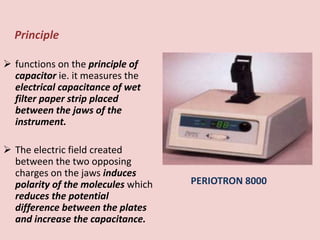
Principle
 functions on the principle of
capacitor ie. it measures the
electrical capacitance of wet
filter paper strip placed
between the jaws of the
instrument.
 The electric field created
between the two opposing
charges on the jaws induces
polarity of the molecules which
reduces the potential
difference between the plates
and increase the capacitance.
PERIOTRON 8000
WORKING:
• It has two metal ‘jaws’ which act as the plates of an electrical
condenser.
• If a dry strip is placed between the ‘jaws’, the capacitance is
translated via the electrical circuitry and registers ‘zero’ on the
digital readout.
• A wet strip will increase the capacitance in proportion to the
volume of fluid and this can be measured as an increased
value in the readout
Advantages:
• Rapid technique
• has no discernable effect on GCF sample.
.
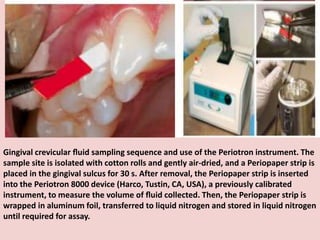
Gingival crevicular fluid sampling sequence and use of the Periotron instrument. The
sample site is isolated with cotton rolls and gently air-dried, and a Periopaper strip is
placed in the gingival sulcus for 30 s. After removal, the Periopaper strip is inserted
into the Periotron 8000 device (Harco, Tustin, CA, USA), a previously calibrated
instrument, to measure the volume of fluid collected. Then, the Periopaper strip is
wrapped in aluminum foil, transferred to liquid nitrogen and stored in liquid nitrogen
until required for assay.
AMOUNT OF GCF COLLECTED
• The amount of GCF collected is extremely small i.e. 0.5 to 2.4 μl/day.
• Measurements performed by Cimasoni,1983showed that a strip of
paper 1.5mm wide and inserted 1mm within the gingival sulcus of a
slightly inflamed gingiva absorbed about 0.1mg of GCF in 3minutes.
• Challacombe,1980 used an isotope dilution method to measure the
amount of GCF present in a particular space at any given time. His
calculations in human volunteers with a mean gingival index of less
than 1 showed that the mean GCF volume in proximal spaces from
molar teeth ranged from 0.43 to 1.56 μl.
• The mean GCF volume in proximal spaces of anterior teeth are 0.24
to 0.43 μl.
PROBLEMS DURING GCF
COLLECTION
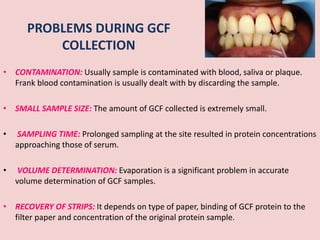
• CONTAMINATION: Usually sample is contaminated with blood, saliva or plaque.
Frank blood contamination is usually dealt with by discarding the sample.
• SMALL SAMPLE SIZE: The amount of GCF collected is extremely small.
• SAMPLING TIME: Prolonged sampling at the site resulted in protein concentrations
approaching those of serum.
• VOLUME DETERMINATION: Evaporation is a significant problem in accurate
volume determination of GCF samples.
• RECOVERY OF STRIPS: It depends on type of paper, binding of GCF protein to the
filter paper and concentration of the original protein sample.
COMPOSITION OF GCF
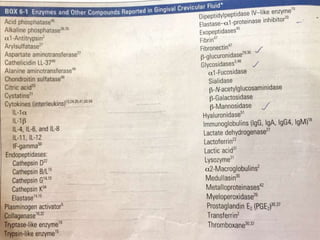
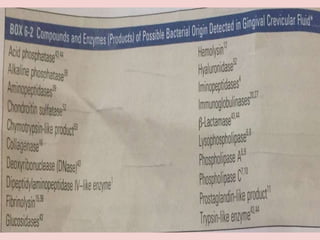
So far, more than 40 compounds found n GCF have been analyzed but
their origin is not known with certainty.
 These compounds can be host derived or produced by the bacteria in
the gingival crevice, but their source can be difficult to elucidate.
 examples include β-glucuronidase, a lysosomal enzyme, and lactic
acid dehydrogenase, a cytoplasmic enzyme.
The source for collagenases may be fibroblasts or polymorphonuclear
leukocytes (PMNs, neutrophils), or collagenases may be secreted by
bacteria. Phospholipases are lysosomal and cytoplasmic enzymes but
are also produced by microorganisms.
 The majority of GCF elements detected thus far have been enzymes,
but there are non- enzymatic substances as well.
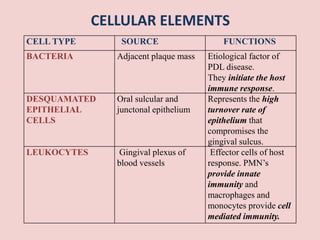
CELLULAR ELEMENTS
CELL TYPE SOURCE FUNCTIONS
BACTERIA Adjacent plaque mass Etiological factor of
PDL disease.
They initiate the host
immune response.
DESQUAMATED
EPITHELIAL
CELLS
Oral sulcular and
junctonal epithelium
Represents the high
turnover rate of
epithelium that
compromises the
gingival sulcus.
LEUKOCYTES Gingival plexus of
blood vessels
Effector cells of host
response. PMN’s
provide innate
immunity and
macrophages and
monocytes provide cell
mediated immunity.
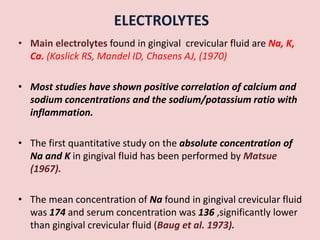
ELECTROLYTES
• Main electrolytes found in gingival crevicular fluid are Na, K,
Ca. (Kaslick RS, Mandel ID, Chasens AJ, (1970)
• Most studies have shown positive correlation of calcium and
sodium concentrations and the sodium/potassium ratio with
inflammation.
• The first quantitative study on the absolute concentration of
Na and K in gingival fluid has been performed by Matsue
(1967).
• The mean concentration of Na found in gingival crevicular fluid
was 174 and serum concentration was 136 ,significantly lower
than gingival crevicular fluid (Baug et al. 1973).
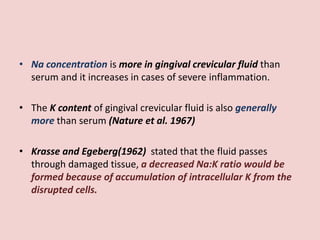
• Na concentration is more in gingival crevicular fluid than
serum and it increases in cases of severe inflammation.
• The K content of gingival crevicular fluid is also generally
more than serum (Nature et al. 1967)
• Krasse and Egeberg(1962) stated that the fluid passes
through damaged tissue, a decreased Na:K ratio would be
formed because of accumulation of intracellular K from the
disrupted cells.
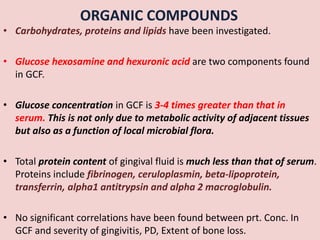
ORGANIC COMPOUNDS
• Carbohydrates, proteins and lipids have been investigated.
• Glucose hexosamine and hexuronic acid are two components found
in GCF.
• Glucose concentration in GCF is 3-4 times greater than that in
serum. This is not only due to metabolic activity of adjacent tissues
but also as a function of local microbial flora.
• Total protein content of gingival fluid is much less than that of serum.
Proteins include fibrinogen, ceruloplasmin, beta-lipoprotein,
transferrin, alpha1 antitrypsin and alpha 2 macroglobulin.
• No significant correlations have been found between prt. Conc. In
GCF and severity of gingivitis, PD, Extent of bone loss.
• Ngo et al. reported 33 peptides and 66 proteins in gingival
crevicular fluid samples collected from multiple periodontal
pockets. (Journal of Proteome Research 2010)
• Grant et al. identified 186 human proteins in gingival
crevicular fluid samples fromperiodontally healthy and
experimental gingivitis sites.
• In a current study conducted by Kido J, Bando et al. 231
proteins were identified in two gingival crevicular fluid
samples from a healthy gingival crevice and an inflamed
periodontal pocket.
• These proteins included circulating blood proteins, enzymes,
cytoskeleton-related proteins, immunity related proteins,
AMP s etc. (Journal of Periodontal Research, 2012)
METABOLIC END PRODUCTS
• Lactic acid
• Urea
• Hydroxyproline: it is a major breakdown product of collagen.
Its presence in gingival fluid is an indicator of rate of progression
of periodontal disease.
• Prostaglandins: It is a component of inflammatory reaction. It
causes vasodilation and inhibition of collagen synthesis.
• Endotoxins: Released from gram negative bacteria are highly
toxic to gingival tissue and pathogenic factor in periodontal
disease.
• Cytotoxic substances
• Hydrogen sulphide
• Antibacterial factors
• Neutrophilic enzymes in GCF:
PRIMARY / AZUROPHILIC
GRANULES
Elastase, cathepsin G, urokinase,
myeloperoxidase, lysozyme and
mannosidase, as well as
hydrolases active at acidic pH,
including cathepsin B, cathepsin
D and b-glucuronidase.
SECONDARY GRANULES
contain lactoferrin,
neutrophil collagenase
[matrix metalloproteinase-
8 (MMP-8)], and lysozyme
Mediators of periodontal disease in GCF
• Numerous cytokines are released from cells of the sulcular and
junctional epithelia, dendritic cells, connective tissue fibroblasts,
macrophages and neutrophils.
• In addition, a number of enzymes, such as matrix metalloproteinases,
are produced by neutrophils, fibroblasts and osteoclasts, leading to
the degradation of connective tissue collagen and alveolar bone.
• To date, more than 90 different components in gingival crevicular
fluid have been evaluated for periodontal diagnosis .
• With the advance of laboratory techniques, GCF has been eluted and
analyzed extensively for the presence of host response factors,
including molecules from blood, local host tissue and plaque biofilm .
• MATRIX METALLOPROTEINASES are an important group of
proteinases that are associated with collagen degradation
during the destructive process of periodontal disease and
can be measured in gingival crevicular fluid.
• Neutrophils are the major source of matrix
metalloproteinases, specifically matrix metalloproteinase-8
and matrix metalloproteinase-9, at the infected site.
( BARROS SP ,WILLIAMS R,OFFENBACHER S , MORELLI T. Gingival
crevicular fluid as a source of biomarkers for periodontitis.
Periodontology 2000 2016;70: 53-64)
• Macrophages and neutrophils are activated, in response to bacterial
lipopolysaccharide, to produce important inflammatory mediators, such as
tumor necrosis factor-alpha, interleukin-6 and interleukin-1, and other
cytokines related to the host response and to tissue destruction .
• Among the biochemical markers for the measurement of bone
homeostasis, pyridinoline cross-linked carboxyterminal telopeptide of
type I collagen, RANKL, osteoprotegerin and osteocalcin are those most
studied in gingival crevicular fluid.
• Carboxyterminal telopeptide of type I collagen is a 12- to 20-kDa fragment
of bone type I collagen released by digestion with trypsin or bacterial
collagenase .
• Gingival crevicular fluid pyridinoline cross-linked carboxyterminal
telopeptide of type I collagen has been shown to be a good predictor of
future alveolar bone and attachment loss, is strongly correlated with clinical
parameters and putative periodontal pathogens, and demonstrates
significant reductions after periodontal therapy.
GINGIVAL CREVICULAR flUID AS A
DIAGNOSTIC TOOL
• Collection of gingival crevicular fluid is noninvasive and therefore
this approach has been extensively explored in the search for
potential diagnostic biomarkers of periodontal disease .
• As a result of interaction between the bacterial biofilm and the
cells of the periodontal tissues, gingival crevicular fluid appears as
an attractive oral diagnostic fluid due to its ease of collection and
allowing for sampling of multiple sites within the oral cavity
simultaneously.
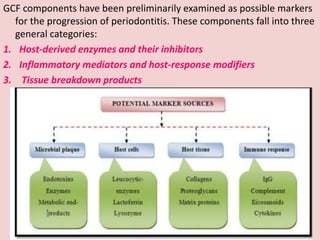
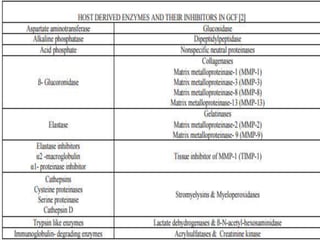
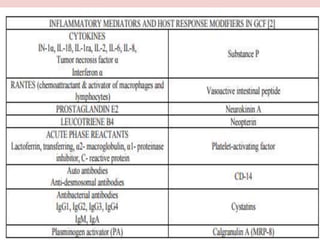
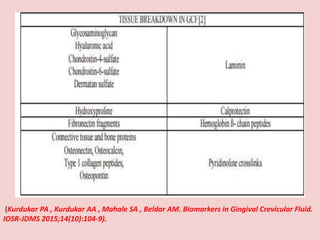
GCF components have been preliminarily examined as possible markers
for the progression of periodontitis. These components fall into three
general categories:
1. Host-derived enzymes and their inhibitors
2. Inflammatory mediators and host-response modifiers
3. Tissue breakdown products
(Kurdukar PA , Kurdukar AA , Mahale SA , Beldar AM. Biomarkers in Gingival Crevicular Fluid.
IOSR-JDMS 2015;14(10):104-9).
GCF ENZYMES AS INDICATORS OF PERIODONTAL
HEALTH
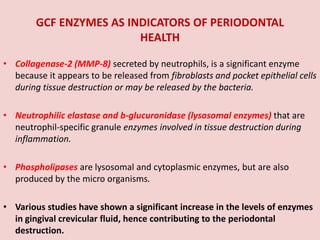
• Collagenase-2 (MMP-8) secreted by neutrophils, is a significant enzyme
because it appears to be released from fibroblasts and pocket epithelial cells
during tissue destruction or may be released by the bacteria.
• Neutrophilic elastase and b-glucuronidase (lysosomal enzymes) that are
neutrophil-specific granule enzymes involved in tissue destruction during
inflammation.
• Phospholipases are lysosomal and cytoplasmic enzymes, but are also
produced by the micro organisms.
• Various studies have shown a significant increase in the levels of enzymes
in gingival crevicular fluid, hence contributing to the periodontal
destruction.
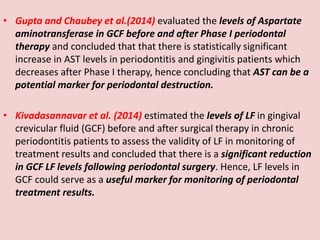
• Gupta and Chaubey et al.(2014) evaluated the levels of Aspartate
aminotransferase in GCF before and after Phase I periodontal
therapy and concluded that that there is statistically significant
increase in AST levels in periodontitis and gingivitis patients which
decreases after Phase I therapy, hence concluding that AST can be a
potential marker for periodontal destruction.
• Kivadasannavar et al. (2014) estimated the levels of LF in gingival
crevicular fluid (GCF) before and after surgical therapy in chronic
periodontitis patients to assess the validity of LF in monitoring of
treatment results and concluded that there is a significant reduction
in GCF LF levels following periodontal surgery. Hence, LF levels in
GCF could serve as a useful marker for monitoring of periodontal
treatment results.
• Shiva Manjunath RJ et al.(2012) estimated the levels of C-
reactive protein in Gingival crevicular fluid in periodontal
health and disease. They concluded that as disease
progression occurs from gingivitis to periodontitis the mean
CRP concentration in GCF increases. This correlates with the
severity of gingival inflammation, attachment loss and
radiographic changes.
• Pradeep AS, Raj et al. (2009) conducted a study to assess the
relationship of Susbstance P in GCF from inflamed gingiva and
periodontal sites and concluded that Substance-P levels were
highest in the gingival crevicular fluid from sites with
periodontal destruction; however, periodontal treatment
resulted in the reduction of Substance-P levels.
CELLULAR AND HUMORAL ACTIVITY IN GCF
Interleukin 1-a
and 1-b
Interferon -
alpha
•Increase the binding of PMN’s
and monocytes/ macrophages
to endothelial cells.
•Stimulate Production of PGE2.
•Release of lysosomal
enzymes.
•Stimulate bone resorption
•Ability to inhibit the
bone resorption
activity of IL-1b.
•May have a protective
role in periodontal
disease.
Analysis of GCF has identified cell and humoral responses in both
healthy individuals and those with periodontal disease.
Cellular immune response includes appearance of cytokines in GCF
IMMUNE COMPONENTS OF GCF
• Both IgG and IgA are present in the GCF and are derived from serum
and plasma cells in the gingival tissues.
• Fujihashi K.1993 noted IgG1,IgG2,IgG3,IgG4 and IgA1, with high
IgA2 cells observed in advanced lesions.
• Kinane and co-workers, IgG1 was the predominant IgG-expressing
plasma cell in gingiva and granulation tissues. In contrast, IgA was
primarily expressed in the gingiva, with IgA1 predominating,
although IgA2 and J-chain positive cells were also enriched in the
gingiva.
• Numerous studies have confirmed that significant local elevations in
immunoglobulins occur in periodontitis resulting from extensive
local production.
• These antibodies are generally specific for bacterial components
and reflect the local colonization/infection by particular species.
• Variation in GCF antibodies across subgingival sites in the oral cavity
reflects the biological variability in clinical presentation and existing
microbial ecologies.
• Even though the role of antibodies in the gingival defense
mechanisms is difficult to ascertain, the consensus is that in a
patient with periodontal disease, (1) a reduction in antibody
response is detrimental, and (2) an antibody response plays a pro-
tective role.
CLINICAL SIGNIFICANCE OF GCF
 GCF is an inflammatory exudate. Its presence in clinically normal
sulci can be explained because gingiva that appears clinically
normal invariably exhibits inflammation when examined
microscopically.
 The amount of GCF is greater when inflammation is present and is
sometimes proportional to the severity of inflammation.
 GCF production is not increased by trauma from occlusion but is
increased by mastication of coarse foods, toothbrushing and
gingival massage, ovulation, hormonal contraceptives, and
smoking.
 Other factors that influence the amount of GCF are circadian
periodicity and periodontal therapy.
CIRCADIAN PERIODICITY
• There is a gradual increase in gingival fluid amount from 6am to
10pm and a decrease afterwards.
GCF AND SEX HORMONES
• Clinical investigations have shown an exacerbation of gingivitis
during pregnancy (Loe 1965), during menstrual cycle (Lemann
1948) and at puberty (Sutcliffe 1972).
• Female sex hormones increase the gingival fluid flow because
they enhance the vascular permeability.
• Pregnancy, ovulation and hormonal contraceptives increase
gingival fluid production.
-(Bissada NF, Schaffer EM, Haus E: Circadian periodicity of human crevicular
fluid. J Periodontol 1967; 38:36)
-(Lindhe J, Attstrom R, Bjorn AL: Influence of sex hormones on gingival
exudate of gingivitis-free female dogs. J Periodont Res 1968; 3:273)
GCF AND DRUGS
• Drugs that are excreted through the GCF may be used advantageously in
periodontal therapy.
• These include:
Tetracycline
Metronidazole
• Bader and Goldhaber (1966) were able to show that intravenous
administration of tetracycline in dogs rapidly emerges within the sulcus.
• Ciancio et al.(1976) measured the concentration of tetracycline in blood
and gingival fluid of 5 adult patients with advanced periodontitis, who
were given 1gm tetracycline HCl daily for 2 weeks and 0.5gmfor 10 weeks.
• Metronidazole is another antibiotic that has been detected in human GCF
(Eiserburg et al 1991).
PDL THERAPY AND GCF
• There is an increase in GCF production during the healing period
after periodontal therapy.
• Arnold et al (1966) reported that this increase was probably the
result of inflammatory reaction from gingival trauma and the loss
of an intact epithelial barrier especially considering the fact that
fluid has been collected by intracrevicular technique.
• With the restoration of gingival integrity, a gradual drop in fluid
flow.
-(Arnold R, Lunstad, G, Bissada, N, et al: Alterations in crevicular fluid flow
during healing following gingival surgery. J Periodont Res 1966; 1:303)
• Konopka L et al. (2012) in a study showed that short-term
nonsurgical therapy resulted in a significant improvement in
periodontal indices and in a marked decrease of IL-1b, IL-8 and
MMP-8 gingival crevicular fluid levels.
• Qiqiang H, Huanxim M et al.(2012) conducted a study to estimate
the levels of short chain fatty acids in gingival crevicular fluid in
chronic periodontitis patients before and after non surgical
periodontal therapy and concluded that he concentrations of lactic
acid, propionic acid, butyric acid and isovaleric acid in the gingival
crevicular fluid of patients with chronic periodontitis had
decreased to the levels found in the healthy control group.
• Kumar, Reddy et al.(2013) in a study have shown a positive
correlation between the levels of prostaglandin E2 in gingival
crevicular fluid and the severity of gingival inflammation. There is
statistically significant increase in PGE2 levels as the periodontal
disease progresses and decreases as the treatment is done.
INFLUENCE OF MECHANICAL STIMULATION
• Chewing and vigorous gingival brushing stimulates the flow of
gingival fluid.
• Even the minor stimuli represented by intrasulcular placement of
paper strips increase the production of fluid.
SMOKING AND GCF
• Smoking produces an immediate transient but marked increase in
gingival fluid flow.
-(McLaughlin WS, Lovat FM, Macgregor IDM, et al: The immediate
effects of smoking on gingival fluid flow. J Clin Periodontol 1993; 20:448)
• The methodology used for the analysis of GCF components is
as varied as the diversity of those components. Examples
include:
• Fluorometry for the detection of metalloproteases;
• Enzyme-linked immunoabsorbent assay (ELISA) tests to
detect enzyme levels and interleukin-1beta (IL-1ß)
• Radio-immunoassays to detect cyclooxygenase derivatives
and procollagen III
• High-pressure liquid chromatography (HPLC) to detect
timidazole.
• Direct and indirect immunodot tests for detection of acute
phase proteins
Gingival crevicular fluid

Gingival crevicular fluid

  • 1.
  • 2.
    GINGIVAL SULCUS • Shallowcrevice/ space around the teeth, bounded by the surface of tooth on one side and epithelium lining the free margin of gingiva on the other side. • V-shaped , barely permits the penetration of probe. • The clinical evaluation used to determine the depth of the sulcus involves the introduction of a metallic instrument, the periodontal probe, and the estimation of the distance it penetrates.
  • 3.
    • Under normalconditions , the depth is 0mm or close to 0mm. (Gottleib B, Orban B, 1993) • Depth in histological sections : 1.8mm, with variations from 0- 6 mm. (Orban B, Kohler J, 1924) • Other studies have reported 1.5 mm and 0.69 mm. • The histologic depth of a sulcus does not need to be exactly equal to the depth of penetration of the probe. • The so-called probing depth of a clinically normal gingival sulcus in humans is 2 to 3 mm
  • 4.
    GINGIVAL CREVICULAR FLUID •Pioneer research by Waerhaug (1950) focussed on the anatomy of sulcus and its transformation into a gingival pocket during the course of periodontitis. • Brill et al. (1950) laid the foundation of understanding the physiology of gingival crevicular fluid formation and its composition. • Loe et al.(1965) used gingival crevicular fluid as an indicator of periodontal disease. • Goodson thoroughly studied major issues in gingival crevicular fluid flow rate and its method of collection. • Egelberg focussed the studies on dentogingival blood vessels and their permeability as they relate to the gingival crevicular fluid flow. (Journal of Periodontal Research 1971).
  • 5.
    • The presenceof sulcular fluid, or gingival crevicular fluid (GCF), has been known since the nineteenth century, but its composition and possible role in oral defense mechanisms were elucidated by the pioneering work of Waerhaug and Brill and Krasse in the 1950s. • Brill and Krasse (1958) introduced filter paper into the gingival sulci of dogs previously injected intramuscularly with fluorescein; within 3 minutes the fluorescent material was recovered on the paper strips. • This indicated the passage of fluid from the blood- stream through the tissues and exiting via the gingival sulcus. (Brill N, Krasse B: The passage of tissue fluid into the clinically healthy gingival pocket, Acta Odontol Scand 1958; 16:223)
  • 6.
    GCF: Transudate orExudate?? • Brill (1959) confirmed the presence of GCF in humans and considered it to be a ‘transudate’. • However, others demonstrated that GCF is an inflammatory exudate, not a continuous transudate. In strictly normal gingiva, little or no fluid can be collected. • Alfano (1974) and Pashley (1976) suggested that the initial fluid is the interstitial fluid which appears in the crevice as a result of osmotic gradient. • This initial, proinflammatory fluid was earlier considered to be transudate, and on stimulation it changes to an exudate.
  • 7.
    MODEL BY PASHLEY(1976) GCF production is governed by the passage of fluid from capillaries into the tissues(capillary filtrate) Removal of fluid is by lymphatic system. when the role of capillary fluid exceeds that of lymphatic uptake, the fluid accumulate as edema and leave the area as GCF.
  • 8.
    A – ABSENCEOF INFLAMMATION: Low Vascular Pressure & Low Permeability Of The BM Low Gcf Flow & High % Intake By Lymph Vessels. B- DURING INFLAMMATION Presence of plaque microorganisms Creates osmotic gradient Increased protein molecules leakage Increased hydrostatic pressure Increased vascular permeability Increased gingival fluid flow
  • 9.
    FUNCTIONS OF GCF Exert antibody activity indefense of gingiva Cleanses materials from the sulcus Contains plasma proteins that may improve adhesion of epi. to tooth Posseses anti- bacterial properties
  • 10.
  • 11.
    The most commonmethod of collection is by using filter paper strips. Originally, these were pieces of laboratory filter paper of various types cut to size by researchers.  It has been reported that recovery of proteins in gingival crevicular fluid samples varies considerably according to the type of filter paper on which the gingival crevicular fluid sample is collected , but this problem is likely to be less of an issue now as most researchers appear to use PERIOPAPERS (ORAflOW INC.). These are presterilized filter paper strips of standard size that can absorb fluid volumes of up to approximately 1.2 l (larger Periocol paper strips are also available for collecting larger volumes of up to 2.0 l). ABSORBENT FILTER PAPER STRIPS
  • 12.
     Methods ofplacement of filter paper strips: i. Intrasulcular (within sulcus) ii. Extrasulcular (at its entrance)  The placement of filter paper strip in relation to the sulcus or pocket is important.
  • 13.
    • BRILL’S TECHNIQUE: strip is inserted until the resistance is felt.  But this induces a degree of irritation of sulcular epithelium, that can itself trigger oozing of fluid. • LOE AND HOLM-PEDERSON TECHNIQUE  To minimize the irritation, they placed the filter paper strip just at the entrance of pocket or over the pocket entrance.  In this way, the fluid seeping out is picked up by the strip, but the sulcular epithelium will not be in contact with the paper.
  • 14.
    Typically, Periopapers areplaced just into the entrance of the sulcus/pocket until mild resistance is felt (i.e. utilizing the intracrevicular method of placement) . Attempts to position Periopapers to the known depth of a particular periodontal pocket are typically unsuccessful because the paper has a tendency to crumple up under the pressure of insertion as it becomes increasingly saturated with fluid.  Furthermore, contamination with blood is also very common if trying to position a Periopaper to the full depth of a pocket. Therefore, the Periopapers are typically inserted no more than 1–2 mm into the sulcus/ pocket to permit absorption of gingival crevicular fluid from the site, with gentle placement until mild resistance is felt.
  • 15.
    The length oftime that the Periopaper is held in place is an important consideration.  Some authors have advocated holding the Periopaper in place until it is ‘visibly wet’, but, more commonly, the Periopaper is held in place for a fixed period of time (typically 30 s). (Kinney et al 2014, Fiorini et al 2013, Eltas & Orbak, 2012) Most researchers currently adopt a standardized method in which the Periopaper is held in place for 30 s before removal. This runs a potential risk of the Periopaper becoming saturated at very inflamed sites with abundant gingival crevicular fluid flow.
  • 16.
    On the otherhand, if the Periopaper is held in place ‘until visibly wet’, it can take a very long time to see any evidence of gingival crevicular fluid wetting the paper, particularly at noninflamed periodontal sites. Therefore, on balance, the most appropriate method is to adopt a standardized sampling protocol, with the Periopaper being placed 1–2 mm into the sulcus/pocket (after careful drying and isolation) and held in place for 30 s. (WASSALL RR , PRESHAW PM. Clinical and technical considerations in the analysis of gingival crevicular fluid. Periodontology 2000 2016; 70: 65-79)
  • 17.
    PREWEIGHTED TWISTED THREADS •This method was used by Weinstein et al. • Threads were placed in the gingival crevice around the tooth and the amount of fluid collected was estimated by the weight of sample thread. • The thread were weighed before collection within a sealed microcentrifugation plastic tube and the weighing was repeated immediately after the collection
  • 18.
    MICROPIPETTES/ CAPILLARY TUBINGS • Krasseand Egelberg (1962) were first to utilize capillary tubing. This permits the collection of fluid by capillary action. • After isolation and drying of collection site, capillary tubes of known diameter are inserted into the entrance of gingival crevice, gingival crevicular fluid migrates into the tube by capillary action.
  • 19.
    • As diameteris known, gingival crevicular fluid can be calculated by measuring the distance which the gingival crevicular fluid has migrated, their content was centrifuged and analysed. • Both fluid and cellular components can be investigated by collecting crevicular fluid by the micro-pipette technique but this is not practicable in subjects with clinically normal gingiva. -Sueda T, Bang J, Cimasoni G. Collection of gingival fluid for quantitative analysis. J Dent Res 1969: 48: 159
  • 20.
    Advantage: it provides anundiluted sample of native GCF whose volume can be accurately assessed. Disadvantages: • It has a long collection period. • The collection of fluid is difficult because the viscosity of fluid makes the aspiration difficult. • Difficult to hold capillary tube at the entrance of gingival crevice for such lengthy periods • It is also difficult to remove the complete sample from the tubing
  • 21.
    CREVICULAR WASHINGS • Gingivalsulcus is perfused with an isotonic solution such as Hank’s balanced salt solution of fixed volume. • Two methods are used: one is the simplest method involving the instillation and re-aspiration of 10 μl of Hank’s balanced salt solution at the interdental papilla. It is repeated 12 times to allow thorough mixing of transport solution and GCF. • The fluid collected then represents a dilution of crevicular fluid and contains both cells and soluble constituents such as plasma proteins. • This technique could therefore be applied either to individual interdental units or to multiple units which were then pooled. Skapski H, Lehner T. A crevicular washing method for investigating immune components of crevicular fluid in man. J Periodontal Res 1976: 11: 19– 24.
  • 22.
    • Second methodis more complicated which involves the construction of a customized acrylic stent that isolates the gingival tissue from the rest of the mouth. The tissues are irrigated with a saline solution, using a peristaltic pump and the diluted GCF is removed. • This method uses an appliance consisting of a hard acrylic plate covering the maxilla with soft borders and a groove following the gingival margin, connected to four collection tubes. • The washings are obtained by rinsing the crevicular area from one side to the other, using a peristaltic pump. -Oppenheim FG. Preliminary observations on the presence and origin of serum albumin in human saliva. Helv Odontol Acta 1970: 14: 10–17
  • 23.
    LIMITATIONS : • Productionof customized acrylic stents is complicated and technically demanding. • It is been useful only in maxillary arch, due to the difficulties of producing a technically satisfactory appliance for the mandibular arch. • GCF from individual sites cannot be analyzed. • All the fluid may not be recovered during the aspiration and re- aspiration procedures. • Precise dilution factor cannot be determined
  • 24.
    MODIFICATION  This methoduses two injection needles fitted one within the other such that during sampling, the inner needle (or ejection) is at the bottom of the pocket and the outside, or collecting, one is at the gingival margin.  The collection needle is drained into the sample tube by continuous suction. Salonen Jl, Paunio KU: An intracrevicular washing method for collection of crevicular contents. Scand J Dent Res 1991; 99: 406-12.
  • 25.
    Advantages: • Useful incases of clinically normal gingiva. • Useful for studying the state and number of cells and bacteria from crevicular area. Disadvantages: • Does not permit the absolute assessment as the dilution factor cannot be determined.
  • 26.
    PERMEABILITY OF JUNCTIONALAND SULCULAR EPITHELIA • Initial studies by Brill and Krasse with fluorescein were later confirmed with substances such as India ink and saccharated iron oxide. • Substances shown to penetrate the sulcular epithelium include ALBUMIN, ENDOTOXIN, THYMIDINE, HISTAMINE, PHENYTOIN AND HORSERADISH PEROXIDE. (these indicate permeability to substances with a molecular weight upto 1000 KD). • Squeir and Johnson reviewed the mechanism of penetration through an intact epithelium. • Intercellular movement of molecules and ions along intercellular spaces appear to be a possible mechanism. Substances taking this route donot traverse the cell membrane.
  • 27.
    METHODS OF ESTIMATINGTHE VOLUME COLLECTED • Amount on the strip is assessed by the distance the fluid has migrated up the strip. • More accurate method is assessing the area of filter paper wetted by GCF sample. • Weighing the strips before and after sample collection. (Weinstein E; 1967, Valazza A; 1972). This has been successful but requires a very sensitive balance to estimate the very small amounts of fluid which maybe collected from a healthy crevice.
  • 28.
    • STAINING OFSTRIPS.  Wetted area can be made more visible by staining with ninhydrin which produces a purple color in the area where GCF had accumulated (Cimasoni G, 1983).  It is then measured planimetrically on an enlarged photograph or with a magnifying glass or microscope.  Similar result was shown with 2g fluorescein given systemically to each patient 2 hours prior to the collection of GCF, following which the strips were examined under ultraviolet light (Weinstein E,1967) fluorescein labeling was 100 times more sensitive than ninhydrin for staining protein.
  • 29.
    Disadvantages:  Not easilyapplied chairside.  Delay in measuring the strip may result in increased variation in the reported volume due to evaporation.  Staining of strips for protein labelling limits the technique to that of volume determination.
  • 30.
    ELECTRONIC METHOD: • Ithas been devised for measuring the fluid collected on a “blotter” (Periopaper), employing an electronic transducer. Periotron, Harco Electronics, Winnipeg, Manitoba • The wetness of paper strip affects the flow of an electronic current and gives a digital read-out. • A comparison of ninhydrin staining and electronic methods revealed no significant differences between two techniques
  • 31.
    PERIOTRON • The volumeof gingival crevicular fluid absorbed by Periopaper strips can be quantified using a Periotron device. • Periotron is an electronic instrument that measures the effect of wetness of filter paper strips on the capacitance between the ‘jaws’ of the device, between which the filter paper is placed after the sample has been collected. • In order to calculate volume from the Periotron read-out, the device must be calibrated with known volumes of fluid pipetted onto Periopaper strips.
  • 32.
    • Typically, serumhas been used for this purpose, being considered to have a similar viscosity to gingival crevicular fluid, although the manufacturer states that distilled water, saliva or serum may all be used. (WASSALL RR , PRESHAW PM. Clinical and technical considerations in the analysis of gingival crevicular fluid. Periodontology 2000 2016;70:65–79) Three models of periotron have been introduced: 600 (1976) 6000 (1983) 8000 (1995) each one has been effective in measuring the volume of GCF.
  • 33.
    Principle  functions onthe principle of capacitor ie. it measures the electrical capacitance of wet filter paper strip placed between the jaws of the instrument.  The electric field created between the two opposing charges on the jaws induces polarity of the molecules which reduces the potential difference between the plates and increase the capacitance. PERIOTRON 8000
  • 34.
    WORKING: • It hastwo metal ‘jaws’ which act as the plates of an electrical condenser. • If a dry strip is placed between the ‘jaws’, the capacitance is translated via the electrical circuitry and registers ‘zero’ on the digital readout. • A wet strip will increase the capacitance in proportion to the volume of fluid and this can be measured as an increased value in the readout Advantages: • Rapid technique • has no discernable effect on GCF sample. .
  • 37.
    Gingival crevicular fluidsampling sequence and use of the Periotron instrument. The sample site is isolated with cotton rolls and gently air-dried, and a Periopaper strip is placed in the gingival sulcus for 30 s. After removal, the Periopaper strip is inserted into the Periotron 8000 device (Harco, Tustin, CA, USA), a previously calibrated instrument, to measure the volume of fluid collected. Then, the Periopaper strip is wrapped in aluminum foil, transferred to liquid nitrogen and stored in liquid nitrogen until required for assay.
  • 38.
    AMOUNT OF GCFCOLLECTED • The amount of GCF collected is extremely small i.e. 0.5 to 2.4 μl/day. • Measurements performed by Cimasoni,1983showed that a strip of paper 1.5mm wide and inserted 1mm within the gingival sulcus of a slightly inflamed gingiva absorbed about 0.1mg of GCF in 3minutes. • Challacombe,1980 used an isotope dilution method to measure the amount of GCF present in a particular space at any given time. His calculations in human volunteers with a mean gingival index of less than 1 showed that the mean GCF volume in proximal spaces from molar teeth ranged from 0.43 to 1.56 μl. • The mean GCF volume in proximal spaces of anterior teeth are 0.24 to 0.43 μl.
  • 39.
    PROBLEMS DURING GCF COLLECTION •CONTAMINATION: Usually sample is contaminated with blood, saliva or plaque. Frank blood contamination is usually dealt with by discarding the sample. • SMALL SAMPLE SIZE: The amount of GCF collected is extremely small. • SAMPLING TIME: Prolonged sampling at the site resulted in protein concentrations approaching those of serum. • VOLUME DETERMINATION: Evaporation is a significant problem in accurate volume determination of GCF samples. • RECOVERY OF STRIPS: It depends on type of paper, binding of GCF protein to the filter paper and concentration of the original protein sample.
  • 40.
    COMPOSITION OF GCF Sofar, more than 40 compounds found n GCF have been analyzed but their origin is not known with certainty.  These compounds can be host derived or produced by the bacteria in the gingival crevice, but their source can be difficult to elucidate.  examples include β-glucuronidase, a lysosomal enzyme, and lactic acid dehydrogenase, a cytoplasmic enzyme. The source for collagenases may be fibroblasts or polymorphonuclear leukocytes (PMNs, neutrophils), or collagenases may be secreted by bacteria. Phospholipases are lysosomal and cytoplasmic enzymes but are also produced by microorganisms.  The majority of GCF elements detected thus far have been enzymes, but there are non- enzymatic substances as well.
  • 43.
    CELLULAR ELEMENTS CELL TYPESOURCE FUNCTIONS BACTERIA Adjacent plaque mass Etiological factor of PDL disease. They initiate the host immune response. DESQUAMATED EPITHELIAL CELLS Oral sulcular and junctonal epithelium Represents the high turnover rate of epithelium that compromises the gingival sulcus. LEUKOCYTES Gingival plexus of blood vessels Effector cells of host response. PMN’s provide innate immunity and macrophages and monocytes provide cell mediated immunity.
  • 44.
    ELECTROLYTES • Main electrolytesfound in gingival crevicular fluid are Na, K, Ca. (Kaslick RS, Mandel ID, Chasens AJ, (1970) • Most studies have shown positive correlation of calcium and sodium concentrations and the sodium/potassium ratio with inflammation. • The first quantitative study on the absolute concentration of Na and K in gingival fluid has been performed by Matsue (1967). • The mean concentration of Na found in gingival crevicular fluid was 174 and serum concentration was 136 ,significantly lower than gingival crevicular fluid (Baug et al. 1973).
  • 45.
    • Na concentrationis more in gingival crevicular fluid than serum and it increases in cases of severe inflammation. • The K content of gingival crevicular fluid is also generally more than serum (Nature et al. 1967) • Krasse and Egeberg(1962) stated that the fluid passes through damaged tissue, a decreased Na:K ratio would be formed because of accumulation of intracellular K from the disrupted cells.
  • 46.
    ORGANIC COMPOUNDS • Carbohydrates,proteins and lipids have been investigated. • Glucose hexosamine and hexuronic acid are two components found in GCF. • Glucose concentration in GCF is 3-4 times greater than that in serum. This is not only due to metabolic activity of adjacent tissues but also as a function of local microbial flora. • Total protein content of gingival fluid is much less than that of serum. Proteins include fibrinogen, ceruloplasmin, beta-lipoprotein, transferrin, alpha1 antitrypsin and alpha 2 macroglobulin. • No significant correlations have been found between prt. Conc. In GCF and severity of gingivitis, PD, Extent of bone loss.
  • 47.
    • Ngo etal. reported 33 peptides and 66 proteins in gingival crevicular fluid samples collected from multiple periodontal pockets. (Journal of Proteome Research 2010) • Grant et al. identified 186 human proteins in gingival crevicular fluid samples fromperiodontally healthy and experimental gingivitis sites. • In a current study conducted by Kido J, Bando et al. 231 proteins were identified in two gingival crevicular fluid samples from a healthy gingival crevice and an inflamed periodontal pocket. • These proteins included circulating blood proteins, enzymes, cytoskeleton-related proteins, immunity related proteins, AMP s etc. (Journal of Periodontal Research, 2012)
  • 48.
    METABOLIC END PRODUCTS •Lactic acid • Urea • Hydroxyproline: it is a major breakdown product of collagen. Its presence in gingival fluid is an indicator of rate of progression of periodontal disease. • Prostaglandins: It is a component of inflammatory reaction. It causes vasodilation and inhibition of collagen synthesis. • Endotoxins: Released from gram negative bacteria are highly toxic to gingival tissue and pathogenic factor in periodontal disease. • Cytotoxic substances • Hydrogen sulphide • Antibacterial factors
  • 49.
    • Neutrophilic enzymesin GCF: PRIMARY / AZUROPHILIC GRANULES Elastase, cathepsin G, urokinase, myeloperoxidase, lysozyme and mannosidase, as well as hydrolases active at acidic pH, including cathepsin B, cathepsin D and b-glucuronidase. SECONDARY GRANULES contain lactoferrin, neutrophil collagenase [matrix metalloproteinase- 8 (MMP-8)], and lysozyme
  • 50.
    Mediators of periodontaldisease in GCF • Numerous cytokines are released from cells of the sulcular and junctional epithelia, dendritic cells, connective tissue fibroblasts, macrophages and neutrophils. • In addition, a number of enzymes, such as matrix metalloproteinases, are produced by neutrophils, fibroblasts and osteoclasts, leading to the degradation of connective tissue collagen and alveolar bone. • To date, more than 90 different components in gingival crevicular fluid have been evaluated for periodontal diagnosis . • With the advance of laboratory techniques, GCF has been eluted and analyzed extensively for the presence of host response factors, including molecules from blood, local host tissue and plaque biofilm .
  • 51.
    • MATRIX METALLOPROTEINASESare an important group of proteinases that are associated with collagen degradation during the destructive process of periodontal disease and can be measured in gingival crevicular fluid. • Neutrophils are the major source of matrix metalloproteinases, specifically matrix metalloproteinase-8 and matrix metalloproteinase-9, at the infected site. ( BARROS SP ,WILLIAMS R,OFFENBACHER S , MORELLI T. Gingival crevicular fluid as a source of biomarkers for periodontitis. Periodontology 2000 2016;70: 53-64)
  • 52.
    • Macrophages andneutrophils are activated, in response to bacterial lipopolysaccharide, to produce important inflammatory mediators, such as tumor necrosis factor-alpha, interleukin-6 and interleukin-1, and other cytokines related to the host response and to tissue destruction . • Among the biochemical markers for the measurement of bone homeostasis, pyridinoline cross-linked carboxyterminal telopeptide of type I collagen, RANKL, osteoprotegerin and osteocalcin are those most studied in gingival crevicular fluid. • Carboxyterminal telopeptide of type I collagen is a 12- to 20-kDa fragment of bone type I collagen released by digestion with trypsin or bacterial collagenase . • Gingival crevicular fluid pyridinoline cross-linked carboxyterminal telopeptide of type I collagen has been shown to be a good predictor of future alveolar bone and attachment loss, is strongly correlated with clinical parameters and putative periodontal pathogens, and demonstrates significant reductions after periodontal therapy.
  • 53.
    GINGIVAL CREVICULAR flUIDAS A DIAGNOSTIC TOOL • Collection of gingival crevicular fluid is noninvasive and therefore this approach has been extensively explored in the search for potential diagnostic biomarkers of periodontal disease . • As a result of interaction between the bacterial biofilm and the cells of the periodontal tissues, gingival crevicular fluid appears as an attractive oral diagnostic fluid due to its ease of collection and allowing for sampling of multiple sites within the oral cavity simultaneously.
  • 54.
    GCF components havebeen preliminarily examined as possible markers for the progression of periodontitis. These components fall into three general categories: 1. Host-derived enzymes and their inhibitors 2. Inflammatory mediators and host-response modifiers 3. Tissue breakdown products
  • 57.
    (Kurdukar PA ,Kurdukar AA , Mahale SA , Beldar AM. Biomarkers in Gingival Crevicular Fluid. IOSR-JDMS 2015;14(10):104-9).
  • 58.
    GCF ENZYMES ASINDICATORS OF PERIODONTAL HEALTH • Collagenase-2 (MMP-8) secreted by neutrophils, is a significant enzyme because it appears to be released from fibroblasts and pocket epithelial cells during tissue destruction or may be released by the bacteria. • Neutrophilic elastase and b-glucuronidase (lysosomal enzymes) that are neutrophil-specific granule enzymes involved in tissue destruction during inflammation. • Phospholipases are lysosomal and cytoplasmic enzymes, but are also produced by the micro organisms. • Various studies have shown a significant increase in the levels of enzymes in gingival crevicular fluid, hence contributing to the periodontal destruction.
  • 59.
    • Gupta andChaubey et al.(2014) evaluated the levels of Aspartate aminotransferase in GCF before and after Phase I periodontal therapy and concluded that that there is statistically significant increase in AST levels in periodontitis and gingivitis patients which decreases after Phase I therapy, hence concluding that AST can be a potential marker for periodontal destruction. • Kivadasannavar et al. (2014) estimated the levels of LF in gingival crevicular fluid (GCF) before and after surgical therapy in chronic periodontitis patients to assess the validity of LF in monitoring of treatment results and concluded that there is a significant reduction in GCF LF levels following periodontal surgery. Hence, LF levels in GCF could serve as a useful marker for monitoring of periodontal treatment results.
  • 60.
    • Shiva ManjunathRJ et al.(2012) estimated the levels of C- reactive protein in Gingival crevicular fluid in periodontal health and disease. They concluded that as disease progression occurs from gingivitis to periodontitis the mean CRP concentration in GCF increases. This correlates with the severity of gingival inflammation, attachment loss and radiographic changes. • Pradeep AS, Raj et al. (2009) conducted a study to assess the relationship of Susbstance P in GCF from inflamed gingiva and periodontal sites and concluded that Substance-P levels were highest in the gingival crevicular fluid from sites with periodontal destruction; however, periodontal treatment resulted in the reduction of Substance-P levels.
  • 61.
    CELLULAR AND HUMORALACTIVITY IN GCF Interleukin 1-a and 1-b Interferon - alpha •Increase the binding of PMN’s and monocytes/ macrophages to endothelial cells. •Stimulate Production of PGE2. •Release of lysosomal enzymes. •Stimulate bone resorption •Ability to inhibit the bone resorption activity of IL-1b. •May have a protective role in periodontal disease. Analysis of GCF has identified cell and humoral responses in both healthy individuals and those with periodontal disease. Cellular immune response includes appearance of cytokines in GCF
  • 62.
    IMMUNE COMPONENTS OFGCF • Both IgG and IgA are present in the GCF and are derived from serum and plasma cells in the gingival tissues. • Fujihashi K.1993 noted IgG1,IgG2,IgG3,IgG4 and IgA1, with high IgA2 cells observed in advanced lesions. • Kinane and co-workers, IgG1 was the predominant IgG-expressing plasma cell in gingiva and granulation tissues. In contrast, IgA was primarily expressed in the gingiva, with IgA1 predominating, although IgA2 and J-chain positive cells were also enriched in the gingiva.
  • 63.
    • Numerous studieshave confirmed that significant local elevations in immunoglobulins occur in periodontitis resulting from extensive local production. • These antibodies are generally specific for bacterial components and reflect the local colonization/infection by particular species. • Variation in GCF antibodies across subgingival sites in the oral cavity reflects the biological variability in clinical presentation and existing microbial ecologies. • Even though the role of antibodies in the gingival defense mechanisms is difficult to ascertain, the consensus is that in a patient with periodontal disease, (1) a reduction in antibody response is detrimental, and (2) an antibody response plays a pro- tective role.
  • 64.
    CLINICAL SIGNIFICANCE OFGCF  GCF is an inflammatory exudate. Its presence in clinically normal sulci can be explained because gingiva that appears clinically normal invariably exhibits inflammation when examined microscopically.  The amount of GCF is greater when inflammation is present and is sometimes proportional to the severity of inflammation.  GCF production is not increased by trauma from occlusion but is increased by mastication of coarse foods, toothbrushing and gingival massage, ovulation, hormonal contraceptives, and smoking.  Other factors that influence the amount of GCF are circadian periodicity and periodontal therapy.
  • 65.
    CIRCADIAN PERIODICITY • Thereis a gradual increase in gingival fluid amount from 6am to 10pm and a decrease afterwards. GCF AND SEX HORMONES • Clinical investigations have shown an exacerbation of gingivitis during pregnancy (Loe 1965), during menstrual cycle (Lemann 1948) and at puberty (Sutcliffe 1972). • Female sex hormones increase the gingival fluid flow because they enhance the vascular permeability. • Pregnancy, ovulation and hormonal contraceptives increase gingival fluid production. -(Bissada NF, Schaffer EM, Haus E: Circadian periodicity of human crevicular fluid. J Periodontol 1967; 38:36) -(Lindhe J, Attstrom R, Bjorn AL: Influence of sex hormones on gingival exudate of gingivitis-free female dogs. J Periodont Res 1968; 3:273)
  • 66.
    GCF AND DRUGS •Drugs that are excreted through the GCF may be used advantageously in periodontal therapy. • These include: Tetracycline Metronidazole • Bader and Goldhaber (1966) were able to show that intravenous administration of tetracycline in dogs rapidly emerges within the sulcus. • Ciancio et al.(1976) measured the concentration of tetracycline in blood and gingival fluid of 5 adult patients with advanced periodontitis, who were given 1gm tetracycline HCl daily for 2 weeks and 0.5gmfor 10 weeks. • Metronidazole is another antibiotic that has been detected in human GCF (Eiserburg et al 1991).
  • 67.
    PDL THERAPY ANDGCF • There is an increase in GCF production during the healing period after periodontal therapy. • Arnold et al (1966) reported that this increase was probably the result of inflammatory reaction from gingival trauma and the loss of an intact epithelial barrier especially considering the fact that fluid has been collected by intracrevicular technique. • With the restoration of gingival integrity, a gradual drop in fluid flow. -(Arnold R, Lunstad, G, Bissada, N, et al: Alterations in crevicular fluid flow during healing following gingival surgery. J Periodont Res 1966; 1:303)
  • 68.
    • Konopka Let al. (2012) in a study showed that short-term nonsurgical therapy resulted in a significant improvement in periodontal indices and in a marked decrease of IL-1b, IL-8 and MMP-8 gingival crevicular fluid levels. • Qiqiang H, Huanxim M et al.(2012) conducted a study to estimate the levels of short chain fatty acids in gingival crevicular fluid in chronic periodontitis patients before and after non surgical periodontal therapy and concluded that he concentrations of lactic acid, propionic acid, butyric acid and isovaleric acid in the gingival crevicular fluid of patients with chronic periodontitis had decreased to the levels found in the healthy control group. • Kumar, Reddy et al.(2013) in a study have shown a positive correlation between the levels of prostaglandin E2 in gingival crevicular fluid and the severity of gingival inflammation. There is statistically significant increase in PGE2 levels as the periodontal disease progresses and decreases as the treatment is done.
  • 69.
    INFLUENCE OF MECHANICALSTIMULATION • Chewing and vigorous gingival brushing stimulates the flow of gingival fluid. • Even the minor stimuli represented by intrasulcular placement of paper strips increase the production of fluid. SMOKING AND GCF • Smoking produces an immediate transient but marked increase in gingival fluid flow. -(McLaughlin WS, Lovat FM, Macgregor IDM, et al: The immediate effects of smoking on gingival fluid flow. J Clin Periodontol 1993; 20:448)
  • 70.
    • The methodologyused for the analysis of GCF components is as varied as the diversity of those components. Examples include: • Fluorometry for the detection of metalloproteases; • Enzyme-linked immunoabsorbent assay (ELISA) tests to detect enzyme levels and interleukin-1beta (IL-1ß) • Radio-immunoassays to detect cyclooxygenase derivatives and procollagen III • High-pressure liquid chromatography (HPLC) to detect timidazole. • Direct and indirect immunodot tests for detection of acute phase proteins