Space infections of head and neck are very
common in Oral and maxillofacial practice. Although
most of the infections can be managed successfully
with minimal or no complication, some can produce
serious morbidity or even death.
Depending on the virulence of
microorganisms and host resistance, bacterial
infections have the potential to spread beyond the
bony confines of jaw bones into surrounding soft
tissues.
๏‚จ Acts as a musculovenous pump-
๏‚จ Limits outward expansion of muscles as they
contract.
๏‚จ Contraction of muscles compresses the intramuscular
veins (push the blood towards the heart).
๏‚จ Determine the direction of spread of infection
Definition -
The fascial spaces in head and neck are the
potential spaces between the various layers of
fascia normally filled with loose connective
Tissue and bounded by anatomical barriers, usually
of bone, muscle or fascial layers.
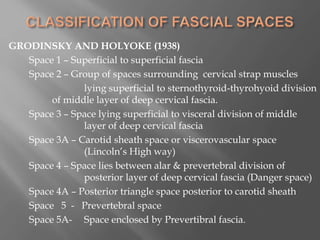
GRODINSKY AND HOLYOKE (1938)
Space 1 โ€“ Superficial to superficial fascia
Space 2 โ€“ Group of spaces surrounding cervical strap muscles
lying superficial to sternothyroid-thyrohyoid division
of middle layer of deep cervical fascia.
Space 3 โ€“ Space lying superficial to visceral division of middle
layer of deep cervical fascia
Space 3A โ€“ Carotid sheath space or viscerovascular space
(Lincolnโ€™s High way)
Space 4 โ€“ Space lies between alar & prevertebral division of
posterior layer of deep cervical fascia (Danger space)
Space 4A โ€“ Posterior triangle space posterior to carotid sheath
Space 5 - Prevertebral space
Space 5A- Space enclosed by Prevertibral fascia.
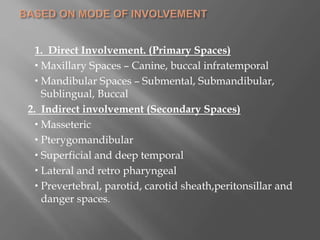
1. Direct Involvement. (Primary Spaces)
๏‚  Maxillary Spaces โ€“ Canine, buccal infratemporal
๏‚  Mandibular Spaces โ€“ Submental, Submandibular,
Sublingual, Buccal
2. Indirect involvement (Secondary Spaces)
๏‚  Masseteric
๏‚  Pterygomandibular
๏‚  Superficial and deep temporal
๏‚  Lateral and retro pharyngeal
๏‚  Prevertebral, parotid, carotid sheath,peritonsillar and
danger spaces.
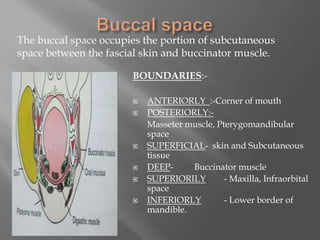
BOUNDARIES:-
๏‚จ ANTERIORLY :-Corner of mouth
๏‚จ POSTERIORLY:-
Masseter muscle, Pterygomandibular
space
๏‚จ SUPERFICIAL- skin and Subcutaneous
tissue
๏‚จ DEEP- Buccinator muscle
๏‚จ SUPERIORILY - Maxilla, Infraorbital
space
๏‚จ INFERIORLY - Lower border of
mandible.
The buccal space occupies the portion of subcutaneous
space between the fascial skin and buccinator muscle.
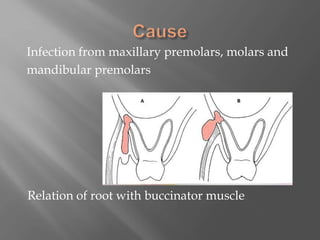
Infection from maxillary premolars, molars and
mandibular premolars
Relation of root with buccinator muscle
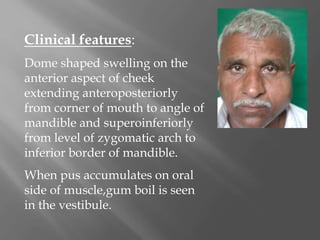
Clinical features:
Dome shaped swelling on the
anterior aspect of cheek
extending anteroposteriorly
from corner of mouth to angle of
mandible and superoinferiorly
from level of zygomatic arch to
inferior border of mandible.
When pus accumulates on oral
side of muscle,gum boil is seen
in the vestibule.
CONTENTS OF BUCCAL SPACE:-
๏‚จ Buccal pad of fat
๏‚จ Stensons (Parotid duct)
๏‚จ Anterior and transverse facial artery and vein.
MUSCLE RELATED โ€“ Buccinator muscle
Neighboring spaces- Infraorbital, pterygomandibular,
infratemporal space
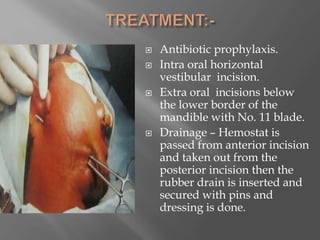
๏‚จ Antibiotic prophylaxis.
๏‚จ Intra oral horizontal
vestibular incision.
๏‚จ Extra oral incisions below
the lower border of the
mandible with No. 11 blade.
๏‚จ Drainage โ€“ Hemostat is
passed from anterior incision
and taken out from the
posterior incision then the
rubber drain is inserted and
secured with pins and
dressing is done.
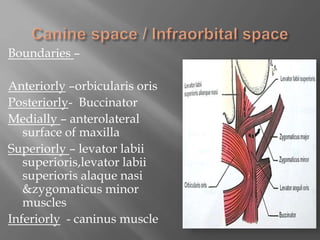
Boundaries โ€“
Anteriorly โ€“orbicularis oris
Posteriorly- Buccinator
Medially โ€“ anterolateral
surface of maxilla
Superiorly โ€“ levator labii
superioris,levator labii
superioris alaque nasi
&zygomaticus minor
muscles
Inferiorly - caninus muscle
๏‚จ Maxillary canine, rarely from maxillary first
premolar.
๏‚จ Rarely from nasal & upper lip infections.
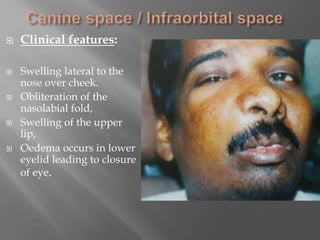
๏‚จ Clinical features:
๏‚จ Swelling lateral to the
nose over cheek.
๏‚จ Obliteration of the
nasolabial fold,
๏‚จ Swelling of the upper
lip,
๏‚จ Oedema occurs in lower
eyelid leading to closure
of eye.
Contents โ€“ Angular artery and vein,
Infraorbital nerve
Neighboring spaces โ€“ Buccal space
๏‚จ Antibiotic prophylaxis
๏‚จ Incision is made intraorally high in the
maxillary labial vestibule.
๏‚จ Small hemostat is inserted through levator
anguli oris into abcess cavity.
๏‚จ Drainage with drain secured.
Boundaries โ€“
๏‚จ Superiorly & Laterally ๏‚ฎ Temporal fascia
๏‚จ Inferiorly โ€“ Zygomatic arch
๏‚จ Medially ๏‚ฎLateral surface Temporalis
muscle
Cause
๏‚จ Infection from maxillary and mandibular
molars.
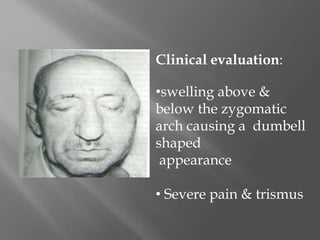
Clinical evaluation:
โ€ขswelling above &
below the zygomatic
arch causing a dumbell
shaped
appearance
โ€ข Severe pain & trismus
๏‚จ Contents- Temporal fat pad, temporal
branch of the facial nerve.
๏‚จ Neighboring spaces โ€“ Buccal , Deep
temporal.
Intraorally vertical incision made medial to the
upper extent of the anterior border of the
mandibular ramus.
๏‚จ Haemostat ๏‚ฎ passed superiorily along the lateral
aspect of the coronoid process to enter superficial
temp. space
๏‚จ Intra oral approach ๏‚ฎ good
๏‚จ Extra-oral incision ๏‚ฎ horizontal incision
๏‚จ Haemostat is passed medially to enter superficial
temporal space.
๏‚จ Drainage ๏‚ฎ drain is placed, dressing is given.
Boundaries -
๏‚จ Laterally ๏‚ฎ medial surface of temporalis m.
๏‚จ Medially ๏‚ฎ Temporal bone
๏‚จ Below the level of zygomatic arch both the
spaces communicate with each other and with
the infratemporal space.
Cause:Infection from maxillary molars
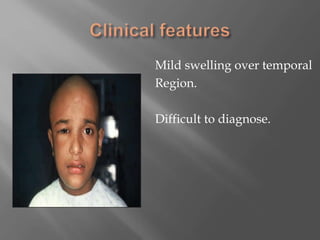
Mild swelling over temporal
Region.
Difficult to diagnose.
๏‚จ Contents
๏‚จ Pterygoid plexus, Internal maxillary artery and
vein.
๏‚จ Neighboring Spaces
๏‚จ Buccal, superficial temporal, inferior petrosal
sinus
๏‚จ Intraorally vertical incision made medial to the
upper extent of the anterior border of the
mandibular ramus.
๏‚จ Haemostat ๏‚ฎ passed supero-medially to enter
deep temporal space.
๏‚จ Through blunt dissection deep temporal space
is approached through temporalis muscle
๏‚จ Drainage ๏‚ฎ drain is placed, dressing is given.
BOUNDARIES
๏‚จ Anteriorly, -Infratemporal surface of the maxilla
๏‚จ Posteriorly,- parotid gland
๏‚จ Superiorly, - Greater wing of the sphenoid below
the infratemporal crest
๏‚จ Inferiorly, - lateral pterygoid muscle
๏‚จ Medially - medial pterygoid plate,medial pterygoid
muscle,lateral pterygoid muscle
๏‚จ Laterally, - Ramus of mandible,temporalis muscle
๏‚จ Infection from maxillary molars
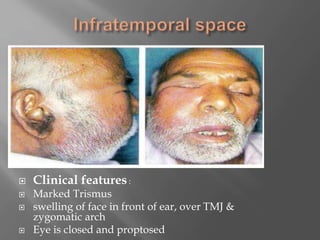
๏‚จ Clinical features :
๏‚จ Marked Trismus
๏‚จ swelling of face in front of ear, over TMJ &
zygomatic arch
๏‚จ Eye is closed and proptosed
๏‚จ Contents
๏‚จ Pterygoid plexus, Internal maxillary
artery and vein.
๏‚จ Neighboring Spaces
๏‚จ Buccal, superficial temporal, inferior petrosal
sinus
๏‚จ Intraoral and extraoral approach
๏‚จ Intraorally, incision is made into buccolabial
fold lateral to maxillary third molar.
(Kruger)
๏‚จ Curved hemostat is inserted behind max.
tuberosity superomedially within the cavity
and drain is inserted.
๏‚จ Intraorally vertical incision made medial to
the upper extent of the anterior border of the
mandibular ramus.(Laskin)
๏‚จ Curved hemostat is passed superiorly into
infratemporal region and drain is inserted.
๏‚จ Extraoral approach in presence of severe
trismus.
It consists of horizontal incision above the
zygomatic arch and then curved hemostat is
directed in inferior and medial direction to
enter infratemporal space followed by
insertion of drain.
Plain film. MRI
๏‚จ Osteomyelitis
๏‚จ Mediastenitis
๏‚จ Brain abcess
๏‚จ Meningitis
๏‚จ Cavernous sinus thrombosis
๏‚จ Scar formation
๏‚จ Sinus tract formation
We being Oral & maxillofacial surgeons must
understand anatomy of fascial spaces, spread of
infection and proper management for the
prevention of further complications and betterment
of health of the patient.
MAXILLARY SPACE INFECTION.pptx

MAXILLARY SPACE INFECTION.pptx

  • 2.
    Space infections ofhead and neck are very common in Oral and maxillofacial practice. Although most of the infections can be managed successfully with minimal or no complication, some can produce serious morbidity or even death. Depending on the virulence of microorganisms and host resistance, bacterial infections have the potential to spread beyond the bony confines of jaw bones into surrounding soft tissues.
  • 3.
    ๏‚จ Acts asa musculovenous pump- ๏‚จ Limits outward expansion of muscles as they contract. ๏‚จ Contraction of muscles compresses the intramuscular veins (push the blood towards the heart). ๏‚จ Determine the direction of spread of infection
  • 4.
    Definition - The fascialspaces in head and neck are the potential spaces between the various layers of fascia normally filled with loose connective Tissue and bounded by anatomical barriers, usually of bone, muscle or fascial layers.
  • 5.
    GRODINSKY AND HOLYOKE(1938) Space 1 โ€“ Superficial to superficial fascia Space 2 โ€“ Group of spaces surrounding cervical strap muscles lying superficial to sternothyroid-thyrohyoid division of middle layer of deep cervical fascia. Space 3 โ€“ Space lying superficial to visceral division of middle layer of deep cervical fascia Space 3A โ€“ Carotid sheath space or viscerovascular space (Lincolnโ€™s High way) Space 4 โ€“ Space lies between alar & prevertebral division of posterior layer of deep cervical fascia (Danger space) Space 4A โ€“ Posterior triangle space posterior to carotid sheath Space 5 - Prevertebral space Space 5A- Space enclosed by Prevertibral fascia.
  • 6.
    1. Direct Involvement.(Primary Spaces) ๏‚  Maxillary Spaces โ€“ Canine, buccal infratemporal ๏‚  Mandibular Spaces โ€“ Submental, Submandibular, Sublingual, Buccal 2. Indirect involvement (Secondary Spaces) ๏‚  Masseteric ๏‚  Pterygomandibular ๏‚  Superficial and deep temporal ๏‚  Lateral and retro pharyngeal ๏‚  Prevertebral, parotid, carotid sheath,peritonsillar and danger spaces.
  • 8.
    BOUNDARIES:- ๏‚จ ANTERIORLY :-Cornerof mouth ๏‚จ POSTERIORLY:- Masseter muscle, Pterygomandibular space ๏‚จ SUPERFICIAL- skin and Subcutaneous tissue ๏‚จ DEEP- Buccinator muscle ๏‚จ SUPERIORILY - Maxilla, Infraorbital space ๏‚จ INFERIORLY - Lower border of mandible. The buccal space occupies the portion of subcutaneous space between the fascial skin and buccinator muscle.
  • 9.
    Infection from maxillarypremolars, molars and mandibular premolars Relation of root with buccinator muscle
  • 10.
    Clinical features: Dome shapedswelling on the anterior aspect of cheek extending anteroposteriorly from corner of mouth to angle of mandible and superoinferiorly from level of zygomatic arch to inferior border of mandible. When pus accumulates on oral side of muscle,gum boil is seen in the vestibule.
  • 11.
    CONTENTS OF BUCCALSPACE:- ๏‚จ Buccal pad of fat ๏‚จ Stensons (Parotid duct) ๏‚จ Anterior and transverse facial artery and vein. MUSCLE RELATED โ€“ Buccinator muscle Neighboring spaces- Infraorbital, pterygomandibular, infratemporal space
  • 12.
    ๏‚จ Antibiotic prophylaxis. ๏‚จIntra oral horizontal vestibular incision. ๏‚จ Extra oral incisions below the lower border of the mandible with No. 11 blade. ๏‚จ Drainage โ€“ Hemostat is passed from anterior incision and taken out from the posterior incision then the rubber drain is inserted and secured with pins and dressing is done.
  • 13.
    Boundaries โ€“ Anteriorly โ€“orbicularisoris Posteriorly- Buccinator Medially โ€“ anterolateral surface of maxilla Superiorly โ€“ levator labii superioris,levator labii superioris alaque nasi &zygomaticus minor muscles Inferiorly - caninus muscle
  • 14.
    ๏‚จ Maxillary canine,rarely from maxillary first premolar. ๏‚จ Rarely from nasal & upper lip infections.
  • 15.
    ๏‚จ Clinical features: ๏‚จSwelling lateral to the nose over cheek. ๏‚จ Obliteration of the nasolabial fold, ๏‚จ Swelling of the upper lip, ๏‚จ Oedema occurs in lower eyelid leading to closure of eye.
  • 16.
    Contents โ€“ Angularartery and vein, Infraorbital nerve Neighboring spaces โ€“ Buccal space
  • 17.
    ๏‚จ Antibiotic prophylaxis ๏‚จIncision is made intraorally high in the maxillary labial vestibule. ๏‚จ Small hemostat is inserted through levator anguli oris into abcess cavity. ๏‚จ Drainage with drain secured.
  • 18.
    Boundaries โ€“ ๏‚จ Superiorly& Laterally ๏‚ฎ Temporal fascia ๏‚จ Inferiorly โ€“ Zygomatic arch ๏‚จ Medially ๏‚ฎLateral surface Temporalis muscle Cause ๏‚จ Infection from maxillary and mandibular molars.
  • 19.
    Clinical evaluation: โ€ขswelling above& below the zygomatic arch causing a dumbell shaped appearance โ€ข Severe pain & trismus
  • 20.
    ๏‚จ Contents- Temporalfat pad, temporal branch of the facial nerve. ๏‚จ Neighboring spaces โ€“ Buccal , Deep temporal.
  • 21.
    Intraorally vertical incisionmade medial to the upper extent of the anterior border of the mandibular ramus. ๏‚จ Haemostat ๏‚ฎ passed superiorily along the lateral aspect of the coronoid process to enter superficial temp. space ๏‚จ Intra oral approach ๏‚ฎ good ๏‚จ Extra-oral incision ๏‚ฎ horizontal incision ๏‚จ Haemostat is passed medially to enter superficial temporal space. ๏‚จ Drainage ๏‚ฎ drain is placed, dressing is given.
  • 22.
    Boundaries - ๏‚จ Laterally๏‚ฎ medial surface of temporalis m. ๏‚จ Medially ๏‚ฎ Temporal bone ๏‚จ Below the level of zygomatic arch both the spaces communicate with each other and with the infratemporal space. Cause:Infection from maxillary molars
  • 23.
    Mild swelling overtemporal Region. Difficult to diagnose.
  • 24.
    ๏‚จ Contents ๏‚จ Pterygoidplexus, Internal maxillary artery and vein. ๏‚จ Neighboring Spaces ๏‚จ Buccal, superficial temporal, inferior petrosal sinus
  • 25.
    ๏‚จ Intraorally verticalincision made medial to the upper extent of the anterior border of the mandibular ramus. ๏‚จ Haemostat ๏‚ฎ passed supero-medially to enter deep temporal space. ๏‚จ Through blunt dissection deep temporal space is approached through temporalis muscle ๏‚จ Drainage ๏‚ฎ drain is placed, dressing is given.
  • 26.
    BOUNDARIES ๏‚จ Anteriorly, -Infratemporalsurface of the maxilla ๏‚จ Posteriorly,- parotid gland ๏‚จ Superiorly, - Greater wing of the sphenoid below the infratemporal crest ๏‚จ Inferiorly, - lateral pterygoid muscle ๏‚จ Medially - medial pterygoid plate,medial pterygoid muscle,lateral pterygoid muscle ๏‚จ Laterally, - Ramus of mandible,temporalis muscle
  • 27.
    ๏‚จ Infection frommaxillary molars
  • 28.
    ๏‚จ Clinical features: ๏‚จ Marked Trismus ๏‚จ swelling of face in front of ear, over TMJ & zygomatic arch ๏‚จ Eye is closed and proptosed
  • 29.
    ๏‚จ Contents ๏‚จ Pterygoidplexus, Internal maxillary artery and vein. ๏‚จ Neighboring Spaces ๏‚จ Buccal, superficial temporal, inferior petrosal sinus
  • 30.
    ๏‚จ Intraoral andextraoral approach ๏‚จ Intraorally, incision is made into buccolabial fold lateral to maxillary third molar. (Kruger) ๏‚จ Curved hemostat is inserted behind max. tuberosity superomedially within the cavity and drain is inserted. ๏‚จ Intraorally vertical incision made medial to the upper extent of the anterior border of the mandibular ramus.(Laskin) ๏‚จ Curved hemostat is passed superiorly into infratemporal region and drain is inserted.
  • 31.
    ๏‚จ Extraoral approachin presence of severe trismus. It consists of horizontal incision above the zygomatic arch and then curved hemostat is directed in inferior and medial direction to enter infratemporal space followed by insertion of drain.
  • 32.
  • 33.
    ๏‚จ Osteomyelitis ๏‚จ Mediastenitis ๏‚จBrain abcess ๏‚จ Meningitis ๏‚จ Cavernous sinus thrombosis ๏‚จ Scar formation ๏‚จ Sinus tract formation
  • 34.
    We being Oral& maxillofacial surgeons must understand anatomy of fascial spaces, spread of infection and proper management for the prevention of further complications and betterment of health of the patient.

Editor's Notes

  • #9ย Anteriorly- orbicularis oris , zygomaticus major Deep โ€“ buccopharygeal fascial Superiorly -Zygomatic arch
  • #11ย Repated buccal space infection suspects crohnโ€™s disease
  • #14ย Anteriorly - Orbicularis oris m.
  • #22ย Intraoral apprch provides more dependent drainage and prevents contraction of temporalis fiblres againts drainage. If passed medial to coronoid process then it willenter deep temporal space Extraoral approach โ€“ if trismus is there
  • #23ย Medially- g wing of spghenoid also
  • #25ย Mandibular nerve
  • #27ย Ant- maxillary tuborosity
  • #29ย Optic neuritis is complication Pterygoid plexus makes this infection dangerous coz emmisory veins connect it to cavernous sinus ..therefore it can spread to cav sinus and can cause hdch phtpho nausea vmtn drwsns.
  • #30ย Mandibular nerve
  • #31ย Intraoral approach โ€“ krugers apprch