Muneeb Muhammed Ali
Presented on:1-2-17
1
 INTRODUCTION
 DEFINITION
 TYPES
 STAGES OF TISSUE RESPONSE TO
INJURY
 CLINICAL AND RADIOGRAPHIC
FEATURES OF TFO
 TREATMENT OF TFO
 CONCLUSION
 REFERENCE
 Trauma from occlusion is a term used to describe
pathologic alterations or adaptive changes which
develop in the periodontium as a result of undue force
produced by the masticatory muscles
 “A condition where injury results to the supporting structures of the teeth
by the act of bringing the jaws into a closed position”.
(Stillman 1917)
 When occlusal forces exceed the adaptive capacity of the tissues, tissue
injury results. this resultant injury is termed TFO.
(Orban &Glickman 1968
Carranza)
 “Damage in the periodontium caused by stress on the teeth produced
directly or indirectly by teeth of the opposing jaw”.
( WHO1978)
 An injury to the attachment apparatus as a result of excessive occlusal
force.
(Glossary of periodontic terms ,1992)
 results from an abrupt occlusal impact, such as that produced
by biting on a hard object
 In addition, restorations or prosthetic appliances that interfere
with or alter direction of occlusal forces on the teeth may
induce acute trauma
Clinical features :
1. Tooth pain.
2. Sensitivity to percussion.
3. Tooth mobility.
4. Fractured Cusp
 develops from gradual changes in
a) occlusion produced by tooth wear,
b) drifting movement
c) extrusion of teeth,
d) combined with parafunctional habits such as bruxism and
clenching .
 When the trauma from occlusion is the result of
alteration in the occlusal forces,it is called Primary
Trauma from occlusion

 Predisposes
1. Insertion of High fillings
2. Insertion of prosthetic replacement that creates
excessive force on abutments
3. Orthodontic movement of teeth into functionally
unacceptable positions
It does not Initiate pocket formation
It do not alter the level of connective tissue
attachment
This is because supracrestal gingival fibers
are not affected and therefore prevent apical
migration of junctional epithelium
 Secondary trauma from occlusion occurs when the
adaptive capacity of the tissues to withstand
occlusal forces is impaired by bone loss resulting
from marginal inflammation
 This reduces the periodontal attachment area and
alters laverage on remaining tissues
 This periodontium become more vulnerable to
injury,and previously well tolerated occlusal force
become traumatic
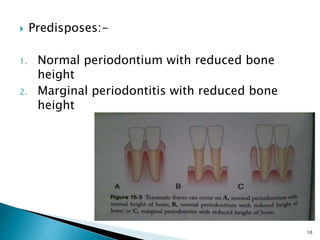
 Predisposes:-
1. Normal periodontium with reduced bone
height
2. Marginal periodontitis with reduced bone
height
10
1. Stage I:Injury
2. Stage 2:Repair
3. Stage 3:Adaptive remodelling of
periodontium
11
 When a tooth is exposed to excessive occlusal
forces,the periodontal tissues are unable to withstand
and hence they distribute,while maintaining the stability
of the tooth
 This may lead to certain well defined reactions in the
periodontal ligament and alveolar bone,eventually
resulting in adaptation of periodontal structures to
altered functional demand
12
 When the tooth is subjected to horizontal
forces the tooth rotates or tilts in the
direction of force . this tilting results in the
pressure and tension zones,within the
marginal and apical parts of the
periodontium
13
 TFO stimulates increased reparative
activity.when bone is resorbed by excessive
occlusal forces,the body attempts to reinforce
the thinned bony trabeculae with new bone
 This attempt to compensate for the lost bone is
called buttressing bone formation which is an
important feature of reparative process
associated with Trauma from occlusion
14
 Buttressing bone formation can occur within
the jaw called central buttressing and on
bony surface called as peripheral buttressing
 It usually occurs on the facial and lingual plates
of the alveolar bone,if it produces a shelf like
thickening of alveolar bone it is referred to as
lipping
15
 If the process cannot keep pace with the
destruction caused by occlusion,the
periodontium may get remodeled in order to
maintain the structural relationship
 This may result in thickened periodontal
ligament,angular defects in the bone with no
pocket formation,loose teeth and increased
vascularization
16
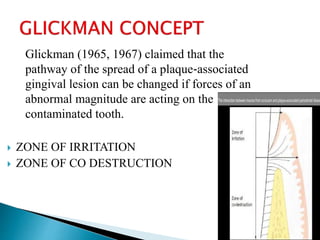
Glickman (1965, 1967) claimed that the
pathway of the spread of a plaque‐associated
gingival lesion can be changed if forces of an
abnormal magnitude are acting on the
contaminated tooth.
 ZONE OF IRRITATION
 ZONE OF CO DESTRUCTION
1
4
/
3
1
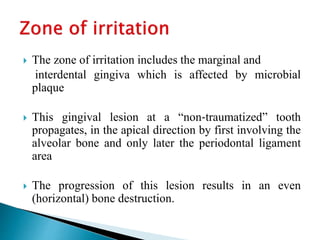
 The zone of irritation includes the marginal and
interdental gingiva which is affected by microbial
plaque
 This gingival lesion at a “non‐traumatized” tooth
propagates, in the apical direction by first involving the
alveolar bone and only later the periodontal ligament
area
 The progression of this lesion results in an even
(horizontal) bone destruction.
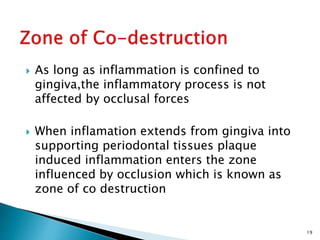
 As long as inflammation is confined to
gingiva,the inflammatory process is not
affected by occlusal forces
 When inflamation extends from gingiva into
supporting periodontal tissues plaque
induced inflammation enters the zone
influenced by occlusion which is known as
zone of co destruction
19
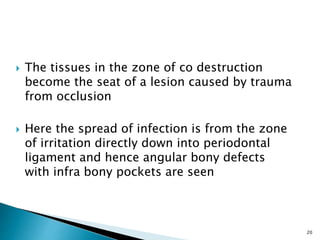
 The tissues in the zone of co destruction
become the seat of a lesion caused by trauma
from occlusion
 Here the spread of infection is from the zone
of irritation directly down into periodontal
ligament and hence angular bony defects
with infra bony pockets are seen
20
 The loss of connective attachment and bone
around teeth is, according to Waerhaug,
exclusively the result of inflammatory lesions
associated with subgingival plaque
 Waerhaug concluded that angular bony defects
and infrabony pockets occur when the subgingival
plaque of one tooth has reached a more apical
level than the plaque on the neighbouring tooth,
and when the volume of the alveolar bone
surrounding the roots is comparatively large.
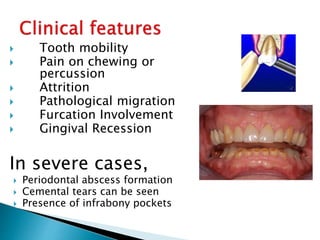
 Tooth mobility
 Pain on chewing or
percussion
 Attrition
 Pathological migration
 Furcation Involvement
 Gingival Recession
In severe cases,
 Periodontal abscess formation
 Cemental tears can be seen
 Presence of infrabony pockets
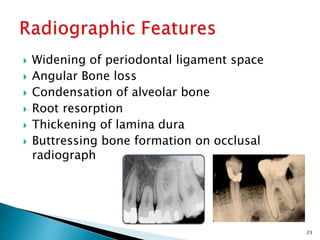
 Widening of periodontal ligament space
 Angular Bone loss
 Condensation of alveolar bone
 Root resorption
 Thickening of lamina dura
 Buttressing bone formation on occlusal
radiograph
23
 Fremitus Test
 Miller’s tooth mobility test
 Percussion test
 Articulating paper test
 Checking wear facets
24
◦ It is the measurement of vibratory pattern of the
teeth when teeth are placed in contacting
positions and movements
◦ Wet the ungloved finger and place it partially on
the gingiva and partially on teeth and ask the
patient to bite repeatedly
◦ Observe the vibration produced in lateral
protrusive movements and positions
◦ Grade the movement according to fremitus test
scale
25
 Class I : Mild vibrations or movements
detected
 Class 2:Easily palpable vibrations but no
visible movements
 Class 3:Movements visible with naked eyes
26
PROPOSED BY AAP(1996)
1. Reduce /eliminate tooth mobility
2. Eliminate occlusal prematurities
3. Eliminate parafunctional habits
4. Prevent further tooth migration
5. Permanent or Temporary splint
 Periodontal structures depend on functional occlusal forces to
activate the periodontal mechanoreceptors in the neuromuscular
physiology of the masticatory system. A traumatic occlusion on a
healthy periodontium leads to an increased mobility but not to
attachment loss. In inflamed periodontal structures traumatic
occlusion contributes to a further and faster spread of the
inflammation apically and to more bone loss.
 Abnormal forces on the tooth can increase tooth mobility.the
elimination of plaque and prevention of its formation can helps to
maintain periodontal health even if traumatic forces are allowed to
persist,however the elimination of trauma may increse chance for
bone regeneration and gain of attachment
 Carranza’s Clinical Periodontology 11th
Edition
 “Trauma from occlusion:a review’’-Dave
Rupprecht (January 2004)
 “Association of Trauma from occlusion with
localized gingival recession in mandibular
anteriors’’-Prathiba Panduranga (2009)
 “Trauma from occlusion-An orthodontist’s
perspective’’-R Saravanan (June 2010)
 “Periodontitis and TFO’’-Adriana Campos
passenazi
29
30

Trauma from occlusion

  • 1.
  • 2.
     INTRODUCTION  DEFINITION TYPES  STAGES OF TISSUE RESPONSE TO INJURY  CLINICAL AND RADIOGRAPHIC FEATURES OF TFO  TREATMENT OF TFO  CONCLUSION  REFERENCE
  • 3.
     Trauma fromocclusion is a term used to describe pathologic alterations or adaptive changes which develop in the periodontium as a result of undue force produced by the masticatory muscles
  • 4.
     “A conditionwhere injury results to the supporting structures of the teeth by the act of bringing the jaws into a closed position”. (Stillman 1917)  When occlusal forces exceed the adaptive capacity of the tissues, tissue injury results. this resultant injury is termed TFO. (Orban &Glickman 1968 Carranza)  “Damage in the periodontium caused by stress on the teeth produced directly or indirectly by teeth of the opposing jaw”. ( WHO1978)  An injury to the attachment apparatus as a result of excessive occlusal force. (Glossary of periodontic terms ,1992)
  • 5.
     results froman abrupt occlusal impact, such as that produced by biting on a hard object  In addition, restorations or prosthetic appliances that interfere with or alter direction of occlusal forces on the teeth may induce acute trauma Clinical features : 1. Tooth pain. 2. Sensitivity to percussion. 3. Tooth mobility. 4. Fractured Cusp
  • 6.
     develops fromgradual changes in a) occlusion produced by tooth wear, b) drifting movement c) extrusion of teeth, d) combined with parafunctional habits such as bruxism and clenching .
  • 7.
     When thetrauma from occlusion is the result of alteration in the occlusal forces,it is called Primary Trauma from occlusion   Predisposes 1. Insertion of High fillings 2. Insertion of prosthetic replacement that creates excessive force on abutments 3. Orthodontic movement of teeth into functionally unacceptable positions
  • 8.
    It does notInitiate pocket formation It do not alter the level of connective tissue attachment This is because supracrestal gingival fibers are not affected and therefore prevent apical migration of junctional epithelium
  • 9.
     Secondary traumafrom occlusion occurs when the adaptive capacity of the tissues to withstand occlusal forces is impaired by bone loss resulting from marginal inflammation  This reduces the periodontal attachment area and alters laverage on remaining tissues  This periodontium become more vulnerable to injury,and previously well tolerated occlusal force become traumatic
  • 10.
     Predisposes:- 1. Normalperiodontium with reduced bone height 2. Marginal periodontitis with reduced bone height 10
  • 11.
    1. Stage I:Injury 2.Stage 2:Repair 3. Stage 3:Adaptive remodelling of periodontium 11
  • 12.
     When atooth is exposed to excessive occlusal forces,the periodontal tissues are unable to withstand and hence they distribute,while maintaining the stability of the tooth  This may lead to certain well defined reactions in the periodontal ligament and alveolar bone,eventually resulting in adaptation of periodontal structures to altered functional demand 12
  • 13.
     When thetooth is subjected to horizontal forces the tooth rotates or tilts in the direction of force . this tilting results in the pressure and tension zones,within the marginal and apical parts of the periodontium 13
  • 14.
     TFO stimulatesincreased reparative activity.when bone is resorbed by excessive occlusal forces,the body attempts to reinforce the thinned bony trabeculae with new bone  This attempt to compensate for the lost bone is called buttressing bone formation which is an important feature of reparative process associated with Trauma from occlusion 14
  • 15.
     Buttressing boneformation can occur within the jaw called central buttressing and on bony surface called as peripheral buttressing  It usually occurs on the facial and lingual plates of the alveolar bone,if it produces a shelf like thickening of alveolar bone it is referred to as lipping 15
  • 16.
     If theprocess cannot keep pace with the destruction caused by occlusion,the periodontium may get remodeled in order to maintain the structural relationship  This may result in thickened periodontal ligament,angular defects in the bone with no pocket formation,loose teeth and increased vascularization 16
  • 17.
    Glickman (1965, 1967)claimed that the pathway of the spread of a plaque‐associated gingival lesion can be changed if forces of an abnormal magnitude are acting on the contaminated tooth.  ZONE OF IRRITATION  ZONE OF CO DESTRUCTION 1 4 / 3 1
  • 18.
     The zoneof irritation includes the marginal and interdental gingiva which is affected by microbial plaque  This gingival lesion at a “non‐traumatized” tooth propagates, in the apical direction by first involving the alveolar bone and only later the periodontal ligament area  The progression of this lesion results in an even (horizontal) bone destruction.
  • 19.
     As longas inflammation is confined to gingiva,the inflammatory process is not affected by occlusal forces  When inflamation extends from gingiva into supporting periodontal tissues plaque induced inflammation enters the zone influenced by occlusion which is known as zone of co destruction 19
  • 20.
     The tissuesin the zone of co destruction become the seat of a lesion caused by trauma from occlusion  Here the spread of infection is from the zone of irritation directly down into periodontal ligament and hence angular bony defects with infra bony pockets are seen 20
  • 21.
     The lossof connective attachment and bone around teeth is, according to Waerhaug, exclusively the result of inflammatory lesions associated with subgingival plaque  Waerhaug concluded that angular bony defects and infrabony pockets occur when the subgingival plaque of one tooth has reached a more apical level than the plaque on the neighbouring tooth, and when the volume of the alveolar bone surrounding the roots is comparatively large.
  • 22.
     Tooth mobility Pain on chewing or percussion  Attrition  Pathological migration  Furcation Involvement  Gingival Recession In severe cases,  Periodontal abscess formation  Cemental tears can be seen  Presence of infrabony pockets
  • 23.
     Widening ofperiodontal ligament space  Angular Bone loss  Condensation of alveolar bone  Root resorption  Thickening of lamina dura  Buttressing bone formation on occlusal radiograph 23
  • 24.
     Fremitus Test Miller’s tooth mobility test  Percussion test  Articulating paper test  Checking wear facets 24
  • 25.
    ◦ It isthe measurement of vibratory pattern of the teeth when teeth are placed in contacting positions and movements ◦ Wet the ungloved finger and place it partially on the gingiva and partially on teeth and ask the patient to bite repeatedly ◦ Observe the vibration produced in lateral protrusive movements and positions ◦ Grade the movement according to fremitus test scale 25
  • 26.
     Class I: Mild vibrations or movements detected  Class 2:Easily palpable vibrations but no visible movements  Class 3:Movements visible with naked eyes 26
  • 27.
    PROPOSED BY AAP(1996) 1.Reduce /eliminate tooth mobility 2. Eliminate occlusal prematurities 3. Eliminate parafunctional habits 4. Prevent further tooth migration 5. Permanent or Temporary splint
  • 28.
     Periodontal structuresdepend on functional occlusal forces to activate the periodontal mechanoreceptors in the neuromuscular physiology of the masticatory system. A traumatic occlusion on a healthy periodontium leads to an increased mobility but not to attachment loss. In inflamed periodontal structures traumatic occlusion contributes to a further and faster spread of the inflammation apically and to more bone loss.  Abnormal forces on the tooth can increase tooth mobility.the elimination of plaque and prevention of its formation can helps to maintain periodontal health even if traumatic forces are allowed to persist,however the elimination of trauma may increse chance for bone regeneration and gain of attachment
  • 29.
     Carranza’s ClinicalPeriodontology 11th Edition  “Trauma from occlusion:a review’’-Dave Rupprecht (January 2004)  “Association of Trauma from occlusion with localized gingival recession in mandibular anteriors’’-Prathiba Panduranga (2009)  “Trauma from occlusion-An orthodontist’s perspective’’-R Saravanan (June 2010)  “Periodontitis and TFO’’-Adriana Campos passenazi 29
  • 30.

Editor's Notes

  • #23 Injury stage: pdl destroy Adaptive stage: widening of pdl It is nt pathologic as it is body adaptive response not a disease.