Multiple myeloma
DR.SWARNITA SAHU
DNB RESIDENT
RADIATION ONCOLOGY
BATRA HOSPITAL AND MEDICAL RESEARCH CENTRE
NEW DELHI
EPIDEMIOLOGY
• PLASMA CELL NEOPLASMS- 22% OF ALL MATURE B CELL
NEOPLASMS.
 MULTIPLE MYELOMA - MAJORITY
 SOLITARY PLASMACYTOMA - <6%
 PLASMA CELL LEUKAEMIA - VERY RARELY
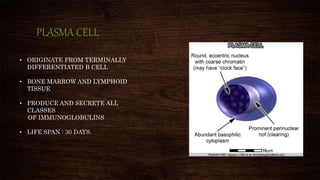
PLASMA CELL
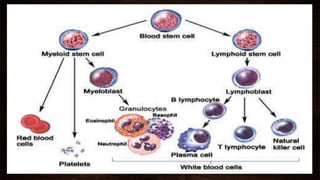
• ORIGINATE FROM TERMINALLY
DIFFERENTIATED B CELL
• BONE MARROW AND LYMPHOID
TISSUE
• PRODUCE AND SECRETE ALL
CLASSES
OF IMMUNOGLOBULINS
• LIFE SPAN : 30 DAYS.
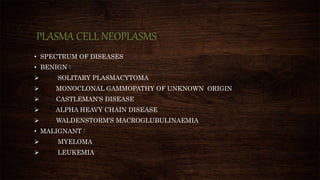
PLASMA CELL NEOPLASMS
• SPECTRUM OF DISEASES
• BENIGN :
 SOLITARY PLASMACYTOMA
 MONOCLONAL GAMMOPATHY OF UNKNOWN ORIGIN
 CASTLEMAN’S DISEASE
 ALPHA HEAVY CHAIN DISEASE
 WALDENSTORM’S MACROGLUBULINAEMIA
• MALIGNANT :
 MYELOMA
 LEUKEMIA
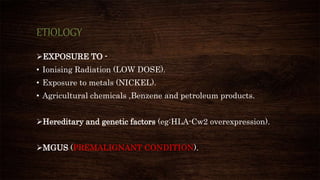
ETIOLOGY
EXPOSURE TO -
• Ionising Radiation (LOW DOSE).
• Exposure to metals (NICKEL).
• Agricultural chemicals ,Benzene and petroleum products.
Hereditary and genetic factors (eg:HLA-Cw2 overexpression).
MGUS (PREMALIGNANT CONDITION).
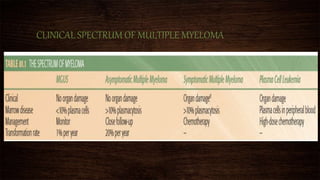
CLINICAL SPECTRUM OF MULTIPLE MYELOMA
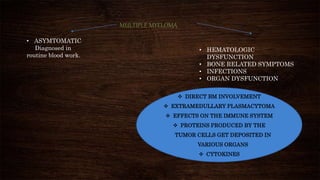
MULTIPLE MYELOMA
• ASYMTOMATIC
Diagnosed in
routine blood work.
• HEMATOLOGIC
DYSFUNCTION
• BONE RELATED SYMPTOMS
• INFECTIONS
• ORGAN DYSFUNCTION
 DIRECT BM INVOLVEMENT
 EXTRAMEDULLARY PLASMACYTOMA
 EFFECTS ON THE IMMUNE SYSTEM
 PROTEINS PRODUCED BY THE
TUMOR CELLS GET DEPOSITED IN
VARIOUS ORGANS
 CYTOKINES
ANAEMIA
Normocytic normochromic
• Tumor cells in the marrow
• Inadequate erythropoietin responsiveness
• Cytokines
• Decreased renal function-----decreased
erythropoiesis
• Increased Igg levels---dilutional effects.
• Fatigue
• Weakness
• Occasional shortness of breath
Rx- ERYTHROPOIETIN ADMINISTRATION (IMP SUPPORTIVE CARE)
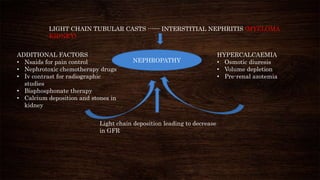
NEPHROPATHY
LIGHT CHAIN TUBULAR CASTS ------ INTERSTITIAL NEPHRITIS (MYELOMA
KIDNEY)
ADDITIONAL FACTORS
• Nsaids for pain control
• Nephrotoxic chemotherapy drugs
• Iv contrast for radiographic
studies
• Bisphosphonate therapy
• Calcium deposition and stones in
kidney
HYPERCALCAEMIA
• Osmotic diuresis
• Volume depletion
• Pre-renal azotemia
Light chain deposition leading to decrease
in GFR
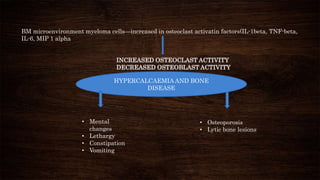
HYPERCALCAEMIA AND BONE
DISEASE
• Osteoporosis
• Lytic bone lesions
• Mental
changes
• Lethargy
• Constipation
• Vomiting
BM microenvironment myeloma cells—increased in osteoclast activatin factors(IL-1beta, TNF-beta,
IL-6, MIP 1 alpha
INCREASED OSTEOCLAST ACTIVITY
DECREASED OSTEOBLAST ACTIVITY
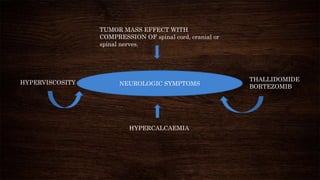
NEUROLOGIC SYMPTOMS
HYPERCALCAEMIA
HYPERVISCOSITY
THALLIDOMIDE
BORTEZOMIB
TUMOR MASS EFFECT WITH
COMPRESSION OF spinal cord, cranial or
spinal nerves.
HYPERVISCOSITY COAGULOPATHY
• Increased production of
immunoglobulins
• Increased levels of
paraproteins interfering
normal coagulation
• Thrombosis(d/t
hyperviscosity)
• Platelet dysfunction
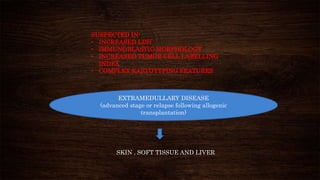
EXTRAMEDULLARY DISEASE
(advanced stage or relapse following allogenic
transplantation)
SKIN , SOFT TISSUE AND LIVER
SUSPECTED IN:
• INCREASED LDH
• IMMUNOBLASTIC MORPHOLOGY
• INCREASED TUMOR CELL LABELLING
INDEX
• COMPLEX KARYOTYPING FEATURES
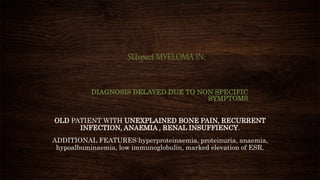
SUspect MYELOMA IN:
DIAGNOSIS DELAYED DUE TO NON SPECIFIC
SYMPTOMS
OLD PATIENT WITH UNEXPLAINED BONE PAIN, RECURRENT
INFECTION, ANAEMIA , RENAL INSUFFIENCY.
ADDITIONAL FEATURES:hyperproteinaemia, proteinuria, anaemia,
hypoalbuminaemia, low immunoglobulin, marked elevation of ESR.
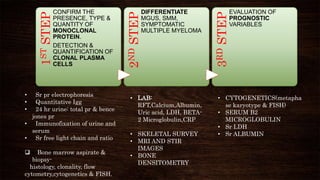
1STSTEP
CONFIRM THE
PRESENCE, TYPE &
QUANTITY OF
MONOCLONAL
PROTEIN.
DETECTION &
QUANTIFICATION OF
CLONAL PLASMA
CELLS
2NDSTEP
DIFFERENTIATE
MGUS, SMM,
SYMPTOMATIC
MULTIPLE MYELOMA
3RDSTEP
EVALUATION OF
PROGNOSTIC
VARIABLES
• LAB:
RFT,Calcium,Albumin,
Uric acid, LDH, BETA-
2 Microglobulin,CRP
• SKELETAL SURVEY
• MRI AND STIR
IMAGES
• BONE
DENSITOMETRY
• CYTOGENETICS(metapha
se karyotype & FISH)
• SERUM B2
MICROGLOBULIN
• Sr LDH
• Sr ALBUMIN
• Sr pr electrophoresis
• Quantitative Igg
• 24 hr urine: total pr & bence
jones pr
• Immunofixation of urine and
serum
• Sr free light chain and ratio
 Bone marrow aspirate &
biopsy-
histology, clonality, flow
cytometry,cytogenetics & FISH.
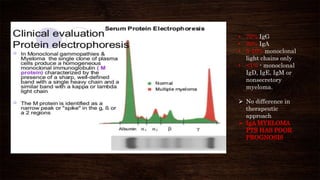
• 70% IgG
• 20% IgA
• 5-10% monoclonal
light chains only
• <1% - monoclonal
IgD, IgE, IgM or
nonsecretory
myeloma.
 No difference in
therapeutic
approach
 IgA MYELOMA
PTS HAS POOR
PROGNOSIS
RADIOGRAPHIC EVALUATION
• SKELETAL SURVEY:A skeletal survey is comprised of various x-rays of all the bones in the body.
Typically, this procedure involves radiographs of the skull, spine, humeri, ribs, pelvis and femora.
 Osteopenia in early stages
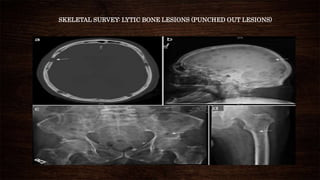
 Lytic bone lesions in advanced disease
 Osteosclerotic lesions in POEMS syndrome.(exception)
• BONE SCAN: NOT USEFUL
 Due to predominant osteoclastic acivity and OSTEOBLASTIC INACTIVITY.
• DEXA SCAN: IMPORTANT TOOL
 measurement of bone mineral density by dual energy X-ray absorptiometry detects osteopenia.
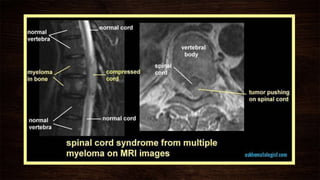
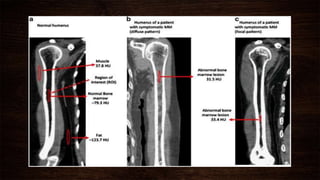
• MRI:
 Spine and pelvis-in all patients with solitary plasmacytoma and SMM( detect occult and progression)
 Defines pattern of marrow inv-diffuse /focal
 Cord compression
• PET:
 Detection of extraosseous soft tissue masses
 Evaluation of ribs and appendicular bone lesions.
SKELETAL SURVEY: LYTIC BONE LESIONS (PUNCHED OUT LESIONS)
DIAGNOSTIC CRITERIA FOR MYELOMA AND
ITS VARIANTS
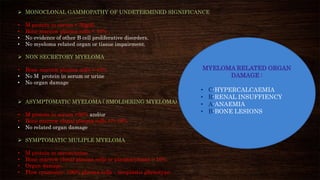
 MONOCLONAL GAMMOPATHY OF UNDETERMINED SIGNIFICANCE
• M protein in serum < 30g/dl.
• Bone marrow plasma cells < 10% .
• No evidence of other B cell proliferative disorders.
• No myeloma related organ or tissue impairment.
 NON SECRETORY MYELOMA
• Bone marrow plasma cells > 10%
• No M protein in serum or urine
• No organ damage
 ASYMPTOMATIC MYELOMA ( SMOLDERING MYELOMA)
• M protein in serum >30% and/or
• Bone marrow clonal plasma cells >/= 10%.
• No related organ damage
 SYMPTOMATIC MULIPLE MYELOMA
• M protein in serum/urine.
• Bone marrow clonal plasma cells or plasmacytoma > 10%.
• Organ damage.
• Flow cytometry: >90% plasma cells – neoplastic phenotype.
MYELOMA RELATED ORGAN
DAMAGE :
• C-HYPERCALCAEMIA
• R-RENAL INSUFFIENCY
• A-ANAEMIA
• B-BONE LESIONS
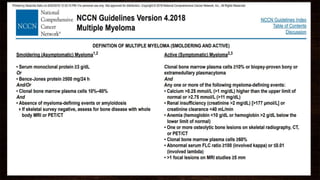
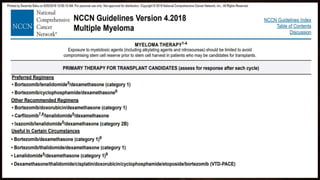
UPDATE (NCCN)
Active multiple myeloma is no longer diagnosed using the CRAB criteria for end-
organ damage. The current diagnostic criteria are as follows
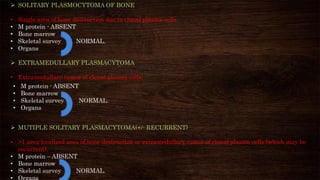
 SOLITARY PLASMOCYTOMA OF BONE
• Single area of bone destruction due to clonal plasma cells
• M protein - ABSENT
• Bone marrow
• Skeletal survey NORMAL.
• Organs
 EXTRAMEDULLARY PLASMACYTOMA
• Extramedullary tumor of clonal plasma cells.
 MUTIPLE SOLITARY PLASMACYTOMA(+/- RECURRENT)
• >1 area localized area of bone destruction or extramedullary tumor of clonal plasma cells (which may be
recurrent).
• M protein – ABSENT
• Bone marrow
• Skeletal survey NORMAL.
• Organs
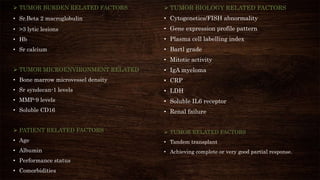
PROGNOSTIC VARIABLES
 TUMOR BURDEN RELATED FACTORS
• Sr.Beta 2 macroglobulin
• >3 lytic lesions
• Hb
• Sr calcium
 TUMOR MICROENVIRONMENT RELATED
• Bone marrow microvessel density
• Sr syndecan-1 levels
• MMP-9 levels
• Soluble CD16
 PATIENT RELATED FACTORS
• Age
• Albumin
• Performance status
• Comorbidities
 TUMOR BIOLOGY RELATED FACTORS
• Cytogenetics/FISH abnormality
• Gene expression profile pattern
• Plasma cell labelling index
• Bartl grade
• Mitotic activity
• IgA myeloma
• CRP
• LDH
• Soluble IL6 receptor
• Renal failure
 TUMOR RELATED FACTORS
• Tandem transplant
• Achieving complete or very good partial response.
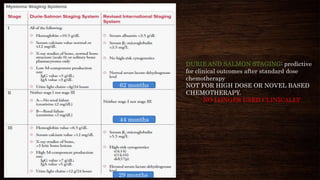
DURIE AND SALMON STAGING: predictive
for clinical outcomes after standard dose
chemotherapy
NOT FOR HIGH DOSE OR NOVEL BASED
CHEMOTHERAPY.
NO LONGER USED CLINICALLY
62 months
44 months
29 months
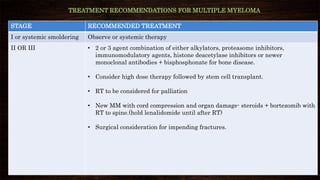
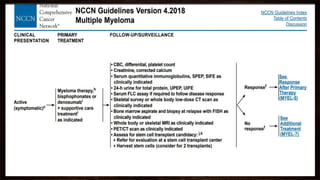
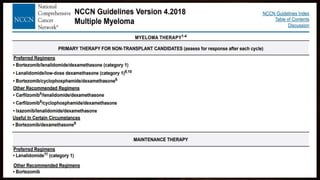
TREATMENT
STAGE RECOMMENDED TREATMENT
I or systemic smoldering Observe or systemic therapy
II OR III • 2 or 3 agent combination of either alkylators, proteasome inhibitors,
immunomodulatory agents, histone deacetylase inhibitors or newer
monoclonal antibodies + bisphosphonate for bone disease.
• Consider high dose therapy followed by stem cell transplant.
• RT to be considered for palliation
• New MM with cord compression and organ damage- steroids + bortezomib with
RT to spine.(hold lenalidomide until after RT)
• Surgical consideration for impending fractures.
TREATMENT RECOMMENDATIONS FOR MULTIPLE MYELOMA
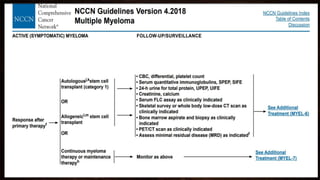
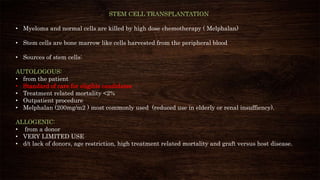
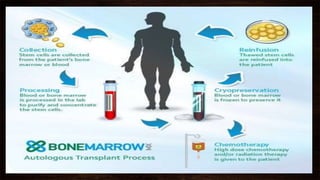
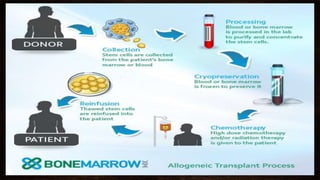
STEM CELL TRANSPLANTATION
• Myeloma and normal cells are killed by high dose chemotherapy ( Melphalan)
• Stem cells are bone marrow like cells harvested from the peripheral blood
• Sources of stem cells:
AUTOLOGOUS:
• from the patient
• Standard of care for eligible candidates
• Treatment related mortality <2%
• Outpatient procedure
• Melphalan (200mg/m2 ) most commonly used (reduced use in elderly or renal insuffiency).
ALLOGENIC:
• from a donor
• VERY LIMITED USE
• d/t lack of donors, age restriction, high treatment related mortality and graft versus host disease.
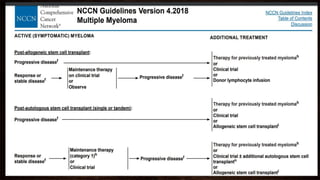
TANDEM TRANSPLANTATION
• Tandem/second transplant : planned second ASCT
• Tandem vs single transplant : overall survival better with
tandem.
• To be considered in patients with suboptimal response to
the first ASCT.
RELAPSE AFTER ASCT
CONVENTIONAL THERAPY:
• Repeated course of alkylator based therapy(melphalan).
• Cyclophosphamide and steroids
TRANSPLANTATION:
• Second autologous stem cell transplant
HIGH DOSE CHEMOTHERAPY:
• High dose cyclophosphamide
• DTPACE (dexamethasone, thalidomide, cisplatin, doxorubicin, cyclophosphamide, etoposide)
NOVEL AGENTS:
• Thalidomide
• Bortezomib
• Lenalidomide
COMBINATION OF CONVENTIONAL & NOVEL AGENT.
RADIATION THERAPY IN MULTIPLE
MYELOMA
• Considered mainstay of treatment prior to chemotherapeutic
options.
• NOW – VERY LIMITED ROLE in multiple myeloma.
• Definitive role – solitary bone and extramedullary
plasmacytoma.
TOTAL BODY IRRADIATION
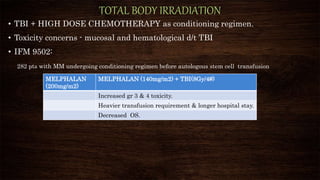
• TBI + HIGH DOSE CHEMOTHERAPY as conditioning regimen.
• Toxicity concerns - mucosal and hematological d/t TBI
• IFM 9502:
282 pts with MM undergoing conditioning regimen before autologous stem cell transfusion
MELPHALAN
(200mg/m2)
MELPHALAN (140mg/m2) + TBI(8Gy/4#)
Increased gr 3 & 4 toxicity.
Heavier transfusion requirement & longer hospital stay.
Decreased OS.
HEMIBODY IRRADIATION
• Palliation of diffuse bone pain.
• 5-8Gy in single #.
• UNIRRADIATED MARROW: serves as stem cells which
repopulated the irradiated marrow after treatment.
• RARELY USED NOW.
• Remain useful for palliation of advanced disease in
chemotherapy refractory patients.
LOCAL EBRT FOR PALLIATION:
• Most common use of radiotherapy.
• Relief of compression of spinal / cranial / peripheral nerves.
• Reduces incidence of impending fractures.
ROLE UNCLEAR
High risk lesions - referred for surgical stabilization.
RT preferred for RESIDUAL disease ,post surgery.
• Bone lesions- treat entire bone except for long bones and pelvis (to decrease
the dose in bone marrow)
• Vertebrae- treat 1-2 vertebrae above and below the diseased vertebrae
• PAIN- 10-20Gy/5-10# - pain relief is often partial.
• SPINAL CORD COMPRESSION- Motor improvement in 50% of the
patients.
(30Gy/10# better neurologic response than 20Gy/5# or 8Gy/1#)
RADIOIMMUNOTHERAPY APPROACHES (TARGETED RADIATION
THERAPY)
• SAMARIUM
• HOLIUM
• Emits gamma rays- permitting scanning to locate areas of
uptake
• Agents used for palliation
• Higher doses than TBI can be given
• 30-60Gy (sparing dose limiting normal tissues-lung, mucosa,
kidneys)
SUPPORTIVE CARE
• Erythropoietic agents.
• Bisphosphonates (even has an effect on overall survival).
• Local RT.
• Newer surgical techniques: vertebroplasty & kyphoplasty.
Multiple myeloma
Multiple myeloma

Multiple myeloma

  • 1.
    Multiple myeloma DR.SWARNITA SAHU DNBRESIDENT RADIATION ONCOLOGY BATRA HOSPITAL AND MEDICAL RESEARCH CENTRE NEW DELHI
  • 2.
    EPIDEMIOLOGY • PLASMA CELLNEOPLASMS- 22% OF ALL MATURE B CELL NEOPLASMS.  MULTIPLE MYELOMA - MAJORITY  SOLITARY PLASMACYTOMA - <6%  PLASMA CELL LEUKAEMIA - VERY RARELY
  • 4.
    PLASMA CELL • ORIGINATEFROM TERMINALLY DIFFERENTIATED B CELL • BONE MARROW AND LYMPHOID TISSUE • PRODUCE AND SECRETE ALL CLASSES OF IMMUNOGLOBULINS • LIFE SPAN : 30 DAYS.
  • 5.
    PLASMA CELL NEOPLASMS •SPECTRUM OF DISEASES • BENIGN :  SOLITARY PLASMACYTOMA  MONOCLONAL GAMMOPATHY OF UNKNOWN ORIGIN  CASTLEMAN’S DISEASE  ALPHA HEAVY CHAIN DISEASE  WALDENSTORM’S MACROGLUBULINAEMIA • MALIGNANT :  MYELOMA  LEUKEMIA
  • 6.
    ETIOLOGY EXPOSURE TO - •Ionising Radiation (LOW DOSE). • Exposure to metals (NICKEL). • Agricultural chemicals ,Benzene and petroleum products. Hereditary and genetic factors (eg:HLA-Cw2 overexpression). MGUS (PREMALIGNANT CONDITION).
  • 7.
    CLINICAL SPECTRUM OFMULTIPLE MYELOMA
  • 8.
    MULTIPLE MYELOMA • ASYMTOMATIC Diagnosedin routine blood work. • HEMATOLOGIC DYSFUNCTION • BONE RELATED SYMPTOMS • INFECTIONS • ORGAN DYSFUNCTION  DIRECT BM INVOLVEMENT  EXTRAMEDULLARY PLASMACYTOMA  EFFECTS ON THE IMMUNE SYSTEM  PROTEINS PRODUCED BY THE TUMOR CELLS GET DEPOSITED IN VARIOUS ORGANS  CYTOKINES
  • 10.
    ANAEMIA Normocytic normochromic • Tumorcells in the marrow • Inadequate erythropoietin responsiveness • Cytokines • Decreased renal function-----decreased erythropoiesis • Increased Igg levels---dilutional effects. • Fatigue • Weakness • Occasional shortness of breath Rx- ERYTHROPOIETIN ADMINISTRATION (IMP SUPPORTIVE CARE)
  • 11.
    NEPHROPATHY LIGHT CHAIN TUBULARCASTS ------ INTERSTITIAL NEPHRITIS (MYELOMA KIDNEY) ADDITIONAL FACTORS • Nsaids for pain control • Nephrotoxic chemotherapy drugs • Iv contrast for radiographic studies • Bisphosphonate therapy • Calcium deposition and stones in kidney HYPERCALCAEMIA • Osmotic diuresis • Volume depletion • Pre-renal azotemia Light chain deposition leading to decrease in GFR
  • 12.
    HYPERCALCAEMIA AND BONE DISEASE •Osteoporosis • Lytic bone lesions • Mental changes • Lethargy • Constipation • Vomiting BM microenvironment myeloma cells—increased in osteoclast activatin factors(IL-1beta, TNF-beta, IL-6, MIP 1 alpha INCREASED OSTEOCLAST ACTIVITY DECREASED OSTEOBLAST ACTIVITY
  • 13.
    NEUROLOGIC SYMPTOMS HYPERCALCAEMIA HYPERVISCOSITY THALLIDOMIDE BORTEZOMIB TUMOR MASSEFFECT WITH COMPRESSION OF spinal cord, cranial or spinal nerves.
  • 14.
    HYPERVISCOSITY COAGULOPATHY • Increasedproduction of immunoglobulins • Increased levels of paraproteins interfering normal coagulation • Thrombosis(d/t hyperviscosity) • Platelet dysfunction
  • 15.
    EXTRAMEDULLARY DISEASE (advanced stageor relapse following allogenic transplantation) SKIN , SOFT TISSUE AND LIVER SUSPECTED IN: • INCREASED LDH • IMMUNOBLASTIC MORPHOLOGY • INCREASED TUMOR CELL LABELLING INDEX • COMPLEX KARYOTYPING FEATURES
  • 16.
    SUspect MYELOMA IN: DIAGNOSISDELAYED DUE TO NON SPECIFIC SYMPTOMS OLD PATIENT WITH UNEXPLAINED BONE PAIN, RECURRENT INFECTION, ANAEMIA , RENAL INSUFFIENCY. ADDITIONAL FEATURES:hyperproteinaemia, proteinuria, anaemia, hypoalbuminaemia, low immunoglobulin, marked elevation of ESR.
  • 18.
    1STSTEP CONFIRM THE PRESENCE, TYPE& QUANTITY OF MONOCLONAL PROTEIN. DETECTION & QUANTIFICATION OF CLONAL PLASMA CELLS 2NDSTEP DIFFERENTIATE MGUS, SMM, SYMPTOMATIC MULTIPLE MYELOMA 3RDSTEP EVALUATION OF PROGNOSTIC VARIABLES • LAB: RFT,Calcium,Albumin, Uric acid, LDH, BETA- 2 Microglobulin,CRP • SKELETAL SURVEY • MRI AND STIR IMAGES • BONE DENSITOMETRY • CYTOGENETICS(metapha se karyotype & FISH) • SERUM B2 MICROGLOBULIN • Sr LDH • Sr ALBUMIN • Sr pr electrophoresis • Quantitative Igg • 24 hr urine: total pr & bence jones pr • Immunofixation of urine and serum • Sr free light chain and ratio  Bone marrow aspirate & biopsy- histology, clonality, flow cytometry,cytogenetics & FISH.
  • 19.
    • 70% IgG •20% IgA • 5-10% monoclonal light chains only • <1% - monoclonal IgD, IgE, IgM or nonsecretory myeloma.  No difference in therapeutic approach  IgA MYELOMA PTS HAS POOR PROGNOSIS
  • 21.
    RADIOGRAPHIC EVALUATION • SKELETALSURVEY:A skeletal survey is comprised of various x-rays of all the bones in the body. Typically, this procedure involves radiographs of the skull, spine, humeri, ribs, pelvis and femora.  Osteopenia in early stages  Lytic bone lesions in advanced disease  Osteosclerotic lesions in POEMS syndrome.(exception) • BONE SCAN: NOT USEFUL  Due to predominant osteoclastic acivity and OSTEOBLASTIC INACTIVITY. • DEXA SCAN: IMPORTANT TOOL  measurement of bone mineral density by dual energy X-ray absorptiometry detects osteopenia. • MRI:  Spine and pelvis-in all patients with solitary plasmacytoma and SMM( detect occult and progression)  Defines pattern of marrow inv-diffuse /focal  Cord compression • PET:  Detection of extraosseous soft tissue masses  Evaluation of ribs and appendicular bone lesions.
  • 22.
    SKELETAL SURVEY: LYTICBONE LESIONS (PUNCHED OUT LESIONS)
  • 25.
    DIAGNOSTIC CRITERIA FORMYELOMA AND ITS VARIANTS
  • 26.
     MONOCLONAL GAMMOPATHYOF UNDETERMINED SIGNIFICANCE • M protein in serum < 30g/dl. • Bone marrow plasma cells < 10% . • No evidence of other B cell proliferative disorders. • No myeloma related organ or tissue impairment.  NON SECRETORY MYELOMA • Bone marrow plasma cells > 10% • No M protein in serum or urine • No organ damage  ASYMPTOMATIC MYELOMA ( SMOLDERING MYELOMA) • M protein in serum >30% and/or • Bone marrow clonal plasma cells >/= 10%. • No related organ damage  SYMPTOMATIC MULIPLE MYELOMA • M protein in serum/urine. • Bone marrow clonal plasma cells or plasmacytoma > 10%. • Organ damage. • Flow cytometry: >90% plasma cells – neoplastic phenotype. MYELOMA RELATED ORGAN DAMAGE : • C-HYPERCALCAEMIA • R-RENAL INSUFFIENCY • A-ANAEMIA • B-BONE LESIONS
  • 27.
    UPDATE (NCCN) Active multiplemyeloma is no longer diagnosed using the CRAB criteria for end- organ damage. The current diagnostic criteria are as follows
  • 29.
     SOLITARY PLASMOCYTOMAOF BONE • Single area of bone destruction due to clonal plasma cells • M protein - ABSENT • Bone marrow • Skeletal survey NORMAL. • Organs  EXTRAMEDULLARY PLASMACYTOMA • Extramedullary tumor of clonal plasma cells.  MUTIPLE SOLITARY PLASMACYTOMA(+/- RECURRENT) • >1 area localized area of bone destruction or extramedullary tumor of clonal plasma cells (which may be recurrent). • M protein – ABSENT • Bone marrow • Skeletal survey NORMAL. • Organs
  • 30.
  • 31.
     TUMOR BURDENRELATED FACTORS • Sr.Beta 2 macroglobulin • >3 lytic lesions • Hb • Sr calcium  TUMOR MICROENVIRONMENT RELATED • Bone marrow microvessel density • Sr syndecan-1 levels • MMP-9 levels • Soluble CD16  PATIENT RELATED FACTORS • Age • Albumin • Performance status • Comorbidities  TUMOR BIOLOGY RELATED FACTORS • Cytogenetics/FISH abnormality • Gene expression profile pattern • Plasma cell labelling index • Bartl grade • Mitotic activity • IgA myeloma • CRP • LDH • Soluble IL6 receptor • Renal failure  TUMOR RELATED FACTORS • Tandem transplant • Achieving complete or very good partial response.
  • 32.
    DURIE AND SALMONSTAGING: predictive for clinical outcomes after standard dose chemotherapy NOT FOR HIGH DOSE OR NOVEL BASED CHEMOTHERAPY. NO LONGER USED CLINICALLY 62 months 44 months 29 months
  • 33.
  • 34.
    STAGE RECOMMENDED TREATMENT Ior systemic smoldering Observe or systemic therapy II OR III • 2 or 3 agent combination of either alkylators, proteasome inhibitors, immunomodulatory agents, histone deacetylase inhibitors or newer monoclonal antibodies + bisphosphonate for bone disease. • Consider high dose therapy followed by stem cell transplant. • RT to be considered for palliation • New MM with cord compression and organ damage- steroids + bortezomib with RT to spine.(hold lenalidomide until after RT) • Surgical consideration for impending fractures. TREATMENT RECOMMENDATIONS FOR MULTIPLE MYELOMA
  • 40.
    STEM CELL TRANSPLANTATION •Myeloma and normal cells are killed by high dose chemotherapy ( Melphalan) • Stem cells are bone marrow like cells harvested from the peripheral blood • Sources of stem cells: AUTOLOGOUS: • from the patient • Standard of care for eligible candidates • Treatment related mortality <2% • Outpatient procedure • Melphalan (200mg/m2 ) most commonly used (reduced use in elderly or renal insuffiency). ALLOGENIC: • from a donor • VERY LIMITED USE • d/t lack of donors, age restriction, high treatment related mortality and graft versus host disease.
  • 43.
    TANDEM TRANSPLANTATION • Tandem/secondtransplant : planned second ASCT • Tandem vs single transplant : overall survival better with tandem. • To be considered in patients with suboptimal response to the first ASCT.
  • 44.
    RELAPSE AFTER ASCT CONVENTIONALTHERAPY: • Repeated course of alkylator based therapy(melphalan). • Cyclophosphamide and steroids TRANSPLANTATION: • Second autologous stem cell transplant HIGH DOSE CHEMOTHERAPY: • High dose cyclophosphamide • DTPACE (dexamethasone, thalidomide, cisplatin, doxorubicin, cyclophosphamide, etoposide) NOVEL AGENTS: • Thalidomide • Bortezomib • Lenalidomide COMBINATION OF CONVENTIONAL & NOVEL AGENT.
  • 45.
    RADIATION THERAPY INMULTIPLE MYELOMA
  • 46.
    • Considered mainstayof treatment prior to chemotherapeutic options. • NOW – VERY LIMITED ROLE in multiple myeloma. • Definitive role – solitary bone and extramedullary plasmacytoma.
  • 47.
    TOTAL BODY IRRADIATION •TBI + HIGH DOSE CHEMOTHERAPY as conditioning regimen. • Toxicity concerns - mucosal and hematological d/t TBI • IFM 9502: 282 pts with MM undergoing conditioning regimen before autologous stem cell transfusion MELPHALAN (200mg/m2) MELPHALAN (140mg/m2) + TBI(8Gy/4#) Increased gr 3 & 4 toxicity. Heavier transfusion requirement & longer hospital stay. Decreased OS.
  • 48.
    HEMIBODY IRRADIATION • Palliationof diffuse bone pain. • 5-8Gy in single #. • UNIRRADIATED MARROW: serves as stem cells which repopulated the irradiated marrow after treatment. • RARELY USED NOW. • Remain useful for palliation of advanced disease in chemotherapy refractory patients.
  • 49.
    LOCAL EBRT FORPALLIATION: • Most common use of radiotherapy. • Relief of compression of spinal / cranial / peripheral nerves. • Reduces incidence of impending fractures. ROLE UNCLEAR High risk lesions - referred for surgical stabilization. RT preferred for RESIDUAL disease ,post surgery. • Bone lesions- treat entire bone except for long bones and pelvis (to decrease the dose in bone marrow) • Vertebrae- treat 1-2 vertebrae above and below the diseased vertebrae • PAIN- 10-20Gy/5-10# - pain relief is often partial. • SPINAL CORD COMPRESSION- Motor improvement in 50% of the patients. (30Gy/10# better neurologic response than 20Gy/5# or 8Gy/1#)
  • 50.
    RADIOIMMUNOTHERAPY APPROACHES (TARGETEDRADIATION THERAPY) • SAMARIUM • HOLIUM • Emits gamma rays- permitting scanning to locate areas of uptake • Agents used for palliation • Higher doses than TBI can be given • 30-60Gy (sparing dose limiting normal tissues-lung, mucosa, kidneys)
  • 51.
    SUPPORTIVE CARE • Erythropoieticagents. • Bisphosphonates (even has an effect on overall survival). • Local RT. • Newer surgical techniques: vertebroplasty & kyphoplasty.

Editor's Notes

  • #17 Low igg – specific type due to increase in other igg
  • #19 Free light chains- diagnostic value and can assess the effect of therapy and is of specific significance in nonsecretory myeloma,mgus,or light chain myeloma. Derranged k/lambda ratio
  • #24 WHITE COLOR---SPINAL FLUID
  • #25 RADIODENSITY….