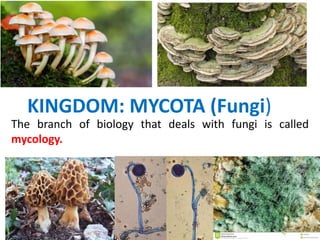
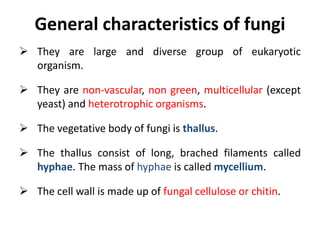
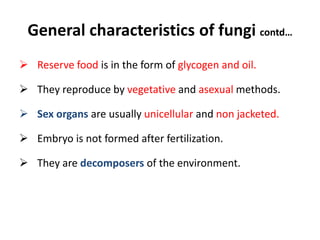
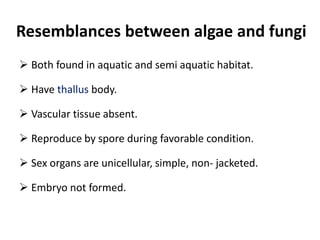
KINGDOM: MYCOTA (Fungi)
The branch of biology that deals with fungi is called
mycology.
General characteristics of fungi
 They are large and diverse group of eukaryotic
organism.
 They are non-vascular, non green, multicellular (except
yeast) and heterotrophic organisms.
 The vegetative body of fungi is thallus.
 The thallus consist of long, brached filaments called
hyphae. The mass of hyphae is called mycellium.
 The cell wall is made up of fungal cellulose or chitin.
General characteristics of fungi contd…
 Reserve food is in the form of glycogen and oil.
 They reproduce by vegetative and asexual methods.
 Sex organs are usually unicellular and non jacketed.
 Embryo is not formed after fertilization.
 They are decomposers of the environment.
Resemblances between algae and fungi
 Both found in aquatic and semi aquatic habitat.
 Have thallus body.
 Vascular tissue absent.
 Reproduce by spore during favorable condition.
 Sex organs are unicellular, simple, non- jacketed.
 Embryo not formed.
Mode of nutrition in fungi
 Fungi lack chlorophyll and they depend upon other
organism for their food. (heterotrophic mode of
nutrition)
 Their nutrition involves absorption of soluble substances.
 They are either saprophytes or parasites or symbionts.
Mode of nutrition in fungi contd..
1. Saprophytic fungi:
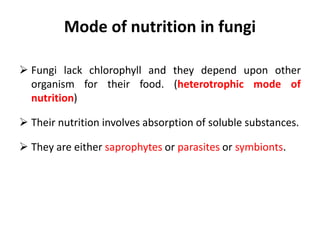
 They absorb food from dead and
decaying organic matter.
 Some of them die without
decaying organic matter are called
obligate saprophytes. Eg. Mucor.
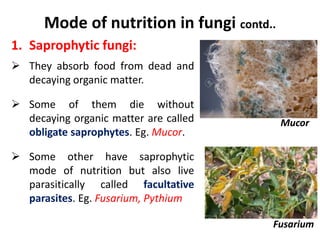
 Some other have saprophytic
mode of nutrition but also live
parasitically called facultative
parasites. Eg. Fusarium, Pythium
Mucor
Fusarium
Mode of nutrition in fungi contd..
2. Parasitic fungi:
 They obtain their food from the
host or protoplasm of the living
plants or animals.
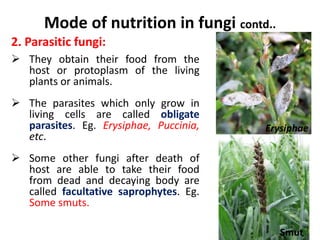
 The parasites which only grow in
living cells are called obligate
parasites. Eg. Erysiphae, Puccinia,
etc.
 Some other fungi after death of
host are able to take their food
from dead and decaying body are
called facultative saprophytes. Eg.
Some smuts.
Erysiphae
Smut
Mode of nutrition in fungi contd..
3. Symbiotic fungi:
 Some fungi from partnerships with
other group of plants by which both
the plants and fungi are benefited.
 This type of association is called
symbiosis and such fungi are called
symbiotic fungi. E.g. Mycorrhiza.
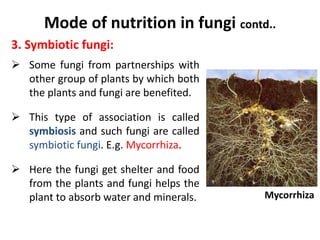
 Here the fungi get shelter and food
from the plants and fungi helps the
plant to absorb water and minerals. Mycorrhiza
Reproduction in fungi:
 By vegetative, asexual and sexual methods.
Vegetative Reproduction
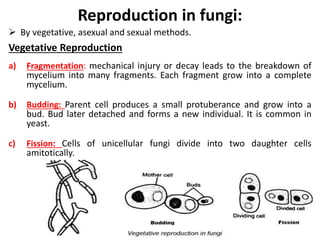
a) Fragmentation: mechanical injury or decay leads to the breakdown of
mycelium into many fragments. Each fragment grow into a complete
mycelium.
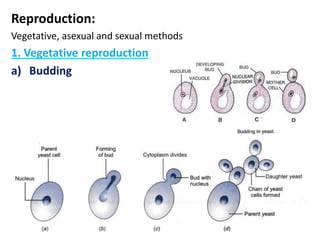
b) Budding: Parent cell produces a small protuberance and grow into a
bud. Bud later detached and forms a new individual. It is common in
yeast.
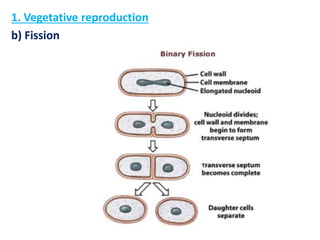
c) Fission: Cells of unicellular fungi divide into two daughter cells
amitotically.
Asexual reproduction:
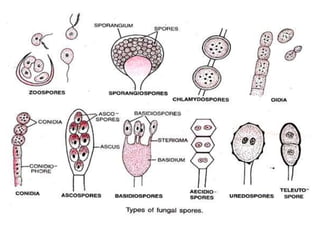
It takes place by the formation of spores.
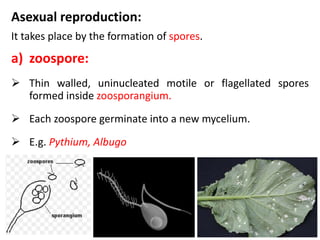
a) zoospore:
 Thin walled, uninucleated motile or flagellated spores
formed inside zoosporangium.
 Each zoospore germinate into a new mycelium.
 E.g. Pythium, Albugo
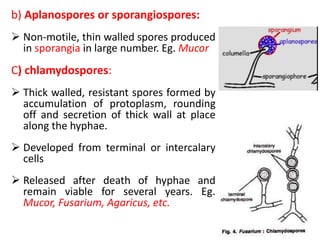
b) Aplanospores or sporangiospores:
 Non-motile, thin walled spores produced
in sporangia in large number. Eg. Mucor
C) chlamydospores:
 Thick walled, resistant spores formed by
accumulation of protoplasm, rounding
off and secretion of thick wall at place
along the hyphae.
 Developed from terminal or intercalary
cells
 Released after death of hyphae and
remain viable for several years. Eg.
Mucor, Fusarium, Agaricus, etc.
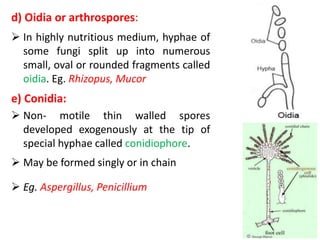
d) Oidia or arthrospores:
 In highly nutritious medium, hyphae of
some fungi split up into numerous
small, oval or rounded fragments called
oidia. Eg. Rhizopus, Mucor
e) Conidia:
 Non- motile thin walled spores
developed exogenously at the tip of
special hyphae called conidiophore.
 May be formed singly or in chain
 Eg. Aspergillus, Penicillium
Sexual reproduction
 Most of the fungi reproduce sexually except fungi imperfectii
(Deuteromycetes).
 It occurs by fusion of 2 gametes and their nuclei of opposite mating
types.
 It involves:
a. Plasmogamy
b. Karyogamy
c. Meiosis.
 The product of meiosis is called as meiospores which acts as
sexual spores and germinate to give mycelium.
Sex organs-
 In fungi sex organ called as gametangia (unicellular and
naked)
 Homothallism- sexual reproduction may occur in the sex
organs formed on different hyphae of same mycelium.
 Heterothallism- sexual reproduction involves sex organ
formed on hyphae of 2 different mycelia.
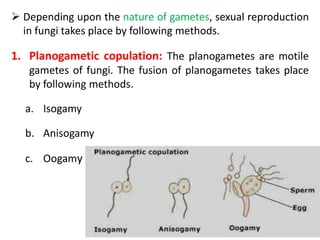
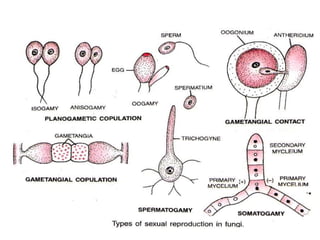
 Depending upon the nature of gametes, sexual reproduction
in fungi takes place by following methods.
1. Planogametic copulation: The planogametes are motile
gametes of fungi. The fusion of planogametes takes place
by following methods.
a. Isogamy
b. Anisogamy
c. Oogamy
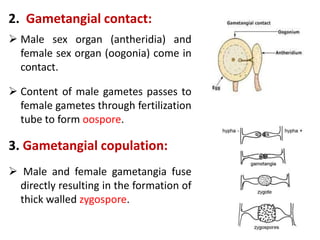
2. Gametangial contact:
 Male sex organ (antheridia) and
female sex organ (oogonia) come in
contact.
 Content of male gametes passes to
female gametes through fertilization
tube to form oospore.
3. Gametangial copulation:
 Male and female gametangia fuse
directly resulting in the formation of
thick walled zygospore.
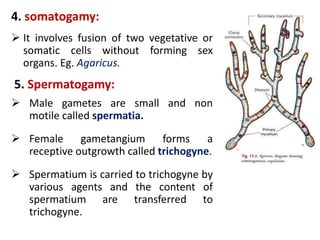
4. somatogamy:
 It involves fusion of two vegetative or
somatic cells without forming sex
organs. Eg. Agaricus.
5. Spermatogamy:
 Male gametes are small and non
motile called spermatia.
 Female gametangium forms a
receptive outgrowth called trichogyne.
 Spermatium is carried to trichogyne by
various agents and the content of
spermatium are transferred to
trichogyne.
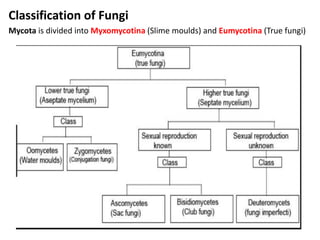
Classification of Fungi
Mycota is divided into Myxomycotina (Slime moulds) and Eumycotina (True fungi)
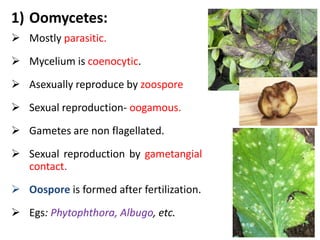
1) Oomycetes:
 Mostly parasitic.
 Mycelium is coenocytic.
 Asexually reproduce by zoospore
 Sexual reproduction- oogamous.
 Gametes are non flagellated.
 Sexual reproduction by gametangial
contact.
 Oospore is formed after fertilization.
 Egs: Phytophthora, Albugo, etc.
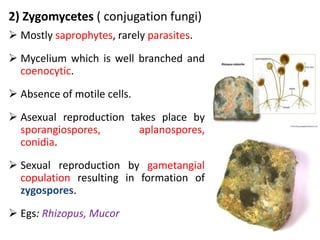
2) Zygomycetes ( conjugation fungi)
 Mostly saprophytes, rarely parasites.
 Mycelium which is well branched and
coenocytic.
 Absence of motile cells.
 Asexual reproduction takes place by
sporangiospores, aplanospores,
conidia.
 Sexual reproduction by gametangial
copulation resulting in formation of
zygospores.
 Egs: Rhizopus, Mucor
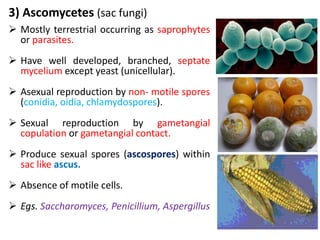
3) Ascomycetes (sac fungi)
 Mostly terrestrial occurring as saprophytes
or parasites.
 Have well developed, branched, septate
mycelium except yeast (unicellular).
 Asexual reproduction by non- motile spores
(conidia, oidia, chlamydospores).
 Sexual reproduction by gametangial
copulation or gametangial contact.
 Produce sexual spores (ascospores) within
sac like ascus.
 Absence of motile cells.
 Egs. Saccharomyces, Penicillium, Aspergillus
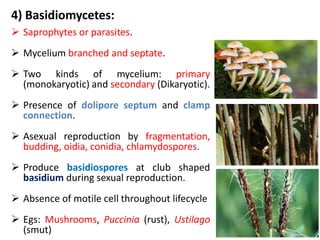
4) Basidiomycetes:
 Saprophytes or parasites.
 Mycelium branched and septate.
 Two kinds of mycelium: primary
(monokaryotic) and secondary (Dikaryotic).
 Presence of dolipore septum and clamp
connection.
 Asexual reproduction by fragmentation,
budding, oidia, conidia, chlamydospores.
 Produce basidiospores at club shaped
basidium during sexual reproduction.
 Absence of motile cell throughout lifecycle
 Egs: Mushrooms, Puccinia (rust), Ustilago
(smut)
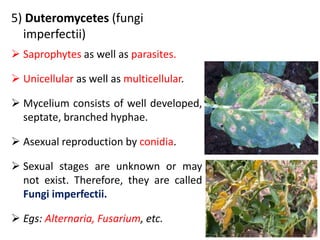
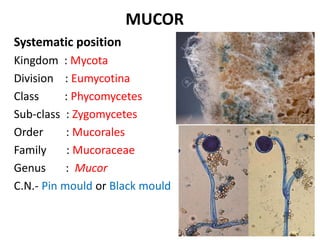
5) Duteromycetes (fungi
imperfectii)
 Saprophytes as well as parasites.
 Unicellular as well as multicellular.
 Mycelium consists of well developed,
septate, branched hyphae.
 Asexual reproduction by conidia.
 Sexual stages are unknown or may
not exist. Therefore, they are called
Fungi imperfectii.
 Egs: Alternaria, Fusarium, etc.
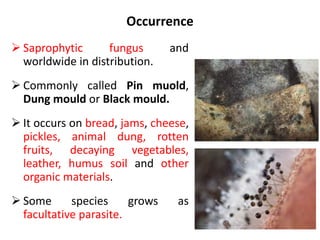
MUCOR
Systematic position
Kingdom : Mycota
Division : Eumycotina
Class : Phycomycetes
Sub-class : Zygomycetes
Order : Mucorales
Family : Mucoraceae
Genus : Mucor
C.N.- Pin mould or Black mould
Occurrence
 Saprophytic fungus and
worldwide in distribution.
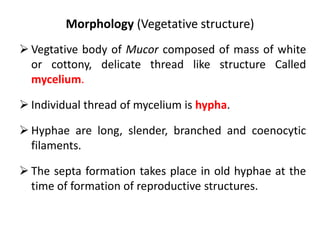
 Commonly called Pin muold,
Dung mould or Black mould.
 It occurs on bread, jams, cheese,
pickles, animal dung, rotten
fruits, decaying vegetables,
leather, humus soil and other
organic materials.
 Some species grows as
facultative parasite.
Morphology (Vegetative structure)
 Vegtative body of Mucor composed of mass of white
or cottony, delicate thread like structure Called
mycelium.
 Individual thread of mycelium is hypha.
 Hyphae are long, slender, branched and coenocytic
filaments.
 The septa formation takes place in old hyphae at the
time of formation of reproductive structures.
Morphology (Vegetative structure) cont….
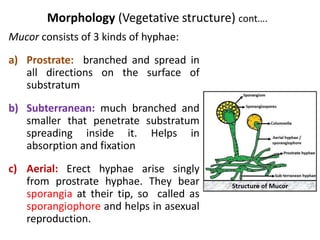
Mucor consists of 3 kinds of hyphae:
a) Prostrate: branched and spread in
all directions on the surface of
substratum
b) Subterranean: much branched and
smaller that penetrate substratum
spreading inside it. Helps in
absorption and fixation
c) Aerial: Erect hyphae arise singly
from prostrate hyphae. They bear
sporangia at their tip, so called as
sporangiophore and helps in asexual
reproduction.
Morphology (Vegetative structure) cont….
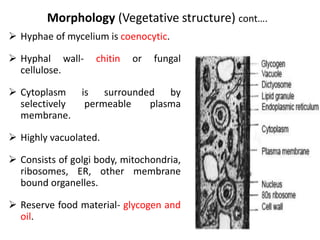
 Hyphae of mycelium is coenocytic.
 Hyphal wall- chitin or fungal
cellulose.
 Cytoplasm is surrounded by
selectively permeable plasma
membrane.
 Highly vacuolated.
 Consists of golgi body, mitochondria,
ribosomes, ER, other membrane
bound organelles.
 Reserve food material- glycogen and
oil.
Reproduction
Reproduces by vegetative, asexual and sexual methods.
1. Vegetative reproduction:
 By Fragmentation:
2. Asexual reproduction:
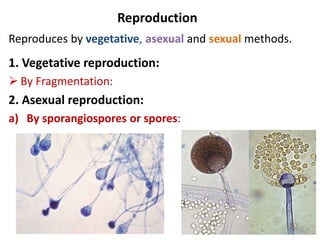
a) By sporangiospores or spores:
a) By sporangiospores or
spores cont…
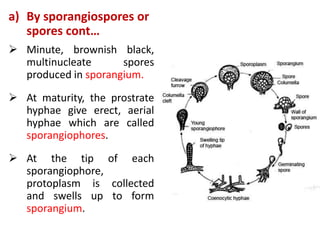
 Minute, brownish black,
multinucleate spores
produced in sporangium.
 At maturity, the prostrate
hyphae give erect, aerial
hyphae which are called
sporangiophores.
 At the tip of each
sporangiophore,
protoplasm is collected
and swells up to form
sporangium.
a) By sporangiospores or
spores cont…
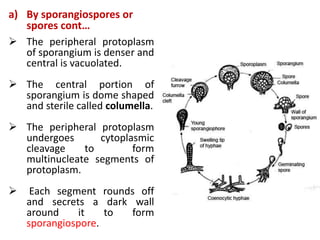
 The peripheral protoplasm
of sporangium is denser and
central is vacuolated.
 The central portion of
sporangium is dome shaped
and sterile called columella.
 The peripheral protoplasm
undergoes cytoplasmic
cleavage to form
multinucleate segments of
protoplasm.
 Each segment rounds off
and secrets a dark wall
around it to form
sporangiospore.
a) By sporangiospores or
spores cont…
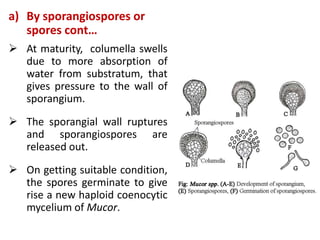
 At maturity, columella swells
due to more absorption of
water from substratum, that
gives pressure to the wall of
sporangium.
 The sporangial wall ruptures
and sporangiospores are
released out.
 On getting suitable condition,
the spores germinate to give
rise a new haploid coenocytic
mycelium of Mucor.
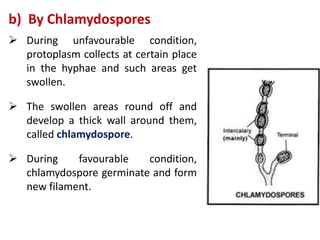
b) By Chlamydospores
 During unfavourable condition,
protoplasm collects at certain place
in the hyphae and such areas get
swollen.
 The swollen areas round off and
develop a thick wall around them,
called chlamydospore.
 During favourable condition,
chlamydospore germinate and form
new filament.
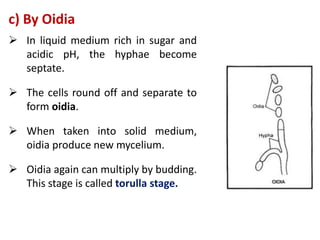
c) By Oidia
 In liquid medium rich in sugar and
acidic pH, the hyphae become
septate.
 The cells round off and separate to
form oidia.
 When taken into solid medium,
oidia produce new mycelium.
 Oidia again can multiply by budding.
This stage is called torulla stage.
Sexual Reproduction
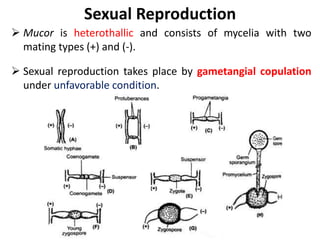
 Mucor is heterothallic and consists of mycelia with two
mating types (+) and (-).
 Sexual reproduction takes place by gametangial copulation
under unfavorable condition.
Sexual Reproduction
Process:
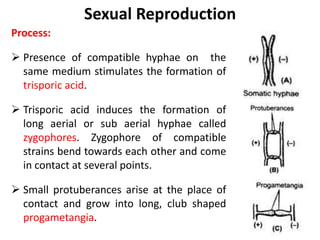
 Presence of compatible hyphae on the
same medium stimulates the formation of
trisporic acid.
 Trisporic acid induces the formation of
long aerial or sub aerial hyphae called
zygophores. Zygophore of compatible
strains bend towards each other and come
in contact at several points.
 Small protuberances arise at the place of
contact and grow into long, club shaped
progametangia.
Sexual Reproduction
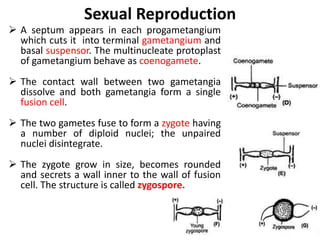
 A septum appears in each progametangium
which cuts it into terminal gametangium and
basal suspensor. The multinucleate protoplast
of gametangium behave as coenogamete.
 The contact wall between two gametangia
dissolve and both gametangia form a single
fusion cell.
 The two gametes fuse to form a zygote having
a number of diploid nuclei; the unpaired
nuclei disintegrate.
 The zygote grow in size, becomes rounded
and secrets a wall inner to the wall of fusion
cell. The structure is called zygospore.
Sexual Reproduction
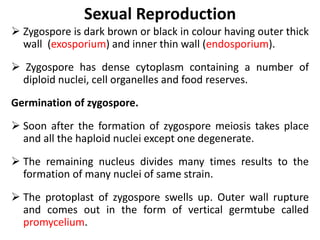
 Zygospore is dark brown or black in colour having outer thick
wall (exosporium) and inner thin wall (endosporium).
 Zygospore has dense cytoplasm containing a number of
diploid nuclei, cell organelles and food reserves.
Germination of zygospore.
 Soon after the formation of zygospore meiosis takes place
and all the haploid nuclei except one degenerate.
 The remaining nucleus divides many times results to the
formation of many nuclei of same strain.
 The protoplast of zygospore swells up. Outer wall rupture
and comes out in the form of vertical germtube called
promycelium.
Sexual Reproduction
Germination of zygospore cont…
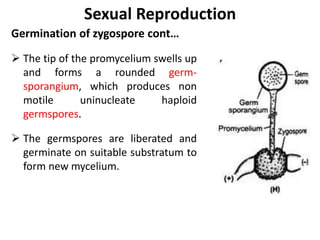
 The tip of the promycelium swells up
and forms a rounded germ-
sporangium, which produces non
motile uninucleate haploid
germspores.
 The germspores are liberated and
germinate on suitable substratum to
form new mycelium.
Economic importance of Mucor
Positive effects:
 Mucor spp. living in soil take part in decaying organic matter
and maintain soil fertility.
 Alcoholic fermentation of rice and other food.
 Citric acid can be prepared from molases with the help of
Mucor.
Negative effects:
 Rotting of fruits and vegetables.
 Mucor pusillus cause myosis (fungal disease) of internal organs
seriously.
 Spoilage food stuffs.
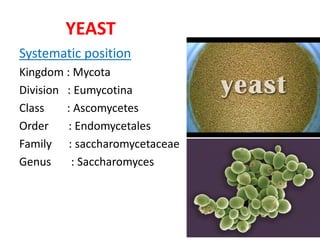
YEAST
Systematic position
Kingdom : Mycota
Division : Eumycotina
Class : Ascomycetes
Order : Endomycetales
Family : saccharomycetaceae
Genus : Saccharomyces
YEAST
Occurrence:
 Includes about 30 species and cosmopolitan in distribution.
 Saprophytic fungi found in organic matters.
 Common on rotting fruits, cane juices, nectaries of flowers,
sweets, decaying organic matters, etc. Also found in animal
excreta and humus of soil.
 Some species are parasitic to plants and animals.
3 types-
 budding yeast (Saccharomyces)
 fission yeast (Schizosaccharomyces)
 halobial yeast ( both budding and fission) Saccharomycoides
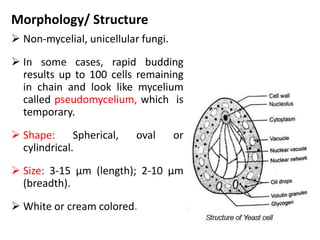
Morphology/ Structure
 Non-mycelial, unicellular fungi.
 In some cases, rapid budding
results up to 100 cells remaining
in chain and look like mycelium
called pseudomycelium, which is
temporary.
 Shape: Spherical, oval or
cylindrical.
 Size: 3-15 µm (length); 2-10 µm
(breadth).
 White or cream colored.
Morphology/ Structure cont..
 Cell wall: thin, rigid outer protective covering made up of
chitin.
 Inner to cell wall- cell membrane which encloses
protoplasm.
 Protoplasm consists of nucleus and other cell organelles
like mitochondria, ER, Dictyosome, ribosomes, etc.
 Reserve food material is in the form of glygogen or fats.
 A large central vacuole is found in Saccharomyces
cerevisiae.
 Nucleus lies at one end of vacuole. From nucleus, dark
staining fine threads of unknown significance are spread
over the surface of vacuole. Such type of vacuole is called
nuclear vacuole.
Reproduction:
Vegetative, asexual and sexual methods
1. Vegetative reproduction
a) Budding
1. Vegetative reproduction
b) Fission
Asexual reproduction
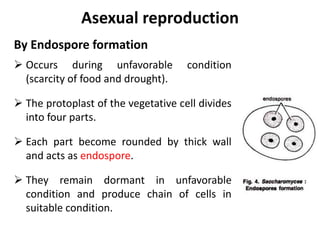
By Endospore formation
 Occurs during unfavorable condition
(scarcity of food and drought).
 The protoplast of the vegetative cell divides
into four parts.
 Each part become rounded by thick wall
and acts as endospore.
 They remain dormant in unfavorable
condition and produce chain of cells in
suitable condition.
Sexual Reproduction
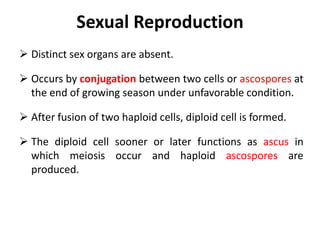
 Distinct sex organs are absent.
 Occurs by conjugation between two cells or ascospores at
the end of growing season under unfavorable condition.
 After fusion of two haploid cells, diploid cell is formed.
 The diploid cell sooner or later functions as ascus in
which meiosis occur and haploid ascospores are
produced.
On the basis of mode of sexual reproduction
Three types of life cycle
1. Haplobiontic life cycle
2. Diplobiontic life cycle
3. Haplodiplobiontic life cycle.
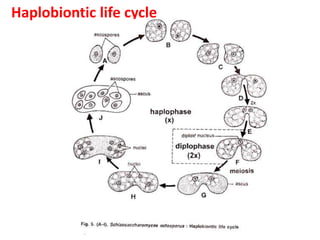
Haplobiontic life cycle
 Occurs in Schizosaccharomyces octosporus (fission yeast).
 Haploid phase is dominant.
 Diploid phase is short and represented by zygote only.
Haplobiontic life cycle
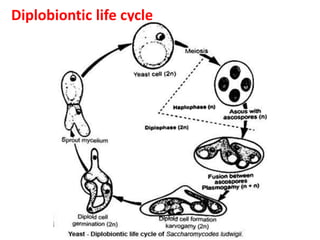
Diplobiontic life cycle
 Occurs in Saccharomycoides ludwigii (budding yeast).
 Diploid phase is long and dominant and represented by
somatic cells.
 Haploid somatic cells cannot be observed.
 Short haploid phase is represented by ascospores.
Diplobiontic life cycle
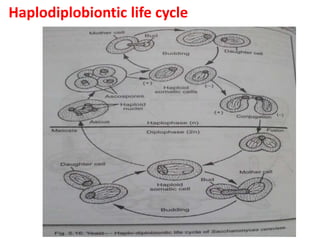
Haplodiplobiontic life cycle
 Occurs in Saccharomyces cerevisiae (Baker’s yeast).
 Both haploid and diploid phase are equally dominant.
 Vegetative cell is both haploid and diploid.
Haplodiplobiontic life cycle
Economic Importance of Yeast
1. Positive effects:
 Yeasts produce enzymes zymase and
invertase and helps in fermentation. So
they are used in alcohol industries
 Saccharomyes cerevisae is used in backing
industry as it can make bread soft and
porous.
 Yeast can synthesize protein, fat and
vitamin B complex.
 Some yeasts are used to cure skin
diseases.
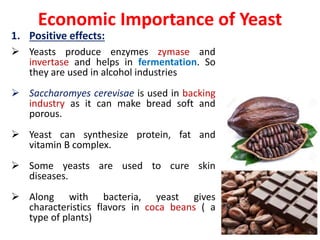
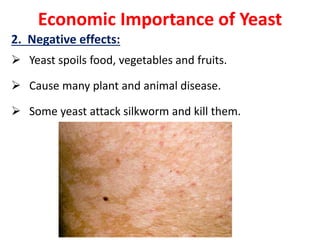
 Along with bacteria, yeast gives
characteristics flavors in coca beans ( a
type of plants)
Economic Importance of Yeast
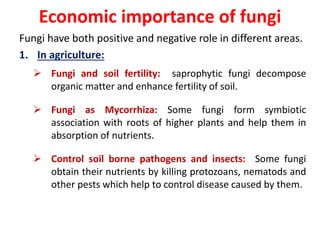
2. Negative effects:
 Yeast spoils food, vegetables and fruits.
 Cause many plant and animal disease.
 Some yeast attack silkworm and kill them.
Economic importance of fungi
Fungi have both positive and negative role in different areas.
1. In agriculture:
 Fungi and soil fertility: saprophytic fungi decompose
organic matter and enhance fertility of soil.
 Fungi as Mycorrhiza: Some fungi form symbiotic
association with roots of higher plants and help them in
absorption of nutrients.
 Control soil borne pathogens and insects: Some fungi
obtain their nutrients by killing protozoans, nematods and
other pests which help to control disease caused by them.
Economic importance of fungi
1. In agriculture:
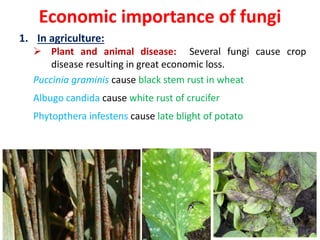
 Plant and animal disease: Several fungi cause crop
disease resulting in great economic loss.
Puccinia graminis cause black stem rust in wheat
Albugo candida cause white rust of crucifer
Phytopthera infestens cause late blight of potato
Economic importance of fungi
2. In medicine and human health
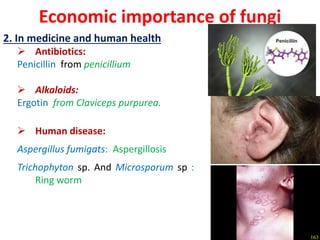
 Antibiotics:
Penicillin from penicillium
 Alkaloids:
Ergotin from Claviceps purpurea.
 Human disease:
Aspergillus fumigats: Aspergillosis
Trichophyton sp. And Microsporum sp :
Ring worm
Economic importance of fungi
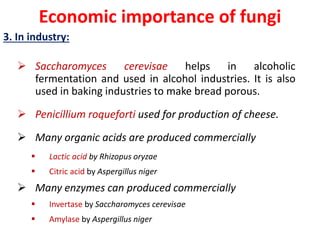
3. In industry:
 Saccharomyces cerevisae helps in alcoholic
fermentation and used in alcohol industries. It is also
used in baking industries to make bread porous.
 Penicillium roqueforti used for production of cheese.
 Many organic acids are produced commercially
 Lactic acid by Rhizopus oryzae
 Citric acid by Aspergillus niger
 Many enzymes can produced commercially
 Invertase by Saccharomyces cerevisae
 Amylase by Aspergillus niger
Economic importance of fungi
3. In industry:
 Gibberellins (hormone) produced from
Gibberrella fujikuroi.
 Many pigments and vitamins are also
produced.
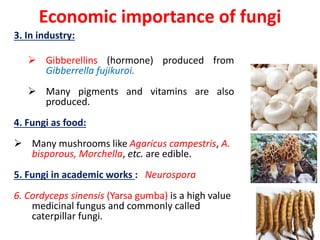
4. Fungi as food:
 Many mushrooms like Agaricus campestris, A.
bisporous, Morchella, etc. are edible.
5. Fungi in academic works : Neurospora
6. Cordyceps sinensis (Yarsa gumba) is a high value
medicinal fungus and commonly called
caterpillar fungi.

Mycota.pptx

  • 1.
    KINGDOM: MYCOTA (Fungi) Thebranch of biology that deals with fungi is called mycology.
  • 2.
    General characteristics offungi  They are large and diverse group of eukaryotic organism.  They are non-vascular, non green, multicellular (except yeast) and heterotrophic organisms.  The vegetative body of fungi is thallus.  The thallus consist of long, brached filaments called hyphae. The mass of hyphae is called mycellium.  The cell wall is made up of fungal cellulose or chitin.
  • 3.
    General characteristics offungi contd…  Reserve food is in the form of glycogen and oil.  They reproduce by vegetative and asexual methods.  Sex organs are usually unicellular and non jacketed.  Embryo is not formed after fertilization.  They are decomposers of the environment.
  • 4.
    Resemblances between algaeand fungi  Both found in aquatic and semi aquatic habitat.  Have thallus body.  Vascular tissue absent.  Reproduce by spore during favorable condition.  Sex organs are unicellular, simple, non- jacketed.  Embryo not formed.
  • 5.
    Mode of nutritionin fungi  Fungi lack chlorophyll and they depend upon other organism for their food. (heterotrophic mode of nutrition)  Their nutrition involves absorption of soluble substances.  They are either saprophytes or parasites or symbionts.
  • 6.
    Mode of nutritionin fungi contd.. 1. Saprophytic fungi:  They absorb food from dead and decaying organic matter.  Some of them die without decaying organic matter are called obligate saprophytes. Eg. Mucor.  Some other have saprophytic mode of nutrition but also live parasitically called facultative parasites. Eg. Fusarium, Pythium Mucor Fusarium
  • 7.
    Mode of nutritionin fungi contd.. 2. Parasitic fungi:  They obtain their food from the host or protoplasm of the living plants or animals.  The parasites which only grow in living cells are called obligate parasites. Eg. Erysiphae, Puccinia, etc.  Some other fungi after death of host are able to take their food from dead and decaying body are called facultative saprophytes. Eg. Some smuts. Erysiphae Smut
  • 8.
    Mode of nutritionin fungi contd.. 3. Symbiotic fungi:  Some fungi from partnerships with other group of plants by which both the plants and fungi are benefited.  This type of association is called symbiosis and such fungi are called symbiotic fungi. E.g. Mycorrhiza.  Here the fungi get shelter and food from the plants and fungi helps the plant to absorb water and minerals. Mycorrhiza
  • 9.
    Reproduction in fungi: By vegetative, asexual and sexual methods. Vegetative Reproduction a) Fragmentation: mechanical injury or decay leads to the breakdown of mycelium into many fragments. Each fragment grow into a complete mycelium. b) Budding: Parent cell produces a small protuberance and grow into a bud. Bud later detached and forms a new individual. It is common in yeast. c) Fission: Cells of unicellular fungi divide into two daughter cells amitotically.
  • 10.
    Asexual reproduction: It takesplace by the formation of spores. a) zoospore:  Thin walled, uninucleated motile or flagellated spores formed inside zoosporangium.  Each zoospore germinate into a new mycelium.  E.g. Pythium, Albugo
  • 11.
    b) Aplanospores orsporangiospores:  Non-motile, thin walled spores produced in sporangia in large number. Eg. Mucor C) chlamydospores:  Thick walled, resistant spores formed by accumulation of protoplasm, rounding off and secretion of thick wall at place along the hyphae.  Developed from terminal or intercalary cells  Released after death of hyphae and remain viable for several years. Eg. Mucor, Fusarium, Agaricus, etc.
  • 12.
    d) Oidia orarthrospores:  In highly nutritious medium, hyphae of some fungi split up into numerous small, oval or rounded fragments called oidia. Eg. Rhizopus, Mucor e) Conidia:  Non- motile thin walled spores developed exogenously at the tip of special hyphae called conidiophore.  May be formed singly or in chain  Eg. Aspergillus, Penicillium
  • 14.
    Sexual reproduction  Mostof the fungi reproduce sexually except fungi imperfectii (Deuteromycetes).  It occurs by fusion of 2 gametes and their nuclei of opposite mating types.  It involves: a. Plasmogamy b. Karyogamy c. Meiosis.  The product of meiosis is called as meiospores which acts as sexual spores and germinate to give mycelium.
  • 15.
    Sex organs-  Infungi sex organ called as gametangia (unicellular and naked)  Homothallism- sexual reproduction may occur in the sex organs formed on different hyphae of same mycelium.  Heterothallism- sexual reproduction involves sex organ formed on hyphae of 2 different mycelia.
  • 16.
     Depending uponthe nature of gametes, sexual reproduction in fungi takes place by following methods. 1. Planogametic copulation: The planogametes are motile gametes of fungi. The fusion of planogametes takes place by following methods. a. Isogamy b. Anisogamy c. Oogamy
  • 17.
    2. Gametangial contact: Male sex organ (antheridia) and female sex organ (oogonia) come in contact.  Content of male gametes passes to female gametes through fertilization tube to form oospore. 3. Gametangial copulation:  Male and female gametangia fuse directly resulting in the formation of thick walled zygospore.
  • 18.
    4. somatogamy:  Itinvolves fusion of two vegetative or somatic cells without forming sex organs. Eg. Agaricus. 5. Spermatogamy:  Male gametes are small and non motile called spermatia.  Female gametangium forms a receptive outgrowth called trichogyne.  Spermatium is carried to trichogyne by various agents and the content of spermatium are transferred to trichogyne.
  • 20.
    Classification of Fungi Mycotais divided into Myxomycotina (Slime moulds) and Eumycotina (True fungi)
  • 21.
    1) Oomycetes:  Mostlyparasitic.  Mycelium is coenocytic.  Asexually reproduce by zoospore  Sexual reproduction- oogamous.  Gametes are non flagellated.  Sexual reproduction by gametangial contact.  Oospore is formed after fertilization.  Egs: Phytophthora, Albugo, etc.
  • 22.
    2) Zygomycetes (conjugation fungi)  Mostly saprophytes, rarely parasites.  Mycelium which is well branched and coenocytic.  Absence of motile cells.  Asexual reproduction takes place by sporangiospores, aplanospores, conidia.  Sexual reproduction by gametangial copulation resulting in formation of zygospores.  Egs: Rhizopus, Mucor
  • 23.
    3) Ascomycetes (sacfungi)  Mostly terrestrial occurring as saprophytes or parasites.  Have well developed, branched, septate mycelium except yeast (unicellular).  Asexual reproduction by non- motile spores (conidia, oidia, chlamydospores).  Sexual reproduction by gametangial copulation or gametangial contact.  Produce sexual spores (ascospores) within sac like ascus.  Absence of motile cells.  Egs. Saccharomyces, Penicillium, Aspergillus
  • 24.
    4) Basidiomycetes:  Saprophytesor parasites.  Mycelium branched and septate.  Two kinds of mycelium: primary (monokaryotic) and secondary (Dikaryotic).  Presence of dolipore septum and clamp connection.  Asexual reproduction by fragmentation, budding, oidia, conidia, chlamydospores.  Produce basidiospores at club shaped basidium during sexual reproduction.  Absence of motile cell throughout lifecycle  Egs: Mushrooms, Puccinia (rust), Ustilago (smut)
  • 25.
    5) Duteromycetes (fungi imperfectii) Saprophytes as well as parasites.  Unicellular as well as multicellular.  Mycelium consists of well developed, septate, branched hyphae.  Asexual reproduction by conidia.  Sexual stages are unknown or may not exist. Therefore, they are called Fungi imperfectii.  Egs: Alternaria, Fusarium, etc.
  • 26.
    MUCOR Systematic position Kingdom :Mycota Division : Eumycotina Class : Phycomycetes Sub-class : Zygomycetes Order : Mucorales Family : Mucoraceae Genus : Mucor C.N.- Pin mould or Black mould
  • 27.
    Occurrence  Saprophytic fungusand worldwide in distribution.  Commonly called Pin muold, Dung mould or Black mould.  It occurs on bread, jams, cheese, pickles, animal dung, rotten fruits, decaying vegetables, leather, humus soil and other organic materials.  Some species grows as facultative parasite.
  • 28.
    Morphology (Vegetative structure) Vegtative body of Mucor composed of mass of white or cottony, delicate thread like structure Called mycelium.  Individual thread of mycelium is hypha.  Hyphae are long, slender, branched and coenocytic filaments.  The septa formation takes place in old hyphae at the time of formation of reproductive structures.
  • 29.
    Morphology (Vegetative structure)cont…. Mucor consists of 3 kinds of hyphae: a) Prostrate: branched and spread in all directions on the surface of substratum b) Subterranean: much branched and smaller that penetrate substratum spreading inside it. Helps in absorption and fixation c) Aerial: Erect hyphae arise singly from prostrate hyphae. They bear sporangia at their tip, so called as sporangiophore and helps in asexual reproduction.
  • 30.
    Morphology (Vegetative structure)cont….  Hyphae of mycelium is coenocytic.  Hyphal wall- chitin or fungal cellulose.  Cytoplasm is surrounded by selectively permeable plasma membrane.  Highly vacuolated.  Consists of golgi body, mitochondria, ribosomes, ER, other membrane bound organelles.  Reserve food material- glycogen and oil.
  • 31.
    Reproduction Reproduces by vegetative,asexual and sexual methods. 1. Vegetative reproduction:  By Fragmentation: 2. Asexual reproduction: a) By sporangiospores or spores:
  • 32.
    a) By sporangiosporesor spores cont…  Minute, brownish black, multinucleate spores produced in sporangium.  At maturity, the prostrate hyphae give erect, aerial hyphae which are called sporangiophores.  At the tip of each sporangiophore, protoplasm is collected and swells up to form sporangium.
  • 33.
    a) By sporangiosporesor spores cont…  The peripheral protoplasm of sporangium is denser and central is vacuolated.  The central portion of sporangium is dome shaped and sterile called columella.  The peripheral protoplasm undergoes cytoplasmic cleavage to form multinucleate segments of protoplasm.  Each segment rounds off and secrets a dark wall around it to form sporangiospore.
  • 34.
    a) By sporangiosporesor spores cont…  At maturity, columella swells due to more absorption of water from substratum, that gives pressure to the wall of sporangium.  The sporangial wall ruptures and sporangiospores are released out.  On getting suitable condition, the spores germinate to give rise a new haploid coenocytic mycelium of Mucor.
  • 35.
    b) By Chlamydospores During unfavourable condition, protoplasm collects at certain place in the hyphae and such areas get swollen.  The swollen areas round off and develop a thick wall around them, called chlamydospore.  During favourable condition, chlamydospore germinate and form new filament.
  • 36.
    c) By Oidia In liquid medium rich in sugar and acidic pH, the hyphae become septate.  The cells round off and separate to form oidia.  When taken into solid medium, oidia produce new mycelium.  Oidia again can multiply by budding. This stage is called torulla stage.
  • 37.
    Sexual Reproduction  Mucoris heterothallic and consists of mycelia with two mating types (+) and (-).  Sexual reproduction takes place by gametangial copulation under unfavorable condition.
  • 38.
    Sexual Reproduction Process:  Presenceof compatible hyphae on the same medium stimulates the formation of trisporic acid.  Trisporic acid induces the formation of long aerial or sub aerial hyphae called zygophores. Zygophore of compatible strains bend towards each other and come in contact at several points.  Small protuberances arise at the place of contact and grow into long, club shaped progametangia.
  • 39.
    Sexual Reproduction  Aseptum appears in each progametangium which cuts it into terminal gametangium and basal suspensor. The multinucleate protoplast of gametangium behave as coenogamete.  The contact wall between two gametangia dissolve and both gametangia form a single fusion cell.  The two gametes fuse to form a zygote having a number of diploid nuclei; the unpaired nuclei disintegrate.  The zygote grow in size, becomes rounded and secrets a wall inner to the wall of fusion cell. The structure is called zygospore.
  • 40.
    Sexual Reproduction  Zygosporeis dark brown or black in colour having outer thick wall (exosporium) and inner thin wall (endosporium).  Zygospore has dense cytoplasm containing a number of diploid nuclei, cell organelles and food reserves. Germination of zygospore.  Soon after the formation of zygospore meiosis takes place and all the haploid nuclei except one degenerate.  The remaining nucleus divides many times results to the formation of many nuclei of same strain.  The protoplast of zygospore swells up. Outer wall rupture and comes out in the form of vertical germtube called promycelium.
  • 41.
    Sexual Reproduction Germination ofzygospore cont…  The tip of the promycelium swells up and forms a rounded germ- sporangium, which produces non motile uninucleate haploid germspores.  The germspores are liberated and germinate on suitable substratum to form new mycelium.
  • 42.
    Economic importance ofMucor Positive effects:  Mucor spp. living in soil take part in decaying organic matter and maintain soil fertility.  Alcoholic fermentation of rice and other food.  Citric acid can be prepared from molases with the help of Mucor. Negative effects:  Rotting of fruits and vegetables.  Mucor pusillus cause myosis (fungal disease) of internal organs seriously.  Spoilage food stuffs.
  • 43.
    YEAST Systematic position Kingdom :Mycota Division : Eumycotina Class : Ascomycetes Order : Endomycetales Family : saccharomycetaceae Genus : Saccharomyces
  • 44.
    YEAST Occurrence:  Includes about30 species and cosmopolitan in distribution.  Saprophytic fungi found in organic matters.  Common on rotting fruits, cane juices, nectaries of flowers, sweets, decaying organic matters, etc. Also found in animal excreta and humus of soil.  Some species are parasitic to plants and animals. 3 types-  budding yeast (Saccharomyces)  fission yeast (Schizosaccharomyces)  halobial yeast ( both budding and fission) Saccharomycoides
  • 45.
    Morphology/ Structure  Non-mycelial,unicellular fungi.  In some cases, rapid budding results up to 100 cells remaining in chain and look like mycelium called pseudomycelium, which is temporary.  Shape: Spherical, oval or cylindrical.  Size: 3-15 µm (length); 2-10 µm (breadth).  White or cream colored.
  • 46.
    Morphology/ Structure cont.. Cell wall: thin, rigid outer protective covering made up of chitin.  Inner to cell wall- cell membrane which encloses protoplasm.  Protoplasm consists of nucleus and other cell organelles like mitochondria, ER, Dictyosome, ribosomes, etc.  Reserve food material is in the form of glygogen or fats.  A large central vacuole is found in Saccharomyces cerevisiae.  Nucleus lies at one end of vacuole. From nucleus, dark staining fine threads of unknown significance are spread over the surface of vacuole. Such type of vacuole is called nuclear vacuole.
  • 47.
    Reproduction: Vegetative, asexual andsexual methods 1. Vegetative reproduction a) Budding
  • 48.
  • 49.
    Asexual reproduction By Endosporeformation  Occurs during unfavorable condition (scarcity of food and drought).  The protoplast of the vegetative cell divides into four parts.  Each part become rounded by thick wall and acts as endospore.  They remain dormant in unfavorable condition and produce chain of cells in suitable condition.
  • 50.
    Sexual Reproduction  Distinctsex organs are absent.  Occurs by conjugation between two cells or ascospores at the end of growing season under unfavorable condition.  After fusion of two haploid cells, diploid cell is formed.  The diploid cell sooner or later functions as ascus in which meiosis occur and haploid ascospores are produced.
  • 51.
    On the basisof mode of sexual reproduction Three types of life cycle 1. Haplobiontic life cycle 2. Diplobiontic life cycle 3. Haplodiplobiontic life cycle.
  • 52.
    Haplobiontic life cycle Occurs in Schizosaccharomyces octosporus (fission yeast).  Haploid phase is dominant.  Diploid phase is short and represented by zygote only.
  • 53.
  • 54.
    Diplobiontic life cycle Occurs in Saccharomycoides ludwigii (budding yeast).  Diploid phase is long and dominant and represented by somatic cells.  Haploid somatic cells cannot be observed.  Short haploid phase is represented by ascospores.
  • 55.
  • 56.
    Haplodiplobiontic life cycle Occurs in Saccharomyces cerevisiae (Baker’s yeast).  Both haploid and diploid phase are equally dominant.  Vegetative cell is both haploid and diploid.
  • 57.
  • 58.
    Economic Importance ofYeast 1. Positive effects:  Yeasts produce enzymes zymase and invertase and helps in fermentation. So they are used in alcohol industries  Saccharomyes cerevisae is used in backing industry as it can make bread soft and porous.  Yeast can synthesize protein, fat and vitamin B complex.  Some yeasts are used to cure skin diseases.  Along with bacteria, yeast gives characteristics flavors in coca beans ( a type of plants)
  • 59.
    Economic Importance ofYeast 2. Negative effects:  Yeast spoils food, vegetables and fruits.  Cause many plant and animal disease.  Some yeast attack silkworm and kill them.
  • 60.
    Economic importance offungi Fungi have both positive and negative role in different areas. 1. In agriculture:  Fungi and soil fertility: saprophytic fungi decompose organic matter and enhance fertility of soil.  Fungi as Mycorrhiza: Some fungi form symbiotic association with roots of higher plants and help them in absorption of nutrients.  Control soil borne pathogens and insects: Some fungi obtain their nutrients by killing protozoans, nematods and other pests which help to control disease caused by them.
  • 61.
    Economic importance offungi 1. In agriculture:  Plant and animal disease: Several fungi cause crop disease resulting in great economic loss. Puccinia graminis cause black stem rust in wheat Albugo candida cause white rust of crucifer Phytopthera infestens cause late blight of potato
  • 62.
    Economic importance offungi 2. In medicine and human health  Antibiotics: Penicillin from penicillium  Alkaloids: Ergotin from Claviceps purpurea.  Human disease: Aspergillus fumigats: Aspergillosis Trichophyton sp. And Microsporum sp : Ring worm
  • 63.
    Economic importance offungi 3. In industry:  Saccharomyces cerevisae helps in alcoholic fermentation and used in alcohol industries. It is also used in baking industries to make bread porous.  Penicillium roqueforti used for production of cheese.  Many organic acids are produced commercially  Lactic acid by Rhizopus oryzae  Citric acid by Aspergillus niger  Many enzymes can produced commercially  Invertase by Saccharomyces cerevisae  Amylase by Aspergillus niger
  • 64.
    Economic importance offungi 3. In industry:  Gibberellins (hormone) produced from Gibberrella fujikuroi.  Many pigments and vitamins are also produced. 4. Fungi as food:  Many mushrooms like Agaricus campestris, A. bisporous, Morchella, etc. are edible. 5. Fungi in academic works : Neurospora 6. Cordyceps sinensis (Yarsa gumba) is a high value medicinal fungus and commonly called caterpillar fungi.