University of Allahabad
Department of botany
Topic- general characterstics of fungi
Submitted to
Dr. Somanjana khatua
Dr.Ricky rai
Dr.Ashwani
Submitted by
Vasudha yadav
Msc 1st semester
U2110206
• According to Bessey (1968), fungi are chlorophyll less non vascular plants whose reproductive or
vegetative structure do not permit them to be assigned to position among recognized group of
higher plants.
Fungi
• Fungi are achlorophyllas, heterotrophic eukaryotic thallophytes.
• According to Alexopoulos (1962), the fungi include nucleated spore
bearing achlorophyllas organisms that generally reproduce sexually and
whose filamentous branched somatic structure are typically surrounded by
cell wall containing cellulose or chitin or both
• The branch of botany that deals with the fungi is called mycology and
the scientist who is concern with the fungi is called a mycologist.
General characters of fungi
Some of the most important characters of fungi are as follows: 1. Occurrence 2. Thallus
organization 3. Different forms of mycelium 4. Cell structure 5. Nutrition 6. Heterothallism and
Homothallism 7. Reproduction.
❖ Fungi are cosmopolitan and occur in air, water soil and on
plants and animals.
❖ They prefer to grow in warm and humid places. Hence, we
keep food in the refrigerator to prevent bacterial and
fungal infestation.
1.Occurrence
2.Thallus organisation
❖ Except some unicellular forms (e.g. Yeasts, Synchytrium),the fungal body is a
thallus called mycelium.
❖ The mycelium is an interwoven mass of thread-like
hyphae (Sing, hypha). Hyphae may be septate (with cross
wall) and aseptate (without cross wall). Some fungi are
dimorphic that found as both unicellular and mycelial
forms e.g. Candida albicans.
❖ The thallus may be two types: Unicellular and filamentous.
Unicellular thallus: In some of the lower fungi, thallus is more or less a spherical, single celled
structure. At the time of reproduction it becomes a reproductive unit. Such fungi are called
holocarpic. In the unicellular holocarpic forms, the mycelium is absent e.g. Synchytrium. Some
holocarpic fungi (e.g., yeast) producing bud cells in succession and these remain attached to one
another in a chain. Such a chain of bud cells is referred to as pseudomycelium.
Filamentous thallus: In most true fungi, the thallus is filamentous composed of Hyphae.
Loosely aggregated hyphae are collectively forms a network known as mycelium. Each hypha may
vary in shapes and sizes. Branching of hyphae is dichotomous. On the basis of presence or
absence of septa the hyphae of mycelical fungi are of two types:
1. Aseptate
2. Septate
Primary septa: Primary septa are formed in association with mitotic or meiotic nuclear division,
and they separate the daughter nuclei. These types of septa are found in Ascomycotina,
Basidiomycotina and their asexual states.
• Adventitious septa: Adventitious septa are formed in the absence of mitosis or meiosis and
occur especially in association with change in the local concentration of cytoplasm. These are
found in lower groups of fungi as mastigomycotina and zygomycotina.
3.Different form of mycellium
Different forms of mycelium refer to as the various shapes and the functions of mycelium which modified
according to the circumstances. These includes the following forms:
Plectenchyma (fungal tissue): In a fungal mycelium, hyphae organized loosely or compactly woven to form a
tissue called plectenchyma. It is two types:
✓ Prosenchyma or Prosoplectenchyma: In these fungal tissue hyphae are loosely interwoven lying more or
less parallel to each other.
✓ Pseudoparenchyma or paraplectenchyma: In these fungal tissue hyphae are compactly interwoven looking
like a parenchyma in cross-section.
b. Sclerotia (Gr. Skleros=haid): These are hard dormant
bodies consist of compact hyphae protected by external
thickened hyphae. Each Sclerotium germinates into a
mycelium, on return of favourable condition, e.g.,
Penicillium.
c. Rhizomorphs: They are root-like compactly interwoven
hyphae with distinct growing tip. They help in absorption
and perennation (to tide over the unfavourable periods),
e.g., Armillaria mellea.
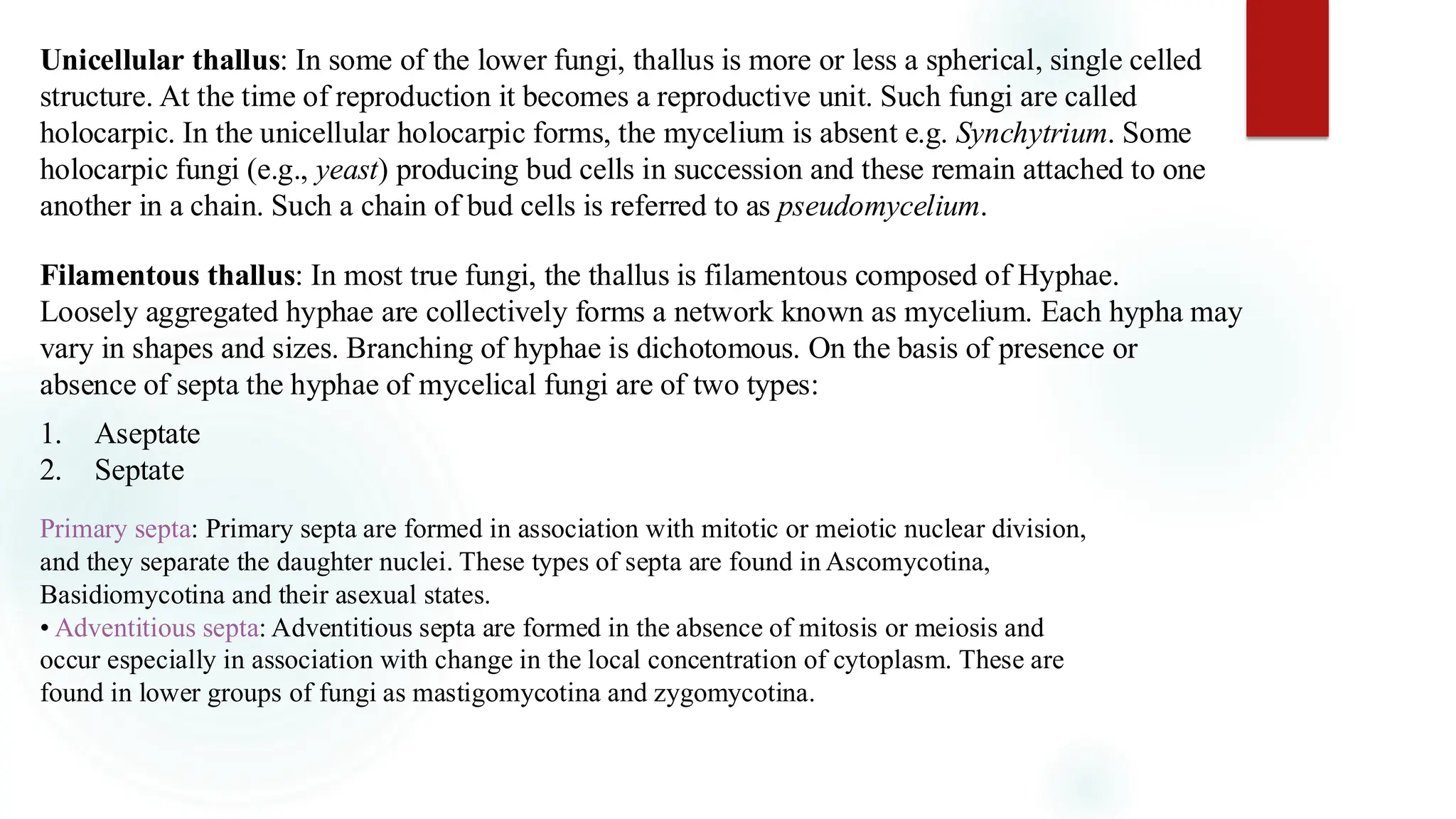
d. Rhizoids: A rhizoid is a short, root like filamentous branch of the thallus,
generally formed in tufts at the baseof the thallus. These also function as anchoring
and absorbing, e.g., Rhizophydium, Rhizopus.
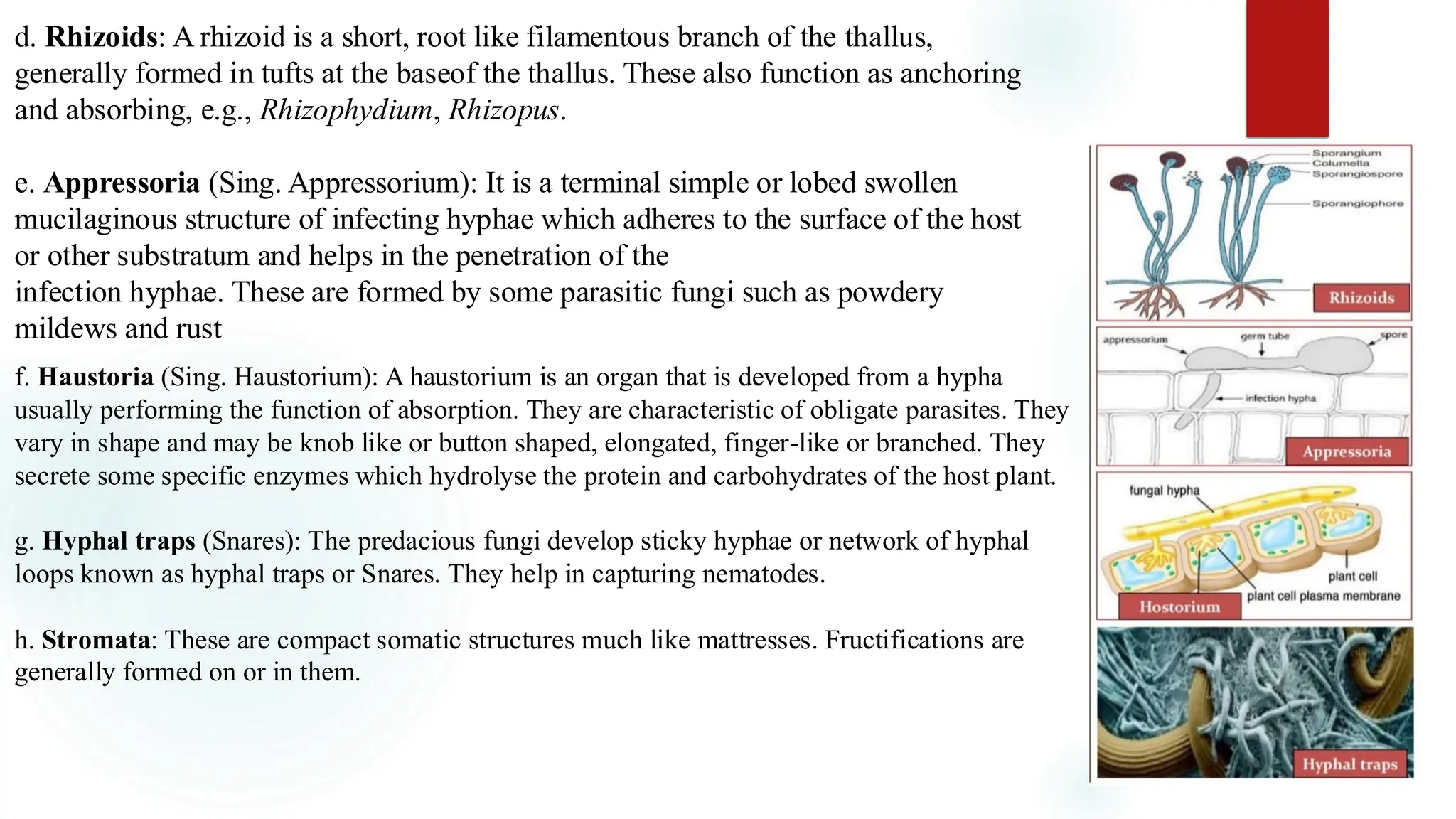
e. Appressoria (Sing. Appressorium): It is a terminal simple or lobed swollen
mucilaginous structure of infecting hyphae which adheres to the surface of the host
or other substratum and helps in the penetration of the
infection hyphae. These are formed by some parasitic fungi such as powdery
mildews and rust
f. Haustoria (Sing. Haustorium): A haustorium is an organ that is developed from a hypha
usually performing the function of absorption. They are characteristic of obligate parasites. They
vary in shape and may be knob like or button shaped, elongated, finger-like or branched. They
secrete some specific enzymes which hydrolyse the protein and carbohydrates of the host plant.
g. Hyphal traps (Snares): The predacious fungi develop sticky hyphae or network of hyphal
loops known as hyphal traps or Snares. They help in capturing nematodes.
h. Stromata: These are compact somatic structures much like mattresses. Fructifications are
generally formed on or in them.
4.Cell structure
❖ Fungi are the eukaryotic organisms.
❖ The cell wall determines the characteristic shape of a cell. It protects the
cell from osmotic lysis and also acts as a binding site for some enzymes.
❖ The chemical composition of the cell wall is not the same in all fungi.
Chitin is characteristically present in the cell walls of most fungi. The
chitin in fungal cell wall is not strictly identical with animal chitin, and the
formula (C22H54N4O21)n has been suggested for the fungal chitin: It is a
polymer of N-acetylglucosamine.
❖ The cytoplasm at hyphal tip contains Golgi vesicles called cytosomes
which filled with cell wall materials.
❖ Nucleus and mitochondria are found to connect with ER. Nucleus
divides by intracellular mitosis called karyochoresis where nuclear envelop
remain intact during nuclear division and internal spindle develop.
5.Nutrition
❖ The fungi lack chlorophyll. Therefore, they cannot synthesis their own food.
Depending on from where and how they get nutrition, fungi are of following types
a. Saprotrophs: They obtain food from dead and decaying organic matter. They
secrete digesting enzymes to outside which digest the substratum and then absorb
nutrients, e.g., Mucor, Agarious,
b. Parasitic: They obtain food from living organisms. They may be facultative or obligate.
Facultative parasites grow on a variety of tissues e.g., Ustilago.
The obiigate- parasites growonly upon suitable host,e.g., downy mildews. The parasitic fungi
that grow on surface of host cells and absorb food through haustoria are called ectoparasites
or ectophytic parasites (e.g., Mucor, Erisphae). When parasitic fungi grow inside the host
tissue are called endoparasites or endophytic parasites (e.g.Pythium, Puccinia).
c. Predacious: Some soil fungi develop ring-like noses to trap annelids, nematodes etc. e.g.,
Arthrobotrys, Zoophagus, Dactylella etc.
d. Symbiotic: They live in mutualistic relationship with another organism by which both are
benefited. The two common examples are lichens and mycorrhiza.
❖ Lichens are symbiotic associations between fungi and algae. The fungal partner is a member
of ascomycetes or basidiomycetes that provides water and nutrients, while the algal partner is a
green alga or cyanobacteria that prepares food by photosynthesis.
e. Mycorrhizas: or mycorrhizae are the mutualistic symbiotic associations between soil fungi and
the roots of most plant species. According to the carbohydrate theory (Bjorkman, 1949), the
plants that grow in soils deficient in P and N, and high intensity light develop mycorrhizas.
❖ The two most common types of mycorrhizas are the ectomycorrhizas (ECM) and the
endomycorrhizas (also known as arbuscular mycorrhiza). The two groups are differentiated by
the fact that the hyphae of ectomycorrhizal fungi do not penetrate the cell wall of the plant’s
root cells, while the hyphae of arbuscular mycorrhizal fungi penetrate the cell wall.
6.Reproduction
• In fungi reproduction may takes place by-vegetative, sexual, asexual method
Vegetative reproduction
Fragmentation
Budding
Fission
Rhizomorph
Sclerotia
Sexual reproduction
It involves the formation and fusion of gametes. Sexual reproduction found in all
groups of fungi except deuteromycetes or fungi imperfecti. Sexual reproduction has three
distinct phases i.e. Plasmogamy (protoplasmic fusion),karyogamy (fusion of nuclei) and
meiosis (reduction division of zygote).
Asexual reproduction
It commonly take place through spores, either motile or non-motile and form in a specialized
part of mycelium
Thank you

Presentation fungi pdf general characteristics of fungi

  • 1.
    University of Allahabad Departmentof botany Topic- general characterstics of fungi Submitted to Dr. Somanjana khatua Dr.Ricky rai Dr.Ashwani Submitted by Vasudha yadav Msc 1st semester U2110206
  • 2.
    • According toBessey (1968), fungi are chlorophyll less non vascular plants whose reproductive or vegetative structure do not permit them to be assigned to position among recognized group of higher plants. Fungi • Fungi are achlorophyllas, heterotrophic eukaryotic thallophytes. • According to Alexopoulos (1962), the fungi include nucleated spore bearing achlorophyllas organisms that generally reproduce sexually and whose filamentous branched somatic structure are typically surrounded by cell wall containing cellulose or chitin or both • The branch of botany that deals with the fungi is called mycology and the scientist who is concern with the fungi is called a mycologist.
  • 3.
    General characters offungi Some of the most important characters of fungi are as follows: 1. Occurrence 2. Thallus organization 3. Different forms of mycelium 4. Cell structure 5. Nutrition 6. Heterothallism and Homothallism 7. Reproduction. ❖ Fungi are cosmopolitan and occur in air, water soil and on plants and animals. ❖ They prefer to grow in warm and humid places. Hence, we keep food in the refrigerator to prevent bacterial and fungal infestation. 1.Occurrence
  • 4.
    2.Thallus organisation ❖ Exceptsome unicellular forms (e.g. Yeasts, Synchytrium),the fungal body is a thallus called mycelium. ❖ The mycelium is an interwoven mass of thread-like hyphae (Sing, hypha). Hyphae may be septate (with cross wall) and aseptate (without cross wall). Some fungi are dimorphic that found as both unicellular and mycelial forms e.g. Candida albicans. ❖ The thallus may be two types: Unicellular and filamentous.
  • 5.
    Unicellular thallus: Insome of the lower fungi, thallus is more or less a spherical, single celled structure. At the time of reproduction it becomes a reproductive unit. Such fungi are called holocarpic. In the unicellular holocarpic forms, the mycelium is absent e.g. Synchytrium. Some holocarpic fungi (e.g., yeast) producing bud cells in succession and these remain attached to one another in a chain. Such a chain of bud cells is referred to as pseudomycelium. Filamentous thallus: In most true fungi, the thallus is filamentous composed of Hyphae. Loosely aggregated hyphae are collectively forms a network known as mycelium. Each hypha may vary in shapes and sizes. Branching of hyphae is dichotomous. On the basis of presence or absence of septa the hyphae of mycelical fungi are of two types: 1. Aseptate 2. Septate Primary septa: Primary septa are formed in association with mitotic or meiotic nuclear division, and they separate the daughter nuclei. These types of septa are found in Ascomycotina, Basidiomycotina and their asexual states. • Adventitious septa: Adventitious septa are formed in the absence of mitosis or meiosis and occur especially in association with change in the local concentration of cytoplasm. These are found in lower groups of fungi as mastigomycotina and zygomycotina.
  • 6.
    3.Different form ofmycellium Different forms of mycelium refer to as the various shapes and the functions of mycelium which modified according to the circumstances. These includes the following forms: Plectenchyma (fungal tissue): In a fungal mycelium, hyphae organized loosely or compactly woven to form a tissue called plectenchyma. It is two types: ✓ Prosenchyma or Prosoplectenchyma: In these fungal tissue hyphae are loosely interwoven lying more or less parallel to each other. ✓ Pseudoparenchyma or paraplectenchyma: In these fungal tissue hyphae are compactly interwoven looking like a parenchyma in cross-section. b. Sclerotia (Gr. Skleros=haid): These are hard dormant bodies consist of compact hyphae protected by external thickened hyphae. Each Sclerotium germinates into a mycelium, on return of favourable condition, e.g., Penicillium. c. Rhizomorphs: They are root-like compactly interwoven hyphae with distinct growing tip. They help in absorption and perennation (to tide over the unfavourable periods), e.g., Armillaria mellea.
  • 7.
    d. Rhizoids: Arhizoid is a short, root like filamentous branch of the thallus, generally formed in tufts at the baseof the thallus. These also function as anchoring and absorbing, e.g., Rhizophydium, Rhizopus. e. Appressoria (Sing. Appressorium): It is a terminal simple or lobed swollen mucilaginous structure of infecting hyphae which adheres to the surface of the host or other substratum and helps in the penetration of the infection hyphae. These are formed by some parasitic fungi such as powdery mildews and rust f. Haustoria (Sing. Haustorium): A haustorium is an organ that is developed from a hypha usually performing the function of absorption. They are characteristic of obligate parasites. They vary in shape and may be knob like or button shaped, elongated, finger-like or branched. They secrete some specific enzymes which hydrolyse the protein and carbohydrates of the host plant. g. Hyphal traps (Snares): The predacious fungi develop sticky hyphae or network of hyphal loops known as hyphal traps or Snares. They help in capturing nematodes. h. Stromata: These are compact somatic structures much like mattresses. Fructifications are generally formed on or in them.
  • 8.
    4.Cell structure ❖ Fungiare the eukaryotic organisms. ❖ The cell wall determines the characteristic shape of a cell. It protects the cell from osmotic lysis and also acts as a binding site for some enzymes. ❖ The chemical composition of the cell wall is not the same in all fungi. Chitin is characteristically present in the cell walls of most fungi. The chitin in fungal cell wall is not strictly identical with animal chitin, and the formula (C22H54N4O21)n has been suggested for the fungal chitin: It is a polymer of N-acetylglucosamine. ❖ The cytoplasm at hyphal tip contains Golgi vesicles called cytosomes which filled with cell wall materials. ❖ Nucleus and mitochondria are found to connect with ER. Nucleus divides by intracellular mitosis called karyochoresis where nuclear envelop remain intact during nuclear division and internal spindle develop.
  • 9.
    5.Nutrition ❖ The fungilack chlorophyll. Therefore, they cannot synthesis their own food. Depending on from where and how they get nutrition, fungi are of following types a. Saprotrophs: They obtain food from dead and decaying organic matter. They secrete digesting enzymes to outside which digest the substratum and then absorb nutrients, e.g., Mucor, Agarious, b. Parasitic: They obtain food from living organisms. They may be facultative or obligate. Facultative parasites grow on a variety of tissues e.g., Ustilago. The obiigate- parasites growonly upon suitable host,e.g., downy mildews. The parasitic fungi that grow on surface of host cells and absorb food through haustoria are called ectoparasites or ectophytic parasites (e.g., Mucor, Erisphae). When parasitic fungi grow inside the host tissue are called endoparasites or endophytic parasites (e.g.Pythium, Puccinia). c. Predacious: Some soil fungi develop ring-like noses to trap annelids, nematodes etc. e.g., Arthrobotrys, Zoophagus, Dactylella etc.
  • 10.
    d. Symbiotic: Theylive in mutualistic relationship with another organism by which both are benefited. The two common examples are lichens and mycorrhiza. ❖ Lichens are symbiotic associations between fungi and algae. The fungal partner is a member of ascomycetes or basidiomycetes that provides water and nutrients, while the algal partner is a green alga or cyanobacteria that prepares food by photosynthesis. e. Mycorrhizas: or mycorrhizae are the mutualistic symbiotic associations between soil fungi and the roots of most plant species. According to the carbohydrate theory (Bjorkman, 1949), the plants that grow in soils deficient in P and N, and high intensity light develop mycorrhizas. ❖ The two most common types of mycorrhizas are the ectomycorrhizas (ECM) and the endomycorrhizas (also known as arbuscular mycorrhiza). The two groups are differentiated by the fact that the hyphae of ectomycorrhizal fungi do not penetrate the cell wall of the plant’s root cells, while the hyphae of arbuscular mycorrhizal fungi penetrate the cell wall.
  • 11.
    6.Reproduction • In fungireproduction may takes place by-vegetative, sexual, asexual method Vegetative reproduction Fragmentation Budding Fission Rhizomorph Sclerotia
  • 12.
    Sexual reproduction It involvesthe formation and fusion of gametes. Sexual reproduction found in all groups of fungi except deuteromycetes or fungi imperfecti. Sexual reproduction has three distinct phases i.e. Plasmogamy (protoplasmic fusion),karyogamy (fusion of nuclei) and meiosis (reduction division of zygote).
  • 13.
    Asexual reproduction It commonlytake place through spores, either motile or non-motile and form in a specialized part of mycelium
  • 15.