General characters of fungi
N. H. SHANKAR REDDY
1st , Ph.D Plant Pathology
Annamalai University
• Fungi are eukaryotic, achlorophyllous, non motile, unicellular or
multicellular organism, which reproduce by means of asexual or sexual
spores
• Nutrition – Heterotrophic (lack of preparation of own food material)
and absorptive (ingestion rare)
• Thallus – Unicellular, filamentous, septate or non-septate typically non
motile (protoplasmic flow) but motile stages (Zoospores) may occur
• Cell wall – Well defined and typically chitinised (cellulose in
Oomycota)
• Life cycle – Simple or complex
• Sexuality – Asexual or sexual and homothallic or heterothallic
• Habitat – Ubiquitous as saprobes, symbionts, parasites or
hyperparasites
• They reproduce sexually by means of spores asexually by means of
budding, fragmentation etc.
• Fungi exhibit the phenomenon of alternation of generation.
• Fungi lack chlorophyll and hence cannot perform photosynthesis.
• During mitosis, the nuclear envelope is not dissolved.
• The fungi have no embryonic stage. They develop from the spores.
• Fungi produce sex hormones play a major role in sexual
reproduction.
• The majority of fungi belonging to the phylum Ascomycota,
basidiomycota, zygomycota etc.
• Eg - Mushrooms, moulds, yeast
Thallus – Vegetative/ somatic body (entire body) of fungus. Thallus is
not differentiated into distinct parts. Thallus is divided into two
• Holocarpic thallus – The entire thallus at maturity become converted
into single or several reproductive organs.
• Eg – Olphidium and Synchytrium
• Eucarpic thallus – The mature thallus is differentiated at the time
of reproduction, into a vegetative part (which absorb nutrinets) and
reproductive part.
• Eg – Pythium and Phytophthora
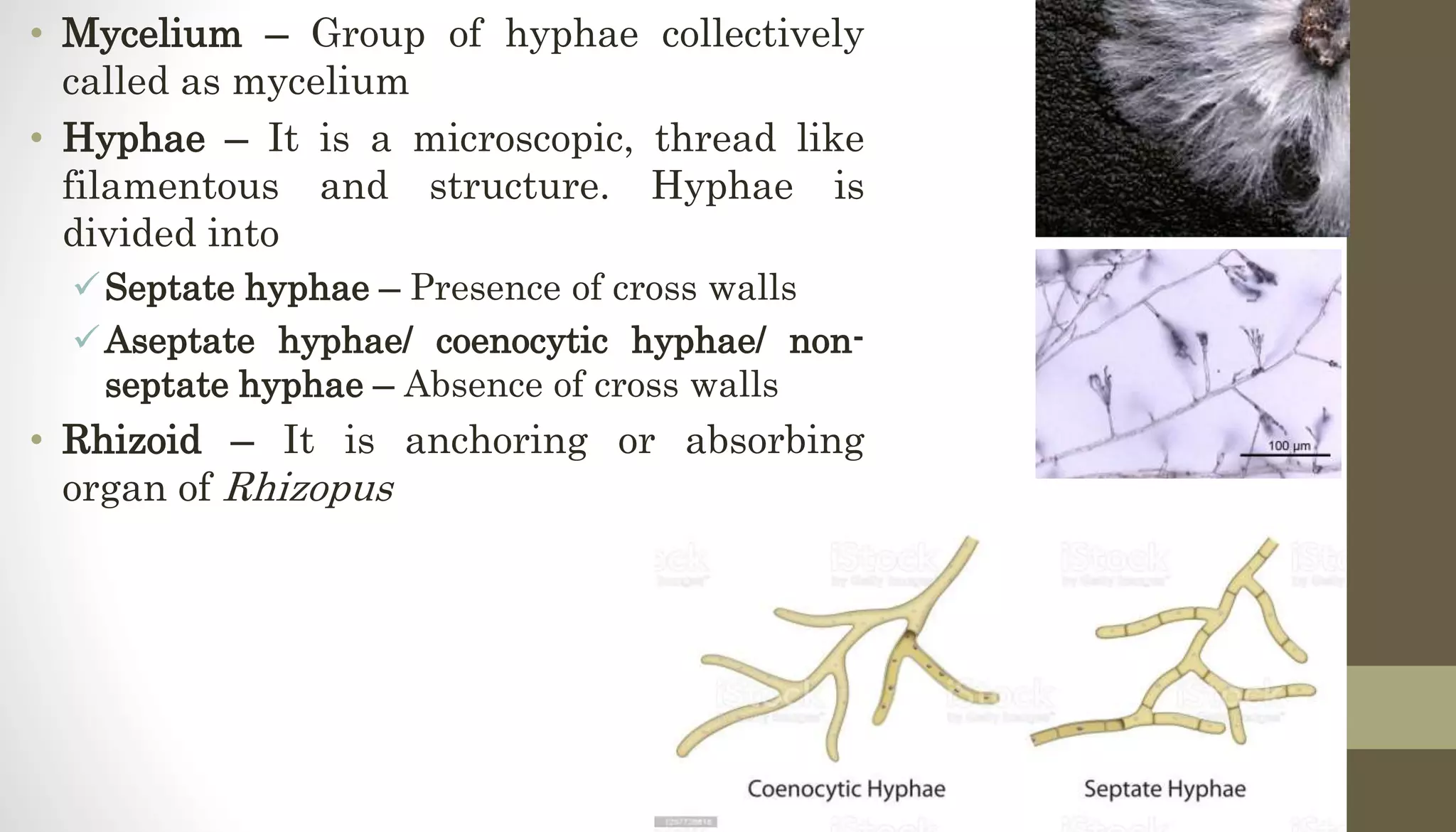
• Mycelium – Group of hyphae collectively
called as mycelium
• Hyphae – It is a microscopic, thread like
filamentous and structure. Hyphae is
divided into
Septate hyphae – Presence of cross walls
Aseptate hyphae/ coenocytic hyphae/ non-
septate hyphae – Absence of cross walls
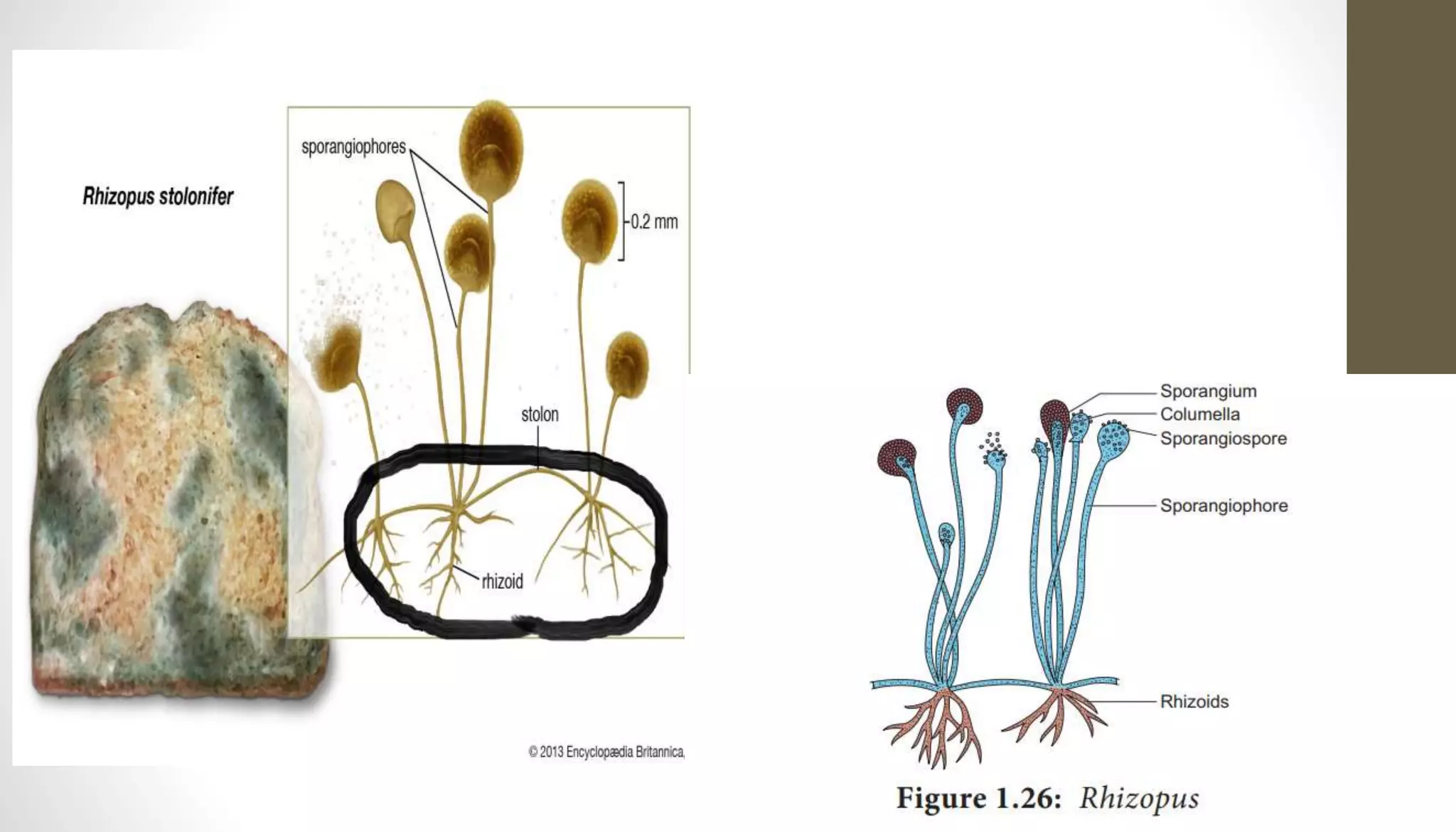
• Rhizoid – It is anchoring or absorbing
organ of Rhizopus
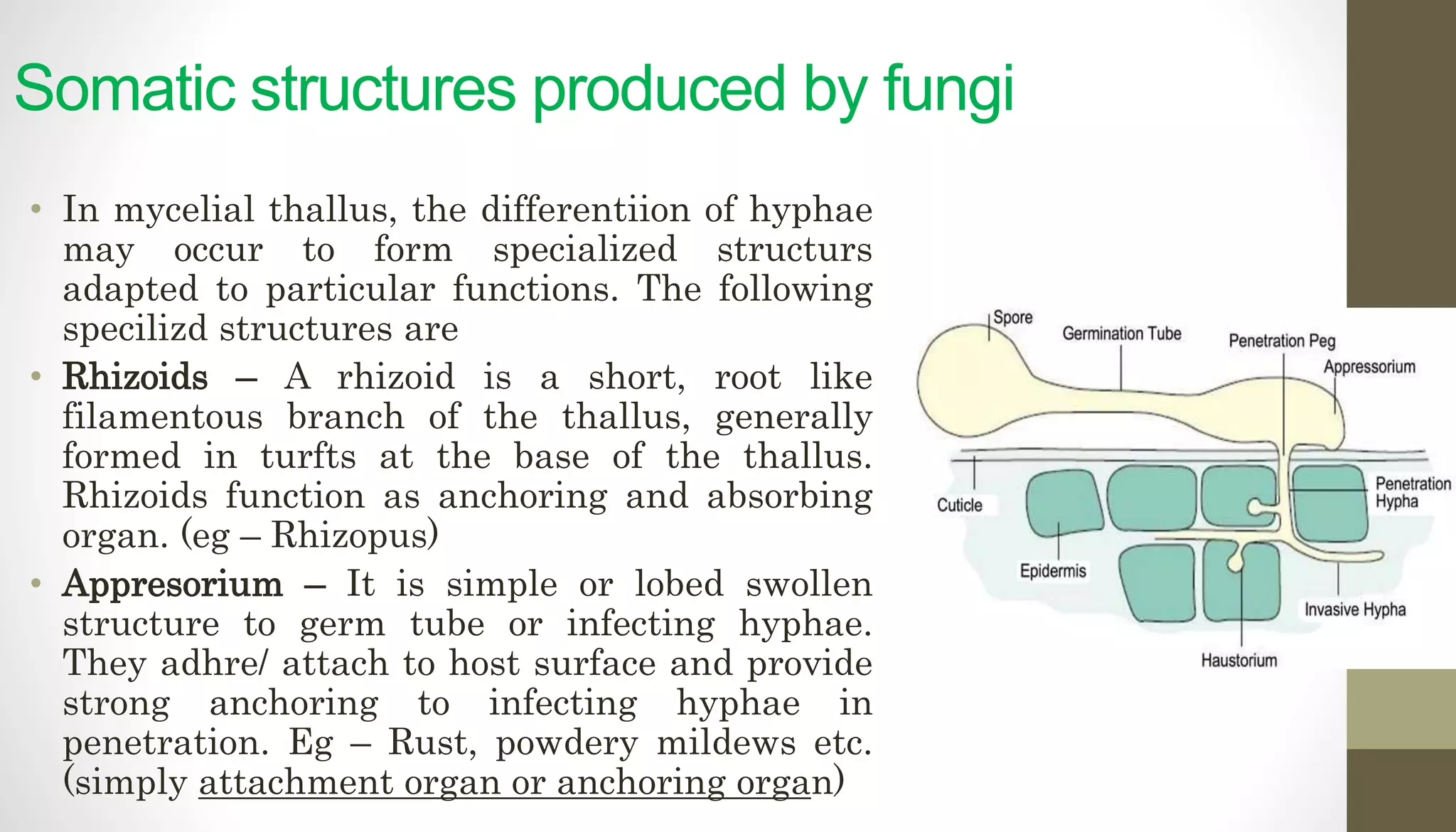
Somatic structures produced by fungi
• In mycelial thallus, the differentiion of hyphae
may occur to form specialized structurs
adapted to particular functions. The following
specilizd structures are
• Rhizoids – A rhizoid is a short, root like
filamentous branch of the thallus, generally
formed in turfts at the base of the thallus.
Rhizoids function as anchoring and absorbing
organ. (eg – Rhizopus)
• Appresorium – It is simple or lobed swollen
structure to germ tube or infecting hyphae.
They adhre/ attach to host surface and provide
strong anchoring to infecting hyphae in
penetration. Eg – Rust, powdery mildews etc.
(simply attachment organ or anchoring organ)
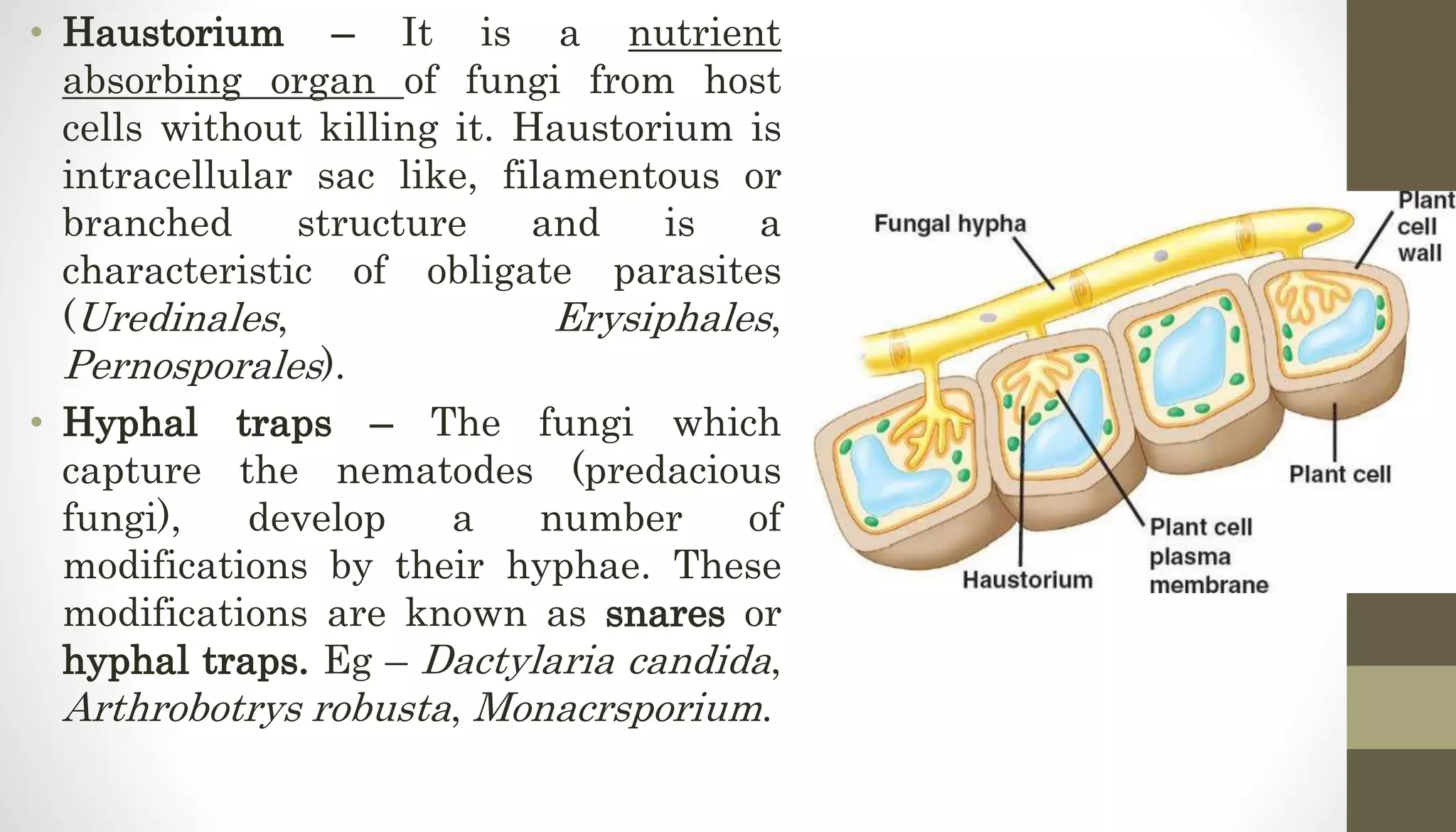
• Haustorium – It is a nutrient
absorbing organ of fungi from host
cells without killing it. Haustorium is
intracellular sac like, filamentous or
branched structure and is a
characteristic of obligate parasites
(Uredinales, Erysiphales,
Pernosporales).
• Hyphal traps – The fungi which
capture the nematodes (predacious
fungi), develop a number of
modifications by their hyphae. These
modifications are known as snares or
hyphal traps. Eg – Dactylaria candida,
Arthrobotrys robusta, Monacrsporium.
Hyphal modifications in fungi or mycelial aggregations in fungi
• The fungal structure as resting bodies, fruiting bodies, migratory
strands etc. are formd by the aggregation of hyphae to various
extents.
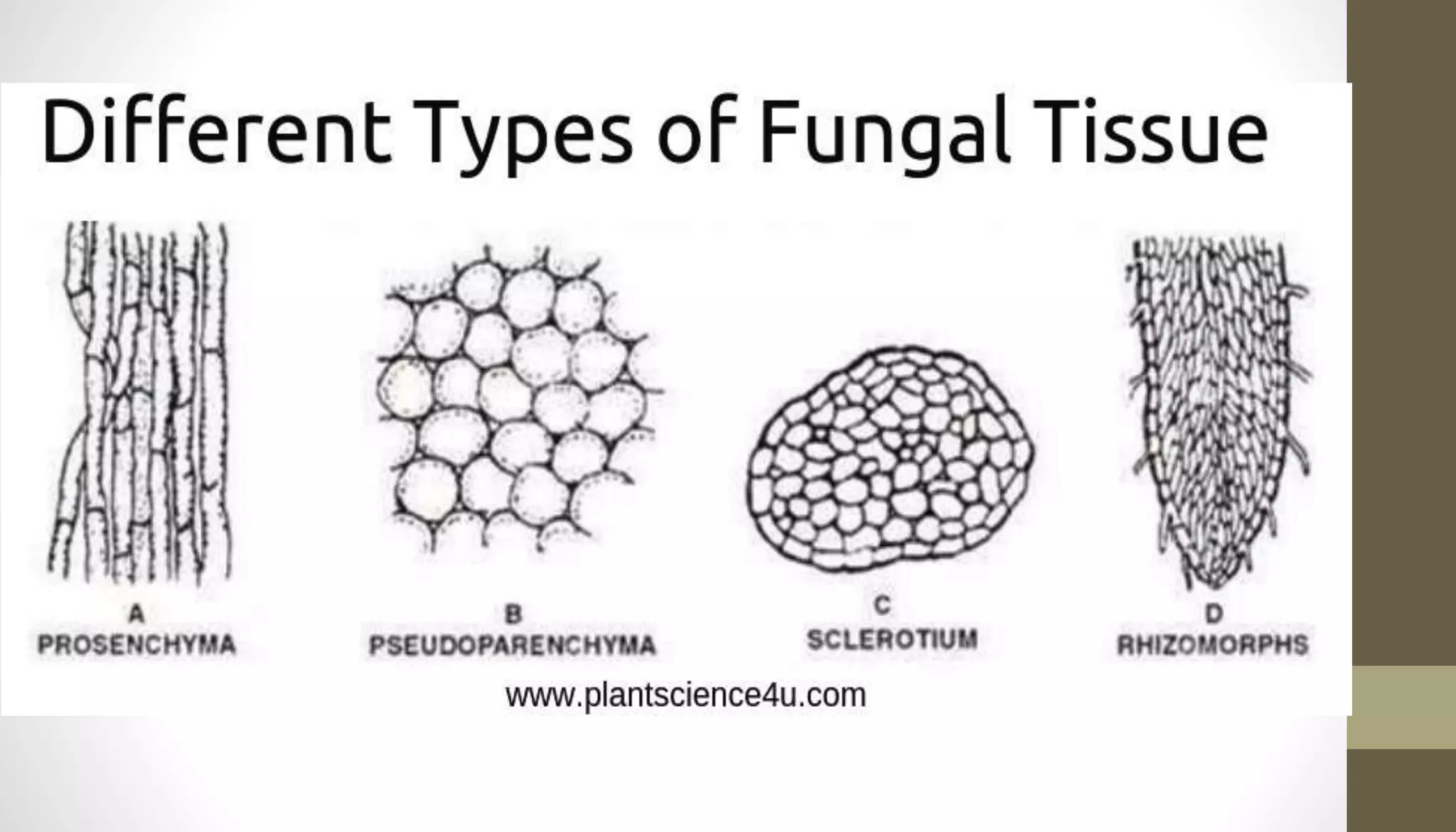
• The mycelium becomes organized into loosely or compactly woven
tissues called as plectenchyma, used to designate all organized
fungal tissues. Plectenchyma basically of two types
• Prosenchyma - Loosely woven tissue in which the individual hyphae
lie more or less parallel to one another and their elongated cells are
easily distinguished from each another.
• Pseudoparenchma – It consists of loosely packed, more or less
isodiametric oval cells recembling the parenchyma of higher plants
in cross section.
• Prosenchyma and pseudoparenchyma makes various types of
somatic or reproductive structures are produced below
Somatic or reproductive strutcture of fungi
1. Stromata – A stroma is a compact mass of tissues.
This somatic structure is like a mattress on which
fructifications are formed.
2. Sclerotia – Hyphal aggregations with determinate
growth. This is made of pseudoparenchymatous
tissues. These types of resting bodies are produced by
the pathogenic members of Sclerotinia, Claviceps,
Rhizoctonia etc. they contains huge amount of reserve
food material (in the form of mannitol, trehalose,
glycogen and lipids) for long term survival.
3. Mycelial strands – The formation of aggregates of
parallel, relatively undifferentiated hyphae. A strand
is formed around one or more leader hyphae which
grow out of the margin of the thallus. They are
capable of translocating materials in both directions.
Commonly observed in Basidiomycotina and some
Ascomycotina and Deuteromycotina.
Rhizomorphs – The root like aggregation of hyphae.
Certain fungi have highly differentiatiated
aggregations of hyphae with well developed apical
meristem and a central core of thick walled
elongated cells. They are about 4 mm and having
4000 hyphae aggregations togeather.
Eg – Armillariella mellea (honey fugus or honey
agaric)
Do u know – The sclerotium of the Australian
Polyporus milittae can reach the size of man’s head
(about 15 kg) and is known as native bread or black
fello’s bread.
REPRODUCTION IN FUNGI
• Reproduction is the formation of new individuals with all
characteristics.
• Types
Vegetative reproduction
Asexual reproduction
Sexual reproduction
Vegetative reproduction
• It does not involve in the the union of nuclei, no sex cells (gamaates)
or sex organs (gametangia) are produced. The asexual spores are
also called as mitospores.
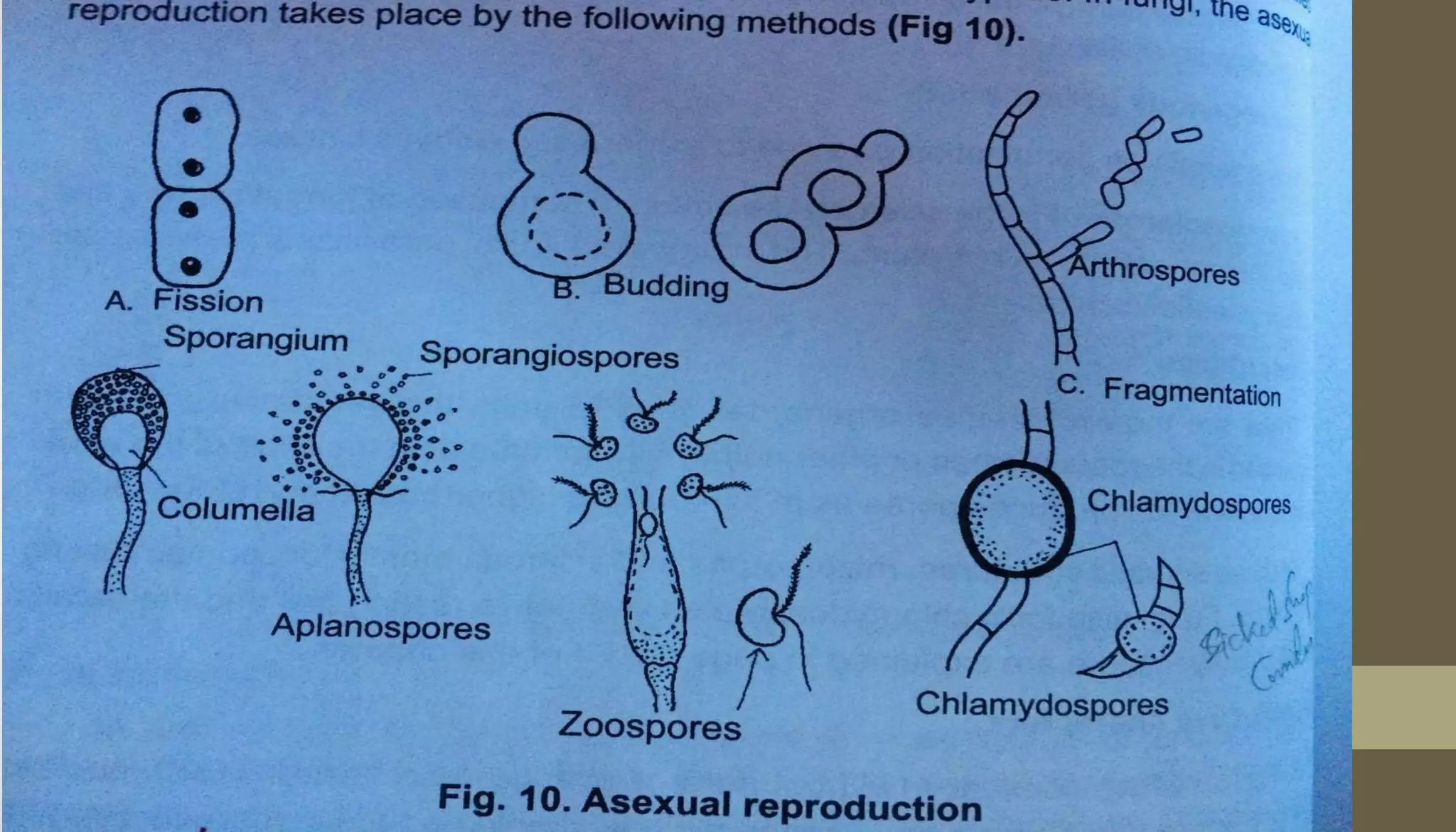
• Fragmentation - A bit of broken fragment of hyphae detchd and
establishes a new colony..
• Budding – It is the production of a small outgrowth (bud) from a
parent cell or spore. Each bud produces a new individual. As the bud
is formed, the nuclei of parent cell divides and one daughter nucleus
migrates into bud. Budding can be observed in yeast.
• Fission – The splitting of a cell into two daughter cells by
constriction. The nucleus divides mitotically along with the
formation of a cell wall. Although, it is a characteristic of bacteria
and it also occurs in fission yeasts.
Asexual reproduction
• Production of asexual spores – Spore is a reproductive structure of
fungi. There are two major kinds of asexual spores in fungi.
1. Sporangiospores – Producd within the sporangium. The
sporangiospore are two types
• Aplanospores – They are non motile spores having typical cell wall
around them. They ar uni or multinucleate, unicellular, smooth
walled, globose or ellipsoid in shape. The number of aplanospores per
sporangium ranges from one to several thousands.
Eg – Zygomycotinai (Mucorales)
• Zoospores – These are motile spore and are self propelled by means of
flagella. They lack cell walls and contains cell envelope in a
membrane. Eg - Mastigomycotina
2. Conida or condisospores – They are asexual reproductive
structure producd by different groups of fungi especially
Ascomycotina and Deuteomycotina. Conidia are produced
exogenously on condiophores.
• Arthrospores – They are formed by close separation in basipeta
succession. Each cells rouds off and sets free as a thin-walled
arthrospores. It is also called as oidia.
• Eg – Oidium, Endomyces
• Chlamydospores – It is a thick walled resting spore surrounded
by pigmented wall and is formed from terminal or intercalary
cells of hyphae. They contains enormous amount of food
reserves in the form of glycogen or oil. They may be dispersed in
water currents and then known as gemmae.
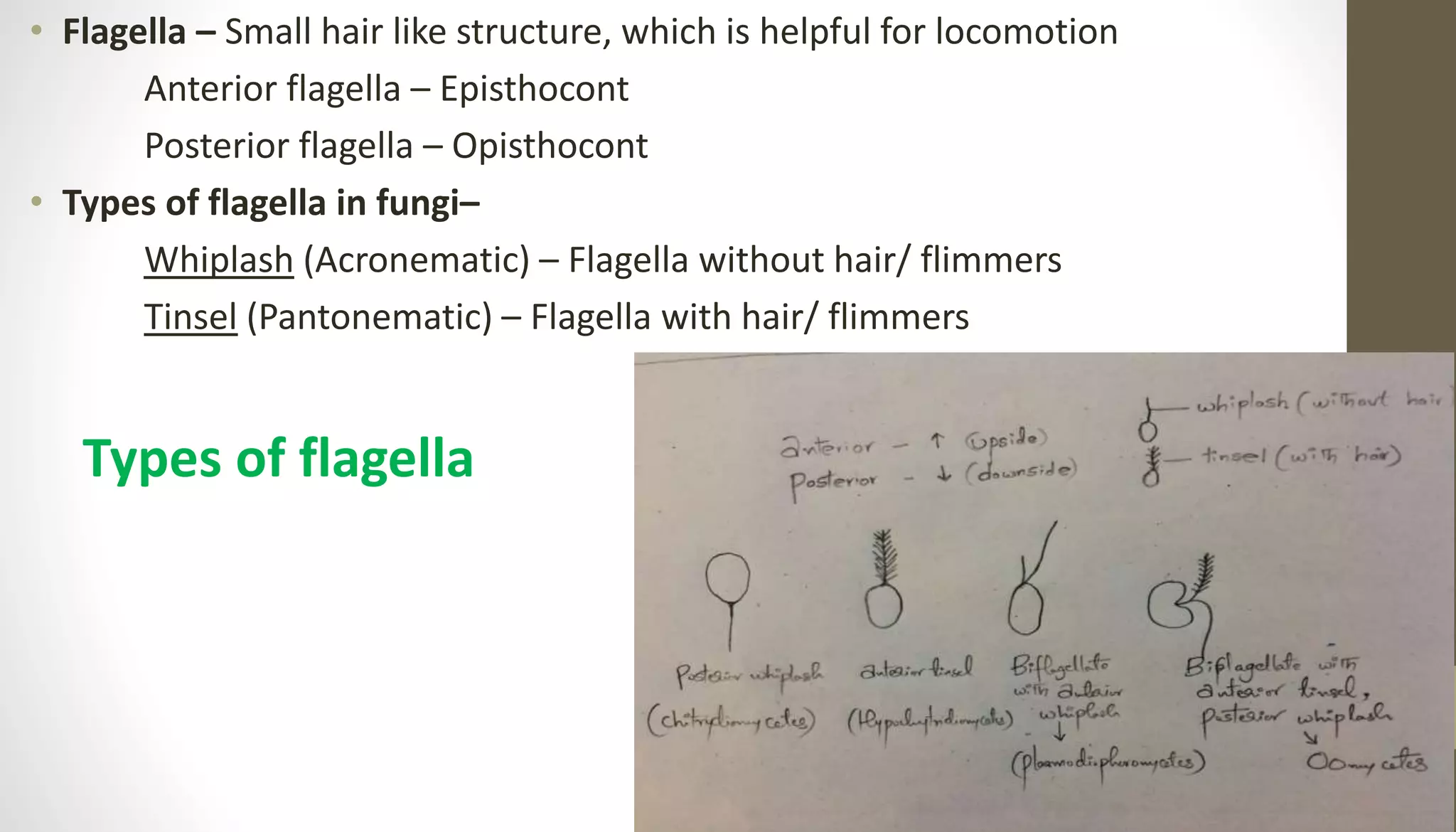
• Flagella – Small hair like structure, which is helpful for locomotion
Anterior flagella – Episthocont
Posterior flagella – Opisthocont
• Types of flagella in fungi–
Whiplash (Acronematic) – Flagella without hair/ flimmers
Tinsel (Pantonematic) – Flagella with hair/ flimmers
Types of flagella
Sexual reproduction
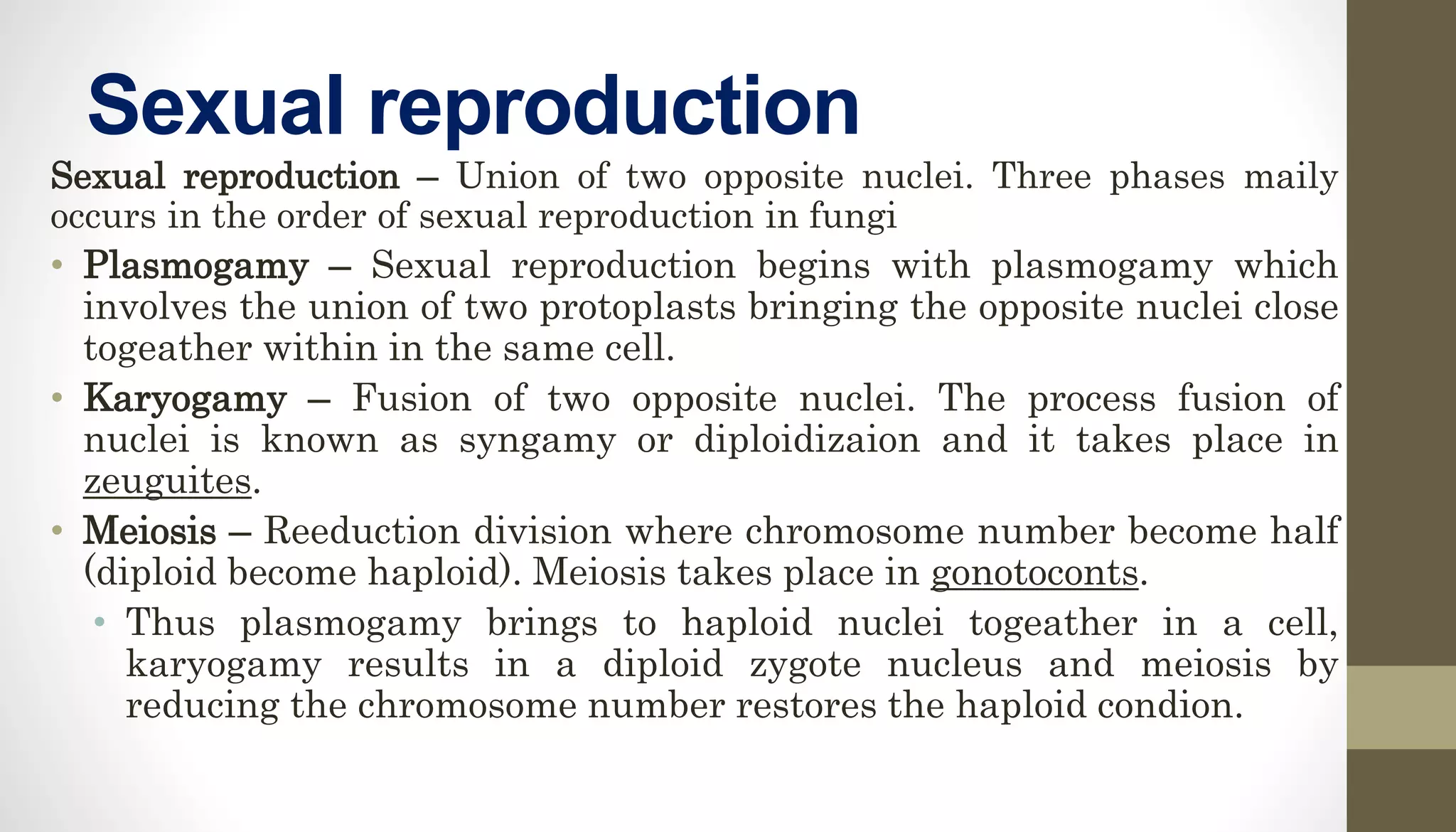
Sexual reproduction – Union of two opposite nuclei. Three phases maily
occurs in the order of sexual reproduction in fungi
• Plasmogamy – Sexual reproduction begins with plasmogamy which
involves the union of two protoplasts bringing the opposite nuclei close
togeather within in the same cell.
• Karyogamy – Fusion of two opposite nuclei. The process fusion of
nuclei is known as syngamy or diploidizaion and it takes place in
zeuguites.
• Meiosis – Reeduction division where chromosome number become half
(diploid become haploid). Meiosis takes place in gonotoconts.
• Thus plasmogamy brings to haploid nuclei togeather in a cell,
karyogamy results in a diploid zygote nucleus and meiosis by
reducing the chromosome number restores the haploid condion.
Types of plasmogamy
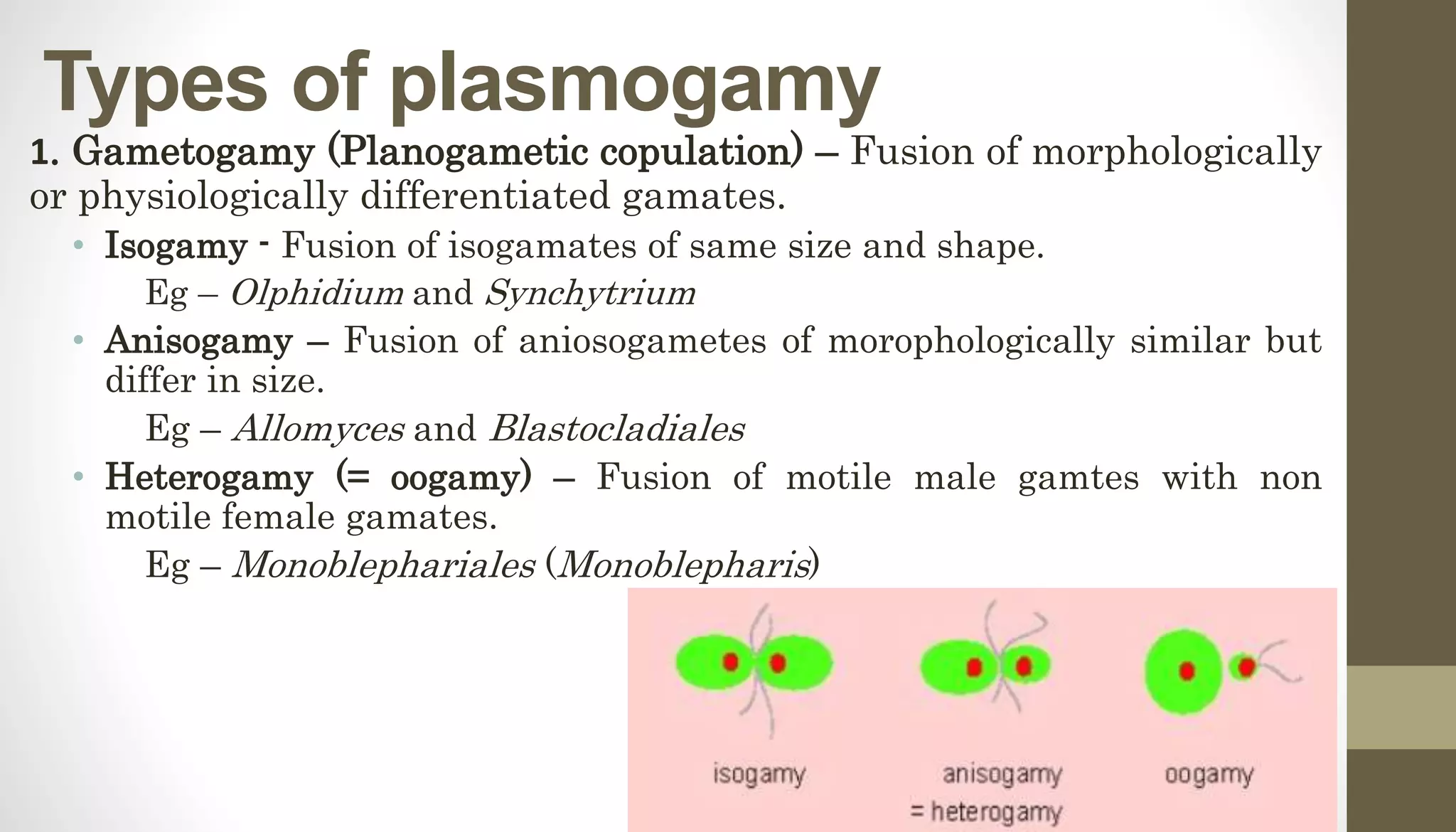
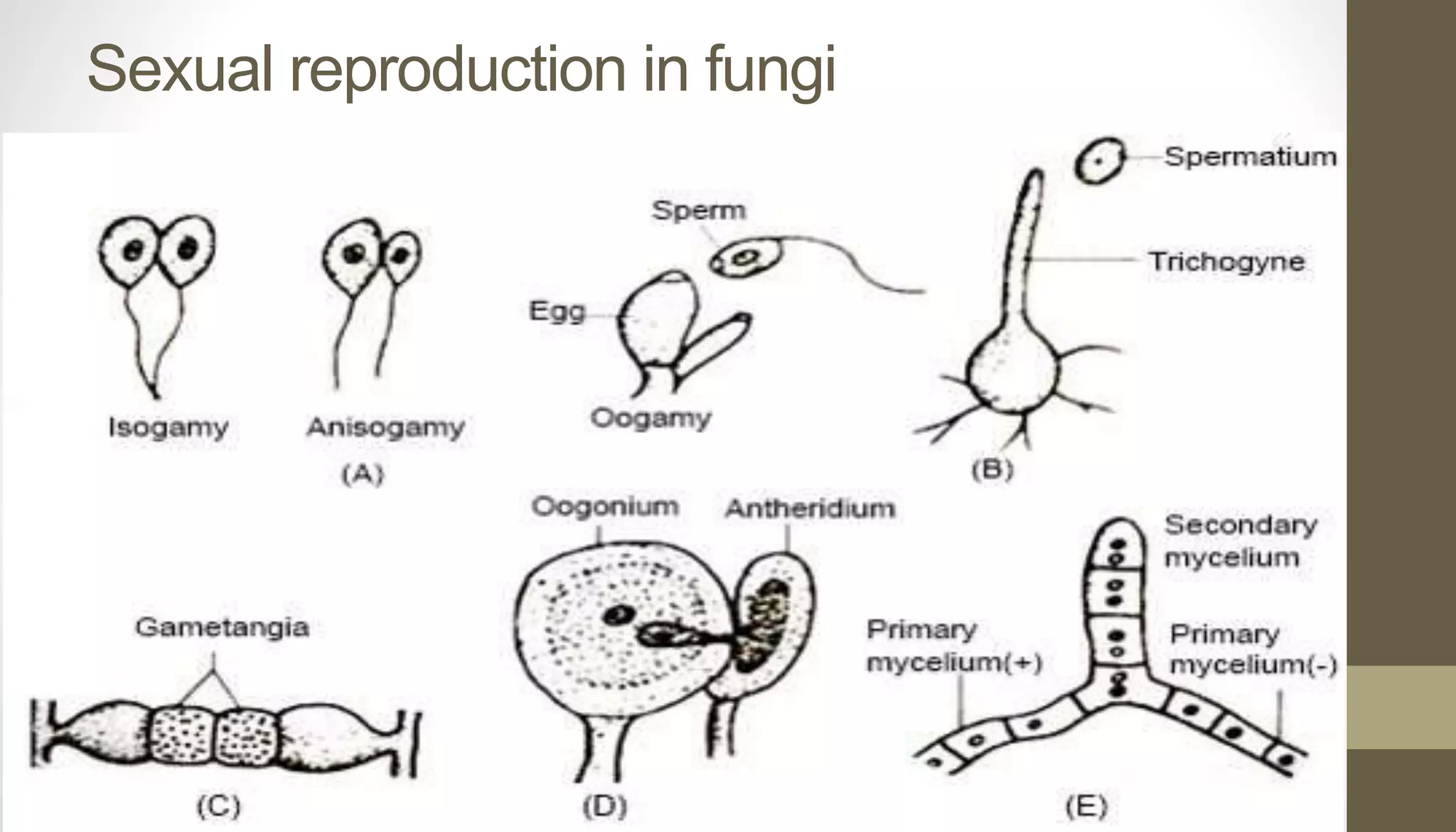
1. Gametogamy (Planogametic copulation) – Fusion of morphologically
or physiologically differentiated gamates.
• Isogamy - Fusion of isogamates of same size and shape.
Eg – Olphidium and Synchytrium
• Anisogamy – Fusion of aniosogametes of morophologically similar but
differ in size.
Eg – Allomyces and Blastocladiales
• Heterogamy (= oogamy) – Fusion of motile male gamtes with non
motile female gamates.
Eg – Monoblephariales (Monoblepharis)
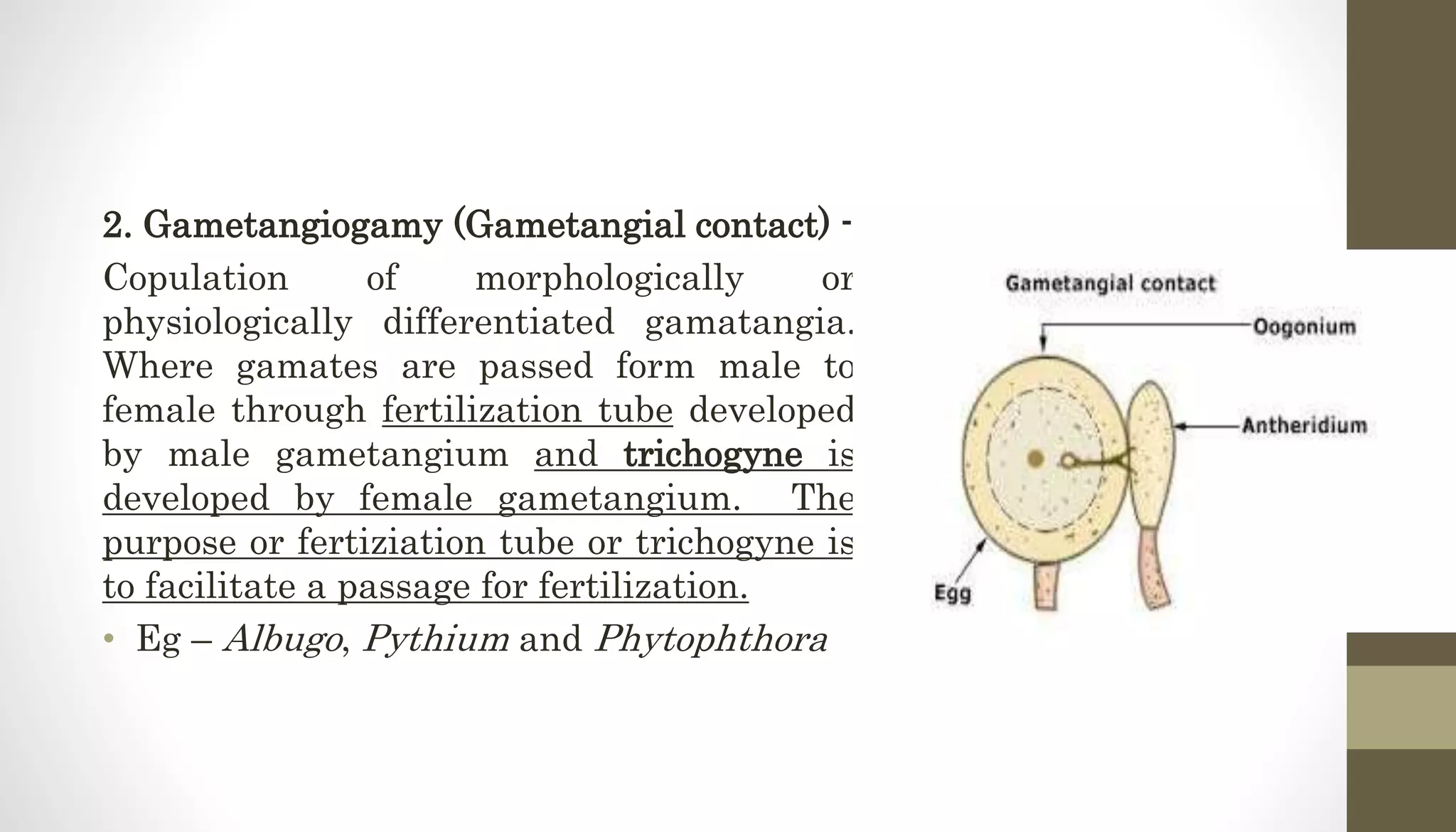
2. Gametangiogamy (Gametangial contact) -
Copulation of morphologically or
physiologically differentiated gamatangia.
Where gamates are passed form male to
female through fertilization tube developed
by male gametangium and trichogyne is
developed by female gametangium. The
purpose or fertiziation tube or trichogyne is
to facilitate a passage for fertilization.
• Eg – Albugo, Pythium and Phytophthora
3. Gametangy (Gametagial copulation) – Fusion of entire
content of two gametangia. Fusion takes in different ways
• Hologamy - Whole content of one gametangium passes into
another gametangium
Eg – Chytridis and Yeast (Polyphogus and Rhizophidium)
• Direct fusion - Fusion of two morphologically similar
gametangia and become a single cell
Eg – Mucor and Rhizopus
• Anisogametangial population – Fusion between unequa
gametangia
Eg – Mucorales
4. Spermatization - This method of sexual reproduction can be
observed in ruts. Rust produce numerous, tiny, uninucleate,
non-motile, spore like male sex cells called spermatia. They
form flask shaped organs called spermogonia developed on the
upper surface of leaf of the second host. The spermatia are
carried by various agencies, generally by insects, wind or water
to the receptive hyphae of opposite strains produced in another
spermagonium. At the point of contact the wall was dissolved
and a pore is formed, the content of spermatium (male
gamates) migrates through the pore into the receptive hypha
and become binucleate. The union of hyphae with the receptive
hyphae is known as spermatization.
• Eg – Puccinia graminis and Podospora
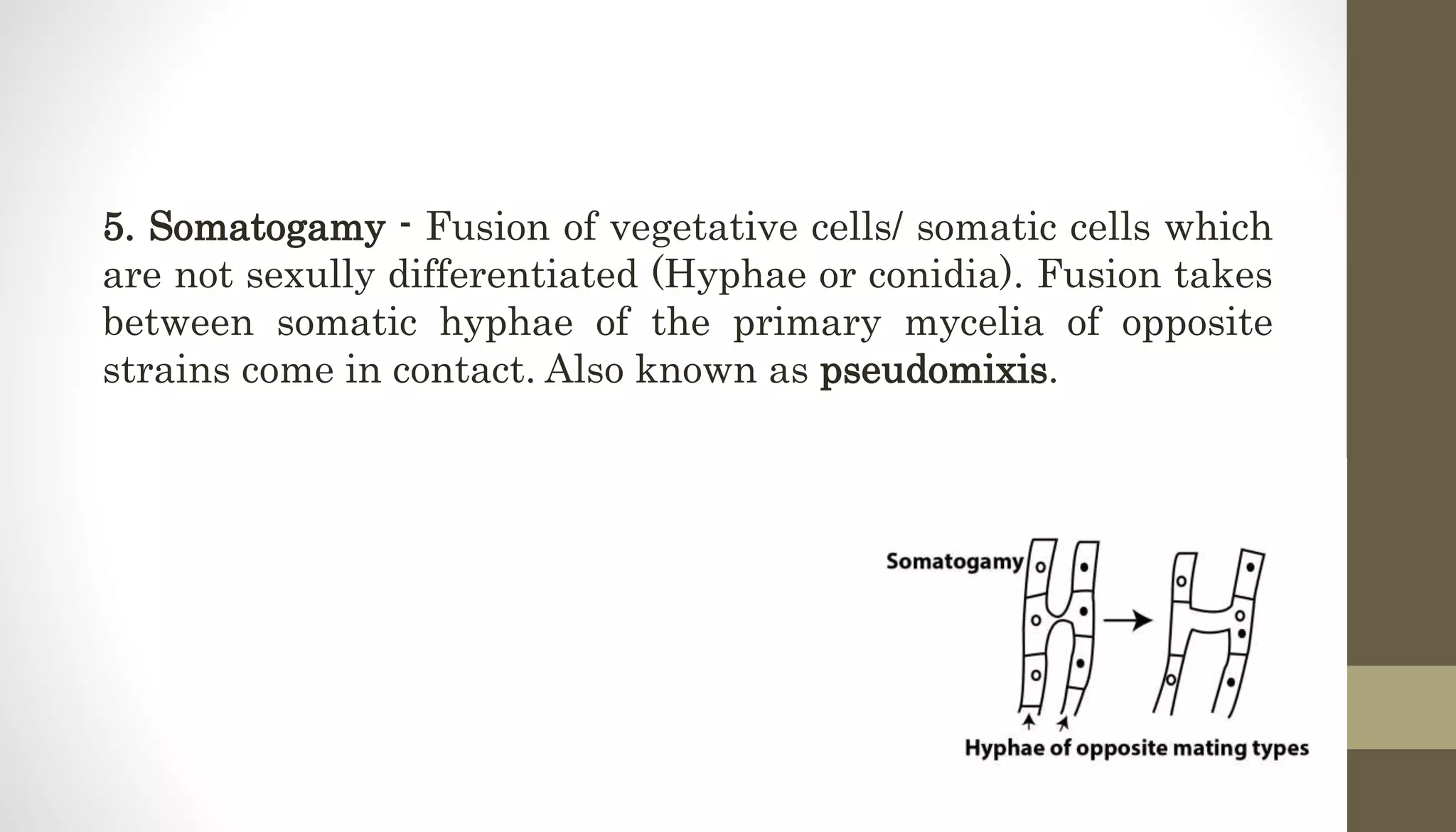
5. Somatogamy - Fusion of vegetative cells/ somatic cells which
are not sexully differentiated (Hyphae or conidia). Fusion takes
between somatic hyphae of the primary mycelia of opposite
strains come in contact. Also known as pseudomixis.
Sexual reproduction in fungi

General characters of fungi

  • 1.
    General characters offungi N. H. SHANKAR REDDY 1st , Ph.D Plant Pathology Annamalai University
  • 2.
    • Fungi areeukaryotic, achlorophyllous, non motile, unicellular or multicellular organism, which reproduce by means of asexual or sexual spores • Nutrition – Heterotrophic (lack of preparation of own food material) and absorptive (ingestion rare) • Thallus – Unicellular, filamentous, septate or non-septate typically non motile (protoplasmic flow) but motile stages (Zoospores) may occur • Cell wall – Well defined and typically chitinised (cellulose in Oomycota) • Life cycle – Simple or complex • Sexuality – Asexual or sexual and homothallic or heterothallic • Habitat – Ubiquitous as saprobes, symbionts, parasites or hyperparasites
  • 3.
    • They reproducesexually by means of spores asexually by means of budding, fragmentation etc. • Fungi exhibit the phenomenon of alternation of generation. • Fungi lack chlorophyll and hence cannot perform photosynthesis. • During mitosis, the nuclear envelope is not dissolved. • The fungi have no embryonic stage. They develop from the spores. • Fungi produce sex hormones play a major role in sexual reproduction. • The majority of fungi belonging to the phylum Ascomycota, basidiomycota, zygomycota etc. • Eg - Mushrooms, moulds, yeast
  • 4.
    Thallus – Vegetative/somatic body (entire body) of fungus. Thallus is not differentiated into distinct parts. Thallus is divided into two • Holocarpic thallus – The entire thallus at maturity become converted into single or several reproductive organs. • Eg – Olphidium and Synchytrium • Eucarpic thallus – The mature thallus is differentiated at the time of reproduction, into a vegetative part (which absorb nutrinets) and reproductive part. • Eg – Pythium and Phytophthora
  • 5.
    • Mycelium –Group of hyphae collectively called as mycelium • Hyphae – It is a microscopic, thread like filamentous and structure. Hyphae is divided into Septate hyphae – Presence of cross walls Aseptate hyphae/ coenocytic hyphae/ non- septate hyphae – Absence of cross walls • Rhizoid – It is anchoring or absorbing organ of Rhizopus
  • 6.
    Somatic structures producedby fungi • In mycelial thallus, the differentiion of hyphae may occur to form specialized structurs adapted to particular functions. The following specilizd structures are • Rhizoids – A rhizoid is a short, root like filamentous branch of the thallus, generally formed in turfts at the base of the thallus. Rhizoids function as anchoring and absorbing organ. (eg – Rhizopus) • Appresorium – It is simple or lobed swollen structure to germ tube or infecting hyphae. They adhre/ attach to host surface and provide strong anchoring to infecting hyphae in penetration. Eg – Rust, powdery mildews etc. (simply attachment organ or anchoring organ)
  • 8.
    • Haustorium –It is a nutrient absorbing organ of fungi from host cells without killing it. Haustorium is intracellular sac like, filamentous or branched structure and is a characteristic of obligate parasites (Uredinales, Erysiphales, Pernosporales). • Hyphal traps – The fungi which capture the nematodes (predacious fungi), develop a number of modifications by their hyphae. These modifications are known as snares or hyphal traps. Eg – Dactylaria candida, Arthrobotrys robusta, Monacrsporium.
  • 9.
    Hyphal modifications infungi or mycelial aggregations in fungi • The fungal structure as resting bodies, fruiting bodies, migratory strands etc. are formd by the aggregation of hyphae to various extents. • The mycelium becomes organized into loosely or compactly woven tissues called as plectenchyma, used to designate all organized fungal tissues. Plectenchyma basically of two types • Prosenchyma - Loosely woven tissue in which the individual hyphae lie more or less parallel to one another and their elongated cells are easily distinguished from each another. • Pseudoparenchma – It consists of loosely packed, more or less isodiametric oval cells recembling the parenchyma of higher plants in cross section. • Prosenchyma and pseudoparenchyma makes various types of somatic or reproductive structures are produced below
  • 11.
    Somatic or reproductivestrutcture of fungi 1. Stromata – A stroma is a compact mass of tissues. This somatic structure is like a mattress on which fructifications are formed. 2. Sclerotia – Hyphal aggregations with determinate growth. This is made of pseudoparenchymatous tissues. These types of resting bodies are produced by the pathogenic members of Sclerotinia, Claviceps, Rhizoctonia etc. they contains huge amount of reserve food material (in the form of mannitol, trehalose, glycogen and lipids) for long term survival. 3. Mycelial strands – The formation of aggregates of parallel, relatively undifferentiated hyphae. A strand is formed around one or more leader hyphae which grow out of the margin of the thallus. They are capable of translocating materials in both directions. Commonly observed in Basidiomycotina and some Ascomycotina and Deuteromycotina.
  • 12.
    Rhizomorphs – Theroot like aggregation of hyphae. Certain fungi have highly differentiatiated aggregations of hyphae with well developed apical meristem and a central core of thick walled elongated cells. They are about 4 mm and having 4000 hyphae aggregations togeather. Eg – Armillariella mellea (honey fugus or honey agaric) Do u know – The sclerotium of the Australian Polyporus milittae can reach the size of man’s head (about 15 kg) and is known as native bread or black fello’s bread.
  • 13.
    REPRODUCTION IN FUNGI •Reproduction is the formation of new individuals with all characteristics. • Types Vegetative reproduction Asexual reproduction Sexual reproduction
  • 14.
    Vegetative reproduction • Itdoes not involve in the the union of nuclei, no sex cells (gamaates) or sex organs (gametangia) are produced. The asexual spores are also called as mitospores. • Fragmentation - A bit of broken fragment of hyphae detchd and establishes a new colony.. • Budding – It is the production of a small outgrowth (bud) from a parent cell or spore. Each bud produces a new individual. As the bud is formed, the nuclei of parent cell divides and one daughter nucleus migrates into bud. Budding can be observed in yeast. • Fission – The splitting of a cell into two daughter cells by constriction. The nucleus divides mitotically along with the formation of a cell wall. Although, it is a characteristic of bacteria and it also occurs in fission yeasts.
  • 15.
    Asexual reproduction • Productionof asexual spores – Spore is a reproductive structure of fungi. There are two major kinds of asexual spores in fungi. 1. Sporangiospores – Producd within the sporangium. The sporangiospore are two types • Aplanospores – They are non motile spores having typical cell wall around them. They ar uni or multinucleate, unicellular, smooth walled, globose or ellipsoid in shape. The number of aplanospores per sporangium ranges from one to several thousands. Eg – Zygomycotinai (Mucorales) • Zoospores – These are motile spore and are self propelled by means of flagella. They lack cell walls and contains cell envelope in a membrane. Eg - Mastigomycotina
  • 16.
    2. Conida orcondisospores – They are asexual reproductive structure producd by different groups of fungi especially Ascomycotina and Deuteomycotina. Conidia are produced exogenously on condiophores. • Arthrospores – They are formed by close separation in basipeta succession. Each cells rouds off and sets free as a thin-walled arthrospores. It is also called as oidia. • Eg – Oidium, Endomyces • Chlamydospores – It is a thick walled resting spore surrounded by pigmented wall and is formed from terminal or intercalary cells of hyphae. They contains enormous amount of food reserves in the form of glycogen or oil. They may be dispersed in water currents and then known as gemmae.
  • 18.
    • Flagella –Small hair like structure, which is helpful for locomotion Anterior flagella – Episthocont Posterior flagella – Opisthocont • Types of flagella in fungi– Whiplash (Acronematic) – Flagella without hair/ flimmers Tinsel (Pantonematic) – Flagella with hair/ flimmers Types of flagella
  • 19.
    Sexual reproduction Sexual reproduction– Union of two opposite nuclei. Three phases maily occurs in the order of sexual reproduction in fungi • Plasmogamy – Sexual reproduction begins with plasmogamy which involves the union of two protoplasts bringing the opposite nuclei close togeather within in the same cell. • Karyogamy – Fusion of two opposite nuclei. The process fusion of nuclei is known as syngamy or diploidizaion and it takes place in zeuguites. • Meiosis – Reeduction division where chromosome number become half (diploid become haploid). Meiosis takes place in gonotoconts. • Thus plasmogamy brings to haploid nuclei togeather in a cell, karyogamy results in a diploid zygote nucleus and meiosis by reducing the chromosome number restores the haploid condion.
  • 20.
    Types of plasmogamy 1.Gametogamy (Planogametic copulation) – Fusion of morphologically or physiologically differentiated gamates. • Isogamy - Fusion of isogamates of same size and shape. Eg – Olphidium and Synchytrium • Anisogamy – Fusion of aniosogametes of morophologically similar but differ in size. Eg – Allomyces and Blastocladiales • Heterogamy (= oogamy) – Fusion of motile male gamtes with non motile female gamates. Eg – Monoblephariales (Monoblepharis)
  • 21.
    2. Gametangiogamy (Gametangialcontact) - Copulation of morphologically or physiologically differentiated gamatangia. Where gamates are passed form male to female through fertilization tube developed by male gametangium and trichogyne is developed by female gametangium. The purpose or fertiziation tube or trichogyne is to facilitate a passage for fertilization. • Eg – Albugo, Pythium and Phytophthora
  • 22.
    3. Gametangy (Gametagialcopulation) – Fusion of entire content of two gametangia. Fusion takes in different ways • Hologamy - Whole content of one gametangium passes into another gametangium Eg – Chytridis and Yeast (Polyphogus and Rhizophidium) • Direct fusion - Fusion of two morphologically similar gametangia and become a single cell Eg – Mucor and Rhizopus • Anisogametangial population – Fusion between unequa gametangia Eg – Mucorales
  • 23.
    4. Spermatization -This method of sexual reproduction can be observed in ruts. Rust produce numerous, tiny, uninucleate, non-motile, spore like male sex cells called spermatia. They form flask shaped organs called spermogonia developed on the upper surface of leaf of the second host. The spermatia are carried by various agencies, generally by insects, wind or water to the receptive hyphae of opposite strains produced in another spermagonium. At the point of contact the wall was dissolved and a pore is formed, the content of spermatium (male gamates) migrates through the pore into the receptive hypha and become binucleate. The union of hyphae with the receptive hyphae is known as spermatization. • Eg – Puccinia graminis and Podospora
  • 24.
    5. Somatogamy -Fusion of vegetative cells/ somatic cells which are not sexully differentiated (Hyphae or conidia). Fusion takes between somatic hyphae of the primary mycelia of opposite strains come in contact. Also known as pseudomixis.
  • 25.