FUNGI
PRESENTED BY : ANAMIKA RAJ
(DEPARTMENT OF BOTANY)
St. Xavier’s College , Ranchi - 843001
HYPHAL MODIFICATION
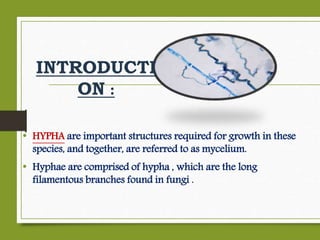
• HYPHA are important structures required for growth in these
species, and together, are referred to as mycelium.
• Hyphae are comprised of hypha , which are the long
filamentous branches found in fungi .
INTRODUCTI
ON :
Hyphae Structure
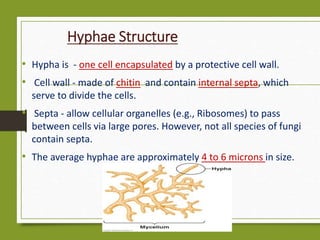
• Hypha is - one cell encapsulated by a protective cell wall.
• Cell wall - made of chitin and contain internal septa, which
serve to divide the cells.
• Septa - allow cellular organelles (e.g., Ribosomes) to pass
between cells via large pores. However, not all species of fungi
contain septa.
• The average hyphae are approximately 4 to 6 microns in size.
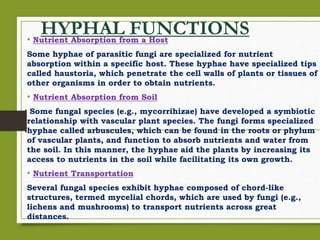
HYPHAL FUNCTIONS• Nutrient Absorption from a Host
Some hyphae of parasitic fungi are specialized for nutrient
absorption within a specific host. These hyphae have specialized tips
called haustoria, which penetrate the cell walls of plants or tissues of
other organisms in order to obtain nutrients.
• Nutrient Absorption from Soil
Some fungal species (e.g., mycorrihizae) have developed a symbiotic
relationship with vascular plant species. The fungi forms specialized
hyphae called arbuscules, which can be found in the roots or phylum
of vascular plants, and function to absorb nutrients and water from
the soil. In this manner, the hyphae aid the plants by increasing its
access to nutrients in the soil while facilitating its own growth.
• Nutrient Transportation
Several fungal species exhibit hyphae composed of chord-like
structures, termed mycelial chords, which are used by fungi (e.g.,
lichens and mushrooms) to transport nutrients across great
distances.
•RHIZOMORPH
•HAUSTORIA
•SCLEROTIA
RHIZOMORPH
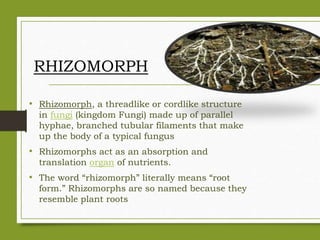
• Rhizomorph, a threadlike or cordlike structure
in fungi (kingdom Fungi) made up of parallel
hyphae, branched tubular filaments that make
up the body of a typical fungus
• Rhizomorphs act as an absorption and
translation organ of nutrients.
• The word “rhizomorph” literally means “root
form.” Rhizomorphs are so named because they
resemble plant roots
CHARATERISTICS OF
RHIZOMORPHS
• Rhizomorphs are thick strands or root like aggregation of somatic hyphae
in some fungi.
• They are also called mycelial cords.
• They are gelatinous, dark brown and rope like coiled structures.
• In rhizomorphs the interwining of hyphae is too tight so that hyphae loose
its individuality.
• Individual hyphae are arranged in parallel way.
• Rhizomorphs have higher infection capacity than individual hyphae.
• They are perennating structures with high penetration capacity.
• Rhizomorphs survives for many years and they give rise to new mycelia in
favourable conditions.
ARE RHIZOMORPHS GOOD OR BAD
• The fungi that form rhizomorphs can be plant allies, plant enemies, or neutral
decomposers. It all depends on what fungal species is the source of the
rhizomorph and whether nearby plants are healthy or sick. A plant enemy that
forms rhizomorphs is the bootlace fungus (Armillaria mellea). This Armillaria
species is a major cause of root rot that often kills trees and shrubs. It can infect
previously healthy trees of susceptible species, or it can attack already weakened
specimens of other tree species. The black or reddish-brown rhizomorphs of
this species grow just beneath the infected tree’s bark and in the surrounding
soil. They resemble bootlaces and can reach up to 0.2 inch (5 mm.) in diameter.
• Other rhizomorph-forming fungi are saprophytes, meaning that they live on decomposing
organic material such as fallen leaves and logs. They indirectly benefit plants by building
soil and playing an important role in soil food webs.
• Some mycorrhizal fungi form rhizomorphs. Mycorrhizae are symbiotic alliances between
plants and fungi in which the fungus delivers water and nutrients absorbed from the soil to
the plant in exchange for carbohydrates the plant produces. Long-ranging rhizomorphs
help the fungal partner bring in water and nutrients from a much larger volume of soil than
the plant’s roots could explore on their own. These beneficial rhizomorphs are important
nutrient sources for many tree species.
WHAT DO RHIZOMORPH DO ?
For the fungus, the rhizomorph’s functions include
branching out to search for additional food sources and
transporting nutrients over long distances. Rhizomorphs on
fungi can travel farther than individual hyphae can. Some
rhizomorphs have hollow centers similar to plant xylem,
which allows the fungus to transport larger volumes of
water and water-soluble nutrients. Rhizomorph-forming
mycorrhizal fungi use these structures to locate new trees
to partner with. The bootlace fungus uses its rhizomorphs
to travel through soil and reach new trees to infect. This is
how the fungus spreads through forests of susceptible trees
HAUSTORIA
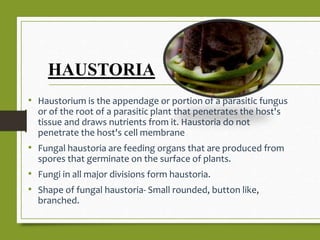
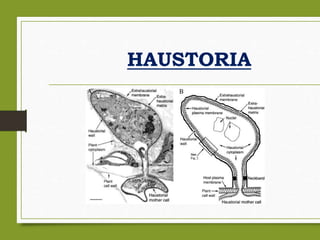
• Haustorium is the appendage or portion of a parasitic fungus
or of the root of a parasitic plant that penetrates the host's
tissue and draws nutrients from it. Haustoria do not
penetrate the host's cell membrane
• Fungal haustoria are feeding organs that are produced from
spores that germinate on the surface of plants.
• Fungi in all major divisions form haustoria.
• Shape of fungal haustoria- Small rounded, button like,
branched.
What type of fungi produce
haustoria ?
• Haustorium production is limited to fungi that need their host
plant to be alive for atleast part of the lifecycle.
• Biotrophic fungi are fungal pathogen that require a living plant
for all of their lifecycle. Such pathogen produce these
specialised feeding structures.
• Examples of biotrophic fungi
Downy mildews
Powdery mildews
Rusts
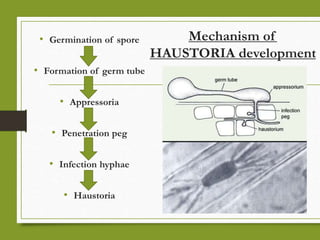
Mechanism of
HAUSTORIA development
• Germination of spore
• Formation of germ tube
• Appressoria
• Penetration peg
• Infection hyphae
• Haustoria
Results of HAUSTORIA penetration into
host cells
• Fungi that do not kill their host utilize specialised feeding
structure called haustoria.
• These structures are formed from the hyphal tip that
penetrates into the host cell and forms a union with plants
plasma membrane which serves as the site for uptake of
nutrients.
• This constant drain of nutrients results in yield losses,
discoloration and are visibly stunted in their growth.
HAUSTORIA
SCLEROTIA
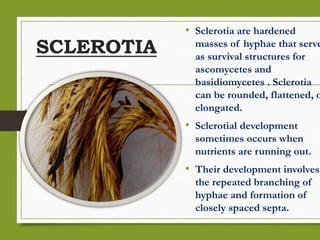
• Sclerotia are hardened
masses of hyphae that serve
as survival structures for
ascomycetes and
basidiomycetes . Sclerotia
can be rounded, flattened, o
elongated.
• Sclerotial development
sometimes occurs when
nutrients are running out.
• Their development involves
the repeated branching of
hyphae and formation of
closely spaced septa.
CHARACTERISTICS OF
SCLEROTIA:
• Sclerotia is a compact globose structure formed by the aggregation of hypha
in some fungi.
• The interwoven hyphae are very much compact so that the individuality of
hyphae is lost and the mass become rounded and cushion like structures.
• Sclerotia survives for long periods, sometimes for many years.
• They are the resting stage of some fungi.
• They accumulate food materials and help in vegetative reproduction.
• Outer portion of sclerotia become dark brown while the inner cells are
colourless.
• Their sizes range from the 0.1-mm-diameter microsclerotia of the plant
pathogen Macrophomina phaseolina, to the 30 cm sclerotia of the edible
Australian fungus Laccocephalum mylittae that weigh several kilogrammes.
IMPORTANCE OF SCLEROTIA
• Sclerotia are important in the understanding of the life cycle
and reproduction of fungi, as a food source, as medicine (for
example, ergotamine), and in agricultural blight management.
• Sclerotia are rich in hyphae emergency supplies, especially
oil.
• They contain a very small amount of water (5-10%) and can
survive in a dry environment for several years without losing
the ability to grow
ERGOT
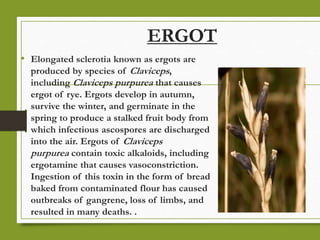
• Elongated sclerotia known as ergots are
produced by species of Claviceps,
including Claviceps purpurea that causes
ergot of rye. Ergots develop in autumn,
survive the winter, and germinate in the
spring to produce a stalked fruit body from
which infectious ascospores are discharged
into the air. Ergots of Claviceps
purpurea contain toxic alkaloids, including
ergotamine that causes vasoconstriction.
Ingestion of this toxin in the form of bread
baked from contaminated flour has caused
outbreaks of gangrene, loss of limbs, and
resulted in many deaths. .
THANK YOU !!☺

KINGDOM FUNGIII - ITS HYPHAL MODIFICATIONS

  • 1.
  • 2.
    PRESENTED BY :ANAMIKA RAJ (DEPARTMENT OF BOTANY) St. Xavier’s College , Ranchi - 843001
  • 3.
  • 4.
    • HYPHA areimportant structures required for growth in these species, and together, are referred to as mycelium. • Hyphae are comprised of hypha , which are the long filamentous branches found in fungi . INTRODUCTI ON :
  • 5.
    Hyphae Structure • Hyphais - one cell encapsulated by a protective cell wall. • Cell wall - made of chitin and contain internal septa, which serve to divide the cells. • Septa - allow cellular organelles (e.g., Ribosomes) to pass between cells via large pores. However, not all species of fungi contain septa. • The average hyphae are approximately 4 to 6 microns in size.
  • 6.
    HYPHAL FUNCTIONS• NutrientAbsorption from a Host Some hyphae of parasitic fungi are specialized for nutrient absorption within a specific host. These hyphae have specialized tips called haustoria, which penetrate the cell walls of plants or tissues of other organisms in order to obtain nutrients. • Nutrient Absorption from Soil Some fungal species (e.g., mycorrihizae) have developed a symbiotic relationship with vascular plant species. The fungi forms specialized hyphae called arbuscules, which can be found in the roots or phylum of vascular plants, and function to absorb nutrients and water from the soil. In this manner, the hyphae aid the plants by increasing its access to nutrients in the soil while facilitating its own growth. • Nutrient Transportation Several fungal species exhibit hyphae composed of chord-like structures, termed mycelial chords, which are used by fungi (e.g., lichens and mushrooms) to transport nutrients across great distances.
  • 7.
  • 8.
    RHIZOMORPH • Rhizomorph, athreadlike or cordlike structure in fungi (kingdom Fungi) made up of parallel hyphae, branched tubular filaments that make up the body of a typical fungus • Rhizomorphs act as an absorption and translation organ of nutrients. • The word “rhizomorph” literally means “root form.” Rhizomorphs are so named because they resemble plant roots
  • 9.
    CHARATERISTICS OF RHIZOMORPHS • Rhizomorphsare thick strands or root like aggregation of somatic hyphae in some fungi. • They are also called mycelial cords. • They are gelatinous, dark brown and rope like coiled structures. • In rhizomorphs the interwining of hyphae is too tight so that hyphae loose its individuality. • Individual hyphae are arranged in parallel way. • Rhizomorphs have higher infection capacity than individual hyphae. • They are perennating structures with high penetration capacity. • Rhizomorphs survives for many years and they give rise to new mycelia in favourable conditions.
  • 10.
    ARE RHIZOMORPHS GOODOR BAD • The fungi that form rhizomorphs can be plant allies, plant enemies, or neutral decomposers. It all depends on what fungal species is the source of the rhizomorph and whether nearby plants are healthy or sick. A plant enemy that forms rhizomorphs is the bootlace fungus (Armillaria mellea). This Armillaria species is a major cause of root rot that often kills trees and shrubs. It can infect previously healthy trees of susceptible species, or it can attack already weakened specimens of other tree species. The black or reddish-brown rhizomorphs of this species grow just beneath the infected tree’s bark and in the surrounding soil. They resemble bootlaces and can reach up to 0.2 inch (5 mm.) in diameter. • Other rhizomorph-forming fungi are saprophytes, meaning that they live on decomposing organic material such as fallen leaves and logs. They indirectly benefit plants by building soil and playing an important role in soil food webs. • Some mycorrhizal fungi form rhizomorphs. Mycorrhizae are symbiotic alliances between plants and fungi in which the fungus delivers water and nutrients absorbed from the soil to the plant in exchange for carbohydrates the plant produces. Long-ranging rhizomorphs help the fungal partner bring in water and nutrients from a much larger volume of soil than the plant’s roots could explore on their own. These beneficial rhizomorphs are important nutrient sources for many tree species.
  • 11.
    WHAT DO RHIZOMORPHDO ? For the fungus, the rhizomorph’s functions include branching out to search for additional food sources and transporting nutrients over long distances. Rhizomorphs on fungi can travel farther than individual hyphae can. Some rhizomorphs have hollow centers similar to plant xylem, which allows the fungus to transport larger volumes of water and water-soluble nutrients. Rhizomorph-forming mycorrhizal fungi use these structures to locate new trees to partner with. The bootlace fungus uses its rhizomorphs to travel through soil and reach new trees to infect. This is how the fungus spreads through forests of susceptible trees
  • 12.
    HAUSTORIA • Haustorium isthe appendage or portion of a parasitic fungus or of the root of a parasitic plant that penetrates the host's tissue and draws nutrients from it. Haustoria do not penetrate the host's cell membrane • Fungal haustoria are feeding organs that are produced from spores that germinate on the surface of plants. • Fungi in all major divisions form haustoria. • Shape of fungal haustoria- Small rounded, button like, branched.
  • 13.
    What type offungi produce haustoria ? • Haustorium production is limited to fungi that need their host plant to be alive for atleast part of the lifecycle. • Biotrophic fungi are fungal pathogen that require a living plant for all of their lifecycle. Such pathogen produce these specialised feeding structures. • Examples of biotrophic fungi Downy mildews Powdery mildews Rusts
  • 14.
    Mechanism of HAUSTORIA development •Germination of spore • Formation of germ tube • Appressoria • Penetration peg • Infection hyphae • Haustoria
  • 15.
    Results of HAUSTORIApenetration into host cells • Fungi that do not kill their host utilize specialised feeding structure called haustoria. • These structures are formed from the hyphal tip that penetrates into the host cell and forms a union with plants plasma membrane which serves as the site for uptake of nutrients. • This constant drain of nutrients results in yield losses, discoloration and are visibly stunted in their growth.
  • 16.
  • 17.
    SCLEROTIA • Sclerotia arehardened masses of hyphae that serve as survival structures for ascomycetes and basidiomycetes . Sclerotia can be rounded, flattened, o elongated. • Sclerotial development sometimes occurs when nutrients are running out. • Their development involves the repeated branching of hyphae and formation of closely spaced septa.
  • 18.
    CHARACTERISTICS OF SCLEROTIA: • Sclerotiais a compact globose structure formed by the aggregation of hypha in some fungi. • The interwoven hyphae are very much compact so that the individuality of hyphae is lost and the mass become rounded and cushion like structures. • Sclerotia survives for long periods, sometimes for many years. • They are the resting stage of some fungi. • They accumulate food materials and help in vegetative reproduction. • Outer portion of sclerotia become dark brown while the inner cells are colourless. • Their sizes range from the 0.1-mm-diameter microsclerotia of the plant pathogen Macrophomina phaseolina, to the 30 cm sclerotia of the edible Australian fungus Laccocephalum mylittae that weigh several kilogrammes.
  • 19.
    IMPORTANCE OF SCLEROTIA •Sclerotia are important in the understanding of the life cycle and reproduction of fungi, as a food source, as medicine (for example, ergotamine), and in agricultural blight management. • Sclerotia are rich in hyphae emergency supplies, especially oil. • They contain a very small amount of water (5-10%) and can survive in a dry environment for several years without losing the ability to grow
  • 20.
    ERGOT • Elongated sclerotiaknown as ergots are produced by species of Claviceps, including Claviceps purpurea that causes ergot of rye. Ergots develop in autumn, survive the winter, and germinate in the spring to produce a stalked fruit body from which infectious ascospores are discharged into the air. Ergots of Claviceps purpurea contain toxic alkaloids, including ergotamine that causes vasoconstriction. Ingestion of this toxin in the form of bread baked from contaminated flour has caused outbreaks of gangrene, loss of limbs, and resulted in many deaths. .
  • 21.