Genus mycobacterium
Almugadam B Saad
Lecturer of medical microbiology
Faculty of medical laboratory sciences
Full name
Babiker Saad Almugadam Yousif
University of El Imam El Mahadi
Kosti-Sudan
MSc University of Khartoum
BSc University of El Imam El Mahadi
Genus mycobacterium
1-Important properties , M.Important
With the end of this topic , You should
know the following:
Learning
objectives
species , Pathogenesis , Lab diagnosis
,and drugs of choice
2-How to differentiate between the
species
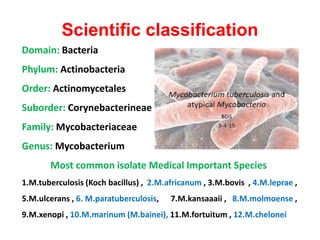
Scientific classification
Domain: Bacteria
Phylum: Actinobacteria
Order: Actinomycetales
Suborder: Corynebacterineae
Family: Mycobacteriaceae
Genus: Mycobacterium
Most common isolate Medical Important Species
1.M.tuberculosis (Koch bacillus) , 2.M.africanum , 3.M.bovis , 4.M.leprae ,
5.M.ulcerans , 6. M.paratuberculosis, 7.M.kansaaaii , 8.M.molmoense ,
9.M.xenopi , 10.M.marinum (M.bainei), 11.M.fortuitum , 12.M.chelonei
They are acid-fast bacilli (AFB), aerobic,
non-motile , non-capsulated , non
sporeform , Gram+ve but fail to stain
with Gram stain only stain with acid fast
stain .Growth is generally slow. They do
General Characters of
mycobacterium
stain .Growth is generally slow. They do
not grow on ordinary media , require
enriched media with egg albumin.
as Löwenstein-Jensen’s medium
Acid-fast bacilli : resist decolorization
with acid alcohol due to presence of
large amount of fatty acid (mycolic acid)
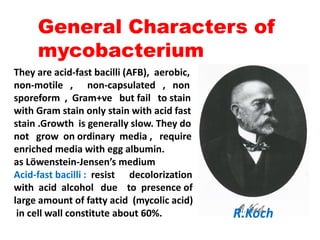
in cell wall constitute about 60%. R.Koch
Classification of mycobacterium
A. Base on pathogenesis: classify into 2 groups
Obligate pathogenic species
Opportunistic pathogenic species
B. Base on rate of growth: classify into 2 groups
Rapid grower : colony visible with in 5 day
Slow grower : colony visible with in weeks , upto 12 weeksSlow grower : colony visible with in weeks , upto 12 weeks
C. Base on disease which cause : classify into 2 groups
1.M.Tuberculosis complex (MTC) : cause Tuberculosis
2.Other group : cause different diseases and has take several collective
names Include Atypical , Tuberculoid , anonymous , non tuberculosis ,
mycobacterium other than tuberculosis bacilli (MOTT).
M.Leprae not fit in either group and consider separatedly.
M.avium complex : cause pulmonary
infection in HIV and localized infection
in children. It include M.avium ,M.intra-
cellular , M.scrofulaceum.
M.avium intracellular =(MAI)
Runyon classification for atypical
mycobacterium: classify it into 4 groups
Group 1 (Photochromogen)
Group 2 (Soctochromogen: )
Group 3 (Nonchromogen)
D. Base on production of pigment :
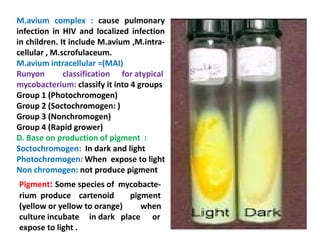
Soctochromogen: In dark and light
Photochromogen: When expose to light
Non chromogen: not produce pigment
Rebecca lancefield
Pigment: Some species of mycobacte-
rium produce cartenoid pigment
(yellow or yellow to orange) when
culture incubate in dark place or
expose to light .
Group 3 (Nonchromogen)
Group 4 (Rapid grower)
Pathogenesis
M.tuberculosis complex
-Are group of species include M.tuberculosis ,M.africanum,
M.bovis , and M.microti.
-Diseases : All cause tuberculosis except M.microti
-Tuberculosis: either
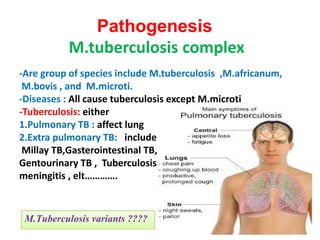
1.Pulmonary TB : affect lung1.Pulmonary TB : affect lung
2.Extra pulmonary TB: include
Millay TB,Gasterointestinal TB,
Gentourinary TB , Tuberculosis
meningitis , elt………….
M.Tuberculosis variants ????
-Diseases : Skin ulcer (Buruli ulcer)
M.ulcerans
M.paratuberculosis
-Diseases : Cause crohns disease
M.Kansaaaii
-Diseases : Cause Tuberculosis like disease
M.molmoenseM.molmoense
-Diseases : Cause pulmonary infection , and cervical adenitis
M.Xenopi
-Diseases : Cause pulmonary infection
M.Marinum
-Diseases : cause skin infection called fish tank granuloma
(swimming pool granuloma)
M.fortuitum
-Diseases : cause skin infection and pulmonary infection
M.chelonei
-Diseases : Cause pulmonary infection , Skin infection
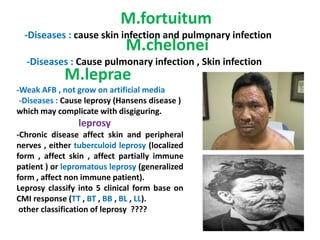
M.leprae
-Weak AFB , not grow on artificial media
-Diseases : Cause leprosy (Hansens disease )
which may complicate with disgiguring.
leprosyleprosy
-Chronic disease affect skin and peripheral
nerves , either tuberculoid leprosy (localized
form , affect skin , affect partially immune
patient ) or lepromatous leprosy (generalized
form , affect non immune patient).
Leprosy classify into 5 clinical form base on
CMI response (TT , BT , BB , BL , LL).
other classification of leprosy ????
Lab diagnosis
-Specimen: depend on site and
type of infection (eg: sputum in case
of TB , urine in case of renal TB ).
Sputum collection : in sterile contai-
ner , early morning , instruct patient
to cough deeply ?? .
Urine collection : in sterile contai
ner , collect consecutive earlyner , collect consecutive early
morning urine during 3 days.
Sample preservation ???
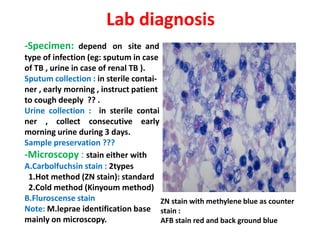
-Microscopy : stain either with
A.Carbolfuchsin stain : 2types
1.Hot method (ZN stain): standard
2.Cold method (Kinyoum method)
B.Fluroscense stain
Note: M.leprae identification base
mainly on microscopy.
ZN stain with methylene blue as counter
stain :
AFB stain red and back ground blue
- Isolation: All work under biosafety cabinet level 3
Require enrich selective media (some opportunistic pathogen as m.chelonei
and m.fortuitum able to grow in non enrich media as nutrient agar.
Commonly use enrich media is LJ media .
Other used media is middle brooks( 7 H10 agar , 7H11 agar , 7H9 broth)media
Kirchner or Dubos media are use as enrichment media.
Others media???
Culture characters which use in identification are growth rate (rapid or slow)
,pigment production , time of incubation , temperature of incubation(25 or 37
or 45 ) ,and colony morphology.
colony morphology: mycobacterium spp produce either eugonic(rough ,buff ,colony morphology: mycobacterium spp produce either eugonic(rough ,buff ,
tough)or dysgonic (small , smooth)colonies.
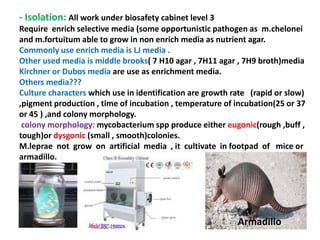
M.leprae not grow on artificial media , it cultivate in footpad of mice or
armadillo.
Armadillo
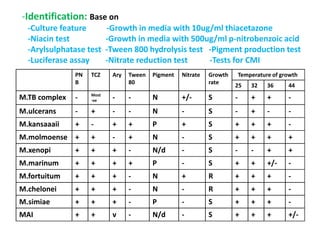
-Identification: Base on
-Culture feature -Growth in media with 10ug/ml thiacetazone
-Niacin test -Growth in media with 500ug/ml p-nitrobenzoic acid
-Arylsulphatase test -Tween 800 hydrolysis test -Pigment production test
-Luciferase assay -Nitrate reduction test -Tests for CMI
PN
B
TCZ Ary Tween
80
Pigment Nitrate Growth
rate
Temperature of growth
25 32 36 44
M.TB complex - Most
-ve - - N +/- S - + + -
M.ulcerans - + - - N - S - + - -
M.kansaaaii + - + + P + S + + + -
Baird barker agar
M.kansaaaii + - + + P + S + + + -
M.molmoense + + - + N - S + + + +
M.xenopi + + + - N/d - S - - + +
M.marinum + + + + P - S + + +/- -
M.fortuitum + + + - N + R + + + -
M.chelonei + + + - N - R + + + -
M.simiae + + + - P - S + + + -
MAI + + v - N/d - S + + + +/-
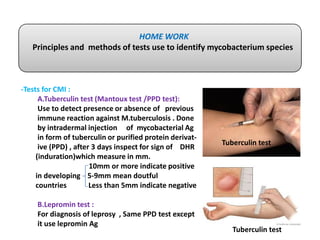
-Tests for CMI :
A.Tuberculin test (Mantoux test /PPD test):
Use to detect presence or absence of previous
immune reaction against M.tuberculosis . Done
HOME WORK
Principles and methods of tests use to identify mycobacterium species
immune reaction against M.tuberculosis . Done
by intradermal injection of mycobacterial Ag
in form of tuberculin or purified protein derivat-
ive (PPD) , after 3 days inspect for sign of DHR
(induration)which measure in mm.
10mm or more indicate positive
in developing 5-9mm mean doutful
countries Less than 5mm indicate negative
B.Lepromin test :
For diagnosis of leprosy , Same PPD test except
it use lepromin Ag
Tuberculin test
Tuberculin test
Treatment
- Tuberculosis treated with multi drug therapy (MDT) include streptomycin ,
isonicotinc acid hydrazid , rifampicin , and paranitro-saliacylic acid.
-Leprosy Tuberculosis treated with MDT include Dapsone and rifampicin
(plus clofazimine in case of lepromatous leprosy .
Prevention
-BCG (bacillus calmette and guerin) vaccine is attenuated bovine strain
potent against M.tuberculosis by enhancing CMI , also give some
protection against M.ulcerans and M.leprae.
.
protection against M.ulcerans and M.leprae.

mycobacteria

  • 1.
    Genus mycobacterium Almugadam BSaad Lecturer of medical microbiology Faculty of medical laboratory sciences Full name Babiker Saad Almugadam Yousif University of El Imam El Mahadi Kosti-Sudan MSc University of Khartoum BSc University of El Imam El Mahadi
  • 2.
    Genus mycobacterium 1-Important properties, M.Important With the end of this topic , You should know the following: Learning objectives species , Pathogenesis , Lab diagnosis ,and drugs of choice 2-How to differentiate between the species
  • 3.
    Scientific classification Domain: Bacteria Phylum:Actinobacteria Order: Actinomycetales Suborder: Corynebacterineae Family: Mycobacteriaceae Genus: Mycobacterium Most common isolate Medical Important Species 1.M.tuberculosis (Koch bacillus) , 2.M.africanum , 3.M.bovis , 4.M.leprae , 5.M.ulcerans , 6. M.paratuberculosis, 7.M.kansaaaii , 8.M.molmoense , 9.M.xenopi , 10.M.marinum (M.bainei), 11.M.fortuitum , 12.M.chelonei
  • 4.
    They are acid-fastbacilli (AFB), aerobic, non-motile , non-capsulated , non sporeform , Gram+ve but fail to stain with Gram stain only stain with acid fast stain .Growth is generally slow. They do General Characters of mycobacterium stain .Growth is generally slow. They do not grow on ordinary media , require enriched media with egg albumin. as Löwenstein-Jensen’s medium Acid-fast bacilli : resist decolorization with acid alcohol due to presence of large amount of fatty acid (mycolic acid) in cell wall constitute about 60%. R.Koch
  • 5.
    Classification of mycobacterium A.Base on pathogenesis: classify into 2 groups Obligate pathogenic species Opportunistic pathogenic species B. Base on rate of growth: classify into 2 groups Rapid grower : colony visible with in 5 day Slow grower : colony visible with in weeks , upto 12 weeksSlow grower : colony visible with in weeks , upto 12 weeks C. Base on disease which cause : classify into 2 groups 1.M.Tuberculosis complex (MTC) : cause Tuberculosis 2.Other group : cause different diseases and has take several collective names Include Atypical , Tuberculoid , anonymous , non tuberculosis , mycobacterium other than tuberculosis bacilli (MOTT). M.Leprae not fit in either group and consider separatedly.
  • 6.
    M.avium complex :cause pulmonary infection in HIV and localized infection in children. It include M.avium ,M.intra- cellular , M.scrofulaceum. M.avium intracellular =(MAI) Runyon classification for atypical mycobacterium: classify it into 4 groups Group 1 (Photochromogen) Group 2 (Soctochromogen: ) Group 3 (Nonchromogen) D. Base on production of pigment : Soctochromogen: In dark and light Photochromogen: When expose to light Non chromogen: not produce pigment Rebecca lancefield Pigment: Some species of mycobacte- rium produce cartenoid pigment (yellow or yellow to orange) when culture incubate in dark place or expose to light . Group 3 (Nonchromogen) Group 4 (Rapid grower)
  • 7.
    Pathogenesis M.tuberculosis complex -Are groupof species include M.tuberculosis ,M.africanum, M.bovis , and M.microti. -Diseases : All cause tuberculosis except M.microti -Tuberculosis: either 1.Pulmonary TB : affect lung1.Pulmonary TB : affect lung 2.Extra pulmonary TB: include Millay TB,Gasterointestinal TB, Gentourinary TB , Tuberculosis meningitis , elt…………. M.Tuberculosis variants ????
  • 8.
    -Diseases : Skinulcer (Buruli ulcer) M.ulcerans M.paratuberculosis -Diseases : Cause crohns disease M.Kansaaaii -Diseases : Cause Tuberculosis like disease M.molmoenseM.molmoense -Diseases : Cause pulmonary infection , and cervical adenitis M.Xenopi -Diseases : Cause pulmonary infection M.Marinum -Diseases : cause skin infection called fish tank granuloma (swimming pool granuloma)
  • 9.
    M.fortuitum -Diseases : causeskin infection and pulmonary infection M.chelonei -Diseases : Cause pulmonary infection , Skin infection M.leprae -Weak AFB , not grow on artificial media -Diseases : Cause leprosy (Hansens disease ) which may complicate with disgiguring. leprosyleprosy -Chronic disease affect skin and peripheral nerves , either tuberculoid leprosy (localized form , affect skin , affect partially immune patient ) or lepromatous leprosy (generalized form , affect non immune patient). Leprosy classify into 5 clinical form base on CMI response (TT , BT , BB , BL , LL). other classification of leprosy ????
  • 10.
    Lab diagnosis -Specimen: dependon site and type of infection (eg: sputum in case of TB , urine in case of renal TB ). Sputum collection : in sterile contai- ner , early morning , instruct patient to cough deeply ?? . Urine collection : in sterile contai ner , collect consecutive earlyner , collect consecutive early morning urine during 3 days. Sample preservation ??? -Microscopy : stain either with A.Carbolfuchsin stain : 2types 1.Hot method (ZN stain): standard 2.Cold method (Kinyoum method) B.Fluroscense stain Note: M.leprae identification base mainly on microscopy. ZN stain with methylene blue as counter stain : AFB stain red and back ground blue
  • 11.
    - Isolation: Allwork under biosafety cabinet level 3 Require enrich selective media (some opportunistic pathogen as m.chelonei and m.fortuitum able to grow in non enrich media as nutrient agar. Commonly use enrich media is LJ media . Other used media is middle brooks( 7 H10 agar , 7H11 agar , 7H9 broth)media Kirchner or Dubos media are use as enrichment media. Others media??? Culture characters which use in identification are growth rate (rapid or slow) ,pigment production , time of incubation , temperature of incubation(25 or 37 or 45 ) ,and colony morphology. colony morphology: mycobacterium spp produce either eugonic(rough ,buff ,colony morphology: mycobacterium spp produce either eugonic(rough ,buff , tough)or dysgonic (small , smooth)colonies. M.leprae not grow on artificial media , it cultivate in footpad of mice or armadillo. Armadillo
  • 12.
    -Identification: Base on -Culturefeature -Growth in media with 10ug/ml thiacetazone -Niacin test -Growth in media with 500ug/ml p-nitrobenzoic acid -Arylsulphatase test -Tween 800 hydrolysis test -Pigment production test -Luciferase assay -Nitrate reduction test -Tests for CMI PN B TCZ Ary Tween 80 Pigment Nitrate Growth rate Temperature of growth 25 32 36 44 M.TB complex - Most -ve - - N +/- S - + + - M.ulcerans - + - - N - S - + - - M.kansaaaii + - + + P + S + + + - Baird barker agar M.kansaaaii + - + + P + S + + + - M.molmoense + + - + N - S + + + + M.xenopi + + + - N/d - S - - + + M.marinum + + + + P - S + + +/- - M.fortuitum + + + - N + R + + + - M.chelonei + + + - N - R + + + - M.simiae + + + - P - S + + + - MAI + + v - N/d - S + + + +/-
  • 13.
    -Tests for CMI: A.Tuberculin test (Mantoux test /PPD test): Use to detect presence or absence of previous immune reaction against M.tuberculosis . Done HOME WORK Principles and methods of tests use to identify mycobacterium species immune reaction against M.tuberculosis . Done by intradermal injection of mycobacterial Ag in form of tuberculin or purified protein derivat- ive (PPD) , after 3 days inspect for sign of DHR (induration)which measure in mm. 10mm or more indicate positive in developing 5-9mm mean doutful countries Less than 5mm indicate negative B.Lepromin test : For diagnosis of leprosy , Same PPD test except it use lepromin Ag Tuberculin test Tuberculin test
  • 14.
    Treatment - Tuberculosis treatedwith multi drug therapy (MDT) include streptomycin , isonicotinc acid hydrazid , rifampicin , and paranitro-saliacylic acid. -Leprosy Tuberculosis treated with MDT include Dapsone and rifampicin (plus clofazimine in case of lepromatous leprosy . Prevention -BCG (bacillus calmette and guerin) vaccine is attenuated bovine strain potent against M.tuberculosis by enhancing CMI , also give some protection against M.ulcerans and M.leprae. . protection against M.ulcerans and M.leprae.