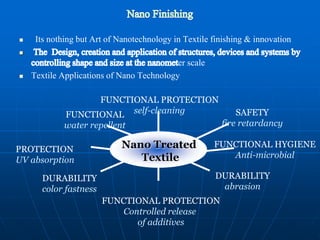
 Its nothing but Art of Nanotechnology in Textile finishing & innovation

er scale
 Textile Applications of Nano Technology
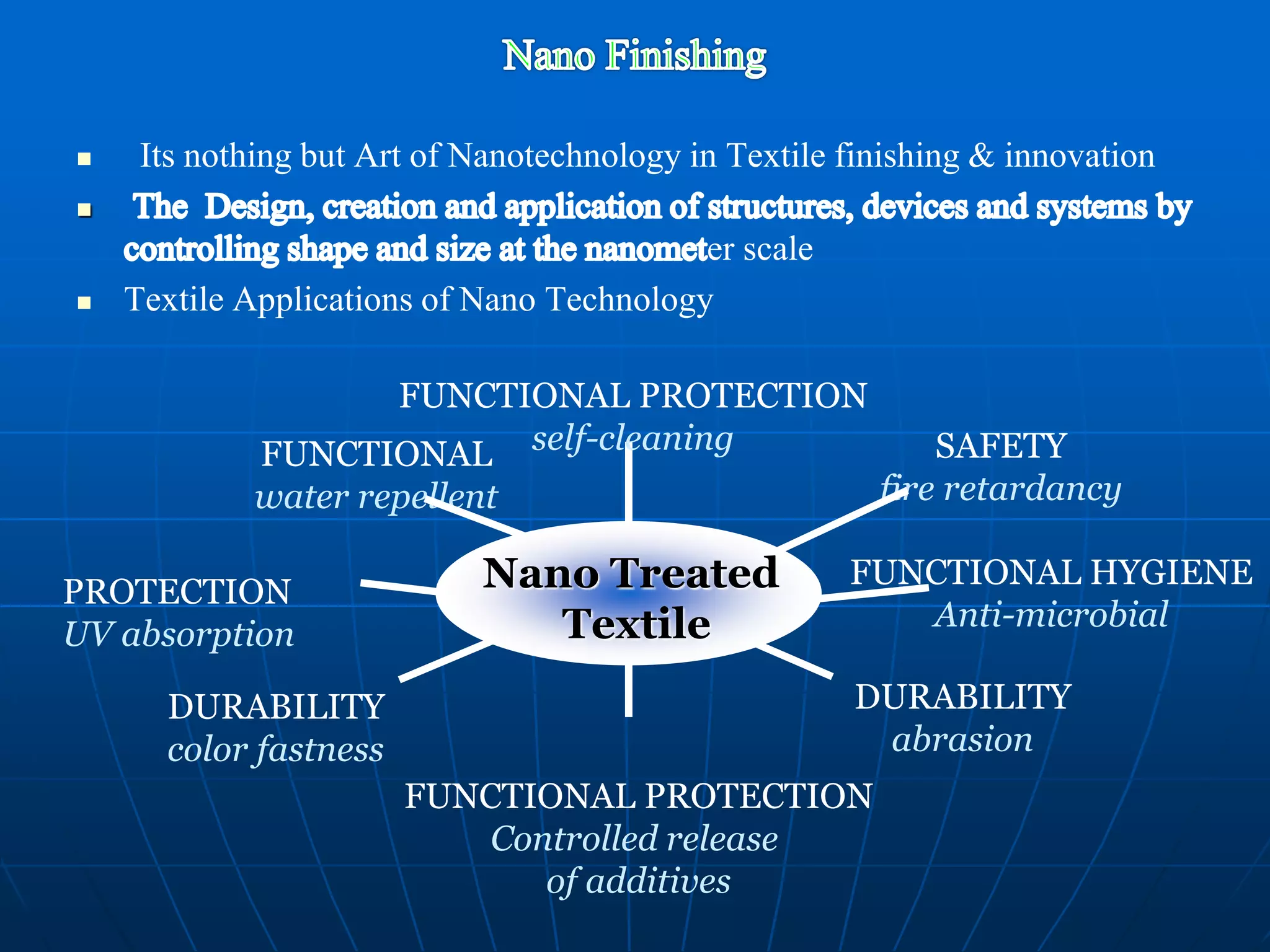
FUNCTIONAL
water repellent
PROTECTION
UV absorption
DURABILITY
color fastness
DURABILITY
abrasion
SAFETY
fire retardancy
FUNCTIONAL HYGIENE
Anti-microbial
FUNCTIONAL PROTECTION
Controlled release
of additives
Nano Treated
Textile
FUNCTIONAL PROTECTION
self-cleaning
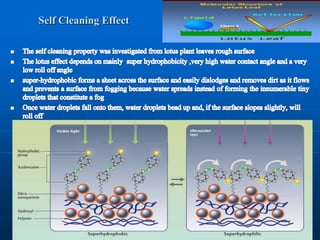
Self Cleaning Effect
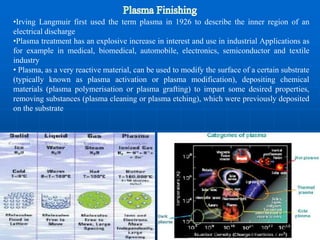
•Irving Langmuir first used the term plasma in 1926 to describe the inner region of an
electrical discharge
•Plasma treatment has an explosive increase in interest and use in industrial Applications as
for example in medical, biomedical, automobile, electronics, semiconductor and textile
industry
• Plasma, as a very reactive material, can be used to modify the surface of a certain substrate
(typically known as plasma activation or plasma modification), depositing chemical
materials (plasma polymerisation or plasma grafting) to impart some desired properties,
removing substances (plasma cleaning or plasma etching), which were previously deposited
on the substrate

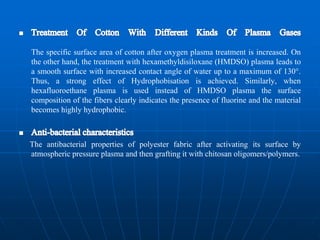
The specific surface area of cotton after oxygen plasma treatment is increased. On
the other hand, the treatment with hexamethyldisiloxane (HMDSO) plasma leads to
a smooth surface with increased contact angle of water up to a maximum of 130°.
Thus, a strong effect of Hydrophobisation is achieved. Similarly, when
hexafluoroethane plasma is used instead of HMDSO plasma the surface
composition of the fibers clearly indicates the presence of fluorine and the material
becomes highly hydrophobic.
The antibacterial properties of polyester fabric after activating its surface by
atmospheric pressure plasma and then grafting it with chitosan oligomers/polymers.

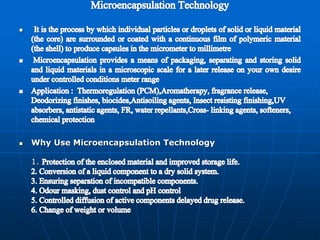
 Why Use Microencapsulation Technology
1.
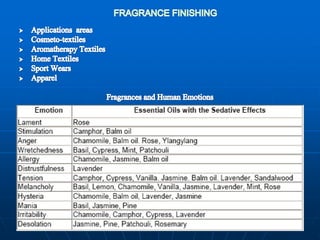
 Fragrances and Human Emotions
1.
.
.
CONT….
Functional ppt
Functional ppt
Functional ppt
Functional ppt
Functional ppt

Functional ppt

  • 1.
     Its nothingbut Art of Nanotechnology in Textile finishing & innovation  er scale  Textile Applications of Nano Technology FUNCTIONAL water repellent PROTECTION UV absorption DURABILITY color fastness DURABILITY abrasion SAFETY fire retardancy FUNCTIONAL HYGIENE Anti-microbial FUNCTIONAL PROTECTION Controlled release of additives Nano Treated Textile FUNCTIONAL PROTECTION self-cleaning
  • 2.
  • 4.
    •Irving Langmuir firstused the term plasma in 1926 to describe the inner region of an electrical discharge •Plasma treatment has an explosive increase in interest and use in industrial Applications as for example in medical, biomedical, automobile, electronics, semiconductor and textile industry • Plasma, as a very reactive material, can be used to modify the surface of a certain substrate (typically known as plasma activation or plasma modification), depositing chemical materials (plasma polymerisation or plasma grafting) to impart some desired properties, removing substances (plasma cleaning or plasma etching), which were previously deposited on the substrate
  • 6.
  • 7.
    The specific surfacearea of cotton after oxygen plasma treatment is increased. On the other hand, the treatment with hexamethyldisiloxane (HMDSO) plasma leads to a smooth surface with increased contact angle of water up to a maximum of 130°. Thus, a strong effect of Hydrophobisation is achieved. Similarly, when hexafluoroethane plasma is used instead of HMDSO plasma the surface composition of the fibers clearly indicates the presence of fluorine and the material becomes highly hydrophobic. The antibacterial properties of polyester fabric after activating its surface by atmospheric pressure plasma and then grafting it with chitosan oligomers/polymers.
  • 8.
      Why UseMicroencapsulation Technology 1.
  • 9.
     Fragrances andHuman Emotions
  • 10.
  • 11.
  • 14.