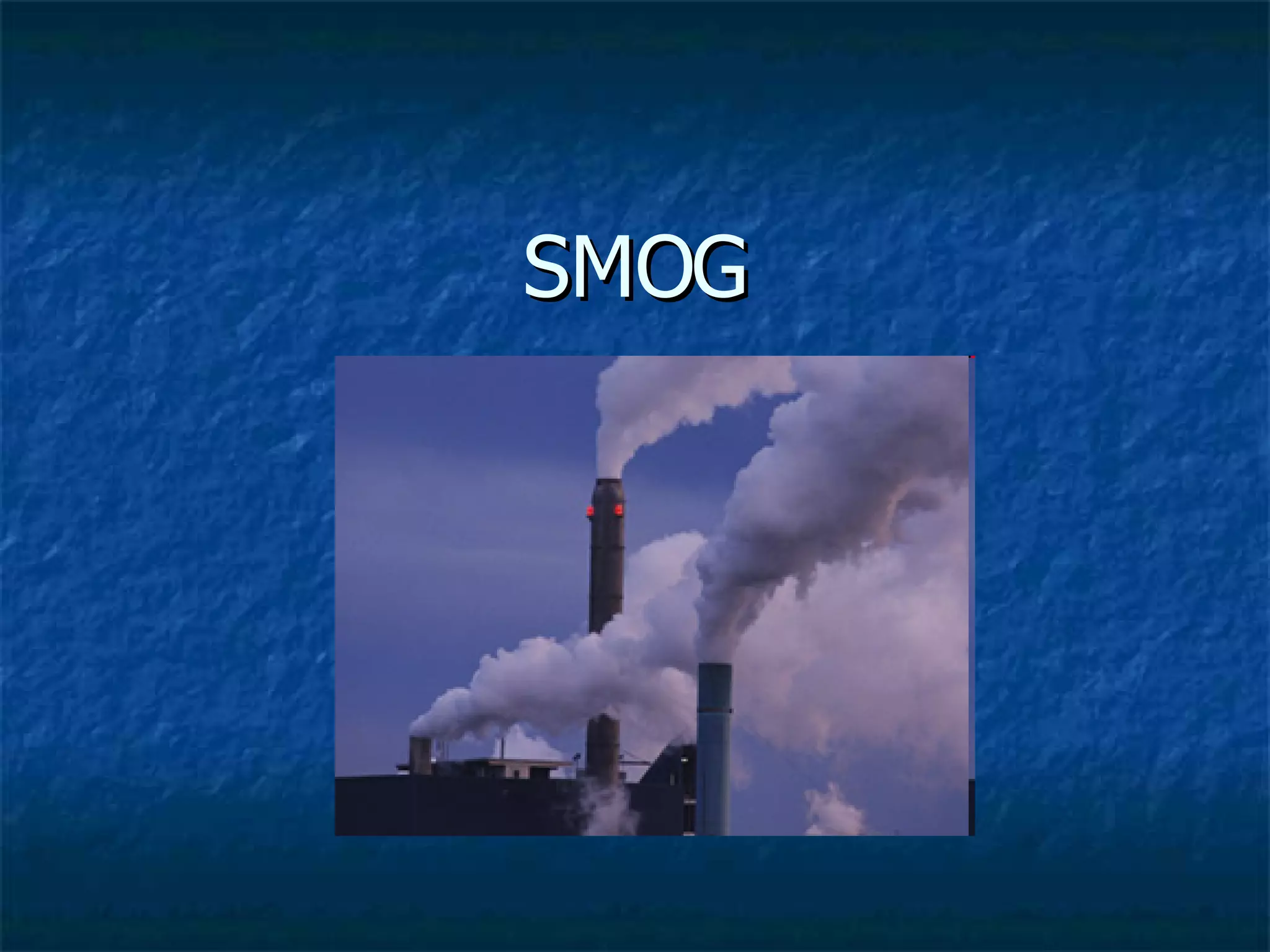
SMOG
Reactions in reducing Smog The gas mainly responsible is sulfur dioxide. It is called a reducing smog because the sulfur dioxide reduces other gases in the atmosphere producing a range of other pollutants. At the same time the sulfur dioxide is oxidized to sulfur trioxide which dissolves in water to produce a mist or smog.
Reducing Smog This can happen in 2 ways: Heterolytic catalyst.  Free radical catalysts.
Heterolytic catalyst.  Unburnt hydrocarbons or metal ions in the air are called particulates  Oxygen atoms can absorb these particulates, weakening the bond and catalyzing their reaction with SO2 into SO3 .
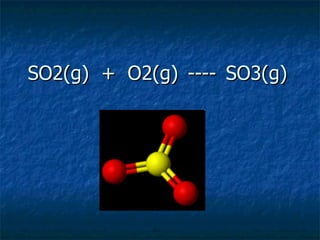
SO2(g)  +  O2(g) ----  SO3(g)
It then reacts with water in the atmosphere to form acidic smog SO3(g)  +  H2O(l)   H2SO4(aq)
The free radicals is produced by the fission of a nitrogen dioxide molecule in the presence of UV light Which in turns produce oxygen free radicals. NO2(g) --NO(g) + O*(g) Free radical catalysts.
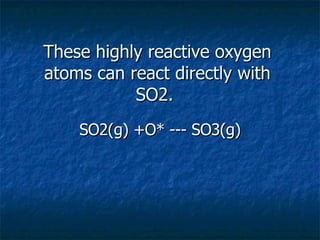
These highly reactive oxygen atoms can react directly with SO2.  SO2(g) +O* --- SO3(g)
This free radical will then catalyze the reaction of either sulfur dioxide or nitrogen oxides  Giving off sulfuric or nitric acid mist/smog

Smog

  • 1.
  • 2.
    Reactions in reducingSmog The gas mainly responsible is sulfur dioxide. It is called a reducing smog because the sulfur dioxide reduces other gases in the atmosphere producing a range of other pollutants. At the same time the sulfur dioxide is oxidized to sulfur trioxide which dissolves in water to produce a mist or smog.
  • 3.
    Reducing Smog Thiscan happen in 2 ways: Heterolytic catalyst. Free radical catalysts.
  • 4.
    Heterolytic catalyst. Unburnt hydrocarbons or metal ions in the air are called particulates Oxygen atoms can absorb these particulates, weakening the bond and catalyzing their reaction with SO2 into SO3 .
  • 5.
    SO2(g) + O2(g) ---- SO3(g)
  • 6.
    It then reactswith water in the atmosphere to form acidic smog SO3(g) + H2O(l) H2SO4(aq)
  • 7.
    The free radicalsis produced by the fission of a nitrogen dioxide molecule in the presence of UV light Which in turns produce oxygen free radicals. NO2(g) --NO(g) + O*(g) Free radical catalysts.
  • 8.
    These highly reactiveoxygen atoms can react directly with SO2. SO2(g) +O* --- SO3(g)
  • 9.
    This free radicalwill then catalyze the reaction of either sulfur dioxide or nitrogen oxides Giving off sulfuric or nitric acid mist/smog