SMOG
Smog is a combination of 'smoke' and 'fog'.
Smog is grimy, dirty, smelly and foul, it is more
dangerous than smoke.
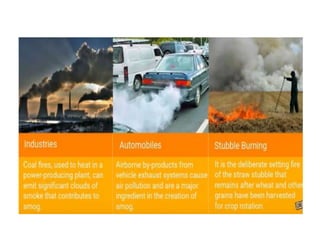
 When pollutants from the automobiles, factories
etc. are released into the atmosphere, under certain
conditions of the atmosphere these particles remain
suspended in the air. This suspended layer of
pollutants forms smog.
SMOG
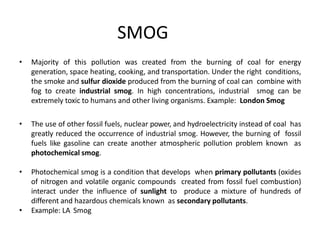
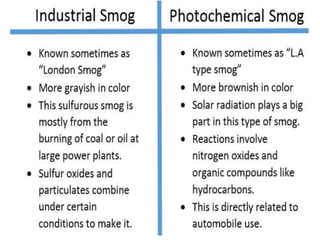
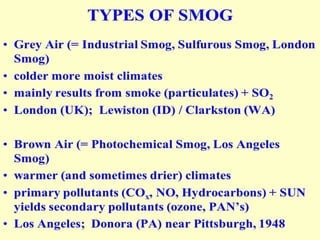
• Majority of this pollution was created from the burning of coal for energy
generation, space heating, cooking, and transportation. Under the right conditions,
the smoke and sulfur dioxide produced from the burning of coal can combine with
fog to create industrial smog. In high concentrations, industrial smog can be
extremely toxic to humans and other living organisms. Example: London Smog
• The use of other fossil fuels, nuclear power, and hydroelectricity instead of coal has
greatly reduced the occurrence of industrial smog. However, the burning of fossil
fuels like gasoline can create another atmospheric pollution problem known as
photochemical smog.
• Photochemical smog is a condition that develops when primary pollutants (oxides
of nitrogen and volatile organic compounds created from fossil fuel combustion)
interact under the influence of sunlight to produce a mixture of hundreds of
different and hazardous chemicals known as secondary pollutants.
• Example: LA Smog
PHOTOCHEMICAL
SMOG
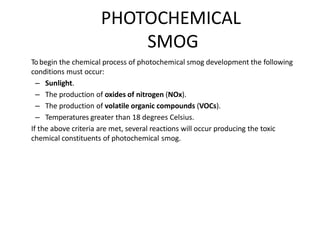
Tobegin the chemical process of photochemical smog development the following
conditions must occur:
– Sunlight.
– The production of oxides of nitrogen (NOx).
– The production of volatile organic compounds (VOCs).
– Temperatures greater than 18 degrees Celsius.
If the above criteria are met, several reactions will occur producing the toxic
chemical constituents of photochemical smog.
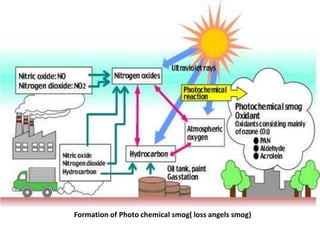
Formation of Photo chemical smog( loss angels smog)
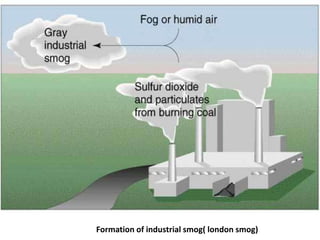
Formation of industrial smog( london smog)
REACTIONS
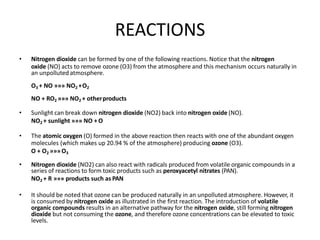
• Nitrogen dioxide can be formed by one of the following reactions. Notice that the nitrogen
oxide (NO) acts to remove ozone (O3) from the atmosphere and this mechanism occurs naturally in
an unpolluted atmosphere.
O3 + NO »»» NO2 +O2
NO + RO2 »»» NO2 + otherproducts
• Sunlight can break down nitrogen dioxide (NO2) back into nitrogen oxide (NO).
NO2 + sunlight »»» NO +O
• The atomic oxygen (O) formed in the above reaction then reacts with one of the abundant oxygen
molecules (which makes up 20.94 % of the atmosphere) producing ozone (O3).
O + O2 »»»O3
• Nitrogen dioxide (NO2) can also react with radicals produced from volatile organic compounds in a
series of reactions to form toxic products such as peroxyacetyl nitrates (PAN).
NO2 + R »»» products such as PAN
• It should be noted that ozone can be produced naturally in an unpolluted atmosphere. However, it
is consumed by nitrogen oxide as illustrated in the first reaction. The introduction of volatile
organic compounds results in an alternative pathway for the nitrogen oxide, still forming nitrogen
dioxide but not consuming the ozone, and therefore ozone concentrations can be elevated to toxic
levels.
The London Smog Disaster of 1952.
Days of toxic darkness.
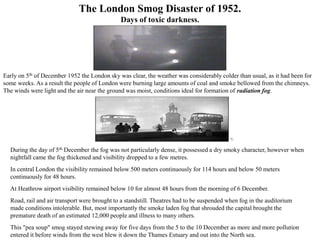
Early on 5th of December 1952 the London sky was clear, the weather was considerably colder than usual, as it had been for
some weeks. As a result the people of London were burning large amounts of coal and smoke bellowed from the chimneys.
The winds were light and the air near the ground was moist, conditions ideal for formation of radiation fog.
During the day of 5th December the fog was not particularly dense, it possessed a dry smoky character, however when
nightfall came the fog thickened and visibility dropped to a few metres.
In central London the visibility remained below 500 meters continuously for 114 hours and below 50 meters
continuously for 48 hours.
At Heathrow airport visibility remained below 10 for almost 48 hours from the morning of 6 December.
Road, rail and air transport were brought to a standstill. Theatres had to be suspended when fog in the auditorium
made conditions intolerable. But, most importantly the smoke laden fog that shrouded the capital brought the
premature death of an estimated 12,000 people and illness to many others.
This "pea soup" smog stayed stewing away for five days from the 5 to the 10 December as more and more pollution
entered it before winds from the west blew it down the Thames Estuary and out into the North sea.
P
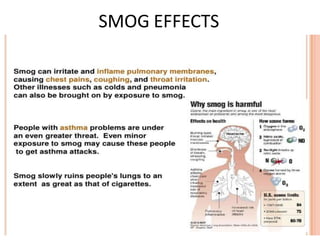
SMOG EFFECTS
Smog ppt

Smog ppt

  • 2.
    SMOG Smog is acombination of 'smoke' and 'fog'. Smog is grimy, dirty, smelly and foul, it is more dangerous than smoke.  When pollutants from the automobiles, factories etc. are released into the atmosphere, under certain conditions of the atmosphere these particles remain suspended in the air. This suspended layer of pollutants forms smog.
  • 3.
    SMOG • Majority ofthis pollution was created from the burning of coal for energy generation, space heating, cooking, and transportation. Under the right conditions, the smoke and sulfur dioxide produced from the burning of coal can combine with fog to create industrial smog. In high concentrations, industrial smog can be extremely toxic to humans and other living organisms. Example: London Smog • The use of other fossil fuels, nuclear power, and hydroelectricity instead of coal has greatly reduced the occurrence of industrial smog. However, the burning of fossil fuels like gasoline can create another atmospheric pollution problem known as photochemical smog. • Photochemical smog is a condition that develops when primary pollutants (oxides of nitrogen and volatile organic compounds created from fossil fuel combustion) interact under the influence of sunlight to produce a mixture of hundreds of different and hazardous chemicals known as secondary pollutants. • Example: LA Smog
  • 6.
    PHOTOCHEMICAL SMOG Tobegin the chemicalprocess of photochemical smog development the following conditions must occur: – Sunlight. – The production of oxides of nitrogen (NOx). – The production of volatile organic compounds (VOCs). – Temperatures greater than 18 degrees Celsius. If the above criteria are met, several reactions will occur producing the toxic chemical constituents of photochemical smog.
  • 7.
    Formation of Photochemical smog( loss angels smog)
  • 8.
    Formation of industrialsmog( london smog)
  • 9.
    REACTIONS • Nitrogen dioxidecan be formed by one of the following reactions. Notice that the nitrogen oxide (NO) acts to remove ozone (O3) from the atmosphere and this mechanism occurs naturally in an unpolluted atmosphere. O3 + NO »»» NO2 +O2 NO + RO2 »»» NO2 + otherproducts • Sunlight can break down nitrogen dioxide (NO2) back into nitrogen oxide (NO). NO2 + sunlight »»» NO +O • The atomic oxygen (O) formed in the above reaction then reacts with one of the abundant oxygen molecules (which makes up 20.94 % of the atmosphere) producing ozone (O3). O + O2 »»»O3 • Nitrogen dioxide (NO2) can also react with radicals produced from volatile organic compounds in a series of reactions to form toxic products such as peroxyacetyl nitrates (PAN). NO2 + R »»» products such as PAN • It should be noted that ozone can be produced naturally in an unpolluted atmosphere. However, it is consumed by nitrogen oxide as illustrated in the first reaction. The introduction of volatile organic compounds results in an alternative pathway for the nitrogen oxide, still forming nitrogen dioxide but not consuming the ozone, and therefore ozone concentrations can be elevated to toxic levels.
  • 11.
    The London SmogDisaster of 1952. Days of toxic darkness. Early on 5th of December 1952 the London sky was clear, the weather was considerably colder than usual, as it had been for some weeks. As a result the people of London were burning large amounts of coal and smoke bellowed from the chimneys. The winds were light and the air near the ground was moist, conditions ideal for formation of radiation fog. During the day of 5th December the fog was not particularly dense, it possessed a dry smoky character, however when nightfall came the fog thickened and visibility dropped to a few metres. In central London the visibility remained below 500 meters continuously for 114 hours and below 50 meters continuously for 48 hours. At Heathrow airport visibility remained below 10 for almost 48 hours from the morning of 6 December. Road, rail and air transport were brought to a standstill. Theatres had to be suspended when fog in the auditorium made conditions intolerable. But, most importantly the smoke laden fog that shrouded the capital brought the premature death of an estimated 12,000 people and illness to many others. This "pea soup" smog stayed stewing away for five days from the 5 to the 10 December as more and more pollution entered it before winds from the west blew it down the Thames Estuary and out into the North sea.
  • 12.
  • 14.