Acid rain
By: Dhirendra Nath
Introduction
• Acid rain is basically rain that has a higher
than normal acid level (low pH,pH of less than
5.6 ).
 Acid rain is otherwise known as the
phenomenon of abnormally acidic
precipitation, e.g. Rain, hail, snow ,fog , frost,
and dry as dust.
Cont..
• The term acid rain refers to the presence of
dissolved acidic pollutants.
• A more precise term is deposition acidic
components, referring to a mixture of wet and
dry deposition form the atmosphere containing
higher than normal amounts of nitric and sulfuric
acids.
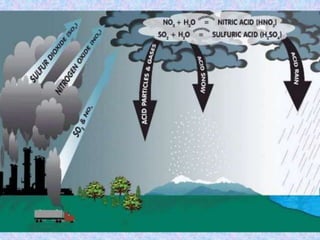
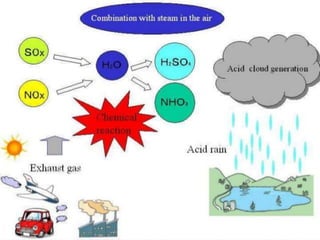
• Acid rain occurs when these gases react in the
atmosphere with water, oxygen and other
chemicals to form various acidic components.
Sources
Human Activity
• Major gases are sulphuric acid and nitrogen
compounds from human sources i.e. electricity
generation, factories and motor vehicles. The
gases can be carried 100 of miles in atmosphere
• Electrical power complexes utilizing coal are
among the greatest contributors to gaseous
pollutions that are responsible for acidic rain.
Human Activity
• Extraction of ore containing sulfur
• Combustion of fuels produces sulfur dioxide
and nitric oxides. They are converted into
sulfuric acid and nitric acid
2 Natural Sources
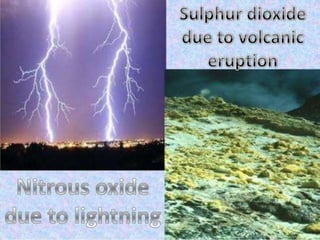
• Emissions from volcanoes, forest fire
• Electrical activity in the atmosphere such as
lightning produces nitric acid.
• Biological processes occurring on the land, in
wetlands and oceans. The major biological
source of sulfur containing compounds is
dimethyl sulfide.
Mechanism
• Gas Phase Chemistry
– In this phase sulfur dioxide is oxidized by reaction with
the hydroxyl radical via an intermolecular reaction
• SO2 + OH· → HOSO2· …………which is followed by:
• HOSO2· + O2 → HO2· + SO3
– In the presence of water, sulfur trioxide (SO3) is
converted rapidly to sulfuric acid:
• SO3 (g) + H2O (l) → H2SO4 (aq)
– Nitrogen dioxide reacts with OH to form nitric acid:
• NO2 + OH· → HNO3
Mechanism
• Chemistry in cloud droplets
– When clouds are present, the reaction becomes faster
than can be explained by gas phase chemistry & this is due
to reactions in the liquid water droplets
• Hydrolysis
– SO2 (g)+ H2O=SO2.H20
– SO2.H20=H++ HSO3
-
– HSO3
-=H++SO3
2-
• Oxidation
• There are a large number of aqueous reactions that oxidize sulfur
from S(IV) to S(VI), leading to the formation of sulfuric acid.
• The most important oxidation reactions are with ozone, hydrogen
peroxide and oxygen (reactions with oxygen are catalyzed
by iron and manganese in the cloud droplets)
Impacts of acid rain
• A] On Aquatic ecosystem
• Both the lower pH and higher aluminum
concentrations in surface water that occur as a
result of acid rain can cause damage to fish and
other aquatic animals.
• At pH lower than 5 most fish eggs will not hatch
and lower pHcan kill adult fish.
• As a result of acidification, fishes suffered
significant changes in mortality, reproductive
failure, reduced growth, skeletal deformities and
increased uptake of heavy metals.
Cont…..
• As lakes and rivers become more acidic
biodiversity is reduced. Acid rain has
eliminated insect life and some fish species,
including the brook trout in some lakes,
streams, and creek in geographically sensitive
areas, such as the Adirondack Mountains of
the United States
Cont…
• B] On animals
• Proportion of birds laying defective eggs have
rose from roughly 10% in 1983-1984 to 40%
by 1987/88 (limited in areas of acid rain).
• No snails are found in lakes with a pH of less
than 5.
Cont…….
• C] On plants
• Acid rain does not usually kill trees directly. It weakens trees by
• slowing up the growth of forests,
• damaging their leaves; cause leaves and needles to turn brown and
fall off & die
• limiting the nutrients available to them, or
• exposing them to toxic substances slowly released from the soil and
• makes them more susceptible to other threats.
• Forests in high mountain regions often are exposed to greater
amounts of acid than other
• It directly reduces the yield of radishes, carrots, broccoli
Cont..
• D] Soil
• Soil biology and chemistry can be seriously damaged
by acid rain.
• Some microbes are unable to tolerate changes to low
pH and are killed. The enzymes of these microbes
are denatured (changed in shape so they no longer
function) by the acid
• The hydronium ions of acid rain also
mobilize toxins such as aluminium, and leach away
essential nutrients and minerals such as magnesium
• 2 H+ (aq) + Mg2+ (clay) 2 H+ (clay) + Mg2+ (aq)
Cont……..
• E] Human health
• Acid rain does not directly affect human health.
The acid in the rainwater is too dilute to have
direct adverse effects
• However, the particulates responsible for acid
rain (sulfur dioxide and nitrogen oxides) do have
an adverse effect.
• Increased amounts of fine particulate matter in
the air do contribute to heart and lung problems
including asthma and bronchitis
Cont……..
• F] Damage of Infrastructure:
• accelerates the decay of building materials and paints,
including irreplaceable buildings, statues, and sculptures
that heritage are parts of our nation’s cultural property.
• Acid rain has the unsettling ability to erase and obliterate
stone and metal, the most durable of materials (especially
those made of rocks, such as limestone and marble, that
contain large amounts of calcium carbonate)
• Increases the corrosion rate of metals
• It can downgrade leather and rubber
• It causes carvings and monuments in stones to lose their
features
Cont……
• G] The Socioeconomic Consequences of
Acidification
• Acid deposition causes accelerated corrosion,
fracturing, and discoloration of buildings,
structures, and monuments.
• Lower productivity in fisheries, forestry, and
agriculture translates to lower profits and
fewer jobs for some important industries
Prevention
• a. Technical Solutions/ clean up smokestacks and
exhaust pipes
• Many coal-firing power stations use flue-gas
desulfurization (FGD) to remove sulfur-
containing gases from their stack gases
• For a typical coal-fired power station, FGD will
remove 95% or more of the SO2 in the flue gases
• An example of FGD is the wet scrubber which is
commonly used. A wet scrubber is basically a
reaction tower equipped with a fan that extracts
hot smoke stack gases from a power plant into
the tower.
Cont…
• Lime or limestone in slurry form is also
injected into the tower to mix with the stack
gases and combine with the sulfur dioxide
present. The calcium carbonate of the
limestone produces pH-neutral calcium
sulfate that is physically removed from the
scrubber. That is, the scrubber turns sulfur
pollution into industrial sulfates
•
Cont…
• b. Use alternative energy sources:
• There are other sources of electricity besides
fossil fuels. They include: nuclear power,
hydropower, wind energy, geothermal energy,
and solar energy.
• There are also alternative energies available to
power automobiles, including natural gas
powered vehicles, battery-powered cars, fuel
cells, and combinations of alternative and
gasoline powered vehicles.
•
Cont..
• c. Restore a damaged environment:
• Acid deposition penetrates deeply into the fabric of an
ecosystem, changing the chemistry of the soil as well
as the chemistry of the streams and narrowing,
sometimes to nothing, the space where certain plants
and animals can survive.
• For example, while the visibility might improve within
days, and small or episodic chemical changes in
streams improve within months, chronically
acidified lakes, streams, forests, and soils can take
years to decades or even centuries (in the case of soils)
to heal.
Cont..
• Limestone or lime can be added to acidic lakes to
"cancel out" the acidity. This process, called liming,
• Liming tends to be expensive, has to be done
repeatedly to keep the water from returning to its
acidic condition, and is considered a short-term
remedy in only specific areas rather than an effort to
reduce or prevent pollution.
• However, liming does often permit fish to remain in a
lake, so it allows the native population to survive in
place until emissions reductions reduce the amount of
acid deposition in the area
• d. International Treaties
• A number of international treaties on the long
range transport of atmospheric pollutants have
been agreed for example, Sulphur Emissions
Reduction Protocol under the Convention on
Long-Range Trans-boundary Air Pollution
• Canada and the US signed the Air Quality
Agreement in 1991.Most European countries and
Canada have
• e. Emission Trading
• In this regulatory scheme, every current polluting
facility is given or may purchase on an open
market an emissions allowance for each unit of a
designated pollutant it emits
• f. Individual’s action:
• It may seem like there is not much that one
individual can do to stop acid deposition.
Cont..
• However, like many environmental
problems, acid deposition is caused by the
cumulative actions of millions of individual
people.
• Therefore, each individual can also reduce
their contribution to the problem and become
part of the solution.
Cont..
• Individuals can contribute directly by conserving
energy, since energy production causes the largest
portion of the acid deposition problem. For example,
we can:
• - Turn off lights, computers, and other appliances
when you're not using them
• - Use energy efficient appliances: lighting, AC, heaters,
refrigerators, washing machines
• - Only use electric appliances when you need them.
• - Keep our thermostat at 68 F in the winter and 72 F in
the summer.
Cont..
• - Insulate your home as best you can.
• - Carpool, use public transportation, or better
yet, walk or bicycle whenever possible
• - Buy vehicles with low NO2 emissions, and
maintain all vehicles well.
• - Be well-informed.
Acid rain
Acid rain

Acid rain

  • 1.
  • 2.
    Introduction • Acid rainis basically rain that has a higher than normal acid level (low pH,pH of less than 5.6 ).  Acid rain is otherwise known as the phenomenon of abnormally acidic precipitation, e.g. Rain, hail, snow ,fog , frost, and dry as dust.
  • 3.
    Cont.. • The termacid rain refers to the presence of dissolved acidic pollutants. • A more precise term is deposition acidic components, referring to a mixture of wet and dry deposition form the atmosphere containing higher than normal amounts of nitric and sulfuric acids. • Acid rain occurs when these gases react in the atmosphere with water, oxygen and other chemicals to form various acidic components.
  • 5.
    Sources Human Activity • Majorgases are sulphuric acid and nitrogen compounds from human sources i.e. electricity generation, factories and motor vehicles. The gases can be carried 100 of miles in atmosphere • Electrical power complexes utilizing coal are among the greatest contributors to gaseous pollutions that are responsible for acidic rain.
  • 6.
    Human Activity • Extractionof ore containing sulfur • Combustion of fuels produces sulfur dioxide and nitric oxides. They are converted into sulfuric acid and nitric acid
  • 7.
    2 Natural Sources •Emissions from volcanoes, forest fire • Electrical activity in the atmosphere such as lightning produces nitric acid. • Biological processes occurring on the land, in wetlands and oceans. The major biological source of sulfur containing compounds is dimethyl sulfide.
  • 10.
    Mechanism • Gas PhaseChemistry – In this phase sulfur dioxide is oxidized by reaction with the hydroxyl radical via an intermolecular reaction • SO2 + OH· → HOSO2· …………which is followed by: • HOSO2· + O2 → HO2· + SO3 – In the presence of water, sulfur trioxide (SO3) is converted rapidly to sulfuric acid: • SO3 (g) + H2O (l) → H2SO4 (aq) – Nitrogen dioxide reacts with OH to form nitric acid: • NO2 + OH· → HNO3
  • 11.
    Mechanism • Chemistry incloud droplets – When clouds are present, the reaction becomes faster than can be explained by gas phase chemistry & this is due to reactions in the liquid water droplets • Hydrolysis – SO2 (g)+ H2O=SO2.H20 – SO2.H20=H++ HSO3 - – HSO3 -=H++SO3 2- • Oxidation • There are a large number of aqueous reactions that oxidize sulfur from S(IV) to S(VI), leading to the formation of sulfuric acid. • The most important oxidation reactions are with ozone, hydrogen peroxide and oxygen (reactions with oxygen are catalyzed by iron and manganese in the cloud droplets)
  • 12.
    Impacts of acidrain • A] On Aquatic ecosystem • Both the lower pH and higher aluminum concentrations in surface water that occur as a result of acid rain can cause damage to fish and other aquatic animals. • At pH lower than 5 most fish eggs will not hatch and lower pHcan kill adult fish. • As a result of acidification, fishes suffered significant changes in mortality, reproductive failure, reduced growth, skeletal deformities and increased uptake of heavy metals.
  • 13.
    Cont….. • As lakesand rivers become more acidic biodiversity is reduced. Acid rain has eliminated insect life and some fish species, including the brook trout in some lakes, streams, and creek in geographically sensitive areas, such as the Adirondack Mountains of the United States
  • 14.
    Cont… • B] Onanimals • Proportion of birds laying defective eggs have rose from roughly 10% in 1983-1984 to 40% by 1987/88 (limited in areas of acid rain). • No snails are found in lakes with a pH of less than 5.
  • 15.
    Cont……. • C] Onplants • Acid rain does not usually kill trees directly. It weakens trees by • slowing up the growth of forests, • damaging their leaves; cause leaves and needles to turn brown and fall off & die • limiting the nutrients available to them, or • exposing them to toxic substances slowly released from the soil and • makes them more susceptible to other threats. • Forests in high mountain regions often are exposed to greater amounts of acid than other • It directly reduces the yield of radishes, carrots, broccoli
  • 16.
    Cont.. • D] Soil •Soil biology and chemistry can be seriously damaged by acid rain. • Some microbes are unable to tolerate changes to low pH and are killed. The enzymes of these microbes are denatured (changed in shape so they no longer function) by the acid • The hydronium ions of acid rain also mobilize toxins such as aluminium, and leach away essential nutrients and minerals such as magnesium • 2 H+ (aq) + Mg2+ (clay) 2 H+ (clay) + Mg2+ (aq)
  • 17.
    Cont…….. • E] Humanhealth • Acid rain does not directly affect human health. The acid in the rainwater is too dilute to have direct adverse effects • However, the particulates responsible for acid rain (sulfur dioxide and nitrogen oxides) do have an adverse effect. • Increased amounts of fine particulate matter in the air do contribute to heart and lung problems including asthma and bronchitis
  • 18.
    Cont…….. • F] Damageof Infrastructure: • accelerates the decay of building materials and paints, including irreplaceable buildings, statues, and sculptures that heritage are parts of our nation’s cultural property. • Acid rain has the unsettling ability to erase and obliterate stone and metal, the most durable of materials (especially those made of rocks, such as limestone and marble, that contain large amounts of calcium carbonate) • Increases the corrosion rate of metals • It can downgrade leather and rubber • It causes carvings and monuments in stones to lose their features
  • 19.
    Cont…… • G] TheSocioeconomic Consequences of Acidification • Acid deposition causes accelerated corrosion, fracturing, and discoloration of buildings, structures, and monuments. • Lower productivity in fisheries, forestry, and agriculture translates to lower profits and fewer jobs for some important industries
  • 20.
    Prevention • a. TechnicalSolutions/ clean up smokestacks and exhaust pipes • Many coal-firing power stations use flue-gas desulfurization (FGD) to remove sulfur- containing gases from their stack gases • For a typical coal-fired power station, FGD will remove 95% or more of the SO2 in the flue gases • An example of FGD is the wet scrubber which is commonly used. A wet scrubber is basically a reaction tower equipped with a fan that extracts hot smoke stack gases from a power plant into the tower.
  • 21.
    Cont… • Lime orlimestone in slurry form is also injected into the tower to mix with the stack gases and combine with the sulfur dioxide present. The calcium carbonate of the limestone produces pH-neutral calcium sulfate that is physically removed from the scrubber. That is, the scrubber turns sulfur pollution into industrial sulfates •
  • 22.
    Cont… • b. Usealternative energy sources: • There are other sources of electricity besides fossil fuels. They include: nuclear power, hydropower, wind energy, geothermal energy, and solar energy. • There are also alternative energies available to power automobiles, including natural gas powered vehicles, battery-powered cars, fuel cells, and combinations of alternative and gasoline powered vehicles. •
  • 23.
    Cont.. • c. Restorea damaged environment: • Acid deposition penetrates deeply into the fabric of an ecosystem, changing the chemistry of the soil as well as the chemistry of the streams and narrowing, sometimes to nothing, the space where certain plants and animals can survive. • For example, while the visibility might improve within days, and small or episodic chemical changes in streams improve within months, chronically acidified lakes, streams, forests, and soils can take years to decades or even centuries (in the case of soils) to heal.
  • 24.
    Cont.. • Limestone orlime can be added to acidic lakes to "cancel out" the acidity. This process, called liming, • Liming tends to be expensive, has to be done repeatedly to keep the water from returning to its acidic condition, and is considered a short-term remedy in only specific areas rather than an effort to reduce or prevent pollution. • However, liming does often permit fish to remain in a lake, so it allows the native population to survive in place until emissions reductions reduce the amount of acid deposition in the area
  • 25.
    • d. InternationalTreaties • A number of international treaties on the long range transport of atmospheric pollutants have been agreed for example, Sulphur Emissions Reduction Protocol under the Convention on Long-Range Trans-boundary Air Pollution • Canada and the US signed the Air Quality Agreement in 1991.Most European countries and Canada have
  • 26.
    • e. EmissionTrading • In this regulatory scheme, every current polluting facility is given or may purchase on an open market an emissions allowance for each unit of a designated pollutant it emits • f. Individual’s action: • It may seem like there is not much that one individual can do to stop acid deposition.
  • 27.
    Cont.. • However, likemany environmental problems, acid deposition is caused by the cumulative actions of millions of individual people. • Therefore, each individual can also reduce their contribution to the problem and become part of the solution.
  • 28.
    Cont.. • Individuals cancontribute directly by conserving energy, since energy production causes the largest portion of the acid deposition problem. For example, we can: • - Turn off lights, computers, and other appliances when you're not using them • - Use energy efficient appliances: lighting, AC, heaters, refrigerators, washing machines • - Only use electric appliances when you need them. • - Keep our thermostat at 68 F in the winter and 72 F in the summer.
  • 29.
    Cont.. • - Insulateyour home as best you can. • - Carpool, use public transportation, or better yet, walk or bicycle whenever possible • - Buy vehicles with low NO2 emissions, and maintain all vehicles well. • - Be well-informed.