“LOW BIRTH WEIGHT
INFANT”
Ms. Anju Bista
M.Sc. Nursing 2nd year
2021 Batch
1
Objectives:
• At the end of this session participant will
be able to know about the low birth
weight infant.
2
Introduction
• The normal weight of the newborn baby is 2.5
– 3.9kg and approximately 2.9 kg.
• The average gestational age of a pregnant
female is about 37-42weeks of gestation.
• A neonate with a birth weight of less than
2.5kg or 2500gm irrespective of the gestational
age are termed to be low birth weight baby.
3
These classifications include the following:
• Preterm: Birth before completion of the 37th
week of gestation regardless of birth weight;
also called premature birth
• Term: Birth occurring between 38 and 42
weeks' gestation
• Post-term: Birth after completion of the 42nd
week of gestation.
4
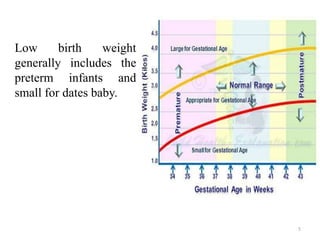
Low birth weight
generally includes the
preterm infants and
small for dates baby.
5
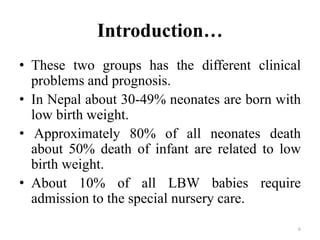
Introduction…
• These two groups has the different clinical
problems and prognosis.
• In Nepal about 30-49% neonates are born with
low birth weight.
• Approximately 80% of all neonates death
about 50% death of infant are related to low
birth weight.
• About 10% of all LBW babies require
admission to the special nursery care.
6
7
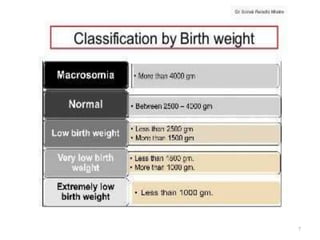
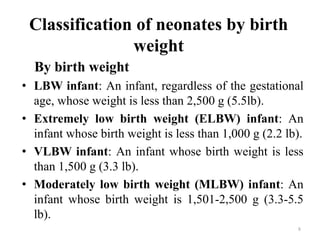
Classification of neonates by birth
weight
By birth weight
• LBW infant: An infant, regardless of the gestational
age, whose weight is less than 2,500 g (5.5lb).
• Extremely low birth weight (ELBW) infant: An
infant whose birth weight is less than 1,000 g (2.2 lb).
• VLBW infant: An infant whose birth weight is less
than 1,500 g (3.3 lb).
• Moderately low birth weight (MLBW) infant: An
infant whose birth weight is 1,501-2,500 g (3.3-5.5
lb).
8
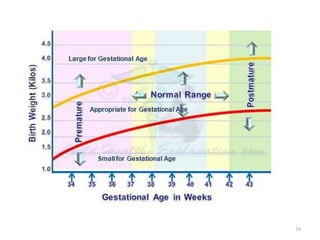
By Gestational age
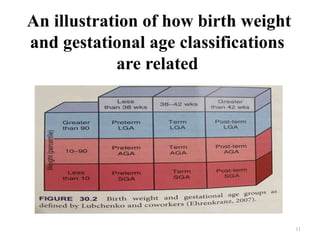
• AGA: An infant whose weight falls between the 10th on
information from the and 90th percentiles.
• Appropriate for dates (APD) babies: babies born with
the birth weight 10th- 90th for the period of the
gestational age. They are also termed as immature,
early born or premature
• Small-for-date (SFD): An infant whose intrauterine
growth was slowed and falls below 1oth percentile.
• LGA: An infant who falls above the 90th percentile.
and delivery.
• Birth weight variations may occur in the preterm, term,
and post-term neonates.
9
10
An illustration of how birth weight
and gestational age classifications
are related
11
• Weight helps assess growth, and gestational age
helps assess maturity.
• A newborn of 40 weeks' gestation who weights
less than 2,500 g (below the 10th percentile for
weight or length) would be mature but under
grown.
• This disorder is called intrauterine growth
retardation, in which the fetus rate of growth does
not meet expected norms; the newborn is
classified as SGA
12
• A newborn of 36 weeks' gestation who weighs
3,500 g (above the 90th percentile for weight)
would be immature but overgrown.
• Such LGA newborns are typical for diabetic
mothers.
• Although this newborn has attained average
term weight, it is actually premature, with
incomplete maturation of organ systems.
13
Introduction
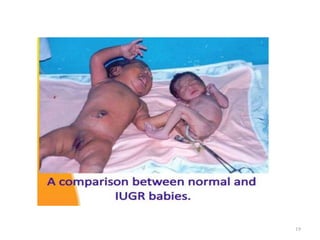
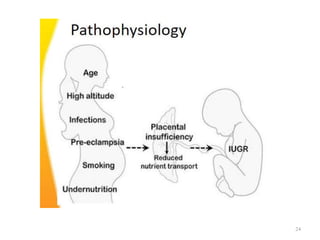
Dysmaturity (Intrauterine Growth Retardation
{IUGR} / Small for Date / Chronic Placental
Insufficiency)
Small for Gestational Age
• Infant whose weight is at or below 10th %.
• Is a high risk condition.
• Results from failure to thrive.
14
DEFINITION:
• It is said to be present in those babies whose
birth weight is below the 10th percentiles of
the average of the gestational age.
• Dysmaturity can occur in preterm, term or post
term babies.
15
Types of Dysmaturity
Based on the clinical evaluation & ultrasound
examination the small fetuses are divided into:
I. Fetuses that are small & healthy. The birth
weight is less than 10th percentile for their
gestational age. normal subcutaneous fat &
usually have uneventful neonatal course.
16
Types of Dysmaturity
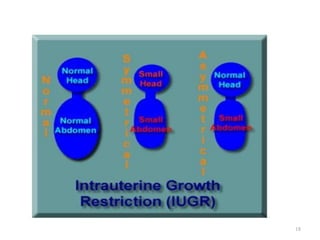
II. Fetuses where growth is restricted by
pathological process (true IUGR) : Depending
upon the relative size of their head, abdomen &
femur, the fetuses are subdivided into:
• Symmetrical or Type I.
• Asymmetrical or Type II.
17
18
19
20
21
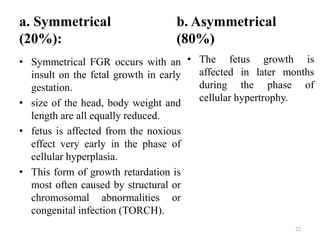
a. Symmetrical
(20%):
• Symmetrical FGR occurs with an
insult on the fetal growth in early
gestation.
• size of the head, body weight and
length are all equally reduced.
• fetus is affected from the noxious
effect very early in the phase of
cellular hyperplasia.
• This form of growth retardation is
most often caused by structural or
chromosomal abnormalities or
congenital infection (TORCH).
b. Asymmetrical
(80%)
• The fetus growth is
affected in later months
during the phase of
cellular hypertrophy.
22
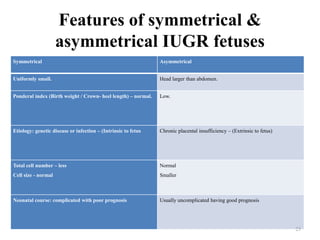
Features of symmetrical &
asymmetrical IUGR fetuses
Symmetrical Asymmetrical
Uniformly small. Head larger than abdomen.
Ponderal index (Birth weight / Crown- heel length) – normal. Low.
Etiology: genetic disease or infection – (Intrinsic to fetus Chronic placental insufficiency – (Extrinsic to fetus)
Total cell number – less
Cell size - normal
Normal
Smaller
Neonatal course: complicated with poor prognosis Usually uncomplicated having good prognosis
23
24
CAUSES
• Unknown (40%): about 40% cases remains
unknwon.
• Fetal cause:
1. Chromosomal Disorders:
Usually result in early onset IUGR.
Trisomies 13, 18, 21 contribute to 5% of IUGR
cases.
Aneuploidy.
Triploidy.
Turner's syndrome
25
Fetal Cause:
2. Congenital Infections:
The growth potential of fetus may be severely impaired
by intrauterine infections.
• Viruses- rubella, CMV, varicella and HIV
rubella is the most embryotoxic virus, it cause capillary
endothelial damage during organogenesis and impairs
fetal growth.
CMV causes cytolysis and localized necrosis in fetus.
• Protozoa- like malaria, toxoplasma, have also been
associated with growth restriction.
26
Fetal Cause:
3. Structural Anomalies :
• All major structural defects involving
CNS,CVS, GIT, Genitourinary and
musculoskeletal system are associated with
increased risk of fetal growth restriction.
• If growth restriction is associated with
polyhydramnios, the incidence of structural
anomaly is substantially increased.
27
Fetal Cause:
4. Genetic Causes:
• Maternal genes have greater influence on fetal
growth.
• Inborn errors of metabolism like genesis of
pancreas, congenital lipodystrophy,
galactosemia, phenylketonuria also result in
growth restriction of fetus.
28
Maternal cause(1):
Constitutional small women, maternal genetic
& racial factors.
Poor maternal nutrition before & during
pregnancy
Poor maternal weight gain during pregnancy.
 Diminished uterine blood flow due to pre-
eclampsia, toxemia, & hypertension.
29
Maternal cause(2):
Mal absorption syndrome/malnutrition.
Low blood oxygen as in heart disease.
Toxin: alcohol, smoking, chronic renal failure,
chronic UTI, etc
30
Placental Causes:
• Placenta is the sole channel for nutrition and
oxygen supply to the fetus.
Single umbilical artery.
Placental hemangiomas have all been
associated with fetal growth restriction
31
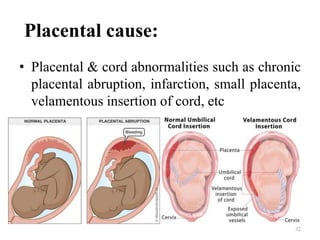
Placental cause:
• Placental & cord abnormalities such as chronic
placental abruption, infarction, small placenta,
velamentous insertion of cord, etc
32
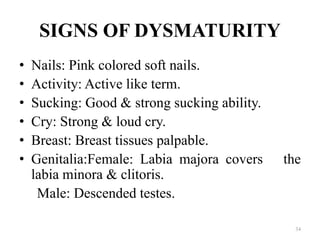
SIGNS OF DYSMATURITY
• Posture: Tonic or flexed as term baby.
• Appearance: Look like an old person.
• Skin: Pink, dry & wrinkled skin.
• Lanugo: Scanty lanugo.
• Vernix: Lots of vernix.
• Fontanelle & suture: Normal wideness
of suture & fontanelle, skull bone as
normal baby.
• Ear: Normal ear pinna.
• Planter creases: Dark & plenty of
planter creases. 33
SIGNS OF DYSMATURITY
• Nails: Pink colored soft nails.
• Activity: Active like term.
• Sucking: Good & strong sucking ability.
• Cry: Strong & loud cry.
• Breast: Breast tissues palpable.
• Genitalia:Female: Labia majora covers the
labia minora & clitoris.
Male: Descended testes.
34
Problems of SGA baby:
1. Perinatal asphyxia : SGA babies tolerate the
stress of labor poorly. They are at risk of
asphyxia.
2. Meconium aspiration: Intrauterine hypoxia
can cause meconium to be passed in utero
leading to meconium aspiration syndrome.
35
Problems of SGA baby:
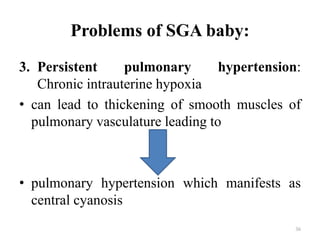
3. Persistent pulmonary hypertension:
Chronic intrauterine hypoxia
• can lead to thickening of smooth muscles of
pulmonary vasculature leading to
• pulmonary hypertension which manifests as
central cyanosis
36
Problems of SGA baby:
4. Polycythemia: Polycythemia and high blood
viscosity can occur secondary to chronic hypoxia
in utero.
5. Metabolic complications: Include both
hypoglycemia (due to decreased stores of
glycogen) and hyperglycemia (due to altered
insulin secretion in VLBW babies) and
hypocalcemia.
6. Decreased immunity : Due to neutropenia and
low IgG levels predisposing to infections.
37
Problems of SGA baby:
7. Other problems: Include congenital
anomalies, hypothermia, feed intolerance,
thrombocytopenia, acute tubular
necrosis/renal insufficiency and pulmonary
hemorrhage.
8. Risk of poor postnatal growth. Recurrent
infections and hospitalization.
38
Problems of SGA baby:
9. Long term outcome: Includes neuro-
developmental morbidities like hyperactivity,
short attention span and learning problems.
39
DETAILED MANAGEMENT
• Hospitalization.
• Warmth.
• Establishment of respiration.
• Maintenance of body temperature.
• Maintain nutrition & feeding.
• Mothering & expert nursing care.
• Prevention of infection.
• Observation.
• Emotional support to family
40
PREMATURITY
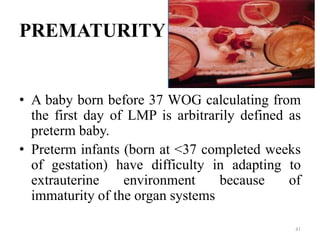
• A baby born before 37 WOG calculating from
the first day of LMP is arbitrarily defined as
preterm baby.
• Preterm infants (born at <37 completed weeks
of gestation) have difficulty in adapting to
extrauterine environment because of
immaturity of the organ systems
41
On the babies born preterm:
• 84% are born between 32 and 36 weeks of
gestation.
• 10% are born between 28 and 31 weeks of
gestation.
• 6% are born at less than 28 weeks of gestation.
• Premature infants born between 34 and 37
weeks of pregnancy are often called late
preterm or near-term infants.
42
Incidence
• Preterm baby consistutes 2/3rd of low birth
weight babies.
• The incidence of low birth weight baby is
about 30=40% in the developing countries as
such incidence of preterm baby is about 20-25
%.
43
44
CAUSES
1. Maternal factors:
• Medical diseases during
pregnancy as heart
disease, anemia, HTN,
renal disease, etc.
• Maternal infection as
hyperpyrexia, trauma.
• Maternal malnutrition.
• Complications of
pregnancy as APH.
• Incompetence of cervix.
• Polyhydramnios.
• Previous history of
premature delivery.
• Physical exertion.
• Heavy smoking & drug
addiction.
• Maternal age below 20
years or age over 35
years.
45
Causes Of preterm
2.Fetal factors:
Multiple pregnancy.
IUGR.
Congenital
malformation.
Rh incompatibility.
3. Iatrogenic:
Improper diagnosis
of maturity in
elective deliveries.
46
Causes
4.Medical factors:
Uncontrolled DM in mother.
Severe cardiac illness, toxemia.
Fetal hypoxia & distress.
Severe iso-immunization in mother or hydrops
fetalis
47
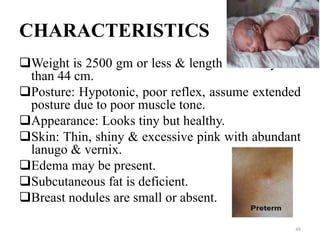
CHARACTERISTICS
Weight is 2500 gm or less & length is usually less
than 44 cm.
Posture: Hypotonic, poor reflex, assume extended
posture due to poor muscle tone.
Appearance: Looks tiny but healthy.
Skin: Thin, shiny & excessive pink with abundant
lanugo & vernix.
Edema may be present.
Subcutaneous fat is deficient.
Breast nodules are small or absent.
48
CHARACTERISTICS(2)
Deep sole creases are often not present
Face & Head: Face is small & head is
large in proportion to the body.
Soft skull bone. Sutures are widely
separated & fontanelles are large.
Microganthia & retroganthia present,
protruding eye due to shallow orbit &
absent of buccal pads of fat.
Hair appears wooly & fuzzy &
individual hair fibers can be seen
separately.
49
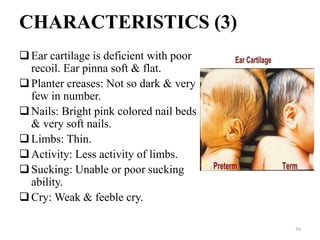
CHARACTERISTICS (3)
Ear cartilage is deficient with poor
recoil. Ear pinna soft & flat.
Planter creases: Not so dark & very
few in number.
Nails: Bright pink colored nail beds
& very soft nails.
Limbs: Thin.
Activity: Less activity of limbs.
Sucking: Unable or poor sucking
ability.
Cry: Weak & feeble cry.
50
CHARACTERISTICS (3)
Breast: No breast tissue palpable.
Chest: Small & narrow and the abdomen large.
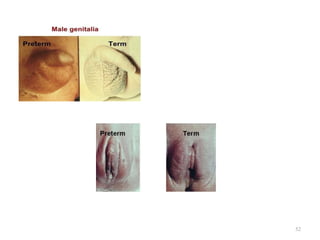
Genitalia: In male, testes are un-descended;
scrotum poorly pigmented & has few
rugorisities.
In female, labia majora are widely separated
exposing labia minora & clitoris.
Reflex: Moro, sucking, swallowing, & other
reflexes are absent or sluggish.
51
52
1. Alternation of respiratory
functions:
• Respiration of preterm neonate are rapid , shallow
irregular with periods of apnea and cyanosis.
• Coughs and gag reflex are weak or absent.
Pulmonary aspiration, atelectasis , hyaline
membrane disease are common.
• Chronic pulmonary insufficiency, weak
respiratory, poor development and expansion of
lungs, inefficient respiratory center and deficiency
of surfactant in the alveoli are responsible for
respiratory problems and resuscitation difficulties
at birth
53
2. Immaturity of central nervous
system:
• The preterm infants are inactive, lethargic and
having poor cough reflex.
• Sucking and swallowing reflexes are
incordinated leading to feeding difficulties.
• These babies are prone to kernicterus and brain
damage at lower serum bilirubin level due to
inefficient blood brain barrier.
54
3. Disturbance of circulatory
functions:
• In preterm neonates, the closure of ductus
arterious may be delayed, the peripheral
circulation is inadequate.
• Weak and fragile blood vessels and hypo
function of bone marrow may result
hemorrhagic problems.
55
4. Impaired thermoregulation:
• Preterm infants are more prone to get
hypothermia due to poorly developed heat
regulating center
large body surface area in regulation to body
weight, poor insulating subcutaneous fat and less
brown adipose tissue.
56
5. Ineffective gastrointestinal and
hepatic functions:
• Sucking and swallowing reflex are poorly
developed in preterm infants.
• Capacity of stomach is less and cardio
esophageal sphincter is incompetent and
results in aspiration and regurgitation.
• Abdominal distension and functional intestinal
obstruction are found due to hypotonia.
57
Contd…
• Hypoglycemia is also common due to poor
hepatic glycogen stores and delayed feeding.
• Neonates are more prone to malnutrition, iron
deficiency anemia and other vitamin
deficiency due to poor absorption of nutrients.
• Poor vitamin k synthesis in liver and poor
prothrombin production leads to hemorrhagic
disorders.
58
6. Metabolic disturbances:
• Preterm neonates are more prone to develop
hypoglycemia, hypocalcemia, hypoxia,
acidosis and hypoproteinimia due to poor
metabolic functions.
59
7. Increased susceptibility to
infections :
• Preterm neonates are 3 to 10 times more
vulnerable to infections than normal neonates.
• Insufficient cellular immunity and low grade
IgG antibody level makes them more
susceptible to infections.
60
8. Impaired renal function:
• Due to low glomerular filtration rate and
reduced concentrating ability the preterm are
more prone to develop acidosis.
• Dehydration, delayed urination, edema as well
as renal failure can be developed as
complication.
61
9. Drug toxicity:
• Poor hepatic detoxification and reduced renal
clearance lead to toxic effects of drug unless
precautions are followed during
administration.
62
Management
• Management depends on the birth weight of
the baby:
• Requires special care at
home
<1.8 kg otherwise
normal
• Requires hospital care
1.5kg -1.8kg
• Management in NICU
(Neonatal ICU)
< 1.8 kg
63
Principal management of LBW in
hospital
1. Correction of hypothermia
2. Correction of hypoglycemia
3. Detection of other complication
4. Treatment of other complication
5. Follow up with all vitals sign being monitored
64
Therapeutic Management:
 When a preterm delivery is expected the
NICU is alerted and the team of neonatal
specialists are present at the time of delivery
 Resuscitation is done if needed in the labor
room the in infant is transferred to NICU in an
incubator
 Measurements taken and vitamin K is given
65
Therapeutic Management:
Respiratory support: Apnea mattress – Incubator –
O2 monitoring
Temperature regulation: Incubator, and
monitoring of temperature, Humidity as
recommended
Complications such as hypoglycemia and
hypocalcaemia are frequent in the premature
infant and are managed according to specific
conditions and monitored frequently
 Respiratory distress syndrome is very common
and required respiratory support.
66
MANAGEMENT OF LOW BIRTH
WEIGHT BABY.
1. Optimal management at birth
• Senior pediatrician should be attending with all
preparation of resuscitation to baby.
• The cord is to be clamped quickly to prevent
hypervolemia & development of
hyperbilirubinemia.
• Promptly dry & kept warm with gentle
handling.
• Give vitamin K 1 mg to prevent hemorrhage.
67
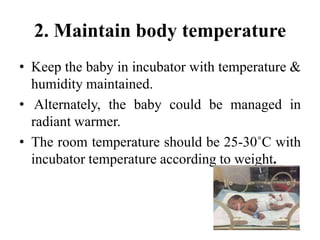
2. Maintain body temperature
• Keep the baby in incubator with temperature &
humidity maintained.
• Alternately, the baby could be managed in
radiant warmer.
• The room temperature should be 25-30˚C with
incubator temperature according to weight.
68
2. Maintain body temperature (2)
• Cover the baby‘s head with clothes. Do not
expose body part unless & otherwise needed for
observation & assessment.
• If baby is receiving IV fluid or EBM, increase
volume of fluid or milk by 10% of total daily
volume/day for those under radiant warmer.
• Check the temperature of warmer & room every
hour & adjust the temperature setting accordingly.
• For extremely low birth weight baby, covered
with cellophane to prevent heat loss through
convection.
69
3. Positioning
• Most baby love to lie in prone position, they
cry less & feel more comfortable. It relieves
abdominal discomfort by passage of flatus &
prevents aspiration.
• Baby should change position 2 hourly.
70
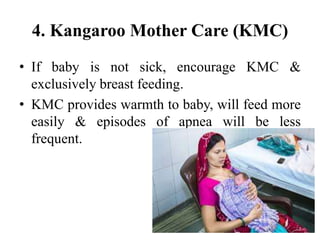
4. Kangaroo Mother Care (KMC)
• If baby is not sick, encourage KMC &
exclusively breast feeding.
• KMC provides warmth to baby, will feed more
easily & episodes of apnea will be less
frequent.
71
5. Oxygen therapy
• It should be administered only when indicated,
stop as soon as it is considered unnecessary. It
should be administered with head box when
SpO2 falls below 85%. It should be maintained
at 90-95% & PaO2 between 60-80%.
• The room fiO2 should be between 20-40%.
72
6. Feeding & nutrition
• Babies < 1.2 kg or gestation < 30 weeks & sick
babies should start IV dextrose solution
(10% dextrose >1kg & 5% dextrose <1 kg).
• Trophic feeds with 1-2 ml EBM 2-3 hourly
through NG tube can be started to all babies
irrespective of age & weight, 2 hourly < 1kg &
3 hourly > 1.2 kg.
• Trophic feeds given in order to stimulate the
development of GI tract of premature baby
73
Feeding & nutrition
• When stabilized enteral feeds are begun with
EBM starting with a volume of 30ml/kg/day on
day 1
• Depending on tolerance feeds increased by 10-20
ml/kg/day every day and IVF are reduced.
• When baby is stable , EBM can be fortified with
human milk fortifier (HMF) for additional
calories and protein.
• Multivitamin drops after 2-3 weeks
• Vitamin E which is powerful antioxidant and
prevent hemolytic anemia and edema.
74
6. Feeding & nutrition (2)
• Gradually increase EBM & decrease IV drip.
• After 7 days, if baby still requires feeding
using an alternative feeding method, increase
20 ml/kg/day until baby reaches 180 ml/kg of
breast milk/day.
75
7. Gentle rhythmic stimulation:
• Gentle touch, massage, cuddling, stroking &
flexing preferably by mother provide useful
tactile stimuli to the baby.
• Soothing auditory stimuli as family voice,
music reduce the stress of procedure &
enhance weight gain.
• Eye to eye contact, colored objects provide
visual inputs.
76
9.Utility of Corticosteroids
• In infant who did not receive antenatal
steroids in baby, a single dose of
dexamethasone 0.2mg/kg iv at 4 hrs of age is
recommended in very LBW babies.
77
9 Prevention of nosocomial
infection:
• Strict hand washing before & after touching
the baby.
• Minimal handling the preterm.
• Effective treatment of suspected infection of
any origin.
78
10.Weight record
• Accurate weihing is a sensitive index of well
being
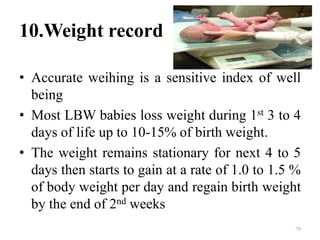
• Most LBW babies loss weight during 1st 3 to 4
days of life up to 10-15% of birth weight.
• The weight remains stationary for next 4 to 5
days then starts to gain at a rate of 1.0 to 1.5 %
of body weight per day and regain birth weight
by the end of 2nd weeks
79
Immunization
• The dose is not reduced in preterm baby.
• Administer 0day vaccines on the day of
discharge.
80
Nursing Management Prematurity &
Dysmaturity
• Nursing assessment:
Vital signs
Activity and behavior
Color: pink, pale, grey, blue, yellow
Capillary refill over upper chest < 2 sec
ABG and electrolyte
Tolerance of feeds: vomiting, gastric residuals and
abd girth
Development of apnic attack, weight
81
Nursing diagnosis
1. Ineffective breathing pattern related to:
immaturity of the respiratory center, as
evidence by visible intercostal retraction.
2. Imbalanced Nutrition Less than Body
Requirements related to :decrease nutrient
deposits, immaturity of enzyme production,
weak abdominal muscles, weak reflexes.
82
Nursing diagnosis
3. Risk for Ineffective thermoregulation related
to : Immature CNS (central regulation of
residues, reduced lean body mass to surface
area, subcutaneous fat loss, inability to feel
cold and clammy, poor metabolic reserves).
4. Risk for infection related to immunological
defense ineffective.
5. Anxiety : parents related to : baby disease
conditions
83
NURSING MANAGEMENT OF
PREMATURITY DYSMATURITY (1)
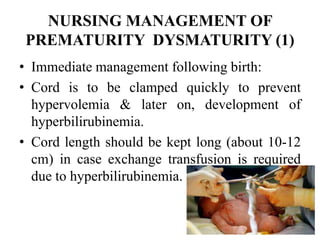
• Immediate management following birth:
• Cord is to be clamped quickly to prevent
hypervolemia & later on, development of
hyperbilirubinemia.
• Cord length should be kept long (about 10-12
cm) in case exchange transfusion is required
due to hyperbilirubinemia.
84
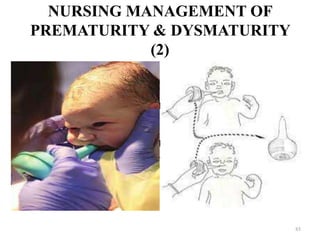
NURSING MANAGEMENT OF
PREMATURITY & DYSMATURITY
(2)
• Air passage should be cleared off mucus
promptly & gently using a mucus sucker.
• Adequate oxygenation through mask or nasal
catheter
• The baby should be wrapped in sterile towel &
is laid on one side in the cot with the head
slightly lowered.
85
NURSING MANAGEMENT OF
PREMATURITY &
DYSMATURITY (3)
• Inj. Vit. K 1mg is to be injected
intramuscularly to prevent hemorrhagic
manifestations.
• The baby should be handled with extreme
gentleness. Preterm & dysmature babies are
both functionally immature & ―special care‖
is needed for their survival
86
Family support :
• The frightened seen of NICU should be
demystified.
• Family should be constantly informed and
involved in care of baby.
• Mother should be encouraged to touch and talk
with her baby and provide routine care under
guidance of nurses.
87
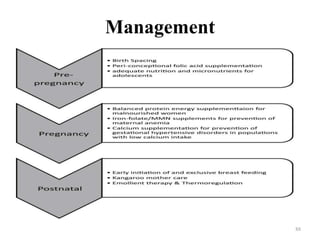
Management
88
Research Articles
• A Case Control Study on Risk Factors
Associated with Low Birth Weight Babies in
Eastern Nepal
• Objectives: to assess the maternal and
sociodemographic factors associated with low
birth weight (LBW) babies.
89
Research article…
Results: More than 50% of LBW babies were from the mothers with
height ≤145 cm while only 9.43% of NBW babies were from the
mothers with that height. Finally, after multivariate logistic
regression analysis, maternal height, time of first antenatal care
(ANC) visit, number of ANC visits, iron supplementation, calcium
supplementation, maternal education, any illness during pregnancy,
and hypertension were found as the significant predictors of LBW.
However, maternal blood group AB, normal maternal Body Mass
Index (BMI), mother’s age of 30 or more years, and starting ANC
visit earlier were found to be protective for LBW.
Conclusion: Study findings suggest that selectively targeted
interventions such as delay age at first pregnancy, improving
maternal education and nutrition, and iron and calcium
supplementation can prevent LBW in Nepal.
90
Reference :
• Ghai O, Paul V, Bagga A. Ghai Essential Pediatrics. 7th
ed. New delhi, India: CSB; 2012.
• Premature birth - Symptoms and causes [Internet].
Mayo Clinic. 2019 [cited 3 October 2019]. Available
from: https://www.mayoclinic.org/diseases-
conditions/premature-birth/symptoms-causes/syc-
20376730
• Care of the preterm and low-birth-weight newborn
[Internet]. World Health Organization. 2019 [cited 3
October 2019]. Available from:
https://www.who.int/maternal_child_adolescent/newbor
ns/prematurity/en/
91
THANK YOU
92

LOW BIRTH WEIGHT INFANT - final (1).pptx

  • 1.
    “LOW BIRTH WEIGHT INFANT” Ms.Anju Bista M.Sc. Nursing 2nd year 2021 Batch 1
  • 2.
    Objectives: • At theend of this session participant will be able to know about the low birth weight infant. 2
  • 3.
    Introduction • The normalweight of the newborn baby is 2.5 – 3.9kg and approximately 2.9 kg. • The average gestational age of a pregnant female is about 37-42weeks of gestation. • A neonate with a birth weight of less than 2.5kg or 2500gm irrespective of the gestational age are termed to be low birth weight baby. 3
  • 4.
    These classifications includethe following: • Preterm: Birth before completion of the 37th week of gestation regardless of birth weight; also called premature birth • Term: Birth occurring between 38 and 42 weeks' gestation • Post-term: Birth after completion of the 42nd week of gestation. 4
  • 5.
    Low birth weight generallyincludes the preterm infants and small for dates baby. 5
  • 6.
    Introduction… • These twogroups has the different clinical problems and prognosis. • In Nepal about 30-49% neonates are born with low birth weight. • Approximately 80% of all neonates death about 50% death of infant are related to low birth weight. • About 10% of all LBW babies require admission to the special nursery care. 6
  • 7.
  • 8.
    Classification of neonatesby birth weight By birth weight • LBW infant: An infant, regardless of the gestational age, whose weight is less than 2,500 g (5.5lb). • Extremely low birth weight (ELBW) infant: An infant whose birth weight is less than 1,000 g (2.2 lb). • VLBW infant: An infant whose birth weight is less than 1,500 g (3.3 lb). • Moderately low birth weight (MLBW) infant: An infant whose birth weight is 1,501-2,500 g (3.3-5.5 lb). 8
  • 9.
    By Gestational age •AGA: An infant whose weight falls between the 10th on information from the and 90th percentiles. • Appropriate for dates (APD) babies: babies born with the birth weight 10th- 90th for the period of the gestational age. They are also termed as immature, early born or premature • Small-for-date (SFD): An infant whose intrauterine growth was slowed and falls below 1oth percentile. • LGA: An infant who falls above the 90th percentile. and delivery. • Birth weight variations may occur in the preterm, term, and post-term neonates. 9
  • 10.
  • 11.
    An illustration ofhow birth weight and gestational age classifications are related 11
  • 12.
    • Weight helpsassess growth, and gestational age helps assess maturity. • A newborn of 40 weeks' gestation who weights less than 2,500 g (below the 10th percentile for weight or length) would be mature but under grown. • This disorder is called intrauterine growth retardation, in which the fetus rate of growth does not meet expected norms; the newborn is classified as SGA 12
  • 13.
    • A newbornof 36 weeks' gestation who weighs 3,500 g (above the 90th percentile for weight) would be immature but overgrown. • Such LGA newborns are typical for diabetic mothers. • Although this newborn has attained average term weight, it is actually premature, with incomplete maturation of organ systems. 13
  • 14.
    Introduction Dysmaturity (Intrauterine GrowthRetardation {IUGR} / Small for Date / Chronic Placental Insufficiency) Small for Gestational Age • Infant whose weight is at or below 10th %. • Is a high risk condition. • Results from failure to thrive. 14
  • 15.
    DEFINITION: • It issaid to be present in those babies whose birth weight is below the 10th percentiles of the average of the gestational age. • Dysmaturity can occur in preterm, term or post term babies. 15
  • 16.
    Types of Dysmaturity Basedon the clinical evaluation & ultrasound examination the small fetuses are divided into: I. Fetuses that are small & healthy. The birth weight is less than 10th percentile for their gestational age. normal subcutaneous fat & usually have uneventful neonatal course. 16
  • 17.
    Types of Dysmaturity II.Fetuses where growth is restricted by pathological process (true IUGR) : Depending upon the relative size of their head, abdomen & femur, the fetuses are subdivided into: • Symmetrical or Type I. • Asymmetrical or Type II. 17
  • 18.
  • 19.
  • 20.
  • 21.
  • 22.
    a. Symmetrical (20%): • SymmetricalFGR occurs with an insult on the fetal growth in early gestation. • size of the head, body weight and length are all equally reduced. • fetus is affected from the noxious effect very early in the phase of cellular hyperplasia. • This form of growth retardation is most often caused by structural or chromosomal abnormalities or congenital infection (TORCH). b. Asymmetrical (80%) • The fetus growth is affected in later months during the phase of cellular hypertrophy. 22
  • 23.
    Features of symmetrical& asymmetrical IUGR fetuses Symmetrical Asymmetrical Uniformly small. Head larger than abdomen. Ponderal index (Birth weight / Crown- heel length) – normal. Low. Etiology: genetic disease or infection – (Intrinsic to fetus Chronic placental insufficiency – (Extrinsic to fetus) Total cell number – less Cell size - normal Normal Smaller Neonatal course: complicated with poor prognosis Usually uncomplicated having good prognosis 23
  • 24.
  • 25.
    CAUSES • Unknown (40%):about 40% cases remains unknwon. • Fetal cause: 1. Chromosomal Disorders: Usually result in early onset IUGR. Trisomies 13, 18, 21 contribute to 5% of IUGR cases. Aneuploidy. Triploidy. Turner's syndrome 25
  • 26.
    Fetal Cause: 2. CongenitalInfections: The growth potential of fetus may be severely impaired by intrauterine infections. • Viruses- rubella, CMV, varicella and HIV rubella is the most embryotoxic virus, it cause capillary endothelial damage during organogenesis and impairs fetal growth. CMV causes cytolysis and localized necrosis in fetus. • Protozoa- like malaria, toxoplasma, have also been associated with growth restriction. 26
  • 27.
    Fetal Cause: 3. StructuralAnomalies : • All major structural defects involving CNS,CVS, GIT, Genitourinary and musculoskeletal system are associated with increased risk of fetal growth restriction. • If growth restriction is associated with polyhydramnios, the incidence of structural anomaly is substantially increased. 27
  • 28.
    Fetal Cause: 4. GeneticCauses: • Maternal genes have greater influence on fetal growth. • Inborn errors of metabolism like genesis of pancreas, congenital lipodystrophy, galactosemia, phenylketonuria also result in growth restriction of fetus. 28
  • 29.
    Maternal cause(1): Constitutional smallwomen, maternal genetic & racial factors. Poor maternal nutrition before & during pregnancy Poor maternal weight gain during pregnancy.  Diminished uterine blood flow due to pre- eclampsia, toxemia, & hypertension. 29
  • 30.
    Maternal cause(2): Mal absorptionsyndrome/malnutrition. Low blood oxygen as in heart disease. Toxin: alcohol, smoking, chronic renal failure, chronic UTI, etc 30
  • 31.
    Placental Causes: • Placentais the sole channel for nutrition and oxygen supply to the fetus. Single umbilical artery. Placental hemangiomas have all been associated with fetal growth restriction 31
  • 32.
    Placental cause: • Placental& cord abnormalities such as chronic placental abruption, infarction, small placenta, velamentous insertion of cord, etc 32
  • 33.
    SIGNS OF DYSMATURITY •Posture: Tonic or flexed as term baby. • Appearance: Look like an old person. • Skin: Pink, dry & wrinkled skin. • Lanugo: Scanty lanugo. • Vernix: Lots of vernix. • Fontanelle & suture: Normal wideness of suture & fontanelle, skull bone as normal baby. • Ear: Normal ear pinna. • Planter creases: Dark & plenty of planter creases. 33
  • 34.
    SIGNS OF DYSMATURITY •Nails: Pink colored soft nails. • Activity: Active like term. • Sucking: Good & strong sucking ability. • Cry: Strong & loud cry. • Breast: Breast tissues palpable. • Genitalia:Female: Labia majora covers the labia minora & clitoris. Male: Descended testes. 34
  • 35.
    Problems of SGAbaby: 1. Perinatal asphyxia : SGA babies tolerate the stress of labor poorly. They are at risk of asphyxia. 2. Meconium aspiration: Intrauterine hypoxia can cause meconium to be passed in utero leading to meconium aspiration syndrome. 35
  • 36.
    Problems of SGAbaby: 3. Persistent pulmonary hypertension: Chronic intrauterine hypoxia • can lead to thickening of smooth muscles of pulmonary vasculature leading to • pulmonary hypertension which manifests as central cyanosis 36
  • 37.
    Problems of SGAbaby: 4. Polycythemia: Polycythemia and high blood viscosity can occur secondary to chronic hypoxia in utero. 5. Metabolic complications: Include both hypoglycemia (due to decreased stores of glycogen) and hyperglycemia (due to altered insulin secretion in VLBW babies) and hypocalcemia. 6. Decreased immunity : Due to neutropenia and low IgG levels predisposing to infections. 37
  • 38.
    Problems of SGAbaby: 7. Other problems: Include congenital anomalies, hypothermia, feed intolerance, thrombocytopenia, acute tubular necrosis/renal insufficiency and pulmonary hemorrhage. 8. Risk of poor postnatal growth. Recurrent infections and hospitalization. 38
  • 39.
    Problems of SGAbaby: 9. Long term outcome: Includes neuro- developmental morbidities like hyperactivity, short attention span and learning problems. 39
  • 40.
    DETAILED MANAGEMENT • Hospitalization. •Warmth. • Establishment of respiration. • Maintenance of body temperature. • Maintain nutrition & feeding. • Mothering & expert nursing care. • Prevention of infection. • Observation. • Emotional support to family 40
  • 41.
    PREMATURITY • A babyborn before 37 WOG calculating from the first day of LMP is arbitrarily defined as preterm baby. • Preterm infants (born at <37 completed weeks of gestation) have difficulty in adapting to extrauterine environment because of immaturity of the organ systems 41
  • 42.
    On the babiesborn preterm: • 84% are born between 32 and 36 weeks of gestation. • 10% are born between 28 and 31 weeks of gestation. • 6% are born at less than 28 weeks of gestation. • Premature infants born between 34 and 37 weeks of pregnancy are often called late preterm or near-term infants. 42
  • 43.
    Incidence • Preterm babyconsistutes 2/3rd of low birth weight babies. • The incidence of low birth weight baby is about 30=40% in the developing countries as such incidence of preterm baby is about 20-25 %. 43
  • 44.
  • 45.
    CAUSES 1. Maternal factors: •Medical diseases during pregnancy as heart disease, anemia, HTN, renal disease, etc. • Maternal infection as hyperpyrexia, trauma. • Maternal malnutrition. • Complications of pregnancy as APH. • Incompetence of cervix. • Polyhydramnios. • Previous history of premature delivery. • Physical exertion. • Heavy smoking & drug addiction. • Maternal age below 20 years or age over 35 years. 45
  • 46.
    Causes Of preterm 2.Fetalfactors: Multiple pregnancy. IUGR. Congenital malformation. Rh incompatibility. 3. Iatrogenic: Improper diagnosis of maturity in elective deliveries. 46
  • 47.
    Causes 4.Medical factors: Uncontrolled DMin mother. Severe cardiac illness, toxemia. Fetal hypoxia & distress. Severe iso-immunization in mother or hydrops fetalis 47
  • 48.
    CHARACTERISTICS Weight is 2500gm or less & length is usually less than 44 cm. Posture: Hypotonic, poor reflex, assume extended posture due to poor muscle tone. Appearance: Looks tiny but healthy. Skin: Thin, shiny & excessive pink with abundant lanugo & vernix. Edema may be present. Subcutaneous fat is deficient. Breast nodules are small or absent. 48
  • 49.
    CHARACTERISTICS(2) Deep sole creasesare often not present Face & Head: Face is small & head is large in proportion to the body. Soft skull bone. Sutures are widely separated & fontanelles are large. Microganthia & retroganthia present, protruding eye due to shallow orbit & absent of buccal pads of fat. Hair appears wooly & fuzzy & individual hair fibers can be seen separately. 49
  • 50.
    CHARACTERISTICS (3) Ear cartilageis deficient with poor recoil. Ear pinna soft & flat. Planter creases: Not so dark & very few in number. Nails: Bright pink colored nail beds & very soft nails. Limbs: Thin. Activity: Less activity of limbs. Sucking: Unable or poor sucking ability. Cry: Weak & feeble cry. 50
  • 51.
    CHARACTERISTICS (3) Breast: Nobreast tissue palpable. Chest: Small & narrow and the abdomen large. Genitalia: In male, testes are un-descended; scrotum poorly pigmented & has few rugorisities. In female, labia majora are widely separated exposing labia minora & clitoris. Reflex: Moro, sucking, swallowing, & other reflexes are absent or sluggish. 51
  • 52.
  • 53.
    1. Alternation ofrespiratory functions: • Respiration of preterm neonate are rapid , shallow irregular with periods of apnea and cyanosis. • Coughs and gag reflex are weak or absent. Pulmonary aspiration, atelectasis , hyaline membrane disease are common. • Chronic pulmonary insufficiency, weak respiratory, poor development and expansion of lungs, inefficient respiratory center and deficiency of surfactant in the alveoli are responsible for respiratory problems and resuscitation difficulties at birth 53
  • 54.
    2. Immaturity ofcentral nervous system: • The preterm infants are inactive, lethargic and having poor cough reflex. • Sucking and swallowing reflexes are incordinated leading to feeding difficulties. • These babies are prone to kernicterus and brain damage at lower serum bilirubin level due to inefficient blood brain barrier. 54
  • 55.
    3. Disturbance ofcirculatory functions: • In preterm neonates, the closure of ductus arterious may be delayed, the peripheral circulation is inadequate. • Weak and fragile blood vessels and hypo function of bone marrow may result hemorrhagic problems. 55
  • 56.
    4. Impaired thermoregulation: •Preterm infants are more prone to get hypothermia due to poorly developed heat regulating center large body surface area in regulation to body weight, poor insulating subcutaneous fat and less brown adipose tissue. 56
  • 57.
    5. Ineffective gastrointestinaland hepatic functions: • Sucking and swallowing reflex are poorly developed in preterm infants. • Capacity of stomach is less and cardio esophageal sphincter is incompetent and results in aspiration and regurgitation. • Abdominal distension and functional intestinal obstruction are found due to hypotonia. 57
  • 58.
    Contd… • Hypoglycemia isalso common due to poor hepatic glycogen stores and delayed feeding. • Neonates are more prone to malnutrition, iron deficiency anemia and other vitamin deficiency due to poor absorption of nutrients. • Poor vitamin k synthesis in liver and poor prothrombin production leads to hemorrhagic disorders. 58
  • 59.
    6. Metabolic disturbances: •Preterm neonates are more prone to develop hypoglycemia, hypocalcemia, hypoxia, acidosis and hypoproteinimia due to poor metabolic functions. 59
  • 60.
    7. Increased susceptibilityto infections : • Preterm neonates are 3 to 10 times more vulnerable to infections than normal neonates. • Insufficient cellular immunity and low grade IgG antibody level makes them more susceptible to infections. 60
  • 61.
    8. Impaired renalfunction: • Due to low glomerular filtration rate and reduced concentrating ability the preterm are more prone to develop acidosis. • Dehydration, delayed urination, edema as well as renal failure can be developed as complication. 61
  • 62.
    9. Drug toxicity: •Poor hepatic detoxification and reduced renal clearance lead to toxic effects of drug unless precautions are followed during administration. 62
  • 63.
    Management • Management dependson the birth weight of the baby: • Requires special care at home <1.8 kg otherwise normal • Requires hospital care 1.5kg -1.8kg • Management in NICU (Neonatal ICU) < 1.8 kg 63
  • 64.
    Principal management ofLBW in hospital 1. Correction of hypothermia 2. Correction of hypoglycemia 3. Detection of other complication 4. Treatment of other complication 5. Follow up with all vitals sign being monitored 64
  • 65.
    Therapeutic Management:  Whena preterm delivery is expected the NICU is alerted and the team of neonatal specialists are present at the time of delivery  Resuscitation is done if needed in the labor room the in infant is transferred to NICU in an incubator  Measurements taken and vitamin K is given 65
  • 66.
    Therapeutic Management: Respiratory support:Apnea mattress – Incubator – O2 monitoring Temperature regulation: Incubator, and monitoring of temperature, Humidity as recommended Complications such as hypoglycemia and hypocalcaemia are frequent in the premature infant and are managed according to specific conditions and monitored frequently  Respiratory distress syndrome is very common and required respiratory support. 66
  • 67.
    MANAGEMENT OF LOWBIRTH WEIGHT BABY. 1. Optimal management at birth • Senior pediatrician should be attending with all preparation of resuscitation to baby. • The cord is to be clamped quickly to prevent hypervolemia & development of hyperbilirubinemia. • Promptly dry & kept warm with gentle handling. • Give vitamin K 1 mg to prevent hemorrhage. 67
  • 68.
    2. Maintain bodytemperature • Keep the baby in incubator with temperature & humidity maintained. • Alternately, the baby could be managed in radiant warmer. • The room temperature should be 25-30˚C with incubator temperature according to weight. 68
  • 69.
    2. Maintain bodytemperature (2) • Cover the baby‘s head with clothes. Do not expose body part unless & otherwise needed for observation & assessment. • If baby is receiving IV fluid or EBM, increase volume of fluid or milk by 10% of total daily volume/day for those under radiant warmer. • Check the temperature of warmer & room every hour & adjust the temperature setting accordingly. • For extremely low birth weight baby, covered with cellophane to prevent heat loss through convection. 69
  • 70.
    3. Positioning • Mostbaby love to lie in prone position, they cry less & feel more comfortable. It relieves abdominal discomfort by passage of flatus & prevents aspiration. • Baby should change position 2 hourly. 70
  • 71.
    4. Kangaroo MotherCare (KMC) • If baby is not sick, encourage KMC & exclusively breast feeding. • KMC provides warmth to baby, will feed more easily & episodes of apnea will be less frequent. 71
  • 72.
    5. Oxygen therapy •It should be administered only when indicated, stop as soon as it is considered unnecessary. It should be administered with head box when SpO2 falls below 85%. It should be maintained at 90-95% & PaO2 between 60-80%. • The room fiO2 should be between 20-40%. 72
  • 73.
    6. Feeding &nutrition • Babies < 1.2 kg or gestation < 30 weeks & sick babies should start IV dextrose solution (10% dextrose >1kg & 5% dextrose <1 kg). • Trophic feeds with 1-2 ml EBM 2-3 hourly through NG tube can be started to all babies irrespective of age & weight, 2 hourly < 1kg & 3 hourly > 1.2 kg. • Trophic feeds given in order to stimulate the development of GI tract of premature baby 73
  • 74.
    Feeding & nutrition •When stabilized enteral feeds are begun with EBM starting with a volume of 30ml/kg/day on day 1 • Depending on tolerance feeds increased by 10-20 ml/kg/day every day and IVF are reduced. • When baby is stable , EBM can be fortified with human milk fortifier (HMF) for additional calories and protein. • Multivitamin drops after 2-3 weeks • Vitamin E which is powerful antioxidant and prevent hemolytic anemia and edema. 74
  • 75.
    6. Feeding &nutrition (2) • Gradually increase EBM & decrease IV drip. • After 7 days, if baby still requires feeding using an alternative feeding method, increase 20 ml/kg/day until baby reaches 180 ml/kg of breast milk/day. 75
  • 76.
    7. Gentle rhythmicstimulation: • Gentle touch, massage, cuddling, stroking & flexing preferably by mother provide useful tactile stimuli to the baby. • Soothing auditory stimuli as family voice, music reduce the stress of procedure & enhance weight gain. • Eye to eye contact, colored objects provide visual inputs. 76
  • 77.
    9.Utility of Corticosteroids •In infant who did not receive antenatal steroids in baby, a single dose of dexamethasone 0.2mg/kg iv at 4 hrs of age is recommended in very LBW babies. 77
  • 78.
    9 Prevention ofnosocomial infection: • Strict hand washing before & after touching the baby. • Minimal handling the preterm. • Effective treatment of suspected infection of any origin. 78
  • 79.
    10.Weight record • Accurateweihing is a sensitive index of well being • Most LBW babies loss weight during 1st 3 to 4 days of life up to 10-15% of birth weight. • The weight remains stationary for next 4 to 5 days then starts to gain at a rate of 1.0 to 1.5 % of body weight per day and regain birth weight by the end of 2nd weeks 79
  • 80.
    Immunization • The doseis not reduced in preterm baby. • Administer 0day vaccines on the day of discharge. 80
  • 81.
    Nursing Management Prematurity& Dysmaturity • Nursing assessment: Vital signs Activity and behavior Color: pink, pale, grey, blue, yellow Capillary refill over upper chest < 2 sec ABG and electrolyte Tolerance of feeds: vomiting, gastric residuals and abd girth Development of apnic attack, weight 81
  • 82.
    Nursing diagnosis 1. Ineffectivebreathing pattern related to: immaturity of the respiratory center, as evidence by visible intercostal retraction. 2. Imbalanced Nutrition Less than Body Requirements related to :decrease nutrient deposits, immaturity of enzyme production, weak abdominal muscles, weak reflexes. 82
  • 83.
    Nursing diagnosis 3. Riskfor Ineffective thermoregulation related to : Immature CNS (central regulation of residues, reduced lean body mass to surface area, subcutaneous fat loss, inability to feel cold and clammy, poor metabolic reserves). 4. Risk for infection related to immunological defense ineffective. 5. Anxiety : parents related to : baby disease conditions 83
  • 84.
    NURSING MANAGEMENT OF PREMATURITYDYSMATURITY (1) • Immediate management following birth: • Cord is to be clamped quickly to prevent hypervolemia & later on, development of hyperbilirubinemia. • Cord length should be kept long (about 10-12 cm) in case exchange transfusion is required due to hyperbilirubinemia. 84
  • 85.
    NURSING MANAGEMENT OF PREMATURITY& DYSMATURITY (2) • Air passage should be cleared off mucus promptly & gently using a mucus sucker. • Adequate oxygenation through mask or nasal catheter • The baby should be wrapped in sterile towel & is laid on one side in the cot with the head slightly lowered. 85
  • 86.
    NURSING MANAGEMENT OF PREMATURITY& DYSMATURITY (3) • Inj. Vit. K 1mg is to be injected intramuscularly to prevent hemorrhagic manifestations. • The baby should be handled with extreme gentleness. Preterm & dysmature babies are both functionally immature & ―special care‖ is needed for their survival 86
  • 87.
    Family support : •The frightened seen of NICU should be demystified. • Family should be constantly informed and involved in care of baby. • Mother should be encouraged to touch and talk with her baby and provide routine care under guidance of nurses. 87
  • 88.
  • 89.
    Research Articles • ACase Control Study on Risk Factors Associated with Low Birth Weight Babies in Eastern Nepal • Objectives: to assess the maternal and sociodemographic factors associated with low birth weight (LBW) babies. 89
  • 90.
    Research article… Results: Morethan 50% of LBW babies were from the mothers with height ≤145 cm while only 9.43% of NBW babies were from the mothers with that height. Finally, after multivariate logistic regression analysis, maternal height, time of first antenatal care (ANC) visit, number of ANC visits, iron supplementation, calcium supplementation, maternal education, any illness during pregnancy, and hypertension were found as the significant predictors of LBW. However, maternal blood group AB, normal maternal Body Mass Index (BMI), mother’s age of 30 or more years, and starting ANC visit earlier were found to be protective for LBW. Conclusion: Study findings suggest that selectively targeted interventions such as delay age at first pregnancy, improving maternal education and nutrition, and iron and calcium supplementation can prevent LBW in Nepal. 90
  • 91.
    Reference : • GhaiO, Paul V, Bagga A. Ghai Essential Pediatrics. 7th ed. New delhi, India: CSB; 2012. • Premature birth - Symptoms and causes [Internet]. Mayo Clinic. 2019 [cited 3 October 2019]. Available from: https://www.mayoclinic.org/diseases- conditions/premature-birth/symptoms-causes/syc- 20376730 • Care of the preterm and low-birth-weight newborn [Internet]. World Health Organization. 2019 [cited 3 October 2019]. Available from: https://www.who.int/maternal_child_adolescent/newbor ns/prematurity/en/ 91
  • 92.