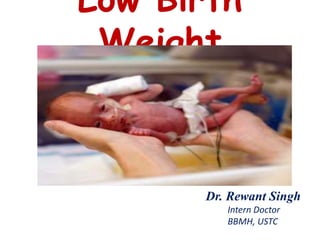
Low Birth
Weight
Dr. Rewant Singh
Intern Doctor
BBMH, USTC
Low Birth weight
• Low birth weight (LBW) is a term used to describe
babies who are born weighing less than 2,500 grams.
“Or”
Babies with a birth weight of less than 2500gm
irrespective of the period of their gestation are
classified as low birth weight babies.
• Average newborn weighs about 2.5 - < 4kg.
Incidence
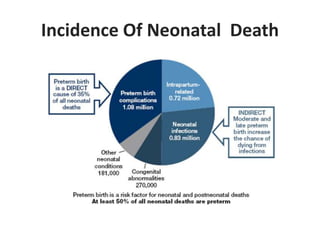
 50% of pre term are Low birth weight baby.
 80% of neonatal death and 50% of infant mortality
are due to LBW.
 Higher incidence of LBW babies in Bangladesh is due
to higher no. of babies with IUGR rather than
preterm.
 About 10% of all LBW babies require admission to
the NICU
Incidence Of Neonatal Death
Classification
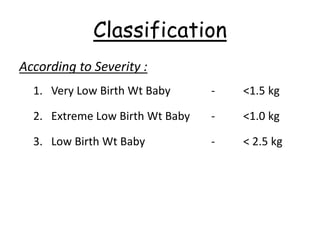
According to Severity :
1. Very Low Birth Wt Baby - <1.5 kg
2. Extreme Low Birth Wt Baby - <1.0 kg
3. Low Birth Wt Baby - < 2.5 kg
According to birth weight and gestational age
• Preterm LBW SAG(small for gestational
age)
Causes of LBW
A. Foetal Causes :
• Foetal distress
• Multiple gestation
• Erythroblastosis foetalis
• Placenta praevia
• Abruptio placenta
• Foetal abnormalities
B. Maternal Causes :
• Maternal Malnutrition
• Poverty
• Multiple pregnancy
• Elderly gravida
• Illiteracy
• Chronic medical illness – CHD, CKD
• Infection during pregnancy – UTI,
Chorioamnionitis
Problems of Prematurity
A. Early
 Hypothermia (Temp < 95oF)
 Hypoglycaemia (RBS < 2.2 mmol/L)
 Respiratory Distress Syndrome / HIE
 Apnoeic spells
 Infection
 Feeding difficulties – Inability to suck & tolerate feed
 Problems of gut – NEC, GERD
 Haematological problems – Anaemia, DIC, Vit. K
deficiency, Hyperbilirubinaemia
 Electrolyte imbalance
B. Late
 Cerebral Palsy
 Mental Retardation & poor school performance
 Seizures
 Microcephaly
 Retinopathy of Prematurity (ROP)
 Bronchopulmonary Dysplasia (BPD)
 Hearing & Visual impairment
 Growth failure
 Child Abuse
Management
Management depends on the birth weight of the
baby
1. >1.8 kg otherwise normal - requires special care
at home
2. > 1 .5 kg but < 1.8 kg - requires Hospital care
3. < 1.5 kg - Management in NICU
Home Management
1. Feeding : EBF
2. Thermal Regulation :
a) Proper wrapping of the baby
b) Maintenance of the room temperature
c) Kangaroo Mother Care (KMC)
d) Kangaroo Father Care (KFC)
3. Prevention of infection
4. Immunisation
5. Follow up after 2 wks or if any problem arises
Danger signals for early detection
and referral to hospital
Lethergy, refuse to feed
 Hypothermia
 Tachypnoea, grunting apnoea
 Seizures
 Abdominal distension
 Bleeding, icteric over palms/soles
Indication for Hospitalization
 Birth weight : <1800 gm
 Gestation : <34 weeks
 Unable to feed
 Sick neonate
Principle of Management of
LBW in hospital
 Correction of hypothermia
 Correction of hypoglycaemia
 Detection of other complications
 Treatment of other complications
 Follow up with all vital signs being monitored
continuously
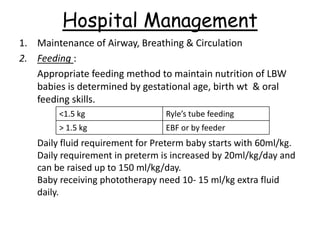
Hospital Management
1. Maintenance of Airway, Breathing & Circulation
2. Feeding :
Appropriate feeding method to maintain nutrition of LBW
babies is determined by gestational age, birth wt & oral
feeding skills.
Daily fluid requirement for Preterm baby starts with 60ml/kg.
Daily requirement in preterm is increased by 20ml/kg/day and
can be raised up to 150 ml/kg/day.
Baby receiving phototherapy need 10- 15 ml/kg extra fluid
daily.
<1.5 kg Ryle’s tube feeding
> 1.5 kg EBF or by feeder
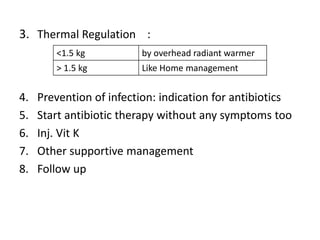
3. Thermal Regulation :
4. Prevention of infection: indication for antibiotics
5. Start antibiotic therapy without any symptoms too
6. Inj. Vit K
7. Other supportive management
8. Follow up
<1.5 kg by overhead radiant warmer
> 1.5 kg Like Home management
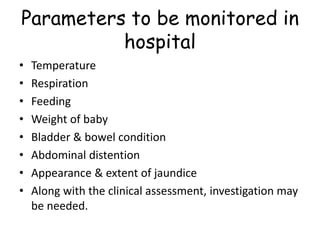
Parameters to be monitored in
hospital
• Temperature
• Respiration
• Feeding
• Weight of baby
• Bladder & bowel condition
• Abdominal distention
• Appearance & extent of jaundice
• Along with the clinical assessment, investigation may
be needed.
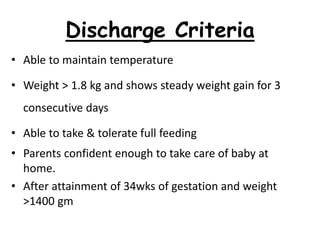
Discharge Criteria
• Able to maintain temperature
• Weight > 1.8 kg and shows steady weight gain for 3
consecutive days
• Able to take & tolerate full feeding
• Parents confident enough to take care of baby at
home.
• After attainment of 34wks of gestation and weight
>1400 gm
Prognosis
Mortality
– inversely related to the gestation and birth weight
– Directly related to severity complications
– More than 90% of LBW babies have no
neurodevelopmental handicaps.
Morbidity
– LBW babies are more prone to infections due to
various reasons
Kangaroo Mother Care (KMC)
• KMC is a special way of caring of low birth weight
babies. It fosters their health and well being by
promoting effective thermal control, breastfeeding,
infection prevention and bonding.
• Kangaroo mother care was invented in 1978 by
Colombian pediatrician Edgar Rey. Faced with a
shortage of incubators, Rey found that mothers
could use their own bodies to warm premature
infants.
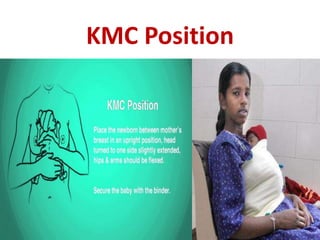
KMC Position
Benefits of KMC
Stabilization of the baby's heart rate.
 Improved (more regular) breathing pattern.
Improved oxygen saturation levels (an indicator of
how well oxygen is being delivered to all the infants
organs and tissues)
Gain in sleep time.
More rapid weight gain.
Decreased crying.
At last
• In fact several renowned and famous people who
were premature and of LBW grew up to become
great personality like Sir Isaac Netwon, Sir Winston
Churchill and great painter Pablo Picasso.
• The parents of premature LBW babies therefore
should not feel despondent.
Low birth weight

Low birth weight

  • 1.
    Low Birth Weight Dr. RewantSingh Intern Doctor BBMH, USTC
  • 3.
    Low Birth weight •Low birth weight (LBW) is a term used to describe babies who are born weighing less than 2,500 grams. “Or” Babies with a birth weight of less than 2500gm irrespective of the period of their gestation are classified as low birth weight babies. • Average newborn weighs about 2.5 - < 4kg.
  • 4.
    Incidence  50% ofpre term are Low birth weight baby.  80% of neonatal death and 50% of infant mortality are due to LBW.  Higher incidence of LBW babies in Bangladesh is due to higher no. of babies with IUGR rather than preterm.  About 10% of all LBW babies require admission to the NICU
  • 5.
  • 6.
    Classification According to Severity: 1. Very Low Birth Wt Baby - <1.5 kg 2. Extreme Low Birth Wt Baby - <1.0 kg 3. Low Birth Wt Baby - < 2.5 kg
  • 7.
    According to birthweight and gestational age • Preterm LBW SAG(small for gestational age)
  • 8.
    Causes of LBW A.Foetal Causes : • Foetal distress • Multiple gestation • Erythroblastosis foetalis • Placenta praevia • Abruptio placenta • Foetal abnormalities
  • 9.
    B. Maternal Causes: • Maternal Malnutrition • Poverty • Multiple pregnancy • Elderly gravida • Illiteracy • Chronic medical illness – CHD, CKD • Infection during pregnancy – UTI, Chorioamnionitis
  • 10.
    Problems of Prematurity A.Early  Hypothermia (Temp < 95oF)  Hypoglycaemia (RBS < 2.2 mmol/L)  Respiratory Distress Syndrome / HIE  Apnoeic spells  Infection  Feeding difficulties – Inability to suck & tolerate feed  Problems of gut – NEC, GERD  Haematological problems – Anaemia, DIC, Vit. K deficiency, Hyperbilirubinaemia  Electrolyte imbalance
  • 11.
    B. Late  CerebralPalsy  Mental Retardation & poor school performance  Seizures  Microcephaly  Retinopathy of Prematurity (ROP)  Bronchopulmonary Dysplasia (BPD)  Hearing & Visual impairment  Growth failure  Child Abuse
  • 12.
    Management Management depends onthe birth weight of the baby 1. >1.8 kg otherwise normal - requires special care at home 2. > 1 .5 kg but < 1.8 kg - requires Hospital care 3. < 1.5 kg - Management in NICU
  • 13.
    Home Management 1. Feeding: EBF 2. Thermal Regulation : a) Proper wrapping of the baby b) Maintenance of the room temperature c) Kangaroo Mother Care (KMC) d) Kangaroo Father Care (KFC) 3. Prevention of infection 4. Immunisation 5. Follow up after 2 wks or if any problem arises
  • 14.
    Danger signals forearly detection and referral to hospital Lethergy, refuse to feed  Hypothermia  Tachypnoea, grunting apnoea  Seizures  Abdominal distension  Bleeding, icteric over palms/soles
  • 15.
    Indication for Hospitalization Birth weight : <1800 gm  Gestation : <34 weeks  Unable to feed  Sick neonate
  • 16.
    Principle of Managementof LBW in hospital  Correction of hypothermia  Correction of hypoglycaemia  Detection of other complications  Treatment of other complications  Follow up with all vital signs being monitored continuously
  • 17.
    Hospital Management 1. Maintenanceof Airway, Breathing & Circulation 2. Feeding : Appropriate feeding method to maintain nutrition of LBW babies is determined by gestational age, birth wt & oral feeding skills. Daily fluid requirement for Preterm baby starts with 60ml/kg. Daily requirement in preterm is increased by 20ml/kg/day and can be raised up to 150 ml/kg/day. Baby receiving phototherapy need 10- 15 ml/kg extra fluid daily. <1.5 kg Ryle’s tube feeding > 1.5 kg EBF or by feeder
  • 18.
    3. Thermal Regulation: 4. Prevention of infection: indication for antibiotics 5. Start antibiotic therapy without any symptoms too 6. Inj. Vit K 7. Other supportive management 8. Follow up <1.5 kg by overhead radiant warmer > 1.5 kg Like Home management
  • 19.
    Parameters to bemonitored in hospital • Temperature • Respiration • Feeding • Weight of baby • Bladder & bowel condition • Abdominal distention • Appearance & extent of jaundice • Along with the clinical assessment, investigation may be needed.
  • 20.
    Discharge Criteria • Ableto maintain temperature • Weight > 1.8 kg and shows steady weight gain for 3 consecutive days • Able to take & tolerate full feeding • Parents confident enough to take care of baby at home. • After attainment of 34wks of gestation and weight >1400 gm
  • 21.
    Prognosis Mortality – inversely relatedto the gestation and birth weight – Directly related to severity complications – More than 90% of LBW babies have no neurodevelopmental handicaps. Morbidity – LBW babies are more prone to infections due to various reasons
  • 22.
    Kangaroo Mother Care(KMC) • KMC is a special way of caring of low birth weight babies. It fosters their health and well being by promoting effective thermal control, breastfeeding, infection prevention and bonding. • Kangaroo mother care was invented in 1978 by Colombian pediatrician Edgar Rey. Faced with a shortage of incubators, Rey found that mothers could use their own bodies to warm premature infants.
  • 23.
  • 24.
    Benefits of KMC Stabilizationof the baby's heart rate.  Improved (more regular) breathing pattern. Improved oxygen saturation levels (an indicator of how well oxygen is being delivered to all the infants organs and tissues) Gain in sleep time. More rapid weight gain. Decreased crying.
  • 25.
    At last • Infact several renowned and famous people who were premature and of LBW grew up to become great personality like Sir Isaac Netwon, Sir Winston Churchill and great painter Pablo Picasso. • The parents of premature LBW babies therefore should not feel despondent.