MITTAL COLLEGE OF NURSINGMITTAL COLLEGE OF NURSING
Submitted to:-Submitted to:-
Mrs. Snehlata ParasharMrs. Snehlata Parashar
LECTURER , OBG. & GYC.LECTURER , OBG. & GYC.
Submitted by:-Submitted by:-
Mayuri Kachhot (B.Sc. Nursing 4Mayuri Kachhot (B.Sc. Nursing 4thth
Year)Year)
Presentation
on
HYDATIDIFORM MOLE
INTRODUCTIONINTRODUCTION
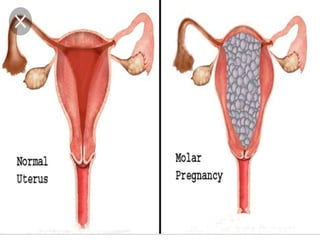
It is a rare mass growth that form insideIt is a rare mass growth that form inside
the womb (uterus)at the beginning of athe womb (uterus)at the beginning of a
pregnancy.pregnancy.
It is also known as molar pregnancy andIt is also known as molar pregnancy and
vesicular mole.vesicular mole.
DEFINITIONDEFINITION
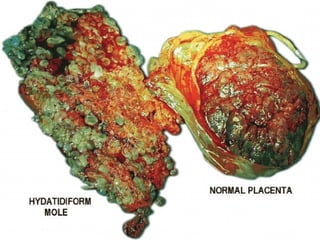
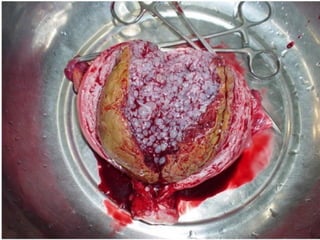
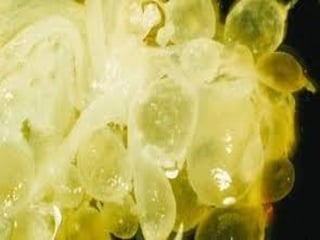
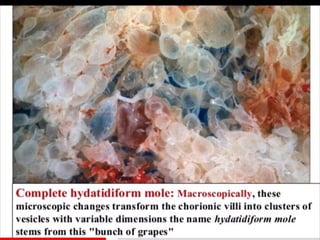
It is a abnormal condition of placenta whereIt is a abnormal condition of placenta where
there are partly degenerative andthere are partly degenerative and
proliferative changes in the chorionic villi andproliferative changes in the chorionic villi and
the result in the formation of cluster of smallthe result in the formation of cluster of small
cyst of varying size ( like bunch of grapescyst of varying size ( like bunch of grapes).).
INCIDENCEINCIDENCE
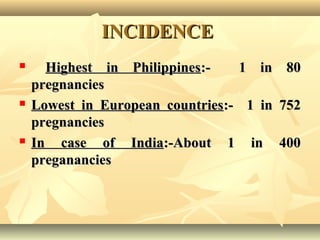
 Highest in PhilippinesHighest in Philippines:- 1 in 80:- 1 in 80
pregnanciespregnancies
 Lowest in European countriesLowest in European countries:- 1 in 752:- 1 in 752
pregnanciespregnancies
 In case of IndiaIn case of India:-About 1 in 400:-About 1 in 400
pregananciespreganancies
TYPESTYPES
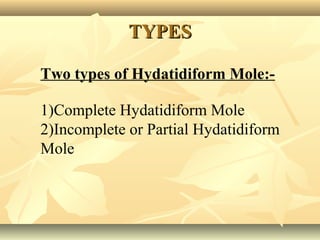
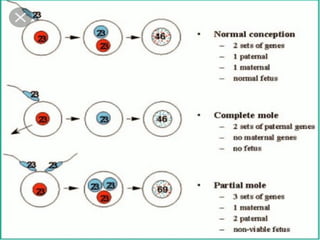
Two types of Hydatidiform Mole:-
1)Complete Hydatidiform Mole
2)Incomplete or Partial Hydatidiform
Mole
COMPLETE HYDATIDIFORMCOMPLETE HYDATIDIFORM
MOLEMOLE
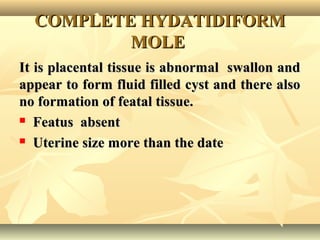
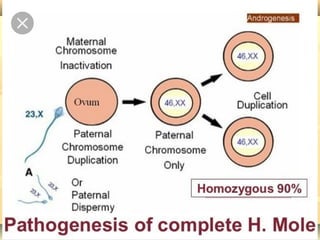
It is placental tissue is abnormal swallon andIt is placental tissue is abnormal swallon and
appear to form fluid filled cyst and there alsoappear to form fluid filled cyst and there also
no formation of featal tissue.no formation of featal tissue.
 Featus absentFeatus absent
 Uterine size more than the dateUterine size more than the date
PARTIAL HYDATIDIFORMPARTIAL HYDATIDIFORM
MOLEMOLE
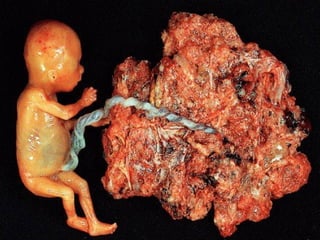
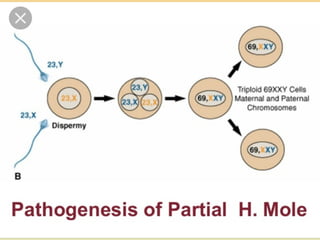
 May be normal placental tissue along withMay be normal placental tissue along with
abnormally forming placental tissue .abnormally forming placental tissue .
 There also be formation of a featus but theThere also be formation of a featus but the
featus is not able to survive.featus is not able to survive.
 Featus is present.Featus is present.
 Uterine size less than the date.Uterine size less than the date.
AETIOLOGYAETIOLOGY
1) Maternal age1) Maternal age
2 ) Previous molar pregnancy2 ) Previous molar pregnancy
3) Nutrition3) Nutrition
4) Cytogenic abnormality4) Cytogenic abnormality
SIGNS AND SYMPTOMSSIGNS AND SYMPTOMS
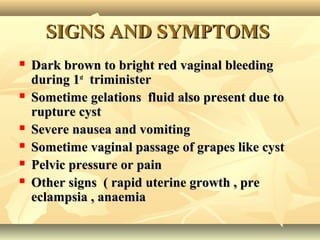
 Dark brown to bright red vaginal bleedingDark brown to bright red vaginal bleeding
during 1during 1stst
triministertriminister
 Sometime gelations fluid also present due toSometime gelations fluid also present due to
rupture cystrupture cyst
 Severe nausea and vomitingSevere nausea and vomiting
 Sometime vaginal passage of grapes like cystSometime vaginal passage of grapes like cyst
 Pelvic pressure or painPelvic pressure or pain
 Other signs ( rapid uterine growth , preOther signs ( rapid uterine growth , pre
eclampsia , anaemiaeclampsia , anaemia
DIAGNOSIS TESTDIAGNOSIS TEST
 History collection and physical examinationHistory collection and physical examination
 CBC , ABO , Rh groupingCBC , ABO , Rh grouping
 SonographySonography
 X- RayX- Ray
 Histological examinationHistological examination
 Urine testUrine test ( HCG value increase more then( HCG value increase more then
100,000 mIu / ml )100,000 mIu / ml )
 CT scan and MRI ( no recommended )CT scan and MRI ( no recommended )
MANAGEMENTMANAGEMENT
(A) SUPPORTIVE MANAGEMENT(A) SUPPORTIVE MANAGEMENT
 I V infusionI V infusion
 Blood transfusionBlood transfusion
 Antibiotics is givenAntibiotics is given
 Blood is kept reservedBlood is kept reserved
((B) DEFINITIVE MANAGEMENTB) DEFINITIVE MANAGEMENT
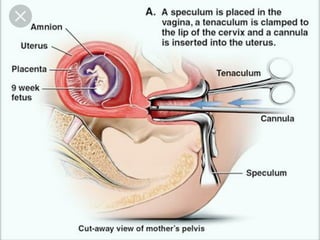
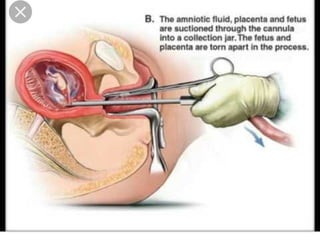
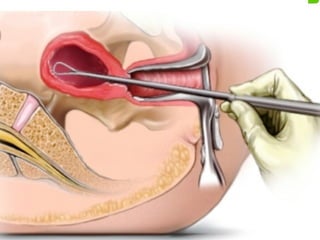
 Suction evacuation:-Suction evacuation:-
 IIt is safe rapid and effective in almost all casest is safe rapid and effective in almost all cases
and its done even when the uterus is of 28and its done even when the uterus is of 28thth
week gestation.week gestation.
 Cervix favourable or group aCervix favourable or group a ( mole is in process of( mole is in process of
expulsion )expulsion )

CCervix unfavourable or group bervix unfavourable or group b ( the uterus remains( the uterus remains
inert )inert )
2222
SUCTION EVACUATION
2323
MANAGEMENTMANAGEMENT
 HystectomyHystectomy
 Curttage following vaginalCurttage following vaginal
evacuationevacuation
2525
FOLLOW UPFOLLOW UP
1.1. Enquiry about relevant symptomEnquiry about relevant symptom
2.2. Abdominovaginal examinationAbdominovaginal examination
3.3. InvestigationInvestigation   
4.4. Contraceptive adviceContraceptive advice
COMPLICATIONSCOMPLICATIONS
 HaemorrhageHaemorrhage
 SepsisSepsis
 Perforate uterusPerforate uterus
 PrecalmsiaPrecalmsia
Thanking You!Thanking You!
2828

hydatidiform mole

  • 1.
    MITTAL COLLEGE OFNURSINGMITTAL COLLEGE OF NURSING Submitted to:-Submitted to:- Mrs. Snehlata ParasharMrs. Snehlata Parashar LECTURER , OBG. & GYC.LECTURER , OBG. & GYC. Submitted by:-Submitted by:- Mayuri Kachhot (B.Sc. Nursing 4Mayuri Kachhot (B.Sc. Nursing 4thth Year)Year) Presentation on HYDATIDIFORM MOLE
  • 2.
    INTRODUCTIONINTRODUCTION It is arare mass growth that form insideIt is a rare mass growth that form inside the womb (uterus)at the beginning of athe womb (uterus)at the beginning of a pregnancy.pregnancy. It is also known as molar pregnancy andIt is also known as molar pregnancy and vesicular mole.vesicular mole.
  • 4.
    DEFINITIONDEFINITION It is aabnormal condition of placenta whereIt is a abnormal condition of placenta where there are partly degenerative andthere are partly degenerative and proliferative changes in the chorionic villi andproliferative changes in the chorionic villi and the result in the formation of cluster of smallthe result in the formation of cluster of small cyst of varying size ( like bunch of grapescyst of varying size ( like bunch of grapes).).
  • 6.
    INCIDENCEINCIDENCE  Highest inPhilippinesHighest in Philippines:- 1 in 80:- 1 in 80 pregnanciespregnancies  Lowest in European countriesLowest in European countries:- 1 in 752:- 1 in 752 pregnanciespregnancies  In case of IndiaIn case of India:-About 1 in 400:-About 1 in 400 pregananciespreganancies
  • 7.
    TYPESTYPES Two types ofHydatidiform Mole:- 1)Complete Hydatidiform Mole 2)Incomplete or Partial Hydatidiform Mole
  • 8.
    COMPLETE HYDATIDIFORMCOMPLETE HYDATIDIFORM MOLEMOLE Itis placental tissue is abnormal swallon andIt is placental tissue is abnormal swallon and appear to form fluid filled cyst and there alsoappear to form fluid filled cyst and there also no formation of featal tissue.no formation of featal tissue.  Featus absentFeatus absent  Uterine size more than the dateUterine size more than the date
  • 10.
    PARTIAL HYDATIDIFORMPARTIAL HYDATIDIFORM MOLEMOLE May be normal placental tissue along withMay be normal placental tissue along with abnormally forming placental tissue .abnormally forming placental tissue .  There also be formation of a featus but theThere also be formation of a featus but the featus is not able to survive.featus is not able to survive.  Featus is present.Featus is present.  Uterine size less than the date.Uterine size less than the date.
  • 12.
    AETIOLOGYAETIOLOGY 1) Maternal age1)Maternal age 2 ) Previous molar pregnancy2 ) Previous molar pregnancy 3) Nutrition3) Nutrition 4) Cytogenic abnormality4) Cytogenic abnormality
  • 16.
    SIGNS AND SYMPTOMSSIGNSAND SYMPTOMS  Dark brown to bright red vaginal bleedingDark brown to bright red vaginal bleeding during 1during 1stst triministertriminister  Sometime gelations fluid also present due toSometime gelations fluid also present due to rupture cystrupture cyst  Severe nausea and vomitingSevere nausea and vomiting  Sometime vaginal passage of grapes like cystSometime vaginal passage of grapes like cyst  Pelvic pressure or painPelvic pressure or pain  Other signs ( rapid uterine growth , preOther signs ( rapid uterine growth , pre eclampsia , anaemiaeclampsia , anaemia
  • 18.
    DIAGNOSIS TESTDIAGNOSIS TEST History collection and physical examinationHistory collection and physical examination  CBC , ABO , Rh groupingCBC , ABO , Rh grouping  SonographySonography  X- RayX- Ray  Histological examinationHistological examination  Urine testUrine test ( HCG value increase more then( HCG value increase more then 100,000 mIu / ml )100,000 mIu / ml )  CT scan and MRI ( no recommended )CT scan and MRI ( no recommended )
  • 20.
    MANAGEMENTMANAGEMENT (A) SUPPORTIVE MANAGEMENT(A)SUPPORTIVE MANAGEMENT  I V infusionI V infusion  Blood transfusionBlood transfusion  Antibiotics is givenAntibiotics is given  Blood is kept reservedBlood is kept reserved
  • 21.
    ((B) DEFINITIVE MANAGEMENTB)DEFINITIVE MANAGEMENT  Suction evacuation:-Suction evacuation:-  IIt is safe rapid and effective in almost all casest is safe rapid and effective in almost all cases and its done even when the uterus is of 28and its done even when the uterus is of 28thth week gestation.week gestation.  Cervix favourable or group aCervix favourable or group a ( mole is in process of( mole is in process of expulsion )expulsion )  CCervix unfavourable or group bervix unfavourable or group b ( the uterus remains( the uterus remains inert )inert )
  • 22.
  • 23.
  • 24.
    MANAGEMENTMANAGEMENT  HystectomyHystectomy  Curttagefollowing vaginalCurttage following vaginal evacuationevacuation
  • 25.
  • 26.
    FOLLOW UPFOLLOW UP 1.1.Enquiry about relevant symptomEnquiry about relevant symptom 2.2. Abdominovaginal examinationAbdominovaginal examination 3.3. InvestigationInvestigation    4.4. Contraceptive adviceContraceptive advice
  • 27.
    COMPLICATIONSCOMPLICATIONS  HaemorrhageHaemorrhage  SepsisSepsis Perforate uterusPerforate uterus  PrecalmsiaPrecalmsia
  • 28.