PRE-TERM, SMALL FOR
GESTATIONAL AGE, POST-
MATURE INFANT
PRESENTED BY
LIPI MONDAL
M.SC NURSING 2ND YEAR STUDENT
TERMINOLOGIES
 Preterm infant: It is defined as one when birth occurs before
completion of 37 weeks menstrual weeks of gestation
regardless of birth weight.
 Small for gestational age: Birth weight less than 10th
percentile for gestational age.
 Appropriate for gestational age: Birth weight lies between the
10th and 90th percentile for gestational age.
 Large for gestational age: Infant’s birth weight above the 90th
percentile for gestational age.
CONTD….
 Low birth weight infant: is defined as one whose
birth weight is less than 2500g irrespective of the
gestaional age.
 Very low birth weight infants weighs 1500g or less
 Extremely low birth weight infants weighs 1000g or
less.
PRE-TERM BABY
ETIOLOGY
1. HISTORY:
 Previous history of induced or spontaneous abortion or
preterm delivery.
 Pregnancy following assisted reproductive techniques
(ART)
 Asymptomatic bacteriuria or recurrent urinary tract
infection
 Smoking habits
 Low socio-economic and nutritional status
 Maternal stress
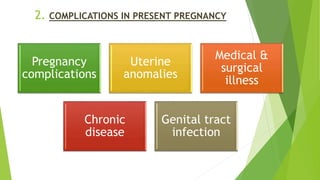
2. COMPLICATIONS IN PRESENT PREGNANCY
Pregnancy
complications
Uterine
anomalies
Medical &
surgical
illness
Chronic
disease
Genital tract
infection
CLINICAL SIGNS OF PREMATURITY
 Baby weighs 2500g or less and length less than 44cm.
 Head and abdomen are relatively large, the skull bones
are soft with wide sutures and posterior fontanelle.
 The head circumference disproportionately exceeds that
of the chest.
 Pinnae of ears are soft flat.
 The eyes are kept closed.
 The skin is thin, red and shiny and also covered by
plentiful lanugo and vernix caseosa.
 Muscle tone is poor.
CONTD…
 Plantar deep creases are not visible before 34
weeks.
 Testicles are undescended.
 Labia minora exposed because majora are not
in contact.
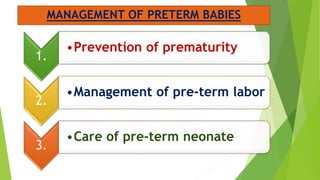
MANAGEMENT OF PRETERM BABIES
1.
•Prevention of prematurity
2.
•Management of pre-term labor
3.
•Care of pre-term neonate
PRINCIPLES OF MANAGEMENT OF WOMEN WITH
PRETERM LABOR
 Glucocorticoids to the mother to reduce neonatal RDS, IVH, NEC, BPD and
PDA.
 Antenatal transfer of the mother with fetus in utero to a tertiary center
equipped with NICU.
 Tocolytic drugs to the mother for a short period unless contraindicated.
 Antibiotics to prevent neonatal infection with Group B Streptococcus (GBS).
 Magnesium sulfate (neuroprotector) to the mother to reduce neonatal
cerebral palsy when pregnancy is <34 weeks.
 Careful intrapartum monitoring, minimal trauma and presence of a
neonatologist during delivery.
 Vaginal delivery is preferred, unless otherwise indicated for cesarean birth.
IMMEDIATE MANAGEMENT FOLLOWING BIRTH
 The cord is to be clamped quickly to prevent hypervolemia and development of
hyperbilirubinemia.
 The cord length is kept long (about 10–12 cm) in case exchange transfusion is
required.
 The air passage should be cleared of mucus promptly and gently using a mucus
sucker.
 Adequate oxygenation through mask or nasal catheter in concentration not
exceeding 35%.
 The baby should be wrapped including head in a sterile warm towel (normal
temperature 36.5–37.5°C). Hypothermia and its sequelae: Hypoxia →
Hypoglycemia → Anaerobic metabolism → Metabolic acidosis.
 Aqueous solution of vitamin K 1 mg is to be injected intramuscularly to prevent
hemorrhagic manifestations.
INTENSIVE CARE PROTOCOL
 The principles that are to be taken for the babies requiring special care
are:
 To maintain a relatively stable thermo-neutral condition—keep delivery room
warm, dry and then wrap the baby with a warm towel, keep the baby with
mother—skin-to-skin contact.
 Adequate humidification to counter balance increased insensible water loss.
 Oxygen therapy and adequate ventilation.
 To prevent infection.
 To maintain nutrition and adequate nursing care.
RESPIRATORY SUPPORT
 The baby is placed in the incubator with oxygen running, alternatively
baby’s head is kept in an oxygen head box for prolonged oxygen therapy.
 Some of the neonates may initially require endotracheal intubation and
mechanical ventilation. Others may need CPAP or high flow nasal cannula
(HFNC).
 Ventilatory status is monitored by blood gas sampling at regular intervals.
Continuous oxygen monitoring is done by pulse oximeter.
 Desirable level of arterial blood gas values should be (i) PaO2 55–65 mm
Hg (ii) PaCO2 35–45 mm Hg and (iii) pH 7.35–7.45 and pulse oximeter
reading should be 90–92% oxygen saturation. Surfactant replacement
therapy is indicated in HMD.
SMALL FOR
GESTATIONAL AGE
DEFINITION
 Small for gestational age is a term used to
describe a baby who is smaller than the usual
amount for the number of weeks of pregnancy.
They have birth weights below the 10th percentile
for babies of the same gestational age.
CAUSES
 MATERNAL FACTORS:
 High blood pressure
 Chronic kidney disease
 Advanced diabetes
 Heart or respiratory disease
 Malnutrition, anemia
 Infection
 Substance use (alcohol, drugs)
 Cigarette smoking
CONTD….
 FACTORS INVOLVING THE UTERUS AND PLACENTA:
 Decreased blood flow in the uterus and placenta
 Placental abruption (placenta detaches from the uterus)
 Placenta previa (placenta attaches low in the uterus)
 Infection in the tissues around the fetus
 FACTORS RELATED TO THE DEVELOPING BABY (FETUS):
 Multiple gestation (for example, twins or triplets)
 Infection
 Birth defects
 Chromosomal abnormality
PROBLEMS FACED BY SGA BABIES
 Babies with SGA and/or IUGR may have problems at birth including
the following:
 Decreased oxygen levels
 Low Apgar score (an assessment that helps identify babies with
difficult adapting after delivery)
 Meconium aspiration (inhalation of the first stools passed in utero)
which can lead to difficulty breathing
 Hypoglycemia (low blood sugar)
 Difficulty maintaining normal body temperature
 Polycythemia (too many red blood cells)
TREATMENT OF BABIES
 Specific treatment for SGA are based on:
 baby’s gestational age, overall health and medical history.
 Extend of the condition
 Tolerance of medications, procedures or therapies.
 Expectations for the course of the condition.
 Treatment of the SGA baby may include:
 Temperature controlled beds or incubators
 Tube feedings (if the baby does not have a strong suck)
 Checking for hypoglycemia (low blood sugar) through blood tests
 Monitoring of oxygen levels
PREVENTION OF SGA
 Prenatal care is important in all pregnancies, and especially to
identify problems with fetal growth.
 Stopping smoking and use of substances such as drugs and alcohol
are essential to a healthy pregnancy and can reduce the risk for
sudden infant death syndrome (SIDS) and other sleep-related infant
deaths.
 Eating a healthy diet in pregnancy may also help.
 Early identification of health problems in mother that affect the
fetal growth ex. PIH, Placenta abnormalities etc.
POST-MATURE INFANT
INTRODUCTION
 The new born baby is considered post-term if a
pregnancy goes beyond 42 weeks.
 The causes of postmaturity of pregnancy is
unknown. It is associated with placental
insufficiency.
 The mortality rate of the newborn who is delivered
after 42 weeks gestation is higher than that of
newborn delivered in term.
CHARACTERISTICS OF A POSTTERM INFANT
 Thin, emaciated appearance (dysmature), with little
subcutaneous fat
 Meconium-stained finger nail.
 Long hair and nails
 Absence of vernix.
 Peeling skin
 Weight is low in relation to the length.
MANAGEMENT
 General supportive care is provided.
 Maintanence of temperature
 They are at risk of hypogycemia so glucose monitoring should
be done regularly.
 Respiratory support by high frequency ventilation, supportive
therapies and inhaled nitric oxide or other pulmonary
vasodilators.
JOURNAL ARTICLE
 “Complications associated with premature birth.”
 Tara M. Randis. C had discussed about the complication of preterm
infants,
 Respiratory distress syndrome, this result from insufficient surfactant
production by the immature lung, leading to decreased lung compliance
and inadequate gas exchange.
 Sepsis is a inflammatory response, often uncontrolled, resulting from
infection, such as bacterial infection with staphylococcus or
streptococcus or a blood stream infection with gram negative bacteria.
 Necrotizingentrocolits: The most serious gastrointestinal complication
affecting preterm infants is nectrotizingenterocolitis.Immaturity of the
gastrointestinal mucosa results in compromised barrier functions, immune
defence and abnormal motility, this leads to bacteril colonization and
ischemic insult are all theorized to contribute to the development of
NEC.
CONTD…
 Intraventricular haemorrhage and periventricular leukomalacia,
This refered to bleeding within the ventricles of the brain which
in severe cases may extend into the surrounding parenchyma.
 Retinaopathy of prematurity, this is major causes of severe
visual impairment or blindness in infants born prematurity. The
disease is characterized by abnormal vascular proliferation in
the immature retina, likely due to the presence of increased
local reactive oxygen species and angiogenic growth factors.
Pre-term, Small for gestational age and Post-term Infant

Pre-term, Small for gestational age and Post-term Infant

  • 1.
    PRE-TERM, SMALL FOR GESTATIONALAGE, POST- MATURE INFANT PRESENTED BY LIPI MONDAL M.SC NURSING 2ND YEAR STUDENT
  • 2.
    TERMINOLOGIES  Preterm infant:It is defined as one when birth occurs before completion of 37 weeks menstrual weeks of gestation regardless of birth weight.  Small for gestational age: Birth weight less than 10th percentile for gestational age.  Appropriate for gestational age: Birth weight lies between the 10th and 90th percentile for gestational age.  Large for gestational age: Infant’s birth weight above the 90th percentile for gestational age.
  • 3.
    CONTD….  Low birthweight infant: is defined as one whose birth weight is less than 2500g irrespective of the gestaional age.  Very low birth weight infants weighs 1500g or less  Extremely low birth weight infants weighs 1000g or less.
  • 4.
  • 5.
    ETIOLOGY 1. HISTORY:  Previoushistory of induced or spontaneous abortion or preterm delivery.  Pregnancy following assisted reproductive techniques (ART)  Asymptomatic bacteriuria or recurrent urinary tract infection  Smoking habits  Low socio-economic and nutritional status  Maternal stress
  • 6.
    2. COMPLICATIONS INPRESENT PREGNANCY Pregnancy complications Uterine anomalies Medical & surgical illness Chronic disease Genital tract infection
  • 7.
    CLINICAL SIGNS OFPREMATURITY  Baby weighs 2500g or less and length less than 44cm.  Head and abdomen are relatively large, the skull bones are soft with wide sutures and posterior fontanelle.  The head circumference disproportionately exceeds that of the chest.  Pinnae of ears are soft flat.  The eyes are kept closed.  The skin is thin, red and shiny and also covered by plentiful lanugo and vernix caseosa.  Muscle tone is poor.
  • 8.
    CONTD…  Plantar deepcreases are not visible before 34 weeks.  Testicles are undescended.  Labia minora exposed because majora are not in contact.
  • 9.
    MANAGEMENT OF PRETERMBABIES 1. •Prevention of prematurity 2. •Management of pre-term labor 3. •Care of pre-term neonate
  • 10.
    PRINCIPLES OF MANAGEMENTOF WOMEN WITH PRETERM LABOR  Glucocorticoids to the mother to reduce neonatal RDS, IVH, NEC, BPD and PDA.  Antenatal transfer of the mother with fetus in utero to a tertiary center equipped with NICU.  Tocolytic drugs to the mother for a short period unless contraindicated.  Antibiotics to prevent neonatal infection with Group B Streptococcus (GBS).  Magnesium sulfate (neuroprotector) to the mother to reduce neonatal cerebral palsy when pregnancy is <34 weeks.  Careful intrapartum monitoring, minimal trauma and presence of a neonatologist during delivery.  Vaginal delivery is preferred, unless otherwise indicated for cesarean birth.
  • 11.
    IMMEDIATE MANAGEMENT FOLLOWINGBIRTH  The cord is to be clamped quickly to prevent hypervolemia and development of hyperbilirubinemia.  The cord length is kept long (about 10–12 cm) in case exchange transfusion is required.  The air passage should be cleared of mucus promptly and gently using a mucus sucker.  Adequate oxygenation through mask or nasal catheter in concentration not exceeding 35%.  The baby should be wrapped including head in a sterile warm towel (normal temperature 36.5–37.5°C). Hypothermia and its sequelae: Hypoxia → Hypoglycemia → Anaerobic metabolism → Metabolic acidosis.  Aqueous solution of vitamin K 1 mg is to be injected intramuscularly to prevent hemorrhagic manifestations.
  • 12.
    INTENSIVE CARE PROTOCOL The principles that are to be taken for the babies requiring special care are:  To maintain a relatively stable thermo-neutral condition—keep delivery room warm, dry and then wrap the baby with a warm towel, keep the baby with mother—skin-to-skin contact.  Adequate humidification to counter balance increased insensible water loss.  Oxygen therapy and adequate ventilation.  To prevent infection.  To maintain nutrition and adequate nursing care.
  • 13.
    RESPIRATORY SUPPORT  Thebaby is placed in the incubator with oxygen running, alternatively baby’s head is kept in an oxygen head box for prolonged oxygen therapy.  Some of the neonates may initially require endotracheal intubation and mechanical ventilation. Others may need CPAP or high flow nasal cannula (HFNC).  Ventilatory status is monitored by blood gas sampling at regular intervals. Continuous oxygen monitoring is done by pulse oximeter.  Desirable level of arterial blood gas values should be (i) PaO2 55–65 mm Hg (ii) PaCO2 35–45 mm Hg and (iii) pH 7.35–7.45 and pulse oximeter reading should be 90–92% oxygen saturation. Surfactant replacement therapy is indicated in HMD.
  • 14.
  • 15.
    DEFINITION  Small forgestational age is a term used to describe a baby who is smaller than the usual amount for the number of weeks of pregnancy. They have birth weights below the 10th percentile for babies of the same gestational age.
  • 16.
    CAUSES  MATERNAL FACTORS: High blood pressure  Chronic kidney disease  Advanced diabetes  Heart or respiratory disease  Malnutrition, anemia  Infection  Substance use (alcohol, drugs)  Cigarette smoking
  • 17.
    CONTD….  FACTORS INVOLVINGTHE UTERUS AND PLACENTA:  Decreased blood flow in the uterus and placenta  Placental abruption (placenta detaches from the uterus)  Placenta previa (placenta attaches low in the uterus)  Infection in the tissues around the fetus  FACTORS RELATED TO THE DEVELOPING BABY (FETUS):  Multiple gestation (for example, twins or triplets)  Infection  Birth defects  Chromosomal abnormality
  • 18.
    PROBLEMS FACED BYSGA BABIES  Babies with SGA and/or IUGR may have problems at birth including the following:  Decreased oxygen levels  Low Apgar score (an assessment that helps identify babies with difficult adapting after delivery)  Meconium aspiration (inhalation of the first stools passed in utero) which can lead to difficulty breathing  Hypoglycemia (low blood sugar)  Difficulty maintaining normal body temperature  Polycythemia (too many red blood cells)
  • 19.
    TREATMENT OF BABIES Specific treatment for SGA are based on:  baby’s gestational age, overall health and medical history.  Extend of the condition  Tolerance of medications, procedures or therapies.  Expectations for the course of the condition.  Treatment of the SGA baby may include:  Temperature controlled beds or incubators  Tube feedings (if the baby does not have a strong suck)  Checking for hypoglycemia (low blood sugar) through blood tests  Monitoring of oxygen levels
  • 20.
    PREVENTION OF SGA Prenatal care is important in all pregnancies, and especially to identify problems with fetal growth.  Stopping smoking and use of substances such as drugs and alcohol are essential to a healthy pregnancy and can reduce the risk for sudden infant death syndrome (SIDS) and other sleep-related infant deaths.  Eating a healthy diet in pregnancy may also help.  Early identification of health problems in mother that affect the fetal growth ex. PIH, Placenta abnormalities etc.
  • 21.
  • 22.
    INTRODUCTION  The newborn baby is considered post-term if a pregnancy goes beyond 42 weeks.  The causes of postmaturity of pregnancy is unknown. It is associated with placental insufficiency.  The mortality rate of the newborn who is delivered after 42 weeks gestation is higher than that of newborn delivered in term.
  • 23.
    CHARACTERISTICS OF APOSTTERM INFANT  Thin, emaciated appearance (dysmature), with little subcutaneous fat  Meconium-stained finger nail.  Long hair and nails  Absence of vernix.  Peeling skin  Weight is low in relation to the length.
  • 24.
    MANAGEMENT  General supportivecare is provided.  Maintanence of temperature  They are at risk of hypogycemia so glucose monitoring should be done regularly.  Respiratory support by high frequency ventilation, supportive therapies and inhaled nitric oxide or other pulmonary vasodilators.
  • 25.
    JOURNAL ARTICLE  “Complicationsassociated with premature birth.”  Tara M. Randis. C had discussed about the complication of preterm infants,  Respiratory distress syndrome, this result from insufficient surfactant production by the immature lung, leading to decreased lung compliance and inadequate gas exchange.  Sepsis is a inflammatory response, often uncontrolled, resulting from infection, such as bacterial infection with staphylococcus or streptococcus or a blood stream infection with gram negative bacteria.  Necrotizingentrocolits: The most serious gastrointestinal complication affecting preterm infants is nectrotizingenterocolitis.Immaturity of the gastrointestinal mucosa results in compromised barrier functions, immune defence and abnormal motility, this leads to bacteril colonization and ischemic insult are all theorized to contribute to the development of NEC.
  • 26.
    CONTD…  Intraventricular haemorrhageand periventricular leukomalacia, This refered to bleeding within the ventricles of the brain which in severe cases may extend into the surrounding parenchyma.  Retinaopathy of prematurity, this is major causes of severe visual impairment or blindness in infants born prematurity. The disease is characterized by abnormal vascular proliferation in the immature retina, likely due to the presence of increased local reactive oxygen species and angiogenic growth factors.