Sanjivani College of Engineering Kopargaon
Department of Mechanical Engineering
-----------------------------------------------------------------------
Class: SY Subject: Numerical Methods
About Numerical Methods (NMs)
 Analytical methods are the most difficult ones, providing
exact solutions, but they become hard to use for complex
problems in practical engineering applications.
 In such cases Numerical methods are important to give
approximate solutions by satisfying certain accuracy.
 NMs use arithmetic operators to solve engineering based
mathematical problems.
 So Engineers must acquire a working knowledge of NMs
and also efficient programming skill for real life
applications.
Steps in NMs
1. Selection of proper NM
2. Algorithm ( Procedural steps)
3. Flowchart ( Graphical representation of procedural steps)
4. Programming (MatLAB)
5. Execution of Program
D.P.Bhaskar
Dept of Mech Engg
Unit 1 Roots of Equation
Polynomial Equation: Function, f x 3x2 9 0 f x 3x2 4x‐8 0 etc.
Transcendental equation. Function, f x 3x2 sin x ex 0
If x contains trigonometric, logarithmic or exponential functions, then 0 is called a
transcendental equation.
Root of Equations:
 Function, f x 3x2 sin x ex 0
 Root of equation means finding value of x to satisfy f x 0.
 It means f x value will be zero for certain x. That is also called as zero of equation.
Numerical Methods to compute Root of Equations:
 Bisection Method Half interval Search Method
 Newton Raphson Method Tangent Method
Bisection Method
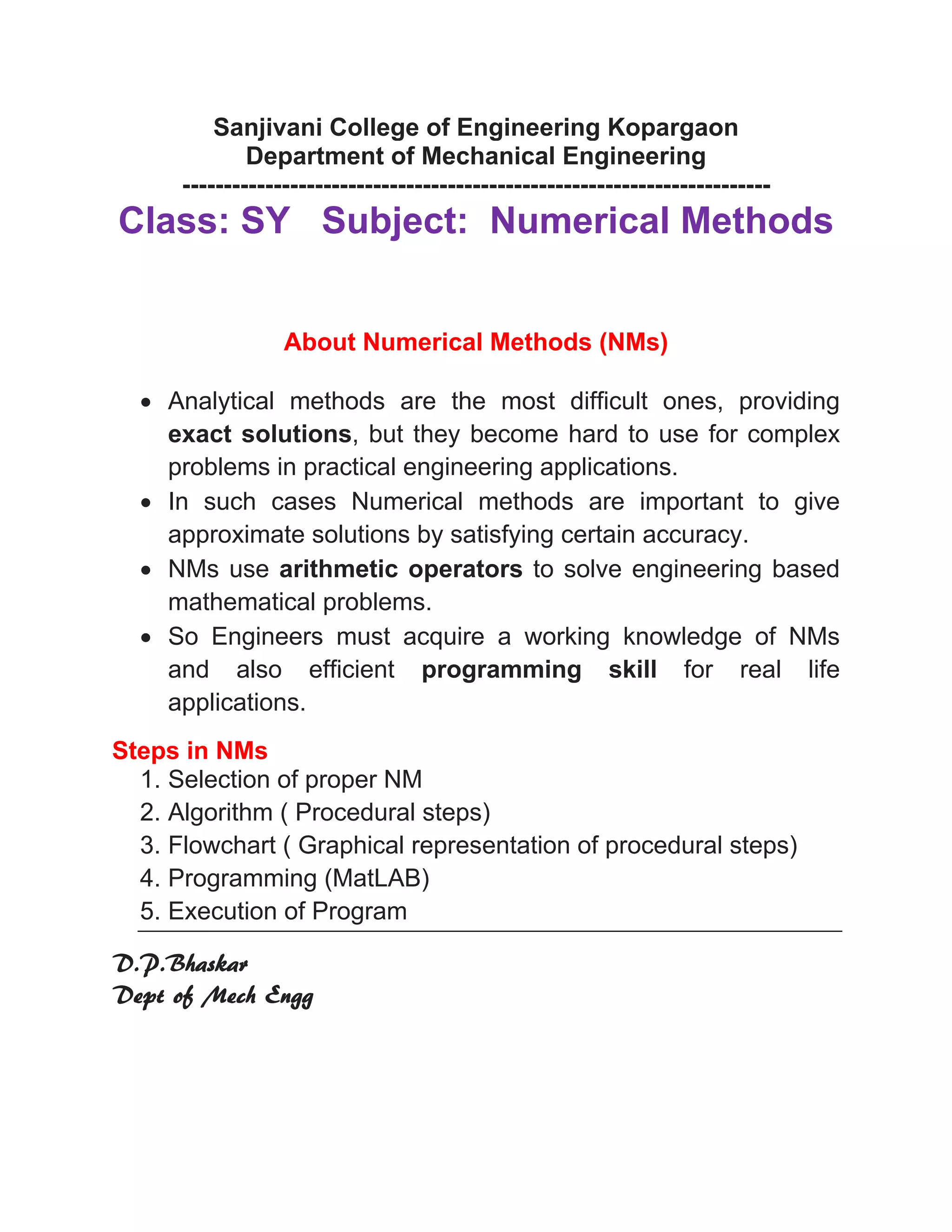
The bisection method is a root‐finding method that applies to any continuous function for
which one knows two values with opposite signs. The method consists of
repeatedly bisecting the interval defined by these values and then selecting the subinterval in
which the function changes sign, and therefore must contain a root.
Steps in Bisection Method
Step1 Initial Guesses X1 & X2 such a that f X1 & f X2 must be of opposite sign.
Step2 Root: X3 X1 X2 /2
Step3 Iterate this Root till Acc is achieved.
If |x1-x2 | X3 is final root Stop Break
Else if f X1 * f X3 is ve X1 ←X3
f X1 * f X3 is ‐ ve X2 ←X3
Step 2 and Iterate …..
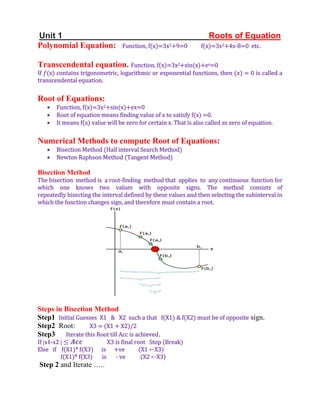
Q1 Find the root of f x x2 ‐ 3. By Bisection Method Let Acc 0.01.
Solution
Initial Guesses
X1 1 f X1 ‐2
X2 2 f X2 1 Are of opposite sign.
Result Table
Procedure:
If |x1-x2 | X3 is final root Stop
Else if f X1 * f X3 is ve X1 ←X3
f X1 * f X3 is ‐ ve X2 ←X3
----------------------------------------------------------------------------------------------------
I x1 x2 x3 |x1‐x2 | f x1 *f x3
---------------------------------------------------------------------------------------------------
1 1. 2. 1.5 1. 1.5
2 1.5 2. 1.75 0.5 ‐0.04
3 1.5 1.75 1.625 0.25 0.2
4 1.625 1.75 1.6875 0.125 0.05
5 1.6875 1.75 1.7188 0.0625 0.007
6 1.7188 1.75 1.7344 0.0312 ‐0.0004
7 1.7188 1.7344 1.7266 0.0156 0.0009
8 1.7266 1.7344 1.7305 0.0078 0.0001
------------------------------------------------------------------------------------------------------
As |x1-x2 | .
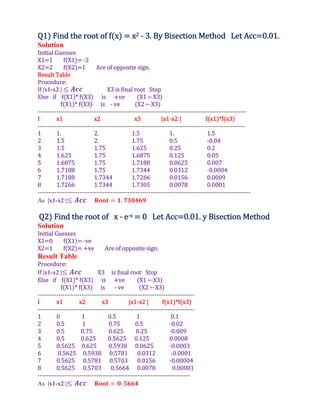
Q2 Find the root of x ‐ e‐x 0 Let Acc 0.01. y Bisection Method
Solution
Initial Guesses
X1 0 f X1 ‐ve
X2 1 f X2 ve Are of opposite sign.
Result Table
Procedure:
If |x1-x2 | X3 is final root Stop
Else if f X1 * f X3 is ve X1 ←X3
f X1 * f X3 is ‐ ve X2 ←X3
---------------------------------------------------------------------------
I x1 x2 x3 |x1‐x2 | f x1 *f x3
---------------------------------------------------------------------------
1 0 1 0.5 1 0.1
2 0.5 1 0.75 0.5 ‐0.02
3 0.5 0.75 0.625 0.25 ‐0.009
4 0.5 0.625 0.5625 0.125 0.0008
5 0.5625 0.625 0.5938 0.0625 ‐0.0003
6 0.5625 0.5938 0.5781 0.0312 ‐0.0001
7 0.5625 0.5781 0.5703 0.0156 ‐0.00004
8 0.5625 0.5703 0.5664 0.0078 0.00001
-------------------------------------------------------------------------
As |x1-x2 | .
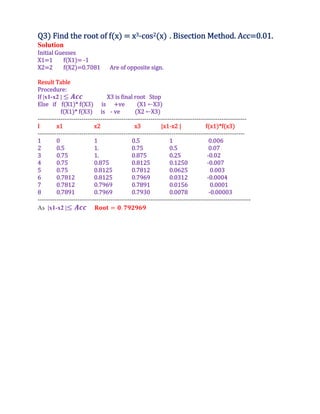
Q3 Find the root of f x x3‐cos2 x . Bisection Method. Acc 0.01.
Solution
Initial Guesses
X1 1 f X1 ‐1
X2 2 f X2 0.7081 Are of opposite sign.
Result Table
Procedure:
If |x1-x2 | X3 is final root Stop
Else if f X1 * f X3 is ve X1 ←X3
f X1 * f X3 is ‐ ve X2 ←X3
----------------------------------------------------------------------------------------------------
I x1 x2 x3 |x1‐x2 | f x1 *f x3
---------------------------------------------------------------------------------------------------
1 0 1 0.5 1 0.006
2 0.5 1. 0.75 0.5 0.07
3 0.75 1. 0.875 0.25 ‐0.02
4 0.75 0.875 0.8125 0.1250 ‐0.007
5 0.75 0.8125 0.7812 0.0625 0.003
6 0.7812 0.8125 0.7969 0.0312 ‐0.0004
7 0.7812 0.7969 0.7891 0.0156 0.0001
8 0.7891 0.7969 0.7930 0.0078 ‐0.00003
------------------------------------------------------------------------------------------------------
As |x1-x2 | .
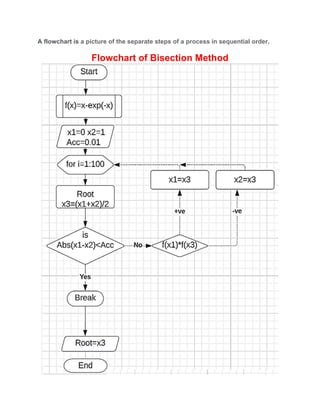
A flowchart is a picture of the separate steps of a process in sequential order.
Flowchart of Bisection Method
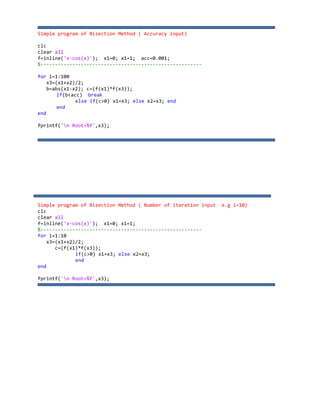
Simple program of Bisection Method ( Accuracy input)
clc
clear all
f=inline('x‐cos(x)'); x1=0; x1=1; acc=0.001;
%‐‐‐‐‐‐‐‐‐‐‐‐‐‐‐‐‐‐‐‐‐‐‐‐‐‐‐‐‐‐‐‐‐‐‐‐‐‐‐‐‐‐‐‐‐‐‐‐‐‐‐‐‐‐‐‐
for i=1:100
x3=(x1+x2)/2;
b=abs(x1‐x2); c=(f(x1)*f(x3));
if(b<acc) break
else if(c>0) x1=x3; else x2=x3; end
end
end
fprintf('n Root=%f',x3);
Simple program of Bisection Method ( Number of iteration input e.g i=10)
clc
clear all
f=inline('x‐cos(x)'); x1=0; x1=1;
%‐‐‐‐‐‐‐‐‐‐‐‐‐‐‐‐‐‐‐‐‐‐‐‐‐‐‐‐‐‐‐‐‐‐‐‐‐‐‐‐‐‐‐‐‐‐‐‐‐‐‐‐‐‐‐‐
for i=1:10
x3=(x1+x2)/2;
c=(f(x1)*f(x3));
if(c>0) x1=x3; else x2=x3;
end
end
fprintf('n Root=%f',x3);
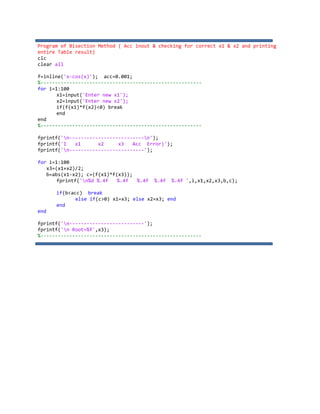
Program of Bisection Method ( Acc inout & checking for correct x1 & x2 and printing
entire Table result)
clc
clear all
f=inline('x‐cos(x)'); acc=0.001;
%‐‐‐‐‐‐‐‐‐‐‐‐‐‐‐‐‐‐‐‐‐‐‐‐‐‐‐‐‐‐‐‐‐‐‐‐‐‐‐‐‐‐‐‐‐‐‐‐‐‐‐‐‐‐‐‐
for i=1:100
x1=input('Enter new x1');
x2=input('Enter new x2');
if(f(x1)*f(x2)<0) break
end
end
%‐‐‐‐‐‐‐‐‐‐‐‐‐‐‐‐‐‐‐‐‐‐‐‐‐‐‐‐‐‐‐‐‐‐‐‐‐‐‐‐‐‐‐‐‐‐‐‐‐‐‐‐‐‐‐‐
fprintf('n‐‐‐‐‐‐‐‐‐‐‐‐‐‐‐‐‐‐‐‐‐‐‐‐‐‐n');
fprintf('I x1 x2 x3 Acc Error)');
fprintf('n‐‐‐‐‐‐‐‐‐‐‐‐‐‐‐‐‐‐‐‐‐‐‐‐‐‐');
for i=1:100
x3=(x1+x2)/2;
b=abs(x1‐x2); c=(f(x1)*f(x3));
fprintf('n%d %.4f %.4f %.4f %.4f %.4f ',i,x1,x2,x3,b,c);
if(b<acc) break
else if(c>0) x1=x3; else x2=x3; end
end
end
fprintf('n‐‐‐‐‐‐‐‐‐‐‐‐‐‐‐‐‐‐‐‐‐‐‐‐‐‐');
fprintf('n Root=%f',x3);
%‐‐‐‐‐‐‐‐‐‐‐‐‐‐‐‐‐‐‐‐‐‐‐‐‐‐‐‐‐‐‐‐‐‐‐‐‐‐‐‐‐‐‐‐‐‐‐‐‐‐‐‐‐‐‐‐
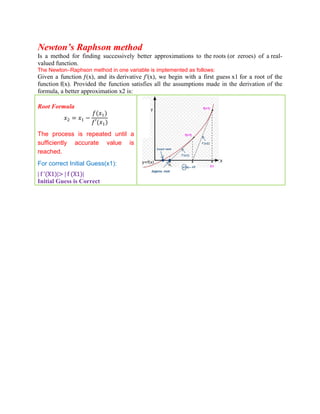
Newton’s Raphson method
Is a method for finding successively better approximations to the roots (or zeroes) of a real-
valued function.
The Newton–Raphson method in one variable is implemented as follows:
Given a function ƒ(x), and its derivative ƒ'(x), we begin with a first guess x1 for a root of the
function f(x). Provided the function satisfies all the assumptions made in the derivation of the
formula, a better approximation x2 is:
Root Formula
′
The process is repeated until a
sufficiently accurate value is
reached.
For correct Initial Guess(x1):
| f ’ X1 | | f X1 |
Initial Guess is Correct
Q1 Find the root of f x excos x ‐1.2 . Newton Raphson Method.
Acc 0.001.
Given
f x excos x ‐1.2 Function
f ’ x ex cos x ‐sin x Tangent or Slope or Derivative
Solution
Initial Guess
X1 1 And | f X1 | 0.2687 | f ’ X1 | 0.8187
Since | f ’ X1 | | f X1 | Initial Guess is Correct
Step 1 Root
′
Step2 If |x1-x2 | X2 is final root Stop
Else X1 ←X2 and goto Step 1
Result table
‐‐‐‐‐‐‐‐‐‐‐‐‐‐‐‐‐‐‐‐‐‐‐‐‐‐‐‐‐‐‐‐‐‐‐‐‐‐‐‐‐‐‐‐‐‐‐‐‐‐‐‐‐‐‐‐‐‐‐‐‐‐‐‐‐‐‐‐‐‐‐‐‐‐‐‐‐‐‐‐‐‐‐‐‐‐‐‐‐‐‐‐‐‐
I x1 f x1 fd x1 x2 |x1‐x2 |
‐‐‐‐‐‐‐‐‐‐‐‐‐‐‐‐‐‐‐‐‐‐‐‐‐‐‐‐‐‐‐‐‐‐‐‐‐‐‐‐‐‐‐‐‐‐‐‐‐‐‐‐‐‐‐‐‐‐‐‐‐‐‐‐‐‐‐‐‐‐‐‐‐‐‐‐‐‐‐‐‐‐‐‐‐‐‐‐‐‐‐‐‐‐
1 1. 0.2687 ‐0.8187 1.3282 0.3282
2 1.3282 ‐0.2934 ‐2.7571 1.2218 0.1064
3 1.2218 ‐0.0397 ‐2.0284 1.2023 0.0196
4 1.2023 ‐0.0012 ‐1.9054 1.2016 0.0006
‐‐‐‐‐‐‐‐‐‐‐‐‐‐‐‐‐‐‐‐‐‐‐‐‐‐‐‐‐‐‐‐‐‐‐‐‐‐‐‐‐‐‐‐‐‐‐‐‐‐‐‐‐‐‐‐‐‐‐‐‐‐‐‐‐‐‐‐‐‐‐‐‐‐‐‐‐‐‐‐‐‐‐‐‐‐‐‐‐‐‐‐‐‐
As |x1-x2 | .
Q1* Find the root of f x excos x ‐1.2 . Newton Raphson Method.
Acc 0.001. Initial Guess is x1 2
| f ’ X1 | | f X1 | ]
Means no need to check
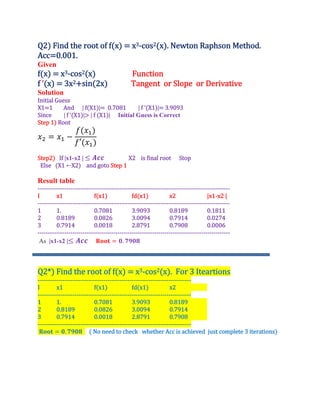
Q2 Find the root of f x x3‐cos2 x . Newton Raphson Method.
Acc 0.001.
Given
f x x3‐cos2 x Function
f ’ x 3x2 sin 2x Tangent or Slope or Derivative
Solution
Initial Guess
X1 1 And | f X1 | 0.7081 | f ’ X1 | 3.9093
Since | f ’ X1 | | f X1 | Initial Guess is Correct
Step 1 Root
′
Step2 If |x1-x2 | X2 is final root Stop
Else X1 ←X2 and goto Step 1
Result table
‐‐‐‐‐‐‐‐‐‐‐‐‐‐‐‐‐‐‐‐‐‐‐‐‐‐‐‐‐‐‐‐‐‐‐‐‐‐‐‐‐‐‐‐‐‐‐‐‐‐‐‐‐‐‐‐‐‐‐‐‐‐‐‐‐‐‐‐‐‐‐‐‐‐‐‐‐‐‐‐‐‐‐‐‐‐‐‐‐‐‐‐‐‐
I x1 f x1 fd x1 x2 |x1‐x2 |
‐‐‐‐‐‐‐‐‐‐‐‐‐‐‐‐‐‐‐‐‐‐‐‐‐‐‐‐‐‐‐‐‐‐‐‐‐‐‐‐‐‐‐‐‐‐‐‐‐‐‐‐‐‐‐‐‐‐‐‐‐‐‐‐‐‐‐‐‐‐‐‐‐‐‐‐‐‐‐‐‐‐‐‐‐‐‐‐‐‐‐‐‐‐
1 1. 0.7081 3.9093 0.8189 0.1811
2 0.8189 0.0826 3.0094 0.7914 0.0274
3 0.7914 0.0018 2.8791 0.7908 0.0006
‐‐‐‐‐‐‐‐‐‐‐‐‐‐‐‐‐‐‐‐‐‐‐‐‐‐‐‐‐‐‐‐‐‐‐‐‐‐‐‐‐‐‐‐‐‐‐‐‐‐‐‐‐‐‐‐‐‐‐‐‐‐‐‐‐‐‐‐‐‐‐‐‐‐‐‐‐‐‐‐‐‐‐‐‐‐‐‐‐‐‐‐‐‐
As |x1-x2 | .
Q2* Find the root of f x x3‐cos2 x . For 3 Iteartions
‐‐‐‐‐‐‐‐‐‐‐‐‐‐‐‐‐‐‐‐‐‐‐‐‐‐‐‐‐‐‐‐‐‐‐‐‐‐‐‐‐‐‐‐‐‐‐‐‐‐‐‐‐‐‐‐‐‐‐‐‐‐‐‐‐‐‐‐‐‐‐‐‐‐‐
I x1 f x1 fd x1 x2
‐‐‐‐‐‐‐‐‐‐‐‐‐‐‐‐‐‐‐‐‐‐‐‐‐‐‐‐‐‐‐‐‐‐‐‐‐‐‐‐‐‐‐‐‐‐‐‐‐‐‐‐‐‐‐‐‐‐‐‐‐‐‐‐‐‐‐‐‐‐‐‐‐‐‐
1 1. 0.7081 3.9093 0.8189
2 0.8189 0.0826 3.0094 0.7914
3 0.7914 0.0018 2.8791 0.7908
‐‐‐‐‐‐‐‐‐‐‐‐‐‐‐‐‐‐‐‐‐‐‐‐‐‐‐‐‐‐‐‐‐‐‐‐‐‐‐‐‐‐‐‐‐‐‐‐‐‐‐‐‐‐‐‐‐‐‐‐‐‐‐‐‐‐‐‐‐‐‐‐‐‐‐
. No need to check whether Acc is achieved just complete 3 iterations
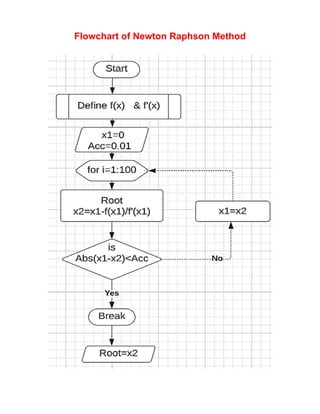
Flowchart of Newton Raphson Method
Program (Simple) %Newton Raphson Method
clc
clear all
f=inline('x-exp(-x)');
fd=inline('1+exp(-x)');
acc=0.0001; x1=1;
for i=1:100
x2=x1-f(x1)/fd(x1);
b=abs(f(x2));
if(b<acc) fprintf('n Root=%f',x2); break
else x1=x2;
end
end
Program (Table) %Newton Raphson Method
clc
clear all
%‐‐‐‐‐‐‐‐‐‐‐‐‐‐‐‐‐‐‐‐‐‐‐‐‐‐‐‐‐‐‐‐‐‐‐‐‐‐‐‐‐‐‐‐‐‐‐‐‐‐‐
f=inline('x.^3‐cos(x)*cos(x)');
fd=inline('2*cos(x)*sin(x) + 3*x.^2');
acc=0.001; x1=1;
%‐‐‐‐‐‐‐‐‐‐‐‐‐‐‐‐‐‐‐‐‐‐‐‐‐‐‐‐‐‐‐‐‐‐‐‐‐‐‐‐‐‐‐‐‐‐‐‐‐‐‐
fprintf('n‐‐‐‐‐‐‐‐‐‐‐‐‐‐‐‐‐‐‐‐‐‐‐‐‐‐‐‐‐‐‐‐‐‐‐‐‐‐‐‐‐‐‐n');
fprintf('I x1 f(x1) fd(x1) x2 Acc');
fprintf('n‐‐‐‐‐‐‐‐‐‐‐‐‐‐‐‐‐‐‐‐‐‐‐‐‐‐‐‐‐‐‐‐‐‐‐‐‐‐‐‐‐‐‐‐');
%‐‐‐‐‐‐‐‐‐‐‐‐‐‐‐‐‐‐‐‐‐‐‐‐‐‐‐‐‐‐‐‐‐‐‐‐‐‐‐‐‐‐‐‐‐‐‐‐‐‐‐
abs(f(x1))
abs(fd(x1))
for i=1:100
x2=x1‐f(x1)/fd(x1);
b=abs(x1‐x2);
fprintf('n%d %.4f %.4f %.4f %.4f %.4f',i,x1, f(x1), fd(x1),x2,b);
if(b <acc) break
else x1=x2;
end
end
%‐‐‐‐‐‐‐‐‐‐‐‐‐‐‐‐‐‐‐‐‐‐‐‐‐‐‐‐‐‐‐‐‐‐‐‐‐‐‐‐‐‐‐‐‐‐‐‐‐‐‐
fprintf('n‐‐‐‐‐‐‐‐‐‐‐‐‐‐‐‐‐‐‐‐‐‐‐‐‐‐');
fprintf('n Root=%f',x2);

1.pdf

  • 1.
    Sanjivani College ofEngineering Kopargaon Department of Mechanical Engineering ----------------------------------------------------------------------- Class: SY Subject: Numerical Methods About Numerical Methods (NMs)  Analytical methods are the most difficult ones, providing exact solutions, but they become hard to use for complex problems in practical engineering applications.  In such cases Numerical methods are important to give approximate solutions by satisfying certain accuracy.  NMs use arithmetic operators to solve engineering based mathematical problems.  So Engineers must acquire a working knowledge of NMs and also efficient programming skill for real life applications. Steps in NMs 1. Selection of proper NM 2. Algorithm ( Procedural steps) 3. Flowchart ( Graphical representation of procedural steps) 4. Programming (MatLAB) 5. Execution of Program D.P.Bhaskar Dept of Mech Engg
  • 2.
    Unit 1 Rootsof Equation Polynomial Equation: Function, f x 3x2 9 0 f x 3x2 4x‐8 0 etc. Transcendental equation. Function, f x 3x2 sin x ex 0 If x contains trigonometric, logarithmic or exponential functions, then 0 is called a transcendental equation. Root of Equations:  Function, f x 3x2 sin x ex 0  Root of equation means finding value of x to satisfy f x 0.  It means f x value will be zero for certain x. That is also called as zero of equation. Numerical Methods to compute Root of Equations:  Bisection Method Half interval Search Method  Newton Raphson Method Tangent Method Bisection Method The bisection method is a root‐finding method that applies to any continuous function for which one knows two values with opposite signs. The method consists of repeatedly bisecting the interval defined by these values and then selecting the subinterval in which the function changes sign, and therefore must contain a root. Steps in Bisection Method Step1 Initial Guesses X1 & X2 such a that f X1 & f X2 must be of opposite sign. Step2 Root: X3 X1 X2 /2 Step3 Iterate this Root till Acc is achieved. If |x1-x2 | X3 is final root Stop Break Else if f X1 * f X3 is ve X1 ←X3 f X1 * f X3 is ‐ ve X2 ←X3 Step 2 and Iterate …..
  • 3.
    Q1 Find theroot of f x x2 ‐ 3. By Bisection Method Let Acc 0.01. Solution Initial Guesses X1 1 f X1 ‐2 X2 2 f X2 1 Are of opposite sign. Result Table Procedure: If |x1-x2 | X3 is final root Stop Else if f X1 * f X3 is ve X1 ←X3 f X1 * f X3 is ‐ ve X2 ←X3 ---------------------------------------------------------------------------------------------------- I x1 x2 x3 |x1‐x2 | f x1 *f x3 --------------------------------------------------------------------------------------------------- 1 1. 2. 1.5 1. 1.5 2 1.5 2. 1.75 0.5 ‐0.04 3 1.5 1.75 1.625 0.25 0.2 4 1.625 1.75 1.6875 0.125 0.05 5 1.6875 1.75 1.7188 0.0625 0.007 6 1.7188 1.75 1.7344 0.0312 ‐0.0004 7 1.7188 1.7344 1.7266 0.0156 0.0009 8 1.7266 1.7344 1.7305 0.0078 0.0001 ------------------------------------------------------------------------------------------------------ As |x1-x2 | . Q2 Find the root of x ‐ e‐x 0 Let Acc 0.01. y Bisection Method Solution Initial Guesses X1 0 f X1 ‐ve X2 1 f X2 ve Are of opposite sign. Result Table Procedure: If |x1-x2 | X3 is final root Stop Else if f X1 * f X3 is ve X1 ←X3 f X1 * f X3 is ‐ ve X2 ←X3 --------------------------------------------------------------------------- I x1 x2 x3 |x1‐x2 | f x1 *f x3 --------------------------------------------------------------------------- 1 0 1 0.5 1 0.1 2 0.5 1 0.75 0.5 ‐0.02 3 0.5 0.75 0.625 0.25 ‐0.009 4 0.5 0.625 0.5625 0.125 0.0008 5 0.5625 0.625 0.5938 0.0625 ‐0.0003 6 0.5625 0.5938 0.5781 0.0312 ‐0.0001 7 0.5625 0.5781 0.5703 0.0156 ‐0.00004 8 0.5625 0.5703 0.5664 0.0078 0.00001 ------------------------------------------------------------------------- As |x1-x2 | .
  • 4.
    Q3 Find theroot of f x x3‐cos2 x . Bisection Method. Acc 0.01. Solution Initial Guesses X1 1 f X1 ‐1 X2 2 f X2 0.7081 Are of opposite sign. Result Table Procedure: If |x1-x2 | X3 is final root Stop Else if f X1 * f X3 is ve X1 ←X3 f X1 * f X3 is ‐ ve X2 ←X3 ---------------------------------------------------------------------------------------------------- I x1 x2 x3 |x1‐x2 | f x1 *f x3 --------------------------------------------------------------------------------------------------- 1 0 1 0.5 1 0.006 2 0.5 1. 0.75 0.5 0.07 3 0.75 1. 0.875 0.25 ‐0.02 4 0.75 0.875 0.8125 0.1250 ‐0.007 5 0.75 0.8125 0.7812 0.0625 0.003 6 0.7812 0.8125 0.7969 0.0312 ‐0.0004 7 0.7812 0.7969 0.7891 0.0156 0.0001 8 0.7891 0.7969 0.7930 0.0078 ‐0.00003 ------------------------------------------------------------------------------------------------------ As |x1-x2 | .
  • 5.
    A flowchart isa picture of the separate steps of a process in sequential order. Flowchart of Bisection Method
  • 6.
    Simple program ofBisection Method ( Accuracy input) clc clear all f=inline('x‐cos(x)'); x1=0; x1=1; acc=0.001; %‐‐‐‐‐‐‐‐‐‐‐‐‐‐‐‐‐‐‐‐‐‐‐‐‐‐‐‐‐‐‐‐‐‐‐‐‐‐‐‐‐‐‐‐‐‐‐‐‐‐‐‐‐‐‐‐ for i=1:100 x3=(x1+x2)/2; b=abs(x1‐x2); c=(f(x1)*f(x3)); if(b<acc) break else if(c>0) x1=x3; else x2=x3; end end end fprintf('n Root=%f',x3); Simple program of Bisection Method ( Number of iteration input e.g i=10) clc clear all f=inline('x‐cos(x)'); x1=0; x1=1; %‐‐‐‐‐‐‐‐‐‐‐‐‐‐‐‐‐‐‐‐‐‐‐‐‐‐‐‐‐‐‐‐‐‐‐‐‐‐‐‐‐‐‐‐‐‐‐‐‐‐‐‐‐‐‐‐ for i=1:10 x3=(x1+x2)/2; c=(f(x1)*f(x3)); if(c>0) x1=x3; else x2=x3; end end fprintf('n Root=%f',x3);
  • 7.
    Program of BisectionMethod ( Acc inout & checking for correct x1 & x2 and printing entire Table result) clc clear all f=inline('x‐cos(x)'); acc=0.001; %‐‐‐‐‐‐‐‐‐‐‐‐‐‐‐‐‐‐‐‐‐‐‐‐‐‐‐‐‐‐‐‐‐‐‐‐‐‐‐‐‐‐‐‐‐‐‐‐‐‐‐‐‐‐‐‐ for i=1:100 x1=input('Enter new x1'); x2=input('Enter new x2'); if(f(x1)*f(x2)<0) break end end %‐‐‐‐‐‐‐‐‐‐‐‐‐‐‐‐‐‐‐‐‐‐‐‐‐‐‐‐‐‐‐‐‐‐‐‐‐‐‐‐‐‐‐‐‐‐‐‐‐‐‐‐‐‐‐‐ fprintf('n‐‐‐‐‐‐‐‐‐‐‐‐‐‐‐‐‐‐‐‐‐‐‐‐‐‐n'); fprintf('I x1 x2 x3 Acc Error)'); fprintf('n‐‐‐‐‐‐‐‐‐‐‐‐‐‐‐‐‐‐‐‐‐‐‐‐‐‐'); for i=1:100 x3=(x1+x2)/2; b=abs(x1‐x2); c=(f(x1)*f(x3)); fprintf('n%d %.4f %.4f %.4f %.4f %.4f ',i,x1,x2,x3,b,c); if(b<acc) break else if(c>0) x1=x3; else x2=x3; end end end fprintf('n‐‐‐‐‐‐‐‐‐‐‐‐‐‐‐‐‐‐‐‐‐‐‐‐‐‐'); fprintf('n Root=%f',x3); %‐‐‐‐‐‐‐‐‐‐‐‐‐‐‐‐‐‐‐‐‐‐‐‐‐‐‐‐‐‐‐‐‐‐‐‐‐‐‐‐‐‐‐‐‐‐‐‐‐‐‐‐‐‐‐‐
  • 8.
    Newton’s Raphson method Isa method for finding successively better approximations to the roots (or zeroes) of a real- valued function. The Newton–Raphson method in one variable is implemented as follows: Given a function ƒ(x), and its derivative ƒ'(x), we begin with a first guess x1 for a root of the function f(x). Provided the function satisfies all the assumptions made in the derivation of the formula, a better approximation x2 is: Root Formula ′ The process is repeated until a sufficiently accurate value is reached. For correct Initial Guess(x1): | f ’ X1 | | f X1 | Initial Guess is Correct
  • 9.
    Q1 Find theroot of f x excos x ‐1.2 . Newton Raphson Method. Acc 0.001. Given f x excos x ‐1.2 Function f ’ x ex cos x ‐sin x Tangent or Slope or Derivative Solution Initial Guess X1 1 And | f X1 | 0.2687 | f ’ X1 | 0.8187 Since | f ’ X1 | | f X1 | Initial Guess is Correct Step 1 Root ′ Step2 If |x1-x2 | X2 is final root Stop Else X1 ←X2 and goto Step 1 Result table ‐‐‐‐‐‐‐‐‐‐‐‐‐‐‐‐‐‐‐‐‐‐‐‐‐‐‐‐‐‐‐‐‐‐‐‐‐‐‐‐‐‐‐‐‐‐‐‐‐‐‐‐‐‐‐‐‐‐‐‐‐‐‐‐‐‐‐‐‐‐‐‐‐‐‐‐‐‐‐‐‐‐‐‐‐‐‐‐‐‐‐‐‐‐ I x1 f x1 fd x1 x2 |x1‐x2 | ‐‐‐‐‐‐‐‐‐‐‐‐‐‐‐‐‐‐‐‐‐‐‐‐‐‐‐‐‐‐‐‐‐‐‐‐‐‐‐‐‐‐‐‐‐‐‐‐‐‐‐‐‐‐‐‐‐‐‐‐‐‐‐‐‐‐‐‐‐‐‐‐‐‐‐‐‐‐‐‐‐‐‐‐‐‐‐‐‐‐‐‐‐‐ 1 1. 0.2687 ‐0.8187 1.3282 0.3282 2 1.3282 ‐0.2934 ‐2.7571 1.2218 0.1064 3 1.2218 ‐0.0397 ‐2.0284 1.2023 0.0196 4 1.2023 ‐0.0012 ‐1.9054 1.2016 0.0006 ‐‐‐‐‐‐‐‐‐‐‐‐‐‐‐‐‐‐‐‐‐‐‐‐‐‐‐‐‐‐‐‐‐‐‐‐‐‐‐‐‐‐‐‐‐‐‐‐‐‐‐‐‐‐‐‐‐‐‐‐‐‐‐‐‐‐‐‐‐‐‐‐‐‐‐‐‐‐‐‐‐‐‐‐‐‐‐‐‐‐‐‐‐‐ As |x1-x2 | . Q1* Find the root of f x excos x ‐1.2 . Newton Raphson Method. Acc 0.001. Initial Guess is x1 2 | f ’ X1 | | f X1 | ] Means no need to check
  • 10.
    Q2 Find theroot of f x x3‐cos2 x . Newton Raphson Method. Acc 0.001. Given f x x3‐cos2 x Function f ’ x 3x2 sin 2x Tangent or Slope or Derivative Solution Initial Guess X1 1 And | f X1 | 0.7081 | f ’ X1 | 3.9093 Since | f ’ X1 | | f X1 | Initial Guess is Correct Step 1 Root ′ Step2 If |x1-x2 | X2 is final root Stop Else X1 ←X2 and goto Step 1 Result table ‐‐‐‐‐‐‐‐‐‐‐‐‐‐‐‐‐‐‐‐‐‐‐‐‐‐‐‐‐‐‐‐‐‐‐‐‐‐‐‐‐‐‐‐‐‐‐‐‐‐‐‐‐‐‐‐‐‐‐‐‐‐‐‐‐‐‐‐‐‐‐‐‐‐‐‐‐‐‐‐‐‐‐‐‐‐‐‐‐‐‐‐‐‐ I x1 f x1 fd x1 x2 |x1‐x2 | ‐‐‐‐‐‐‐‐‐‐‐‐‐‐‐‐‐‐‐‐‐‐‐‐‐‐‐‐‐‐‐‐‐‐‐‐‐‐‐‐‐‐‐‐‐‐‐‐‐‐‐‐‐‐‐‐‐‐‐‐‐‐‐‐‐‐‐‐‐‐‐‐‐‐‐‐‐‐‐‐‐‐‐‐‐‐‐‐‐‐‐‐‐‐ 1 1. 0.7081 3.9093 0.8189 0.1811 2 0.8189 0.0826 3.0094 0.7914 0.0274 3 0.7914 0.0018 2.8791 0.7908 0.0006 ‐‐‐‐‐‐‐‐‐‐‐‐‐‐‐‐‐‐‐‐‐‐‐‐‐‐‐‐‐‐‐‐‐‐‐‐‐‐‐‐‐‐‐‐‐‐‐‐‐‐‐‐‐‐‐‐‐‐‐‐‐‐‐‐‐‐‐‐‐‐‐‐‐‐‐‐‐‐‐‐‐‐‐‐‐‐‐‐‐‐‐‐‐‐ As |x1-x2 | . Q2* Find the root of f x x3‐cos2 x . For 3 Iteartions ‐‐‐‐‐‐‐‐‐‐‐‐‐‐‐‐‐‐‐‐‐‐‐‐‐‐‐‐‐‐‐‐‐‐‐‐‐‐‐‐‐‐‐‐‐‐‐‐‐‐‐‐‐‐‐‐‐‐‐‐‐‐‐‐‐‐‐‐‐‐‐‐‐‐‐ I x1 f x1 fd x1 x2 ‐‐‐‐‐‐‐‐‐‐‐‐‐‐‐‐‐‐‐‐‐‐‐‐‐‐‐‐‐‐‐‐‐‐‐‐‐‐‐‐‐‐‐‐‐‐‐‐‐‐‐‐‐‐‐‐‐‐‐‐‐‐‐‐‐‐‐‐‐‐‐‐‐‐‐ 1 1. 0.7081 3.9093 0.8189 2 0.8189 0.0826 3.0094 0.7914 3 0.7914 0.0018 2.8791 0.7908 ‐‐‐‐‐‐‐‐‐‐‐‐‐‐‐‐‐‐‐‐‐‐‐‐‐‐‐‐‐‐‐‐‐‐‐‐‐‐‐‐‐‐‐‐‐‐‐‐‐‐‐‐‐‐‐‐‐‐‐‐‐‐‐‐‐‐‐‐‐‐‐‐‐‐‐ . No need to check whether Acc is achieved just complete 3 iterations
  • 11.
    Flowchart of NewtonRaphson Method
  • 12.
    Program (Simple) %NewtonRaphson Method clc clear all f=inline('x-exp(-x)'); fd=inline('1+exp(-x)'); acc=0.0001; x1=1; for i=1:100 x2=x1-f(x1)/fd(x1); b=abs(f(x2)); if(b<acc) fprintf('n Root=%f',x2); break else x1=x2; end end Program (Table) %Newton Raphson Method clc clear all %‐‐‐‐‐‐‐‐‐‐‐‐‐‐‐‐‐‐‐‐‐‐‐‐‐‐‐‐‐‐‐‐‐‐‐‐‐‐‐‐‐‐‐‐‐‐‐‐‐‐‐ f=inline('x.^3‐cos(x)*cos(x)'); fd=inline('2*cos(x)*sin(x) + 3*x.^2'); acc=0.001; x1=1; %‐‐‐‐‐‐‐‐‐‐‐‐‐‐‐‐‐‐‐‐‐‐‐‐‐‐‐‐‐‐‐‐‐‐‐‐‐‐‐‐‐‐‐‐‐‐‐‐‐‐‐ fprintf('n‐‐‐‐‐‐‐‐‐‐‐‐‐‐‐‐‐‐‐‐‐‐‐‐‐‐‐‐‐‐‐‐‐‐‐‐‐‐‐‐‐‐‐n'); fprintf('I x1 f(x1) fd(x1) x2 Acc'); fprintf('n‐‐‐‐‐‐‐‐‐‐‐‐‐‐‐‐‐‐‐‐‐‐‐‐‐‐‐‐‐‐‐‐‐‐‐‐‐‐‐‐‐‐‐‐'); %‐‐‐‐‐‐‐‐‐‐‐‐‐‐‐‐‐‐‐‐‐‐‐‐‐‐‐‐‐‐‐‐‐‐‐‐‐‐‐‐‐‐‐‐‐‐‐‐‐‐‐ abs(f(x1)) abs(fd(x1)) for i=1:100 x2=x1‐f(x1)/fd(x1); b=abs(x1‐x2); fprintf('n%d %.4f %.4f %.4f %.4f %.4f',i,x1, f(x1), fd(x1),x2,b); if(b <acc) break else x1=x2; end end %‐‐‐‐‐‐‐‐‐‐‐‐‐‐‐‐‐‐‐‐‐‐‐‐‐‐‐‐‐‐‐‐‐‐‐‐‐‐‐‐‐‐‐‐‐‐‐‐‐‐‐ fprintf('n‐‐‐‐‐‐‐‐‐‐‐‐‐‐‐‐‐‐‐‐‐‐‐‐‐‐'); fprintf('n Root=%f',x2);