Mutual Exclusion in Distributed
Systems
Name : Ajay Kharat
ID : 2019H1030011P
BITS-Pilani
Mutual Exclusion Algorithms for
Distributed Systems
•Classification
•Non Token Based
•Lamport’s
•Ricart Agrawala’s
•Maekawa’s
•Token Based
•Suzuki Kasami’s Broadcast
•Singhal’s Heuristics
•Raymond’s Tree Based
System
SV [1…..N] : System State
SN [1…..N] : Highest Seq. No.
Token
TSV [1…..N] : System State
TSN [1…..N] : Highest Seq. No.
Singhal’s Heuristic Algorithm
S1
S2
S3
S4
SV [ H N N N ]
SN [ 0 0 0 0 ]
SV [ R N N N ]
SN [ 0 0 0 0 ]
SV [ R R N N ]
SN [ 0 0 0 0 ]
SV [ R R R N ]
SN [ 0 0 0 0 ]
TSV [ N N N N ]
TSN [ 0 0 0 0 ]
STATES
R : REQUESTING A TOKEN
H : HOLDING IDLE TOKEN
E : EXECUTING IN CRITICAL SECTION
N:NONE OF THE ABOVE
S1
S2
S3
S4
SV [ H N N N ]
SN [ 0 0 0 0 ]
SV [ R R N N ]
SN [ 0 1 0 0 ]
SV [ R R N N ]
SN [ 0 0 0 0 ]
SV [ R R R N ]
SN [ 0 0 0 0 ]
TSV [ N N N N ]
TSN [ 0 0 0 0 ]
STATES
R : REQUESTING A TOKEN
H : HOLDING IDLE TOKEN
E : EXECUTING IN CRITICAL SECTION
N:NONE OF THE ABOVE
S2 is Requesting
Token
REQUEST Only “HRE”
S1
S2
S3
S4
SV [ H N N N ]
SN [ 0 0 0 0 ]
SV [ R R N N ]
SN [ 0 1 0 0 ]
SV [ R R N N ]
SN [ 0 0 0 0 ]
SV [ R R R N ]
SN [ 0 0 0 0 ]
TSV [ N N N N ]
TSN [ 0 0 0 0 ]
STATES
R : REQUESTING A TOKEN
H : HOLDING IDLE TOKEN
E : EXECUTING IN CRITICAL SECTION
N:NONE OF THE ABOVE
RQ (2,1)
S2 sends Request to S1
S1
S2
S3
S4
SV [ H N N N ]
SN [ 0 0 0 0 ]
SV [ R R N N ]
SN [ 0 1 0 0 ]
SV [ R R N N ]
SN [ 0 0 0 0 ]
SV [ R R R N ]
SN [ 0 0 0 0 ]
TSV [ N N N N ]
TSN [ 0 0 0 0 ]
STATES
R : REQUESTING A TOKEN
H : HOLDING IDLE TOKEN
E : EXECUTING IN CRITICAL SECTION
N:NONE OF THE ABOVE
RQ (2,1)
S1 updates itself and
Token(if reqd)
S1
S2
S3
S4
SV [ H N N N ]
SN [ 0 1 0 0 ]
SV [ R R N N ]
SN [ 0 1 0 0 ]
SV [ R R N N ]
SN [ 0 0 0 0 ]
SV [ R R R N ]
SN [ 0 0 0 0 ]
TSV [ N N N N ]
TSN [ 0 0 0 0 ]
STATES
R : REQUESTING A TOKEN
H : HOLDING IDLE TOKEN
E : EXECUTING IN CRITICAL SECTION
N:NONE OF THE ABOVE
S1 updates itself and
Token(if reqd)
RQ (2,1)
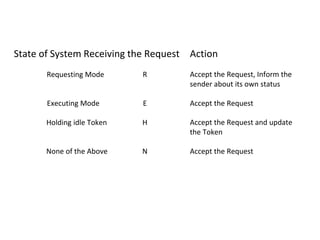
State of System Receiving the Request
Requesting Mode R
Executing Mode E
Holding idle Token H
None of the Above N
Action
Accept the Request, Inform the
sender about its own status
Accept the Request
Accept the Request and update
the Token
Accept the Request
S1
S2
S3
S4
SV [ N R N N ]
SN [ 0 1 0 0 ]
SV [ R R N N ]
SN [ 0 1 0 0 ]
SV [ R R N N ]
SN [ 0 0 0 0 ]
SV [ R R R N ]
SN [ 0 0 0 0 ]
TSV [ N R N N ]
TSN [ 0 1 0 0 ]
STATES
R : REQUESTING A TOKEN
H : HOLDING IDLE TOKEN
E : EXECUTING IN CRITICAL SECTION
N:NONE OF THE ABOVE
Token Updated
S1
S2
S3
S4
SV [ N R N N ]
SN [ 0 1 0 0 ]
SV [ R E N N ]
SN [ 0 1 0 0 ]
SV [ R R N N ]
SN [ 0 0 0 0 ]
SV [ R R R N ]
SN [ 0 0 0 0 ]
TSV [ N R N N ]
TSN [ 0 1 0 0 ]
STATES
R : REQUESTING A TOKEN
H : HOLDING IDLE TOKEN
E : EXECUTING IN CRITICAL SECTION
N:NONE OF THE ABOVE
S1 completes CS
Sends Token to S2 S2 sets status to E and
Executes CS
S1
S2
S3
S4
SV [ N R N N ]
SN [ 0 1 0 0 ]
SV [ R N N N ]
SN [ 0 1 0 0 ]
SV [ R R N N ]
SN [ 0 0 0 0 ]
SV [ R R R N ]
SN [ 0 0 0 0 ]
TSV [ N N N N ]
TSN [ 0 1 0 0 ]
STATES
R : REQUESTING A TOKEN
H : HOLDING IDLE TOKEN
E : EXECUTING IN CRITICAL SECTION
N:NONE OF THE ABOVE
S2 comes out of CS
Sets status to N
Token
Updated
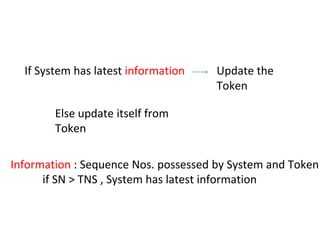
If System has latest information Update the
Token
Else update itself from
Token
Information : Sequence Nos. possessed by System and Token
if SN > TNS , System has latest information
S1
S2
S3
S4
SV [ N R N N ]
SN [ 0 1 0 0 ]
SV [ R N N N ]
SN [ 0 1 0 0 ]
SV [ R R N N ]
SN [ 0 0 0 0 ]
SV [ R R R N ]
SN [ 0 0 0 0 ]
TSV [ N N N N ]
TSN [ 0 1 0 0 ]
STATES
R : REQUESTING A TOKEN
H : HOLDING IDLE TOKEN
E : EXECUTING IN CRITICAL SECTION
N:NONE OF THE ABOVE
S2 updates itself
S1
S2
S3
S4
SV [ N R N N ]
SN [ 0 1 0 0 ]
SV [ N N N N ]
SN [ 0 1 0 0 ]
SV [ R R N N ]
SN [ 0 0 0 0 ]
SV [ R R R N ]
SN [ 0 0 0 0 ]
TSV [ N N N N ]
TSN [ 0 1 0 0 ]
STATES
R : REQUESTING A TOKEN
H : HOLDING IDLE TOKEN
E : EXECUTING IN CRITICAL SECTION
N:NONE OF THE ABOVE
S2 updates itself
S1
S2
S3
S4
SV [ N H N N ]
SN [ 0 1 0 0 ]
SV [ N H N N ]
SN [ 0 1 0 0 ]
SV [ N H N N ]
SN [ 0 1 0 0 ]
SV [ N H N N ]
SN [ 0 1 0 0 ]
TSV [ N N N N ]
TSN [ 0 1 0 0 ]
STATES
R : REQUESTING A TOKEN
H : HOLDING IDLE TOKEN
E : EXECUTING IN CRITICAL SECTION
N:NONE OF THE ABOVE
S2 sets its status to H
All systems are updated
S1
S2
S3
S4
SV [ N H N N ]
SN [ 0 1 0 0 ]
SV [ N H N N ]
SN [ 0 1 0 0 ]
SV [ N H R N ]
SN [ 0 1 1 0 ]
SV [ N H N N ]
SN [ 0 1 0 0 ]
TSV [ N N N N ]
TSN [ 0 1 0 0 ]
STATES
R : REQUESTING A TOKEN
H : HOLDING IDLE TOKEN
E : EXECUTING IN CRITICAL SECTION
N:NONE OF THE ABOVE
Contd.. S3 makes a REQUEST
REQUEST Only “HRE”
R(3,1)
S1
S2
S3
S4
SV [ N H N N ]
SN [ 0 1 0 0 ]
SV [ N H R N ]
SN [ 0 1 1 0 ]
SV [ N H R N ]
SN [ 0 1 1 0 ]
SV [ N H N N ]
SN [ 0 1 0 0 ]
TSV [ N N R N ]
TSN [ 0 1 1 0 ]
STATES
R : REQUESTING A TOKEN
H : HOLDING IDLE TOKEN
E : EXECUTING IN CRITICAL SECTION
N:NONE OF THE ABOVE
S2 sets S3’s status to R
S2 then updates the TOKEN for S3
S1
S2
S3
S4
SV [ N H N N ]
SN [ 0 1 0 0 ]
SV [ N N R N ]
SN [ 0 1 1 0 ]
SV [ N N E N ]
SN [ 0 1 1 0 ]
SV [ N H N N ]
SN [ 0 1 0 0 ]
TSV [ N N R N ]
TSN [ 0 1 1 0 ]
STATES
R : REQUESTING A TOKEN
H : HOLDING IDLE TOKEN
E : EXECUTING IN CRITICAL SECTION
N:NONE OF THE ABOVE
S2 sets its own status to N
Sends TOKEN to S3
S3 sets status to E
Executes CS
S1
S2
S3
S4
SV [ N H N N ]
SN [ 0 1 0 0 ]
SV [ N N R N ]
SN [ 0 1 1 0 ]
SV [ N H N N ]
SN [ 0 1 1 0 ]
SV [ N H N N ]
SN [ 0 1 0 0 ]
TSV [ N N R N ]
TSN [ 0 1 1 0 ]
STATES
R : REQUESTING A TOKEN
H : HOLDING IDLE TOKEN
E : EXECUTING IN CRITICAL SECTION
N:NONE OF THE ABOVE
S3 comes out of CS
Looks for any other ‘R’
S1
S2
S3
S4
SV [ N N H N ]
SN [ 0 1 1 0 ]
SV [ N N H N ]
SN [ 0 1 1 0 ]
SV [ N N H N ]
SN [ 0 1 1 0 ]
SV [ N N H N ]
SN [ 0 1 1 0 ]
TSV [ N N N N ]
TSN [ 0 1 1 0 ]
STATES
R : REQUESTING A TOKEN
H : HOLDING IDLE TOKEN
E : EXECUTING IN CRITICAL SECTION
N:NONE OF THE ABOVE
S2 sets its own status to H
All sites are then updated
DeadLock and Starvation
Request sent to only those
systems who possess the Token or
will get Token in near future : E, R,
or H
If RQ is sent to any other system
if ‘N’ systems send
requests to each other : Deadlock
if a system sends request
to N system : Starvation
S1
S2
SV [ H N N N ]
SN [ 0 1 0 0 ]
SV [ R N N N ]
SN [ 0 1 0 0 ]
S3
SV [ R N N N ]
SN [ 0 1 0 0 ]
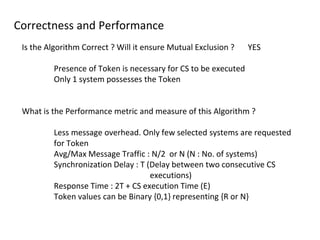
Correctness and Performance
Is the Algorithm Correct ? Will it ensure Mutual Exclusion ? YES
Presence of Token is necessary for CS to be executed
Only 1 system possesses the Token
What is the Performance metric and measure of this Algorithm ?
Less message overhead. Only few selected systems are requested
for Token
Avg/Max Message Traffic : N/2 or N (N : No. of systems)
Synchronization Delay : T (Delay between two consecutive CS
executions)
Response Time : 2T + CS execution Time (E)
Token values can be Binary {0,1} representing {R or N}
Raymond’s Tree Based Algorithm
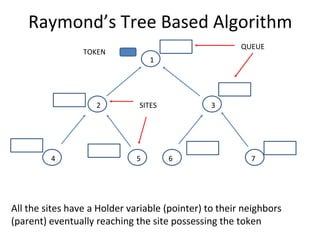
All the sites have a Holder variable (pointer) to their neighbors
(parent) eventually reaching the site possessing the token
6
2 3
4 5
1
7
TOKEN
QUEUE
SITES
Raymond’s Tree Based Algorithm
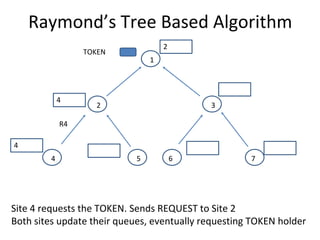
Site 4 requests the TOKEN. Sends REQUEST to Site 2
Both sites update their queues, eventually requesting TOKEN holder
6
2 3
4 5
1
7
TOKEN
4
R4
4
2
Raymond’s Tree Based Algorithm
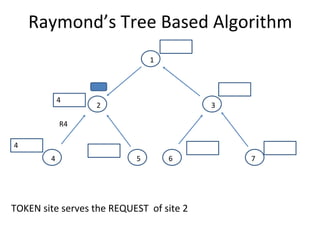
TOKEN site serves the REQUEST of site 2
6
2 3
4 5
1
7
4
R4
4
Raymond’s Tree Based Algorithm
6
2 3
4 5
1
7
6 7
6 7 3
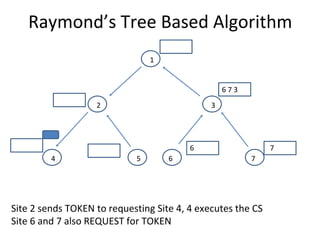
Site 2 sends TOKEN to requesting Site 4, 4 executes the CS
Site 6 and 7 also REQUEST for TOKEN
Raymond’s Tree Based Algorithm
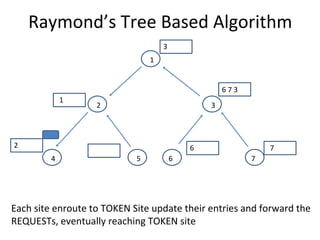
Each site enroute to TOKEN Site update their entries and forward the
REQUESTs, eventually reaching TOKEN site
6
2 3
4 5
1
7
2 6 7
6 7 3
3
1
Raymond’s Tree Based Algorithm
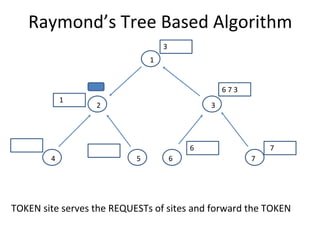
TOKEN site serves the REQUESTs of sites and forward the TOKEN
6
2 3
4 5
1
7
6 7
6 7 3
3
1
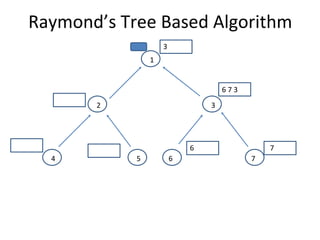
Raymond’s Tree Based Algorithm
6
2 3
4 5
1
7
6 7
6 7 3
3
Raymond’s Tree Based Algorithm
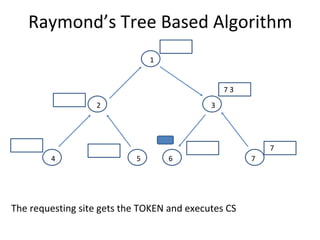
The requesting site gets the TOKEN and executes CS
6
2 3
4 5
1
7
7
7 3
Raymond’s Tree Based Algorithm
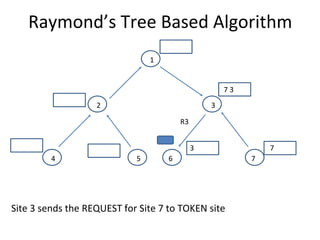
Site 3 sends the REQUEST for Site 7 to TOKEN site
6
2 3
4 5
1
7
7
7 3
R3
3
Raymond’s Tree Based Algorithm
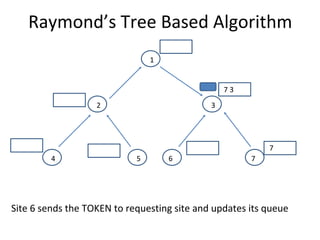
Site 6 sends the TOKEN to requesting site and updates its queue
6
2 3
4 5
1
7
7 3
7
Raymond’s Tree Based Algorithm
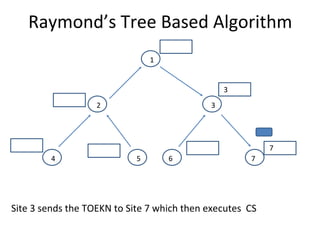
Site 3 sends the TOEKN to Site 7 which then executes CS
6
2 3
4 5
1
7
3
7
Raymond’s Tree Based Algorithm
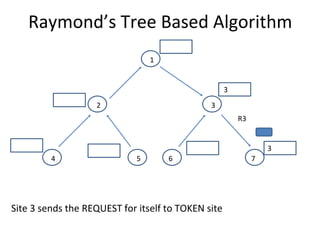
Site 3 sends the REQUEST for itself to TOKEN site
6
2 3
4 5
1
7
3
R3
3
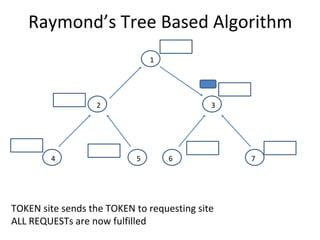
Raymond’s Tree Based Algorithm
TOKEN site sends the TOKEN to requesting site
ALL REQUESTs are now fulfilled
6
2 3
4 5
1
7
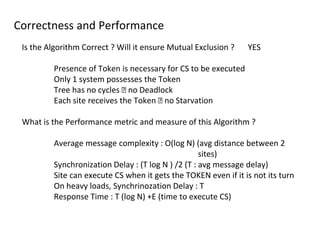
Correctness and Performance
Is the Algorithm Correct ? Will it ensure Mutual Exclusion ? YES
Presence of Token is necessary for CS to be executed
Only 1 system possesses the Token
Tree has no cycles 🡪 no Deadlock
Each site receives the Token 🡪 no Starvation
What is the Performance metric and measure of this Algorithm ?
Average message complexity : O(log N) (avg distance between 2
sites)
Synchronization Delay : (T log N ) /2 (T : avg message delay)
Site can execute CS when it gets the TOKEN even if it is not its turn
On heavy loads, Synchrinozation Delay : T
Response Time : T (log N) +E (time to execute CS)
That’s it..
Thank You

Mutual exclusion in distributed systems

  • 1.
    Mutual Exclusion inDistributed Systems Name : Ajay Kharat ID : 2019H1030011P BITS-Pilani
  • 2.
    Mutual Exclusion Algorithmsfor Distributed Systems •Classification •Non Token Based •Lamport’s •Ricart Agrawala’s •Maekawa’s •Token Based •Suzuki Kasami’s Broadcast •Singhal’s Heuristics •Raymond’s Tree Based
  • 3.
    System SV [1…..N] :System State SN [1…..N] : Highest Seq. No. Token TSV [1…..N] : System State TSN [1…..N] : Highest Seq. No. Singhal’s Heuristic Algorithm
  • 4.
    S1 S2 S3 S4 SV [ HN N N ] SN [ 0 0 0 0 ] SV [ R N N N ] SN [ 0 0 0 0 ] SV [ R R N N ] SN [ 0 0 0 0 ] SV [ R R R N ] SN [ 0 0 0 0 ] TSV [ N N N N ] TSN [ 0 0 0 0 ] STATES R : REQUESTING A TOKEN H : HOLDING IDLE TOKEN E : EXECUTING IN CRITICAL SECTION N:NONE OF THE ABOVE
  • 5.
    S1 S2 S3 S4 SV [ HN N N ] SN [ 0 0 0 0 ] SV [ R R N N ] SN [ 0 1 0 0 ] SV [ R R N N ] SN [ 0 0 0 0 ] SV [ R R R N ] SN [ 0 0 0 0 ] TSV [ N N N N ] TSN [ 0 0 0 0 ] STATES R : REQUESTING A TOKEN H : HOLDING IDLE TOKEN E : EXECUTING IN CRITICAL SECTION N:NONE OF THE ABOVE S2 is Requesting Token REQUEST Only “HRE”
  • 6.
    S1 S2 S3 S4 SV [ HN N N ] SN [ 0 0 0 0 ] SV [ R R N N ] SN [ 0 1 0 0 ] SV [ R R N N ] SN [ 0 0 0 0 ] SV [ R R R N ] SN [ 0 0 0 0 ] TSV [ N N N N ] TSN [ 0 0 0 0 ] STATES R : REQUESTING A TOKEN H : HOLDING IDLE TOKEN E : EXECUTING IN CRITICAL SECTION N:NONE OF THE ABOVE RQ (2,1) S2 sends Request to S1
  • 7.
    S1 S2 S3 S4 SV [ HN N N ] SN [ 0 0 0 0 ] SV [ R R N N ] SN [ 0 1 0 0 ] SV [ R R N N ] SN [ 0 0 0 0 ] SV [ R R R N ] SN [ 0 0 0 0 ] TSV [ N N N N ] TSN [ 0 0 0 0 ] STATES R : REQUESTING A TOKEN H : HOLDING IDLE TOKEN E : EXECUTING IN CRITICAL SECTION N:NONE OF THE ABOVE RQ (2,1) S1 updates itself and Token(if reqd)
  • 8.
    S1 S2 S3 S4 SV [ HN N N ] SN [ 0 1 0 0 ] SV [ R R N N ] SN [ 0 1 0 0 ] SV [ R R N N ] SN [ 0 0 0 0 ] SV [ R R R N ] SN [ 0 0 0 0 ] TSV [ N N N N ] TSN [ 0 0 0 0 ] STATES R : REQUESTING A TOKEN H : HOLDING IDLE TOKEN E : EXECUTING IN CRITICAL SECTION N:NONE OF THE ABOVE S1 updates itself and Token(if reqd) RQ (2,1)
  • 9.
    State of SystemReceiving the Request Requesting Mode R Executing Mode E Holding idle Token H None of the Above N Action Accept the Request, Inform the sender about its own status Accept the Request Accept the Request and update the Token Accept the Request
  • 10.
    S1 S2 S3 S4 SV [ NR N N ] SN [ 0 1 0 0 ] SV [ R R N N ] SN [ 0 1 0 0 ] SV [ R R N N ] SN [ 0 0 0 0 ] SV [ R R R N ] SN [ 0 0 0 0 ] TSV [ N R N N ] TSN [ 0 1 0 0 ] STATES R : REQUESTING A TOKEN H : HOLDING IDLE TOKEN E : EXECUTING IN CRITICAL SECTION N:NONE OF THE ABOVE Token Updated
  • 11.
    S1 S2 S3 S4 SV [ NR N N ] SN [ 0 1 0 0 ] SV [ R E N N ] SN [ 0 1 0 0 ] SV [ R R N N ] SN [ 0 0 0 0 ] SV [ R R R N ] SN [ 0 0 0 0 ] TSV [ N R N N ] TSN [ 0 1 0 0 ] STATES R : REQUESTING A TOKEN H : HOLDING IDLE TOKEN E : EXECUTING IN CRITICAL SECTION N:NONE OF THE ABOVE S1 completes CS Sends Token to S2 S2 sets status to E and Executes CS
  • 12.
    S1 S2 S3 S4 SV [ NR N N ] SN [ 0 1 0 0 ] SV [ R N N N ] SN [ 0 1 0 0 ] SV [ R R N N ] SN [ 0 0 0 0 ] SV [ R R R N ] SN [ 0 0 0 0 ] TSV [ N N N N ] TSN [ 0 1 0 0 ] STATES R : REQUESTING A TOKEN H : HOLDING IDLE TOKEN E : EXECUTING IN CRITICAL SECTION N:NONE OF THE ABOVE S2 comes out of CS Sets status to N Token Updated
  • 13.
    If System haslatest information Update the Token Else update itself from Token Information : Sequence Nos. possessed by System and Token if SN > TNS , System has latest information
  • 14.
    S1 S2 S3 S4 SV [ NR N N ] SN [ 0 1 0 0 ] SV [ R N N N ] SN [ 0 1 0 0 ] SV [ R R N N ] SN [ 0 0 0 0 ] SV [ R R R N ] SN [ 0 0 0 0 ] TSV [ N N N N ] TSN [ 0 1 0 0 ] STATES R : REQUESTING A TOKEN H : HOLDING IDLE TOKEN E : EXECUTING IN CRITICAL SECTION N:NONE OF THE ABOVE S2 updates itself
  • 15.
    S1 S2 S3 S4 SV [ NR N N ] SN [ 0 1 0 0 ] SV [ N N N N ] SN [ 0 1 0 0 ] SV [ R R N N ] SN [ 0 0 0 0 ] SV [ R R R N ] SN [ 0 0 0 0 ] TSV [ N N N N ] TSN [ 0 1 0 0 ] STATES R : REQUESTING A TOKEN H : HOLDING IDLE TOKEN E : EXECUTING IN CRITICAL SECTION N:NONE OF THE ABOVE S2 updates itself
  • 16.
    S1 S2 S3 S4 SV [ NH N N ] SN [ 0 1 0 0 ] SV [ N H N N ] SN [ 0 1 0 0 ] SV [ N H N N ] SN [ 0 1 0 0 ] SV [ N H N N ] SN [ 0 1 0 0 ] TSV [ N N N N ] TSN [ 0 1 0 0 ] STATES R : REQUESTING A TOKEN H : HOLDING IDLE TOKEN E : EXECUTING IN CRITICAL SECTION N:NONE OF THE ABOVE S2 sets its status to H All systems are updated
  • 17.
    S1 S2 S3 S4 SV [ NH N N ] SN [ 0 1 0 0 ] SV [ N H N N ] SN [ 0 1 0 0 ] SV [ N H R N ] SN [ 0 1 1 0 ] SV [ N H N N ] SN [ 0 1 0 0 ] TSV [ N N N N ] TSN [ 0 1 0 0 ] STATES R : REQUESTING A TOKEN H : HOLDING IDLE TOKEN E : EXECUTING IN CRITICAL SECTION N:NONE OF THE ABOVE Contd.. S3 makes a REQUEST REQUEST Only “HRE” R(3,1)
  • 18.
    S1 S2 S3 S4 SV [ NH N N ] SN [ 0 1 0 0 ] SV [ N H R N ] SN [ 0 1 1 0 ] SV [ N H R N ] SN [ 0 1 1 0 ] SV [ N H N N ] SN [ 0 1 0 0 ] TSV [ N N R N ] TSN [ 0 1 1 0 ] STATES R : REQUESTING A TOKEN H : HOLDING IDLE TOKEN E : EXECUTING IN CRITICAL SECTION N:NONE OF THE ABOVE S2 sets S3’s status to R S2 then updates the TOKEN for S3
  • 19.
    S1 S2 S3 S4 SV [ NH N N ] SN [ 0 1 0 0 ] SV [ N N R N ] SN [ 0 1 1 0 ] SV [ N N E N ] SN [ 0 1 1 0 ] SV [ N H N N ] SN [ 0 1 0 0 ] TSV [ N N R N ] TSN [ 0 1 1 0 ] STATES R : REQUESTING A TOKEN H : HOLDING IDLE TOKEN E : EXECUTING IN CRITICAL SECTION N:NONE OF THE ABOVE S2 sets its own status to N Sends TOKEN to S3 S3 sets status to E Executes CS
  • 20.
    S1 S2 S3 S4 SV [ NH N N ] SN [ 0 1 0 0 ] SV [ N N R N ] SN [ 0 1 1 0 ] SV [ N H N N ] SN [ 0 1 1 0 ] SV [ N H N N ] SN [ 0 1 0 0 ] TSV [ N N R N ] TSN [ 0 1 1 0 ] STATES R : REQUESTING A TOKEN H : HOLDING IDLE TOKEN E : EXECUTING IN CRITICAL SECTION N:NONE OF THE ABOVE S3 comes out of CS Looks for any other ‘R’
  • 21.
    S1 S2 S3 S4 SV [ NN H N ] SN [ 0 1 1 0 ] SV [ N N H N ] SN [ 0 1 1 0 ] SV [ N N H N ] SN [ 0 1 1 0 ] SV [ N N H N ] SN [ 0 1 1 0 ] TSV [ N N N N ] TSN [ 0 1 1 0 ] STATES R : REQUESTING A TOKEN H : HOLDING IDLE TOKEN E : EXECUTING IN CRITICAL SECTION N:NONE OF THE ABOVE S2 sets its own status to H All sites are then updated
  • 22.
    DeadLock and Starvation Requestsent to only those systems who possess the Token or will get Token in near future : E, R, or H If RQ is sent to any other system if ‘N’ systems send requests to each other : Deadlock if a system sends request to N system : Starvation S1 S2 SV [ H N N N ] SN [ 0 1 0 0 ] SV [ R N N N ] SN [ 0 1 0 0 ] S3 SV [ R N N N ] SN [ 0 1 0 0 ]
  • 23.
    Correctness and Performance Isthe Algorithm Correct ? Will it ensure Mutual Exclusion ? YES Presence of Token is necessary for CS to be executed Only 1 system possesses the Token What is the Performance metric and measure of this Algorithm ? Less message overhead. Only few selected systems are requested for Token Avg/Max Message Traffic : N/2 or N (N : No. of systems) Synchronization Delay : T (Delay between two consecutive CS executions) Response Time : 2T + CS execution Time (E) Token values can be Binary {0,1} representing {R or N}
  • 24.
    Raymond’s Tree BasedAlgorithm All the sites have a Holder variable (pointer) to their neighbors (parent) eventually reaching the site possessing the token 6 2 3 4 5 1 7 TOKEN QUEUE SITES
  • 25.
    Raymond’s Tree BasedAlgorithm Site 4 requests the TOKEN. Sends REQUEST to Site 2 Both sites update their queues, eventually requesting TOKEN holder 6 2 3 4 5 1 7 TOKEN 4 R4 4 2
  • 26.
    Raymond’s Tree BasedAlgorithm TOKEN site serves the REQUEST of site 2 6 2 3 4 5 1 7 4 R4 4
  • 27.
    Raymond’s Tree BasedAlgorithm 6 2 3 4 5 1 7 6 7 6 7 3 Site 2 sends TOKEN to requesting Site 4, 4 executes the CS Site 6 and 7 also REQUEST for TOKEN
  • 28.
    Raymond’s Tree BasedAlgorithm Each site enroute to TOKEN Site update their entries and forward the REQUESTs, eventually reaching TOKEN site 6 2 3 4 5 1 7 2 6 7 6 7 3 3 1
  • 29.
    Raymond’s Tree BasedAlgorithm TOKEN site serves the REQUESTs of sites and forward the TOKEN 6 2 3 4 5 1 7 6 7 6 7 3 3 1
  • 30.
    Raymond’s Tree BasedAlgorithm 6 2 3 4 5 1 7 6 7 6 7 3 3
  • 31.
    Raymond’s Tree BasedAlgorithm The requesting site gets the TOKEN and executes CS 6 2 3 4 5 1 7 7 7 3
  • 32.
    Raymond’s Tree BasedAlgorithm Site 3 sends the REQUEST for Site 7 to TOKEN site 6 2 3 4 5 1 7 7 7 3 R3 3
  • 33.
    Raymond’s Tree BasedAlgorithm Site 6 sends the TOKEN to requesting site and updates its queue 6 2 3 4 5 1 7 7 3 7
  • 34.
    Raymond’s Tree BasedAlgorithm Site 3 sends the TOEKN to Site 7 which then executes CS 6 2 3 4 5 1 7 3 7
  • 35.
    Raymond’s Tree BasedAlgorithm Site 3 sends the REQUEST for itself to TOKEN site 6 2 3 4 5 1 7 3 R3 3
  • 36.
    Raymond’s Tree BasedAlgorithm TOKEN site sends the TOKEN to requesting site ALL REQUESTs are now fulfilled 6 2 3 4 5 1 7
  • 37.
    Correctness and Performance Isthe Algorithm Correct ? Will it ensure Mutual Exclusion ? YES Presence of Token is necessary for CS to be executed Only 1 system possesses the Token Tree has no cycles 🡪 no Deadlock Each site receives the Token 🡪 no Starvation What is the Performance metric and measure of this Algorithm ? Average message complexity : O(log N) (avg distance between 2 sites) Synchronization Delay : (T log N ) /2 (T : avg message delay) Site can execute CS when it gets the TOKEN even if it is not its turn On heavy loads, Synchrinozation Delay : T Response Time : T (log N) +E (time to execute CS)
  • 38.