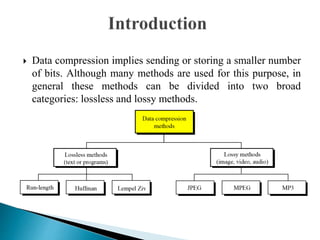
 Data compression implies sending or storing a smaller number
of bits. Although many methods are used for this purpose, in
general these methods can be divided into two broad
categories: lossless and lossy methods.
 In lossless data compression, the integrity of the data is
preserved.
 The original data and the data after compression and
decompression are exactly the same because, in these
methods, the compression and decompression algorithms are
exact inverses of each other: no part of the data is lost in the
process.
 Redundant data is removed in compression and added during
decompression.
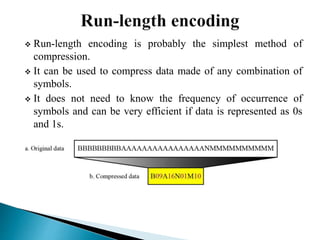
 Run-length encoding is probably the simplest method of
compression.
 It can be used to compress data made of any combination of
symbols.
 It does not need to know the frequency of occurrence of
symbols and can be very efficient if data is represented as 0s
and 1s.
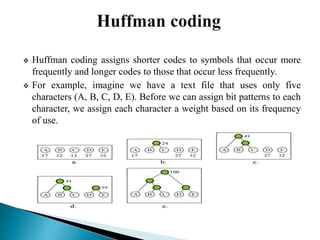
 Huffman coding assigns shorter codes to symbols that occur more
frequently and longer codes to those that occur less frequently.
 For example, imagine we have a text file that uses only five
characters (A, B, C, D, E). Before we can assign bit patterns to each
character, we assign each character a weight based on its frequency
of use.
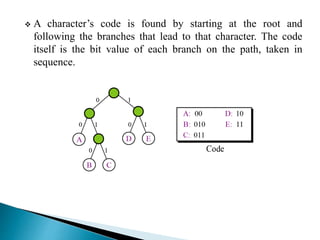
 A character’s code is found by starting at the root and
following the branches that lead to that character. The code
itself is the bit value of each branch on the path, taken in
sequence.
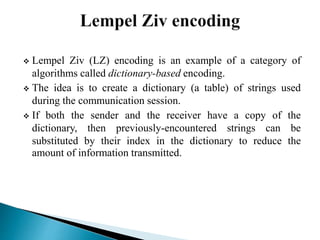
 Lempel Ziv (LZ) encoding is an example of a category of
algorithms called dictionary-based encoding.
 The idea is to create a dictionary (a table) of strings used
during the communication session.
 If both the sender and the receiver have a copy of the
dictionary, then previously-encountered strings can be
substituted by their index in the dictionary to reduce the
amount of information transmitted.
 Our eyes and ears cannot distinguish subtle changes. In such
cases, we can use a lossy data compression method.
 These methods are cheaper—they take less time and space
when it comes to sending millions of bits per second for
images and video.
 Several methods have been developed using lossy
compression techniques. JPEG (Joint Photographic Experts
Group) encoding is used to compress pictures and graphics,
MPEG (Moving Picture Experts Group) encoding is used to
compress video, and MP3 (MPEG audio layer 3) for audio
compression.
 An image can be represented by a two-dimensional array
(table) of picture elements (pixels).
 A grayscale picture of 307,200 pixels is represented by
2,457,600 bits, and a color picture is represented by 7,372,800
bits.
 In JPEG, a grayscale picture is divided into blocks of 8 × 8
pixel blocks to decrease the number of calculations because, as
we will see shortly, the number of mathematical operations for
each picture is the square of the number of units.
 The Moving Picture Experts Group (MPEG) method is used to
compress video. In principle, a motion picture is a rapid
sequence of a set of frames in which each frame is a picture.
 In other words, a frame is a spatial combination of pixels, and
a video is a temporal combination of frames that are sent one
after another.
 Compressing video, then, means spatially compressing each
frame and temporally compressing a set of frames.
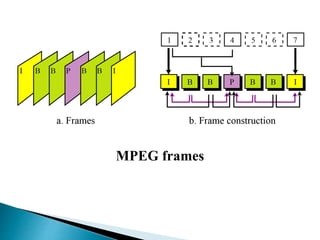
MPEG frames
 Audio compression can be used for speech or music. For
speech we need to compress a 64 kHz digitized signal, while
for music we need to compress a 1.411 MHz signal.
 Two categories of techniques are used for audio compression:
predictive encoding and perceptual encoding.
 In predictive encoding,
thedifferences between
samples are encoded instead
of encoding all the sampled
values.
 This type of compression is
normally used for speech.
Several standards have been
defined such as GSM (13
kbps), G.729 (8 kbps), and
G.723.3 (6.4 or 5.3 kbps).
Detailed discussions of these
techniques are beyond the
scope of this book.
 The most common
compression technique used
to create CD-quality audio
is based on the perceptual
encoding technique.
 This type of audio needs at
least 1.411 Mbps, which
cannot be sent over the
Internet without
compression. MP3 (MPEG
audio layer 3) uses this
technique.

data compression technique

  • 2.
     Data compressionimplies sending or storing a smaller number of bits. Although many methods are used for this purpose, in general these methods can be divided into two broad categories: lossless and lossy methods.
  • 3.
     In losslessdata compression, the integrity of the data is preserved.  The original data and the data after compression and decompression are exactly the same because, in these methods, the compression and decompression algorithms are exact inverses of each other: no part of the data is lost in the process.  Redundant data is removed in compression and added during decompression.
  • 4.
     Run-length encodingis probably the simplest method of compression.  It can be used to compress data made of any combination of symbols.  It does not need to know the frequency of occurrence of symbols and can be very efficient if data is represented as 0s and 1s.
  • 5.
     Huffman codingassigns shorter codes to symbols that occur more frequently and longer codes to those that occur less frequently.  For example, imagine we have a text file that uses only five characters (A, B, C, D, E). Before we can assign bit patterns to each character, we assign each character a weight based on its frequency of use.
  • 6.
     A character’scode is found by starting at the root and following the branches that lead to that character. The code itself is the bit value of each branch on the path, taken in sequence.
  • 7.
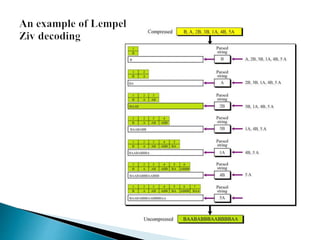
     Lempel Ziv(LZ) encoding is an example of a category of algorithms called dictionary-based encoding.  The idea is to create a dictionary (a table) of strings used during the communication session.  If both the sender and the receiver have a copy of the dictionary, then previously-encountered strings can be substituted by their index in the dictionary to reduce the amount of information transmitted.
  • 9.
     Our eyesand ears cannot distinguish subtle changes. In such cases, we can use a lossy data compression method.  These methods are cheaper—they take less time and space when it comes to sending millions of bits per second for images and video.  Several methods have been developed using lossy compression techniques. JPEG (Joint Photographic Experts Group) encoding is used to compress pictures and graphics, MPEG (Moving Picture Experts Group) encoding is used to compress video, and MP3 (MPEG audio layer 3) for audio compression.
  • 10.
     An imagecan be represented by a two-dimensional array (table) of picture elements (pixels).  A grayscale picture of 307,200 pixels is represented by 2,457,600 bits, and a color picture is represented by 7,372,800 bits.  In JPEG, a grayscale picture is divided into blocks of 8 × 8 pixel blocks to decrease the number of calculations because, as we will see shortly, the number of mathematical operations for each picture is the square of the number of units.
  • 11.
     The MovingPicture Experts Group (MPEG) method is used to compress video. In principle, a motion picture is a rapid sequence of a set of frames in which each frame is a picture.  In other words, a frame is a spatial combination of pixels, and a video is a temporal combination of frames that are sent one after another.  Compressing video, then, means spatially compressing each frame and temporally compressing a set of frames.
  • 12.
  • 13.
     Audio compressioncan be used for speech or music. For speech we need to compress a 64 kHz digitized signal, while for music we need to compress a 1.411 MHz signal.  Two categories of techniques are used for audio compression: predictive encoding and perceptual encoding.
  • 14.
     In predictiveencoding, thedifferences between samples are encoded instead of encoding all the sampled values.  This type of compression is normally used for speech. Several standards have been defined such as GSM (13 kbps), G.729 (8 kbps), and G.723.3 (6.4 or 5.3 kbps). Detailed discussions of these techniques are beyond the scope of this book.  The most common compression technique used to create CD-quality audio is based on the perceptual encoding technique.  This type of audio needs at least 1.411 Mbps, which cannot be sent over the Internet without compression. MP3 (MPEG audio layer 3) uses this technique.