CSD511 – Distributed Systems 
分散式系統 
Chapter 12 
Coordination and Agreement 
吳俊興 
國立高雄大學資訊工程學系
2 
Chapter 12 Coordination and Agreement 
12.1 Introduction 
12.2 Distributed mutual exclusion 
12.3 Elections 
12.4 Multicast communication 
12.5 Consensus and related problems (agreement) 
12.6 Summary
3 
12.1 Introduction 
• Fundamental issue: for a set of processes, how to coordinate 
their actions or to agree on one or more values? 
– even no fixed master-slave relationship between the components 
• Further issue: how to consider and deal with failures when 
designing algorithms 
• Topics covered 
– mutual exclusion 
– how to elect one of a collection of processes to perform a special role 
– multicast communication 
– agreement problem: consensus and byzantine agreement
4 
Failure Assumptions and Failure Detectors 
• Failure assumptions of this chapter 
– Reliable communication channels 
– Processes only fail by crashing unless state otherwise 
• Failure detector: object/code in a process that detects failures 
of other processes 
• unreliable failure detector 
– One of two values: unsuspected or suspected 
• Evidence of possible failures 
– Example: most practical systems 
• Each process sends “alive/I’m here” message to everyone else 
• If not receiving “alive” message after timeout, it’s suspected 
– maybe function correctly, but network partitioned 
• reliable failure detector 
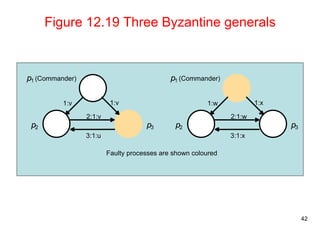
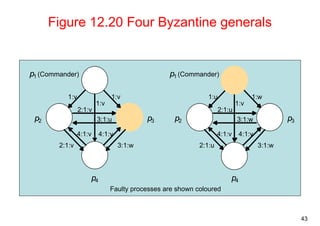
– One of two accurate values: unsuspected or failure 
– few practical systems
5 
12.2 Distributed Mutual Exclusion 
• Process coordination in a multitasking OS 
– Race condition: several processes access and manipulate the same data 
concurrently and the outcome of the execution depends on the particular 
order in which the access take place 
– critical section: when one process is executing in a critical section, no 
other process is to be allowed to execute in its critical section 
– Mutual exclusion: If a process is executing in its critical section, then no 
other processes can be executing in their critical sections 
• Distributed mutual exclusion 
– Provide critical region in a distributed environment 
– message passing 
for example, locking files, lockd daemon in UNIX 
(NFS is stateless, no file-locking at the NFS level)
6 
Algorithms for mutual exclusion 
• Problem: an asynchronous system of N processes 
– processes don't fail 
– message delivery is reliable; not share variables 
– only one critical region 
– application-level protocol: enter(), resourceAccesses(), exit() 
• Requirements for mutual exclusion 
– Essential 
• [ME1] safety: only one process at a time 
• [ME2] liveness: eventually enter or exit 
– Additional 
• [ME3] happened-before ordering: ordering of enter() is the same as HB ordering 
• Performance evaluation 
– overhead and bandwidth consumption: # of messages sent 
– client delay incurred by a process at entry and exit 
– throughput measured by synchronization delay: delay between one's exit 
and next's entry
7 
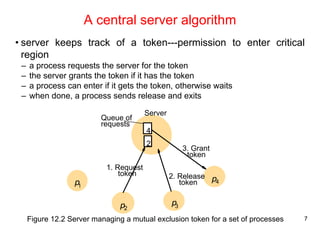
A central server algorithm 
• server keeps track of a token---permission to enter critical 
region 
– a process requests the server for the token 
– the server grants the token if it has the token 
– a process can enter if it gets the token, otherwise waits 
– when done, a process sends release and exits 
Server 
Queue of 
requests 
1. Request 
token 
3. Grant 
token 
2. Release 
token 
4 
2 
p4 
p p3 2 
p1 
Figure 12.2 Server managing a mutual exclusion token for a set of processes
8 
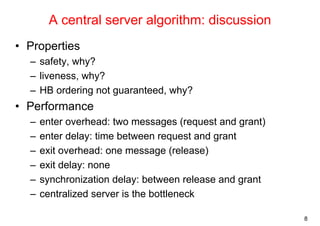
A central server algorithm: discussion 
• Properties 
– safety, why? 
– liveness, why? 
– HB ordering not guaranteed, why? 
• Performance 
– enter overhead: two messages (request and grant) 
– enter delay: time between request and grant 
– exit overhead: one message (release) 
– exit delay: none 
– synchronization delay: between release and grant 
– centralized server is the bottleneck
9 
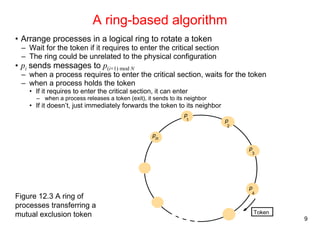
A ring-based algorithm 
• Arrange processes in a logical ring to rotate a token 
– Wait for the token if it requires to enter the critical section 
– The ring could be unrelated to the physical configuration 
• pi sends messages to p(i+1) mod N 
– when a process requires to enter the critical section, waits for the token 
– when a process holds the token 
• If it requires to enter the critical section, it can enter 
– when a process releases a token (exit), it sends to its neighbor 
• If it doesn’t, just immediately forwards the token to its neighbor 
pn 
p 
2 
p 
3 
p 
4 
Token 
p 
1 
Figure 12.3 A ring of 
processes transferring a 
mutual exclusion token
10 
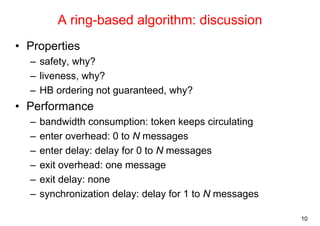
A ring-based algorithm: discussion 
• Properties 
– safety, why? 
– liveness, why? 
– HB ordering not guaranteed, why? 
• Performance 
– bandwidth consumption: token keeps circulating 
– enter overhead: 0 to N messages 
– enter delay: delay for 0 to N messages 
– exit overhead: one message 
– exit delay: none 
– synchronization delay: delay for 1 to N messages
11 
An algorithm using multicast and logical clocks 
• Multicast a request message for the token (Ricart and Agrawala [1981]) 
– enter only if all the other processes reply 
– totally-ordered timestamps: <T, pi > 
• Each process keeps a state: RELEASED, HELD, WANTED 
– if all have state = RELEASED, all reply, a process can hold the token and enter 
– if a process has state = HELD, doesn't reply until it exits 
– if more than one process has state = WANTED, process with the lowest 
timestamp will get all N-1 replies first 
P3 
34 
Reply 
34 
41 
41 
41 
34 
P1 
P2 
Reply 
Reply 
Figure 12.5 Multicast synchronization
12 
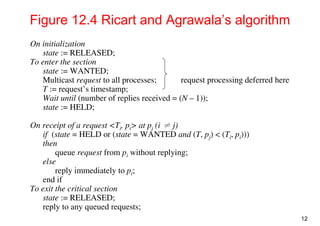
Figure 12.4 Ricart and Agrawala’s algorithm 
On initialization 
state := RELEASED; 
To enter the section 
state := WANTED; 
Multicast request to all processes; request processing deferred here 
T := request’s timestamp; 
Wait until (number of replies received = (N – 1)); 
state := HELD; 
On receipt of a request <Ti, pi> at pj (i ≠ j) 
if (state = HELD or (state = WANTED and (T, pj) < (Ti, pi))) 
then 
queue request from pi without replying; 
else 
reply immediately to pi; 
end if 
To exit the critical section 
state := RELEASED; 
reply to any queued requests;
13 
An algorithm using multicast: discussion 
•Properties 
– safety, why? 
– liveness, why? 
– HB ordering, why? 
• Performance 
– bandwidth consumption: no token keeps circulating 
– entry overhead: 2(N-1), why? [with multicast support: 1 + (N - 
1) = N] 
– entry delay: delay between request and getting all replies 
– exit overhead: 0 to N-1 messages 
– exit delay: none 
– synchronization delay: delay for 1 message (one last reply 
from the previous holder)
14 
Maekawa’s voting algorithm 
•Observation: not all peers to grant it access 
– Only obtain permission from subsets, overlapped by any two processes 
•Maekawa’s approach 
– subsets Vi,Vj for process Pi, Pj 
• Pi ∈Vi, Pj ∈ Vj 
• Vi ∩ Vj ≠ ∅, there is at least one common member 
• subset |Vi|=K, to be fair, each process should have the same size 
– Pi cannot enter the critical section until it has received all K reply messages 
– Choose a subset 
• Simple way (2√N): place processes in a √N by √N matrix and let Vi be the union of 
the row and column containing Pi 
• Optimal (√N): non-trivial to calculate (skim here) 
– Deadlock-prone 
• V1={P1, P2}, V2={P2, P3}, V3={P3, P1} 
• If P1, P2 and P3 concurrently request entry to the critical section, then its possible 
that each process has received one (itself) out of two replies, and none can 
proceed 
• adapted and solved by [Saunders 1987]
15 
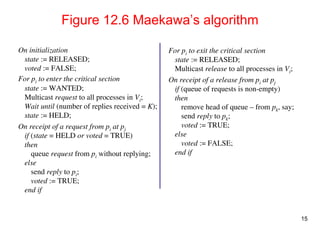
Figure 12.6 Maekawa’s algorithm 
On initialization 
state := RELEASED; 
voted := FALSE; 
For pi to enter the critical section 
state := WANTED; 
Multicast request to all processes in Vi; 
Wait until (number of replies received = K); 
state := HELD; 
On receipt of a request from pi at pj 
if (state = HELD or voted = TRUE) 
then 
queue request from pi without replying; 
else 
send reply to pi; 
voted := TRUE; 
end if 
For pi to exit the critical section 
state := RELEASED; 
Multicast release to all processes in Vi; 
On receipt of a release from pi at pj 
if (queue of requests is non-empty) 
then 
remove head of queue – from pk, say; 
send reply to pk; 
voted := TRUE; 
else 
voted := FALSE; 
end if
16 
12.3 Elections 
• Election: choosing a unique process for a particular role 
– All the processes agree on the unique choice 
– For example, server in dist. mutex 
• Assumptions 
– Each process can call only one election at a time 
– multiple concurrent elections can be called by different processes 
– Participant: engages in an election 
• each process pi has variable electedi = ? (don't know) initially 
• process with the largest identifier wins 
– The (unique) identifier could be any useful value 
• Properties 
– [E1] electedi of a “participant” process must be P (elected process=largest 
id) or ⊥ (undefined) 
– [E2] liveness: all processes participate and eventually set electedi != ⊥ (or 
crash) 
• Performance 
– overhead (bandwidth consumption): # of messages 
– turnaround time: # of messages to complete an election
17 
A ring-based election algorithm 
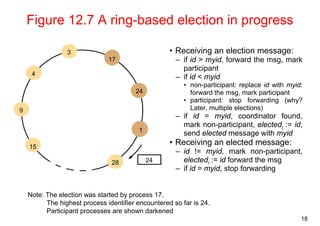
• Arrange processes in a logical ring 
– pi sends messages to p(i+1) mod N 
– It could be unrelated to the physical configuration 
– Elect the coordinator with the largest id 
– Assume no failures 
• Initially, every process is a non-participant. Any process can call 
an election 
– Marks itself as participant 
– Places its id in an election message 
– Sends the message to its neighbor 
– Receiving an election message 
• if id > myid, forward the msg, mark participant 
• if id < myid 
– non-participant: replace id with myid: forward the msg, mark participant 
– participant: stop forwarding (why? Later, multiple elections) 
• if id = myid, coordinator found, mark non-participant, electedi := id, send elected 
message with myid 
– Receiving an elected message 
• id != myid, mark non-participant, electedi := id forward the msg 
• if id = myid, stop forwarding
18 
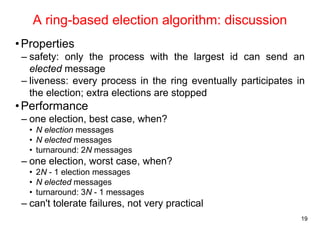
Figure 12.7 A ring-based election in progress 
• Receiving an election message: 
– if id > myid, forward the msg, mark 
participant 
– if id < myid 
• non-participant: replace id with myid: 
forward the msg, mark participant 
• participant: stop forwarding (why? 
Later, multiple elections) 
– if id = myid, coordinator found, 
mark non-participant, electedi := id, 
send elected message with myid 
• Receiving an elected message: 
– id != myid, mark non-participant, 
electedi := id forward the msg 
– if id = myid, stop forwarding 
24 
15 
9 
4 
3 
17 
28 
24 
1 
Note: The election was started by process 17. 
The highest process identifier encountered so far is 24. 
Participant processes are shown darkened
19 
A ring-based election algorithm: discussion 
•Properties 
– safety: only the process with the largest id can send an 
elected message 
– liveness: every process in the ring eventually participates in 
the election; extra elections are stopped 
• Performance 
– one election, best case, when? 
• N election messages 
• N elected messages 
• turnaround: 2N messages 
– one election, worst case, when? 
• 2N - 1 election messages 
• N elected messages 
• turnaround: 3N - 1 messages 
– can't tolerate failures, not very practical
20 
The bully election algorithm 
•Assumption 
– Each process knows which processes have higher identifiers, 
and that it can communicate with all such processes 
•Compare with ring-based election 
– Processes can crash and be detected by timeouts 
• synchronous 
• timeout T = 2Ttransmitting (max transmission delay) + Tprocessing (max 
processing delay) 
•Three types of messages 
– Election: announce an election 
– Answer: in response to Election 
– Coordinator: announce the identity of the elected process
21 
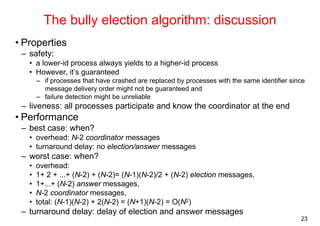
The bully election algorithm: howto 
• Start an election when detect the coordinator has failed or 
begin to replace the coordinator, which has lower identifier 
– Send an election message to all processes with higher id's and waits for 
answers (except the failed coordinator/process) 
• If no answers in time T 
– Considers it is the coordinator 
– sends coordinator message (with its id) to all processes with lower id's 
• else 
– waits for a coordinator message and starts an election if T’ timeout 
– To be a coordinator, it has to start an election 
• A higher id process can replace the current coordinator (hence “bully”) 
– The highest one directly sends a coordinator message to all process with lower identifiers 
• Receiving an election message 
– sends an answer message back 
– starts an election if it hasn't started one—send election messages to all 
higher-id processes (including the “failed” coordinator—the coordinator 
might be up by now) 
• Receiving a coordinator message 
– set electedi to the new coordinator
22 
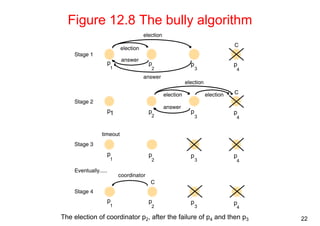
Figure 12.8 The bully algorithm 
p1 p 
2 
p 
3 
C 
p 
4 
p 
1 
p 
2 
p 
3 
p 
4 
C 
coordinator 
Stage 4 
C 
election 
election 
Stage 2 
p 
1 
p 
2 
p 
3 
p 
4 
election 
answer 
answer 
election 
Stage 1 
timeout 
Stage 3 
Eventually..... 
p 
1 
p 
2 
p 
3 p 
4 
election 
answer 
The election of coordinator p2, after the failure of p4 and then p3
23 
The bully election algorithm: discussion 
• Properties 
– safety: 
• a lower-id process always yields to a higher-id process 
• However, it’s guaranteed 
– if processes that have crashed are replaced by processes with the same identifier since 
message delivery order might not be guaranteed and 
– failure detection might be unreliable 
– liveness: all processes participate and know the coordinator at the end 
• Performance 
– best case: when? 
• overhead: N-2 coordinator messages 
• turnaround delay: no election/answer messages 
– worst case: when? 
• overhead: 
• 1+ 2 + ...+ (N-2) + (N-2)= (N-1)(N-2)/2 + (N-2) election messages, 
• 1+...+ (N-2) answer messages, 
• N-2 coordinator messages, 
• total: (N-1)(N-2) + 2(N-2) = (N+1)(N-2) = O(N2) 
– turnaround delay: delay of election and answer messages
24 
12.4 Multicast Communication 
• Group (multicast) communication: for each of a group of 
processes to receive copies of the messages sent to the group, 
often with delivery guarantees 
– The set of messages that every process of the group should receive 
– On the delivery ordering across the group members 
• Challenges 
– Efficiency concerns include minimizing overhead activities and increasing 
throughput and bandwidth utilization 
– Delivery guarantees ensure that operations are completed 
• Types of group 
– Static or dynamic: whether joining or leaving is considered 
– Closed or open 
• A group is said to be closed if only members of the group can multicast to it. A 
process in a closed group sends to itself any messages to the group 
• A group is open if processes outside the group can send to it
25 
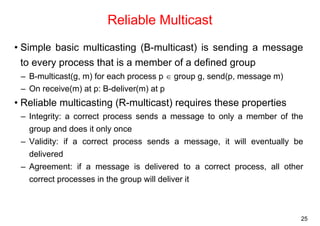
Reliable Multicast 
• Simple basic multicasting (B-multicast) is sending a message 
to every process that is a member of a defined group 
– B-multicast(g, m) for each process p ∈ group g, send(p, message m) 
– On receive(m) at p: B-deliver(m) at p 
• Reliable multicasting (R-multicast) requires these properties 
– Integrity: a correct process sends a message to only a member of the 
group and does it only once 
– Validity: if a correct process sends a message, it will eventually be 
delivered 
– Agreement: if a message is delivered to a correct process, all other 
correct processes in the group will deliver it
26 
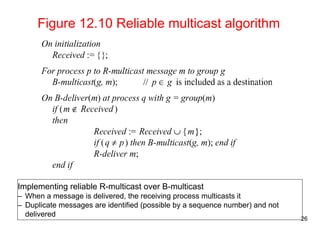
Figure 12.10 Reliable multicast algorithm 
Implementing reliable R-multicast over B-multicast 
– When a message is delivered, the receiving process multicasts it 
– Duplicate messages are identified (possible by a sequence number) and not 
delivered
27 
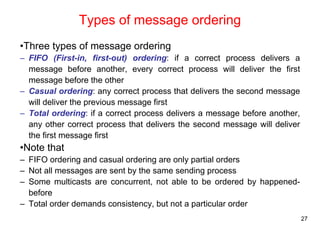
Types of message ordering 
•Three types of message ordering 
– FIFO (First-in, first-out) ordering: if a correct process delivers a 
message before another, every correct process will deliver the first 
message before the other 
– Casual ordering: any correct process that delivers the second message 
will deliver the previous message first 
– Total ordering: if a correct process delivers a message before another, 
any other correct process that delivers the second message will deliver 
the first message first 
•Note that 
– FIFO ordering and casual ordering are only partial orders 
– Not all messages are sent by the same sending process 
– Some multicasts are concurrent, not able to be ordered by happened-before 
– Total order demands consistency, but not a particular order
28 
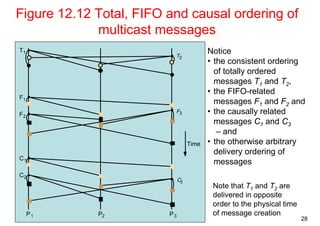
Figure 12.12 Total, FIFO and causal ordering of 
multicast messages 
Notice 
• the consistent ordering 
of totally ordered 
messages T1 and T2, 
• the FIFO-related 
messages F1 and F2 and 
• the causally related 
messages C1 and C3 
– and 
• the otherwise arbitrary 
delivery ordering of 
messages 
F3 
F1 
F2 
T2 
T1 
P1 P2 P3 
Time 
C3 
C1 
C2 
Note that T1 and T2 are 
delivered in opposite 
order to the physical time 
of message creation
29 
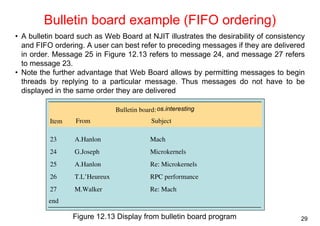
Bulletin board example (FIFO ordering) 
• A bulletin board such as Web Board at NJIT illustrates the desirability of consistency 
and FIFO ordering. A user can best refer to preceding messages if they are delivered 
in order. Message 25 in Figure 12.13 refers to message 24, and message 27 refers 
to message 23. 
• Note the further advantage that Web Board allows by permitting messages to begin 
threads by replying to a particular message. Thus messages do not have to be 
displayed in the same order they are delivered 
Bulletin board: os.interesting 
Item From Subject 
23 A.Hanlon Mach 
24 G.Joseph Microkernels 
25 A.Hanlon Re: Microkernels 
26 T.L’Heureux RPC performance 
27 M.Walker Re: Mach 
end 
Figure 12.13 Display from bulletin board program
30 
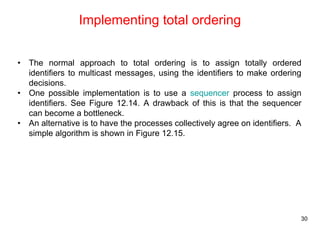
Implementing total ordering 
• The normal approach to total ordering is to assign totally ordered 
identifiers to multicast messages, using the identifiers to make ordering 
decisions. 
• One possible implementation is to use a sequencer process to assign 
identifiers. See Figure 12.14. A drawback of this is that the sequencer 
can become a bottleneck. 
• An alternative is to have the processes collectively agree on identifiers. A 
simple algorithm is shown in Figure 12.15.
31 
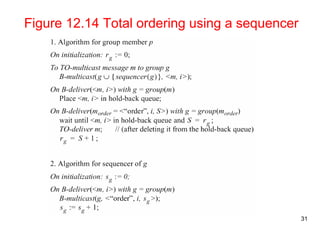
Figure 12.14 Total ordering using a sequencer
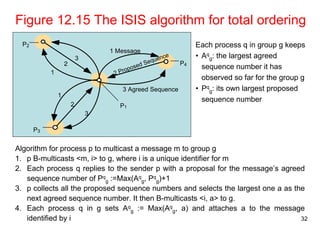
Figure 12.15 The ISIS algorithm for total ordering 
2 
1 
1 
2 
Algorithm for process p to multicast a message m to group g 
1. p B-multicasts <m, i> to g, where i is a unique identifier for m 
2. Each process q replies to the sender p with a proposal for the message’s agreed 
32 
sequence number of Pq 
g :=Max(Aq 
g, Pq 
g)+1 
3. p collects all the proposed sequence numbers and selects the largest one a as the 
next agreed sequence number. It then B-multicasts <i, a> to g. 
4. Each process q in g sets Aq 
g := Max(Aq 
g, a) and attaches a to the message 
identified by i 
1 Message 
P2 
P3 
P1 
P4 
3 Agreed Sequence 
3 
3 
2 Proposed Sequence 
Each process q in group g keeps 
• Aq 
g: the largest agreed 
sequence number it has 
observed so far for the group g 
• Pq 
g: its own largest proposed 
sequence number
33 
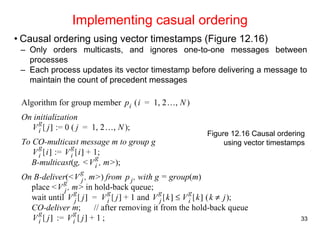
Implementing casual ordering 
• Causal ordering using vector timestamps (Figure 12.16) 
– Only orders multicasts, and ignores one-to-one messages between 
processes 
– Each process updates its vector timestamp before delivering a message to 
maintain the count of precedent messages 
Figure 12.16 Causal ordering 
using vector timestamps
34 
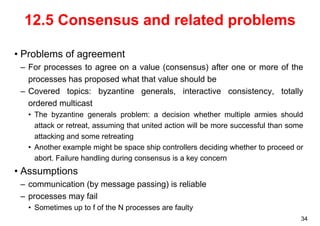
12.5 Consensus and related problems 
• Problems of agreement 
– For processes to agree on a value (consensus) after one or more of the 
processes has proposed what that value should be 
– Covered topics: byzantine generals, interactive consistency, totally 
ordered multicast 
• The byzantine generals problem: a decision whether multiple armies should 
attack or retreat, assuming that united action will be more successful than some 
attacking and some retreating 
• Another example might be space ship controllers deciding whether to proceed or 
abort. Failure handling during consensus is a key concern 
• Assumptions 
– communication (by message passing) is reliable 
– processes may fail 
• Sometimes up to f of the N processes are faulty
35 
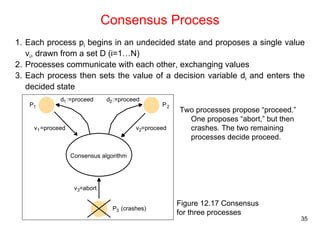
Consensus Process 
1. Each process pi begins in an undecided state and proposes a single value 
vi, drawn from a set D (i=1…N) 
2. Processes communicate with each other, exchanging values 
3. Each process then sets the value of a decision variable di and enters the 
decided state 
1 
P2 
d1:=proceed d2:=proceed 
P3 (crashes) 
P1 
Consensus algorithm 
v1=proceed 
v3=abort 
v2=proceed 
Two processes propose “proceed.” 
One proposes “abort,” but then 
crashes. The two remaining 
processes decide proceed. 
Figure 12.17 Consensus 
for three processes
36 
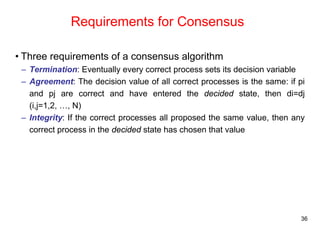
Requirements for Consensus 
• Three requirements of a consensus algorithm 
– Termination: Eventually every correct process sets its decision variable 
– Agreement: The decision value of all correct processes is the same: if pi 
and pj are correct and have entered the decided state, then di=dj 
(i,j=1,2, …, N) 
– Integrity: If the correct processes all proposed the same value, then any 
correct process in the decided state has chosen that value
37 
The byzantine generals problem 
• Problem description 
– Three or more generals must agree to attack or to retreat 
– One general, the commander, issues the order 
– Other generals, the lieutenants, must decide to attack or retreat 
– One or more generals may be treacherous 
• A treacherous general tells one general to attack and another to retreat 
• Difference from consensus is that a single process supplies the 
value to agree on 
• Requirements 
– Termination: eventually each correct process sets its decision variable 
– Agreement: the decision variable of all correct processes is the same 
– Integrity: if the commander is correct, then all correct processes agree on 
the value that the commander has proposed (but the commander need 
not be correct)
38 
The interactive consistency problem 
• Interactive consistency: all correct processes agree on a vector 
of values, one for each process. This is called the decision 
vector 
– Another variant of consensus 
• Requirements 
– Termination: eventually each correct process sets its decision variable 
– Agreement: the decision vector of all correct processes is the same 
– Integrity: if any process is correct, then all correct processes decide the 
correct value for that process
39 
Relating consensus to other problems 
• Consensus (C), Byzantine Generals (BG), and Interactive 
Consensus (IC) are all problems concerned with making 
decisions in the context of arbitrary or crash failures 
• We can sometimes generate solutions for one problem in terms 
of another. For example 
– We can derive IC from BG by running BG N times, once for each process 
with that process acting as commander 
– We can derive C from IC by running IC to produce a vector of values at 
each process, then applying a function to the vector’s values to derive a 
single value. 
– We can derive BG from C by 
• Commander sends proposed value to itself and each remaining process 
• All processes run C with received values 
• They derive BG from the vector of C values
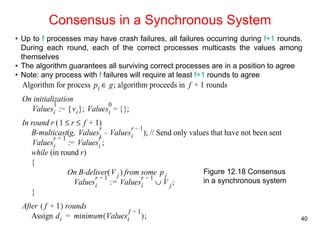
• Up to f processes may have crash failures, all failures occurring during f+1 rounds. 
During each round, each of the correct processes multicasts the values among 
themselves 
• The algorithm guarantees all surviving correct processes are in a position to agree 
• Note: any process with f failures will require at least f+1 rounds to agree 
40 
Consensus in a Synchronous System 
Figure 12.18 Consensus 
in a synchronous system
41 
Limits for solutions to Byzantine Generals 
• Some cases of the Byzantine Generals problems have no 
solutions 
– Lamport et al found that if there are only 3 processes, there is no solution 
– Pease et al found that if the total number of processes is less than three 
times the number of failures plus one, there is no solution 
• Thus there is a solution with 4 processes and 1 failure, if there 
are two rounds 
– In the first, the commander sends the values 
– while in the second, each lieutenant sends the values it received
42 
Figure 12.19 Three Byzantine generals 
p1 (Commander) 
1:v 1:v 
2:1:v 
p2 p3 
3:1:u 
p1 (Commander) 
1:w 1:x 
2:1:w 
p2 p3 
3:1:x 
Faulty processes are shown coloured
43 
Figure 12.20 Four Byzantine generals 
p1 (Commander) 
1:v 1:v 
2:1:v 
1:v 
p2 3:1:u 
p3 
2:1:v 3:1:w 
1:u 1:w 
2:1:u 
4:1:v 
2:1:u 3:1:w 
Faulty processes are shown coloured 
4:1:v 
p4 
4:1:v 
p1 (Commander) 
1:v 
p2 3:1:w 
p3 
p4 
4:1:v
44 
Asynchronous Systems 
• All solutions to consistency and Byzantine generals problems 
are limited to synchronous systems 
• Fischer et al found that there are no solutions in an 
asynchronous system with even one failure 
• This impossibility is circumvented by masking faults or using 
failure detection 
• There is also a partial solution, assuming an adversary 
process, based on introducing random values in the process 
to prevent an effective thwarting strategy. This does not 
always reach consensus

Chapter 11d coordination agreement

  • 1.
    CSD511 – DistributedSystems 分散式系統 Chapter 12 Coordination and Agreement 吳俊興 國立高雄大學資訊工程學系
  • 2.
    2 Chapter 12Coordination and Agreement 12.1 Introduction 12.2 Distributed mutual exclusion 12.3 Elections 12.4 Multicast communication 12.5 Consensus and related problems (agreement) 12.6 Summary
  • 3.
    3 12.1 Introduction • Fundamental issue: for a set of processes, how to coordinate their actions or to agree on one or more values? – even no fixed master-slave relationship between the components • Further issue: how to consider and deal with failures when designing algorithms • Topics covered – mutual exclusion – how to elect one of a collection of processes to perform a special role – multicast communication – agreement problem: consensus and byzantine agreement
  • 4.
    4 Failure Assumptionsand Failure Detectors • Failure assumptions of this chapter – Reliable communication channels – Processes only fail by crashing unless state otherwise • Failure detector: object/code in a process that detects failures of other processes • unreliable failure detector – One of two values: unsuspected or suspected • Evidence of possible failures – Example: most practical systems • Each process sends “alive/I’m here” message to everyone else • If not receiving “alive” message after timeout, it’s suspected – maybe function correctly, but network partitioned • reliable failure detector – One of two accurate values: unsuspected or failure – few practical systems
  • 5.
    5 12.2 DistributedMutual Exclusion • Process coordination in a multitasking OS – Race condition: several processes access and manipulate the same data concurrently and the outcome of the execution depends on the particular order in which the access take place – critical section: when one process is executing in a critical section, no other process is to be allowed to execute in its critical section – Mutual exclusion: If a process is executing in its critical section, then no other processes can be executing in their critical sections • Distributed mutual exclusion – Provide critical region in a distributed environment – message passing for example, locking files, lockd daemon in UNIX (NFS is stateless, no file-locking at the NFS level)
  • 6.
    6 Algorithms formutual exclusion • Problem: an asynchronous system of N processes – processes don't fail – message delivery is reliable; not share variables – only one critical region – application-level protocol: enter(), resourceAccesses(), exit() • Requirements for mutual exclusion – Essential • [ME1] safety: only one process at a time • [ME2] liveness: eventually enter or exit – Additional • [ME3] happened-before ordering: ordering of enter() is the same as HB ordering • Performance evaluation – overhead and bandwidth consumption: # of messages sent – client delay incurred by a process at entry and exit – throughput measured by synchronization delay: delay between one's exit and next's entry
  • 7.
    7 A centralserver algorithm • server keeps track of a token---permission to enter critical region – a process requests the server for the token – the server grants the token if it has the token – a process can enter if it gets the token, otherwise waits – when done, a process sends release and exits Server Queue of requests 1. Request token 3. Grant token 2. Release token 4 2 p4 p p3 2 p1 Figure 12.2 Server managing a mutual exclusion token for a set of processes
  • 8.
    8 A centralserver algorithm: discussion • Properties – safety, why? – liveness, why? – HB ordering not guaranteed, why? • Performance – enter overhead: two messages (request and grant) – enter delay: time between request and grant – exit overhead: one message (release) – exit delay: none – synchronization delay: between release and grant – centralized server is the bottleneck
  • 9.
    9 A ring-basedalgorithm • Arrange processes in a logical ring to rotate a token – Wait for the token if it requires to enter the critical section – The ring could be unrelated to the physical configuration • pi sends messages to p(i+1) mod N – when a process requires to enter the critical section, waits for the token – when a process holds the token • If it requires to enter the critical section, it can enter – when a process releases a token (exit), it sends to its neighbor • If it doesn’t, just immediately forwards the token to its neighbor pn p 2 p 3 p 4 Token p 1 Figure 12.3 A ring of processes transferring a mutual exclusion token
  • 10.
    10 A ring-basedalgorithm: discussion • Properties – safety, why? – liveness, why? – HB ordering not guaranteed, why? • Performance – bandwidth consumption: token keeps circulating – enter overhead: 0 to N messages – enter delay: delay for 0 to N messages – exit overhead: one message – exit delay: none – synchronization delay: delay for 1 to N messages
  • 11.
    11 An algorithmusing multicast and logical clocks • Multicast a request message for the token (Ricart and Agrawala [1981]) – enter only if all the other processes reply – totally-ordered timestamps: <T, pi > • Each process keeps a state: RELEASED, HELD, WANTED – if all have state = RELEASED, all reply, a process can hold the token and enter – if a process has state = HELD, doesn't reply until it exits – if more than one process has state = WANTED, process with the lowest timestamp will get all N-1 replies first P3 34 Reply 34 41 41 41 34 P1 P2 Reply Reply Figure 12.5 Multicast synchronization
  • 12.
    12 Figure 12.4Ricart and Agrawala’s algorithm On initialization state := RELEASED; To enter the section state := WANTED; Multicast request to all processes; request processing deferred here T := request’s timestamp; Wait until (number of replies received = (N – 1)); state := HELD; On receipt of a request <Ti, pi> at pj (i ≠ j) if (state = HELD or (state = WANTED and (T, pj) < (Ti, pi))) then queue request from pi without replying; else reply immediately to pi; end if To exit the critical section state := RELEASED; reply to any queued requests;
  • 13.
    13 An algorithmusing multicast: discussion •Properties – safety, why? – liveness, why? – HB ordering, why? • Performance – bandwidth consumption: no token keeps circulating – entry overhead: 2(N-1), why? [with multicast support: 1 + (N - 1) = N] – entry delay: delay between request and getting all replies – exit overhead: 0 to N-1 messages – exit delay: none – synchronization delay: delay for 1 message (one last reply from the previous holder)
  • 14.
    14 Maekawa’s votingalgorithm •Observation: not all peers to grant it access – Only obtain permission from subsets, overlapped by any two processes •Maekawa’s approach – subsets Vi,Vj for process Pi, Pj • Pi ∈Vi, Pj ∈ Vj • Vi ∩ Vj ≠ ∅, there is at least one common member • subset |Vi|=K, to be fair, each process should have the same size – Pi cannot enter the critical section until it has received all K reply messages – Choose a subset • Simple way (2√N): place processes in a √N by √N matrix and let Vi be the union of the row and column containing Pi • Optimal (√N): non-trivial to calculate (skim here) – Deadlock-prone • V1={P1, P2}, V2={P2, P3}, V3={P3, P1} • If P1, P2 and P3 concurrently request entry to the critical section, then its possible that each process has received one (itself) out of two replies, and none can proceed • adapted and solved by [Saunders 1987]
  • 15.
    15 Figure 12.6Maekawa’s algorithm On initialization state := RELEASED; voted := FALSE; For pi to enter the critical section state := WANTED; Multicast request to all processes in Vi; Wait until (number of replies received = K); state := HELD; On receipt of a request from pi at pj if (state = HELD or voted = TRUE) then queue request from pi without replying; else send reply to pi; voted := TRUE; end if For pi to exit the critical section state := RELEASED; Multicast release to all processes in Vi; On receipt of a release from pi at pj if (queue of requests is non-empty) then remove head of queue – from pk, say; send reply to pk; voted := TRUE; else voted := FALSE; end if
  • 16.
    16 12.3 Elections • Election: choosing a unique process for a particular role – All the processes agree on the unique choice – For example, server in dist. mutex • Assumptions – Each process can call only one election at a time – multiple concurrent elections can be called by different processes – Participant: engages in an election • each process pi has variable electedi = ? (don't know) initially • process with the largest identifier wins – The (unique) identifier could be any useful value • Properties – [E1] electedi of a “participant” process must be P (elected process=largest id) or ⊥ (undefined) – [E2] liveness: all processes participate and eventually set electedi != ⊥ (or crash) • Performance – overhead (bandwidth consumption): # of messages – turnaround time: # of messages to complete an election
  • 17.
    17 A ring-basedelection algorithm • Arrange processes in a logical ring – pi sends messages to p(i+1) mod N – It could be unrelated to the physical configuration – Elect the coordinator with the largest id – Assume no failures • Initially, every process is a non-participant. Any process can call an election – Marks itself as participant – Places its id in an election message – Sends the message to its neighbor – Receiving an election message • if id > myid, forward the msg, mark participant • if id < myid – non-participant: replace id with myid: forward the msg, mark participant – participant: stop forwarding (why? Later, multiple elections) • if id = myid, coordinator found, mark non-participant, electedi := id, send elected message with myid – Receiving an elected message • id != myid, mark non-participant, electedi := id forward the msg • if id = myid, stop forwarding
  • 18.
    18 Figure 12.7A ring-based election in progress • Receiving an election message: – if id > myid, forward the msg, mark participant – if id < myid • non-participant: replace id with myid: forward the msg, mark participant • participant: stop forwarding (why? Later, multiple elections) – if id = myid, coordinator found, mark non-participant, electedi := id, send elected message with myid • Receiving an elected message: – id != myid, mark non-participant, electedi := id forward the msg – if id = myid, stop forwarding 24 15 9 4 3 17 28 24 1 Note: The election was started by process 17. The highest process identifier encountered so far is 24. Participant processes are shown darkened
  • 19.
    19 A ring-basedelection algorithm: discussion •Properties – safety: only the process with the largest id can send an elected message – liveness: every process in the ring eventually participates in the election; extra elections are stopped • Performance – one election, best case, when? • N election messages • N elected messages • turnaround: 2N messages – one election, worst case, when? • 2N - 1 election messages • N elected messages • turnaround: 3N - 1 messages – can't tolerate failures, not very practical
  • 20.
    20 The bullyelection algorithm •Assumption – Each process knows which processes have higher identifiers, and that it can communicate with all such processes •Compare with ring-based election – Processes can crash and be detected by timeouts • synchronous • timeout T = 2Ttransmitting (max transmission delay) + Tprocessing (max processing delay) •Three types of messages – Election: announce an election – Answer: in response to Election – Coordinator: announce the identity of the elected process
  • 21.
    21 The bullyelection algorithm: howto • Start an election when detect the coordinator has failed or begin to replace the coordinator, which has lower identifier – Send an election message to all processes with higher id's and waits for answers (except the failed coordinator/process) • If no answers in time T – Considers it is the coordinator – sends coordinator message (with its id) to all processes with lower id's • else – waits for a coordinator message and starts an election if T’ timeout – To be a coordinator, it has to start an election • A higher id process can replace the current coordinator (hence “bully”) – The highest one directly sends a coordinator message to all process with lower identifiers • Receiving an election message – sends an answer message back – starts an election if it hasn't started one—send election messages to all higher-id processes (including the “failed” coordinator—the coordinator might be up by now) • Receiving a coordinator message – set electedi to the new coordinator
  • 22.
    22 Figure 12.8The bully algorithm p1 p 2 p 3 C p 4 p 1 p 2 p 3 p 4 C coordinator Stage 4 C election election Stage 2 p 1 p 2 p 3 p 4 election answer answer election Stage 1 timeout Stage 3 Eventually..... p 1 p 2 p 3 p 4 election answer The election of coordinator p2, after the failure of p4 and then p3
  • 23.
    23 The bullyelection algorithm: discussion • Properties – safety: • a lower-id process always yields to a higher-id process • However, it’s guaranteed – if processes that have crashed are replaced by processes with the same identifier since message delivery order might not be guaranteed and – failure detection might be unreliable – liveness: all processes participate and know the coordinator at the end • Performance – best case: when? • overhead: N-2 coordinator messages • turnaround delay: no election/answer messages – worst case: when? • overhead: • 1+ 2 + ...+ (N-2) + (N-2)= (N-1)(N-2)/2 + (N-2) election messages, • 1+...+ (N-2) answer messages, • N-2 coordinator messages, • total: (N-1)(N-2) + 2(N-2) = (N+1)(N-2) = O(N2) – turnaround delay: delay of election and answer messages
  • 24.
    24 12.4 MulticastCommunication • Group (multicast) communication: for each of a group of processes to receive copies of the messages sent to the group, often with delivery guarantees – The set of messages that every process of the group should receive – On the delivery ordering across the group members • Challenges – Efficiency concerns include minimizing overhead activities and increasing throughput and bandwidth utilization – Delivery guarantees ensure that operations are completed • Types of group – Static or dynamic: whether joining or leaving is considered – Closed or open • A group is said to be closed if only members of the group can multicast to it. A process in a closed group sends to itself any messages to the group • A group is open if processes outside the group can send to it
  • 25.
    25 Reliable Multicast • Simple basic multicasting (B-multicast) is sending a message to every process that is a member of a defined group – B-multicast(g, m) for each process p ∈ group g, send(p, message m) – On receive(m) at p: B-deliver(m) at p • Reliable multicasting (R-multicast) requires these properties – Integrity: a correct process sends a message to only a member of the group and does it only once – Validity: if a correct process sends a message, it will eventually be delivered – Agreement: if a message is delivered to a correct process, all other correct processes in the group will deliver it
  • 26.
    26 Figure 12.10Reliable multicast algorithm Implementing reliable R-multicast over B-multicast – When a message is delivered, the receiving process multicasts it – Duplicate messages are identified (possible by a sequence number) and not delivered
  • 27.
    27 Types ofmessage ordering •Three types of message ordering – FIFO (First-in, first-out) ordering: if a correct process delivers a message before another, every correct process will deliver the first message before the other – Casual ordering: any correct process that delivers the second message will deliver the previous message first – Total ordering: if a correct process delivers a message before another, any other correct process that delivers the second message will deliver the first message first •Note that – FIFO ordering and casual ordering are only partial orders – Not all messages are sent by the same sending process – Some multicasts are concurrent, not able to be ordered by happened-before – Total order demands consistency, but not a particular order
  • 28.
    28 Figure 12.12Total, FIFO and causal ordering of multicast messages Notice • the consistent ordering of totally ordered messages T1 and T2, • the FIFO-related messages F1 and F2 and • the causally related messages C1 and C3 – and • the otherwise arbitrary delivery ordering of messages F3 F1 F2 T2 T1 P1 P2 P3 Time C3 C1 C2 Note that T1 and T2 are delivered in opposite order to the physical time of message creation
  • 29.
    29 Bulletin boardexample (FIFO ordering) • A bulletin board such as Web Board at NJIT illustrates the desirability of consistency and FIFO ordering. A user can best refer to preceding messages if they are delivered in order. Message 25 in Figure 12.13 refers to message 24, and message 27 refers to message 23. • Note the further advantage that Web Board allows by permitting messages to begin threads by replying to a particular message. Thus messages do not have to be displayed in the same order they are delivered Bulletin board: os.interesting Item From Subject 23 A.Hanlon Mach 24 G.Joseph Microkernels 25 A.Hanlon Re: Microkernels 26 T.L’Heureux RPC performance 27 M.Walker Re: Mach end Figure 12.13 Display from bulletin board program
  • 30.
    30 Implementing totalordering • The normal approach to total ordering is to assign totally ordered identifiers to multicast messages, using the identifiers to make ordering decisions. • One possible implementation is to use a sequencer process to assign identifiers. See Figure 12.14. A drawback of this is that the sequencer can become a bottleneck. • An alternative is to have the processes collectively agree on identifiers. A simple algorithm is shown in Figure 12.15.
  • 31.
    31 Figure 12.14Total ordering using a sequencer
  • 32.
    Figure 12.15 TheISIS algorithm for total ordering 2 1 1 2 Algorithm for process p to multicast a message m to group g 1. p B-multicasts <m, i> to g, where i is a unique identifier for m 2. Each process q replies to the sender p with a proposal for the message’s agreed 32 sequence number of Pq g :=Max(Aq g, Pq g)+1 3. p collects all the proposed sequence numbers and selects the largest one a as the next agreed sequence number. It then B-multicasts <i, a> to g. 4. Each process q in g sets Aq g := Max(Aq g, a) and attaches a to the message identified by i 1 Message P2 P3 P1 P4 3 Agreed Sequence 3 3 2 Proposed Sequence Each process q in group g keeps • Aq g: the largest agreed sequence number it has observed so far for the group g • Pq g: its own largest proposed sequence number
  • 33.
    33 Implementing casualordering • Causal ordering using vector timestamps (Figure 12.16) – Only orders multicasts, and ignores one-to-one messages between processes – Each process updates its vector timestamp before delivering a message to maintain the count of precedent messages Figure 12.16 Causal ordering using vector timestamps
  • 34.
    34 12.5 Consensusand related problems • Problems of agreement – For processes to agree on a value (consensus) after one or more of the processes has proposed what that value should be – Covered topics: byzantine generals, interactive consistency, totally ordered multicast • The byzantine generals problem: a decision whether multiple armies should attack or retreat, assuming that united action will be more successful than some attacking and some retreating • Another example might be space ship controllers deciding whether to proceed or abort. Failure handling during consensus is a key concern • Assumptions – communication (by message passing) is reliable – processes may fail • Sometimes up to f of the N processes are faulty
  • 35.
    35 Consensus Process 1. Each process pi begins in an undecided state and proposes a single value vi, drawn from a set D (i=1…N) 2. Processes communicate with each other, exchanging values 3. Each process then sets the value of a decision variable di and enters the decided state 1 P2 d1:=proceed d2:=proceed P3 (crashes) P1 Consensus algorithm v1=proceed v3=abort v2=proceed Two processes propose “proceed.” One proposes “abort,” but then crashes. The two remaining processes decide proceed. Figure 12.17 Consensus for three processes
  • 36.
    36 Requirements forConsensus • Three requirements of a consensus algorithm – Termination: Eventually every correct process sets its decision variable – Agreement: The decision value of all correct processes is the same: if pi and pj are correct and have entered the decided state, then di=dj (i,j=1,2, …, N) – Integrity: If the correct processes all proposed the same value, then any correct process in the decided state has chosen that value
  • 37.
    37 The byzantinegenerals problem • Problem description – Three or more generals must agree to attack or to retreat – One general, the commander, issues the order – Other generals, the lieutenants, must decide to attack or retreat – One or more generals may be treacherous • A treacherous general tells one general to attack and another to retreat • Difference from consensus is that a single process supplies the value to agree on • Requirements – Termination: eventually each correct process sets its decision variable – Agreement: the decision variable of all correct processes is the same – Integrity: if the commander is correct, then all correct processes agree on the value that the commander has proposed (but the commander need not be correct)
  • 38.
    38 The interactiveconsistency problem • Interactive consistency: all correct processes agree on a vector of values, one for each process. This is called the decision vector – Another variant of consensus • Requirements – Termination: eventually each correct process sets its decision variable – Agreement: the decision vector of all correct processes is the same – Integrity: if any process is correct, then all correct processes decide the correct value for that process
  • 39.
    39 Relating consensusto other problems • Consensus (C), Byzantine Generals (BG), and Interactive Consensus (IC) are all problems concerned with making decisions in the context of arbitrary or crash failures • We can sometimes generate solutions for one problem in terms of another. For example – We can derive IC from BG by running BG N times, once for each process with that process acting as commander – We can derive C from IC by running IC to produce a vector of values at each process, then applying a function to the vector’s values to derive a single value. – We can derive BG from C by • Commander sends proposed value to itself and each remaining process • All processes run C with received values • They derive BG from the vector of C values
  • 40.
    • Up tof processes may have crash failures, all failures occurring during f+1 rounds. During each round, each of the correct processes multicasts the values among themselves • The algorithm guarantees all surviving correct processes are in a position to agree • Note: any process with f failures will require at least f+1 rounds to agree 40 Consensus in a Synchronous System Figure 12.18 Consensus in a synchronous system
  • 41.
    41 Limits forsolutions to Byzantine Generals • Some cases of the Byzantine Generals problems have no solutions – Lamport et al found that if there are only 3 processes, there is no solution – Pease et al found that if the total number of processes is less than three times the number of failures plus one, there is no solution • Thus there is a solution with 4 processes and 1 failure, if there are two rounds – In the first, the commander sends the values – while in the second, each lieutenant sends the values it received
  • 42.
    42 Figure 12.19Three Byzantine generals p1 (Commander) 1:v 1:v 2:1:v p2 p3 3:1:u p1 (Commander) 1:w 1:x 2:1:w p2 p3 3:1:x Faulty processes are shown coloured
  • 43.
    43 Figure 12.20Four Byzantine generals p1 (Commander) 1:v 1:v 2:1:v 1:v p2 3:1:u p3 2:1:v 3:1:w 1:u 1:w 2:1:u 4:1:v 2:1:u 3:1:w Faulty processes are shown coloured 4:1:v p4 4:1:v p1 (Commander) 1:v p2 3:1:w p3 p4 4:1:v
  • 44.
    44 Asynchronous Systems • All solutions to consistency and Byzantine generals problems are limited to synchronous systems • Fischer et al found that there are no solutions in an asynchronous system with even one failure • This impossibility is circumvented by masking faults or using failure detection • There is also a partial solution, assuming an adversary process, based on introducing random values in the process to prevent an effective thwarting strategy. This does not always reach consensus