CS 3551 DISTRIBUTED
COMPUTING
Critical Section + Mutual Exclusion
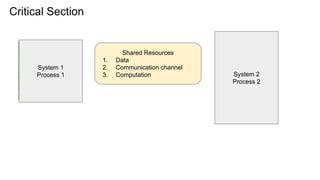
Critical Section
System 1
Process 1 System 2
Process 2
Shared Resources
1. Data
2. Communication channel
3. Computation
Critical Section
● In process synchronization, a critical section is a section of code that accesses shared
resources such as variables or data structures, and which must be executed by only one
process at a time to avoid race conditions and other synchronization-related issues.
● Mutual exclusion ensures that concurrent access of processes to a shared resource or data is
serialized, that is, executed in a mutually exclusive manner
● In a distributed system, shared variables (semaphores) or a local kernel cannot be used to
implement mutual exclusion.
● Message passing is the sole means for implementing distributed mutual exclusion.
● The decision as to which process is allowed access to the CS next is arrived at by message
passing, in which each process learns about the state of all other processes in some
consistent way
3 Approaches for Implementing Mutex
Key Points
● Token Based Approach
○ In the token-based approach, a unique token (also known as the PRIVILEGE message) is shared
among the sites.
○ A site is allowed to enter its CS if it possesses the token and it continues to hold the token until the
execution of the CS is over.
○ Mutual exclusion is ensured because the token is unique.
● Non-token-based approach
○ two or more successive rounds of messages are exchanged among the sites to determine which site
will enter the CS next.
○ A site enters the critical section (CS) when an assertion, defined on its local variables, becomes true.
Mutual exclusion is enforced because the assertion becomes true only at one site at any given time.
● Quorum-based approach
○ each site requests permission to execute the CS from a subset of sites (called a quorum).
○ The quorums are formed in such a way that when two sites concurrently request access to the CS, at
least one site receives both the requests and this site is responsible to make sure that only one
request executes the CS at any time.
1. System Model
● The system consists of N sites, S1
, S2
, , SN
.with a single process is running on each site.
● The process at site Si
is denoted by pi
.
● All these processes communicate asynchronously over an underlying communication
network.
● A process wishing to enter the CS requests all other or a subset of processes by sending
REQUEST messages, and waits for appropriate replies before entering the CS.
● While waiting the process is not allowed to make further requests to enter the CS.
● States for a Site:
○ requesting the CS
○ executing the CS
○ or neither requesting nor executing the CS (i.e., idle).
● In the “requesting the CS” state, the site is blocked and cannot make further requests for
the CS.
● In the “idle” state, the site is executing outside the CS.
● In the token-based algorithms, a site can also be in a state where a site holding the token is
executing outside the CS. Such state is referred to as the idle token state.
● At any instant, a site may have several pending requests for CS. A site queues up these
requests and serves them one at a time.
● the smaller the timestamp of a request, the higher its priority to execute the CS
2. Requirements for Algorithms
3. Performance Metrics
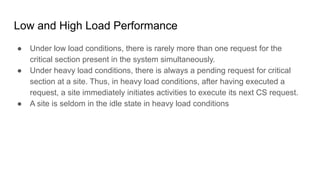
Low and High Load Performance
● Under low load conditions, there is rarely more than one request for the
critical section present in the system simultaneously.
● Under heavy load conditions, there is always a pending request for critical
section at a site. Thus, in heavy load conditions, after having executed a
request, a site immediately initiates activities to execute its next CS request.
● A site is seldom in the idle state in heavy load conditions
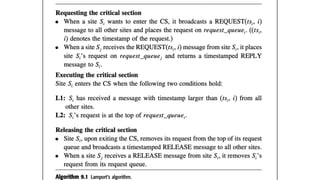
Lamport’s Algorithm
Student
Coordinator
HOD
Dean
Key Points
● The algorithm is fair in the sense that a request for CS are executed in the order of
their timestamps and time is determined by logical clocks.
● When a site processes a request for the CS, it updates its local clock and assigns
the request a timestamp.
● The algorithm executes CS requests in the increasing order of timestamps.
● Every site Si
keeps a queue, request_queuei
, which contains mutual exclusion
requests ordered by their timestamps. (Note that this queue is different from the
queue that contains local requests for CS execution awaiting their turn.)
● This algorithm requires communication channels to deliver messages in FIFO order.
● When a site removes a request from its request queue, its own request may come
at the top of the queue, enabling it to enter the CS. Clearly, when a site receives a
REQUEST, REPLY, or RELEASE message, it updates its clock using the timestamp
in the message
Lamport’s algorithm achieves mutual exclusion
Lamport’s algorithm is fair.
Unit 3 Part 1.pdf distribution computing

Unit 3 Part 1.pdf distribution computing

  • 1.
  • 2.
    Critical Section +Mutual Exclusion
  • 3.
    Critical Section System 1 Process1 System 2 Process 2 Shared Resources 1. Data 2. Communication channel 3. Computation
  • 4.
    Critical Section ● Inprocess synchronization, a critical section is a section of code that accesses shared resources such as variables or data structures, and which must be executed by only one process at a time to avoid race conditions and other synchronization-related issues. ● Mutual exclusion ensures that concurrent access of processes to a shared resource or data is serialized, that is, executed in a mutually exclusive manner ● In a distributed system, shared variables (semaphores) or a local kernel cannot be used to implement mutual exclusion. ● Message passing is the sole means for implementing distributed mutual exclusion. ● The decision as to which process is allowed access to the CS next is arrived at by message passing, in which each process learns about the state of all other processes in some consistent way
  • 5.
    3 Approaches forImplementing Mutex
  • 6.
    Key Points ● TokenBased Approach ○ In the token-based approach, a unique token (also known as the PRIVILEGE message) is shared among the sites. ○ A site is allowed to enter its CS if it possesses the token and it continues to hold the token until the execution of the CS is over. ○ Mutual exclusion is ensured because the token is unique. ● Non-token-based approach ○ two or more successive rounds of messages are exchanged among the sites to determine which site will enter the CS next. ○ A site enters the critical section (CS) when an assertion, defined on its local variables, becomes true. Mutual exclusion is enforced because the assertion becomes true only at one site at any given time. ● Quorum-based approach ○ each site requests permission to execute the CS from a subset of sites (called a quorum). ○ The quorums are formed in such a way that when two sites concurrently request access to the CS, at least one site receives both the requests and this site is responsible to make sure that only one request executes the CS at any time.
  • 8.
    1. System Model ●The system consists of N sites, S1 , S2 , , SN .with a single process is running on each site. ● The process at site Si is denoted by pi . ● All these processes communicate asynchronously over an underlying communication network. ● A process wishing to enter the CS requests all other or a subset of processes by sending REQUEST messages, and waits for appropriate replies before entering the CS. ● While waiting the process is not allowed to make further requests to enter the CS. ● States for a Site: ○ requesting the CS ○ executing the CS ○ or neither requesting nor executing the CS (i.e., idle). ● In the “requesting the CS” state, the site is blocked and cannot make further requests for the CS. ● In the “idle” state, the site is executing outside the CS. ● In the token-based algorithms, a site can also be in a state where a site holding the token is executing outside the CS. Such state is referred to as the idle token state. ● At any instant, a site may have several pending requests for CS. A site queues up these requests and serves them one at a time. ● the smaller the timestamp of a request, the higher its priority to execute the CS
  • 9.
  • 10.
  • 12.
    Low and HighLoad Performance ● Under low load conditions, there is rarely more than one request for the critical section present in the system simultaneously. ● Under heavy load conditions, there is always a pending request for critical section at a site. Thus, in heavy load conditions, after having executed a request, a site immediately initiates activities to execute its next CS request. ● A site is seldom in the idle state in heavy load conditions
  • 14.
  • 18.
    Key Points ● Thealgorithm is fair in the sense that a request for CS are executed in the order of their timestamps and time is determined by logical clocks. ● When a site processes a request for the CS, it updates its local clock and assigns the request a timestamp. ● The algorithm executes CS requests in the increasing order of timestamps. ● Every site Si keeps a queue, request_queuei , which contains mutual exclusion requests ordered by their timestamps. (Note that this queue is different from the queue that contains local requests for CS execution awaiting their turn.) ● This algorithm requires communication channels to deliver messages in FIFO order. ● When a site removes a request from its request queue, its own request may come at the top of the queue, enabling it to enter the CS. Clearly, when a site receives a REQUEST, REPLY, or RELEASE message, it updates its clock using the timestamp in the message

  • 20.
  • 22.