POST’s CORRESPONDENCE PROBLEM
• General Objective:
– to understand the concept of PCP
• Specific Objectives
– State the objective of PCP
– Define PCP problem
– Check whether the PCP instance have a solution or not.
– Define MPCP
– Illustrate the conversion of TM to MPCP with an example
Post Correspondence Problem
• It involves with strings
• Goal:
– To prove this problem about strings to be
undecidable
Post Correspondence Problem
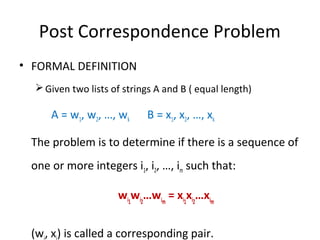
• FORMAL DEFINITION
Given two lists of strings A and B ( equal length)
A = w1, w2, …, wk B = x1, x2, …, xk
The problem is to determine if there is a sequence of
one or more integers i1, i2, …, im such that:
wi1
wi2
…wim
= xi1
xi2
…xim
(w, x) is called a corresponding pair.
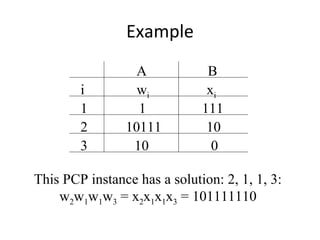
Example
A B
i
1
2
3
wi
1
10111
10
xi
111
10
0
This PCP instance has a solution: 2, 1, 1, 3:
w2w1w1w3 = x2x1x1x3 = 101111110
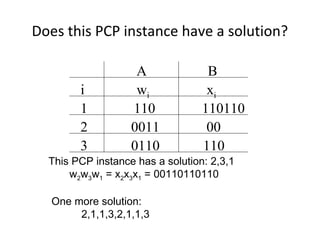
Does this PCP instance have a solution?
A B
i
1
2
3
wi
110
0011
0110
xi
110110
00
110
This PCP instance has a solution: 2,3,1
w2w3w1 = x2x3x1 = 00110110110
One more solution:
2,1,1,3,2,1,1,3
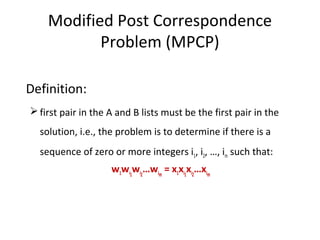
Modified Post Correspondence
Problem (MPCP)
Definition:
first pair in the A and B lists must be the first pair in the
solution, i.e., the problem is to determine if there is a
sequence of zero or more integers i1, i2, …, im such that:
w1wi1
wi2
…wim
= x1xi1
xi2
…xim
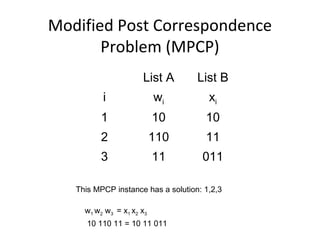
Modified Post Correspondence
Problem (MPCP)
List A List B
i wi xi
1 10 10
2 110 11
3 11 011
This MPCP instance has a solution: 1,2,3
w1 w2 w3 = x1 x2 x3
10 110 11 = 10 11 011
Undecidability of PCP
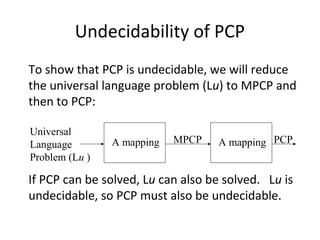
To show that PCP is undecidable, we will reduce
the universal language problem (Lu) to MPCP and
then to PCP:
If PCP can be solved, Lu can also be solved. Lu is
undecidable, so PCP must also be undecidable.
Universal
Language
Problem (Lu )
MPCP PCPA mapping A mapping
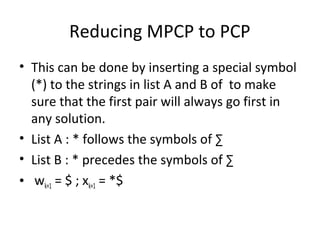
Reducing MPCP to PCP
• This can be done by inserting a special symbol
(*) to the strings in list A and B of to make
sure that the first pair will always go first in
any solution.
• List A : * follows the symbols of ∑
• List B : * precedes the symbols of ∑
• wk+1 = $ ; xk+1 = *$
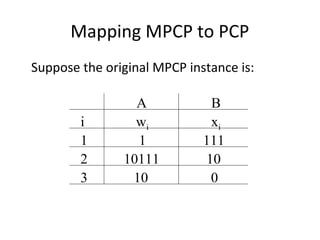
Mapping MPCP to PCP
Suppose the original MPCP instance is:
A B
i
1
2
3
wi
1
10111
10
xi
111
10
0
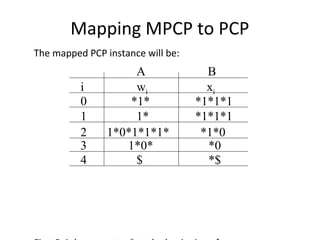
Mapping MPCP to PCP
The mapped PCP instance will be:
A B
i
0
1
2
wi
*1*
1*0*1*1*1*
1*0*
xi
*1*1*1
*1*0
*03
4
1* *1*1*1
$ *$
Mapping Lu to MPCP
• Turing machine M and an input w, we want to
determine if M will accept w.
• the mapped MPCP instance should have a
solution if and only if M accepts w.
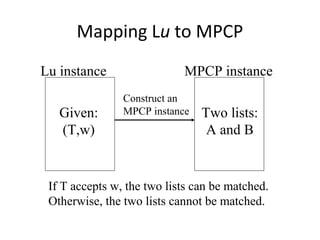
Mapping Lu to MPCP
Given:
(T,w)
Two lists:
A and B
Construct an
MPCP instance
If T accepts w, the two lists can be matched.
Otherwise, the two lists cannot be matched.
Lu instance MPCP instance
Rules of Reducing Lu to MPCP
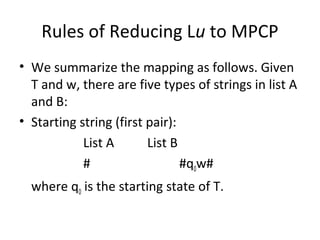
• We summarize the mapping as follows. Given
T and w, there are five types of strings in list A
and B:
• Starting string (first pair):
List A List B
# #q0w#
where q0 is the starting state of T.
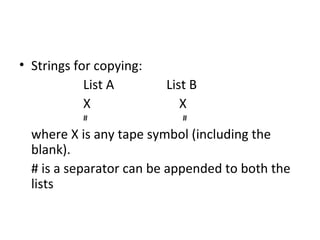
• Strings for copying:
List A List B
X X
# #
where X is any tape symbol (including the
blank).
# is a separator can be appended to both the
lists
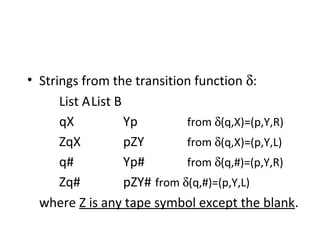
• Strings from the transition function δ:
List AList B
qX Yp from δ(q,X)=(p,Y,R)
ZqX pZY from δ(q,X)=(p,Y,L)
q# Yp# from δ(q,#)=(p,Y,R)
Zq# pZY# from δ(q,#)=(p,Y,L)
where Z is any tape symbol except the blank.
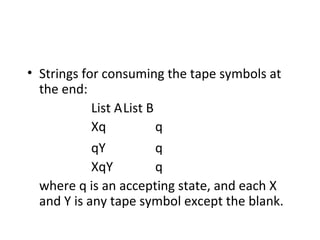
• Strings for consuming the tape symbols at
the end:
List AList B
Xq q
qY q
XqY q
where q is an accepting state, and each X
and Y is any tape symbol except the blank.
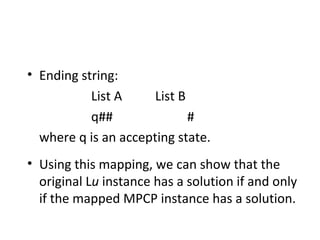
• Ending string:
List A List B
q## #
where q is an accepting state.
• Using this mapping, we can show that the
original Lu instance has a solution if and only
if the mapped MPCP instance has a solution.
PCP is undecidable
• Theorm: Post’s Correspondence Problem is undecidable.
• We have seen the reduction of MPCP to PCP
• now we see how to reduce Lu to MPCP.
– M accepts w if and only if the constructed MPCP instance has a
solution.
– As Lu is undecidable, MPCP is also undecidable.
Rice Theorem
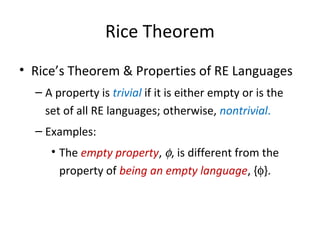
• Rice’s Theorem & Properties of RE Languages
– A property is trivial if it is either empty or is the
set of all RE languages; otherwise, nontrivial.
– Examples:
• The empty property, φ, is different from the
property of being an empty language, {φ}.
Undecidable Problems about
Turing Machines
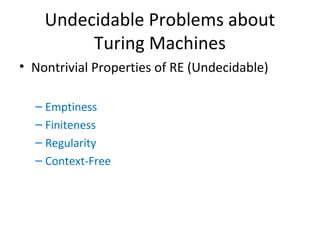
• Nontrivial Properties of RE (Undecidable)
– Emptiness
– Finiteness
– Regularity
– Context-Free
Rice Theorem
• Theorem:
– Every nontrivial property of the RE language is
undecidable.
• Proof:
– Let P be the nontrivial property of RE.
– Assume Ø, the empty language is not in P
– Since P is nontrivial, there must be some non-
empty language L is in P
– Let MLbe a TM accepting L.
Rice Theorem
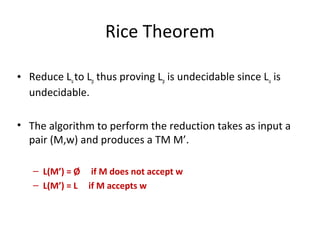
• Reduce Luto Lp thus proving Lp is undecidable since Lu is
undecidable.
• The algorithm to perform the reduction takes as input a
pair (M,w) and produces a TM M’.
– L(M’) = Ø if M does not accept w
– L(M’) = L if M accepts w
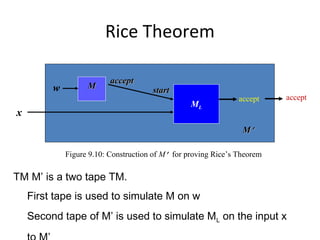
Rice Theorem
MM’’
ML
MM
acceptaccept
x
Figure 9.10: Construction of M’ for proving Rice’s Theorem
accept accept
w startstart
TM M’ is a two tape TM.
First tape is used to simulate M on w
Second tape of M’ is used to simulate ML on the input x
26
Undecidable Problems about
Turing Machines
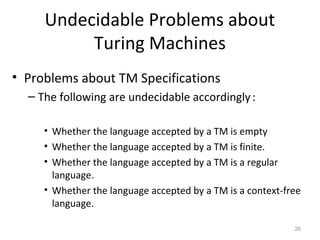
• Problems about TM Specifications
– The following are undecidable accordingly:
• Whether the language accepted by a TM is empty
• Whether the language accepted by a TM is finite.
• Whether the language accepted by a TM is a regular
language.
• Whether the language accepted by a TM is a context-free
language.

POST’s CORRESPONDENCE PROBLEM

  • 1.
  • 2.
    • General Objective: –to understand the concept of PCP • Specific Objectives – State the objective of PCP – Define PCP problem – Check whether the PCP instance have a solution or not. – Define MPCP – Illustrate the conversion of TM to MPCP with an example
  • 3.
    Post Correspondence Problem •It involves with strings • Goal: – To prove this problem about strings to be undecidable
  • 4.
    Post Correspondence Problem •FORMAL DEFINITION Given two lists of strings A and B ( equal length) A = w1, w2, …, wk B = x1, x2, …, xk The problem is to determine if there is a sequence of one or more integers i1, i2, …, im such that: wi1 wi2 …wim = xi1 xi2 …xim (w, x) is called a corresponding pair.
  • 5.
    Example A B i 1 2 3 wi 1 10111 10 xi 111 10 0 This PCPinstance has a solution: 2, 1, 1, 3: w2w1w1w3 = x2x1x1x3 = 101111110
  • 6.
    Does this PCPinstance have a solution? A B i 1 2 3 wi 110 0011 0110 xi 110110 00 110 This PCP instance has a solution: 2,3,1 w2w3w1 = x2x3x1 = 00110110110 One more solution: 2,1,1,3,2,1,1,3
  • 7.
    Modified Post Correspondence Problem(MPCP) Definition: first pair in the A and B lists must be the first pair in the solution, i.e., the problem is to determine if there is a sequence of zero or more integers i1, i2, …, im such that: w1wi1 wi2 …wim = x1xi1 xi2 …xim
  • 8.
    Modified Post Correspondence Problem(MPCP) List A List B i wi xi 1 10 10 2 110 11 3 11 011 This MPCP instance has a solution: 1,2,3 w1 w2 w3 = x1 x2 x3 10 110 11 = 10 11 011
  • 9.
    Undecidability of PCP Toshow that PCP is undecidable, we will reduce the universal language problem (Lu) to MPCP and then to PCP: If PCP can be solved, Lu can also be solved. Lu is undecidable, so PCP must also be undecidable. Universal Language Problem (Lu ) MPCP PCPA mapping A mapping
  • 10.
    Reducing MPCP toPCP • This can be done by inserting a special symbol (*) to the strings in list A and B of to make sure that the first pair will always go first in any solution. • List A : * follows the symbols of ∑ • List B : * precedes the symbols of ∑ • wk+1 = $ ; xk+1 = *$
  • 11.
    Mapping MPCP toPCP Suppose the original MPCP instance is: A B i 1 2 3 wi 1 10111 10 xi 111 10 0
  • 12.
    Mapping MPCP toPCP The mapped PCP instance will be: A B i 0 1 2 wi *1* 1*0*1*1*1* 1*0* xi *1*1*1 *1*0 *03 4 1* *1*1*1 $ *$
  • 13.
    Mapping Lu toMPCP • Turing machine M and an input w, we want to determine if M will accept w. • the mapped MPCP instance should have a solution if and only if M accepts w.
  • 14.
    Mapping Lu toMPCP Given: (T,w) Two lists: A and B Construct an MPCP instance If T accepts w, the two lists can be matched. Otherwise, the two lists cannot be matched. Lu instance MPCP instance
  • 15.
    Rules of ReducingLu to MPCP • We summarize the mapping as follows. Given T and w, there are five types of strings in list A and B: • Starting string (first pair): List A List B # #q0w# where q0 is the starting state of T.
  • 16.
    • Strings forcopying: List A List B X X # # where X is any tape symbol (including the blank). # is a separator can be appended to both the lists
  • 17.
    • Strings fromthe transition function δ: List AList B qX Yp from δ(q,X)=(p,Y,R) ZqX pZY from δ(q,X)=(p,Y,L) q# Yp# from δ(q,#)=(p,Y,R) Zq# pZY# from δ(q,#)=(p,Y,L) where Z is any tape symbol except the blank.
  • 18.
    • Strings forconsuming the tape symbols at the end: List AList B Xq q qY q XqY q where q is an accepting state, and each X and Y is any tape symbol except the blank.
  • 19.
    • Ending string: ListA List B q## # where q is an accepting state. • Using this mapping, we can show that the original Lu instance has a solution if and only if the mapped MPCP instance has a solution.
  • 20.
    PCP is undecidable •Theorm: Post’s Correspondence Problem is undecidable. • We have seen the reduction of MPCP to PCP • now we see how to reduce Lu to MPCP. – M accepts w if and only if the constructed MPCP instance has a solution. – As Lu is undecidable, MPCP is also undecidable.
  • 21.
    Rice Theorem • Rice’sTheorem & Properties of RE Languages – A property is trivial if it is either empty or is the set of all RE languages; otherwise, nontrivial. – Examples: • The empty property, φ, is different from the property of being an empty language, {φ}.
  • 22.
    Undecidable Problems about TuringMachines • Nontrivial Properties of RE (Undecidable) – Emptiness – Finiteness – Regularity – Context-Free
  • 23.
    Rice Theorem • Theorem: –Every nontrivial property of the RE language is undecidable. • Proof: – Let P be the nontrivial property of RE. – Assume Ø, the empty language is not in P – Since P is nontrivial, there must be some non- empty language L is in P – Let MLbe a TM accepting L.
  • 24.
    Rice Theorem • ReduceLuto Lp thus proving Lp is undecidable since Lu is undecidable. • The algorithm to perform the reduction takes as input a pair (M,w) and produces a TM M’. – L(M’) = Ø if M does not accept w – L(M’) = L if M accepts w
  • 25.
    Rice Theorem MM’’ ML MM acceptaccept x Figure 9.10:Construction of M’ for proving Rice’s Theorem accept accept w startstart TM M’ is a two tape TM. First tape is used to simulate M on w Second tape of M’ is used to simulate ML on the input x
  • 26.
    26 Undecidable Problems about TuringMachines • Problems about TM Specifications – The following are undecidable accordingly: • Whether the language accepted by a TM is empty • Whether the language accepted by a TM is finite. • Whether the language accepted by a TM is a regular language. • Whether the language accepted by a TM is a context-free language.