Ms.A.Dhivya M.Sc.,M.Phil.,
Assistant Professor
 Load on a system/node can correspond to the queue length
of tasks/ processes that need to be processed.
 Queue length of waiting tasks: proportional to task
response time, hence a good indicator of system load.
 Distributing load: transfer tasks/processes among nodes.
 If a task transfer (from another node) takes a long time,
the node may accept more tasks during the transfer time.
 Causes the node to be highly loaded. Affects performance.
 Solution: artificially increment the queue length when a
task is accepted for transfer from remote node (to account
for the proposed increased in load).
 Task transfer can fail? : use timeouts.
 Static load distribution algorithms: Decisions are
hard-coded into an algorithm with a priori knowledge
of system.
 Dynamic load distribution: use system state
information such as task queue length, processor
utilization.
 Adaptive load distribution: adapt the approach based
on system state.
 (e.g.,) Dynamic distribution algorithms collect load
information from nodes even at very high system loads.
 Load information collection itself can add load on the system
as messages need to be exchanged.
 Adaptive distribution algorithms may stop collecting state
information at high loads.
 Load balancing: Equalize load on the participating
nodes.
 Transfer tasks even if a node is not heavily loaded so that
queue lengths on all nodes are approximately equal.
 More number of task transfers, might degrade performance.
 Load sharing: Reduce burden of an overloaded node.
 Transfer tasks only when the queue length exceeds a certain
threshold.
 Less number of task transfers.
 Anticipatory task transfers: transfer from overloaded
nodes to ones that are likely to become idle/lightly
loaded.
 More like load balancing, but may be less number of transfers.
 Preemptive task transfers: transfer tasks that are
partially executed.
 Expensive as it involves collection of task states.
 Task state: virtual memory image, process control block, IO
buffers, file pointers, timers, ...
 Non-preemptive task transfers: transfer tasks that
have not begun execution.
 Do not require transfer of task states.
 Can be considered as task placements. Suitable for load
sharing not for load balancing.
 Both transfers involve information on user’s current
working directory, task privileges/priority.
 Transfer policy: to decide whether a node needs to
transfer tasks.
 Thresholds, perhaps in terms of number of tasks, are generally
used. (Another threshold can be processor utilization).
 When a load on a node exceeds a threshold T, the node becomes a
sender. When it falls below a threshold, it becomes a receiver.
 Selection Policy: to decide which task is to be transferred.
 Criteria: task transfer should lead to reduced response time, i.e.,
transfer overhead should be worth incurring.
 Simplest approach: select newly originated tasks. Transfer costs
lower as no state information is to be transferred. Non-
preemptive transfers.
 Other factors for selection: smaller tasks have less overhead.
Location-dependent system calls minimal (else, messages need to
be exchanged to perform system calls at the original node).
 Location Policy: to decide the receiving node for a task.
 Polling is generally used. A node polls/checks whether another is
suitable and willing.
 Polling can be done serially or in parallel (using multicast).
 Alternative: broadcasting a query, sort of invitation to share load.
 Information policy: for collecting system state
information. The collected information is used by transfer,
selection, and location.
 Demand-driven Collection: Only when a node is highly or lightly
loaded, i.e., when a node becomes a potential sender or receiver.
 Can be sender-initiated, receiver-initiated, or both(symmetric).
 Periodic: May not be adaptive. Collection may be done at high
loads worsening system performance.
 State-change driven: only when state changes by a certain
degree.
 Unstable system: long term arrival rate of work to a
system is greater than the CPU power.
 Load sharing/balancing algorithm may add to the
system load making it unstable. (e.g.,) load
information collection at high system loads.
 Effectiveness of algorithm: Effective if it improves
the performance relative to that of a system not using
it. (Effective algorithm cannot be unstable).
 Load balancing algorithms should avoid fruitless
actions. (e.g.,) processor thrashing: task transfer
makes the receiver highly loaded, so the task gets
transferred again, perhaps repeatedly.
 Sender-initiated: distribution initiated by an
overloaded node.
 Receiver-initiated: distribution initiated by lightly
loaded nodes.
 Symmetric: initiated by both senders and receivers.
Has advantages and disadvantages of both the
approaches.
 Adaptive: sensitive to state of the system.
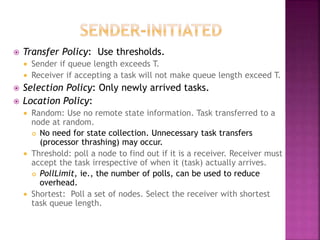
 Transfer Policy: Use thresholds.
 Sender if queue length exceeds T.
 Receiver if accepting a task will not make queue length exceed T.
 Selection Policy: Only newly arrived tasks.
 Location Policy:
 Random: Use no remote state information. Task transferred to a
node at random.
 No need for state collection. Unnecessary task transfers
(processor thrashing) may occur.
 Threshold: poll a node to find out if it is a receiver. Receiver must
accept the task irrespective of when it (task) actually arrives.
 PollLimit, ie., the number of polls, can be used to reduce
overhead.
 Shortest: Poll a set of nodes. Select the receiver with shortest
task queue length.
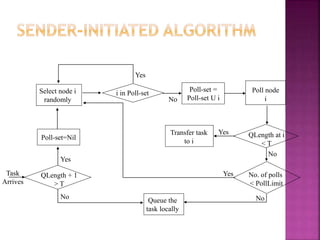
QLength + 1
> T
Poll-set=Nil
Select node i
randomly
i in Poll-set
Poll-set =
Poll-set U i
Poll node
i
QLength at i
< T
Transfer task
to i
No. of polls
< PollLimit
Queue the
task locally
Task
Arrives
Yes
No
Yes
No
Yes
No
No
Yes
 Information Policy: demand-driven.
 Stability: can become unstable at high loads.
 At high loads, it may become difficult for senders to find
receivers.
 Also, the number of senders increase at high system loads
thereby increasing the polling activity.
 Polling activity may make the system unstable at high loads.
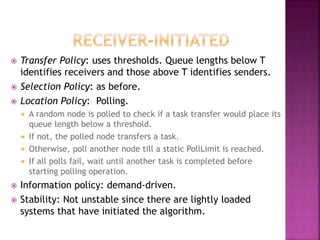
 Transfer Policy: uses thresholds. Queue lengths below T
identifies receivers and those above T identifies senders.
 Selection Policy: as before.
 Location Policy: Polling.
 A random node is polled to check if a task transfer would place its
queue length below a threshold.
 If not, the polled node transfers a task.
 Otherwise, poll another node till a static PollLimit is reached.
 If all polls fail, wait until another task is completed before
starting polling operation.
 Information policy: demand-driven.
 Stability: Not unstable since there are lightly loaded
systems that have initiated the algorithm.
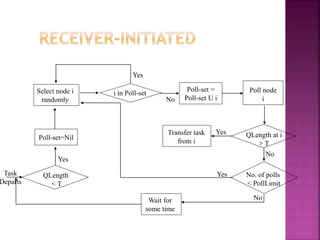
QLength
< T
Poll-set=Nil
Select node i
randomly
i in Poll-set
Poll-set =
Poll-set U i
Poll node
i
QLength at i
> T
Transfer task
from i
No. of polls
< PollLimit
Wait for
some time
Task
Departs
Yes
Yes
No
Yes
No
No
Yes
 Drawback:
 Polling initiated by receiver implies that it is difficult to find
senders with new tasks.
 Reason: systems try to schedule tasks as and when they arrive.
 Effect: receiver-initiated approach might result in preemptive
transfers. Hence transfer costs are more.
 Sender-initiated: transfer costs are low as new jobs are
transferred and so no need for transferring task states.
 Senders search for receivers and vice-versa.
 Low loads: senders can find receivers easily. High
loads: receivers can find senders easily.
 May have disadvantages of both: polling at high loads
can make the system unstable. Receiver-initiated task
transfers can be preemptive and so expensive.
 Simple algorithm: combine previous two approaches.
 Above-average algorithm:
 Transfer Policy: Two adaptive thresholds instead of one. If a
node’s estimated average load is A, a higher threshold TooHigh
> A and a lower threshold TooLow < A are used.
 Load < TooLow -> receiver. Load > TooHigh -> sender.
 Location policy:
 Sender Component
 Node with TooHigh load, broadcasts a TooHigh message, sets
TooHigh timer, and listens for an Accept message.
 A receiver that gets the (TooHigh) message sends an Accept
message, increases its load, and sets AwaitingTask timer.
 If the AwaitingTask timer expires, load is decremented.
 On receiving the Accept message: if the node is still a sender, it
chooses the best task to transfer and transfers it to the node.
 When sender is waiting for Accept, it may receive a TooLow
message (receiver initiated). Sender sends TooHigh to that
receiver. Do step 2 & 3.
 On expiration of TooHigh timer, if no Accept message is received,
system is highly loaded. Sender broadcasts a ChangeAverage
message.
 Receiver Component
 Node with TooLow load, broadcasts a TooLow message, sets a
TooLow timer, and listens for TooHigh message.
 If TooHigh message is received, do step 2 & 3 in Sender
Component.
 If TooLow timer expires before receiving any TooHigh message,
receiver broadcasts a ChangeAverage message to decrease the
load estimate at other nodes.
 Selection Policy: as discussed before.
 Information policy: demand driven. Average load is
modified based on system load. High loads may have less
number of senders progressively.
 Average system load is determined individually. There is a range
of acceptable load before trying to be a sender or a receiver.
 Limit Sender’s polling actions at high load to avoid instability.
 Utilize the collected state information during previous polling
operations to classify nodes as: Sender/overloaded,
receiver/underloaded, OK (in acceptable load range).
 Maintained as separate lists for each class.
 Initially, each node assumes that all others are receivers.
 Location policy at sender:
 Sender polls the head of the receiver list.
 Polled node puts the sender at the head of it sender list. It informs the
sender whether it is a receiver, a sender, or a OK node.
 If the polled node is still a receiver, the new task is transferred.
 Else the sender updates the polled node’s status, polls the next
potential receiver.
 If this polling process fails to identify a receiver, the task can still be
transferred during a receiver-initiated dialogue.
 Location policy at receiver
 Receivers obtain tasks from potential senders. Lists are scanned
in the following order.
 Head to tail in senders list (most up-to-date info used), tail to head in
OK list (least up-to-date used), tail to head in receiver list.
 Least up-to-date used in the hope that status might have changed.
 Receiver polls the selected node. If the node is a sender, a task
is transferred.
 If the node is not a sender, both the polled node and receiver
update each other’s status.
 Polling process stops if a sender is found or a static PollLimit is
reached.
 At high loads, sender-initiated polling gradually reduces
as nodes get removed from receiver list (and become
senders).
 Whereas at low loads, sender will generally find some receiver.
 At high loads, receiver-initiated works and can find a
sender.
 At low loads, receiver may not find senders, but that does not
affect the performance.
 Algorithm dynamically becomes sender-initiated at low
loads and receiver-initiated at high loads.
 Hence, algorithm is stable and can use non-preemptive
transfers at low loads (sender initiated).

Types of Load distributing algorithm in Distributed System

  • 1.
  • 2.
     Load ona system/node can correspond to the queue length of tasks/ processes that need to be processed.  Queue length of waiting tasks: proportional to task response time, hence a good indicator of system load.  Distributing load: transfer tasks/processes among nodes.  If a task transfer (from another node) takes a long time, the node may accept more tasks during the transfer time.  Causes the node to be highly loaded. Affects performance.  Solution: artificially increment the queue length when a task is accepted for transfer from remote node (to account for the proposed increased in load).  Task transfer can fail? : use timeouts.
  • 3.
     Static loaddistribution algorithms: Decisions are hard-coded into an algorithm with a priori knowledge of system.  Dynamic load distribution: use system state information such as task queue length, processor utilization.  Adaptive load distribution: adapt the approach based on system state.  (e.g.,) Dynamic distribution algorithms collect load information from nodes even at very high system loads.  Load information collection itself can add load on the system as messages need to be exchanged.  Adaptive distribution algorithms may stop collecting state information at high loads.
  • 4.
     Load balancing:Equalize load on the participating nodes.  Transfer tasks even if a node is not heavily loaded so that queue lengths on all nodes are approximately equal.  More number of task transfers, might degrade performance.  Load sharing: Reduce burden of an overloaded node.  Transfer tasks only when the queue length exceeds a certain threshold.  Less number of task transfers.  Anticipatory task transfers: transfer from overloaded nodes to ones that are likely to become idle/lightly loaded.  More like load balancing, but may be less number of transfers.
  • 5.
     Preemptive tasktransfers: transfer tasks that are partially executed.  Expensive as it involves collection of task states.  Task state: virtual memory image, process control block, IO buffers, file pointers, timers, ...  Non-preemptive task transfers: transfer tasks that have not begun execution.  Do not require transfer of task states.  Can be considered as task placements. Suitable for load sharing not for load balancing.  Both transfers involve information on user’s current working directory, task privileges/priority.
  • 6.
     Transfer policy:to decide whether a node needs to transfer tasks.  Thresholds, perhaps in terms of number of tasks, are generally used. (Another threshold can be processor utilization).  When a load on a node exceeds a threshold T, the node becomes a sender. When it falls below a threshold, it becomes a receiver.  Selection Policy: to decide which task is to be transferred.  Criteria: task transfer should lead to reduced response time, i.e., transfer overhead should be worth incurring.  Simplest approach: select newly originated tasks. Transfer costs lower as no state information is to be transferred. Non- preemptive transfers.  Other factors for selection: smaller tasks have less overhead. Location-dependent system calls minimal (else, messages need to be exchanged to perform system calls at the original node).
  • 7.
     Location Policy:to decide the receiving node for a task.  Polling is generally used. A node polls/checks whether another is suitable and willing.  Polling can be done serially or in parallel (using multicast).  Alternative: broadcasting a query, sort of invitation to share load.  Information policy: for collecting system state information. The collected information is used by transfer, selection, and location.  Demand-driven Collection: Only when a node is highly or lightly loaded, i.e., when a node becomes a potential sender or receiver.  Can be sender-initiated, receiver-initiated, or both(symmetric).  Periodic: May not be adaptive. Collection may be done at high loads worsening system performance.  State-change driven: only when state changes by a certain degree.
  • 8.
     Unstable system:long term arrival rate of work to a system is greater than the CPU power.  Load sharing/balancing algorithm may add to the system load making it unstable. (e.g.,) load information collection at high system loads.  Effectiveness of algorithm: Effective if it improves the performance relative to that of a system not using it. (Effective algorithm cannot be unstable).  Load balancing algorithms should avoid fruitless actions. (e.g.,) processor thrashing: task transfer makes the receiver highly loaded, so the task gets transferred again, perhaps repeatedly.
  • 9.
     Sender-initiated: distributioninitiated by an overloaded node.  Receiver-initiated: distribution initiated by lightly loaded nodes.  Symmetric: initiated by both senders and receivers. Has advantages and disadvantages of both the approaches.  Adaptive: sensitive to state of the system.
  • 10.
     Transfer Policy:Use thresholds.  Sender if queue length exceeds T.  Receiver if accepting a task will not make queue length exceed T.  Selection Policy: Only newly arrived tasks.  Location Policy:  Random: Use no remote state information. Task transferred to a node at random.  No need for state collection. Unnecessary task transfers (processor thrashing) may occur.  Threshold: poll a node to find out if it is a receiver. Receiver must accept the task irrespective of when it (task) actually arrives.  PollLimit, ie., the number of polls, can be used to reduce overhead.  Shortest: Poll a set of nodes. Select the receiver with shortest task queue length.
  • 11.
    QLength + 1 >T Poll-set=Nil Select node i randomly i in Poll-set Poll-set = Poll-set U i Poll node i QLength at i < T Transfer task to i No. of polls < PollLimit Queue the task locally Task Arrives Yes No Yes No Yes No No Yes
  • 12.
     Information Policy:demand-driven.  Stability: can become unstable at high loads.  At high loads, it may become difficult for senders to find receivers.  Also, the number of senders increase at high system loads thereby increasing the polling activity.  Polling activity may make the system unstable at high loads.
  • 13.
     Transfer Policy:uses thresholds. Queue lengths below T identifies receivers and those above T identifies senders.  Selection Policy: as before.  Location Policy: Polling.  A random node is polled to check if a task transfer would place its queue length below a threshold.  If not, the polled node transfers a task.  Otherwise, poll another node till a static PollLimit is reached.  If all polls fail, wait until another task is completed before starting polling operation.  Information policy: demand-driven.  Stability: Not unstable since there are lightly loaded systems that have initiated the algorithm.
  • 14.
    QLength < T Poll-set=Nil Select nodei randomly i in Poll-set Poll-set = Poll-set U i Poll node i QLength at i > T Transfer task from i No. of polls < PollLimit Wait for some time Task Departs Yes Yes No Yes No No Yes
  • 15.
     Drawback:  Pollinginitiated by receiver implies that it is difficult to find senders with new tasks.  Reason: systems try to schedule tasks as and when they arrive.  Effect: receiver-initiated approach might result in preemptive transfers. Hence transfer costs are more.  Sender-initiated: transfer costs are low as new jobs are transferred and so no need for transferring task states.
  • 16.
     Senders searchfor receivers and vice-versa.  Low loads: senders can find receivers easily. High loads: receivers can find senders easily.  May have disadvantages of both: polling at high loads can make the system unstable. Receiver-initiated task transfers can be preemptive and so expensive.  Simple algorithm: combine previous two approaches.  Above-average algorithm:  Transfer Policy: Two adaptive thresholds instead of one. If a node’s estimated average load is A, a higher threshold TooHigh > A and a lower threshold TooLow < A are used.  Load < TooLow -> receiver. Load > TooHigh -> sender.
  • 17.
     Location policy: Sender Component  Node with TooHigh load, broadcasts a TooHigh message, sets TooHigh timer, and listens for an Accept message.  A receiver that gets the (TooHigh) message sends an Accept message, increases its load, and sets AwaitingTask timer.  If the AwaitingTask timer expires, load is decremented.  On receiving the Accept message: if the node is still a sender, it chooses the best task to transfer and transfers it to the node.  When sender is waiting for Accept, it may receive a TooLow message (receiver initiated). Sender sends TooHigh to that receiver. Do step 2 & 3.  On expiration of TooHigh timer, if no Accept message is received, system is highly loaded. Sender broadcasts a ChangeAverage message.
  • 18.
     Receiver Component Node with TooLow load, broadcasts a TooLow message, sets a TooLow timer, and listens for TooHigh message.  If TooHigh message is received, do step 2 & 3 in Sender Component.  If TooLow timer expires before receiving any TooHigh message, receiver broadcasts a ChangeAverage message to decrease the load estimate at other nodes.  Selection Policy: as discussed before.  Information policy: demand driven. Average load is modified based on system load. High loads may have less number of senders progressively.  Average system load is determined individually. There is a range of acceptable load before trying to be a sender or a receiver.
  • 19.
     Limit Sender’spolling actions at high load to avoid instability.  Utilize the collected state information during previous polling operations to classify nodes as: Sender/overloaded, receiver/underloaded, OK (in acceptable load range).  Maintained as separate lists for each class.  Initially, each node assumes that all others are receivers.  Location policy at sender:  Sender polls the head of the receiver list.  Polled node puts the sender at the head of it sender list. It informs the sender whether it is a receiver, a sender, or a OK node.  If the polled node is still a receiver, the new task is transferred.  Else the sender updates the polled node’s status, polls the next potential receiver.  If this polling process fails to identify a receiver, the task can still be transferred during a receiver-initiated dialogue.
  • 20.
     Location policyat receiver  Receivers obtain tasks from potential senders. Lists are scanned in the following order.  Head to tail in senders list (most up-to-date info used), tail to head in OK list (least up-to-date used), tail to head in receiver list.  Least up-to-date used in the hope that status might have changed.  Receiver polls the selected node. If the node is a sender, a task is transferred.  If the node is not a sender, both the polled node and receiver update each other’s status.  Polling process stops if a sender is found or a static PollLimit is reached.
  • 21.
     At highloads, sender-initiated polling gradually reduces as nodes get removed from receiver list (and become senders).  Whereas at low loads, sender will generally find some receiver.  At high loads, receiver-initiated works and can find a sender.  At low loads, receiver may not find senders, but that does not affect the performance.  Algorithm dynamically becomes sender-initiated at low loads and receiver-initiated at high loads.  Hence, algorithm is stable and can use non-preemptive transfers at low loads (sender initiated).