Musculoskeletal
Pathophysiology
Composition of the
Musculoskeletal System
1) Bone
2) Muscle
3) Joints
4) Ligaments
5) Tendons
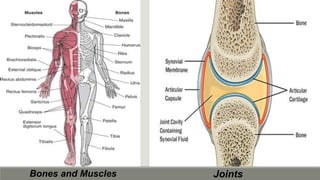
Bones and Muscles Joints
Bone Functions
1) Body movement
2) Body position
3) Stabilize joints
4) Maintain body temperature
Bone Shape
Short
Long
Flat
Irregular
Bone Tissue
Intracellular Matrix – strong, rigid structure of fibers and
calcium phosphate
Compact Bone – outer bone covering
Spongy Bone – interior bone
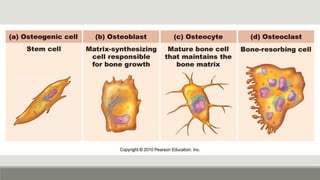
Bone Cells
Osteocytes – mature bone cells
Osteoblasts – producing cells that make collagen and
matrix proteins
Osteoclasts – resorption cells that secrete collagenase
Functions of Muscles
1) Produce body movement
2) Stabilize body position
3) Regulate organ volume
4) Move substances within the body
5) Generate heat
Smooth Muscle
Major Location – walls of hollow viscera, blood vessels
Major Function – movement of viscera, peristalsis,
vasoconstriction
Cellular Characteristics – no striations, single nucleus,
and lacks transverse tubules
Mode of Control - involuntary
Characteristics of Contractions – contracts and relaxes
slowly; self-exciting; rhythmic
Cardiac Muscle
Major Location – heart walls
Major Function – pumping action of the heart
Cellular Characteristics – has striations, single
nucleus, and well-developed transverse tubules;
intercalated discs separate adjacent cells
Mode of Control - involuntary
Characteristics of Contraction – network of cells
contracts as a unit; self-exciting; rhythmic
Skeletal Muscle
Major Location – muscles
Major Function – movement of bones at joints,
maintenance of posture
Cellular Characteristics – has striations, many nuclei,
and well-developed transverse tubules
Mode of Control – voluntary
Characteristics of Contraction – contracts and relaxes
rapidly
Joints
Functions
◦ Act as levers for complex movement
◦ Maintain body posture
Types
◦ 1) Synarthroses – immovable joints
◦ 2) Amphiarthroses – slightly moveable joints
◦ 3) Diarthroses – freely moving joints
Ligaments
Connect bone to bone
Tendons
Connect muscles to bone
Fractures
Present with bleeding, local inflammation, and necrosis of
tissue at the end of the broken bone.
Types of Fractures
◦ Complete – break ends across entire bone
◦ Incomplete – some of fracture components are still partially
joined
◦ Comminuted – crushed, small, crumbled bone fragments
near the fracture
◦ Pott’s Fracture – fracture of the lower tibia
◦ LeFort Fracture – fracture of the face and/or base of skull
Osteoporosis
Decrease in bone mass and bone density
Loss of bone matrix and bone mineralization
Predisposing Factors: 50+ y/o, sedentary, hormonal, low
BMI, diet, and Asian/European Ancestry
Treatment: dietary supplements like calcium and vitamin
D, weight-bearing activities, and PT
Rickets and Osteomalacia
Deficit of vitamin D and phosphates.
Weak bones in pediatrics
Soft bones in adults
Paget’s Disease
Excessive bone destruction with replacement by fibrous
tissue and abnormal bone
Tumors
Bone is a common area of secondary tumors.
Primary tumors are usually malignant.
Types
◦1) Osteosarcoma – cancerous tumor in bone
◦2) Chondrosarcoma – cartilage cells in adults
◦3) Ewing’s Sarcoma – shaft of long bone in adolescents
Muscular Dystrophy
Autosomal recessive disorder causing degeneration of
skeletal muscle
Signs/Symptoms in boys: dystrophin deficit, and
replacement of skeletal muscle by fat and fibrous
connective tissues
Diagnostic Tests: genetic abnormalities, elevated creatine
kinase levels, EMG, muscle biopsy, blood test
Treatment: no curative treatment, only supportive
treatment - moderate exercise, PT/OT, massage, assistive
device, or ventilator
Osteoarthritis
Degenerative wear and tear of bone
Cause: increased weight lifting or articular cartilage
damage.
Signs/Symptoms: bone spurs, inflammation, rough and
worn surface, lack of range of motion, pain, and falls
Treatment: assistive devices, NSAIDS, glucosamine-
chondroitin supplements, or joint replacement
Rheumatoid Arthritis
Autoimmune, chronic, systemic, and inflammatory disease.
Cause: unknown
Signs/Symptoms: synovitis, red and swollen joints,
pannus formation, cartilage erosion, fibrosis, muscle
atrophy, muscle spasms, muscle contractions
Systemic Signs/Symptoms: fatigue, anorexia, mild fever
Treatment: rest, limit activity, heat/cold therapy, NSAIDS,
glucocorticoids, analgesics, surgery, and drugs
Gout
Cause: deposits of uric acid in the joint
Signs/Symptoms: inflammation, redness, swelling, pain
Diagnosis: examination of synovial fluid, blood tests
Treatment: reduce uric acid levels by drugs and dietary
changes
Ankylosing Spondylitis
Cause: joint fixation, inflammation of spinal joint or
costovertebral joints, inflammation of intervertebral spaces
of axial skeleton, fibrosis, calcification of joints
Signs/Symptoms: low blood pressure, pain when supine,
rigid spine
Systemic Signs/Symptoms: fatigue, fever, weight loss,
iritis
Treatment: relieve pain, restore mobility, anti-inflammatory
drugs, analgesics, daily exercise, PT/OT
Musculoskeletal Pathophysiology

Musculoskeletal Pathophysiology

  • 1.
  • 2.
    Composition of the MusculoskeletalSystem 1) Bone 2) Muscle 3) Joints 4) Ligaments 5) Tendons
  • 3.
  • 5.
    Bone Functions 1) Bodymovement 2) Body position 3) Stabilize joints 4) Maintain body temperature
  • 6.
  • 7.
    Bone Tissue Intracellular Matrix– strong, rigid structure of fibers and calcium phosphate Compact Bone – outer bone covering Spongy Bone – interior bone
  • 8.
    Bone Cells Osteocytes –mature bone cells Osteoblasts – producing cells that make collagen and matrix proteins Osteoclasts – resorption cells that secrete collagenase
  • 10.
    Functions of Muscles 1)Produce body movement 2) Stabilize body position 3) Regulate organ volume 4) Move substances within the body 5) Generate heat
  • 11.
    Smooth Muscle Major Location– walls of hollow viscera, blood vessels Major Function – movement of viscera, peristalsis, vasoconstriction Cellular Characteristics – no striations, single nucleus, and lacks transverse tubules Mode of Control - involuntary Characteristics of Contractions – contracts and relaxes slowly; self-exciting; rhythmic
  • 13.
    Cardiac Muscle Major Location– heart walls Major Function – pumping action of the heart Cellular Characteristics – has striations, single nucleus, and well-developed transverse tubules; intercalated discs separate adjacent cells Mode of Control - involuntary Characteristics of Contraction – network of cells contracts as a unit; self-exciting; rhythmic
  • 15.
    Skeletal Muscle Major Location– muscles Major Function – movement of bones at joints, maintenance of posture Cellular Characteristics – has striations, many nuclei, and well-developed transverse tubules Mode of Control – voluntary Characteristics of Contraction – contracts and relaxes rapidly
  • 18.
    Joints Functions ◦ Act aslevers for complex movement ◦ Maintain body posture Types ◦ 1) Synarthroses – immovable joints ◦ 2) Amphiarthroses – slightly moveable joints ◦ 3) Diarthroses – freely moving joints
  • 20.
  • 21.
  • 22.
    Fractures Present with bleeding,local inflammation, and necrosis of tissue at the end of the broken bone. Types of Fractures ◦ Complete – break ends across entire bone ◦ Incomplete – some of fracture components are still partially joined ◦ Comminuted – crushed, small, crumbled bone fragments near the fracture ◦ Pott’s Fracture – fracture of the lower tibia ◦ LeFort Fracture – fracture of the face and/or base of skull
  • 24.
    Osteoporosis Decrease in bonemass and bone density Loss of bone matrix and bone mineralization Predisposing Factors: 50+ y/o, sedentary, hormonal, low BMI, diet, and Asian/European Ancestry Treatment: dietary supplements like calcium and vitamin D, weight-bearing activities, and PT
  • 26.
    Rickets and Osteomalacia Deficitof vitamin D and phosphates. Weak bones in pediatrics Soft bones in adults
  • 27.
    Paget’s Disease Excessive bonedestruction with replacement by fibrous tissue and abnormal bone
  • 28.
    Tumors Bone is acommon area of secondary tumors. Primary tumors are usually malignant. Types ◦1) Osteosarcoma – cancerous tumor in bone ◦2) Chondrosarcoma – cartilage cells in adults ◦3) Ewing’s Sarcoma – shaft of long bone in adolescents
  • 30.
    Muscular Dystrophy Autosomal recessivedisorder causing degeneration of skeletal muscle Signs/Symptoms in boys: dystrophin deficit, and replacement of skeletal muscle by fat and fibrous connective tissues Diagnostic Tests: genetic abnormalities, elevated creatine kinase levels, EMG, muscle biopsy, blood test Treatment: no curative treatment, only supportive treatment - moderate exercise, PT/OT, massage, assistive device, or ventilator
  • 32.
    Osteoarthritis Degenerative wear andtear of bone Cause: increased weight lifting or articular cartilage damage. Signs/Symptoms: bone spurs, inflammation, rough and worn surface, lack of range of motion, pain, and falls Treatment: assistive devices, NSAIDS, glucosamine- chondroitin supplements, or joint replacement
  • 34.
    Rheumatoid Arthritis Autoimmune, chronic,systemic, and inflammatory disease. Cause: unknown Signs/Symptoms: synovitis, red and swollen joints, pannus formation, cartilage erosion, fibrosis, muscle atrophy, muscle spasms, muscle contractions Systemic Signs/Symptoms: fatigue, anorexia, mild fever Treatment: rest, limit activity, heat/cold therapy, NSAIDS, glucocorticoids, analgesics, surgery, and drugs
  • 36.
    Gout Cause: deposits ofuric acid in the joint Signs/Symptoms: inflammation, redness, swelling, pain Diagnosis: examination of synovial fluid, blood tests Treatment: reduce uric acid levels by drugs and dietary changes
  • 38.
    Ankylosing Spondylitis Cause: jointfixation, inflammation of spinal joint or costovertebral joints, inflammation of intervertebral spaces of axial skeleton, fibrosis, calcification of joints Signs/Symptoms: low blood pressure, pain when supine, rigid spine Systemic Signs/Symptoms: fatigue, fever, weight loss, iritis Treatment: relieve pain, restore mobility, anti-inflammatory drugs, analgesics, daily exercise, PT/OT