ALLPPT.com _ Free PowerPoint Templates, Diagrams and Charts
Mr. Amit M. Belekar (M. Pharm)
Lecturer, KDCA’s Institute of Pharmacy, Kolhapur.
The skeleton
Joints & Movements
Contents
• Definition of Joints
• Classification of joint
• Synovial joint & types
• Movements of body
joints & movements
Joint
Definition
• A joint / articulation is a point
of contact
• between two bones,
• between bone and cartilage
• or between bone and teeth
Joint
Functional Classification
Depending upon degree of movement
• Synarthrosis:
• immovable joint
• e.g. sutures
• Amphiarthrosis:
• slightly movable joint
• e.g. intervertebral joint.
• Diarthrosis:
• freely movable joints
• e.g. all synovial joints.
Joint
Structural Classification
Depending upon presence or absence of space (synovial cavity)
& type of connective tissue that binds bones
• Fibrous joints
• Cartilaginous joints
• Synovial joints
Joint
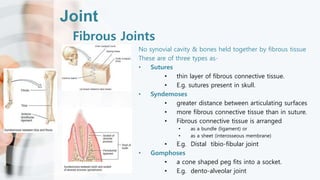
Fibrous Joints
No synovial cavity & bones held together by fibrous tissue
These are of three types as-
• Sutures
• thin layer of fibrous connective tissue.
• E.g. sutures present in skull.
• Syndemoses
• greater distance between articulating surfaces
• more fibrous connective tissue than in suture.
• Fibrous connective tissue is arranged
• as a bundle (ligament) or
• as a sheet (interosseous membrane)
• E.g. Distal tibio-fibular joint
• Gomphoses
• a cone shaped peg fits into a socket.
• E.g. dento-alveolar joint
Joint
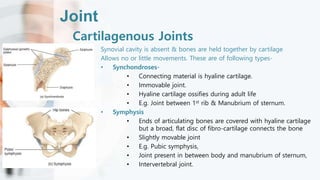
Cartilagenous Joints
Synovial cavity is absent & bones are held together by cartilage
Allows no or little movements. These are of following types-
• Synchondroses-
• Connecting material is hyaline cartilage.
• Immovable joint.
• Hyaline cartilage ossifies during adult life
• E.g. Joint between 1st rib & Manubrium of sternum.
• Symphysis
• Ends of articulating bones are covered with hyaline cartilage
but a broad, flat disc of fibro-cartilage connects the bone
• Slightly movable joint
• E.g. Pubic symphysis,
• Joint present in between body and manubrium of sternum,
• Intervertebral joint.
Joint
Synovial Joints
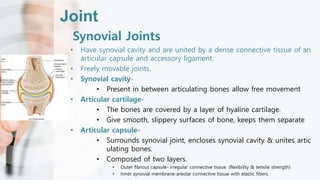
• Have synovial cavity and are united by a dense connective tissue of an
articular capsule and accessory ligament.
• Freely movable joints.
• Synovial cavity-
• Present in between articulating bones allow free movement
• Articular cartilage-
• The bones are covered by a layer of hyaline cartilage.
• Give smooth, slippery surfaces of bone, keeps them separate
• Articular capsule-
• Surrounds synovial joint, encloses synovial cavity & unites artic
ulating bones.
• Composed of two layers.
• Outer fibrous capsule- irregular connective tissue. (flexibility & tensile strength)
• Inner synovial membrane-areolar connective tissue with elastic fibers.
Joint
Synovial Joints
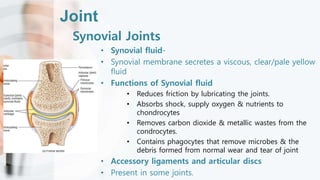
• Synovial fluid-
• Synovial membrane secretes a viscous, clear/pale yellow
fluid
• Functions of Synovial fluid
• Reduces friction by lubricating the joints.
• Absorbs shock, supply oxygen & nutrients to
chondrocytes
• Removes carbon dioxide & metallic wastes from the
condrocytes.
• Contains phagocytes that remove microbes & the
debris formed from normal wear and tear of joint
• Accessory ligaments and articular discs
• Present in some joints.
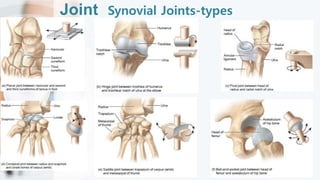
Joint Synovial Joints-types
Joint Synovial Joints- Types
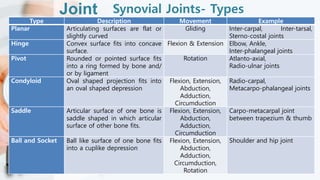
Type Description Movement Example
Planar Articulating surfaces are flat or
slightly curved
Gliding Inter-carpal, Inter-tarsal,
Sterno-costal joints
Hinge Convex surface fits into concave
surface.
Flexion & Extension Elbow, Ankle,
Inter-phalangeal joints
Pivot Rounded or pointed surface fits
into a ring formed by bone and/
or by ligament
Rotation Atlanto-axial,
Radio-ulnar joints
Condyloid Oval shaped projection fits into
an oval shaped depression
Flexion, Extension,
Abduction,
Adduction,
Circumduction
Radio-carpal,
Metacarpo-phalangeal joints
Saddle Articular surface of one bone is
saddle shaped in which articular
surface of other bone fits.
Flexion, Extension,
Abduction,
Adduction,
Circumduction
Carpo-metacarpal joint
between trapezium & thumb
Ball and Socket Ball like surface of one bone fits
into a cuplike depression
Flexion, Extension,
Abduction,
Adduction,
Circumduction,
Rotation
Shoulder and hip joint
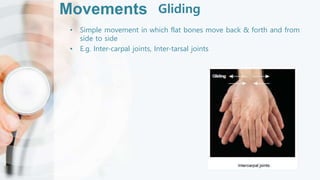
Movements Gliding
• Simple movement in which flat bones move back & forth and from
side to side
• E.g. Inter-carpal joints, Inter-tarsal joints
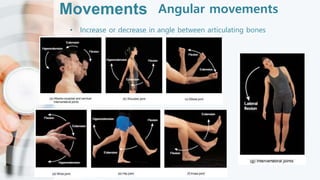
Movements Angular movements
• Increase or decrease in angle between articulating bones
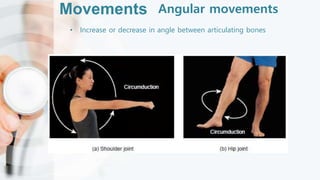
Movements Angular movements
• Increase or decrease in angle between articulating bones
Movements Angular movements
• Increase or decrease in angle between articulating bones
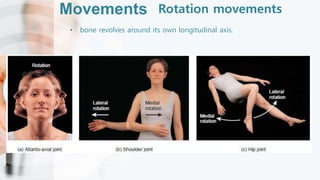
Movements Rotation movements
• bone revolves around its own longitudinal axis.
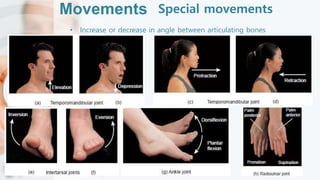
Movements Special movements
• Increase or decrease in angle between articulating bones
Disorders of Bones
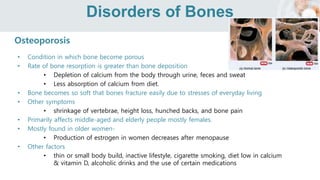
Osteoporosis
• Condition in which bone become porous
• Rate of bone resorption is greater than bone deposition
• Depletion of calcium from the body through urine, feces and sweat
• Less absorption of calcium from diet.
• Bone becomes so soft that bones fracture easily due to stresses of everyday living
• Other symptoms
• shrinkage of vertebrae, height loss, hunched backs, and bone pain
• Primarily affects middle-aged and elderly people mostly females.
• Mostly found in older women-
• Production of estrogen in women decreases after menopause
• Other factors
• thin or small body build, inactive lifestyle, cigarette smoking, diet low in calcium
& vitamin D, alcoholic drinks and the use of certain medications
Disorders of Bones
Rickets & Osteomalacia
• Diseases that result from inadequate calcification of extracellular bone matrix
• due to deficiency of vitamin D.
• Rickets (disease of children)
• Growing bones become soft and are easily deformed.
• Symptoms- bowed legs, deformities of the skull, rib cage & pelvis
• Osteomalacia (adult version of rickets)
• New bone formed during remodeling fails to calcify,
• Person experiences varying degrees of pain and tenderness in bones.
• Bone fractures also result from minor trauma.
• Prevention & treatment- by administration of adequate vitamin D.
Disorders of Joints
Rheumatism & Arthritis
• Rheumatism
• painful disorder of the supporting structure of the body like
bones, tendons, ligaments or muscles that is not caused by
infection.
• Arthritis
• is a form of rheumatism in which joints are swollen, stiff &
painful.
• It is of two types as-
• Osteoarthritis
• Rheumatoid arthritis
Disorders of Joints
Osteoarthritis
• Cartilage of joint gradually degenerates & lost due to
• aging, obesity, irritation of joints, muscle weakness, wear & abrasion.
• Degenerated cartilage is exposed in synovial joints
• Small patches of new osseous tissue are deposited to prevent the friction
• Decreases space between two bones and reduce joint movements.
Disorders of Joints
Rheumatoid arthritis
• Auto-immune disease in which immune system of the body attacks its own tissues
• e. g. own cartilage & joint linings.
• Characters-
• inflammation of the joint- swelling, pain and loss of function.
• Bilaterally e.g. if one wrist is affected, other also likely to be affected.
• Primary symptom
• inflammation of the synovial membrane
• If untreated synovial membrane becomes thick and synovial fluid accumulates
• Resulting pressure produces pain.
• Membrane produces abnormal granulation tissue on surface of articular cartilage & erodes
it completely.
• After destruction of cartilage fibrous tissue is exposed which ossify afterwards
• Fuses the joint and joint become immovable.
Disorders of Joints
Gout
• Uric acid (waste product produced during metabolism of nucleic acid)
• Produces excessive amount of uric acid or its excretion is reduced.
• Uric acid accumulates in blood
• Reacts with sodium to form a salt called sodium urate.
• Crystals of the salt accumulates in soft tissues of body such as kidney, cartilages etc.
• In gouty arthritis crystals of urate are deposited in soft tissues of bone
• Erode the cartilage causing inflammation, swelling and acute pain.
• If it is untreated ends of articulating bone fuse and the joints become immovable.

Joints & movements.pptx

  • 1.
    ALLPPT.com _ FreePowerPoint Templates, Diagrams and Charts Mr. Amit M. Belekar (M. Pharm) Lecturer, KDCA’s Institute of Pharmacy, Kolhapur. The skeleton Joints & Movements
  • 2.
    Contents • Definition ofJoints • Classification of joint • Synovial joint & types • Movements of body joints & movements
  • 3.
    Joint Definition • A joint/ articulation is a point of contact • between two bones, • between bone and cartilage • or between bone and teeth
  • 4.
    Joint Functional Classification Depending upondegree of movement • Synarthrosis: • immovable joint • e.g. sutures • Amphiarthrosis: • slightly movable joint • e.g. intervertebral joint. • Diarthrosis: • freely movable joints • e.g. all synovial joints.
  • 5.
    Joint Structural Classification Depending uponpresence or absence of space (synovial cavity) & type of connective tissue that binds bones • Fibrous joints • Cartilaginous joints • Synovial joints
  • 6.
    Joint Fibrous Joints No synovialcavity & bones held together by fibrous tissue These are of three types as- • Sutures • thin layer of fibrous connective tissue. • E.g. sutures present in skull. • Syndemoses • greater distance between articulating surfaces • more fibrous connective tissue than in suture. • Fibrous connective tissue is arranged • as a bundle (ligament) or • as a sheet (interosseous membrane) • E.g. Distal tibio-fibular joint • Gomphoses • a cone shaped peg fits into a socket. • E.g. dento-alveolar joint
  • 7.
    Joint Cartilagenous Joints Synovial cavityis absent & bones are held together by cartilage Allows no or little movements. These are of following types- • Synchondroses- • Connecting material is hyaline cartilage. • Immovable joint. • Hyaline cartilage ossifies during adult life • E.g. Joint between 1st rib & Manubrium of sternum. • Symphysis • Ends of articulating bones are covered with hyaline cartilage but a broad, flat disc of fibro-cartilage connects the bone • Slightly movable joint • E.g. Pubic symphysis, • Joint present in between body and manubrium of sternum, • Intervertebral joint.
  • 8.
    Joint Synovial Joints • Havesynovial cavity and are united by a dense connective tissue of an articular capsule and accessory ligament. • Freely movable joints. • Synovial cavity- • Present in between articulating bones allow free movement • Articular cartilage- • The bones are covered by a layer of hyaline cartilage. • Give smooth, slippery surfaces of bone, keeps them separate • Articular capsule- • Surrounds synovial joint, encloses synovial cavity & unites artic ulating bones. • Composed of two layers. • Outer fibrous capsule- irregular connective tissue. (flexibility & tensile strength) • Inner synovial membrane-areolar connective tissue with elastic fibers.
  • 9.
    Joint Synovial Joints • Synovialfluid- • Synovial membrane secretes a viscous, clear/pale yellow fluid • Functions of Synovial fluid • Reduces friction by lubricating the joints. • Absorbs shock, supply oxygen & nutrients to chondrocytes • Removes carbon dioxide & metallic wastes from the condrocytes. • Contains phagocytes that remove microbes & the debris formed from normal wear and tear of joint • Accessory ligaments and articular discs • Present in some joints.
  • 10.
  • 11.
    Joint Synovial Joints-Types Type Description Movement Example Planar Articulating surfaces are flat or slightly curved Gliding Inter-carpal, Inter-tarsal, Sterno-costal joints Hinge Convex surface fits into concave surface. Flexion & Extension Elbow, Ankle, Inter-phalangeal joints Pivot Rounded or pointed surface fits into a ring formed by bone and/ or by ligament Rotation Atlanto-axial, Radio-ulnar joints Condyloid Oval shaped projection fits into an oval shaped depression Flexion, Extension, Abduction, Adduction, Circumduction Radio-carpal, Metacarpo-phalangeal joints Saddle Articular surface of one bone is saddle shaped in which articular surface of other bone fits. Flexion, Extension, Abduction, Adduction, Circumduction Carpo-metacarpal joint between trapezium & thumb Ball and Socket Ball like surface of one bone fits into a cuplike depression Flexion, Extension, Abduction, Adduction, Circumduction, Rotation Shoulder and hip joint
  • 12.
    Movements Gliding • Simplemovement in which flat bones move back & forth and from side to side • E.g. Inter-carpal joints, Inter-tarsal joints
  • 13.
    Movements Angular movements •Increase or decrease in angle between articulating bones
  • 14.
    Movements Angular movements •Increase or decrease in angle between articulating bones
  • 15.
    Movements Angular movements •Increase or decrease in angle between articulating bones
  • 16.
    Movements Rotation movements •bone revolves around its own longitudinal axis.
  • 17.
    Movements Special movements •Increase or decrease in angle between articulating bones
  • 18.
    Disorders of Bones Osteoporosis •Condition in which bone become porous • Rate of bone resorption is greater than bone deposition • Depletion of calcium from the body through urine, feces and sweat • Less absorption of calcium from diet. • Bone becomes so soft that bones fracture easily due to stresses of everyday living • Other symptoms • shrinkage of vertebrae, height loss, hunched backs, and bone pain • Primarily affects middle-aged and elderly people mostly females. • Mostly found in older women- • Production of estrogen in women decreases after menopause • Other factors • thin or small body build, inactive lifestyle, cigarette smoking, diet low in calcium & vitamin D, alcoholic drinks and the use of certain medications
  • 19.
    Disorders of Bones Rickets& Osteomalacia • Diseases that result from inadequate calcification of extracellular bone matrix • due to deficiency of vitamin D. • Rickets (disease of children) • Growing bones become soft and are easily deformed. • Symptoms- bowed legs, deformities of the skull, rib cage & pelvis • Osteomalacia (adult version of rickets) • New bone formed during remodeling fails to calcify, • Person experiences varying degrees of pain and tenderness in bones. • Bone fractures also result from minor trauma. • Prevention & treatment- by administration of adequate vitamin D.
  • 20.
    Disorders of Joints Rheumatism& Arthritis • Rheumatism • painful disorder of the supporting structure of the body like bones, tendons, ligaments or muscles that is not caused by infection. • Arthritis • is a form of rheumatism in which joints are swollen, stiff & painful. • It is of two types as- • Osteoarthritis • Rheumatoid arthritis
  • 21.
    Disorders of Joints Osteoarthritis •Cartilage of joint gradually degenerates & lost due to • aging, obesity, irritation of joints, muscle weakness, wear & abrasion. • Degenerated cartilage is exposed in synovial joints • Small patches of new osseous tissue are deposited to prevent the friction • Decreases space between two bones and reduce joint movements.
  • 22.
    Disorders of Joints Rheumatoidarthritis • Auto-immune disease in which immune system of the body attacks its own tissues • e. g. own cartilage & joint linings. • Characters- • inflammation of the joint- swelling, pain and loss of function. • Bilaterally e.g. if one wrist is affected, other also likely to be affected. • Primary symptom • inflammation of the synovial membrane • If untreated synovial membrane becomes thick and synovial fluid accumulates • Resulting pressure produces pain. • Membrane produces abnormal granulation tissue on surface of articular cartilage & erodes it completely. • After destruction of cartilage fibrous tissue is exposed which ossify afterwards • Fuses the joint and joint become immovable.
  • 23.
    Disorders of Joints Gout •Uric acid (waste product produced during metabolism of nucleic acid) • Produces excessive amount of uric acid or its excretion is reduced. • Uric acid accumulates in blood • Reacts with sodium to form a salt called sodium urate. • Crystals of the salt accumulates in soft tissues of body such as kidney, cartilages etc. • In gouty arthritis crystals of urate are deposited in soft tissues of bone • Erode the cartilage causing inflammation, swelling and acute pain. • If it is untreated ends of articulating bone fuse and the joints become immovable.